the women should keep silent in the churches. For they are not permitted to speak, but should be in submission, as the Law also says. (1 Corinthians 14:34).
Paul was exhorting about orderly worship here. Worship had gotten out of hand. Worship must be orderly, quiet, and respectful, that was the watchword. And Paul gave that word in this passage.
Is there a time for a woman to holler and throw stools at the pastor? Apparently there was for Jenny Geddes. She’s gone down in Reformation History as someone who stood up for Jesus. Here’s how.
Jenny Geddes (c. 1600 – c. 1660) was a Scottish market-trader in Edinburgh, who is alleged to have thrown her stool at the head of the minister in St Giles’ Cathedral in objection to the first public use of the Anglican Book of Common Prayer in Scotland. The act is reputed to have sparked the riot which led to the Wars of the Three Kingdoms, which included the English Civil War.
Well, that’s some stool. It all happened on July 23, 1637 in Edinburgh.
Always independent, the Puritan Scots had become suspicious of the increasing encroachment of liturgy and rigid traditions a la the Roman Catholic Church. They had observed King Charles Is’ coronation rites and were displeased with his use of Anglican rituals. Next came forced use of the Book of Common Prayer, a high Episcopalian book, with its readings in the Apocrypha. King Charles issued a warrant in 1635 declaring his spiritual power over the Church of Scotland, insisting that the Church would be issued with a new book of liturgy which would be read at services. And on July 23, 1637 in St. Giles Cathedral, the Common Book of prayer was opened and John Hanna, Dean of Edinburgh, began to read.
Jenny Geddes sat fuming on her “fald stool” or a “creepie-stool” meaning a folding stool. Finally she had heard enough and stood up and cried; “Deil colic the wame o’ ye, fause thief; daur ye say Mass in my lug?” meaning “Devil cause you severe pain and flatulent distension of your abdomen, false thief: dare you say the Mass in my ear?” And at that she hurled her stool straight at the Dean’s head. This sparked a full scale riot in the church. one congregation member who had been heard uttering a response to the liturgy was thumped with Bibles. The Dean took cover and the Provost summoned his men to put down the disturbance. The rioters were soon ejected from St Giles and the Bishop of Edinburgh appealed for calm. However this was not going to end quietly…
The national spiritual unrest was real, but overlaid upon the spiritual unrest was political unrest too. Hence the riots that sparked the Wars of the Three Kingdoms, and then the English Civil War. You can read about that part of the history elsewhere.
Jenny Geddes’ anger at the encroachment of evil into the pure worship service reminded me of another, more recent ‘Jenny Geddes.’
On November 10, 2013, Memorial Church of the Reformation in the city of Speyer, Germany hosted Karl Jenkins’ performance piece, titled “A Mass for Peace- “The Armed Man” where as part of the performance, the Islamic call to prayer is performed by an Imam.
German woman Heidi Mund had heard of this performance, grabbed her flag on which is emblazoned “Jesus Christ is Lord” headed to the church, and bought her ticket. But first, Ms Mund said, she prayed. To make matters even more emotional, the church the performance was to be held at was the Memorial Church of the Protestation in Speyer Germany, constructed specifically in 1900 where,
Its construction was supposed to be a reminder of the protest action that the imperial evangelical states brought to bear in 1529 at the Reichstag in Speyer. The Luther memorial in the vestibule and the adjacent statues of local Protestant rulers serve as reminders of this event.
Having no particular plan, she quietly listened to the music and readings, but when the Imam began praying to Allah in Arabic and saying, “Allahu Akbar!” she felt what she called a holy anger rising up in her. Much like Jenny Geddes, who was righteously aggrieved with the blasphemy in her midst, Mund stood up at this “interfaith event” and fearlessly began shouting that Lord Jesus alone is God and proclaimed His supremacy over all the earth.
If we are confronted with something of like kind, what would be our reaction? There is a time to sit silently and submissively, but is there ever a time for disruption and holy anger? Jenny Geddes threw a stool, narrowly missing the preacher’s head. Physical violence is never appropriate. How would we react to the incursion of evil into a holy place, a place set aside for the proclamation of the pure word? Just food for thought.
Both Geddes and Mund knew of what was to happen during the service. Neither were surprised. Mund prayed ahead, one can surmise that perhaps Geddes had also prayed ahead. In one way or another, we are all confronted with false doctrine creeping in. Start praying ahead for strength in the Lord to react in ways that honor and glorify Him.
———————————— Further Reading
Trivia: Scottish Poet Robert Burns named his mare Jenny Geddes
Do I think more highly of myself than I ought? Of course I do! Just like Peter. Here’s Peter-
Peter: When Jesus asked the disciples if they want to leave Him too, Peter said, “Lord, to whom shall we go? You have words of eternal life.” (John 6:67-68)
Peter again: But Peter repeatedly said insistently, “Even if I have to die with You, I will not deny You!” (Mark 14:31).
We are warned not to think of ourselves too highly. There is only One who truly knows us inside out, and that One is Jesus. He knows what is in every man. (John 2:23-25). We may think we know ourselves, but we do not.
For through the grace given to me I say to everyone among you not to think more highly of himself than he ought to think; but to think so as to have sound judgment, as God has allotted to each a measure of faith. (Romans 12:3)
Barnes Notes says of the Romans verse, "Not to over-estimate himself, or to think more of himself than he ought to. What is the true standard by which we ought to estimate ourselves he immediately adds. This is a caution against pride; and an exhortation not to judge of ourselves by our talents, wealth, or function, but to form another standard of judging of ourselves, by our Christian character"
The humility we are supposed to cultivate is for the good of the church. As believers walk with the Lord individually, we also walk with Him in unity. We are a congregation, and the local unit of believers comprising the church should reduce themselves in thought rather than elevate themselves for the good of the one anothers. This is because spiritual pride is deadly in the church.
Peter was given great insights by the Holy Spirit. Peter also thought he knew himself, but Jesus knew Peter would deny Him within hours, and with curses, too. James and John wanted to sit at Jesus’ right and left hand in the kingdom. Jesus asked them if they were able to drink the cup prepared for Jesus and they said without hesitation, “We are able.” The two of them were thinking of themselves more highly than they ought.
We should not think too highly of ourselves. We don’t know ourselves as well as we think we do.
When pride comes, then comes dishonor; But with the humble there is wisdom. Proverbs 11:2
Some things in the Bible are illuminated by the Spirit through concept. In these cases, there isn’t a specific Bible verse that says, THIS IS THE ANSWER YOU’RE LOOKING FOR! The answer is gained by being part of the great sweep and scope of the Bible from Genesis to Revelation. Some doctrines are learned from a concept rather than an explicit verse spelling it out. In these cases, the Bible student needs to make a logical conclusion. Paul spoke often of reasoning together, (Acts 17:2, Acts 17:17) and using terms like “so then”, or “therefore”. This was his way of announcing a conclusion was imminent.
This is called “necessary inference” and you come to understand it by inference.
Alan Hunter the Polite Leader on Youtube takes 6 minutes to refute the oft-heard chestnut that since Deborah ruled (judged) then that means women today can preach. People who claim this are taking a big scriptural leap, but oftentimes we ladies don’t have an adequately scriptural rebuttal. Here, Alan does it for you.
God did not ordain women to preach in the church, nor to teach in authority over men.
A woman must quietly receive instruction with entire submissiveness. But I do not allow a woman to teach or to exercise authority over a man, but to remain quiet. For it was Adam who was first created, and then Eve. And it was not Adam who was deceived, but the woman was deceived and became a wrongdoer. But women will be preserved through childbirth—if they continue in faith, love, and sanctity, with moderation. (1 Timothy 2:11-15)
Women are not to preach, be ordained as pastor, or be considered for any ‘office’ where she is in authority over men: Al Mohler explains–
In truth, the issue of women serving as pastors fueled the Conservative Resurgence in the SBC. The question was instantly clarifying. The divide over women serving in the pastorate served as a signal of the deeper divide over the authority and interpretation of the Bible. Simply put, the only way to affirm women serving in the pastoral role is to reject the authority and sufficiency of biblical texts such as 1 Corinthians 14 and 1 Timothy 2. There is more to the picture, but not less. Furthermore, the Christian church in virtually every tradition through nearly two millennia in almost every place on earth has understood these texts clearly. In most churches around the world, there is no question about these texts even now. Furthermore, there is the testimony of God-given differences in the roles of men and women in the church and in the home throughout the Bible. The pattern of revealed truth is not hard to follow.”
Voddie Baucham Provides Answers about Women Pastors, Teachers and Elders in the Church (Joyce Meyer)
Where did all these para-church organizations come from? Why do we need them?
EPrata photo
While laudatory in many cases, these organizations increasingly draw women away from their home church, infuse them with false doctrine, and re-seed them back to their church to infect it.
What are para-church organizations? Wikipedia definition: “Parachurch organizations are Christian faith-based organizations that work outside and across denominations to engage in social welfare and evangelism. Parachurch organizations seek to come alongside the church and specialize in things that individual churches may not be able to specialize in by themselves.”
GotQuestions defines a parachurch ministry this way: “The definition of a Christian parachurch ministry is “a Christian faith-based organization which carries out its mission usually independent of church oversight.”
Some different types of para-church ministries are, those involved in evangelism (Billy Graham Evangelistic Association, Child Evangelism Fellowship), discipleship, (The Navigators, InterVarsity Christian Fellowship), Bible dissemination (Gideons International), disaster relief (Samaritan’s Purse), medical helps, domestic violence shelters, and so on. Christian book publishers and Bible translators are also considered a para-church organization. RC Sproul’s Ligonier.org is a parachurch organization designed to have a primary focus on the theological education of laypeople.
The pro with some para-church organizations such as radio ministries Bible dissemination, or missions organizations are that the Gospel can be introduced in closed countries or places devoid of a church. The downside to a parachurch organization is that many of them lack oversight. Some discipleship parachurch organizations even become a substitute for church.
Yet, Paul wrote to Timothy in 1 Timothy 3:14 of the church that “the household of God, which is the church of the living God, the pillar and support of the truth.”
The local church is to teach-
The things which you have heard from me in the presence of many witnesses, entrust these to faithful people who will be able to teach others also. (2 Timothy 2:2).
Until I come, devote yourself to the public reading of Scripture, to exhortation, and to teaching. (1 Timothy 4:13)
Parachurch organizations did not exist during the time of the first century church, so the Bible doesn’t mention them. Acts 2:42 outlines principles of the purpose of the church: “They devoted themselves to the apostles’ teaching and to the fellowship, to the breaking of bread and to prayer.”
The church is the pillar, and Jesus is the cornerstone of it. Our entire focus should be life lived in and around our home church. We read in this article, Who is Responsible for Training Pastors? :
"Training pastors is the responsibility of both church leaders as well as churches as a whole. Churches are responsible to support their pastor’s work in training men for ministry, give whatever resources they can to train men for ministry, encourage and equip men themselves, and ultimately to select their own leaders, which implies some kind of responsibility to oversee their training."
The life if a believer should focus on one’s own church. It goes without saying that believers should be a member of a church, submitted to elders and faithfully attending. There is no such thing as a Lone Ranger Christian. Each of us has a spiritual gift given to us by the Holy Spirit for the purpose of edifying each other within our local body of believers. Staying outside the confines of the church life is a denial of the gift and makes a hole in the global tapestry Jesus seeks to weave. Not to mention the practice of and witness to the Lord’s Supper and Baptism.
Our focus for our believing lives on earth should be the local church. If your church has raised up men to lead Bible studies, great, or women who disciple as per Titus 2, super. If you have activities for children and youth, that’s wonderful.
Sadly, some women look elsewhere than their own church for fellowship, prayer, or Bible study. They gravitate toward parachurch organizations. Some do so simply because they were invited by a friend, and being curious and with servant attitude, follow her friend to the organization to try it out. Those are the organizations to which I took exception in the second paragraph, the ones rife with false doctrine and slyly begin to substitute for the local church. Upon first reading of these parachurch organizations they sound good. Their aims and goals sound solid. Healing, discipleship, fellowship, what is wrong with that?
Nothing…until you look deeper and you realize these organizations are founded on something other than the word of God. Many of them are based on experiences, half-biblical truths, or ecumenicalism of the worst degree, where false religions’ doctrines are introduced. Here are a few examples of these parachurch ministries to be careful of.
Immanuel Prayer / Emmanuel Approach
Immanuel Prayer/Emmanuel Approach is one of these parachurch organizations that is dangerous in my opinion. IP circumvents the Bible entirely and counsels seekers along the lines of past experiences, memories, and emotions. They also mention that they are a ‘deliverance ministry’ and a ‘prophetic ministry’. They focus on healing psychological trauma and offer counsel in the form of what amounts to contemplative prayer.
This ministry’s practitioners focus on the Lord’s presence and how you feel about it, in order to emotionally heal you. They write that the opening session begins with prayer and goes like this–
1.) Recall past experiences of positive connection with the Lord;
2.) Deliberately appreciate specific aspects of/details from these past positive experiences; and
3.) Refresh perception of the Lord’s presence and connection with Him in the present.
They get involved with demons and deliverance, ‘binding’ demons and stating they can be aware of certain demons who may be attacking the counselee or the counselor. Secular Psychology. This sounds like a very dangerous ‘ministry’.
The founders are a husband-wife team. The wife is Charlotte Lehman, who is referred to as “Pastor Charlotte” and duties include preaching at church and teaching mixed audiences at retreats etc. This activity is not scriptural.
IP is based on theophostic counseling, which is not scriptural. More information here on Immanuel Prayer, and Theophostic Counseling-
If you are in need of counseling, please approach your own pastors / elders for help, either receiving counseling from them or obtaining a referral from them to a solid and biblical organization. Immanuel Approach is rife with false doctrine and is a dangerous approach to counseling. It will draw you away from your church, and worse, from Jesus.
If:Gathering
This is a parachurch ministry begun by Jennie Allen in 2014. At that first Gathering she announced that a few years prior “a voice from the sky” whispered to her to begin this ministry. This statement alone should be enough to stay away from this parachurch organization. Their foundation is based the question, “If God is real…then what?” which is a question straight from Genesis chapter 3 from the serpent to Eve. Again, if you weren’t convinced not to participate in an organization where the founder is deceived enough to follow a voice from the sky she interprets to be God, then participating in an organization founded on doubt should cement it for you.
Their About statement is that they exist not only as an annual conference event, “but a discipleship ministry focused on putting tools and resources in the hands of women in the church. Through these, IF is able to empower women to reclaim discipleship as God’s means to change the world.” The local church should disciple women and puts resources in women’s hands. We don’t need a duplicate of what the church is charged to do. I am unaware of a need to reclaim something that has never expired. That statement indicates that IF:Gathering believes itself to be a substitute for the church.
Also, the use of the word ‘reclaim’ and ’empower’ are concerning. IF has a lack of male oversight and is mainly run by women, who also develop the study materials. They are all about liberal theology, shaky hermeneutics, usurping lifestyles, and pushing their idol of social justice. Please do not be drawn away into this subculture of female reclamation and empowerment AKA feminism, under the guise of discipleship.
The aim of the program is to make known to people the love of God and to revive them for service to others as a lifetime priority. This is a good thing.
However, Cursillo’s theological grounding is from the Catholic religious system, its methods use emotional and psychological manipulation (to purposely “break you down” through intensive experiences), it is theology-lite, and as a parachurch ministry it tends to separate people from their own church, or undermine it, requiring constant reunion meetings and written “service sheets” to track your Cursillo efforts.
Further, the experience deliberately separates wives from husbands, who participate on different weekends. I am suspicious of any teaching or experience that disallows husbands and wives to be together, just as I am suspicious of the Passion Conference which does not allow parents to accompany their youth (only the youth minister is allowed to chaperone the youths inside the arena. Cursillo is labeled a ‘movement’ and the movement is recognized by the Catholic Holy See as member of the International Catholic Organizations of the Pontifical Council for the Laity in Rome.
Brian V. Janssen wrote, “It is evident that Cursillo is not really about theology from the fact that the method is so readily adaptable to very divergent theological perspectives: Roman Catholicism, Lutheranism (Via de Christo), Methodism, (Walk to Emmaus), Anglicanism (Episcopal Cursillo), Presbyterianism (Presbyterian Cursillo and [Great Banquet], Pentecostalism, (Tres Dias), and Dutch Reformed (Reformed Cursillo).”
Can one participate in an immersion weekend and emerge unaffected by an all-purpose or watered down theology? A theology born of Catholicism no less?
Not all parachurch organizations are at locations to which you go, separate from the church, such as IF:Gathering in people’s homes or a certain retreat location such as Cursillo. Some parachurch organizations develop Bible Studies which are to be introduced into your church. One would hope that the Sunday School Superintendent or overseer of curricula, preferably the pastor, would vet the materials on which his sheep will be feeding. Sadly, that is not always the case. When I saw that the next ‘study’ at an old church I used to attend was about to bring Priscilla Shirer’s Jonah Bible Study in, I approached the Superintendent in charge of curriculum. He dismissed my concerns out of hand, saying, “If it’s from Lifeway, it’s good.”
Community Bible Study does both, develops curricula to be used in church or as small-group Bible studies to be done in a leader’s home. About page says their goal is to encourage individual study. “Transformation happens as individuals engage with God in His Word. Study questions help participants apply the timeless truths of the Bible to their daily lives. Participants gain additional insights and grow in their confidence with God’s Word as they discuss Bible passages in a safe small-group setting.” Isn’t that the job of the church?
I’ve heard from women and read online that CBS quotes and uses material from less than solid female teachers, in fact, this woman said she was introduced to Beth Moore through a CBS. This leadership newsletter for Community Bible Study teachers pushes material from Moore, Priscilla Shirer, Max Lucado, Bill Hybels, Jim Cymbala, Anne Graham Lotz, and other false teachers.
This woman enjoys CBS, saying, “CBS does not take the place of your local church or church activities. Instead, through study of the Word of God, CBS raises up local members to become disciples of Jesus Christ. Through that discipleship members often times take what they have learned back to their local church in the form of Sunday school teachers and adult ministry leaders.”
Well if that’s the case, yes it does take the place of your church. The local church is supposed to train up leaders and educate its people. Al Mohler, the President of the nation’s largest seminary, said in 2014,
"I emphatically believe that the best and most proper place for the education and preparation of pastors is in the local church. We should be ashamed that churches fail miserably in their responsibility to train future pastors. Established pastors should be ashamed if they are not pouring themselves into the lives of young men whom God has called into the teaching and leadership ministry of the church."
See also the Acts and the Timothy verses above as to what a church’s mission and activities should be. A friend told me some years ago about one of these para-church ministries she had tried out, that it seemed to her when the participants returned to church after having had the experience, it was creating a two-tier membership. It felt to her there was a growing clique of folks who felt superior because they had enjoyed the breakthrough experiences, or had ‘heard from God,’ and they pitied in the rest of the congregation because they had not enjoyed such experiences.
Some para-church organizations are good and might even be necessary. I’m sure the goals of such ministries don’t start out negatively, but the inevitability of an organization started on less than solid foundation, lacking oversight, it will inevitably drift in its mission and instead of coming alongside a church as para is defined, will begin to compete with it.
And Hannah Anderson raises an important point specifically regarding female parachurch ministries.
"On the other hand, because so many female spiritual leaders are operating in parachurch contexts, their ministries have the potential to lose the doctrinal and structural accountability that the established Church provides. The digital age may free women from the gendered constraints of traditional ministry, but this means that they also have the potential to become free agents." (Source)
Hannah Anderson continues, "Consider how few female evangelical leaders are visibly attached to an institution such as a church, seminary, or non-profit that did not grow up around their personality. Name a male leader like Rick Warren and you immediately think of Saddleback Church. Say Beth Moore or Ann Voskamp or Jen Hatmaker and most of us will draw a blank about which local church these women affiliate with. This is not to say that they aren’t connected, but their local church isn't a visible or central a component to their public ministry." (Source)
However, the fact is, if you think about the most popular national women’s ministries/discipleship organizations, they’re led by women who don’t seem attached to their own local church. IF:Gathering, Propel Women by Christine Caine, Living Proof by Beth Moore, Going Beyond by Priscilla Shirer, and more, are all female led ministries and parachurch entities that lack theological grounding and real oversight.
Before you get involved
Before getting involved in one of these ministries or organizations ask yourself some questions:
What is this parachurch ministry offering that I connect with, that my church doesn’t offer? Is it a sinful lust, or a genuine spiritual need?
If it’s a genuine spiritual need, such as a small group Bible study, have you spoken with your elders about the possibility of them starting one in your own church? Or you starting one?
If your church does offer training up, leadership opportunities, Bible studies, etc, why am I interested in going outside the church when it’s essentially a duplication? Is it because it’s new and shiny? Is it because I have unresolved social issues with some members in my church or its group leader?
If I truly believe that participating in this parachurch ministry is genuine and necessary, have I done my diligence in vetting it, or have I asked my husband or my pastor to look into it for me to ensure it has integrity in its doctrine and function?
If I decide to participate in a parachurch organization is there solid and thriving male oversight, and is there a disciplinary mechanism?
Social media is great! I like it. You can see how friends and family who live far away are doing. I enjoy seeing their kids get older as photos are posted year after year. We can celebrate each other’s accomplishments. People share tips and recommendations. People encourage each other. We become aware of needs we can fulfill.
But one thing I do not like about social media is the tendency for people to pass along gossip from comments and to circulate false information from poorly researched ‘news’ sites. People do that a lot.
Since the advent of the internet, there has been opportunity for people without credentials or training to call themselves journalists. Organizations write the news but they are really just anonymous gossipmongers. If I’m in a charitable mood I’d say it’s because these less than credible organizations are simply inexperienced with how to gather news properly, or they are inexperienced at how to write news well.
More often, these less than credible news organizations actually have an agenda. It’s that they want to influence you. They want to pollute the public square with twisted facts, spread misinformation, or confuse you.
There is a reason these people and organizations have an agenda of spreading false news. A populace needs solid information they can trust for several reasons. One is to have accurate information so they can be a good citizen. They need to trust the people they elect and in order to elect people to civil service we need credible information about them. We also need good information in general to be a good citizen. Trying to live our lives but never trusting the information or the people we live with in our spheres creates confusion then anger, angst, and eventually defeat and retreat from public life, saying “What’s the use?” Tyrants arise out of an apathetic citizenry. A lot of bad is done behind closed doors in smoke-filled rooms.
During wartime, the Propaganda ministry was booming. There is a reason why. Flooding the culture with false and/or confusing information does our head in. Wars are won with guns, but also with words. Currently, the war has merely shifted to peacetime. Though guns may be absent, never doubt that propaganda under the guise of news” is part of an ongoing campaign to win power. Christians should be careful not to participate in it.
Christians bear a special responsibility not to fall into the trap of disseminating bad information and helping people with less than credible bad motives pollute the civic arena. We are supposed to be better than that. Jesus said,
Behold, I am sending you out as sheep in the midst of wolves; so be as wary as serpents, and as innocent as doves. (Matthew 10:16).
'be ye therefore wise as serpents, and harmless as doves'—Wonderful combination this! Alone, the wisdom of the serpent is mere cunning, and the harmlessness of the dove little better than weakness: but in combination, the wisdom of the serpent would save them from unnecessary exposure to danger; the harmlessness of the dove, from sinful expedients to escape it. In the apostolic age of Christianity, how harmoniously were these qualities displayed! Instead of the fanatical thirst for martyrdom, to which a later age gave birth, there was a manly combination of unflinching zeal and calm discretion, before which nothing was able to stand.
Further, we are supposed to be in the world, NOT of the world. This same principle stands for us as social citizens IN the world. Passing along unsourced and poorly written news or memes is being a person OF the world. Just because a news article tickles your fancy or aligns with your presuppositions or opinions, does not mean you should pass it along.
People who constantly circulate this kind of stuff remind me of the verse “For the time will come when they will not tolerate sound doctrine; but wanting to have their ears tickled, they will accumulate for themselves teachers in accordance with their own desires,” 2 Timothy 4:3, where they don’t want (or don’t know how, to be charitable) to do the hard work of critical thinking, analysis, or evaluation, but instead just gravitate to news articles that make them feel good, confirm their own notions, or satisfy some kind of lust of the flesh.
If a Christian is constantly promoting news that’s based on opinion or at the least is non-credible, it’s a sure bet she’s also gravitating to less than credible Bible Studies that rely on emotion and opinion, too.
Christian ladies, we need to be more thoughtful in evaluating information. We need to be careful before we press ‘send’. We are not supposed to bear false witness. We’re not to be passing along unfounded news, unsourced gossip, and unfactual information is in a sense bearing false witness against our neighbor.
So, to the practical part of this post. How are we to test if the news we circulate is factual? I was a journalist who worked for newspapers for 6 years. I was selected to participate in Bloomberg News Training. The Society of Professional Journalists/Bloomberg News “Training On The Go”. TOTG was a journalist training program led by leading national journalists from a variety of media. Participation depended upon completing an application and invitations to selected participants were extended to a few chosen applicants. I was also a three-time New England Newspapers Award winner, twice for writing and once for general excellence in advertising. I’m not saying this to boast- I desire the reader to know I have been trained and I’m credible to say these things. I am not a hypocrite speaking out of two sides of my mouth. These concepts are dear to me.
Here is a chart I found helpful.
We are called to be in the world and in so doing we must be the best Christians we can be. Good citizens, models of propriety and honor. Critical thinkers, wise but harmless. If a Christian can’t evaluate a secular piece of trash writing, how will she evaluate a nuanced doctrine from the Bible? If people who twist the Bible are called “unstable” (2 Peter 3:16), how unstable is a believer who passes along twisted worldly facts? That same verse calls such people ignorant. Yet believers are called to be wise.
The Bible says in Proverbs 12:18, There is one who speaks rashly like the thrusts of a sword, But the tongue of the wise brings healing. On social media, pressing send without proper vetting of the information is speaking rashly.
Friends, before you press send, THINK (of your neighbor). EVALUATE (the information). ASSESS (whether to pass it along). Be wise and harmless.
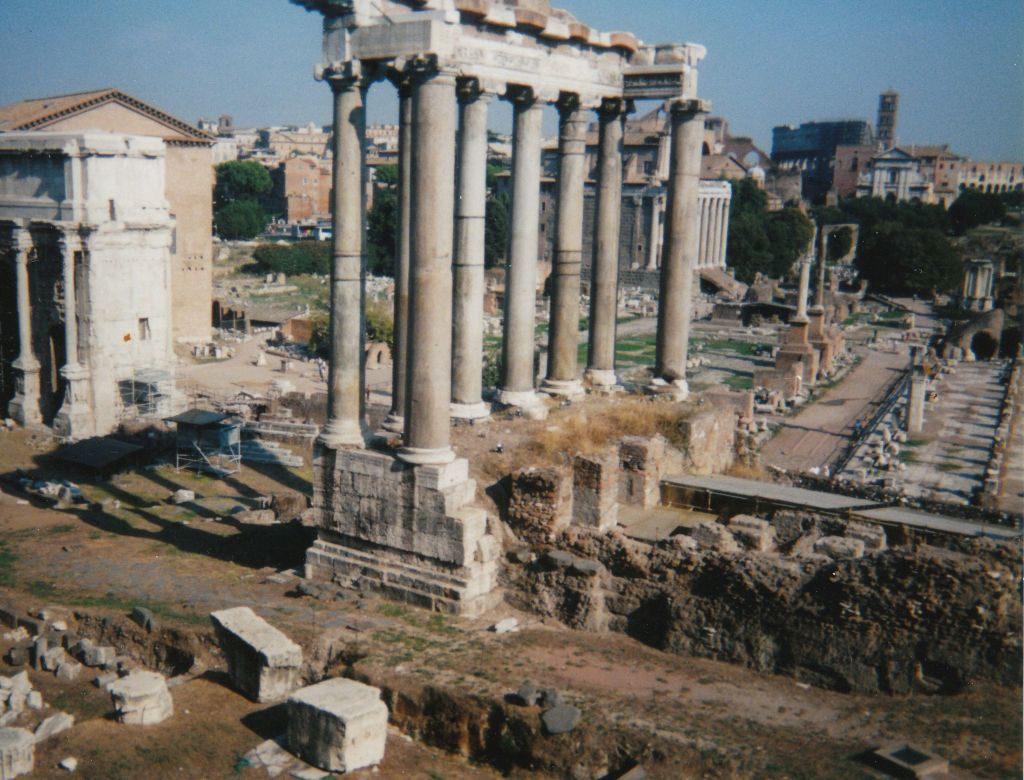
Rome wasn’t built in a day and it didn’t collapse in a day. The Roman Republic lasted a bit more than 500 years, one of the best examples of a representative democracy the world has seen. However, when the first emperor came in it spelled their doom. When the city was a Republic the people were supposedly sovereign, but then it became an Empire with a dictator who thought he was a god. Corruption, moral decay, and judicial rot subsequently infected the Empire and it became an unwieldy, lumbering, ripe-for-sacking has-been.
Rome, Italy Forum. EPrata photo
Encyclopedia Britannica writes, During the early Roman Republic, important new political offices and institutions were created, and old ones were adapted to cope with the changing needs of the state. According to the ancient historians, these changes and innovations resulted from a political struggle between two social orders, the patricians and the plebeians, that began during the first years of the republic and lasted for more than 200 years.
Patricians were the aristocrats, higher-ups with money. The plebeians were the common folks. The gap widened, and with it, the desire for the higher ups to maintain the status quo and keep their power, privileges, and most of all, their wealth.
Encyclopedia Britannica again, For a time the common people were placated with bread and circuses, as the authorities attempted to divert their attention from the gap between their standard of living and that of the aristocracy. Slavery fueled the Roman economy, and its rewards for the wealthy turned out to be disastrous for the working classes. Tensions grew and civil wars erupted. The ensuing period of unrest and revolution marked the transition of Rome from a republic to an empire.
And the rest is history, Edward Gibbons’ History of The Decline and Fall of the Roman Empire.
Back when I’d first read the prophecies in Revelation 6 and 13 and 18 I looked around at the world, especially the US, and wondered, how will we get from here to there? The US seemed so solid, durable, permanent. We were thriving and would seemingly go on forever. I knew we would for sure get there, the Bible promises it as a global future. But I was perplexed as to how that change would come about. Let me explain the change of which I speak.
Revelation 6 prophesies economic Armageddon upon the world. It shows inflation, famine, want, need, and it also shows luxuries, trade and an ongoing economic system, albeit one of a one world currency and one world economy, but people are still buying and trading. Some people. Certainly not all people.
The Third Seal: Famine: When He broke the third seal, I heard the third living creature saying, “Come!” I looked, and behold, a black horse, and the one who sat on it had a pair of scales in his hand. And I heard something like a voice in the center of the four living creatures saying, “A quart of wheat for a denarius, and three quarts of barley for a denarius; and do not damage the oil and the wine.” (Revelation 6:5-6).
A denarius was the coin of the day and back in those times it was about a day’s pay. A quart of wheat made flour for bread, but only for one person. Barley makes heavy, less tasty black bread, and the poor and the slaves used it because it was cheaper. Even at that, the presence of the scales indicates rationing, or careful measuring of the item to the purchaser due to scarcity. Inflation does that, makes things scarce. If it took a whole day’s pay to buy enough for one loaf of bread, this is poverty that inhibits life, not just lifestyle. They will be barely subsisting.
However, the oil and the wine were items the rich used even though they were expensive. (Proverbs 21:17; Jeremiah 31:12; Psalm 104:15). These items are noted for being on the tables of the wealthy. The Black Horse will be a judgment but will affect the common folks the most. They will be sorely pressed during the early days of the Tribulation, though Revelation 18 shows that in the end even the rich do not escape judgment.
In Revelation 18 we see that when the tail end of that economy crashes down there are three groups of people bemoan the loss. The Kings of the Earth, the Apostate Church, and the Merchants wail at the loss of the world’s luxuries and with them, the money they had gained from their ill-gotten trade and partnership with the evil church.
“For all the nations have fallen because of the wine of the passion of her sexual immorality, and the kings of the earth have committed acts of sexual immorality with her, and the merchants of the earth have become rich from the excessive wealth of her luxury.” (Revelation 18:3)
Plebeians are in dire need but the ‘patricians’ do not care that they starve on the streets. They do not care that inflation has ruined the economy, or made them re-form the economy, they just want their wealth. It’s all about money.
They (the kings of the earth) commit fornication with Babylon. They love the systems of the harlot. The apostate church loves the world for the wealth she can obtain from the riches of the world; and, of course, the world gladly welcomes the love of the apostate church because she promises to open the door of Heaven to all who PAY WELL. There is a third group mentioned here: "the merchants of the earth are waxed rich through the abundance of her delicacies." This group follows the apostate system for gain. There has always been a class of people who join religious systems for what they can get out of religion. They use the church as a stepping stone to advance their business interests. Babylon will offer great temptation to such people. The abundance of her luxuries will certainly attract the merchants of the earth and the merchants will become rich thereby. Therefore, when the system is destroyed, these merchants will weep and wail over the ruin of their source of riches. Source: Oliver B. Greene "The Revelation Verse-By-Verse Study"
How will the world come to be that way? Aside from God ordaining it and providentially moving every moment of life on earth toward that time, from our perspective, it happens incrementally to the moment when money becomes more important that human souls. (Revelation 18:13)
The first thing in how it happens is that your leaders have to disrespect the rule of law. God raises up leaders in governments to set ethical and moral boundaries in order to keep society in check. When individuals or groups violate those boundaries (rule of law) there must be repercussions. (censure, arrests, trials, etc). With no repercussions addressing law-breakers, society founders. Government is supposed to restrain sin, but when government is the biggest perpetrator of sin, the populace loses its moral compass. Just as in the Bible it says that a student goes no higher than his teacher, in the secular world a citizenry goes no higher than its leaders.
I remember the Impeachment of President Bill Clinton in 1998. Most of America followed it closely, likely due to the unfortunate relating of titillating details at the hearings and on the news. Most of America was not in favor of the Impeachment however. They thought that a man’s moral compass was separate from his ability to do the job. Clinton’s job rating remained high throughout the impeachment, despite his immoral peccadilloes being put on parade.
Even though I was unsaved at the time, I realized that man in general was morally corrupt. It seemed obvious that most Presidents had, in one way or another, been morally suspect. It seemed to me that a man cannot even reach high levels of power without compromising on ethical issues and succumbing to moral temptations that come along due to his power. The man might even begin to feel especially entitled to sample the moral wares flinging herself at him.
I remember also, however, that the issue at root of Clinton’s impeachment was not moral. It was the rule of law. I seemed to be in the minority with this one. Clinton obstructed justice, lied under oath, and perjured himself. Yes, it was over a moral issue (infidelity) but the rule of law must remain intact, no matter who is pressing against it, even the President. I felt that the example at highest levels of setting aside of the Rule of Law for personal gain was going to have dramatically deleterious effects on America.
I think I was right. I personally believe it was a watershed moment. It seemed to me to be a tremendous lurch forward on God’s prophetic plan in His crumbling of the foundations of the country.
"Obstruction of justice and lying under oath by a President inevitably subverts the respect for law which is essential to the wellbeing of our constitutional system. Such misconduct by the President sets an example of lawlessness and corruption, an example that cannot fail to have an 'adverse impact on the system of government.' ... If this committee ignores an act of perjury by the President, what impact will that have on the next generation, on our rule of law and our justice system? I would not be on this committee if I did not have a love for the law and a belief that any citizen can seek justice with complete confidence that intentional falsehoods under oath are not acceptable." Senate document on the Impeachment of William Jefferson Clinton
Further, the legal profession itself did not stand up for its ideals when the impeachment occurred. This next quote is from the College of William & Mary Law School/ William & Mary Law School Scholarship Repository,
The legal profession also failed to perform admirably throughout the President's legal proceedings. First, leaders of the bar, law school deans, and prominent law professors failed "in general to emphasize the importance of the rule of law in general and of telling the truth in depositions and in testimony before a grand jury, in particular, and to point out that Clinton is a member of the Arkansas bar and that the conduct in which he engaged would ordinarily result in disbarment" Faculty Publications Faculty and Deans 2000 The Perils of Presidential Impeachment Michael J. Gerhard.
How do we get from a thriving, rule-following, powerful nation to one that has either collapsed or is subsumed under a One World Government Revelation predicts? One where the rich are so far above the poor that the rich are blinded and deaf to the piteous cries of the starving? This is how. First you set aside the rule of law. Then you make the power-spheres in which you are given into govern your personal playground. Then your conscience becomes so seared by constant sampling of financial and immoral wares that you don’t care about your own country sinking under you. You just grab more and then more. It’s like the cartoon character sawing the branch but he’s on the outer edge of the branch, and will fall once the branch he is sitting on is sawn through.
In the last 23 years since the Clinton rule of law issue, our nation has come to the place where the patrician media, medicine, education, legal profession, large corporations, and so on don’t even try to hide their degenerate attitude toward the plebeians. Every area is so corrupt. They’re not even hiding it any more. They are saying the quiet parts out loud.
Imagine how bad it will be when the restraining influence of the Spirit and the restraining influence of the church are gone and they just power and money grab. Inflation through the roof, a dollar bill worth pennies, and hearts as cold as stone.
The antidote for all that is to be part of God’s economy NOW. To repent of your sins and cast yourself onto Jesus as Lord and Savior. He forgives sins and brings you into the Kingdom, where you will live forever in glory. He is the Door. Wouldn’t it be wonderful to live in an economy of perfection where everything is just and there is no corruption anywhere? Where the sole Leader is perfect, holy, and has only our best interests in mind? Where love is pure? I long for that day.
And He who sits on the throne said, “Behold, I am making all things new.” And He said, “Write, for these words are faithful and true.” Then He said to me, “It is done. I am the Alpha and the Omega, the beginning and the end. I will give water to the one who thirsts from the spring of the water of life, without cost. The one who overcomes will inherit these things, and I will be his God and he will be My son.” (Revelation 21:5-7)
I had a three-day weekend this past weekend We had Fall Break at school, and it was completely welcome. I enjoyed my extra day off. I stayed at home, wrote, loafed, and napped.
EPrata photo
By the way, educators do not get paid for the days at home. I am paid for the 190 days per year I work and that’s all. It’s just that they spread out the paychecks evenly so there is a regular deposit. For that I’m grateful.
At this point I’d rather have the time off than the money. I like being at home. Sometimes this surprises me because for many years I traveled at the drop of a hat. I was an expert at throwing things into a carryon and heading off to Labrador or Ecuador or Italy or just anywhere. But I guess I got all that out of my system. When you get older things like a comfy chair, a good pillow and a hard nap are what you desire!
I’ve rounded up some links that are in my opinion edifying and helpful. I hope you enjoy them too! Now I’m going to sit in my comfy chair and read!
Harry Walls at The Master’s University Chapel with a message to students departing for fall break to be salt and light, to be impactful in their spheres because of being who Jesus says they are.
Pastor Josh Buice responds to a review of Voddie Baucham’s book Fault Lines with focusing on showing in this article that it’s important to name names of false teachers who are harming the people of the faith: Making Honey and Naming Names.
I adore the title of this study from Sharon Lareau. Her blog posts on the topic were made into a paperback book! Congratulations! This is exactly the kind of material we want, zero fluff!
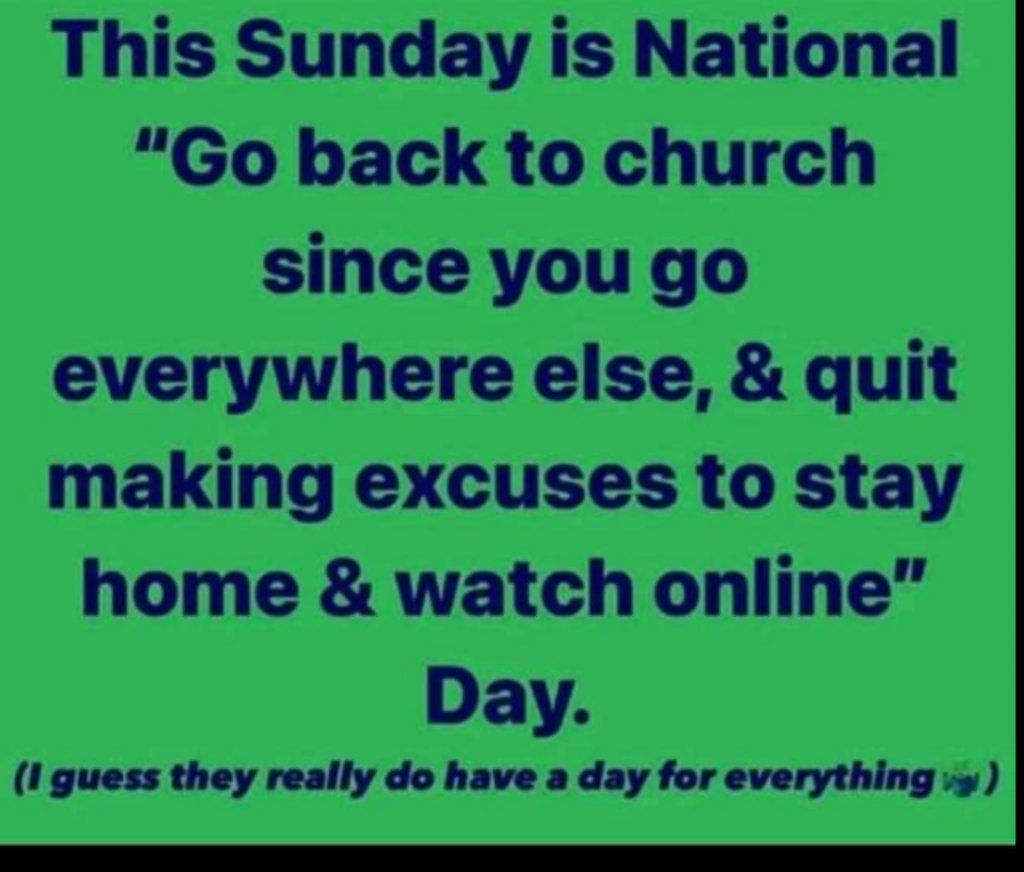
This meme packs an ooof punch!
People are weary. They are going through things, prices are going up and they are worried about making ends meet. They have concerns for their children growing up in times like these. Let’s be kind to one another. John Gill, on the Duties of Church Members to Each Other: “First, and which is a principal one, to love one another; “Owe no man anything, but to love one another,” is an apostolical advice, and good advice; this is a debt which every man owes to another, and should be always paying, especially Christians and members of churches (Rom. 13:8, 12:10).”
The Open Hearts in a Closed World ladies have some new exciting things coming: first, there is a new Book Club! “Ladies Join us on AGTV for the Open Hearts book Club- “Encouraging each other as the day draws near-” Hebrews 10:25 where we will be reading excerpts from chapters in the book and then answering study questions from each chapter monthly. We will also have a dive deeper with Lauren Hereford from Tulips and Honey where she will be interviewing guests on the book and asking them questions from the book. Stay tuned for more details later this month so you can go get a copy of our book selection.”
Also the Open Hearts in a Closed World ladies announce a new podcast! Brooke Bartz and Erin Coates are pairing up and will be podcasting, encouraging women to live life verse by verse. Starting in November.
In many places in the United States, like where I live, fall weather has come and it’s delightful. The hot, sticky humid air is swept away by air crisp as an apple and sweet as a pumpkin spice latte. I hope you can enjoy where you are as we step into the tail end of the year 2021, with Fall, Harvest Festivals, Reformation Day, Thanksgiving, and Christmas.