
I recommend John Owen’s works. Admittedly, his writing is dense and difficult, being 350 years old. However, there are many helps available to aid understanding of his writing, many notes and modern language updates. Here is one from Meet the Puritans. It is very much worth it to pursue a study of Owen’s monumental books.
Here is Texas Poet Kay Cude with her thoughts sprung from Owen’s work Mortification of Sin. Used with permission. Right-click to open larger in new tab.
I came to the Lord sometime between December 10, 2003 and January 1, 2004. There were many reasons for my accepting the Truth, (besides the fact that it is the LORD who opens eyes and hearts) but one of them was a long-time curiosity with how the world got started and a dissatisfaction with the secular answer of evolution, Big Bang, and simple chance. During this time of my peak curiosity, I was fortunate to be able to travel the world for ten years. I saw many sunsets, the majestic Alps, active volcanoes, the Northern Lights, myriad exotic animals, the ocean at peace and in turmoil, and I would think, ‘there HAS to be more to it than a Bang…this is all so beautiful and delicately complex.’ In this, the scripture in Romans 1:20 comes into play, “For the invisible things of him from the creation of the world are clearly seen, being understood by the things that are made, even his eternal power and Godhead; so that they are without excuse:” Eventually, I clearly saw, and I understood. More important, I believed.
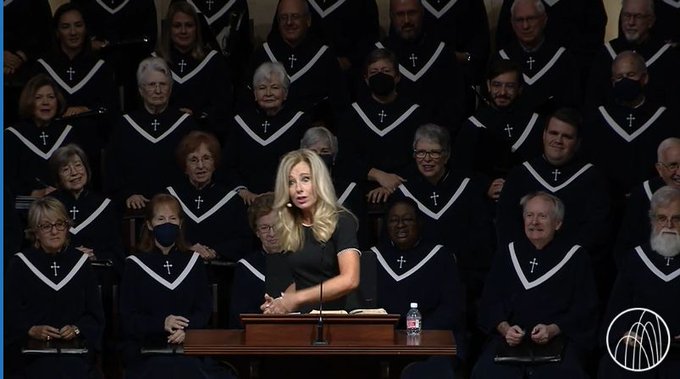
The elephant in the room is: Why did the SBC allow Beth Moore to preach, usurp, & be so divisive?
In 2019 John MacArthur hosted the Truth Matters conference at Grace Community Church. 2019 marked the 50th year he has been pastoring and teaching at that same church, a remarkable achievement for which we have the Holy Spirit to thank.
At the conference there was a Question and Answer session, as there usually is at these things. Todd Friel of Wretched Radio moderated. He explained at one point near the end he was going to have the men on the panel enter a sort of lightning round, requesting one or two word answers to the names Friel would utter.
Before my salvation as I was growing up and studying cultures and then traveling a lot, I mused that it sure was weird that every culture on earth that is and ever was had a spiritual side where the people worshiped something greater than themselves. And I wondered why so many cultures have a flood story and a creation story.
I love the verses in the Bible that show Jesus with the children. Matthew 18:1-6 is an example. So is Matthew 19:13-15. He said that the kingdom is made of such as these.
Marriage is hard. It takes a lot of work, denial of self, service to the spouse, and submission. (Ephesians 5:22-23; 1 Corinthians 13:7, Having Jesus at the center is necessary for success and even then, some marriages between professing partners still fail. Without Christ, I am not sure how any marriage survives! You take two sinners and put them together as one flesh, and each must submit to the other and … well, without Christ the entire endeavor is harder than salmon swimming upstream. We swim against our sin which is hard enough, and then cover the spouse’s sin (1 Peter 4:8; Proverbs 17:9). We need Jesus in marriage, He is our All in All.
So many spheres of our lives feels like they are unraveling, undergoing pressure, or otherwise getting worse than it was even a few years ago. It sure feels like things are spinning out of control.
They’re not.
I was musing on God’s orderliness. Time and time again in the Bible He shows us just how much He is in control. Everything happens in His schedule, in His timetable, in His timing, for His reasons. Nothing escapes His notice. Nothing happens unless He causes it, allows it, or oversees it and then brings it all to the good for those who love Him.
I pray you all had a blessed Resurrection Sunday service yesterday. Those services on Easter are especially sweet. We leave refreshed and fired up.
Now is the time to capture that fervor and those raised up feelings of endearment to Jesus and pursue! The Christian life is one of pursuit.
We pursue sin in ourselves so as to mortify it. We pursue holiness, the holiness that Jesus has graced us with in His propitiation. We pursue His ways, walking the straight street that led from the narrow gate that we entered at salvation. We pursue His word so as to hide it in our heart and meditate on it daily We pursue prayer.
We do not run from anything. We face trials, we face temptations, we face the road to sanctification ahead. As we read in The Pilgrim’s Progress, Christian faced Apollyon and was scared to death, but realized his armor was all in his front, there was nothing to cover his back!
But now, in this valley of Humiliation, poor Christian was hard put to it; for he had gone but a little way before he espied a foul fiend coming over the field to meet him: his name is Apollyon. Then did Christian begin to be afraid, and to cast in his mind whether to go back, or to stand his ground. But he considered again, that he had no armor for his back, and therefore thought that to turn the back to him might give him greater advantage with ease to pierce him with his darts; therefore he resolved to venture and stand his ground: for, thought he, had I no more in mine eye than the saving of my life, it would be the best way to stand. ~John Bunyan, The Pilgrim’s Progress
Isn’t it interesting that the Christian life is one of so many active verbs. Pursue, run, walk, strive, stand. Nothing about retreat, sleep, or rest.
There is no such thing as long as we are alive as a coasting Christian, a resting Christian, a sleeping Christian. In The Pilgrim’s Progress, Christian fell asleep at one point.
Now about the midway to the top of the hill was a pleasant Arbor, made by the Lord of the hill for the refreshment of weary travellers. Thither, therefore, Christian got, where also he sat down to rest him: then he pulled his roll out of his bosom, and read therein to his comfort; he also now began afresh to take a review of the coat or garment that was given to him as he stood by the cross. Thus pleasing himself awhile, he at last fell into a slumber, and thence into a fast sleep, which detained him in that place until it was almost night; and in his sleep his roll fell out of his hand. Now, as he was sleeping, there came one to him, and awaked him, saying, “Go to the ant, thou sluggard; consider her ways, and be wise.” Prov. 6:6. And with that, Christian suddenly started up, and sped him on his way, and went apace till he came to the top of the hill.
The roll or scroll Christian has is representative of his assurance of salvation. The arbor on the Hill Difficulty is supposed to provide a respite, a short one, not a long one. At first, Christian does what weary travelers are supposed to do in the Arbor, catch his breath, pause for a moment, and reflect on God’s graces. But self-satisfied Christian falls asleep. The Arbor is not meant for lodging.
In this verse we see another of those verbs, ‘press on’.
Not that I have already attained, or am already perfected; but I press on, that I may lay hold of that for which Christ Jesus has also laid hold of me. Brethren, I do not count myself to have apprehended; but one thing I do, forgetting those things which are behind and reaching forward to those things which are ahead, I press toward the goal for the prize of the upward call of God in Christ Jesus (Philippians 3:12-14).
Ken Puls’ Notes and Commentary on The Pilgrims Progress: “Earlier on the Hill Christian was running, going, or at least clambering, but now his inactivity and sloth give way to sleep until it is almost night. Jesus warns us“:
A little while longer the light is with you. Walk while you have the light, lest darkness overtake you; he who walks in darkness does not know where he is going (John 12:35).
By sleeping during a time when God had given him light that he might walk, Christian was guilty of presuming upon the grace of God and the Roll he so cherished fell out of his hand. He could not stay idly in one place, content with no more progress along the Way, and be assured that all was well with his soul.
Notice, however, that account of Christian’s failings also teaches us of God’s unending faithfulness and abiding love. Even as Christian lies sleeping, one comes and awakens him with wisdom from God’s Word:
Go to the ant, you sluggard! Consider her ways and be wise (Proverbs 6:6).
God is not content to leave His pilgrims in spiritual slumber and inactivity. His Word can be applied to the comfort and rest of our souls, but it can also come to warn us, arouse us and spur us to action. Christian hears the Proverb and realizes that now is not the time to sleep. He immediately arises and hurries up the Hill. End Ken Puls’ Notes and Commentary on The Pilgrim’s Progress
So, dear sister, pursue! Let the winds of refreshment from yesterday’s service propel you forward in our walk toward the Celestial City. We are content to walk, run, even clamber, but we must keep moving. Let the graces enjoyed yesterday at The Interpreter’s House (church) fill your soul with joy and awe for this life we have been given, here on earth and the one to come, forever and ever amen.
What strikes me very forcibly is this—no mere man going to his grave could say, “I have power to take my life again.” The departure of life leaves the man necessarily powerless—he cannot restore himself to life. Behold the sacred Body of Jesus embalmed in spices and wrapped about with linen. It is laid within the sealed and guarded tomb—how can it come back to life? Yet Jesus said, “I have power to take My life again.” And He proved it. Strange power—that spirit of His which had traveled through the under lands and upwards to the eternal Glory—had power to return and to re-enter that holy Thing which had been born of the virgin and to revivify that flesh which could not see corruption.
Behold the dead and buried One makes Himself alive again! Herein is a marvelous thing. He was master over death, even when death seemed to have mastered Him—He entered the grave as a captive but left it as a conqueror. He was compassed by the bonds of death but He could not be held by them. Even in His burial garments He came to life—from those wrappings He unbound Himself—from the sealed tomb He stepped into liberty. If, in the extremity of His weakness He had the power to rise out of the sepulcher and come forth in newness of life, what can He not accomplish now? ~Charles Spurgeon “The Power of the Resurrection“
So they took the body of Jesus and bound it in linen wrappings with the spices, as is the burial custom of the Jews. (John 19:40)
Though the Bible does not systematically describe Hebrew burial practice, several features can be gleaned from individual passages. Joseph closed his father’s eyelids soon after Jacob’s death (Genesis 46:4). Jesus’ body was prepared for burial by anointing it with aromatic oils and spices and wrapping it in a linen cloth (Mark 16:1; Luke 24:1; John 19:39). The arms and legs of Lazarus’ body were bound with cloth, and the face covered by a napkin (John 11:44). The body of Tabitha was washed in preparation for burial (Acts 9:37). Putting them all together may give a picture of the Hebrew method of preparing bodies for burial. Source:
Freeman, J. M., & Chadwick, H. J. (1998). Manners & customs of the Bible (p. 523). Bridge-Logos Publishers.
O Lord Jesus Christ, Thou innocent and spotless Lamb of God, who didst suffer for us the ignominious death of the cross, which it is Thy will that it never be forgotten by us. From the depth of our hearts we again give Thee praise, honor and thanks for this Thy love and mercy, that Thou didst so dearly purchase us poor sinners by Thy innocent sufferings and death, and didst become obedient to Thy heavenly Father, unto death on the cross. Thou didst also shed Thy precious blood to wash away and blot out our sins, and didst lay down Thy life in order to rescue us from eternal death. O faithful Saviour! how much didst Thou suffer in our behalf; what unspeakable torture and pain didst Thou endure in body and soul in order that we might be free from it forever. O Lord Jesus!
Thou patient Lamb of God, that taketh away the sins of the world, we confess, that with our manifold and gross sins we have caused Thee such pains and labors and brought about this Thy death. Be gracious and merciful unto us and let this Thy bitter and painful suffering not be in vain for us. Grant unto us Thy grace that daily we may think of Thy death, heartily praise and thank Thee for the same, and by the contemplation of these Thy sufferings and crucifixion we may crucify and mortify in us all lusts of the flesh and evil passions of our corrupt nature, and since Thou didst suffer for us, help therefore also, that we may obediently follow Thee with the cross, which we daily deserve on account of our sins, and for Thy sake, bear all things patiently, that, finally, we may, with all the elect, be and forever remain with Thee in heavenly joy and bliss. Amen.
This early work by Fra Angelico accentuates the drama of the Crucifixion by showing the Virgin collapsed in grief with the lamenting Maries and emphasizing the varied attitudes of the Roman soldiers and their horses. There is an exquisite delicacy about this work that Fra Angelico will develop in his mature paintings. The innovative circular composition was inspired by the bronze doors created by Lorenzo Ghiberti for the Baptistry of Florence.