Here are some practical ideas on HOW to love as Jesus would have us love. Love these days is in short supply in the world. Our love will shine brightly if we love as Christians- loving our brethren, our families, the pagans, and even our enemies.
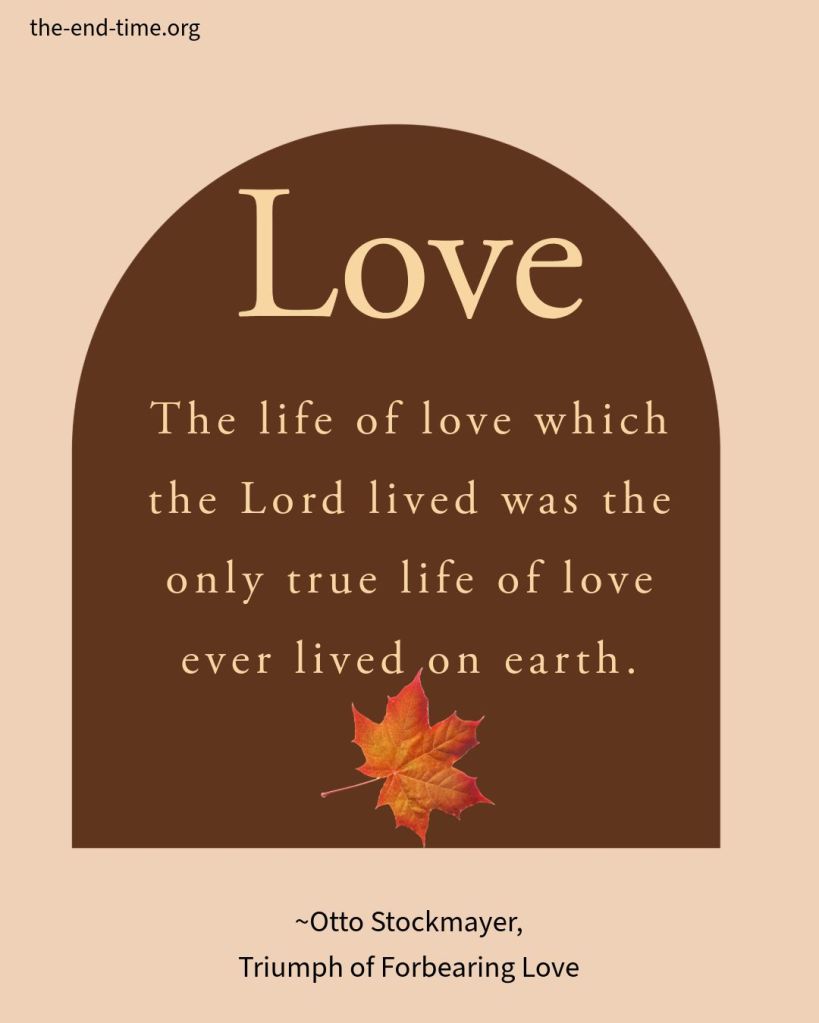
Extended quote from Free Grace Broadcaster #159, Love, from Chapel Library: essay The Triumph of Forbearing Love by Otto Stockmayer,
“Let us stop and consider the form of the expression. Of course, so far as we are children of God, Christ is in us. We cannot be born of God without having Christ in us. Christ must indeed be formed in us (Gal 4:19), but at the very moment we are born again from above He is in us.
Might it not be a very practical test, and a Biblical and Scriptural way of proving that Christ is in us, to get into the holy habit of always seeing Christ in our brother? Even if he were born again but yesterday, or only an hour ago, it is well for us at the very beginning of his Christian life to see in him, through faith, Christ abiding in his heart by the Spirit of God; a being of whom God—Father, Son, and Holy Spirit—has taken possession.
Let us learn to look at our brother as seeing in him the unseen Christ, and we shall help him in a mighty way to take heed that Christ may shine in his life. By this means he will become conscious of the holy ground on which he stands and moves and walks, by having become a Christian. We who have for years walked with Christ must help the babe, the child, to awake to his high calling as quickly as possible.
By recognizing Christ in him, we shall help him to become conscious of the wonderful secret of his new life; and we must prove ourselves to be men in Christ by not stopping short at what we see with our eyes and hear with our ears of the manifestations of the flesh which we may find in the young Christian. We must be able, through Divine love shed abroad in our hearts and free grace in our lives, to look beyond what is seen; we must love our brother through faith in God, that He may bring out the new creation in him in a beautiful way… more beautiful, it may be, than in our own lives.”
I have always loved paper. I’m a writer, to comes with the territory! Especially since I spent half my life expressing myself on paper before computer screens were invented. When I was in Italy, I purposely made a trip to the town of Fabriano. That place is one of the earliest and most important places in the West that sparked the trade in paper. The tradesmen there in the 1200s invented vats with multiple hammers, shortening the pounding time necessary to grind fiber to a malleable state. They also invented the watermark.
With a love of paper naturally comes a love of journals. I recently discovered the paper-journal-site Archer & Olive. This is an upscale, super-beautifully designed journal site. Their mission statement says,
At Archer & Olive, we believe creativity and planning should feel inspiring not overwhelming. That’s why we create premium journaling tools designed to support your mental wellness and help you stay organized in a way that feels joyful.
Archer & Olive’s Stamp Collector Collection
Premium is right. They make stunningly beautiful designs for their journals, notebooks, washi tape, and so on. An especially exciting product is their Subscription box. Inside are a myriad of freshly designed items sent to the subscriber. Each box bundle, and each season’s release of new individual collections, is freshly and uniquely designed by the talent behind the scenes.
For subscribers, the anticipation quickens as the date nears for the quarterly subscription box’s contents to be previewed and then released to the subscribers. They sell out quickly, I understand, and no wonder. They are beautiful as well as practical for the journaler or crafter who likes to create art in such notebooks.
Archer & Olive’s Homespun Collection
Last week, on September 1, the Subscriber box was released to current subscribers, and a few days later, the opportunity for new quarterly subscribers to buy one was opened on their site.
I enjoyed seeing the glimpses and previews of the new designs, as well as viewing old “unboxings” on Youtube. These designers really know their craft.
Yesterday I read a statement from Archer & Olive that saddened me. Now, the state of social media is known to one and all. You can carve out a quiet corner for yourself by making intentional follows and relentless blocking… but still, the negativity, trolling, and downright hate will be present even when you make innocuous statements or put out a benign vibe. And so it was with A&O. They wrote:
In the past week, we have been getting an unprecedented number of comments questioning our design process. We will be honest, we were taken by surprise by the sudden influx. Our team have a longstanding history of gorgeous designs, long before generative Al developed to where it is now, and we naively believed those years of designs spoke for themselves. However, as more new people find us, we understand that we haven’t built your trust yet, so here’s what we’re doing going forward.
MAKING OUR STANCE CLEAR
Our team quickly put together this page to clearly state our stance against Al-art, as well as including some insights on our design processwe have shared before:
This page is not comprehensive, but we wanted to respond quickly to show we are actively engaged in the discussion, and working on ways to make our stance clear.
WHAT WE WILL BE DOING GOING FORWARD?
We have plans to continue to share more behind the scenes, and we are talking to our artists about sharing more of their process. However, we hope that everyone can understand that we will first and foremost be prioritizing the privacy and mental health of our staff. All our artists are in-house employees, and after being met with hostility when personally engaging with comments, many have become hesitant to have a public presence.
We do genuinely understand the vigilance when looking for Al, but our designs are created by real humans; real people who are seeing the unfounded comments and increased negativity towards their work. If you see an error, there was a real person behind that error. Our team are amazing, many who have been with us from the early days of Archer and Olive, and some newer faces who have allowed us to expand our designs and style over the years. We only hope going forward their work can be met with the praise it deserves.
How bad does society need to be that floods an innocent design site with trolls spewing hate! So sad. Here they are, making beautiful things, selling them, enjoying their own products, wanting to help people through journaling, and along come a flood of negative nellies who are skeptical that real, live designers have toiled hard to bring these pretty items to the public. Real, live designers whose work is not only not acknowledged positively, but denied at all!
How unkind.
You know that photo of all the men saluting Hitler in the Nazi salute and one guy rebelliously has his arms crossed?
In these days of unkindness, we can be that guy. Being kind in an unkind world will stand out. It will be a balm, a breath of fresh air, a sweet zephyr of repose for those around you.
To fellow Christians, Be kind to one another, compassionate, forgiving each other, just as God in Christ also has forgiven you. (Ephesians 4:32).
Therefore, as the elect of God, holy and beloved, clothe yourselves with hearts of compassion, kindness, humility, gentleness, and patience. (Colossians 3:12).
Kindness is a spiritual fruit. But the fruit of the Spirit is love, joy, peace, patience, kindness, goodness, faithfulness (Galatians 5:22).
As in like manner, kindness will also stand out in a darkening world in our attitudes and behavior toward non-Christians, too.
So then, while we have opportunity, let’s do good to all people, and especially to those who are of the household of the faith. (Galatians 6:10).
Even to those who are enemies! We should be kind. Luke 6:35 says, But love your enemies and do good, and lend, expecting nothing in return; and your reward will be great, and you will be sons of the Most High; for He Himself is kind to ungrateful and evil people.
It profits no one anything to be unkind. I know I have failed myself in this regard many times. I begin each day with an appeal to the Holy Spirit to help me be kind to one and all. Fading energy, irritation, illness, are some reasons why I fail to restrain the unkindness and it comes out. But to purposely troll a business with floods of unkind negativity is beyond appropriate.
Stand out by being kind, even in the face of unkindness. Paul quoted Proverbs 25:21–22 in Romans 12:20 (ESV), To the contrary, “if your enemy is hungry, feed him; if he is thirsty, give him something to drink; for by so doing you will heap burning coals on his head.” As GotQuestions explains,
Verse 21 explains the idea of heaping burning coals on someone by saying, “Do not be overcome by evil, but overcome evil with good.” Anyone can return evil for evil. But when a Christian does so, the watching world sees nothing different about our lives. It is not even clear who is right and who is wrong when we respond in kind to the one who wronged us. But, when we follow Jesus’ instruction to love our enemies (Matthew 5:43–44) and return good for evil, the contrast is stark. Our kind and gentle reaction to hatred spotlights the depravity of the one who treated us poorly and leaves the hurtful person alone in his or her hatefulness. Nothing pricks the conscience of a hateful person like a soft, forgiving spirit in the one he has wronged (Proverbs 15:1).
I was asked about the spiritual realm. It is a huge subject! Angels are an interesting subject, and I am like many of you who wonder why preachers do not preach on the subject. It IS a legitimate feature of most Systematic Theology divisions, after all. It’s called Angelology.
“Go, therefore, and make disciples of all the nations, baptizing them in the name of the Father and the Son and the Holy Spirit, teaching them to follow all that I commanded you; and behold, I am with you always, to the end of the age.“
This is known as The Great Commission, where Jesus, upon the occasion of His departure from earth, told His disciples to evangelize, baptize, and raise up more disciples.
Mark 16:15 says, And He said to them, “Go into all the world and preach the gospel to all creation.
So, we do. We share the Gospel (using words). It is our duty and our privilege.
So it seems like it would be a dereliction of duty to quit giving the Gospel to someone who rejects it. But it isn’t. If a person has been shared with and given the blessed Gospel of God, not only once but a few times, and they reject, it is OK to stop. In fact, sometimes they entrench further into their depravity and sin each time we bring it up. Rather that push the issue, stop and let the Holy Spirit do His work. If that person has been chosen and elect, they will at some point come to see as the scales fall from their eyes.
As Paul is a great model for sharing the Gospel he is also a great model of when to stop sharing the Gospel:
Acts 18:6, But when they resisted and blasphemed, he shook out his garments and said to them, “Your blood is on your own heads! I am clean. From now on I will go to the Gentiles.“
If they were blaspheming, their minds were definitely not ready and that meant their heart was not accepting either. Let them go and move on to more fruitful fields. Also, if they were blaspheming, they were heaping sin upon themselves. We don’t want that for them. Just let them go and let the seed germinate if it is going to.
Here is another example-
Acts 19:9, But when some were becoming hardened and disobedient, speaking evil of the Way before the people, he [Paul] withdrew from them and took the disciples away with him, and had discussions daily in the school of Tyrannus.
They were becoming hardened. Sometimes when we share the Gospel with a loved one, we can spiritually see them hardening. We feel them moving away from Jesus, not toward.
Sometimes it is OK to stop giving the Gospel if they ask you to stop. If you have shared and are satisfied with your clarity in that share, and the next time or two you’ve raised the issue and they say ‘stop’ then respect that and just love them.
This verse is kind of a brutal description, but remember, it’s advice from the All Omniscient One-
“Do not give what is holy to dogs, and do not throw your pearls before pigs, or they will trample them under their feet, and turn and tear you to pieces.” (Matthew 7:6).
And we remember Matthew 10:14, where Jesus instructed them,
And whoever does not receive you nor listen to your words, as you leave that house or city, shake the dust off your feet.
So, is the person you’re sharing with stomping on the Gospel, rejecting it in a blaspheming way, or just weary of the ‘Jesus-talk’? It is OK to stop. It is actually loving to keep on loving them but refrain from continuing the Gospel share so that they do not blaspheme or harden. But pray for them.
It’s high summer here in the US, and where I live (in the South). It gets very hot in July. We are predicted to have a “heat dome” next week for the 4th of July, which won’t be fun for the poor marching bands participating in the parades. I am looking forward to the festivities that are planned for our country’s 250th birthday! It’s hard to think of how fast June flew by!
SYNOPSIS: The passage rejects the idea that Christians receive personal “whispers” from the Holy Spirit. Criticizing popular Christian women authors, it argues that God’s revelation is complete in Scripture and that believers should seek guidance through prayer, biblical wisdom, and spiritual discipline rather than subjective impressions or inner messages.
SYNOPSIS: This essay examines Beth Moore’s early role as a sorority chaplain, critiques her experiential approach to Christianity, and urges discernment regarding chaplaincy in general.
SYNOPSIS: I reflect on the internet’s evolution from a joyful tool for connection and faith-sharing to a platform spreading moral confusion, proposing that ordinary Christian family life has become a radical witness.
In 2 Peter 3:15-16, Peter wrote that there are some things Paul wrote that are hard to understand. The unstable distort those things. Perhaps the Holy Spirit did that on purpose so that it would weed out who truly sought understanding and who likes to find a chink and crowbar it further apart in order to insert their own wrong interpretation (so as to lead followers astray). This is my speculation. After all, He sends false teachers in order to test us (2 John 9-11, Deuteronomy 13:3, etc.).
But the Holy Spirit’s inspiration of God’s word through the minds and personalities of the Bible writers is remarkable for so many reasons, but for my purposes today, for its honesty.
There are hard things to understand in the Bible. The following phrase is one of them: “covenant of salt”. It is mentioned a few times in the Old Testament.
GotQuestions has some ideas, also giving a historical context as to the importance of salt. Phrases we use even today harken back to the days when salt was a precious commodity. For example, GotQuestions wrote-
There is more to salt than meets the taste buds. Salt has been used in many cultures as a valuable commodity. The word salary comes from an ancient word meaning “salt-money,” referring to a Roman soldier’s allowance for the purchase of salt. Someone who earns his pay is still said to be “worth his salt.”
EPrata photo
Salt was used in that culture as part of a legally binding contract. That notion was carried forward into the Old Testament Law. King Abijah mentioned it in 2 Chronicles 13:5,
Do you not know that the LORD God of Israel gave the rule over Israel forever to David and his sons by a covenant of salt?
The Israelites were commanded to use salt as part of the grain offering and reminded not to forget that part of the offering, ever-
Every grain offering of yours, moreover, you shall season with salt, so that the salt of the covenant of your God will not be lacking from your grain offering; with all your offerings you shall offer salt. (Leviticus 2:13).
Matthew Henry on Leviticus 2:13, “Salt is required in all their offerings, v. 13. The altar was the table of the Lord; and therefore, salt being always set on our tables, God would have it always used at his. It is called the salt of the covenant, because, as men confirmed their covenants with each other by eating and drinking together, at all which collations salt was used, so God, by accepting his people’s gifts and feasting them upon his sacrifices, supping with them and they with him (Rev. 3:20), did confirm his covenant with them.”
Among the ancients salt was a symbol of friendship. The salt for the sacrifice was not brought by the offerers, but was provided at the public charge, as the wood was, Ezra 7:20–22. And there was a chamber in the court of the temple called the chamber of salt, in which they laid it up. Can that which is unsavoury be eaten without salt? God would hereby intimate to them that their sacrifices in themselves were unsavoury.
The saints, who are living sacrifices to God, must have salt in themselves, for every sacrifice must be salted with salt (Mk. 9:49, 50), and our speech must be always with grace (Col. 4:6), so must all our religious performances be seasoned with that salt. Christianity is the salt of the earth.
Henry, M. (1994). Matthew Henry’s commentary on the whole Bible: complete and unabridged in one volume (p. 153). Hendrickson.
Again the salt covenant is mentioned in Numbers-
Numbers 18:19, “All the offerings of the holy gifts, which the sons of Israel offer to the LORD, I have given to you and your sons and your daughters with you, as a permanent allotment. It is a permanent covenant of salt before the LORD to you and your descendants with you.“
JFB commentary on Numbers 18:19, “it is a covenant of salt—that is, a perpetual ordinance. This figurative form of expression was evidently founded on the conservative property of salt, which keeps meat from corruption; and hence it became an emblem of inviolability and permanence. It is a common phrase among Oriental people, who consider the eating of salt a pledge of fidelity, binding them in a covenant of friendship. Hence the partaking of the altar meats, which were appropriated to the priests on condition of their services and of which salt formed a necessary accompaniment, was naturally called “a covenant of salt” (Lev 2:13).
Jamieson, R., Fausset, A. R., & Brown, D. (1997). Commentary Critical and Explanatory on the Whole Bible (Vol. 1, pp. 108–109). Logos Research Systems, Inc.
Here are a few resources on the fascinating topic of salt in the Bible!
Have you heard of the new trend sweeping through our society from Gen Z-ers to Boomers? It’s analog. Yes, the new fashioned word for an old fashioned life- one filled with tactile hobbies like knitting and crosswords in real books and newspapers. Design trends where prospective house buyers seek a home like grandma had- with real rooms, not open concept, afghans, wallpaper, hardwood floors, sunrooms, even sewing rooms. They call it ‘a grandma house.’
The last 30 years has seen a rise of the digital, and a resulting loss of the tactile. People are tired of the constant notifications, intrusive surveillance, annoying advertisements/pop-ups, and anxiety known as FOMO (Fear Of Missing Out). When we’re always ‘connected’, we tend to compare our lives to others and covetousness, jealousy, and unease rises. Frankly, we’re tired.
The Book
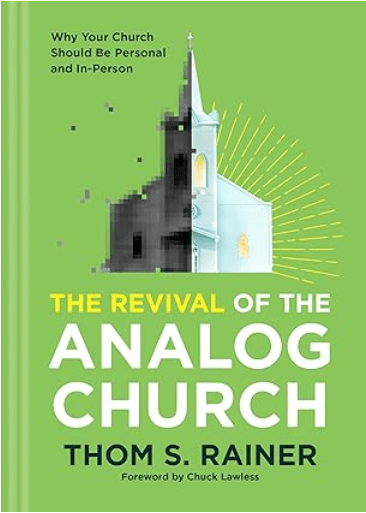
The church has not escaped the impact of the rise of digital lifestyles. Into this rising trend of concern and yearning for simpler times is Thom Rainer’s forthcoming book, “The Revival of the Analog Church: Why Your Church Should Be Personal and In-Person (Church Answers Resources)”. It is due out in October 2026, and it is being published by Tyndale Momentum.
The Problem
The church never escapes being influenced by the world around us. Even diligent churches that resist worldly trends have to fight hard to push back. Church is composed of people, and people for the last 30 years have grabbed onto all things digital. Many churches have suffered for it.
Rainer wrote, “Have we digitized what was meant to be deeply personal? The digital world gave us tools. Helpful ones. We could reach farther and faster. Sermons went online. Groups went virtual. Resources were available with a click.”
But all these tools come with a cost. We are suffering from ‘digital fatigue’ and this includes churches. It’s no so much the tools that churches use, such as streaming the sermon or digital Bibles, it is the pace at which the digital world has taught us to run. It is the brain, always pumping for more, the new, the next. Digital is a tool, but it has overpowered us and taught us that we need to always be moving. This constant movement includes a hurry-up pace in church. Yet, Rainer writes, church is exactly the place where we need to slow down, pray pensively, linger in relationship, be present emotionally, mentally, physically. He advocates for “the sacred simplicity of a Sabbath-like presence.”
Rainer’s point is synopsized with this- we are digitally numb, and ‘Digital numbness leads to spiritual numbness.’
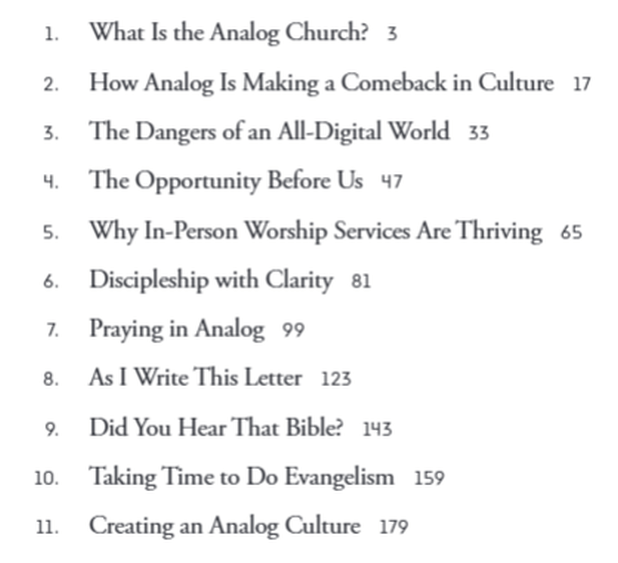
The chapters, 11 of them, describe the problem and offer solutions. Rainer includes reflection questions at the end of each chapter.
My Review
Rainer begins with a solid explanation of the difference between analog and digital, and how this is impacting the church. He humbly relates that he himself had fallen into the fast-paced digital world, at one point, to the detriment of his family. He loves the digital and assures the reader he is no naysayer, writing, “We have not sinned by embracing digital tools.”
However, Rainer makes the case that we must mindfully slow our pace, be present at church, and restore an unhurried worship.
This book is positioned well to capture this wave of analog yearning to return to an unhurried pace with real relationships. The realization that digital has its limits is fueling the desire to return to unhurried worship and discipleship in its fullest sense. In his book, Rainer describes how.
There is no doubt that digital media has drastically changed how people communicate and how people commune with each other, and the change has impacted not only worship but witnessing and evangelism. This must be a concern for us all.
His point is that “People are weary of a life that feels like it’s always in motion but never truly grounded.” It’s true that the digital world has taught us to live in fragments, when Jesus actually taught to live by thinking deeply, slowly, and intentionally in worship.
Positives:
–The author captures and crystallizes and amorphous unease many people seem to be dealing with regarding the digital lifestyle,
–His end-of-chapter questions are thought provoking,
–Rainer provides solutions, not just identifying the problem,
–He Humbly includes himself in the digital problem.
Negatives:
–I saw a few scriptures, maybe 3 or 4. I’d like to see more scripture use in a book about the importance of relational worship,
–His likening of listening to vinyl records or playing board games to church life as examples of analog were a bit of a stretch. In my opinion, he could have written more deeply about analog church life. I felt the book was more overview than deep theology. Of course, this is fine for someone new to the concept of the problem of digital vs. analog.
–The writing style was very much digital. Too many sentences beginning with ‘And’, staccato short bulleted sentences, and lots of “it’s not this, it’s that.” Rainer mentioned several times how he has absorbed and enjoyed the digital life and pace, and this absorption shows through in his writing, which definitely mimics the digital.
Conclusion
If you are new to the idea that digital fatigue is rising and beginning to permeate our society -and the church- from the oldest adult generation to the youngest, then this would be 4-stars for you. If you are already familiar with the concept and want a more deeply theological examination of the issue, then this book is a 3-star for you, with other suggestions below.
Further Resources:
Out-Of-Doors in the Holy Land by Henry van Dyke. Published 1908 and considered a classic of Holy Land travelogues. Blurb: “Van Dyke’s beautiful descriptions and thoughtful reflections on the landscape, the people, and the spiritual significance of the places he visits make this a must-read for anyone interested in travel, religion, or culture. This work has been selected by scholars as being culturally important”. The premise is that Christianity was an out of doors religion, where walking, pondering, contemplating and considering were all slow processes.
Digital Minimalism by Cal Newport. (2019). Blurb: “a book that proposes a philosophy for using technology intentionally to support your values, rather than letting it control you, advocating for a focused life by drastically reducing low-value digital activities”.
Twelve Ways Your Phone is Changing You, by Tony Reinke. (2017). Blurb- “Drawing from the insights of numerous thinkers, published studies, and his own research, writer Tony Reinke identifies twelve potent ways our smartphones have changed us—for good and bad. Reinke calls us to cultivate wise thinking and healthy habits in the digital age.”
Competing Spectacles by Tony Reinke. (2019). Blurb- “We live in a world full of shiny distractions, faced with an onslaught of viral media constantly competing for our attention and demanding our affections. These ever-present visual “spectacles” can quickly erode our hearts, making it more difficult than ever to walk through life actively treasuring that which is most important and yet invisible: Jesus Christ.”
God, Technology, and the Christian Life by Tony Reinke (2022). “Highlights: Biblical, Informed Look at Technology; Gathers Ideas from Industry Experts and Theologians by Interacting with Christian and non-Christian sources on technology and theology including John Calvin, Herman Bavinck, Wendell Berry, and Elon Musk, and is Educational: Discusses the history and philosophy behind major technological innovations.”
Amazon Bio: Thom S. Rainer is the founder and CEO of Church Answers. Prior to Church Answers, he served as president and CEO of LifeWay Christian Resources. He also served at The Southern Baptist Theological Seminary for twelve years where he was the founding dean of the Billy Graham School of Missions and Evangelism. He has been a pastor of four churches and interim pastor of ten churches. He has written several books, including “I am a Church Member” and “Simple Church”.
DISCLAIMER- My Advanced Reader Copy was provided via NetGalley. I received a free digital copy of this book from Tyndale, the publisher, in exchange for an honest review.









 the-end-time.org