Kay Cude poetry. Used with permission. Right-Click to open larger in new tab or see text below.
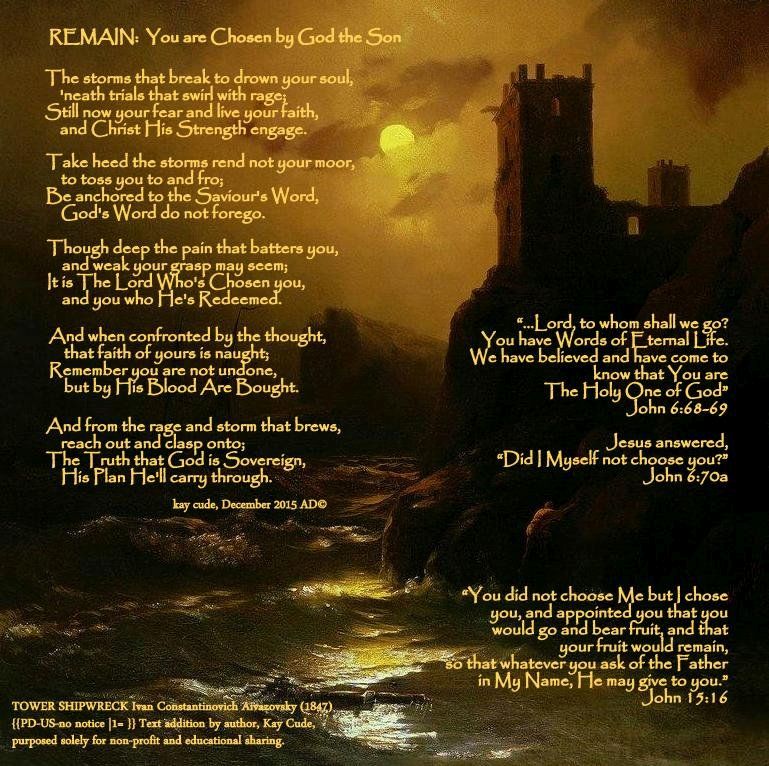
REMAIN: You are Chosen by God the Son
The storms that break to drown your soul, ‘neath trials that swirl with rage; Still now your fear and live your faith, and Christ His Strength engage.
Take heed the storms rend not your moor, to toss you to and fro; Be anchored to the Saviour’s Word, God’s Word do not forego.
Though deep the pain that batters you, and weak your grasp may seem; It is The Lord Who’s Chosen you, and you who He’s Redeemed.
And when confronted by the thought, that faith of yours is naught; Remember you are not undone, but by His Blood Are Bought.
And from the rage and storm that brews, reach out and clasp onto; The Truth that God is Sovereign, His Plan He’ll carry through.
“…Lord, to whom shall we go? You have Words of Eternal Life. We have believed and have come to know that You are The Holy One of God” John 6:68-69.
Jesus answered, “Did I Myself not choose you?” John 6:70a “You did not choose Me but I chose you, and appointed you that you would go and bear fruit, and that your fruit would remain, so that whatever you ask of the Father in My Name, He may give to you.” John 15:16
kay cude, December 2015 ADⒸ
TOWER SHIPWRECK Ivan Constantinovich Aivazovsky (1847).Image-
Text addition by author, Kay Cude, purposed solely for non-profit and educational sharing.
Previously, the word was Transcendence. God is apart from His creation, different from it. This week the word is Immanent or Immanence,
God’s immanence refers to His presence within His creation. (It is not to be confused with imminence, which refers to the timing of Jesus’ return to earth.) A belief in God’s immanence holds that God is present in all of creation, while remaining distinct from it. In other words, there is no place where God is not. His sovereign control extends everywhere simultaneously. Source GotQuestions
Immanence: God’s presence and activity within the creation and human history. Source: Biblical Doctrine, MacArthur/Mayhue, p 931
God is so majestic! Mysterious! How can He be both apart from His creation, and present within it?! At the same time? It shows who our God is. It’s why I chose these two words one after the other to demonstrate His essential otherness.
One additional notion that is important to emphasize.
Pantheism and deism twist many people’s view of how God relates to His creation. Pantheists believe that everything is God or is a part of God, making Him equal with His creation and unable to act upon it. Deists hold that God is distinct from His creation but deny that He plays an active role in it. Contrary to these and other false views of God, the Bible says that God is both different from His creation and actively upholding it.
We must not stress His immanence at the expense of His transcendence, and vice versa.
That they should seek God, in the hope that they might feel their way toward him and find him. Yet he is actually not far from each one of us, (Acts 17:27).
Note: Modern pantheism is seen in William P. Young’s The Shack, Oprah Winfrey’s promotion of Eckart Tolle, and in Ann Voskamp’s book One Thousand Gifts as an offshoot of pantheism, panentheism. It is easy to twist both immanence and transcendence, either by direct twisting or omitting one in favor of the other. It is why it is important to learn these terms so we retain a balanced view of God.
Poetry by Kay Cude. Used with permission. Right click on image to open larger in new tab. Or read the text below the artwork. Artist’s statement:
I keep returning to our (me!!) needing to “remember” God’s promises and provision. GOD THE I AM is the only fortress in Whom we find a righteous protector, defender and provider. He is the only place of eternal refuge from the world’s continuing tragedies and chaos. He is the stronghold Who is and Who will provide peace, wisdom, understanding, instruction and endurance.
OUR FORTRESS PREVAILS
FACING FEAR: IN THE MIDST OF GOD’S PROVIDENCE As waves of fear rolled nearer still, as deep its swell approached us nigh; our hearts near failed as we cried out, “O Lord, Your servants rescue now!” And crashed the waves of terror strong, our lives at risk — we knew death’s tide; yet stilled our hearts Your Glorious Word and on we clung and Truth prevailed.
As deep and dark, as depth of brine, we battled ‘gainst the foe’s onslaught; its torrents fierce as bounding main, — with cruelest rage this foe can slay. Yet in Your Will, O Saviour ours, Salvation’s Light’s our mighty Ark; afloat we stay midst evil’s gale, for You prevail within its rage.
Afloat we ride with knowledge sure, we look ahead with strength not ours; Endurance meets us Face-to-face, ’tis You our Strength our sure Bulwark, The fears we face — our spirit’s gain, makes strong we resolute of heart, to live God’s Will through providence — and triumph through His Will’s Intent.
~kay cude, October 1, 2017
“The LORD is my Rock and my Fortress and my Deliverer, my GOD, my Rock, in whom I take refuge; my Shield and the Horn of my Salvation, my Stronghold. I call upon the LORD, WHO is worthy to be praised, and I am saved from my enemies. The cords of death encompassed me, and the torrents of ungodliness terrified me. The ropes of Sheol entangled me; the snares of death confronted me. In my distress I called upon the LORD, and cried to my GOD for help; HE heard my voice out of HIS TEMPLE, and my cry for help before HIM CAME INTO HIS EARS.” Psalm 18:2-6
OUR FORTRESS PREVAILS Refer to Psalm 46. FEAR NOT, GOD IS OUR ETERNAL REFUGE AND STRENGTH.
“We will not fear, for God hath willed His Truth to triumph through us; The body they may kill. God’s Truth abideth still, His Kingdom is FOREVER.” ~Martin Luther
IT IS the grace of God through His unfathomable mercy through the power of His predetermined love that urges us to remain and stand in His will concerning providence! WHAT THEN
IS IT that assails our thoughts with such unrelenting vengeance that can tempt us into overbearing fear when trials overtake us?
IT IS not remembering His Word — that He is Sovereign over all circumstances and issues we will encounter during our lives, during our service to, for and through Him…
SYNOPSIS: This article examines the rise of the homosexual rights movement in the 1970s and highlights Anita Bryant’s opposition through her Save Our Children campaign. It argues that Bryant’s biblical convictions shaped her activism, influenced conservative politics, and came at significant personal cost.
I love the pre-dawn. It is quiet and cool and dark but the light is coming, and already is.
I live in an area which is fairly rural, and there is not much traffic. Though I live on a major artery in the county, there isn’t enough traffic even during the day to really bother me. However, in the pre-dawn, there is none at all. I can hear from afar off the dogs bark, cows moo, occasional owl screech, an early rooster…
EPrata photo
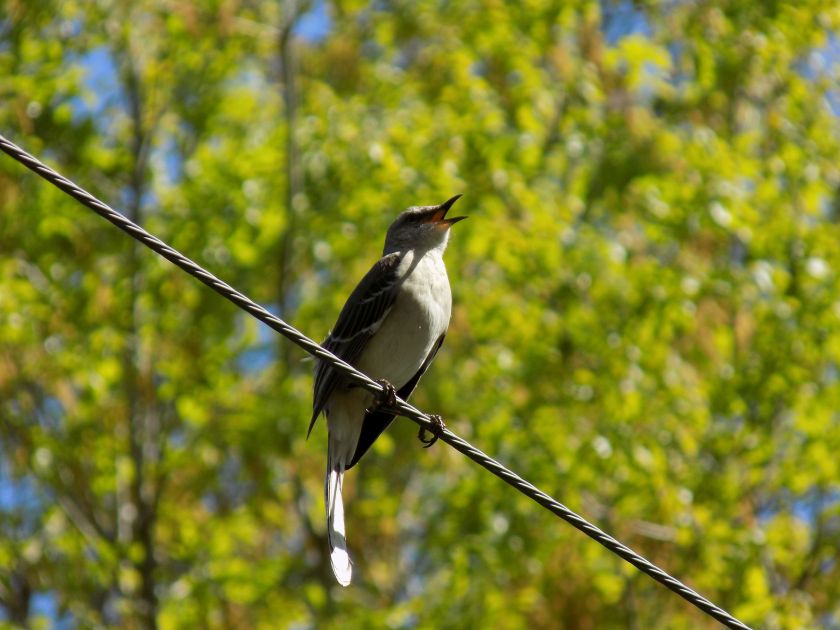
At about 6 am there is always one bird. From out of the darkness, suddenly, there will be a happy series of lone chirps. He is loud, and the sound is joyous to me. Not to anthropomorphize too much, but the bird really does sound happy. The piercing, lengthy call sounds like he is waking up his brethren. Perhaps it is an ovenbird.
After the first bird goes first, then in a few moments the dawn chorus begins. The dawn chorus is a worldwide event. At Cornell, they wrote, “The dawn chorus is one of the most conspicuous vocal behaviors of birds, and one of the least understood. Near sunrise, birds often sing more loudly and vigorously than they do at other times of the day.“
EPrata photo
I like to think they are thanking their Creator. He knows them, and I like to think they know their Creator back. God says, “I know all the fowls of the mountains: and the wild beasts of the field are mine.” (Psalms 50:11). We know that all creation groaneth in travail until now, (Romans 8:22). They groan…do they sing in joy as well?
Birds suffer for man’s sin, (Genesis 6:7; Jeremiah 12:4; Ezekiel 38:20; Hosea 4:3). The Bible says they flee away when calamity comes as well. (Jeremiah 4:25; Jeremiah 9:10)
Yet they sing:
10You make springs gush forth in the valleys; they flow between the hills; 11 they give drink to every beast of the field; the wild donkeys quench their thirst. 12 Beside them the birds of the heavens dwell; they sing among the branches. 13 From your lofty abode you water the mountains; the earth is satisfied with the fruit of your work. (Psalm 104:10-13)
Imagine the ‘dawn chorus’ in heaven! Birds will sing all the time because there is no dusk and no dawn, only day! (1 John 1:5, Revelation 21:25).
I believe that in heaven when He brings His bride to her place and presents our dwelling place to us, our rooms will not have screens on the windows. Because why would they? No biting insects or animals will creep in and harass us. All creation will be reconciled to its Creator and there will be no reason to have bars or screens to keep things out, or in. Maybe a bird will swoop in to my room and sing in joy at the perfection of the Creator and gladness to be part of it, and I will join. Together we are all groaning now, but the Day will come when we will all sing in joyous praise to the One who made us. Birds too.
In the meantime, I’ll enjoy the first bird each morning, knowing that before the day’s groaning begins, there is joy in creation among the created.
Before I was saved I breathed in the air of common grace, grace that is filled with the creation knowledge of Him. It was poison to my lungs. I flopped around like a caught fish on the deck, breathing grace but longing for the murky waters to envelop me once again, the weeds wrapping around my head, because I loved the darkness. (cf Jonah 2:5b)
And this is the judgment: the light has come into the world, and people loved the darkness rather than the light because their works were evil. (John 3:19).
as it is written:
None is righteous, no, not one; no one understands; no one seeks for God.
(Romans 3:10)
And yet He loved me, a sinner, and set me upright, washed me, had given gave me common grace all my unsaved life and now added saving grace to my soul.
For the law of the Spirit of life has set you free in Christ Jesus from the law of sin and death.(Romans 8:2).
After salvation I breathe in the sweetness of special grace, the savor of Jesus and His sanctifying work of atonement. The Light came.
Doesn’t it just amaze you to pray to Jesus…and know He hears us? It’s incredible, and a privilege we always remember in gratitude.
As Isaiah cried in his wonder and grief, “I am a man of unclean lips!” (Isaiah 6:5). In my case, a woman of unclean lips. Why should I be able to use these lips to pray to Jesus when I am the chief of sinners, wretched woman that I am? What is man that God should be mindful of us? (Psalm 8:4). Why should He hear us?
But He does.
Though ‘El Shama’ is not an official name of God, it refers to the fact that God hears…He listens. God told Hagar to name her soon to be born son Ishmael. Ishmael is is a combination of el and shama, “God hears” or “God listens”. The name would be a reminder to Hagar and all who knew them that He heard Hagar’s cry in the wilderness. (Genesis 16:11). He listens.
Psalm 17:6 says
I have called on you, for you will hear me, O God: incline your ear to me, and hear my speech.
Gill’s Expositions says of the Psalmist’s plea in verse 6,
“for thou wilt hear me, O God; God is a God hearing prayer; he is used to hear his people, and they have frequent experience of it, and they may be assured that whatsoever they ask according to his will, and in the name of Christ, he will hear; and such an assurance is a reason engaging the saints to a constant calling upon God, Psalm 116:2; and such confidence of being always heard Christ had, John 11:41;”
1 John 5:14 says,
And this is the confidence that we have toward him, that if we ask anything according to his will he hears us.
Did Peter forever relive his anguish in his remaining life, when he heard the rooster crow the day awake and remembered his own perfidy? Owww, Peter, I understand your grief, the pain of betraying Jesus in word or in deed from our own sinful actions. Yet…Jesus prayed for Peter. Luke 22:32. He did not pray for Judas. Both men betrayed Jesus, but Jesus prayed for Peter.
If you’re a Christian, Jesus prays for you, too. It’s staggering to consider that the God of the Universe prays for us. He hears us, and He prays for us. We have a superlative God, One who is true and kind and loving and compassionate. Sister, no matter what you are going through, Jesus hears your prayer and He takes your cares to the Father in prayer. Be encouraged.
This essay explores Christian disagreement, urging discernment in speech, balancing boldness with love, and promoting patient, Scripture-centered, civil discourse that fosters growth while faithfully representing Christ.
Biblical speech must be gracious and gentle when contending for the faith; yet disagreement persists due to sin, ignorance, or conflicting worldviews, not merely poor communication.
SYNOPSIS: Christians must contend for the faith with truth and love, rejecting shallow “drive-by” comments, pursuing humble dialogue, and standing firm despite opposition in today’s public, digital arena.
Introduction
The practicalities of how to contend for the faith is a big subject. We’re told to contend, of course, many times and in many ways. For example, Jude wanted to write a nice, little encouraging letter, but found that because of false brothers teaching false doctrine, he had to do his duty first and clear up some misconceptions and errors.
Beloved, although I made every effort to write you about the salvation we share, I felt it necessary to write and urge you to contend earnestly for the faith entrusted once for all to the saints. (Jude 1:2)
Paul was sure that in his absence the Philippians will be “contending side by side for the faith of the gospel,” (Philippians 1:27).
Paul urged Timothy to “fight the good fight“. (1 Timothy 6:12).
Stand firm, do not turn, speak truth, and so on.
It’s important to consider, especially in this day and age of social media platforms with widespread audiences watching us, reading our words, and listening to our debates. Even in Solomon’s Portico or at the Areopagus or on the hillside at the Sermon on the Mount, with tens of thousands in attendance, today’s audiences who either lurk or engage with us online are an order of magnitude larger than those audiences.
But how? How do we contend appropriately? Sometimes we’re called to be gentle, other times to be direct. Righteous anger is allowed, but not unrighteous anger, and don’t let the sun set on any anger. Paul used holy sarcasm, but are we allowed to? Maybe? Maybe not.
I’ll do my best to answer the above but first, there is one part of online life in civil discourse I’d like to address as I fold it into the larger issue of appropriate theological discourse. I call these the “Drive By Debaters”.
Drive-By Commenters
It’s when someone takes the time to read the post. They take the time to comment on the post. Or they haven’t even read it (more common). But when they reply, they then state their position and end it by saying “I don’t want to debate.”
This kind of comment is opposed to true theological discourse, and even undermines it. It shuts down the point of any biblical discussion, which is to work together to arrive at a common understanding, mutual edification, and brotherly love with Christ as a center point. That kind of comment says ‘I’m right, you’re wrong, and I don’t care if you accept it or not, I just wanted to use your platform to say so. Buh-bye.’
The purpose of discussing biblical principles, interpretations, or concepts in person or online is to arrive at a common understanding. It’s to teach and be taught. The drive-by debate-denier displays they have an unteachable spirit.
Likewise, you who are younger, be subject to the elders. Clothe yourselves, all of you, with humility toward one another, for “God opposes the proud but gives grace to the humble.” (1 Peter 5:5).
What I do if someone says “I don’t want to debate” on one of my platforms (Facebook, Twitter, blog, or email) is to engage once more by gently asking a question about what they’d said. Sometimes they’ll come back and we can begin discussion. If they don’t, I delete their original comment. I figure, if they don’t want to discuss, then we won’t discuss. At all.
I won’t allow my platforms to be used by drive by commenters, because from the outset they display that they are not interested in the rules of honest civil engagement. We should all seek wisdom, then understanding. This should be true from the top-most sage teacher to the newest babe.
Wisdom is to be highly prized. Proverbs 4:7-9 says,
The beginning of wisdom is this: Get wisdom, and whatever you get, get insight. 8 Prize her highly, and she will exalt you; she will honor you if you embrace her. 9 She will place on your head a graceful garland; she will bestow on you a beautiful crown.”
How Should We Contend?
As for my main point, how to contend. I share theological truths with friendly people and unfriendly people. Some of the most unfriendly people I deal with are those who claim they are Christians but are not. When addressing their stance, they explode in myriad ways. When pointing out their favorite teacher is false, they go off like a rocket. If you really want to poke a bear, either discuss a sin with a false professing Christian, or identify their favorite teacher as false. Both discussions go to the same root: sin. Satan is protective of his peoples’ sin and it does not like to be exposed to the light of day. (John 3:19). That’s why the person explodes on you.
Some Bible verses call for gentleness on the part of the deliverer of the message, other Bible verses call for firmness, harshness even. In today’s ‘tolerant’ and ‘don’t judge’ atmosphere, when discussing biblical things, if the other person blows up it’s often seen as a failure of communication on our part. But in many cases it’s not, and don’t be afraid if it happens to you.
The descendants also are impudent and stubborn: I send you to them, and you shall say to them, ‘Thus says the Lord GOD.’ 5And whether they hear or refuse to hear (for they are a rebellious house) they will know that a prophet has been among them. 6And you, son of man, be not afraid of them, nor be afraid of their words, though briers and thorns are with you and you sit on scorpions. Be not afraid of their words, nor be dismayed at their looks, for they are a rebellious house. 7And you shall speak my words to them, whether they hear or refuse to hear, for they are a rebellious house.(Ezekiel 2:4-7).
Not that we are Prophets like Ezekiel was, but in New Testament times we are God’s witnesses, His ambassadors, people with a sent message. We are one of the ways Jesus uses to either draw people to Himself through the Gospel message, or we are one of the ways He will condemn them on the last day, if they refuse the message. In our case we say ‘Thus says the LORD’ via His written word.
In addition to sharing the Gospel, we are called to warn, encourage, rebuke, teach and exhort and so on. We are constantly called upon to employ a humble attitude and to contend in myriad ways. Though our proclamations sometimes will not be received well either, we still speak them. The LORD assured Ezekiel and He gives us the same assurance in Luke 12:4 and Revelation 2:10.
In the part 2 of this series I’ll sift through the various verses that discuss our speaking up in warnings and rebukes and exhortations, and being a witness through appropriate theological discourse in difficult times. There’s a lot to it, but mainly it boils down to two ingredients; speaking the truth, in love. I’ll share my perspective on this tomorrow.