
By Elizabeth Prata
SYNOPSIS: Rising digital fatigue, AI deception, and surveillance concerns are driving people toward analog experiences, urging believers especially to reclaim attention, deepen comprehension, and pursue real-world connection and spiritual focus.
Yesterday I wrote about the fictional AI persona called “Miss Pearl”, the fact that some systematic theologies are being written and published from a totally AI author, and how after John MacArthur’s passing, people flooded social media with AI ‘sermons’ from him putting words in his mouth he never said. All these digital activities are dangerous to the faith and to the individual psyche.

I recently wrote a review of Thom Rainer’s new book titled The Revival of the Analog Church here- Book Review: From digital fatigue to analog renewal- Thom Rainer’s “The Revival of the Analog Church”
The essay discussed not only the my opinion of the book but its notion that there is a rising discontentment with a digital life filled with screens and fake AI personas. People are seeking real connections with real people, either through in-person book clubs, hobby get togethers, or just personal time with something that one can put their hands on that isn’t a screen. Digital fatigue is real.
With that in mind, I came across a beautiful short reel featuring people in a historic basilica (the acoustics!) where there was live, quiet classical music playing and people at tables, sitting on pillows, and makeshift chairs, reading, painting, or journaling. Quiet, contemplative activities in a beautiful setting, with music- and without a phone or tablet in sight. Ahhh, it was lovely.
You can view it here, https://www.instagram.com/p/C7b-u0dIABI/
The get-together was held in Amsterdam, and hosted by “The Offline Club”. This club was started in February 2024 by three residents of Amsterdam, and has quickly grown to establish chapters in 16 European cities. There has been some interest in founding chapters in India and also San Diego. There is not a chapter in the United States, yet.
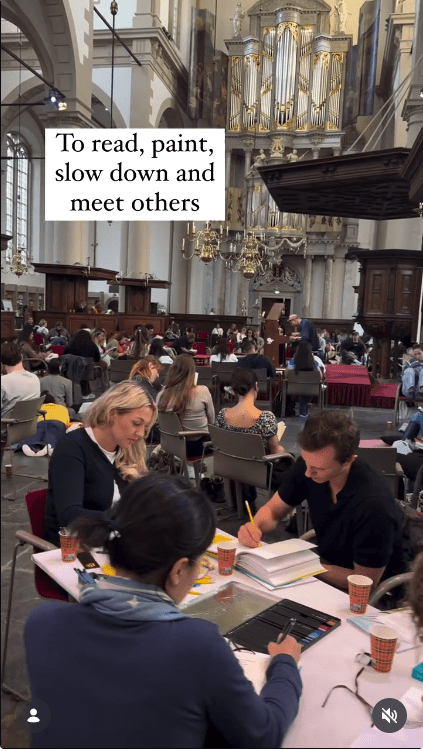
The club offers no-screen business retreats, ‘do-nothing retreats’, wellness retreats, and no-screen hangouts like the reel shows. The Offline Club states of its mission & intent:
“The Offline Club brings people together, offline. We host phone-free events and digital detox retreats where talking to strangers is the norm, being unreachable is cool, and life goes a little slower. It’s like going back to the 90s, when people still made eye contact and read books in cafes, when notifications didn’t interrupt conversations, and when burnout culture wasn’t a thing.“
This article described the offline club’s activity like this-
“Since the beginning of 2024, a Netherlands-based start-up called The Offline Club has been encouraging people to go offline at cafés at regularly occurring pop-up events. The rapidly growing project asks people to “swap screen time for real-time” at each of the offline-only meet-ups that they host. Instead of scrolling or working in the day’s chosen coffee shop, attendees drop their phones in lockboxes at the door and unplug for the duration of the meet-up. Event programming encourages attendees to alternate between chatting and connecting, then taking time to themselves to draw, read, embroider, do a crossword, or any other activity provided it doesn’t disturb others.“

In Boulder, Colorado, after the so-called pandemic restrictions were lifted, these coffee shop owners re-opened – minus WiFi. It is stated in this article,
“The co-owners’ choice not only created more available seating for customers throughout the day (since tables turned over quicker with fewer workers camping out on laptops), but it also allowed people to spend some time away from the devices that had dominated their lives for months on end during lockdowns. Customers have since appreciated the resulting atmosphere in the shop, where at times, there isn’t a single laptop inside. Instead, tables are filled with readers, journalers, and conversationalists.“
Starting 30 years ago, the world quickly grabbed onto digital lifestyles after their invention and emergence into the culture. But after three decades of increasing aggressiveness and oversaturation of the digital into our lives, attention-sucking technology, and diminished attention spans, people are fatigued. Worse, we seem to have reached a tipping point where the opportunity for our choice to use digital technology as a tool has turned us into the tool that digital technology now uses. There are increasing concerns, one is the aggressive spreading use of “flock cameras”, as this article describes-
“The cloud Automatic License Plate Reader (ALPR or LPR) company Flock is building a dangerous nationwide mass-surveillance infrastructure, as we have been pointing out for several years now. The problem with mass surveillance is that it always expands beyond the uses for which it is initially justified — and sure enough, Flock’s system is undergoing insidious expansion across multiple dimensions. … Flock sells their cloud-connected cameras to police departments and private customers across the nation, pulls the license plate readings they collect into their own servers, and allows police to do nationwide searches of the resulting database, giving even the smallest-town police chief access to an enormously powerful driver-surveillance tool.”
And now Ford Motors’ “AI Assistant” is causing major concerns and outcry. The AI technology Ford has developed has been patented and is aimed at installation in 2027 vehicles. Apparently, in-cabin cameras and sensors can scan irises, read faces, monitor heart rates, track facial expressions, and even “read lips” for AI to ‘check’ if a driver is fit to drive or to enhance voice commands. The in-vehicle AI can even ‘listen’ to conversations, all the better to present specific targeted ads, they say. If AI decides that the biometrics indicate a person is impaired, the car or truck will not shift our of park. It will decide not allow you to drive.
We have sadly discovered that though technology that has taken over our lives does have benefits, it also features unintended downsides. Overuse can bring on depression, FOMO, teen suicide, bullying, and government overreach in intruding into and tracking our movement, our lives, and our behavior.
With all that said, in Athens, GA near me, there is a Silent Book Club. Their About says, “Join us for independent reading in a cozy community setting. Adults of all ages are welcome. BYOBook!” They host meetups at various venues around Athens. It’s free but you need to sign up here because of space limitations.
From their site, here is an example of a silent reading get together at the Foxglove Plant Bar:
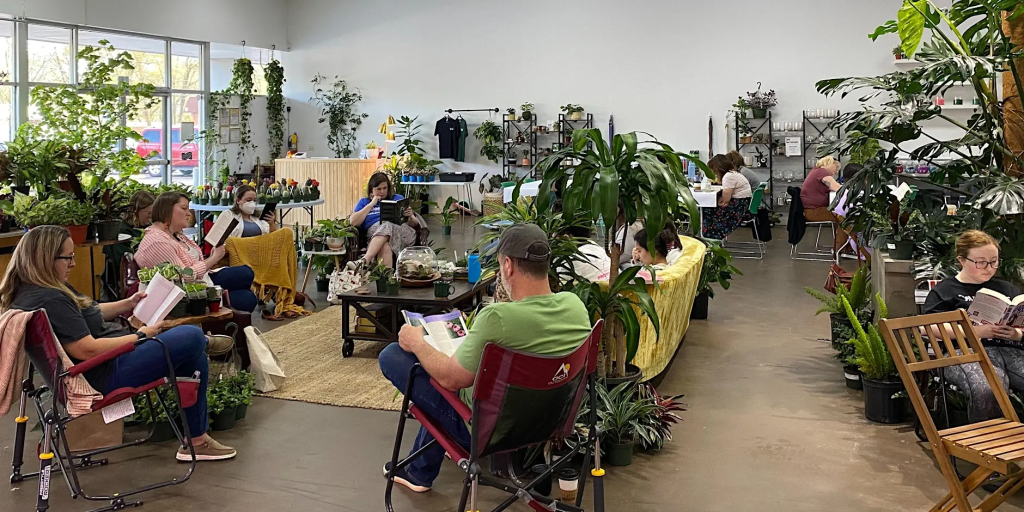
The club hosts get-togethers at various locations. There is a half hour to talk and get settled in, then a reading hour, then a half-hour to conclude and pack up.
I’ve enjoyed the digital life. I was a full adult when I got online. It is an aid that now I can’t remember how I lived without. But I am also skeptical of any tool that satan can and does use to his advantage. If you are becoming digitally fatigued, yearning for human connection in some form, your emotions or attitude being shaped by your personal technology, there are solutions. If you don’t know how to ratchet back on your tech use, try a silent book club.
These kind of bok clubs are numerous in Georgia. There are $5 State Park activities, crafting sessions, and hikes. The Botanical Garden in Athens is free. Libraries host many hands-on activities. So do senior centers. The Lyndon House Art center in Athens is free and they offer workshops.
If you are in Georgia and on Facebook, this lady at Main Street & Back Roads uncovers a TON of free or nearly free things to do within 3 hours of Atlanta as she presents them in her videos. https://www.facebook.com/mainstreetbackroads/reels/
In another example of how digital fatigue is being addressed in the culture, Marriott has bought out the cabins formerly known as Getaway and renamed them “Postcard Cabins.” These tiny, self-contained cabins are part of the Marriott Bonvoy Outdoor Collection, offering 29+ locations near major US cities for cozy, nature-focused escapes. Located two hours or less from major cities across the US, they are designed for a quiet escape into nature. SOme have wife but most cabins don’t. There is even a phone lockboxk you can store your phone in so you aren’t distracted by notifications and so on.
Since there is a rising tide of people (here at home and internationally) wanting a digital break, there are more and more options for you to begin to break away a bit from tech. You don’t have to detox alone, you can find some of these options and dip your toe in with others trying the same thing. “Detox” at your own pace, but it doesn’t have to be alone.
The concern here is for believers who read the Bible and other edifying material, especially younger believers who have grown up with a screen in front of him or her. Do we read long enough to comprehend? Do we focus on Bible reading while we are reading it? Are we absorbing it to the extent that we are refreshed by the word, or other interesting books and theological material? Two scientists did a big study on the impact of attention after use of digital screens. Their study is called The inattentive on-screen reading: Reading medium affects attention and reading comprehension under time pressure. The authors said-
Our results show that reading on screen lead to inattentive reading particularly when the task demands an increase in on-task attention for efficient information processing. We argue that this inattentive reading is causing, at least in part, a shallow information processing and lower comprehension.
Maybe occasional ‘digital detoxing’ is not such a bad idea!

 the-end-time.org
Thank you for sharing. Lots of information here.
LikeLike