Posted in prophecy, Uncategorized

Predestination means people are elected as vessels of wrath, too. Part 2

The verse to consider today is from Romans 9:21-24

Has the potter no right over the clay, to make out of the same lump one vessel for honorable use and another for dishonorable use? 22 What if God, desiring to show his wrath and to make known his power, has endured with much patience vessels of wrath prepared for destruction, 23 in order to make known the riches of his glory for vessels of mercy, which he has prepared beforehand for glory— 24 even us whom he has called, not from the Jews only but also from the Gentiles?

There are vessels of mercy, and there are vessels of wrath. Considering anything regarding God is weighty and should fill the saved and the non-saved with awe and humility. But to really consider His work of judgment should bring to mind the famous comment attributed to martyr John Bradford,”There but for the grace of God go I”.

Here is Scottish pastor Robert Murray M’Cheyne preaching on the Romans verse. In my opinion, it’s brilliant. I’ll post M’Cheyne’s point 3 tomorrow, Lord willing. Part 1 is hereM’Cheyne’s full sermon is here.

~~~~~~~~~~~~~~~~~~~~~
The Vessels of Wrath Fitted to Destruction

I come now to the second reason why any are left to perish–it is, that God may show his power. “What if God, willing to make his power known?” We are frequently told in the Bible of the power of God. He said to Abraham, “I am the Almighty God.” We are told in the ninety-third Psalm, that “the Lord on high is mightier than the noise of many waters; yea, than the mighty waves of the sea.” We are frequently told of his almighty power; and not only so, but we have brilliant examples of it.

The first upon record is creation. “God said, Let there be light: and there was light.” “He spake and it was done – he commanded and all things stood fast.”

Another example of the same thing is, the constant providence of God. “In him we live, and move, and have our being.” He rides on the swift wings of the wind.

Another example of the power of God is, his restraining and bridling of the wicked. “Be ye not as the horse, or as the mule, which have no understanding, whose mouth must be held in with the bit and bridle.” – Psalms 32:9. This is the way in which God holds the wicked.

Another way in which God makes his power known is, in the conversion of souls. “Not by might, nor by power, but by my Spirit, saith the Lord.” This is said to be “the wisdom of God and the power of God.” I believe the converting of a soul is something greater than the making of the world.

Brethren, there is one exhibition of divine power that yet remains – it is, the destruction of the wicked. “What if God, willing to shew his wrath, and to make his power known, endured with much longsuffering the vessels of wrath fitted to destruction?” I believe, dear friends, that the reason why God has raised up Pharaohs is to show his power in them. He said to Pharaoh, “For this cause have I raised thee up, that I might show my power in thee.” No, I say, in regard of those of you in this congregation who will die unsaved, that God has raised you up, to show his power in you. Thus, it is said in Isaiah 62, “I will tread them in mine anger, and trample them in my fury; and their blood shall be sprinkled upon my garments, and I will stain all my raiment.” And then in Revelation 18, “She shall be utterly burned with fire; for strong is the Lord God who judgeth her.” And we are told by our Lord in Matthew 10:28, to fear God, “who is able to destroy both soul and body in hell.” You will notice in this passage that he says, “God is able to destroy”; and therefore, brethren, it is plain that there must be some great power exercised in his destroying the wicked; and I think it is to consist in this – God will destroy their well-being, but not their being. Here, then, is another exhibition of the power of God.

When lately in the north of Scotland, I stood on the sea-shore, and saw the rocks standing out of the sea. It was very remarkable to stand and see the mighty waves dashing upon the rocks. There were two things remarkable in it: first, the greatness of the rocks on which the waves dashed: second, the rocks remaining unmoved – no force of the waves could move them. Brethren, this scene is an emblem of what will be witnessed another day, when God shall pour out his wrath on the wicked. Ah, brethren! will it not be fearful to see God put out his power upon the wicked – to see him upholding them with one hand, and pouring out his wrath upon them with the other? Surely, brethren, the power of God’s wrath is very great. If any of you have seen a great furnace, you will have seen the power that the fire has; but fire is God’s creature. What must his power be who is the Creator?
——————————–

Further Reading

Predestination means people are elected as vessels of wrath, too. Part 1
Predestination means people are elected as vessels of wrath, too, part 3

Jesus’ Predestined Life

Is Predestination biblical?

Posted in prophecy

Predestination means people are elected as vessels of wrath, too. Part 1

A few days ago I’d posted an essay about predestination. This is the doctrine where the Bible teaches that God is completely sovereign over everything that happens, including individual salvations. He elects people to salvation, independently and apart from foreknowledge of any decision they make. It’s all His grace, and not our decision.

People dislike that doctrine and fight against it. One of the reasons people resist the plain truth of the doctrine is that people want to think that somewhere in their heart or mind, they chose God. However, we are dead in sins and trespasses and have no ability to choose God, or ‘make a decision’ about our salvation. It is granted to us. (Galatians 3:22). We have no part in it, except the resulting gratitude and service in His name.

The verse to consider today is from Romans 9:21-24

Has the potter no right over the clay, to make out of the same lump one vessel for honorable use and another for dishonorable use? 22 What if God, desiring to show his wrath and to make known his power, has endured with much patience vessels of wrath prepared for destruction, 23 in order to make known the riches of his glory for vessels of mercy, which he has prepared beforehand for glory— 24 even us whom he has called, not from the Jews only but also from the Gentiles?

There are vessels of mercy, and there are vessels of wrath. Considering anything regarding God is weighty and should fill the saved and the non-saved with awe and humility. But to really consider His work of judgment should bring to mind the famous comment attributed to martyr John Bradford, “There but for the grace of God go I”.

Here is M’Cheyne preaching on the Romans verse. In my opinion, it’s brilliant. I post ed M’Cheyne’s point 2 here. I’ll post point 3 tomorrow and the next day, Lord willing. The full sermon is here.

~~~~~~~~~~~~~~~~~~~~~

The Vessels of Wrath Fitted to Destruction

The following sermon preached on the afternoon of March 12, 1843, was the author’s last in St. Peter’s. “It was observed, both then and on other occasions,” says Andrew Bonar, “that he spoke with peculiar strength upon the sovereignty of God.” The following evening McCheyne’s illness commenced and on Saturday, March 25, he went to the Saviour whose glory he lived to proclaim.
“What if God, willing to shew his wrath, and to make his power known, endured with much longsuffering the vessels of wrath fitted to destruction: and that he might make known the riches of his glory on the vessels of mercy, which he had afore prepared unto glory?” – Romans 9:22,23

In a former discourse, brethren, I attempted to show you that the reason why God will punish the wicked eternally is, because he loveth righteousness. It is said in the eleventh Psalm, “Upon the wicked He shall rain snares, fire, and brimstone, and an horrible tempest: this shall be the portion of their cup, for the righteous Lord loveth righteousness.” I then tried to show you, that God has created hell, and will maintain it for ever, not because He loves human pain – I believe it is not so, nor is it because He is subject to passion, as men speak of passion – but because the righteous Lord loveth righteousness.

And I showed you, as you will remember, what a certainty hell is to the wicked. If it had its origin in the love of human pain, then you might have hoped that it would have an end; or, if it proceeded from passionateness, then it might cool; but ah! when it proceeds from Jehovah’s love of righteousness, I see, brethren, in that a reason why “the worm dieth not, and the fire is not quenched.”

There is a second question which no doubt has occurred to you: why are there any left unpardoned at all? Why was Adam left to fall? Could God not have held him up? Or, if it was necessary that Adam should fall, in order that Christ might die, why are not all saved? Surely there is efficacy in the blood of Christ to pardon all – why, then, are not all saved? There are many answers to that question which we will know in a higher state of being; but here is one; “What if God, willing to show His wrath and to make His power known, endured with much longsuffering the vessels of wrath fitted to destruction: and that He might make known the riches of His glory on the vessels of mercy, which He had afore prepared unto glory?” You will notice, brethren, that in these words the apostle Paul tries to give an answer to that question. He does not answer it directly, he employs a “what if”.

Let us enter into this subject a little more deeply. There are three reasons set down here why men are allowed to perish.

I. The first is, that God was willing to show His wrath. These words are terrible. We are told frequently in the Bible of the wrath of God. It is not like human wrath: it is calm, settled – it consists principally in a regard to what is right. This is the wrath of God. We are told a great deal about it in the Bible. It is revealed against all sin. “For the wrath of God is revealed from heaven against all ungodliness and unrighteousness of men, who hold the truth in unrighteousness.” – Romans 1:18 Observe the word “all” – it is against all sin. Then Colossians 3:6, “For which things’ sake the wrath of God cometh on the children of disobedience.” We are told also, brethren, that this anger is constant. “God is angry with the wicked every day.” – Psalms 7:11. The bow of God’s justice is, as it were, already bent against the wicked, the arrow of God’s is already on the string against the wicked. And then we are told that His wrath is intolerable. In the Psalm which we were singing (Psalms 90:11), it is said, “Who knows the power of thy wrath?” And we are told in Revelation, “The great day of His wrath is come, and who shall be able to stand?”

But we learn more by example than even by these declarations. We have many examples of God’s wrath and its consequences. The first example we have is, his casting the angels out of heaven. We are told by Jude, “That the angels which kept not their first estate, He hath reserved in everlasting chains, under darkness, unto the judgment of the great day.” And we are told by Peter, “That God spared not the angels that sinned, but cast them down to hell, and delivered them into chains of darkness, to be reserved unto judgment.” Now, brethren, in several respects this was one of the greatest examples of divine wrath we have, for it seems to have happened in one day. One day these angels were in heaven – the next in hell. One day they were angels of light – the next fiends of darkness. And then this made it fearful, when the Lord left them no room for repentance. One thing the universe might have learned from this was, that God will certainly punish sin.

Another example of God’s punishing sin was not in heaven, but one earth, when He sent the deluge upon it. “God saw that the wickedness of man was great in the earth, and that every imagination of the thoughts of his heart was only evil continually. And it repented the Lord that He had made man on the earth, and it grieved Him at His heart. And the Lord said, I will destroy man, whom I have created, from the face of the earth.” And so it came to pass: “The flood came, and carried them all away;” and it has left traces on our world still, to show that God will not fail to punish sin.

Another example of divine vengeance was, when God destroyed Sodom. “Now, the men of Sodom were wicked, and sinners before the Lord exceedingly.” The cry of its wickedness went up to heaven, and God sent down two angels, to see if it was according to the cry that came up; and they found it even so; and, when they had taken out just Lot, God rained fire and brimstone upon the devoted city; and he has left traces of it there to this hour.

There was yet another exhibition of divine wrath on earth – it was the death of God’s dear Son. If ever there was a time when God could have said that he would forego his wrath it was surely this. It was this for two reasons. First, because the object of that wrath was dear to God. There never was on in the universe so dear to God as his Son. And another reason was, Christ had no sin of his own. Just as his robe was seamless, so was his soul sinless. Nay, brethren, that one act of his – laying down his life, was so glorious, as an exhibition of God’s justice, that the universe never saw its “marrow”. “Yet it pleased God to bruise him.” These words do not give the least shadow of his suffering from God on account of our sin. Brethren, if any thing in the world can show that God will punish sin, it was the death of his dear and sinless Son.

There is one exhibition of his wrath yet to come. Verse 22 – “What if God, willing to shew his wrath, and to make his power known, endured with much longsuffering the vessels of wrath fitted to destruction?” God is yet to destroy the souls that he has made–not the angels that fell, for he has done that already, when he cast them into hell, but the souls on which he has waited. There is to be a new exhibition of wrath that the world never saw the like of before. He is going to show what he will do to the despisers of his Son – to those who despise his gospel. it will be a new thing when “God will be revealed from heaven in flaming fire, taking vengeance on them that know him not, and that have not obeyed the gospel.” God waits to show his wrath. Ah, brethren! it will be fearful to feel it – it is fearful even to think of it. so I believe it will be with the wicked: they will be beacons, to show how God will punish sin.

~~~~~~~~~~~~~~~~~~~~~
Posted in Uncategorized

One day as a thousand years, a thousand years as a day

The reality of a faith-filled life is a beautiful thing. Jesus’ sweet intercessions, His providential care, the magnanimity of His salvation, the ongoing gratitude we feel during increased sanctification, are all wonderful buttresses to the daily grind we experience. It’s wonderful to have Him to focus upon as the object of our adoration and awe.

Just as pondering His love and kindness is an encouragement, His wrath and judgment are weighty topics that should be mulled over as well. The fact is, many human beings will populate the Lake of Fire for all eternity, a devastating thought if you really chew on it for a while.

I’ll be posting a three-part series on the verse from Romans 9:22 about the vessels of wrath prepared for destruction. I’d found a wonderful sermon from Robert Murray M’Cheyne, his last sermon in fact. He raised three important points about God’s electing people to be His ‘vessels of wrath prepared for destruction,’ and I intend to post them piecemeal over the next 3 days.

Meanwhile, I’ve been thinking about the reality of hell for the lost. One of the verses I studied today was this from 2 Peter 3:8.

But do not overlook this one fact, beloved, that with the Lord one day is as a thousand years, and a thousand years as one day. (2 Peter 3:8).

In context, Peter is assuring his readers that the Lord’s final plan regarding His return and the judgment WILL come to pass. God is not slack concerning His promise, Peter goes onto state. The point of the verse was to remind the audience that God is outside of time and in control of everything. We read a parallel to the time thing in Psalm 90:4,

For a thousand years in your sight
are but as yesterday when it is past,
or as a watch in the night

The Jamieson-Fausset-Brown Commentary explained the thousand year/day v. day/thousand year part of the 2 Peter verse.

No delay which occurs is long to God: as to a man of countless riches, a thousand guineas are as a single penny. God’s œonologe (eternal-ages measurer) differs wholly from man’s horologe (hour-glass). His gnomon (dial-pointer) shows all the hours at once in the greatest activity and in perfect repose. To Him the hours pass away, neither more slowly, nor more quickly, than befits His economy. There is nothing to make Him need either to hasten or delay the end. The words, “with the Lord” (Ps 90:4, “In Thy sight”), silence all man’s objections on the ground of his incapability of understanding this

When reading the J-F-B about the gnomon, œonologe, and horologe, I got pretty excited! More stuff to study. But for today’s thought, back to the beginning of thinking over the fate of the lost in the Lake of Fire for all eternity, it might be helpful to see the thousand year part of the verse this way. Though there is not a literal ‘day’ in heaven or in hell:

–Those who are with the Lord in heaven experience such post-life joy that a thousand years passes as one day.
–Those who are with the Lord in hell (He is not there but His wrath is), experience such post-life torment that one day is as a thousand years.

It is a sobering thought.

Posted in discernment, Uncategorized

Is the god of The Shack the God of heaven?

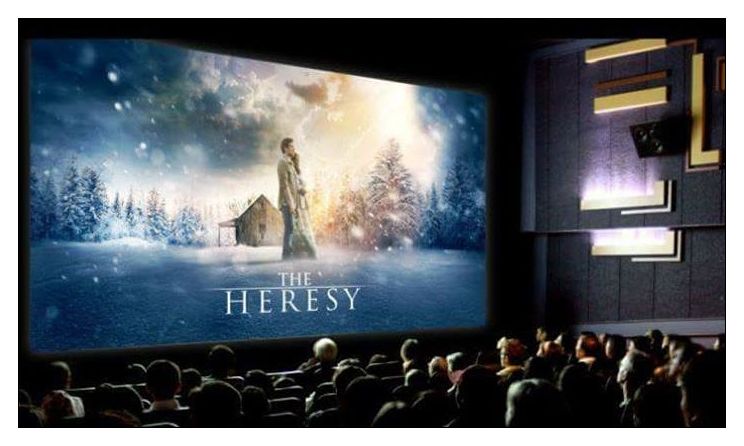
Almost ten years ago author William P. Young published what became a phenomenal success in the  publishing world, a book called The Shack. It has recently been made into a movie, which was released this past weekend.

I’ve written about The Shack’s theological issues and heresies before, and many other people have written against it as well. As a matter of fact, I was so upset about The Shack’s heresies and inroads in deluding my friends, that I write about it on my personal blog in 2008. It as that essay that started me thinking about creating a second blog to deal solely with theological issues, and a few months later I began my blog The End Time, which you are reading now.

I mulled over whether to post about The Shack, and had decided against it. There is already so much circulating about the movie that any Christian can easily find what they desire about the film, both supportive AND negative, more’s the pity.

But my friend Pastor James Bell of Gallatin TN wrote an essay and emailed it out, and I truly enjoyed his perspective. Pastor Bell isn’t a towering name in the evangelical world like Paul Washer. He’s not a preacher leading a famous church like John MacArthur. Nor is he President of a seminary like Dr Albert Mohler. He’s not someone of whom you have likely to have heard. He is a regular pastor who lovingly and consistently labors over his sheep in his section of the world, contending, encouraging, and sharing his wisdom and perspective via his pulpit and Facebook. He has been pastor at his church for 42 years, a feat I greatly admire the Holy Spirit for sustaining.

I’m going to re-post his piece because it’s wise and discerning and I wanted to give it an audience that might not otherwise be exposed to it. His piece is thorough because it’s a white paper, so it’s long. That’s OK. Just settle in and read it when you have time and no distractions.

So, Pastor Bell’s piece is below and then below that I post a link to my own essay about The Shack which also contains further links explaining why The Shack, book or movie, is not good food for the Christian, no matter how fervently a friend might gush that ‘it’s just so encouraging.’ The Shack is not encouraging. Really. It’s not. Please don’t convince yourself that The Shack is OK to read or watch because ‘it’s just fiction’. It’s not. Really it’s not.

——Pastor James Bell, Southside Baptist Church, Gallatin TN——

The Shack!  In January, 2008, I went to Amazon.com, and was immediately amazed at all the praise of the book from pastors, theologians, and teachers along with other folk.

From the many reviews, I was promised that this was a most exciting book, that I would not be able to put it down, that it would be life-changing, that it would be a great resource to help folk win over bitterness and anger, that it was a great story of forgiveness, that most of all it was a great story about the love of God— especially about actually experiencing the love of God and experiencing close fellowship with God.

Moreover, I was promised that I would learn much about the true nature of God. So, I immediately ordered, received, and read the entire ‘SHACK’ book.

Here is some of what I found.

William P. Young, who calls himself, Willie, writes an apparently fictitious story about a man named Mack who (as a child) was beaten with a belt and with Bible verses by a drunken father. He later graduates from Seminary, marries and has a family. He, Mack, is described as not very religious and occasionally showed up at the local ‘pew and pulpit Bible church’… But Mack is an angry man. He is angry at God and especially after one of his children is abducted and murdered. However, it is evident that Mack’s concepts of God, the Bible and the Church of Jesus Christ are very flawed.

It is indeed a real life tragedy that masses folk— the religious, the not so religious and even many genuine Christians— have serious false concepts about God, the Bible and the Church of Jesus Christ.  To solve this problem, Young’s book weaves an imaginary story to show how Mack was introduced to a very different god from the one he grew up hearing about.

However, now we are confronted with a new problem: The god Young creates for Mack is very different from true and living God revealed in Holy Scripture, who is quickened to believing hearts by the wonderful COMFORTER, the Holy Spirit.

Thus, The Shack is a very tragic book. As I read the book,

I went from being badly bored to being really sad.

Religious Fiction is a poor substitute for Biblical truth and also a poor substitute for truth teaching soundly grounded in and faithful to the pure revealed Word of God.

The Holy Spirit is the Spirit of Truth, He leads us into all truth; and it is the truth that sets us free.

The Shack is tragic because it is the story of a troubled man who clearly has a false concept of God, who is given yet another set of false concepts of God from the imagination of William Young.

Mack started with an idol and ends with a different idol. O, but many will protest—the story ends with Mack being forgiven and forgiving, set free and happy!

Yes, you can make fiction fit your desired conclusion.  And, indeed, in real life there are multitudes who FIND a false peace and a false freedom by means of various false gods and religions.

Bottom line: Here are a few of the troubling quotes from THE SHACK.

I will reference the page numbers:

1. Page 16, We learn that Mack literally receives a type written note from ‘Papa’ [God]… telling Mack, “Mackenzie, It’s been a while. I’ve missed you. I’ll be at the shack (the place where Mack’s daughter was killed) next weekend if you want to get together. – Papa

COMMENT: Nowhere in 248 pages does Mack ever receive any specific instruction or revelation from God through the written Word of God! Instead he receives this above note; plus massive amounts of imaginary communication, via visions, dreams or whatever.

Of course, the defenders will claim that the book is ‘based upon’ much Scripture! Yes, there are a few concepts here and there that ‘square with’ Scripture… But no one ever bothered to tell Mack!  For after all, Mack was enjoying a far superior way of God’s communication– God speaking in one’s mind and in visions and dreams.  This is nothing but deadly… a path where every man will lean upon his own understanding.

Page 65- Mack, “In seminary he had been taught that God had completely stopped having any overt [open, not hid] communication with moderns, preferring to have them only listen to and follow sacred Scripture, properly interpreted, of course. God’s voice had been reduced to paper and even that paper had to be moderated and deciphered by proper authorities and intellects.”

COMMENT: William Young (henceforth- WY) sets forth a bad situation and then offers his solution. I’m sure that there are religionists who are as he describes above. But that is not the Biblical model. Moreover, WY never offers the Biblical model as a solution, but rather he sets forth his own imagined solutions. This is true over and over in the book.

But also, if you take at face value the above statements— WY is SLAMMING the true nature and place of God’s Word. Indeed, he obviously does not hold to the absolute authority of God’s Word… for he does not set forth the revelation of God’s Word as solution for the problems Mack faces.

Mack is presented as needing to REALLY KNOW GOD and how to enter into a LIVING RELATIONSHIP with God, of how to understand the human problem of suffering, of how to deal with bitterness and anger, of how to have hope and joy.

The Holy Bible is FULL of amazing and manifold revelation of God! Manifold attributes of God are unfolded and HUNDREDS of names of God the Father, the Son and the Holy Spirit are given.

And the Holy Spirit, who BREATHED OUT the Sacred Scriptures, is now the believer’s DIVINE COMFORTER AND TEACHER… And IN CHRIST, our hearts are now HIS HOME… By the Holy Spirit, Almighty God makes His home in the believer’s heart. Indeed, the true Christian life is not religion but a living RELATIONSHIP.

The Bible is full of divine revelation as to suffering, as to depression and anger, bitterness, forgiveness, etc… and THE HOLY SPIRIT is ever present to personalize and apply the truth to hungry hearts.

But WY never tells Mack any of this. He never tells him that every real Christian is a believer-priest with the Holy Spirit, the MASTER TEACHER indwelling! WY never points Mack to any of the DIVINELY REVEALED NAMES OF GOD… and there are over 200 of them!

INSTEAD, WY pushes aside the pure and wonderful God-breathed Word of God in favor of his imagination. And thus, WY introduces Mack and all the rest of us to WY’s triune God!

1. God the Father is ‘Papa’… and he is a SHE— (page 82)-  Mack arrived at the shack, knocked on the door, “the door flew open, and he was looking directly into the face of a large beaming African-American woman.”… and her name (page 86) is… “You may call me Elousia.”  How interesting.  God in His God breathed book has given divine revelation of His name… In fact, He has revealed Himself by many names. ELOUSIA is not one of them! Yes, the word ‘ELOUSIA’ has historical connections with false gods and has a root meaning of ‘tenderness’…

Is there ‘tenderness’ with the LORD, GOD ALMIGHTY? Yes! But consider: Let’s say, that your name is ‘John Henry Jones’… but I refuse to call you by your name… I give you a name that I want to use! EVEN ON A HUMAN LEVEL, THAT WOULD BE ARROGANCE and disrespectful.

But in The Shack, the author is supposed to be revealing the true God. We are dealing with ALMIGHTY GOD, WHO has revealed himself in creation, in redemption and with a multitude of divinely sanctioned attributes and names.

And all of God’s names and attributes, given in sacred Scripture, REVEAL who God is and what He is like. WY rejects a ton of Biblical revelation and creates his Shack god that has the features and characteristics that WY wants and not more. Such is the way with all man-made idols.

2. God the Son, Jesus is called Jesus in the book; and the Holy Spirit is shown as an Asian woman (page 87) whose name is Sarayu. Once again, there are many glorious descriptions and names given the blessed Holy Spirit in the pure Word of God. Sarayu is not one of them. Again, much like Elousia, Sarayu has a background in manmade religion… and also means, ‘air or wind.’

BUT HERE IS WHAT WE HAVE:

WY says he wants to show us what God is like; and yet he REJECTS, ignores, counts as unworthy of consideration the God-breathed revelation of Scripture and substitutes with his own creations! This is astonishing. And the masses love him for it!

3. All throughout The Shack, WY sets forth a very humanized god– all in the name that we need a God that understands us, that loves us, that wants a relationship with us.

And WY’s ‘Papa’ god is not only a woman, but she is VISIBLE to Mack and she has the SAME WOUNDS on her body as Jesus… (Page 95)…”…and for the first time Mack noticed the scars in her wrists, like those he [Mack] now assumed Jesus also had on his. She allowed him to tenderly touch the scars, outlines of a deep piercing… tears were slowly making a way down her face…

COMMENT: There is a ‘theological’ name for this false teaching: From Wikipedia, the free encyclopedia. Patripassionism is a Christian heresy from the time of the early church. Its adherents believe that God the Father [Patri] was incarnate and suffered on the cross. This is problematic in the context of the doctrine of the Trinity because the Christian Scriptures record Jesus Christ as speaking to God the Father while he was on the cross.

Let me be plain: On the authority of God’s holy Word, there is not the slightest bit of truth in what WY is saying.

If one is writing a book about a mere human; and they take ‘literary liberties with a few of the facts and details… OK… it helped make a good story or a good movie… it was ‘based on fact’…. But not a true history lesson.

HOWEVER, in dealing with Almighty God— to deny and ignore His revelation and to create a god one likes and to set him forth as VISIBLE when He is not— SUCH is not literary liberty. It’s just not the truth.

4. And then… on page 96… When Jesus cried out, “My God, My God, why hast thou forsaken me?”….. WY’s god says, “Regardless of what he [Jesus] felt at that moment, I never left him.”

Wow! Now… who shall I believe— WY?  or Jesus?

I’ll stick with JESUS!

5. Page 119-120… Mack asks the Shack god woman—“Weren’t you always running about killing people in the Bible? You just don’t seem to fit the bill…. But if you are God, aren’t you the one spilling out great bowls of wrath and throwing people into a burning lake of fire?”

WY’s created god of his imagination says, “I am not who you think I am, Mackenzie. I don’t need to punish people for sin. Sin is its own punishment, devouring you from the inside. It’s not my purpose to punish it; it’s my joy to cure it.”

BE IT FROM Mack’s misconceptions about God’s righteous judgments… set forth in a way to slander the righteous character of the True God or in WY’s blatant denial of the holy wrath of God— IN BOTH CASES, horrifying man pleasing deceptions are set forth!

In a strange twist, WY has his papa/mama god saying, “Lies are one of the easiest places for survivors to run. It gives you a sense of safety, a place where you only have to depend on yourself. But it’s a dark place, isn’t it?” (page 187)

Such are the deceptions of the Shack book— The masses run to them. Man has always loved his own creations! Man loves a humanized god. He seeks to hide from the true God revealed in the Word of God and revealed in creation and revealed in the VISIBLE image of the invisible God, Jesus; and made real to human hearts by the indwelling Holy Spirit.  But in the end, such hiding only brings darkness!

6. Page 198-  “Mackenzie, religion is about having the right answers,…but I am about the process that takes you to the living answer and once you get to him, he will change you from the inside… You may see me in a piece of art, or music, or silence, or through people, or in Creation, or in your joy and sorrow… And you will hear me in the Bible in fresh ways. Just don’t look for rules and principles; look for relationship—a way of coming to be with us.”

As is often the case, the false and the true are mixed. Such is the case here.  By the way the reality is that you can be almost anyone from any background and love the Shack. Why? It has no clear revelation or solutions. Each man is left to his own subjective interpretations.

A false dichotomy: The informal fallacy of false dilemma involves a situation in which two alternative statements are held to be the only possible options, when in reality there exists one or more other options which have not been considered. The concept is also known as false choice, false dichotomy, falsified dilemma. WY once again sets up a false dichotomy: 1. On the one hand we have all of Mack’s false concepts about God, about the Bible and about church… 2. Then WY will produce his solution in some form of his subjective, humanized sweet all love god.

WHEN ALL THE WHILE,

1. Yes, Mack has some real problems… many folk do; and there are real, even major problems in the churches… In fact— A lot of what claims to be God’s church, according to the Word of God, is not! She is harlot. She is not bride. She is broad road to destruction…. With a multitude of options, ideas, and experiences.

2. But the REAL solution is not found in subjective imagination or humanistic creation. You see, the problem is not that the Bible and/or Biblical Christianity has been tried and found lacking. The sad reality for most… and certainly for Mack… BIBLICAL CHRISTIANITY and the true triune God had never been experienced.

From page 202, it is clear that Mack only had a ‘works’ concept of how to relate to God. He was a stranger to grace through faith in Jesus Christ.

WY IN 248 PAGES NEVER CLEARLY SETS FORTH THE BIBLICAL TRIUNE GOD NOR THE PROFOUND GOSPEL OF GOD’S AMAZING GRACE.

REALITY: God SPEAKS in and through the Bible, quickened to us by the Holy Spirit… and HE DOES NOT STUTTER!  God’s Word is not opinion; nor is it for us to simply read and give our opinion.  The Bible is the infallible written Word of God, quickened to us by the Holy Spirit.

In and through the Word of God, God speaks and THUS there are Sins to confess; Promises to claim; Attitudes to change; Commands to keep; Examples to follow; Prayers to pray; Errors to avoid and Truth to believe!

BUT FIRST OF ALL AND MOST OF ALL—The Word of God has been given to us that we might KNOW the God of the Word. Above all else the Bible is God-breathed revelation of GOD HIMSELF.

Closely tied into this, of course, is the God-breathed revelation of God having created man for fellowship with God, the revelation of man’s fall into sin and the glorious story of REDEMPTION… of fellowship and RELATIONSHIP restored through Jesus Christ the LAMB of God!

There are several good books dealing with the Divine Attributes of God, with lots of Scripture:
1. J. I. Packer– Knowing God.
2. A. W. Tozer– The Knowledge of the Holy.
3. A. W. Pink– The Attributes of God

———-end James Bell   /   http://www.southsidegallatin.org———
The End Time: The Shack: A discernment lesson. More links here

The Quiet Life: The Shack is a devilish deception. More links here

Posted in prophecy, Uncategorized

The second best moment in all the universe

But the day of the Lord will come like a thief, and then the heavens will pass away with a roar, and the heavenly bodies will be burned up and dissolved, and the earth and the works that are done on it will be exposed. Since all these things are thus to be dissolved, what sort of people ought you to be in lives of holiness and godliness, waiting for and hastening the coming of the day of God, because of which the heavens will be set on fire and dissolved, and the heavenly bodies will melt as they burn! But according to his promise we are waiting for new heavens and a new earth in which righteousness dwells. (2 Peter 3:10-13)

Waiting….waiting…

The best moment in all of the universe through all of time, of course, is when Jesus arose from the grave, victorious over death and sin and Hades. The second best moment in my opinion, will be the culmination of all things, when God puts an end to sin and refreshes the universe by scrubbing it from His presence forever. This will include destroying the old heavens and earth and making a new heavens and a new earth.

The end of this world is a good thing. Jesus will regenerate the earth, He will cleanse us from our sins by glorifying our bodies, He will heal us completely, He will resurrect the saved, He will restore the damaged children, He will appear to us in His full glory, and much more. Who wouldn’t wish for that?

We are blessed, yes, blessed to be watching the Lord of the Universe work visibly in the world. He gave us the Word, and He is allowing us to see His word alive, organic, living and breathing coming true before our eyes in His providence and in His people. He regenerates hearts and His children bear fruit before our eyes. He transforms lives and we watch it before our eyes. The cycle of seasons march through years, and we see His hand ordaining and sustaining it all.

His promises are true, and though no one likes to see hunger and pain and grief, but we do see through those hardships that His promises are true. His promises that trials will come also include all of the above as well- the glory and the justice concluded and the conclusion of His work in the Church Age.

And in addition, when the day comes for your death, or the rapture, you will say as Paul did, “For I am already being poured out like a drink offering, and the time for my departure is near. I have fought the good fight, I have finished the race, I have kept the faith.  (2 Timothy 4:6-7).

There is no shame in longing for His appearing!

Henceforth there is laid up for me the crown of righteousness, which the Lord, the righteous judge, will award to me on that day, and not only to me but also to all who have loved his appearing. (2 Timothy 4:8)

Do not be embarrassed at wishing for His will to be done! There is glory! His glory, made manifest in us who walk the earth doing His will, pointing to the only Hope!

We are waiting…waiting…

Posted in encouragement, Uncategorized

A note of encouragement: Don’t be discouraged by the Internet

I’m thankful for the internet. I leaped on that thing the minute it was invented! I’ve been an Amazon customer for 20 years. I’ve had the same email address for almost 20 years. Recently I was looking at my Flickr account, it’s ten years old. I have over 1500 photos there. I can’t believe so much time has passed. I’ve been blogging for ten years.  I started word processing  on a computer with Windows 3.1 in 1997. This was a big deal to a writer used to carbon, typewriter ribbon and whiteout.

I know we complain about how the internet is a vast wasteland, as Newton Minow famously said in 1961 of the then new technology of television. New technology always degrades because the unsaved human always degrades. But the opportunities today via the world wide web  to get the Gospel out, to hear long lost sermons, archived books like Pilgrim’s Progress on CCEL, is truly astonishing, says this lady who was an adult before the internet was invented.

I know that Social Media oftentimes is not social, especially if you have a conservative or evangelical point of view. Warning about false teachers, presenting the Gospel, sharing Bible verses makes people angry. If you need to limit your time on social media so as to stay encouraged, positive, and joyful, then do so.

But the technology itself is tremendously encouraging to me. I enjoy listening to music from a streaming local Christian radio station, or Pandora. I enjoy hearing sermons on RefNet.fm or Expositor.fm. I love reading the classics or getting access to posted dissertations, papers, and theological material otherwise I’d never see. Youtube’s plethora of clips and sermons is amazing, not to mention archives of long-gone but not forgotten preachers like Martyn Lloyd Jones, S. Lewis Johnson, James Montgomery Boice and Donald Grey Barnhouse… Never mind that last week was the annual Shepherds’ Conference sponsored by Grace Community Church, where 4500 pastors from around the world come to hear biblical preaching, enjoy fellowship, be encouraged, and be served- and it was live streamed and recorded for posterity.

The capacity for us to dwell on the negative is human. It’s always present. If you are having bad experiences online, it’s human nature to let those dominate your thinking and color your perspective. I use filters on Twitter to exclude certain words. I’m not shy about muting certain people. On Facebook, I use F.B. Purity, a free app that lets me exclude certain words, and arrange my wall to limit ads, crass headlines, and other things I don’t want to see. On my blog, I delete comments that tout false doctrine or are simply ad hominem- and I don’t think twice about it. If I say something that ticks someone off because of the Gospel, I reply once or maybe twice, and then end it there if the conversation isn’t going anywhere. I don’t fight. I don’t read sites that fight. I use social media to contend, but not to fight.

Use any and all means available to tailor what you need to tailor on social media so as to keep your sanity and your positive attitude.

But, don’t throw out the baby with the bathwater. Retain a wonder and a gratitude for this amazing vehicle called the world wide web. Use it to be an example of His kindness, and use it to promote His name and His gospel. 🙂 Jesus gave us His peace:

Peace I leave with you; my peace I give you. I do not give to you as the world gives. Do not let your hearts be troubled and do not be afraid. (John 14:27).

Posted in discernment, Uncategorized

Angels: Majestic messengers of God

Valentine’s Day has just passed, two weeks ago. All those chubby little Cupid cherubs flying around with stubby wings, shyly lobbing arrows to create ever more happy, lovestruck couples. Sigh. Cupid comes from Greek and Roman mythology.

The Renaissance Italians did a good job of presenting constant erroneous depictions of angels. Although initially slender, Cupid, the god of love, was increasingly shown as a chubby boy with wings. Wikipedia explains,

In classical mythology, Cupid (Latin Cupido, meaning “desire”) is the god of desire, erotic love, attraction and affection. He is often portrayed as the son of the love goddess Venus and the war god Mars. He is also known in Latin as Amor (“Love”). His Greek counterpart is Eros.

Beginning in the early 1400s, Donatello began the Renaissance revival of the Middle Ages’ depictions of the putto, Italian derivation of the word toddler or child. Soon, the myth of Cupid blended with the putti in art and you had infant angels flying all over the place in paintings, sculpture, and architecture. They became ubiquitous, so much so, that the biblical description of the majestic Cherubim were diminished in peoples’ minds down to the infantile antics by harmless flying cherubic toddlers. This is a peeve of mine.

The picture shows an architectural detail of the Old Sacristy
in the church of San Lorenzo in Florence, by Donatello, 1428-43.
The Rustic Banquet, detail of putti making music,
from the Sala di Amore e Psiche (1528)

The putti and the cherubs are as far from the truth of angelic activity and majesty as the east is from the west. So what roles do angels perform for God?First, the Bible tells us that there is a hierarchy of angels. There are thrones, and powers, and dominions.

The collection of holy (and sometimes unholy) angels is called the heavenly host, the word host in this context indicating an army. God is called the Lord of Hosts. (GotQuestions, See 1 Samuel 1:3; Psalm 24:10; Isaiah 22:14; Jeremiah 2:19; Amos 4:13; Haggai 2:9; Zechariah 8:6; and Malachi 2:16.We are more used to thinking of angels as ministering spirits, (Hebrews 1:14, Matthew 18:10), flying here and there at God’s command, delivering messages and helping people. (Daniel 9:20-21, Luke 1:26-27, Luke 2:10).

We see angels helping Jesus after His Temptation. (Matthew 4:11). We know that sometimes we entertain them unawares. (Hebrews 13:2).Though angels are servants of God, ministering, helping, watching, (Daniel 4:17) and messaging, they are in fact powerful soldiers, enacting God’s judgments. In Revelation we see the angels as extremely active in carrying out God’s judgments. We read of one event early in the Bible of this power angels have to slay many at the same time, in 2 Chronicles 32:21, where an angel of the LORD was sent to kill 185,000 Assyrian soldiers at once. Angels gave the LAW! (Acts 7:53, Galatians 3:19).

Why then the law? It was added because of transgressions, until the offspring should come to whom the promise had been made, and it was put in place through angels by an intermediary. (Galatians 3:19).

Barnes’ Notes says of the Galatians and Acts verses of the Angels giving the Law,

And it was ordained by angels – That is, the Law was ordained by angels. The word ordained here διαταγεὶς diatageis usually means to arrange; to dispose in order; and is commonly used with reference to the marshalling of an army. In regard to the sentiment here that the Law was ordained by angels, see the note at Acts 7:53. The Old Testament makes no mention of the presence of angels at the giving of the Law, but it was a common opinion among the Jews that the Law was given by the instrumentality of angels, and arranged by them; and Paul speaks in accordance with this opinion; compare Hebrews 2:2.

In Revelation, powerful angels stand on the sun, they hold back all 4 winds, they deliver the Gospel to the entire world at once…and this. Just this:

Then I looked, and behold, a white cloud, and seated on the cloud one like a son of man, with a golden crown on his head, and a sharp sickle in his hand. 15And another angel came out of the temple, calling with a loud voice to him who sat on the cloud, “Put in your sickle, and reap, for the hour to reap has come, for the harvest of the earth is fully ripe.” 16So he who sat on the cloud swung his sickle across the earth, and the earth was reaped.

17Then another angel came out of the temple in heaven, and he too had a sharp sickle. 18And another angel came out from the altar, the angel who has authority over the fire, and he called with a loud voice to the one who had the sharp sickle, “Put in your sickle and gather the clusters from the vine of the earth, for its grapes are ripe.” 19So the angel swung his sickle across the earth and gathered the grape harvest of the earth and threw it into the great winepress of the wrath of God. 20And the winepress was trodden outside the city, and blood flowed from the winepress, as high as a horse’s bridle, for 1,600 stadia.

God’s Providence is the understanding that God is in control of all things, and He commands and decrees all outcomes. Angels are important agents of providence, enacting God’s will so that His decrees come to pass in His will and timing.We do not worship angels. (Colossians 2:18, Revelation 22:8-9), but we do respect God’s creation. We respect His orderly fashioning of all things, including the angelic hosts in their spheres. Angels are not winged infants full of childish antics. They are majestic beings as part of God’s order who enact important tasks in worship and obedience for the LORD of Hosts.

~~~~~~~~~~~~~~~~

Further Reading

There is much on the internet about angels, most of it foolish and non-credible. Here are some good study resources about angels. The study of angels is called angelology. Always remember, no matter how interesting angels are, and when you begin studying them you’ll see how often they appear in the Bible, they are servants of the Most High just as we are. They are not to be worshiped or idolized.

Every reference to angels is incidental to some other topic. They are not treated in themselves. God’s revelation never aims at informing us regarding the nature of angels. When they are mentioned, it is always in order to inform us further about God, what he does, and how he does it. Since details about angels are not significant for that purpose, they tend to be omitted. Source: Millard J. Erickson, Christian Theology, Baker Book House, Grand Rapids, 1983, p. 434

Essay by Phil Johnson, Angels- Messengers and Ministers of God 

Sermon: Angelic Messengers, Revelation 14:6-11

Sermon: Good Angels, Martyn Lloyd-Jones, part of the Great Biblical Doctrines series

Who are the only named angels in the Bible?

Posted in encouragement, Uncategorized

Never forget what sinners we are, and what a Savior! (repost)

This was originally published on this blog in June 2014.

The actual wickedness of men’s lives bears a very small proportion to what is in their hearts. But when lust is inwardly cherished, it will break forth into outward sin. Those who tempt others to drunkenness never can be their real friends, and often design their ruin. Thus men execute the Divine vengeance on each other. Those are not only heated with sin, but hardened in sin, who continue to live without prayer, even when in trouble and distress.” ~Matthew Henry’s Commentary on Hosea 7:1-7

Gustav Kaser said of icebergs,

Think of an iceberg! Only about 1/7th rises above the surface of the water. The remaining 6/7ths are under water and not visible to the human eye. A human being is comparable to an iceberg.

The wickedness we see above the surface is only a small proportion to what is in our hearts…

Therefore, praise God that He sent His Son! Jesus lived a sinless life. He died shedding His blood for those appointed to salvation, and pleased with His Son, God raised Him to life on the third day. Now instead of staggering under the weight of all my sin, that which is seen and that which is unseen below the surface, Jesus sees it all, and He saved me anyway. Now I have His righteousness declared upon me by God. As long as I am in this sinful body breathing air on earth, I have been released from the power of sin via the Holy Spirit indwelling me. I have the glorification to look forward to, when I’m no longer even in the presence of sin.

I will greatly rejoice in the Lord; my soul shall exult in my God, for he has clothed me with the garments of salvation; he has covered me with the robe of righteousness, as a bridegroom decks himself like a priest with a beautiful headdress, and as a bride adorns herself with her jewels. (Isaiah 61:10)

Posted in encouragement, Uncategorized

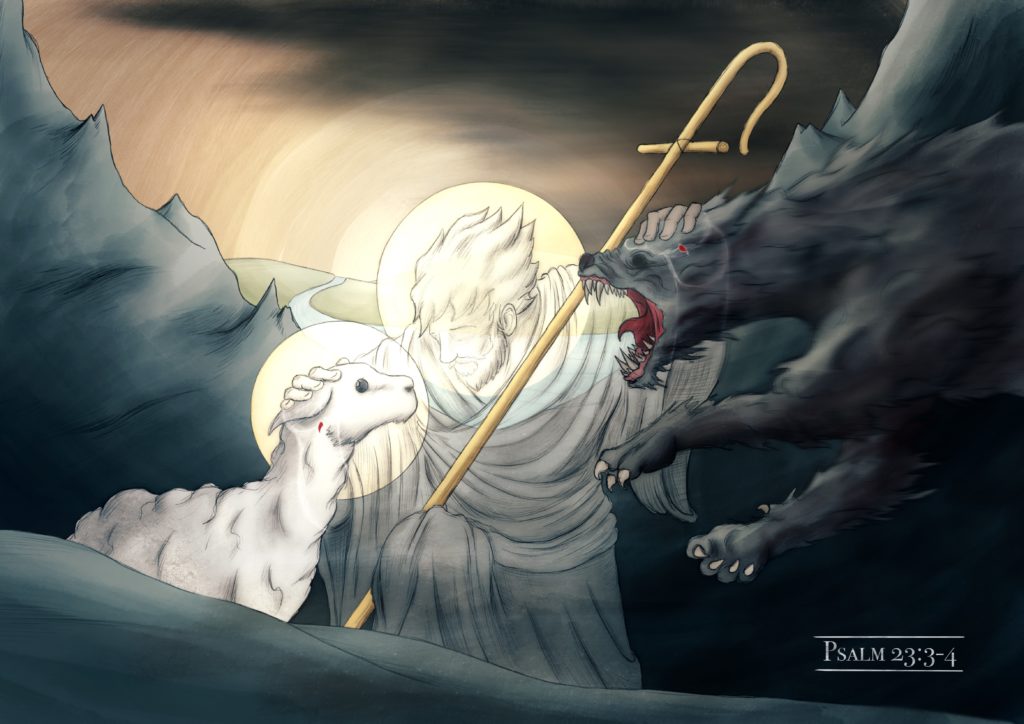
Visual Theology: He restores my soul

Chris Powers is creating visual resources for the global church. His resources are free and meant to be shared. Chris creates tract cards, visual exegesis that can be shared separately or through his book Visual Exegesis Vol. 1, study guides and lessons, animations, and more. Please visit his website at fullofeyes.com. He is also on Patreon, and you can donate to his ministry just once or on a recurring basis. He needs $2,000/month to be self-sustaining, and currently the level of giving is $1,947. Won’t you consider being the patron who puts him over the top?

Thank you for reading and if you’re led, sharing his work and/or giving.

Click to enlarge
He restores my soul. He leads me on paths of righteousness for His name’s sake.
Even though I walk through the valley of the shadow of death,
I will fear no evil, for you are with me; your rod and your staff, they comfort me.”
Psalm 23:3-4

Artist’s Explanation: By Chris Powers

I wanted this image to visually express the transition from the pastures into the valley that takes place between verses 2 and 4. The overall color scheme is much darker and the jagged edges of the valley frame the distant pastures in the background.

Verse 3 emphasizes the sovereign leading of the shepherd. It is he who guides and goes before His sheep. This is significant to note because in verse 4 we find ourselves in the Valley of the Shadow of Death. The implication is that the sheep is in the valley because the Shepherd has led him there. And—because the entrance into the valley of shadow is by the design of the Good Shepherd—I wanted to show that the sheep is no less in the almighty hand of his shepherd in verse 4 than he was in verses 1-3. In fact, the sheep’s intimacy and dependency upon the shepherd is only intensified by the valley.

In the pastures the shepherd’s presence and goodness were mediated by the grass and water, but in the valley the mediators have been removed and the shepherd himself has become the desperate and hope-filled focus of the lamb (“I will fear no evil for you are with me.”).

The attacking wolf represents the onset of the valley and its terrors (It need not be only death. The Hebrew word translated “shadow of death” can apply to various grievous and hard to bear sufferings that come as we live life in a fallen world. Sickness, loss, a season of doubt or darkness in the soul might all be categorized under this shadow). The shepherd’s hand on the wolf’s head is intentionally ambiguous. He could either crush the animal’s skull into the ground….or allow it to continue its trajectory toward the lamb. However—whatever the outcome— the hand on the wolf’s head declares the shepherd’s sovereignty over all that befalls his own (John 10:28, 21:19, 22).

The wounds of the shepherd visible behind the head of both the lamb and the wolf declare two different truths. The wound behind the head of the wolf reminds us that Christ’s death and resurrection has overcome all of His people’s enemies and that—should they be allowed to harm His beloved—it will only be to the enemy’s final downfall and His people’s exaltation (John 16:33, Philippians 1:28-29, 2 Thessalonians 1:5-8, Revelation 12:11).

The wound behind the lamb’s head is a reminder that our Lord and God and Shepherd Himself has suffered equivalent to and greater than any suffering He may ordain for us. The hand wounded in sovereign love authors our sorrows, and because He Himself is a slain yet living Lamb, He has infinite compassion on those whom He leads. The shepherd who laid down his life as a lamb is the one who goes before us (Isaiah 49:10, Micah 2:12-13, John 10:4, Hebrews 2:18, Revelation 7:17). And since he has led the way through suffering into glory, He has transformed all of our suffering into an avenue for deeper fellowship with Him, fuller joy in Him, and greater exaltation of Him (2 Corinthians 12:9, Philippians 3:10, 1 Peter 2:21).

Notice also that, if the wolf is to attack the lamb, it must pass the through the cross (represented in the staff). This is yet another reminder that the death and resurrection of our Good Shepherd has “de-fanged” the enemy. Because of Christ’s victory on Calvary, tribulation, distress, persecution, famine, nakedness, danger, sword—and whatever else might assail the people of God—cannot separate us from the love of God and, indeed, can only serve our ultimate good and His ultimate glory (Romans 8:28. 31-39).

Lastly for verse 4, I wanted to really emphasize the intimate fellowship with the Savior that often comes in the context of suffering (though it might not feel like it in the moment). First, notice that the lamb is intently focused on the shepherd and that the shepherd’s head is inclined toward the lamb. Though the wolf is slathering and raging, it is not the focus, rather, its onslaught has driven the sheep closer to the master. Second, the light of the two halos forms a sort of quiet, personal space—shared by the sheep and shepherd—amidst the darkness and motion in the rest of the image. And lastly, notice that the distant green pastures and still waters are visible through the face and torso of the Shepherd. The soul-restoring kindness of the shepherd, previously mediated through grass and water, is now accessed directly—and only—through communion with the Shepherd Himself.

In conclusion, I want to point back to verse 3. There we read that YHWH leads His people in paths of righteousness for His Name’s sake. There is much to say about that statement, but for this image the main thing I tried to emphasize is that the paths into which YHWH sovereignly leads His own are intended to make the goodness and beauty of His Name known to them and to those who observe their lives. This is true even (and especially) of those paths that lead through dark valleys because the Name of YHWH is most perfectly communicated in the death and resurrection of Christ, and when the Christ-follower is led through a time of hardship, the glory of Christ’s crucifixion and resurrection is—in a sense—echoed in their lives.

Christ’s love-borne death reverberates in His people’s sufferings as they entrust themselves humbly into the hand of God to do with them what He will for His glory (1 Peter 2:19-21). And the joy of Christ’s resurrection radiates from His Bride’s face as she endures hardship with hopes set, not on the things that are seen, but on the unseen, blood-bought, and resurrection-assured glory that is to come (2 Corinthians 4:14-18).

So, by making the practical implications of Christ’s death and resurrection visually apparent in this image, I am attempting to show that the valley experiences of God’s people bring the crucifixion and resurrection to the foreground and, consequently, glorify the name of our Shepherd and God who is climactically declared at the cross (Psalm 23:3, John 17:26).

Posted in discernment

To serve man

I used to watch the old anthology series from the 1950s and 60s called The Twilight Zone. Rod Serling used to intone a message at the beginning, and then there was doo-doo-doo-doo music, and the black and white episode would begin.

My favorite episodes were “Time Enough At Last“, “The Shelter” and “To Serve Man

About To Serve Man, I am going to SPOIL it for you. The episode is 55 years old but still has cultural (and moral) repercussions. Don’t read this if you don’t want to hear about the ending.

Wikipedia says,

“To Serve Man” is episode 89 of the anthology series originally airing on March 2, 1962 on CBS. The story is based on the 1950 short story “To Serve Man”, written by Damon Knight. The title is a play on the verb serve, which has a dual meaning of “to assist” and “to provide as a meal”. The episode is one of the few instances in the series wherein an actor breaks the fourth wall and addresses the viewing audience at the episode’s end.

Here is Wikipedia’s full synopsis of the episode:

The Kanamits, a race of 9-foot-tall aliens, land on Earth. One of them addresses the United Nations via telepathy, announcing that his race’s motive in coming to Earth is to aid humanity by sharing their advanced technology. After answering questions, the Kanamit departs and leaves a book in the Kanamit language without comment, which leads Michael Chambers, a US government cryptographer, to be pressed into service.

Initially wary of an alien race who came “quite uninvited”, international leaders begin to be persuaded of the Kanamits’ benevolence when their advanced technology puts an end to hunger, energy shortages, and nuclear proliferation. Trust in the Kanamits seems to be justified when Patty, a member of the cryptography staff led by Chambers, decodes the title of the Kanamit book: To Serve Man. The Kanamits submit to interrogation and polygraph, at the request of the UN delegates. When declaring their benevolent intentions, the polygraph indicates that the Kanamit is speaking the truth.

Soon, humans are volunteering for trips to the Kanamits’ home planet, which they describe as a paradise. Kanamits now have embassies in every major city on Earth. With the Cold War ended, the code-breaking staff has no real work to do, but Patty is still trying to work out the meaning of the text of To Serve Man.

The day arrives for Chambers’s excursion to the Kanamits’ planet. Just as he mounts the spaceship’s boarding stairs, Patty runs toward him in great agitation. While being held back by a Kanamit guard, Patty cries: “Mr. Chambers, don’t get on that ship! The rest of the book To Serve Man, it’s… it’s a cookbook!” Chambers tries to run back down the stairs, but a Kanamit blocks him, the stairs retract, and the ship lifts off.

Michael Chambers’s ship quarters are a cot in a spartan interior. A voice offers him a choice of dish at all the regular meal times. Each time he refuses food with increasing irritation. At last he says to the audience: “How about you? You still on Earth, or on the ship with me? Really doesn’t make very much difference, because sooner or later, all of us will be on the menu… all of us.” The episode closes as he gives in and breaks his hunger strike.

The episode was rated the best twist ending ever. It certainly has stuck in my memory.

The title To Serve Man is a play on the verb serve, which has a dual meaning of “to assist” and “to provide as a meal”.

We see what we want to see, based on our expectations, and previous experience. We usually connect the new to the known.

When satan comes along, he does not announce himself as a tiny man with horns in a red jumpsuit holding a pitchfork. He deceives. He deludes the unwary into thinking he is there to serve you. But satan actually is there to serve you.

Do not give dogs what is holy, and do not throw your pearls before pigs, lest they trample them underfoot and turn to attack you. (Matthew 7:6).

Be sober-minded; be watchful. Your adversary the devil prowls around like a roaring lion, seeking someone to devour. (1 Peter 5:8)

Beware of false prophets, who come to you in sheep’s clothing but inwardly are ravenous wolves. (Matthew 7:15).

Satan wants to serve you … up on a dinner plate.

But we are not unaware of satan’s schemes. (2 Corinthians 2:11)

For examples, false teachers begin softly, humbly. They seem kind and willing to serve the local or the global body. But false teachers are actually waiting for the moment to pounce. They patiently build up a loyal following, they insulate themselves, and they wait. They are wolves. Wolves are patient, the pack will track a caribou for days. See how wolves hunt:

A wolf pack may trail a herd of elk, caribou or other large prey for days before making its move. During this time, they are already hunting, assessing the herd, looking for an animal that displays any sign of weakness, and this is just the beginning. Wolves must also factor in other conditions that will affect the hunt; weather and terrain can tip the scales in favor of predator or prey. For example, a wide-open plain favors the ungulates, who, if full-grown and healthy, can outrun the fastest wolf. On the other hand, crusty snow or ice favors the wolves whose wide round paws have evolved to perform like snowshoes and carry them effortlessly over the surface. An experienced wolf is well aware that hoofed animals break through the crust and can become bogged down in deep snow.

Do not entertain false teachers. Do not coddle them, forgive them, allow them, make excuses for them…Titus 1:16 says,

They profess to know God, but they deny him by their works. They are detestable, disobedient, unfit for any good work.

Of that verse, John MacArthur preached:

The next time you see a false teacher, you might say, “You rebellious, empty-talking, deceitful, lying, evil beast, slow-bellied glutton.” And you would certainly be within the framework of Scripture. You might have to cope a little bit with 2 Timothy 2, verse 25, which says, “We are to rebuke them with gentleness.” So say it kindly.

Remember, false teachers and false Christians don’t want to serve you, even if their mouths profess it. They want to serve you … up to the wolves…lions…pigs. Satan’s book…it’s a cookbook.