Posted in blackaby, experiencing God, false prophets, henry blackaby, mysticism

Blackaby’s Experiencing God: if we’re to find out where God is at work and join Him there, then where is God NOT working?

I was a baby Christian when the church to which I belonged at the time fell under the hoopla regarding Henry Blackaby’s “Experiencing God” study (published in 1990). Even though the study had been produced and circulating for about many years already, it had taken a bit of a while to get to our small church in rural Georgia.

I remember the promises that were made by the people promoting the book/workbook/study. “It will change lives.” “It will transform the entire church”. “There is nothing like it.”

I like to study and I went along with the flow and participated in it with a small group. Perhaps I am a natural skeptic, but from the outset I was leery of anything that promised life change that was not the Bible. As the study concluded, I decided that it was not for me, there were parts I didn’t understand and it made no change in me at all. The parts I didn’t understand were not because the material was complicated or overly theological or in another language. Even the most difficult or demanding of material I’ve studied in the Bible eventually becomes clear through hard work, proper study, and prayer. The Spirit makes it clear.

All things in Scripture are not alike plain in themselves, nor alike clear unto all (2 Pet. 3:16); yet those things which are necessary to be known, believed, and observed for salvation, are so clearly propounded, and opened in some place of Scripture or other, that not only the learned, but the unlearned, in a due use of the ordinary means, may attain unto a sufficient understanding of them (Ps. 119:105, 130). (Westminster Confession of Faith 1.7)

Experiencing the Experiencing God study caused confusion in me, not clarity. It’s what always happens when something I’m studying goes away from the Bible. The Bible is always clear to me. When things are not based on the truths found in the bible, they are cloudy, unclear, murky, opaque. This is how, through discernment, I know what is edifying and what is not.

It’s been 9 years since I took the Experiencing God study. I have learned quite a lot since then, by the Grace of Jesus and the edifying work of the Holy Spirit. I know that Mr Blackaby and co-author Claude King will have a lot to answer for when they stand before Jesus. Mr Blackaby opened the door to mysticism, (aberrant orthodoxy) and he opened the door to an experiential method of getting to know God and living it. (aberrant orthopraxy). The credentials that he had, of being part of the North American Mission Board, the International Mission Board and LifeWay, opened the door to allowing and encouraging both extremely poor orthodoxy and poor orthopraxy in the most conservative denominations of the faith.

John MacArthur commented on this remarkable and rapid insinuation of the EG study’s main precepts into even conservative sections of the faith in his essay False Prophets and Lying Wonders,

Similar ideas [that God gives extra-biblical persona, revelation] have found sweeping acceptance even among non-charismatic Christians. Southern Baptists have eagerly devoured Experiencing God by Henry Blackaby and Claude King, which suggests that the main way the Holy Spirit leads believers is by speaking to them directly. According to Blackaby, when God gives an individual a message that pertains to the church, it should be shared with the whole body. As a result, extrabiblical “words from the Lord” are now commonplace even in some Southern Baptist circles.

I’m saddened that the Experiencing God study is not only still used, but is still a best seller. According to Amazon.com, Experiencing God is ranked #42 in Books > Christian Books & Bibles > Education > Adult. That is amazing for a religious book/study published in 1990, twenty-five years ago. Many people have reviewed the study and tested it against the Bible. I won’t go into lots of parsing today. I have just a few questions about the book/study.

First, here are a few links to reviewers that have examined the Experiencing God study and why it comes up short when tested against God’s word.

The main point of Experiencing God has been touted again and again as this:

“Experiencing God: Knowing and Doing the Will of God” has a simple -– but challenging -– message: Find out where God is at work and join Him there. (source)

Here is my first question. Where is God NOT working?

Anyone? Anyone?

Yet the Bible says,

But Jesus answered them, “My Father is working until now, and I am working.” (John 5:17)

The answer of course its that God is working everywhere.

If one digs beyond the motto of the study, there are 7 main points that the study brings up. None are bad on the surface. As a matter of fact, some are good. The trouble with this study is that it combines so much biblical truth with some lies that it makes it past the gate of all but the most discerning. Mixing biblical truth with doses of lies makes for a dense evangelical fog.

Here are the study’s 7 main points, which King and Blackaby call “7 realities”:
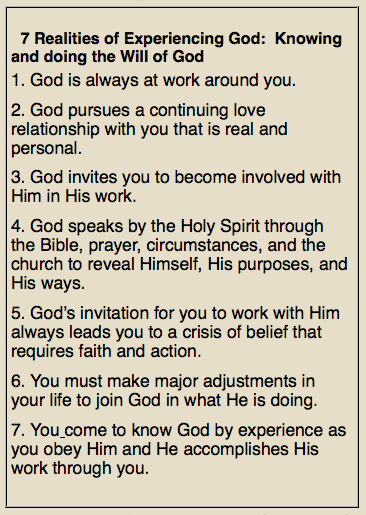
So, as number 1 says if God is always at work around us, why does the study always urge us to “Find out where God is at work and join Him there”. Why do we have to ‘find out’? Why do we have to go there to join Him? If I stay here, and don’t go there, am I in a dead zone, a spot where God is not working? Worse, do we obey God by using our visual senses to make a determination as to what God is doing in a particular place? What about the missionary who worked for years and had not one convert? Was God not working there? What happens when we ‘find out’ where God is working because it is a happenin’, exciting church, and then it plateaus, and we scoot off to another happenin’, exciting place, as Rick Warren says, surfing the experience? Have we not covenanted with the people we worship alongside? Do we just abandon them because we see a better prospect somewhere else?

Or is the seed that was planted and then watered by another dead in the ground … or was it simply waiting on God’s timing to grow it? (1 Corinthians 3:6). Do we wander off into where we “see God is working and join him there? Or there? Or how about over there?

Anyway, you can see the inconsistencies in the 7-point bullet list generated by Blackaby and King. Number 7 is particularly troublesome.

Not to mention the most personal experience of God of all. When we repent and believe, He sends the Spirit to dwell IN US. This is the most personal, intimate, wondrous experience on can have with God, His very self dwelling in us making our body His temple. What a poor substitute Blackaby offers, the temporal and fleeting experience of human experience to determine how to know God.

While some things that last are edifying (the Bible, The Valley of Vision, Pilgrim’s Progress), other things that seem like they are lasting (Experiencing God) are not edifying, and indeed, their popularity bespeaks this warning:

Woe to you, when all people speak well of you, for so their fathers did to the false prophets. (Luke 6:26).

Posted in abram, jerusalem, king, melchizedek, priest

Melchizedek: one of the Bible’s most mysterious characters

One of the most mysterious characters in the Bible is Melchizedek. There are only a few bare references, and what we do know according to the Biblical record, only makes us ask more questions than apparently God has granted answers.

  • What does it mean when we read Melchizedek has a priesthood that will last forever?
  • Why did God establish a priesthood superior to the Levitical priesthood, and is it a precursor to the priesthood of Jesus?
  • How did Abram know Melchizedek ?
  • Is the bread and wine that Melchizedek brings to Abram a precursor of the bread and wine ministration Jesus put into effect at the Last supper?
  • Why doesn’t Melchizedek have a genealogy?
  • Is Jesus Melchizedek in a pre-incarnation?

Sigh.

Anyway here is what we do know about Melchizedek.

His name means “King of Righteousness”: he was both king and priest of Salem, an early name for Jerusalem. Melchizedek blessed Abraham. Jesus Christ succeeded to this role and became a high priest in the order of Melchizedek. 

Melchizedek was both king and priest. As a king, Melchizedek entertained Abraham. (Genesis 14:18 See also Heb 7:1.) 

As a priest, Melchizedek blessed Abraham. (Genesis 14:18-19). 

Abraham acknowledged Melchizedek as a priest of the LORD. (Genesis 14:20,22). Melchizedek here points ahead to Jesus Christ, who is also priest and king. 

The status of Melchizedek 

David appropriates Melchizedek’s office and authority for himself and his descendants Ps 110:1-2,4 The word “order” here means “in succession to”, meaning that Christ assumes the status and function of Melchizedek. 

The Davidic Messiah (Christ) inherits the office of Melchizedek. Jesus Christ was at that time being acclaimed as the “Son of David” and by implication here claims to be the Messiah. 

Jesus Christ as high priest after the order of Melchizedek
Heb 5:8-10; 6:19-20 Only the high priest could sacrifice for the sins of the nation in the inner sanctuary behind the curtain. 

The characteristics of the order of Melchizedek according to Hebrews 7:2-3,
Melchizedek’s order of priesthood was one of kingship, peace and righteousness; it did not depend on genealogical descent (unlike the Levitical priesthood); it is eternal, without known beginning or end. (See also Psalm 110:4; Hebrews 5:6; 6:20; 7:21). 

The uniqueness of Jesus Christ’s high priesthood in the order of Melchizedek Heb 7:6-7 Melchizedek was superior to Abraham and therefore to the Levitical priesthood descended from Abraham; Ps 110:4 The priesthood is secured by God’s oath. See also Heb 6:17-20; 7:16,20-22,26-27; 8:1-2. 

Jesus Christ’s high priesthood makes the Levitical priesthood obsolete Heb 8:13 See also Heb 7:11,18-19; 8:7-13

Source: Manser, M. H. (2009). Dictionary of Bible Themes: The Accessible and Comprehensive Tool for Topical Studies. London: Martin Manser.

Melchizedek in the Old Testament

Genesis 14. Melchizedek first appears after Abram’s victory over Chedorlaomer (Gen 14:1–12). The king of Sodom and Melchizedek, “king of Salem” and “priest of God Most High” (Gen 14:18 ESV), approaches the victorious patriarch. Melchizedek shows hospitality to Abram and pronounces a poetic blessing upon him. Abram responds by giving him a 10th of his spoils (Gen 14:18–20). 

Genesis provides no additional details about the identity of Melchizedek and doesn’t explain how a Canaanite city-king came to be a priest of God Most High. Further, Melchizedek does not appear in any genealogy. 

McKeown focuses on the function of Melchizedek within the narrative, drawing on the contrasting parallels between the kings of Salem and Sodom. Both kings approach Abram after the battle, but only Melchizedek comes bearing gifts. The first words of the priest-king form a poetic blessing, while the king of Sodom issues a command: “Give me the persons” (Gen 14:21 ESV). Within the broader context of Genesis, Melchizedek reminds the reader that Abram has been blessed by God. The character turns Abram’s victory into “a sign of God’s ability to deliver on the promises that he has made” (McKeown, Genesis, 88). 

Psalm 110. Melchizedek’s only other Old Testament appearance is in Psa 110, a psalm addressed to the king of God’s people. In it, the LORD promises to bring victory in battle and to establish the king as “a priest forever after the order of Melchizedek” (Psa 110:4 ESV). The psalmist then declares that God will stand at the right hand of the king, using him to bring judgment upon the nations (Psa 110:5–6). 

This eschatological reading of Psa 110 piqued the curiosity of Jews and later Christians, especially in regard to Melchizedek. Hughes illustrates: “Psalm 110 declared that God was going to do something new by bringing into history a priest-king like Melchizedek. His priesthood would last ‘forever.’ He would be appointed directly by God. A divine oath guaranteed it: ‘The Lord has sworn and will not change his mind.’ What an intriguing prophecy. God was going to establish a totally new priesthood” (Genesis, 215).

The New Testament. 

The first reference to Melchizedek in the New Testament is a quotation of Psa 110:4 found in Heb 5:6. The writer quotes the passage to affirm that Christ was appointed as heavenly high priest: “And being made perfect, [Christ] became the source of eternal salvation to all who obey him, being designated by God a high priest after the order of Melchizedek” (Heb 5:9–10 ESV). Hebrews 7, a commentary on the Old Testament appearances of Melchizedek, elaborates on this teaching. 

The author of Hebrews then turns to Psa 110, citing God’s promise to appoint a priest “after the order of Melchizedek” as indication of the Levitical priesthood’s imperfection (Heb 7:11 ESV). Christ fulfills the eschatological hope of the psalm not by meeting the legal requirement of descent, but by the eternal quality of His life (Heb 7:13–17). He is a superior high priest, bringing a new covenant which grants salvation to all who believe (7:18–25). 

Melchizedek provides Christians with a template for understanding the heavenly priesthood of Christ. This challenges our attempts to substitute human mediators for the divine, revealing a high priest whose saving work cannot be confined to any one culture or bloodline (Thompson, Hebrews, 164). 

Brockway, D. (2012, 2013, 2014, 2015). Melchizedek. In J. D. Barry, D. Bomar, D. R. Brown, R. Klippenstein, D. Mangum, C. Sinclair Wolcott, … W. Widder (Eds.), The Lexham Bible Dictionary. Bellingham, WA: Lexham Press.

Melchizedek blesses Abram

‎Abram’s remarkable victory made him a hero in the land wherein he dwelt. His return from the battle field of Dan was a triumphal march. The king of Sodom came to thank him and bade him keep the grain and treasures which he had regained; but Abram returned everything to the Sodomites, “Save only that which the young men have eaten, and the portion of the men which went with me,” his allies. 

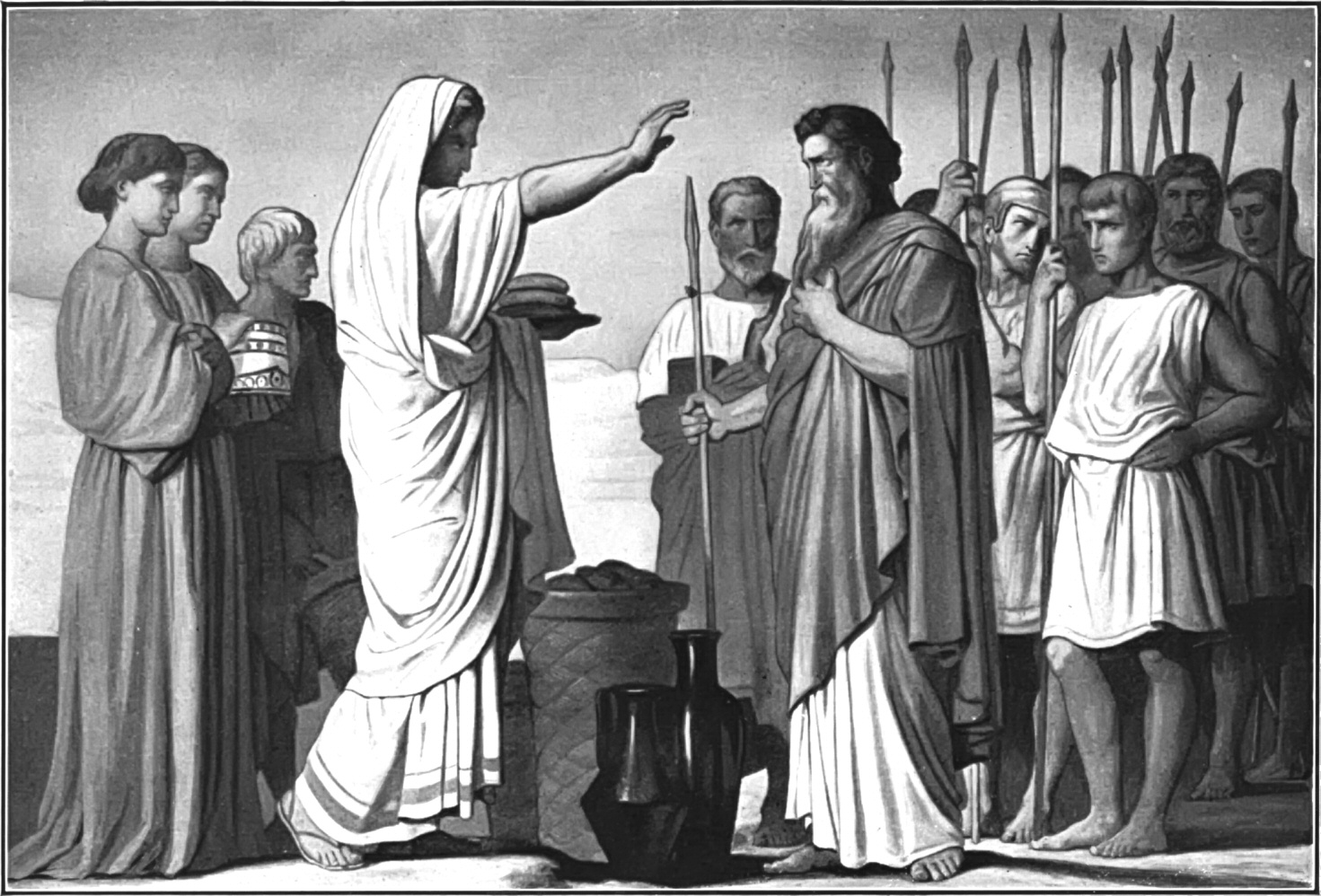
‎Here also occurred that mysterious meeting with Melchizedek, king of Salem, of whom the Bible says, “he was the priest of the most high God.” It would seem, therefore, that God was still worshipped by some people of Canaan. Melchizedek, His minister, came forth from Salem, which may have been Jerusalem; and he bore bread and wine to Abram. The priest king blessed the victor, and Abram gave him a part of all the spoils. Then they separated, apparently forever, two mighty servants of the Lord, who had recognized each other for a moment in passing, and then gone each his way.

When we get to heaven, won’t it be wonderful to seek these answers from the people themselves? If the LORD permits, that is. On the other hand, perhaps some of these questions we find so burning today will wither under the glory of truth shining from the from the face of Jesus. In any case, it will be humbling and thrilling to worship El Elyon alongside such a mighty and worthy king as Melchizedek, whose very name means “Righteousness.”

————————————

Further Reading:

The Priesthood of Melchizedek

Bible Q&A: Who was Melchizedek?

Posted in discernment, gentle speech, rebuke

Gentle speech, curses and rebukes

EPrata photo

The Christian life is one of constant awareness. We are constantly aware that we are bought with a price, and that we we all to Him. Jesus has standards for His ransomed people in which He wants us to live. And because He is our Beloved King, we strive to follow His standards.

Sometimes it’s hard to know what to do when. We pray for everyone unceasingly (1 Thessalonians 5:17)…until we are told not to pray for such a one anymore. (1 John 5:16).

We must share the Gospel with all people (Matthew 28:19) … until we are to shake the dust off our feet (Mark 6:11)…and not give pearls to swine (Matthew 7:6).

I’m not saying the Christian life has contradictions, but I am saying that God knows best in situations what to do and we must stay repented up, prayed up, and studied up in order to discern what His will is when encountering situations that we find ourselves in.

Another situation that demands discernment is our speech. The Bible says a lot about our speech. It is supposed to be patient, gentle, and filled with love. And yet sometimes we read in the Bible that the Apostles were sharp, insulting, and berating.

Here are two essays which speak to the two different ways we’re called upon to speak His wisdom and truths.

Love is how we speak truth, not how we avoid it.

Anyone who spends any time at all in the Bible will soon realize there is a continuous emphasis placed on actively loving one another (i.e.: Leviticus 19:18, John 15:12, Romans 13:8-10, Galatians 5:14, James 2:8, 1 John 4:21), even those who qualify as enemies (Matthew 5:44). First Corinthians 16:14 tells us to “do everything in love.” But many people struggle with this all-encompassing directive especially when they find themselves facing the difficult task of confronting sin in a family member or co-worker. Inevitable questions arise like, “Is it even possible to lovingly rebuke someone?” and if it is, “Does lovingly rebuking sin in someone else mean that we cannot be direct and forthright with the person we are confronting?” As Christians, do we have to sugarcoat what we say to others in order to fulfill God’s command to love them?

And yet there seems to be times when it is necessary to use sharp, cutting language.

Surprised by Scripture: Love and Spirit-inspired insults

Our expectation of the Spirit-filled person is that they would sincerely love people; that they would be manifestly gentle; that they would speak with kindness and patience in all circumstances. And those are good, biblical expectations. But the book of Acts shows us the Spirit-filled life is full of surprises. … Here’s where our expectations about the Spirit-filled life get upended:

But Saul, who was also called Paul, filled with the Holy Spirit, looked intently at him and said, “You son of the devil, you enemy of all righteousness, full of all deceit and villainy, will you not stop making crooked the straight paths of the Lord?” (Acts 13:9–10)

…This doesn’t sound like what we would call kind or civil or gentle. These are biting words, pointed words, sharp words directed at a particular person. In this case, the fruit of the Spirit is name-calling, insults, and harsh words. In this case, Spirit-prompted boldness means not mincing words about the wickedness of this magician. When Spirit-Inspired Insults Are Necessary:

Read both essays to see the bookends of speech we are expected to think about when we are confronting a person in sin. These things are not contradictory, and they are not for all Christians all the time. Some people, usually leaders, can and do make Spirit-inspired insults…and yet sometimes the pointed confrontation is necessary to employ against the sinning one, even to the extent they are ushered from the church under discipline and handed over to satan. (1 Corinthians 5:5).

The idea is that we are always striving to walk in the center line of His ways, constantly seeking Him to determine the proper course of action in any given situation, so that His name is glorified.

Posted in bible, God, god's word

Where is wisdom?

EPrata photo

Some look for wisdom in philosophy. But God’s word says philosophy is empty.

See to it that no one takes you captive by philosophy and empty deceit, according to human tradition, according to the elemental spirits of the world, and not according to Christ. (Colossians 2:8)

Some look for wisdom in psychology. But God’s word says psychology is empty. Solomon said the wise dies just like the fool! (Ecclesiastes 2:16b). Man’s wisdom is vanity. God’s word is sufficient.

Scripture is inspired by God and profitable for teaching, for reproof, for correction, for training in righteousness; so that the man of God may be adequate, equipped for every good work. (2 Timothy 3:16-17)

Some look for wisdom in the heart. But the heart is deceitful above all things, and desperately sick; who can understand it? (Jeremiah 17:9)

Some look for wisdom in the world. But God says the world is in the hand of the evil one.
We know that we are from God, and the whole world lies in the power of the evil one. (1 John 5:19)

It is only God’s word where we can find the knowledge we need for living in a way that pleases Him. David was declared by God to be a man after His own heart. One reason is that David relied on His word, reveled in His word, and walked in His word. See all the ways David describes God’s word:

Blessed are those whose way is blameless,
who walk in the law of the LORD!
Blessed are those who keep his testimonies,
who seek him with their whole heart,
who also do no wrong,
but walk in his ways!
You have commanded your precepts
to be kept diligently.
Oh that my ways may be steadfast
in keeping your statutes!
Then I shall not be put to shame,
having my eyes fixed on all your commandments.
I will praise you with an upright heart,
when I learn your righteous rules.
I will keep your statutes;
do not utterly forsake me! (Psalm 119:1-8)

The Hebrew meaning of each of these different ways David described his delight in God’s word:

way: road, distance, journey, (bespeaks a journey from justification to glorification, not just one instance of obedience)
testimonies: spoken word (bespeaks the legal aspect of the LORD’s commands for His people)
precepts: A mandate of God; collectively when plural, for the Law, commandment (bespeaks His authority and our obedience)
statutes: something prescribed or owed, a statute, limit or boundary (bespeaks do not go beyond but stay within)
commandments: obligation, terms. (commandments are not suggestions)
rules: ordinance promulgated by, law of Kings (bespeaks the origin of the Law)

Do you read your Bible every day? Are you a woman after God’s heart? A man after God’s heart?

Where is wisdom? In God and His word.

Posted in elmer gantry, lists, movies, sermons

List-o-mania: best books, journalists, movies, sermons, and cancelled tv shows

EPrata photo

From I Die Daily (IDD)

This person did a yeoman’s job, but a pleasant and edifying one, listening to over 650 MacArthur sermons in order to make his determination.

TOP 13 JOHN MACARTHUR SERMONS OF ALL TIME

A friend asked me to tell him the best MacArthur sermons of all time, and since it took me a while to put it together, I figure I’ll share with everyone! I have listened to over 650 different MacArthur sermons, and these are “the best” imho.
“The best” depends on what you want to know. For instance, for doctrine there are essential sermons on regeneration, absolute inability, Scripture, premillennialism, perseverance of the saints, saving faith, atonement, salvation assurance, inspiration, repentance, election, effectual call, deliverance, … you name it. Those are CORE and all very, very nice. 

But if you’re looking for the rare-jewels, the KABOOM sermons that you gotta dig out and find through long hours of listening…if you wanna know the sermons that I particularly hold dear… well, I can only hope they also trigger something within you as well! Here they are…

IDD made his list in 2013 but I’d add several recent ones to it, plus my own older favorites.

The first two sermons were a response to cultural goings-on during the US Election cycle in 2012. These sermons made a deep impression on me. It was by then obvious that God was rendering wrath on this nation in terms of lifting His hand and allowing sin to flood in unrestrained.

Abortion and the Campaign for Immorality

Homosexuality and the Campaign for Immorality

These next two are similar tot he above. They were delivered this summer 2015 and the first was a going-away address MacArthur preached in advance of his long summer vacation. He provided his flock with a biblical template for dealing with whatever events occur while he was away. The events that did unfold were shocking and upsetting in the extreme, giving his going-away address an almost prescient or prophetic aura. The Supreme Court decided that homosexuals in all the land have a right to marry, there were shootings on military bases, churches, and movie theaters, and the Planned Parenthood videos were released.

Hope for a Doomed Nation

As a result, when MacArthur returned from vacation, he preached this sermon, which has become a battlecry:

We Will Not Bow

My personal favorite sermons are from a series preached in 1999, a Creation Series from Genesis 1. These sermons astounded and thrilled me. They also made me love the Creator all the more. This first sermon in the series has a code of 90-208 and the series continues with sermon code 90-209 through to 221.

Creation: Believe it or Not Part 1

Tony Reinke lists the The 50 Best Books of 2015 (So Far)

2015 is 60% over, and that means all the books for the year have either been released or announced. In the summer months I begin to compile a rough list of about 50 of the potentially best Christian (non-fiction) books of the year into a list that I will use to pick my top choices in November.

On his list are the solid authors from whom we have come to expect good scholarship, Mark Dever, Iain Murray, Os Guinness, Donald Whitney, Douglas Moo, etc. Check it out.

Of my own favorite books, I strongly recommend:

John MacArthur’s ESV Study Bible,
Pilgrim’s Progress,
Valley Of Vision: A Collection of Puritan Prayers.

Every Christian should have those on their shelves.

I also recommend John MacArthur’s Because the Time is Near, (exposition of Revelation) and Elmer Gantry by Sinclair Lewis, a fictional and devastating portrayal of hypocrisy and opportunism among the Evangelical clergy of the early 20th Century.

Journalists

Oy, what can we say about the state of the media. In America where I live, it is deplorable, no other word can describe what passes for alerting and educating the American public tot he news and events of the day. It’s biased, sloppy, inaccurate, and on broadcasts, loud. All sturm and no drang. With the opening of the US election cycle for voting in November 2016, it’s more important than ever to find media one can trust. Twitter helps here.

I trust Steve Herman, @W7VOA Voice Of America correspondent in Asia, where he has lived for 25 years.

I enjoy Jake Tapper, @jaketapper, CNN Anchor and Chief Washington Correspondent.

Uh, that’s it.

List of most under-appreciated/underrated ‘Christian’ movies. It’s from Relevant Magazine and I have not seen any of these except End of the Spear, which I already recommended in another blog essay movie review. Take note that oftentimes when a magazine recommends a Christian movie it also includes Catholic movies as part of faith, and this list is no exception. There is one immediately identifiable Catholic film, a documentary about monks in the French Alps. Anyway, several of these look intriguing, especially Believe Me, which reminds me of the book Elmer Gantry.

I’ll list them here but the link contains synopses plus trailers.

8 Underrated ‘Christian Movies

Believe Me
Amazing Grace
Blue Like Jazz
Into Great Silence
The Mission
Linsanity
End of the Spear
Book of Eli

List of best shows ever (in my opinion) that were cancelled after one season. This list burns my bacon every time I look at it.

Terriers
Firefly
Hope Island
Enlisted
The Finder
The Cafe (two seasons, but being British, the seasons were short)

OK this is all I can manage today. I threw out my back somehow and it hurts to sit for to long. Till next time!

Posted in enoch, prophecy

Re-post: The enduring comfort of prophecy

I posted this one year ago.
——————————————

God said in Genesis 3:15, “I will put enmity between you and the woman, and between your offspring and her offspring; he shall bruise your head, and you shall bruise his heel.”

Adam in Genesis 3:20, “…named his wife Eve, because she would become the mother of all the living. (NIV)

Jesus tells us things in advance for many reasons. (to foretell). One reason is so that we may be on guard, be warned. (Matthew 24:25). Another is to show His holiness at judgment. (Ezekiel 2:5).

“Eye of God” Helix nebula, source Hubble Telescope

Prophetic declarations of future events also serve to comfort. Adam seemed to be comforted by God’s promise of a future redeemer. Perhaps Adam wondered as they faced God, if He would smite them on the spot. Instead, Adam clung to the knowledge that there would be offspring. Adam was so trusting in God’s word that Adam named his wife Eve, “because she would be the mother of all the living”. Bearing a son was still in the future, (Genesis 4:1), so Adam took comfort in God’s forthtelling, clung to His word, and took action because of it it.

We don’t have new prophecies today that forthtell new information because the canon is closed, but we still are built up when a person reiterates them and preaches truth, which is today’s prophesying. Prophesying includes referring to prophecies, as well as the bible’s poetry, truths, doctrines, and history.

On the other hand, the one who prophesies speaks to people for their upbuilding and encouragement and consolation. (1 Corinthians 14:3). In this case prophesying means forthtelling.

Helix Nebula a different view, NASA

God told the first prophecy in the bible, in Genesis 3:15. Adam re-iterated that prophesy in Genesis 3:20. But who was the bible’s first human prophet? Enoch.

Enoch was the 7th person born from Adam.

Genealogy from Adam, Adam, Seth, Enosh, Kenan, Mahalalel, Jared, Enoch, Methuselah, Lamech, Noah, Shem, Ham and Japheth. (1 Chronicles 1:1-4)

Enoch lived prior to the Flood. At the Institute for Creation Research, Dr. John Morris writes,

One of the favorite characters in the Old Testament is Methuselah, who lived 969 years (Genesis 5:27), longer than anyone else recorded. His father was Enoch, of whom it is said he “walked with God” (5:24) but who was taken to heaven without dying at 365 years. Methuselah’s son Lamech died a few years before the Flood at 777 years (5:31) after bearing Noah.

When Methuselah was born, his godly father must have prophetically known of coming things, for his son’s name means “when he dies, judgment,” and interestingly enough, Methuselah died in the same year God judged the sinful world with the great Flood of Noah’s day.

God took Enoch alive in a snatching away that is a typology of the rapture. Enoch was taken in Genesis 5:24. (Hebrews 11:5)

William Blake’s only known lithograph
(lithography was rather new and experimental in 1807),
illustrating Genesis 5:24 “Enoch walked with God; then was no more,
because God took him away”.)

Genesis 5 records a genealogy. The repetitive language forms a pattern … until you get to Enoch

Genesis 5:5, “Thus all the days that Adam lived were 930 years, and he died.”
Genesis 5:8, “Thus all the days of Seth were 912 years, and he died.”
Genesis 5:11, “Thus all the days of Enosh were 905 years, and he died.”
Genesis 5:14, “Thus all the days of Kenan were 910 years, and he died.”
Genesis 5:17, “Thus all the days of Mahalalel were 895 years, and he died.”
Genesis 5:20, “Thus all the days of Jared were 962 years, and he died.”
Genesis 5:23, “Thus all the days of Enoch were 365 years.”
Genesis 5:24, “Enoch walked with God, and he was not, for God took him.”

Who didn’t die?

By faith Enoch was taken up so that he should not see death, and he was not found, because God had taken him. Now before he was taken he was commended as having pleased God.” (Hebrews 11:5)

Before Enoch was taken up, Enoch prophesied. His prophecy is recorded in Jude.

It was also about these that Enoch, the seventh from Adam, prophesied, saying, “Behold, the Lord comes with ten thousands of his holy ones, to execute judgment on all and to convict all the ungodly of all their deeds of ungodliness that they have committed in such an ungodly way, and of all the harsh things that ungodly sinners have spoken against him.” (Jude 1:14-15)

CC, Wikipedia

This is an extremely precious prophecy. It is an heirloom seed. Why? the Flood.

FLOOD

Noah was six hundred years old when the floodwaters came on the earth. And Noah and his sons and his wife and his sons’ wives entered the ark to escape the waters of the flood. (Genesis 7:6-7)

Enoch’s prophecy was given before the Flood. Everyone on earth died. After the Flood, only 8 people knew the prophecy. For Jude to record it, it means the prophecy was carried through the Flood in the heart and mind of Noah and his family.

What comfort it must have been for Noah to have heard Enoch prophesy before the Flood that the Lord will return with ten thousand of His holy ones to execute judgment. What torture it must have been for righteous Noah, (Genesis 6:9), one of the three declared most righteous men on earth, (Ezekiel 14:14) to live among such evil. Enoch’s prophecy was a light and a pure hope amid the darkest days on earth!

When the waters receded and the family emerged onto a new earth, one where continents were split and only mud existed, Noah knew the prophecy. He told the prophecy. It was told and retold, until it became ingrained in the tradition of the Jews. Jude knew it, and the Holy Spirit inspired Jude to mention it. Though Enoch’s prophecy is not recorded by Enoch in the bible, it is recorded by Jude.

In these dark days, prophecy performs the same function. The Lord WILL RETURN to execute judgment and vindicate His holy name! While we do not take delight in the death of the ungodly, we do delight in knowing Jesus will rectify all wrongs, judge the wicked, and institute peace on earth. This is ultimate comfort. The ark carried 8 precious souls. It carried every kind of animal. And it carried with it the knowledge of the One True God, and His promises to all generations: holiness in the end.

Posted in abram, encouragement, genesis, Sarai

Our Lord’s tenderness toward women: Sarai

I’ve written before about how tender our Lord is. There are many scenes in particular when He is tender with women. His quiet leading of the sinful Woman at the Well…his gentle chiding of Martha … His dawn appearing to Mary in the garden after His resurrection…all beautiful and tender.

I especially love His care of Hagar in the wilderness. Badly used, cast off, alone and about to die, the Lord incarnated and appeared to her, and personally reassured her. I wrote about that twice.

Our Tender and Loving Jesus

Hagar in the Wilderness Drinking from the Living Waters of Life

Harem bed in Istanbul

Here is another example of our Lord’s amazing care and tenderness toward His people. Sarai. See the passage in Genesis 12:10-16,

Now there was a famine in the land. So Abram went down to Egypt to sojourn there, for the famine was severe in the land. When he was about to enter Egypt, he said to Sarai his wife, “I know that you are a woman beautiful in appearance, and when the Egyptians see you, they will say, ‘This is his wife.’ Then they will kill me, but they will let you live. Say you are my sister, that it may go well with me because of you, and that my life may be spared for your sake.” When Abram entered Egypt, the Egyptians saw that the woman was very beautiful. And when the princes of Pharaoh saw her, they praised her to Pharaoh. And the woman was taken into Pharaoh’s house. And for her sake he dealt well with Abram; and he had sheep, oxen, male donkeys, male servants, female servants, female donkeys, and camels.

The Bible is great because it shows us the sins of the sinful people the Lord with which the Lord is building His bride. We are all flawed and sinful, and here Abram was no exception. Counted as righteous, a great man, and a Patriarch of the faith, Abram was still a human…and we know what that means. Sometimes we stumble. Badly.

He lied and a worse, didn’t have a thought for Sarai, knowing likely she would end up in a harem. He knew her beauty would attract the attention of the harem keeper and this would be reported to Pharaoh. That is exactly what happened.

But did God say ‘Because Abram will be my Patriarch, I will fix this.” ? Or, “Because of Abram who is great in my sight, I will fix this.”? No. What did God say?

But the LORD afflicted Pharaoh and his house with great plagues because of Sarai, Abram’s wife. (Genesis 12:17)

Because of Sarai.

God personally intervened. His rescue of the situation focused on the protection of Sarai. Calvin’s Commentary says,

And here we have a remarkable instance of the solicitude with which God protects his servants, by undertaking their cause against the most powerful monarchs;

If you are feeling lonely tonight, marginalized, overlooked, or downtrodden, remember the Lord’s intervention with the Woman at the Well, His tenderness to Martha and Mary, and His descent from heaven itself to comfort Hagar in the desert. He protected Sarai and restored her marriage.

Hagar praised Him, saying

So she called the name of the LORD who spoke to her, “You are a God of seeing,” for she said, “Truly here I have seen him who looks after me.” (Genesis 16:13)

We have a good and gracious God. Lord Jesus is in control and whatever is happening is for your good and His glory. What a comfort.