I comment on the beauty of the quiet predawn of rural life and the first bird’s song of the dawn chorus, seeing in it a symbol of creation’s praise to God. Thinking of scripture and nature, I imagine heavenly harmony where all creation sings in eternal joy.
It’s the day most of us get to go to church. For some who can’t, they listen or watch the livestream. It’s a day when we worship together, considering who our God is and why He is worthy of worship.
I saw this 3 minute video posted on Twitter by Amy Spreeman, and I watched it. I connected with God initially by his attribute of Creator. Paul appealed to God as Creator when witnessing topagans-
“The God who made the world and all things in it, since He is Lord of heaven and earth, does not dwell in temples made with hands; (Acts 17:24 NASB).
Please enjoy watching this video, and ponder the fact that He made all this. And didn’t make only her but all 8 billion people on the planet, each with unique DNA, and all the people before her, and after.
Worship Jesus and Jesus alone. Worship this same Jesus as God revealed Him to the world.
Do not worship Prophets, past or present.
“And Peter said to Jesus, “Lord, it is good that we are here. If you wish, I will make three tents here, one for you and one for Moses and one for Elijah.”” He was still speaking when, behold, a bright cloud overshadowed them, and a voice from the cloud said, “This is my beloved Son, with whom I am well pleased; listen to him.” (Matthew 17:4-5).
Jesus stopped Peter from making three tabernacles. It is acceptable to worship ONLY Jesus. This is such a strong truth that the Spirit stopped Peter from proclaiming worship of Moses and Elijah while he was still saying it.
Do not worship Angels.
“I, John, am the one who heard and saw these things. And when I heard and saw them, I fell down to worship at the feet of the angel who showed them to me, but he said to me, “You must not do that! I am a fellow servant with you and your brothers the prophets, and with those who keep the words of this book. Worship God.” (Revelation 22:8-9).
Again we read, ‘Worship God.’ Angels are fellow servants with us of the Most High God.
Do not worship men.
“And when the crowds saw what Paul had done, they lifted up their voices, saying in Lycaonian, “The gods have come down to us in the likeness of men!” Barnabas they called Zeus, and Paul, Hermes, because he was the chief speaker. And the priest of Zeus, whose temple was at the entrance to the city, brought oxen and garlands to the gates and wanted to offer sacrifice with the crowds. But when the apostles Barnabas and Paul heard of it, they tore their garments and rushed out into the crowd, crying out, “Men, why are you doing these things? We also are men, of like nature with you, and we bring you good news, that you should turn from these vain things to a living God, who made the heaven and the earth and the sea and all that is in them.” (Acts 14:11-15).
The selection of music in churches is important and is not based simply on preferences. Do not pooh-pooh the music by marginalizing it to a second tier of concerns and assigning it as simply a “preference.” Music is doctrine, sacred music is unique to the redeemed because it is our response to His redeeming work, and it is either reflective of the culture or it is reflective of the worshipful heart.
First, let’s talk about what music in church is NOT. These are taken from John MacArthur’s sermon “Is Music Worship?” based on the verses at Ephesians 5:18-20.
Music is not worship. Music is a means to express worship, but it is not worship.
Secondly, a misconception is that music motivates worship, music induces worship. That’s not true either. … [T]he motive for all of our songs is not a sound, it’s a truth.
Another misconception is that when people have trouble worshiping, music will create worship, music will create the mood for worship. Worship is not a mood experience.
What true worship IS, is-
a permanent attitude. John 4, “We worship in spirit and truth.” That’s who we are. … The music of the redeemed is different. We live in a different world. We are citizens of a different kingdom. The music of the redeemed is alien to the music of the world. The music of the redeemed is reflective of that which is most lofty, most elevated, most exalted, most noble: the truth of God – it never changes. So our music doesn’t ride the culture. Music doesn’t ride the culture among the redeemed, it simply reveals the truth, and the truth never changes. (Source)
I encourage you to listen to the sermon. The explanation about music and its place in worship among the redeemed is stupendously explained, especially when you arrive at the powerful ending.
Meanwhile, I’d read missionary Gladys Aylward’s autobiography and was struck by something described at the end of the book. The following is my retelling of Aylward’s event.
Unsplash photo, free to use
There is a great story in China Missionary Gladys Aylward’s autobiographical book “The Little Woman.” This occurred in the mid-1930s. She is trying to escape the invading Japanese, because they had put a price on her head. So she walked in a direction no Chinese went, over some mountains where the map was blank. She was with one other missionary. At dusk, seeing no human, no town, no habitation at all, they were debating whether to go back. The man told Aylward to sit on this nearby stump and he would go ahead a bit and see what’s what. Alone, Gladys began to sing hymns.
Soon the man came back and said, no luck. They might freeze out there or if they go back they might be killed. Just then a Lama (Buddhist Monk) came up. He said, come with me, we will take you to our lamastery. No people were EVER invited into a lamastery. But the duo believed it was an ordained appointment. I mean, what were the odds, right? So they went. They were led up the side of the mountain high up to a lamastery carved into the rock. They were greeted happily and warmly and fed and made comfortable.
She asked the head Lama the next day why they had been so cordially welcomed to such a private and mysterious place. Lama said that 7 years ago they brought to town their licorice that they pick and sell. They heard a lone man in the square saying that there is a God who loves them and salvation is free, if they believe- come to this building tonight to hear more. They were astounded that such a doctrine existed. There is a God? He loves? They accepted the tract the man was handing out, simply the verse at John 3:16 and the address, nothing more.
For five years they sought to learn more but were unable. Every time they went to town to sell their licorice they asked everyone about where to find “the God who loves.” No one else could tell them. Then one day a man was there and he did say yes, go to the China Inland Mission over there and they will tell you. A Mission house had been established.
They went to the Mission house and received New Testament Bibles and tracts, which they brought back to the lamastery and read eagerly. They delighted in the notion that there was a “God who loves” but there was much in the book they did not understand. Still, they read, and they came to the verse where Christ had said of his apostles, “Go ye into all the world and preach the Gospel.” And the monks believed that one day a person would come and preach to them them, because it said so in the book.
And three years later when they heard singing, they knew the person had come, because as the Monk said, “Only people who know God will sing.” And the person was Gladys and her companion. They rejoiced, knowing they were about to learn more. So she and the other missionary told all the monks about Jesus and then they left the next day, not knowing if the lamas were saved or became saved, but trusting that some would, sometime.
~~~~~~~~~~~~~~~~~~~~~~
I had never thought about it before, but no other major religion really sings. Of course anything other than biblical Christianity is a false religion. You get chants, but no hymns. No singing. On that cold, dusky night, Gladys was recognized by Buddhists because she sang. Our music IS unique and we are eternally identified with it. It is not simply a preference. Toward the end of his sermon, John MacArthur said this:
And by the way, Christians are the only religion that sing. Muslims don’t sing, Buddhists don’t sing, Hindus don’t sing. They don’t sing. Some chant in a minor key; Christians sing. But when the Reformation came, music was reintroduced to the church; and you sing a hymn written by Martin Luther who launched the Reformation: A Mighty Fortress is our God. Five-hundred years after that, we’re still singing that hymn.
We sing because we have been redeemed. We sing a new song, one that the world does not hear. We sing because-
He brought me up out of the pit of destruction, out of the miry clay, and He set my feet upon a rock making my footsteps firm. He put a new song in my mouth, a song of praise to our God; many will see and fear and will trust in the Lord. (Psalm 40:2-3)
Because the times are so hard and the world is so dark, I’ve been posting some short essays on worship. Just worship. It’s a way to remind me, and anyone, that “Man’s chief end is to glorify God, and to enjoy Him for ever” says the Westminster Shorter Catechism. Let’s just find ways every day to enjoy God!
I like natural history. It’s God’s creation. I like thinking about how He has created everything from nothing with just a word. I see the intricacy of His creatures and flora and fauna and I’m just amazed.
I walked across my apartment parking lot yesterday when I got home from school. The frigid weather had turned to 68 degrees and it was warm and humid. Halfway across I heard what sounded like a frog. Frogs! I thought it’s way too early for frogs! There is a pond next door butt the sound was coming from high up in the trees on the onterside of the road in the woods.
I went inside and searched for “bird that sounds like a frog” and came up with Hooded Merganser.
But reading natural history books is a two-edged sword. Most are written from a secular point of view, and at some point the constant lies within such books begins to grate, and I abandon them.
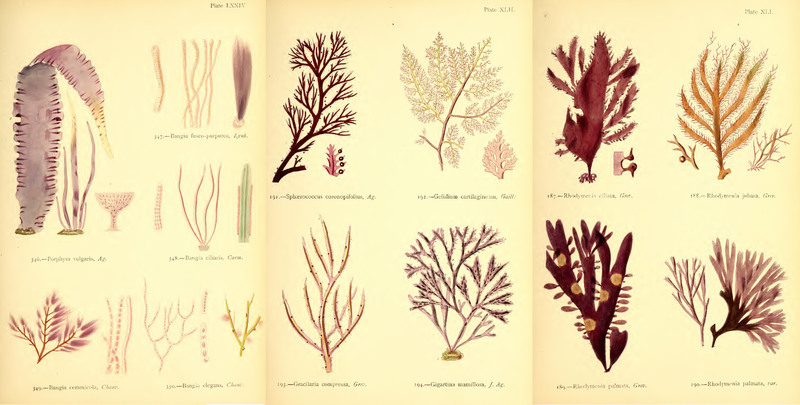
One of the natural history books mentioned in the Atlas Obscura article was a seaweed journal by Margaret Gatty. Atlas Obscura wrote of her,
One of the best known and most dedicated of these so-called seaweeders was Margaret Gatty, a children’s book author who took up the hobby while convalescing in Hastings, on Britain’s southeast coast, in 1848. Gatty’s crowning work of algology, British Sea-Weeds, is an exhaustive compilation of local seaweeds, fully described and illustrated in 86 colored plates.
I did not know there was a whole field of study called ‘algology’. These are selected plates of her seaweed drawings,
Selected plates from Margaret Gatty’s “British Sea-Weeds.” BIODIVERSITY HERITAGE LIBRARY/PUBLIC DOMAIN
I love those colored plates from natural history books from the 1800s. I owned two rare books,
A popular history of the mollusca : comprising a familiar account of their classification, instincts and habits and of the growth and distinguishing characters of their shells, by Mary Roberts, 1851; and
Popular British conchology. A familiar history of the molluscs inhabiting the British Isles, By George Brettingham Sowerby, 1854.
I love the hand colored plates of the plants or animals they carefully drew. I also have several books by Harvard University paleontologist Stephen Jay Gould (secular guy, sigh). There’s French poet-philosopher Paul Valery in his engaging meditation on the aesthetics of the seashell, as Amazon describes his work. Anne Morrow Lindbergh’s musings on shells in her famous Gift from the Sea. And so many other books. I guess now that I’m thinking of listing them, my library contains quite a few natural history books. Rachel Carson, Farley Mowat, John Hay, Abbot & Dance…
In 1664 John Evelyn, diarist, country gentleman, and commissioner at the court of Charles II, produced his monumental book on trees: Sylva, or a Discourse of Forest Trees. It was a seventeenth-century best seller. Evelyn was a true son of the Renaissance. His book is learned and witty and practical and passionate all by turns. No later book on trees has ever had such an impact on the British public.
Hmmm, maybe that’s why the Monty Python comedy troupe mentioned THE LARCH so often…
I love trees. Maybe I’ll get that book.
As much as I love reading about the creation from scientists of various kinds, there’s nothing like reading the Bible, God’s actual account of His world. As poetic as Lindbergh was, as witty as John Evelyn was, as precise as Sowerby or Roberts was, the thrill of reading about the creation from God Himself never fails to thrill me. As familiar as these verses are, they still ignite a reverent awe at His power:
In the beginning, God created the heavens and the earth. 2The earth was without form and void, and darkness was over the face of the deep. And the Spirit of God was hovering over the face of the waters.
3And God said, “Let there be light,” and there was light. 4And God saw that the light was good. And God separated the light from the darkness. 5God called the light Day, and the darkness he called Night. And there was evening and there was morning, the first day.
6And God said, “Let there be an expanse in the midst of the waters, and let it separate the waters from the waters.” 7And God made the expanse and separated the waters that were under the expanse from the waters that were above the expanse. And it was so. 8And God called the expanse Heaven. And there was evening and there was morning, the second day. (Genesis 1:1-8)
Nature displays God’s glory. The best place to read about that is His word, what He, Himself, has declared.
Let the heavens rejoice, let the earth be glad; let the sea resound, and all that is in it. Let the fields be jubilant, and everything in them; let all the trees of the forest sing for joy. (Psalm 96:11-12)
We are glad because as Job 12:10 says,
In his hand is the life of every creature and the breath of all mankind.
Is there any better place to be, if you’re saved? In His hand? Is there any worse place to be, if you’re not saved?
It is a fearful thing to fall into the hands of the living God. (Hebrews 10:31)
Read of His creation. The essays, poems, philosophies of the secular writers and scientists is fine, also good are Natural History books on the Bible such as The Scripture Alphabet of Animals by Mrs. Harriet N. Cook, 1842; The Plants of the Bible by John Hutton Balfour, 1885. But the originator of it all is the one to be worshiped and the best place to do that is read of Him in His word-
Do you not know? Have you not heard? The Everlasting God, the Lord, the Creator of the ends of the earth Does not become weary or tired. His understanding is inscrutable. (Isaiah 40:28)
Before my salvation as I was growing up and studying cultures and then traveling a lot, I mused that it sure was weird that every culture on earth that is and ever was had a spiritual side where the people worshiped something greater than themselves. And I wondered why so many cultures have a flood story and a creation story.
I love the verses in the Bible that show Jesus with the children. Matthew 18:1-6 is an example. So is Matthew 19:13-15. He said that the kingdom is made of such as these.
Now after Jesus was born in Bethlehem of Judea in the days of Herod the king, behold, magi from the east arrived in Jerusalem, saying, 2“Where is He who has been born King of the Jews? For we saw His star in the east and have come to worship Him.” 3When Herod the king heard this, he was troubled, and all Jerusalem with him. 4And gathering together all the chief priests and scribes of the people, he inquired of them where the Messiah was to be born. 5They said to him, “In Bethlehem of Judea; for this is what has been written by the prophet:
6‘AND YOU, BETHLEHEM, LAND OF JUDAH, ARE BY NO MEANS LEAST AMONG THE LEADERS OF JUDAH; FOR FROM YOU WILL COME FORTH A RULER WHO WILL SHEPHERD MY PEOPLE ISRAEL.’” (Matthew 2:1-6).
Setting: Jerusalem
Characters: The Magi from the east, Herod, and the Scribes & Priests
Event: Finding the Christ Child
The Magi were likely some Alchemists/Astrologers/Science men etc. MacArthur describes them this way –
Because of their combined knowledge of science, agriculture, mathematics, history, and the occult, their religious and political influence continued to grow until they became the most prominent and powerful group of advisors in the Medo-Persian and subsequently the Babylonian empire. … We learn from the book of Daniel that the magi were among the highest-ranking officials in Babylon. Because the Lord gave Daniel the interpretation of Nebuchadnezzar’s dream-which none of the other court seers was able to do-Daniel was appointed as “ruler over the whole province of Babylon and chief prefect over all the wise men of Babylon” (Daniel 2:48). (Source).
The Wise Men were monotheistic, that is, they believed there was only one God. Because of the influence of Daniel in those long ago centuries, knowledge about Yahweh still existed in their canon. We know Daniel was a sincere and learned worshiper of Yahweh, so it is likely he taught the wise men of Babylon all about our God.
I know that the Wise Men didn’t arrive at the stable when Jesus was a baby. But, that’s the set.
That knowledge was retained, and it came down to the moment when the Wise Men of Jesus’ day saw the star.
Now after Jesus was born in Bethlehem of Judea in the days of Herod the king, behold, magi from the east arrived in Jerusalem, saying, “Where is He who has been born King of the Jews? For we saw His star in the east and have come to worship Him.” (Matthew 2:1-2).
That is all we know about the Magi, but even with this scant information, we know that they knew there would be born a King of the Jews. Their journey from the east, (likely Babylon) was a journey of about 800-900 miles. They traveled by caravan. Having armed guards to protect them as was the custom of the day is probable, since they were carrying expensive items, especially the gold.
They made that difficult and dangerous months-long journey. The Magi had incomplete knowledge of the King of the Jews, Daniel was long gone 700 years before, and any remaining Hebrews in Babylon likely had probably long since apostatized.
What would spur influential Nobles like the Magi to seek out the Christ child with such single-minded purpose? We don’t know but we can surmise that their knowledge was incomplete. They were not known as strong worshipers of Yahweh but custom says they were Zoroastrians.
More astonishingly, not only did the Magi make the effort to journey to Jerusalem, (a HUGE undertaking), not only did they diligently seek the Child, and then trek to Bethlehem, they fell down and worshiped Him! They did not come to simply gather intel, they did not come simply to offer gifts. They weren’t rubberneckers or looky-loos. They came to WORSHIP HIM.
Let us contrast the diligence and humility of the Magi, pagans from a far-off land, to the Priests & Scribes, priests to the very Jews of whom Jesus had come to be king.
Imagine the scene. A caravan of Nobles along with their animals, tents, and guards, a HUGE retinue, arrives in Jerusalem. It would be akin to the Presidential Motorcade, with the cadre of motorcycles at the front, police cars with sirens, several black SUVs, and all the trailing cars. It’s a hubbub.
The Magi started asking around where is the King of the Jews, and finally got to Herod. Herod was troubled. I would be too if such a large company arrived at my door. But Herod, the Scribes, and Priests evidence no amazement. Worse, when they were asked where is the Christ child to be born, the Priests and Scribes answered immediately. The knew the scripture from Micah 5, and said ‘Bethlehem’. /Yawn/
It is not recorded that the Scribes and Priests said ‘we shall look into this as well.’ They did not ask why the Magi had arrived. Crickets. These Jerusalem men had full knowledge, revelation given to them by Yahweh Himself in the Old Testament. They spend their days studying, talking, interpreting. But when the moment came, in the form of a noticeable retinue of seekers from the east asking for the Messiah, they didn’t even walk the 5 miles to Bethlehem to check it out!
We think of others in the Bible who had incomplete knowledge, but still expended a great deal of effort to find God. The Ethiopian Eunuch, traveled all the way to Jerusalem to worship God. He was in charge of all the treasure of Queen Candace, but was humble enough to admit admitted his incomplete knowledge. He was willing to be taught.
Queen of Sheba of 1 Kings 10:1. Now when the queen of Sheba heard about the fame of Solomon in relation to the name of the Lord, she came to test him with riddles. 2 So she came to Jerusalem with a very large entourage, with camels carrying balsam oil and a very large quantity of gold and precious stones.
She spoke with Solomon for a long time and was amazed. She concluded, “Blessed are your men, and blessed are these servants of yours who stand before you continually and hear your wisdom! 9 Blessed be the Lord your God who delighted in you to put you on the throne of Israel; because the Lord loves Israel forever, He made you king, to do justice and righteousness.” (1 Kings 10:8-9).
Queen of Sheba was careful to question Solomon in relation to the name of the Lord, and also attributed Solomon’s success to God.
No wonder Jesus pronounced woes upon the Scribes and Priests! They had the most knowledge yet were the most apathetic.
Just because a person has head knowledge does not mean much. The rough fishermen whom Jesus called to be His disciples did not have as much knowledge as the Priests & Scribes. Yet they followed Him when called. Mary, though a young girl, was submissive, obedient, and humble. She knew she was a sinner in need of a Savior.
The difference is acting on the knowledge you DO have. Mary said yes. The Ethiopian Eunuch said please teach me. Sheba traveled to find out more. The Magi sought the Child so they could worship Him. Put your head knowledge into action in service to the Lord. Don’t rest in your head like the Scribes & Priests. Their apathy soon turned to hostility. There are only two responses to Christ: worship or rejection. Whatever knowledge you have, whether a seasoned theologian or a new convert-act on it. Act: pray, seek, question, learn, and above all, involve the heart: worship.
Yesterday was Resurrection Sunday, also known as Easter Sunday. People of all stripes drove to their local church, enjoyed an Easter, and afterward people ate together in a Sunday Supper. I say people of all stripes, because it’s one day of two that unsaved family members can sometimes be pressed to join saved family members in the service. Also, Christians-in-name only attend, those would be the people who go to church twice a year, Christmas and Easter. Some people call them Chreasters, a word combining Christmas and Easter.
True Christians see the Resurrection Sunday service as a high point of the year. And why not? It’s the high point of our faith. It’s the high point of history. It’s the high point of eternity. I pray that the joy we felt in the service will be present in our hearts every day, all year. Remember the cross. Remember the resurrection. Remember the ascension. Remember He is coming again.
I hope you think of heaven every day. I hope you think of our home, the country where we are destined to go. I hope you rejoice in the fact that it exists. I hope you are thrilled with the fact that we will be joining the Savior in heaven someday. I hope you think on the fact that His work on the cross made this possible.
He lived as a human (though still God) … endured a lifetime of mundanity and obscurity (even though He is glorious King of All) … received mocking, insults, beatings, humiliation, and death on a cross (even though He received only praise and honor in heaven)… He did all that to be obedient to His Father, and to redeem a people.
We know all this. (I hope).
I do think about heaven a lot. What it will be like to be there. To be in a place of purity and glory. To praise Jesus.
Jesus expects certain kind of worship. He does not accept any type of worship we throw at Him. He has His commandments, which describe a high standard of having no idols, having no other gods before Him, and not taking His name in vain. He has His Old Testament, in which His standards are scrupulously outlined. (No strange fire, Leviticus 10:1-2, Numbers 26:61). He has His New Testament in which we are given precepts for worship and service (No lying, as Ananias and Sapphira discovered, etc). And so on. Jesus does not receive any old worship.
I often think of when I’m in heaven, praising him from pure lips. (Zephaniah 3:9). I contemplate the praise and song I will be delighted to offer Him. I picture the global Bride before His throne, singing and exclaiming to the King.
Then of late, my mental gaze shifts from seeing me in the global body, to picturing Jesus, receiving praise from His Bride. He will accept the song and worship and acclamations that He is due. He will accept praise and honor and glory and it will not be filtered through the Spirit (Romans 8:26-27). The worship Jesus receives on the Day we are brought home will not be rejected as having impure motivations (Proverbs 16:2, Jeremiah 17:9, Hebrews 4:12).
The praise and honor we give Jesus in heaven will be pure and holy and accepted as His due. I cannot wait to see that moment. Picture the global Bride, installed in heaven’s New Jerusalem, where there is no sun to compete with the Light that is the Son. Picture the songs and praises flowing from the rejoicing (and relieved) humanity He redeemed. Picture that glorious throne, upon which sits the King at the right hand of the Father, the train of His robe filling the temple. (I know I’m mixing metaphors and timing of the heavenly temple and the eternal state). Picture the light around His face, hair white as snowy wool, smiling as He surveys His bride, who is singing to Him.
When from our lips and hearts, we offer all honor to Jesus, and He accepts it, because He deserves it. Finally, finally He is given what He expects and is worthy of.
What a day that will be.
the twenty-four elders fall down before him who is seated on the throne and worship him who lives forever and ever. They cast their crowns before the throne, saying, Worthy are you, our Lord and God, to receive glory and honor and power, for you created all things, and by your will they existed and were created.
(Revelation 4:10-11).
And they sang a new song, saying, “Worthy are you to take the scroll and to open its seals, for you were slain, and by your blood you ransomed people for God from every tribe and language and people and nation. (Revelation 5:9).
MOST HOLY GOD,
Animate me with joy that in heaven praise
will never cease,
that adoration will continue for ever,
that no flesh will grow weary,
no congregations disperse,
no affections flag,
no thoughts wander,
no will droop,
but all will be adoring love.
We have our worship together today, and as the Lord’s Day hours progress and come to their end this evening, I pray I will reflect on the joy to come of eternal worship among the assembly, in heaven, forever.





 the-end-time.org