Posted in crown, curse, encouragement, savior, thorns

Exploring Sin and Its Consequences Through Thorns

By Elizabeth Prata

EPrata photo

In the desert, cacti and thorn bushes mean business. Often, there are impenetrable thickets of rough bushes with spiky thorns that hurt even if you catch a glancing blow. Some cacti don’t even wait for a glancing blow but eject their little hairs to hurl at you as the wind of your passage awakens them. Desert thorns means business.

It wasn’t always that way. When the earth was created and the Garden of Eden planted nothing inside the Garden would hurt man as he passed. Which was good, because he was naked and not ashamed. Soft plants, beauteous flowers, stately trees, and mild animals dotted the landscape.

Then sin entered the world through one man, Adam, and because he listened to the voice of his wife, the ground became cursed. In some places today, the landscape even hurts to look at it.

EPrata photo

After the Fall, thorns sprung up everywhere. Thorns hurt, thorns are negative, thorns are because of sin.

And to Adam he said,

“Because you have listened to the voice of your wife
and have eaten of the tree
of which I commanded you,
‘You shall not eat of it,’
cursed is the ground because of you;
in pain you shall eat of it all the days of your life;
18thorns and thistles it shall bring forth for you;

(Genesis 3:17-18)

Anytime there was a curse thereafter, thorns are frequently mentioned as part of the curse. (Nu 33:55; Jos 23:12-13; Isa 5:5-6; 7:23-25; 55:8-13; Jer 12:13; Hos 9:6). Jesus used the symbols of “thorns” in his teaching in a negative sense (Matt. 7:16; Mark 4:7, 18; Heb. 6:8).

Thorns came in with sin, and were part of the curse that was the product of sin, Gen. 3:18. Therefore Christ, being made a curse for us, and dying to remove the curse from us, felt the pain and smart of those thorns, nay, and binds them as a crown to him (Job 31:36); for his sufferings for us were his glory. Matthew Henry’s commentary on the whole Bible: complete and unabridged in one volume.

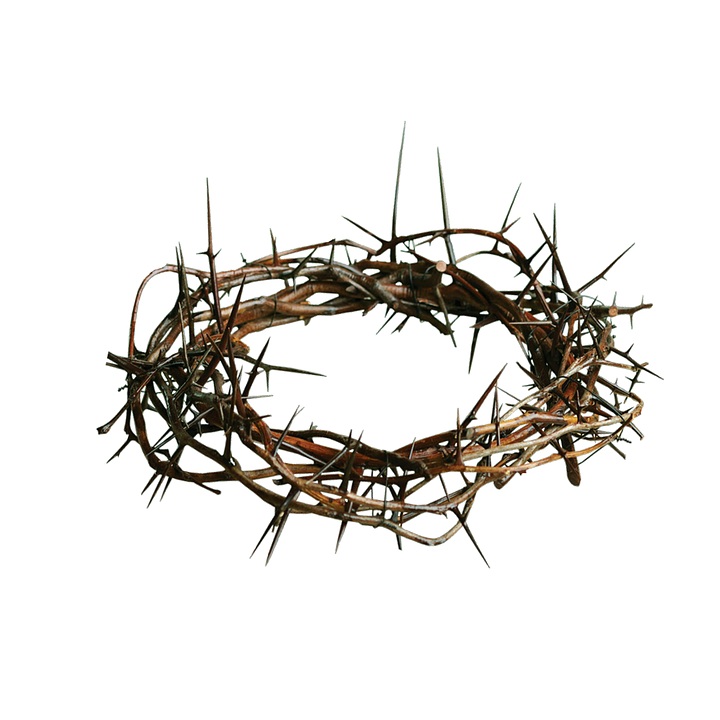
 In Matthew 27:29 we read that the soldiers who were crucifying Christ had some mocking fun with Him and placed a crown of thorns over His head.

In the crown of thorns placed upon His head, it was not only a mocking activity performed by pagans, but symbolic of the Lamb caught in the thorn thicket when Abraham was about to sacrifice Isaac. It is symbolic of the curse of sin that Jesus took upon Himself, so that we may escape it through Him.

EPrata photo

When you see that crown of thorns, and you think about the mockery and pain Jesus endured on our behalf, think about Him the spotless Lamb taking upon Himself the sins you and I do daily.

The Roman soldiers unknowingly took an object of the curse and fashioned it into a crown for the one who would deliver us from that curse. “Christ redeemed us from the curse of the law by becoming a curse for us—for it is written, ‘Cursed is everyone who is hanged on a tree’” (Galatians 3:13). (source)

What a tremendous, loving, wonderful Savior we have in Jesus Christ.

——————————–

Further Reading

The Splendor of Thorns

Can you imagine the Wal-Mart floral department offering a bouquet of thorns? Does the Garden Center ever advertise Acacia thorn bushes? Do carpenters choose two-by-fours made of thorn wood? Except for our botanist friends, few people find thorns captivating. They are not beautiful. And they don’t seem very useful, though they do burn extremely well. The negative associations of thorns are what make their appearance in the Bible so intriguing, for God weaves these very thorns into the revelation of His grace. He gives them a star role in the unfolding drama of His judgment and unbelievable mercy.

The curse on the Man, part 2

In the original Eden you didn’t have to have cultivated planned crops, and you didn’t have any weeds. You had the natural flourishing of the earth producing all manner of food without crops, as we know them, that now produce flour and from that we make bread and there was no siach, no weeds which grow profusely now. And it also mentions in chapter 2 verse 5 that the rain contributes to that as we well know. Take a vacant piece of dirt, do nothing to it, just wait and let it rain and you will have a flourishing field full of weeds.

What is the meaning and significance of the crown of thorns?

After Jesus’ sham trials and subsequent flogging, and before He was crucified, the Roman soldiers “twisted together a crown of thorns and set it on His head. They put a staff in His right hand and knelt in front of Him and mocked Him. ‘Hail, king of the Jews!’ they said” (Matthew 27:29; see also John 19:2-5). While a crown of thorns would be exceedingly painful, the crown of thorns was more about mockery than it was about pain. 
Posted in encouragement, Uncategorized

Earthly Footsteps of The Man of Galilee: the thorny fence

I love the old book, Earthly Footsteps of The Man of Galilee and the Journeys of His Apostles.

The book contains 400 original photographs by Robert E.M. Bain, taken in Egypt, Israel, Syria, Lebanon, Turkey, Greece, and Italy. Descriptions for each photograph are written by James Lee. These photographs depict the life of Christ and the influence of his ministry—the locations where Christ was born, baptized, crucified, as well as scenes from his prayers, miracles, and sermons. This resource also contains photography of sacred sites between Jerusalem and Rome.

In these photographs taken in the late 1890s, not much had changed in Palestine from the time of Jesus until then. When one sees the vintage, sepia photo of a lone colt tied to a tree in front of a house, one can easily imagine the scene when Jesus told the disciples to go find the young donkey so He could ride into Jerusalem. When one sees a cracked and browned picture of an oil or a flour mill, we can easily imagine commerce and trade as Lydia had with her business of purple.

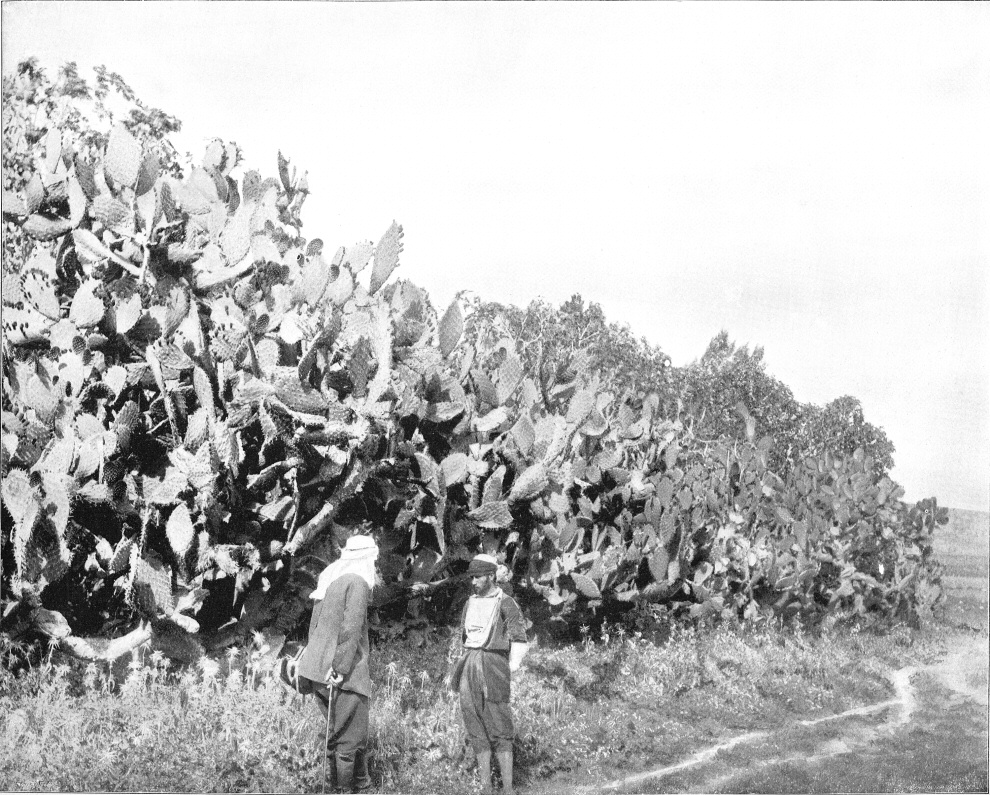
Here below is a fence in Palestine. The caption explains what the reader is seeing and also contains thoughtful ponderings about Jesus and His Gospel. What I think of when I see this photo, is the impenetrable aspect of the fence and the strong deterrent of thorns. The verse from the Parable of the Sower springs to mind.

Other seed fell among thorns, which grew up and choked the plants. (Matthew 13:8)

The agricultural and localized references written in the Bible are so much better appreciated by us in our day when looking at photos like this, or when I seek to learn about the plants and animals of the region.

Sadly, the book is out of print and very rare and expensive, but fortunately, it has been digitized and I can look at the photos on my Logos 6 software. By the way, if you are reading this before noon on this day, Tim Challies has a Free Friday Giveaway that runs until noon on Saturday, raffling off a Logos 7 Silver package. A hefty gift, if you sign up and become the lucky winner.

Earthly Footsteps of The Man of Galilee and the Journeys of His Apostles caption-

‎The thorny cactus abounds in Palestine. It forms a most secure fence, growing sometimes to a height of twelve feet. Beyond this wall are fig trees and olive trees, pleasant vines and fragrant flowers. The man in the picture with white head dress and staff held behind him is the dragoman of the photographic company of 1894.

We linger at Dothan because, besides the memories of Joseph and his brethren, there is an Old Testament picture which must have been recalled by Mary on her pilgrimage to Bethlehem. The prophet Elisha lived here for a time, and it was to Dothan that the Syrian King sent an army to surround and to capture him. By night they came—”horses and chariots and a great host.” And they “compassed the city.”

In the early morning, when Elisha’s servant arose from his bed and went forth “behold, a host compassed the city both with horses and chariots.” Then the prophet’s servant was afraid and he said: “Alas, my master; how shall we do?” And the prophet answered: “Fear not, for they that be with us are more than they that be with them. And Elisha prayed and said: Lord, I pray thee open his eyes that he may see. And the Lord opened the eyes of the young man, and he saw; and behold, the mountain was full of horses and chariots of fire round about Elisha.”—2 Kings 5:13–18.

The reality of the invisible realm, of God and His angels, of life immortal, of the protecting influence of heaven in all the struggles and endeavors of earth—these are doctrines which the Man of Galilee came to proclaim to the race of man. These are doctrines which gave strength and comfort to Mary in her pilgrimage from Nazareth to Bethlehem.

Jesus is utterly fascinating. These long-ago glimpses into the lands upon which He walked are endlessly interesting and encouraging. I hope you find them encouraging also. Of course, nothing can compare to the lands that await us, a renewed earth and domicile in New Jerusalem. Jesus is worthy to be praised, for His earthly sinless life, and His holy sovereign reign over all the earth and universe beyond.

I am the Alpha and the Omega,” says the Lord God, “who is and who was and who is to come, the Almighty.” (Revelation 1:8)

Posted in encouragement, Uncategorized

A thorny crown

In Genesis 3, Eve and Adam sinned. They fell from grace, and destroyed the intimate relationship they’d been enjoying with Holy God. God told Adam that because of his sinful action,

cursed is the ground because of you;
in pain you shall eat of it all the days of your life;
thorns and thistles it shall bring forth for you;
and you shall eat the plants of the field.
(Genesis 3:17b-18a)

Before the Fall, no thorns existed on earth. After the Fall, because of sin, thorns and thistles grew.

EPrata photo

As Jesus was being led to the crucifixion, they mocked Him.

and twisting together a crown of thorns, they put it on his head and put a reed in his right hand. And kneeling before him, they mocked him, saying, “Hail, King of the Jews!” (Matthew 27:29)

The only reason thorns grew is because of sin. The man sinned and as a result, the ground was cursed, and thorns came. The thorns on Jesus’ head are a visual reminder of our sin and the curse of it He came to release us from.

He is a good, good God.