Posted in theology

AI: A Dangerous Shortcut for Pastors, Writers

By Elizabeth Prata

SYNOPSIS

I share Ken Ham’s insights on the implications of artificial intelligence (AI) for pastoral work. Ham argues that using AI diminishes pastors’ theological study and reliance on God’s wisdom. The piece emphasizes the importance of genuine engagement with Scripture rather than easy technological shortcuts in ministry, as well as warnings about technology’s advance and potential for supplanting proper worship of the true Creator.


I respect Ken Ham. I’ve been following his ministry for a long time. I finally got to hear him at a G3 conference. His commitment to creation exposition, to Genesis 1-11 as the foundational belief for our faith, and his persevering and unwavering dedication that built the Creation museum and the Ark Experience is to be praised. He recently wrote a short-ish essay on Facebook about AI becoming a digital god.

I’ve been watching the rise of technology since the 1980s when a lot of things were invented, such as personal computers with graphical user interface (I took a computer elective in 1978 to try and learn coding language FORTRAN…), CDs, VCRs, video games and so much more. My father bought Pong when it first came out in 1972. Our family has always enjoyed the earliest and most advanced tech inventions.

In this era of the 2000s, the rise of sophisticated AI is a concern not only over potential plagiarism issues, laziness issues, or how easily technology controls us (cell phones, anyone?), or how the recent discovery of ‘kill switches’ in Chinese technology sold to the US could wipe us out with one click (Business Today), but because of prophecy.

Revelation 13 discusses how in the future one man and his cronies institute a global world economy and that all who wish to participate in this economy must accept the Mark (of the Beast). From my vantage point of having observed the economy since 1965, I have seen how this prophecy is becoming easier and easier to implement when it arrives on the scene.

In Ken Ham’s recent essay he asked the question, “Should pastors be using AI to write their sermons?”. I am re-posting the essay below in case the link in this paragraph doesn’t work for you, or if you are not on Facebook. He raises some good questions and makes some exhortations to pastors and others who should be wrestling with the scriptures instead of asking an impersonal digital presence to give them instant content.

Answers in Genesis, being a science ministry, also has other great essays pointing to the issues with AI and tech in general. For example, in this essay we read that ,

Google Co-founder Wants to Build AI as a “Digital God”

It’s an interesting notion, how easily we transfer worship to anything other than the only One who should receive it. We’ve seen it over and over in the Bible, and over and over in our own lives. I’ve written before about how prescient EM Forster was in his 1909 novella The Machine Stops, which a 116 years ago predicted this exact moment in technological time. It’s eerie how Forster predicted the loss of original thought, dependence then worship of a machine, and the lack of human contact. Friends and family are on screens only, not real life. You can read Forster’s novella online here.

AiG’s scientist Patricia Engler is an expert in AI, transhumanism, and other technological ethical issues. She recently spoke at the AiG for women conference in April on the issue of transhumanism. Others term the issue “human enhancement”. Engler explains in this 2023 article Thinking Biblically About Transhumanist Technologies at AiG,

The term “human enhancement” can mean anything from moderately improving someone’s natural abilities to radically modifying humankind.

I remember the splash the television show The Six Million Dollar Man made in 1973 when it debuted. He was an “enhanced human.” Wikipedia has a summary, which I excerpt- “a former astronaut, USAF Colonel Steve Austin, portrayed by Lee Majors… After being seriously injured in a NASA test flight crash, Austin is rebuilt (at considerable expense, hence the title of the series) with bionic implants. His right arm, both legs and left eye are replaced with “bionic” implants that enhance his strength, speed and vision far above human norms.”

Viewers including me, marveled at the thought that robotic implants could enhance human capabilities. Of course, 50 years later we are used to hip replacements, knee replacements, organ transplants, hearing aids for the deaf, and the like. We are also used to terms like cyborg, droids, clones, bot, algorithm…

Personally, it is my opinion we have passed a threshold with technology where its grip is on humankind is so tight we can never escape until we are called home. I hear of issues in colleges, high schools, and even younger of plagiarism in using ChatGPT, video games consuming minds for double digit hours on end, parents who prefer their phones to their children, critical thinking abandoned by the wayside in using Grok. Ask Google a question and at least it will yield links that the questioner must sort through and decide for herself if they are credible or not. Grok just tells you. I view AI-generated art as plain creepy. I hate to see it all, I just hate it. I pray the Lord comes for us soon.

As for Grok, the artificial intelligence Elon Musk has built, the name comes from Robert Heinlein’s 1961 science fiction novel, “Stranger in a Strange Land“. I read that book in the 1990s when a hippie friend gushed about its supposed deep truths and wise philosophy. I found it unintelligible. Though the title is taken from Exodus 2:22 KJV, the religion the book espoused is far from anything reasonable. But by secular standards, it seems wise and deep.

We must always remember that God is Creator. Our bodies are a machine on a level that no human creator could ever imagine when building a robot or an artificial intelligence. The sturdy delicacy of our bodies’ systems is amazing to behold. The brain is still a mystery. The Creator is worthy of praise for this and for all living things He has created.

Here is Ken Ham’s essay on AI (artificial intelligence). Though it’s aimed at pastors, anyone who studies, researches, writes on theological topics should be convicted by it. The link to his Facebook page where the essay originated is above.


Should pastors be using AI to write their sermons? I recently saw a website for a company that advertises itself as “Your AI-Powered Sermon Assistant” designed to help pastors “create better sermons in less time” using artificial intelligence.

A video on the website claims you can just type a word (like “forgiveness”) into the sermon builder tool and “instantly have a sermon ready to preach” and if you like the sermon “copy it, paste it, you’re ready to preach.” In other words, as a pastor you don’t even need to go to the Bible yourself to prep for your sermon—AI will do it all for you.

There are many good uses for AI—this is certainly not one of them! Yes, perhaps AI could be useful in pulling some cross-references, finding related passages, or pulling quotes to consider from church fathers (although resources to do all of these things already exist). But using AI to write sermons strips away a pastor’s wrestling with and studying of God’s Word. When a member of such a pastor’s flock comes to him for wisdom, counsel, and shepherding, he won’t know God’s Word to apply it properly!

And pastors surely should be praying (as any teaching pastor should do) for God’s guidance and wisdom as they build sermons. Be assured, AI doesn’t pray for any wisdom from God!

Contrast “copy, paste, preach” with these commands to pastors from God’s Word:

“Let the elders who rule well be considered worthy of double honor, especially those who labor in preaching and teaching. (1 Timothy 5:17)

Preach the word; be ready in season and out of season; reprove, rebuke, and exhort, with complete patience and teaching. (2 Timothy 4:2)

He must hold firm to the trustworthy word as taught, so that he may be able to give instruction in sound doctrine and also to rebuke those who contradict it. (Titus 1:9)

Do your best to present yourself to God as one approved, a worker who has no need to be ashamed, rightly handling the word of truth. (2 Timothy 2:15)”

The work of pastoring isn’t meant to be easy—it’s laboring; it’s having patience; it’s training to be ready. It’s a hard calling, but a worthy one for those who are willing to be trained by the Word of God.

If you’re a pastor, don’t take the easy way out. Labor in your preaching and teaching as God has commanded you to. Don’t outsource one of the most important aspects of your job—opening the Word for your flock—to a robot!

— Ken Ham

FURTHER READING

Owen Strachan had some thoughts about digital media, here on Facebook

Tony Reinke wrote the book called God, Technology, and the Christian Life, you can download a 32 page sample here

Posted in theology

Social Media: The Theater of Our Lives?

By Elizabeth Prata

theater masks

SYNOPSIS

I discuss the concept of social media as a form of theater, highlighting how users often present curated versions of themselves to avoid exposing their own sin and to manage perceptions. While recognizing the dangers of social media, I mention its potential for positive engagement, especially in sharing the Gospel and promoting truth, urging wise and intentional use.

Continue reading “Social Media: The Theater of Our Lives?”
Posted in theology

Technology and Faith: Can We Trust AI?

By Elizabeth Prata

There have always been technological advances in history. The printing press in 1448 comes to mind. The 1978 British TV show Connections “demonstrated how inventions and historical events are interconnected is Connections. Created by science historian James Burke, the series explores how seemingly isolated events and inventions influence the development of others, shaping the modern world”.

But I am glad I’ve been alive at this time in the world’s history, because I’ve seen incredible advances in technology. I remember seeing the movie 2001: A Space Odyssey. It was produced between 1965 and 1968 and released in ’68. The scene where the astronaut puts a credit card in the machine and presses numbers on a keyboard, and the screen lights up with a live video conference with his daughter, drew audible gasps and not a few scoffing laughs. Never in 1968 had the general populace imagined a live video call. I mean, in 1968 push button phones had barely been invented and were not widely used until the late 1970s. And now in 2025, a video conference across vast distances is common.

2001: A Space Odyssey video call scene, complete with push button phone personal computer keyboard, credit card, and live streaming. Envisioned in 1968.

Credit cards were new then, too. The Diner’s Club card was invented in 1950. General credit cards for any kind of purchase, not just restaurants, were not commonplace in 1968. In fact, when 2001 A Space Odyssey began production in 1965, Mastercard was not even on the scene yet. It was invented in 1966 and was called Interbank. In 1969 it was rebranded as Mastercard.

Since the year of my birth I’ve seen satellites, space travel, the internet, streaming, optical fibers, digital cameras, cell phones, personal computing, sonograms, heart transplants, insulin production, cloning, limb reattachment… and so much more.

And now, artificial intelligence.

AI can make ‘art’ (it’ll be a while before I consider a digitally produced picture ‘art’, hence the scare quotes). It can answer questions. Automate tasks. Generate content. Even make predictions. Someone on social media had warned about Grok, Elon Musk’s AI as opposed to Google, the research engine. Google presents the researcher with links for further research, leaving it to the live brain intelligent person to make decisions about the quality of and value in the links presented, while Grok simply gives the answer.

A couple of years ago, I read a novella called “The Machine Stops” by E.M. Forster. I’ve written about it before, it made a big impression on me. It’s a science fiction story written in 1909. The Edwardian era had its own breathtaking advances as well. As we read in this essay about the time period when the novella The Machine Stops was written,

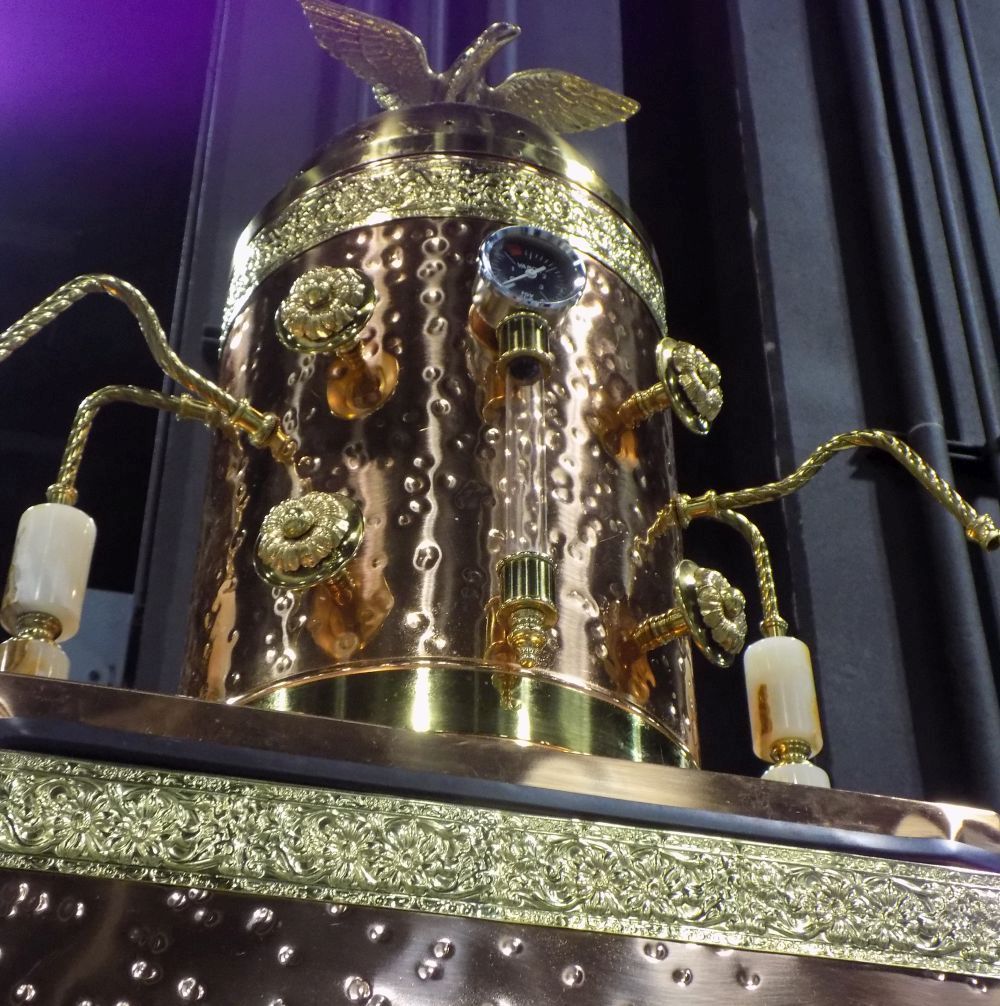
AI generated steampunk machine

automobiles were becoming common; Louis Blériot successfully flew across the English channel in his prototype aircraft; Ernest Henry Shackleton’s expedition reached the South Magnetic Pole; London’s Science Museum was established as an independent institution; physicists Ernest Rutherford, Hans Geiger, and Ernest Marsden carried out their famous Gold Foil experiments, which proved an atom had dense nucleus with a positive charged mass. Edwardian society was modernizing industrially, scientifically, and technologically at an exponential pace.

The novella serves as a cautionary tale about the dangers of over-reliance on technology and the dehumanizing effects of unchecked technological advancement. It seems to predict the very moment in which we find ourselves today, 116 years later.

If you’re interested in prescient science-fiction, this essay describes why The Machine Stops is so eerie, and it’s well-written too.

With all this happening in our world, and trust me, an old lady, it is moving faster and faster, I turned to Answers in Genesis for help on how to think about Artificial Intelligence. We know there are smart, unsaved people, sure, but without gaining knowledge from THE Source, Jesus, it is worthless. Wisdom from the world gains us nothing. In fact, most unsaved people descend into such sinfulness that their thinking becomes futile. (Romans 1:21-22).

AI generated AI brain

The title of the 33-second video is AI Is NOT as Reliable as People Think, the synopsis states:

Multiple researchers have shown how people can easily use publicly available AI to intentionally create false but persuasive information, which is why we must not trust AI as our final authority for truth. God’s Word has to be our final authority in EVERY area.

It is worth watching. As I said, it is only 33 seconds long. We need to be mindful of where wisdom comes from and the final authority of that wisdom. The AiG video is a good exhortation.

For a longer treatment of the subject of AI, Patricia Engler, the local AI expert at AiG, wrote a two part essay, is titled

Part 1- AI: Useful Tool or Existential Threat?
What is AI, and how should Christians engage with it?

Part 2- The Effects of Artificial Intelligence

Only God is all-knowing, infallible, and the ultimate Truth. His Word, not the outputs of AI, must be our final authority. (Source).

AI is handy. It’s convenient. It’s not neutral though. Or is it? Did Grok achieve political neutrality? Is inherent bias completely absent in its algorithms? Time will tell. Meanwhile, we can consult the Bible for most of life’s conundrums. For the nitty gritty not addressed in the Bible, if you use AI, employ common sense and be wise.

Posted in theology

The future, AI, and EM Forster’s novella “The Machine Stops”

By Elizabeth Prata

In 1909 a novella was published by EM Forster, he of the novels A Room with a View (1908), Howards End (1910) and A Passage to India (1924). His novella, again reminding the reader it was published in 1909, was called The Machine Stops. It is a view of the long trajectory of humanity that the author envisioned where humans have become totally dependent on The Machine, even worshiping it. They live underground and are suspicious of those who want to go above. Eventually, travel to the surface is banned. His novella explored overreliance on technology, as well as the impacts of perpetual social isolation and separation from the natural world.

The plot of the novella is below containing spoilers, so skip it if you do not want to know, and scroll down to the next part of this essay. Licensing to reproduce the Wikipedia plot recap is here. The novella is incredibly, INCREDIBLY prescient, predicting the internet, video-conferencing, instant messaging, and more.

Plot summary: The Machine Stops

The story describes a world in which most of the human population has lost the ability to live on the surface of the Earth. Each individual now lives in isolation below ground in a standard room, with all bodily and spiritual needs met by the omnipotent, global Machine. Travel is permitted, but is unpopular and rarely necessary. Communication is made via a kind of instant messaging/video conferencing machine with which people conduct their only activity: the sharing of ideas and what passes for knowledge.

The two main characters, Vashti and her son Kuno, live on opposite sides of the world. Vashti is content with her life, which, like most inhabitants of the world, she spends producing and endlessly discussing secondhand ‘ideas’. Her son Kuno, however, is a sensualist and a rebel. He persuades a reluctant Vashti to endure the journey (and the resultant unwelcome personal interaction) to his room. There, he tells her of his disenchantment with the sanitised, mechanical world.

EPrata photo

He confides to her that he has visited the surface of the Earth without permission and that he saw other humans living outside the world of the Machine. However, the Machine recaptures him, and he is threatened with ‘Homelessness’: expulsion from the underground environment and presumed death. Vashti, however, dismisses her son’s concerns as dangerous madness and returns to her part of the world.

As time passes, and Vashti continues the routine of her daily life, there are two important developments. First, individuals are no longer permitted use of the respirators which are needed to visit the Earth’s surface. Most welcome this development, as they are skeptical and fearful of first-hand experience and of those who desire it. Secondly, “Mechanism”, a kind of religion, is established in which the Machine is the object of worship. People forget that humans created the Machine, and treat it as a mystical entity whose needs supersede their own.

Those who do not accept the deity of the Machine are viewed as ‘unmechanical’ and threatened with Homelessness. The Mending Apparatus—the system charged with repairing defects that appear in the Machine proper—has also failed by this time, but concerns about this are dismissed in the context of the supposed omnipotence of the Machine itself.

EPrata photo

During this time, Kuno is transferred to a room near Vashti’s. He comes to believe that the Machine is breaking down, and tells her cryptically “The Machine stops.” Vashti continues with her life, but eventually defects begin to appear in the Machine. At first, humans accept the deteriorations as the whim of the Machine, to which they are now wholly subservient, but the situation continues to deteriorate as the knowledge of how to repair the Machine has been lost.

Finally, the Machine collapses, bringing ‘civilization’ down with it. Kuno comes to Vashti’s ruined room. Before they both perish, they realise that humanity and its connection to the natural world are what truly matters, and that it will fall to the surface-dwellers who still exist to rebuild the human race and to prevent the mistake of the Machine from being repeated.

Here are a few quick reviews of the novella:

In such a short novel The Machine Stops holds more horror than any number of gothic ghost stories. Everybody should read it, and consider how far we may go ourselves down the road of technological ‘advancement’ and forget what it truly means to be alive;” rating the story as 10 out of 10.” ~The Fantasy Book Review

“‘The Machine Stops’ is not simply prescient; it is a jaw-droppingly, gob-smackingly, breathtakingly accurate literary description of lockdown life in 2020.” ~Will Gompertz, BBC, 2020

1909: E.M. Forster publishes ‘The Machine Stops,’ a chilling tale of a futuristic information-oriented society that grinds to a bloody halt, literally. Some aspects of the story no longer seem so distant in the future.” ~Randy Alfred, Wired magazine, 2010.


EPrata photo

I read The Machine Stops a few years ago. One thing the plot recap nor the reviews mentioned is the impact of over-reliance on technology on the mind. The inhabitants of the underground world ceaselessly delivered lectures to each other by a vast network akin to our video-conferencing today. But the ideas contained in the lectures were derivative of each other, endlessly recycled and repackaged. New ideas were non-existent. This is because there was no input from external stimuli, neither in-person social conversation nor inspirations from nature and the organic world. Everything was sanitized, pneumatic, and sterile. Soon enough their minds were too dulled to create connections to new ideas and did not produce art, music, literature, science, etc.


Reading this essay below reminded me of The Machine Stops. The author is a Christian professor discussing how AI is impacting his life of teaching, but he also related the overall issue of derivative thinking to our faith, the sin problem, and morality.

He said, and I agree, that technology in and of itself is morally neutral. Immorality stems from an individual’s desire to live a life apart from God. The immoral person disbelieves he is going to be judged by a morally perfect God, and errantly believes that God’s behavioral standards do not apply to him. Autonomy from God is the root of all sin. Two examples are mentioned- climate ‘control’ and transhumanism:

Like Frankenstein, these technocrats will seek to replace God by altering nature. Silicon Valley leaders seek immortality in transhumanism. Their goal is an unending life apart from God.” ~Owen Anderson

Most technology invented is one that seeks to give humanity a life of ease. Washing machines, smartphones, automobiles… do make our lives easier.

Work that involves toil and drudgery can be done by technology so that humans can spend their mental efforts on creativity instead.” ~Owen Anderson

Except, they don’t spend their mental efforts on creative endeavors instead. Every time a new invention hits the market it seems that it will be the thing to release us from work-work-work, but then the hours fill in with more work, somehow.

EPrata photo

Many people are unaware of this, but when settlers first came to America, they saw many of the different Native tribes’ leisure time as scandalous. The Native Americans had very little ‘technology.’ Of course, they worked hard for their means, but once accomplished, they actually had copious amounts of time to do as they pleased. They lived lives of leisure with competitive sports, games, gambling, songs, dances. They had much free time and they used it for enjoyment of life.

They viewed the whites’ lives as one of drudgery that was grim and joyless, filled with wealth-building. Benjamin Franklin once said of ‘the savages’, “Having few artificial wants, they have abundance of leisure for improvement by conversation. Our laborious manner of life, compared with theirs, they esteem slavish and base…” “Remarks Concerning the Savages of North America” (1784).

Technology has afforded us in this and the previous generation the ability to proclaim Jesus across the globe. O, how the early missionaries may have envied us this day and age where at the press of a button, an entire whole Bible can be delivered to anyone who wants to receive it, in their language. Where sermons can be heard from a wealth of living and passed on preachers. Church history at the fingertips… and so much more.

But the biggest industry online is porn.

As Mr Anderson said in his essay, “Sinners make tools to sin more effectively. Instead of aiming at the chief end of glorifying God and enjoying him forever, unregenerate humans will seek our own ends.

And what ARE those ends? Satisfying various lusts. Only and forever.

I’d encourage the reader to read Forster’s novella. It is only 46 pages, and can be bought inexpensively as a paperback, read on Kindle, or read for free online. Then compare with Mr Anderson’s thoughts on AI.

AI and the future of technology is a subject worthy of pondering for the Christian, and to come to a settled conviction of how we each approach it. Daniel 12:4 says

But as for you, Daniel, conceal these words and seal up the book until the time of the end; many will go to and fro, and knowledge will increase.

It is true, knowledge has increased, but has wisdom? Critical thinking? No. It has actually declined. I wrote a bit about that here.

I am personally skeptical of AI. I am leery of anything that does my thinking for me. I am old enough to have seen the invention of many things, wonders of science and positive additions to our lives. But by the grace of God post-salvation I now also know the human tendency to use these things for evil purposes. These things are a boon to our lives but at the same time provide yet another temptation we need to guard against.

For example, social media is great for sharing doctrine but also a platform that tempts us to intemperate speech. Smartphones to communicate at a distance with loved ones, but also time-waster TikTok viewing. Streaming platforms to view edifying material, but also lascivious movies we should avoid.

One day all the machines will stop. Then we will worship God and dwell sinlessly in His kingdom. Any technology present that we see or use will be solely for the glory of God! What a day that will be!

Posted in prophecy, theology

The Orwellian time in which we live, and the mark of the beast

By Elizabeth Prata

Annotation 2020-04-21 080231

Tech giants are making decisions for us. Governments, with the assistance of technology, are intruding on our private lives in ways that we’d believe unthinkable two months ago.

Example: Amazon is delaying fulfillment based on their assessment of whether the item is “essential” or not. At the outset of the lockdown, I ordered two items.

1. CPAP headgear
2. Compression socks

Both items were medically necessary for me. I use the CPAP machine to breathe at night, my sleep apnea is bad and I stop breathing multiple times per night for lengthy periods. The headgear is the strap that keeps the mask attached to my face. It had gotten very stretched and through repeated washings the velcro was practically useless. My machine data showed increasing number of apnea incidents during the night due to mask slippage. I ordered a new one. Amazon said it wasn’t essential.

Oh, yes it is.

During times I am not at work I sit a lot at my table and write, edit, use the laptop for entertainment, and communication. I might sit for long periods, and thus the circulation in my legs causes ankle swelling. I use compression socks to help with this. Amazon said the socks weren’t essential.

Oh, yes it is.

So, tech giants are monitoring what we buy and making decisions for us as to whether we truly need it or not.

Then I learn that some tech apps are suspending privileges based on the topic of sermon, if they don’t like it!

Tech Giants Begin the Crackdown on Unapproved Sermons as Churches Are Forced Online

On Friday, Google suspended Christ Church’s app from the Google Play store after accusing the pastors of a lack of sensitivity and/or capitalizing on the current coronavirus pandemic. The church received a notice from the platform, stating: “We don’t allow apps that lack reasonable sensitivity towards or capitalize on a natural disaster, atrocity, conflict, death, or other tragic event. “Your app has been suspended and removed due to this policy issue,” the notice added.
It’s believed Google was referring to Pastor Douglas Wilson’s short lessons on responding faithfully to the COVID-19 crisis, and Pastor Toby J. Sumpter’s sermon calling God’s people to humble repentance in the face of the pandemic.

Tech giants are making decisions about the topics of the video content we view.

Facebook will steer users who interact with coronavirus misinformation to WHO

The move is just the most recent step in an aggressive and coordinated response by Facebook and other tech companies to promote facts and guidance from reputable sources. … Users who have liked, commented on or otherwise reacted to coronavirus misinformation that Facebook has flagged and removed as “harmful” will be directed to a website debunking coronavirus myths from the World Health Organization.

Tech giants making decisions about how we need to be ‘guided’ and to whom (or WHO) we need to be guided TO.

In a chilling dystopian move, 22 states now using drones to enforce lockdowns

In this article, Drone Pandemic, we read, “straight from a dystopian film script—as successive lockdowns have been declared across the world from Wuhan to Lagos—authorities have begun turning to loudspeaker-equipped flying drones to enforce social distancing rules,  Elsewhere, the buzzing beasts hover ominously over upright citizens engaged in seemingly innocent activities like shopping or getting some fresh air…”

In Daytona, they have a drone with “a FLIR cam that can read a person’s body temperature.”

In NJ, “Some may notice drones monitoring your neighborhoods. These drones are going to alert people to move away from each other if they are congregating. … These drones will be around the City with an automated message from the Mayor telling you to STOP gathering, disperse and go home.”

Authorities in Britain were criticized last week for sending drones flying over visitors to a park and then shaming them by posting the footage on Twitter.

Neighbors were encouraged to snitch on other neighbors who were not wearing masks or not staying 6 feet apart from each other.

Technology that finds us, photographs us, does a biometric on us, shames us, orders us, manages our behavior…

Have we given too much authority to the techs?

—————————————

Technology is a blessing. I love technology. I am glad I’m living now, when the internet was invented, color television, cell phones, digital cameras & etc.. I am old enough to have been born before those things were invented and I appreciate being able to use them now.

But as with anything, technology has a dark side. Technology is a slave to user input and users are sinners. Pornography comes to mind. Bank fraud. Shell corporations. Cyber stalking/bullying. I’m personally not crazy about drones.

This next statement will seem like a non sequitur, but eventually I’ll bring these two thoughts together. We are in the end time now. We have been since Jesus ascended, and we will be until the rapture when Jesus returns in the sky and calls up His saints, dead and alive, to heaven, ending the Church Age.

I named this blog The End Time to remind myself and readers of that fact, that we are in the latter days and Jesus could return at any moment. When He does, our duties here on earth will be done. We should have a sense of urgency every day with that fact in mind. His return for His church in the air has always been imminent.

After the rapture, an imminent event described in 1 Corinthians 15:50-53, John 14:1-3, 1 Thessalonians 4:13-18, to name some, there will be a period of judgment on earth called The Time of Jacob’s Trouble. (Jeremiah 30:7). It is when the Jews will be finally punished for 7 years to finish the decree, (Daniel 9:24-27) and also sinful Gentiles remaining on earth will be punished. Jesus said in Matthew 24’s Olivet Discourse that many will have tribulation, so, many people call this time “The Tribulation” as well.

During the 7 year Tribulation, when God’s wrath is poured out over the whole earth (but the Church is not destined for wrath – 1 Thessalonians 5:9; Revelation 3:10), an event occurs which even most unsaved people know about.

It is called the Mark of the Beast. In this time, God allows satan and his demons to run the earth in greater and greater ways than even now (2 Corinthians 4:4). Sin will be king. The upheavals in economies, weather, geophysical, behavior events are so terrible, no a worse time there shall never be, (Matthew 24:21) that the nations reform into one world government with one leader, the antichrist. In Revelation 13:16-17 he is described as instituting a mark upon all the people of the earth. It is a mark of allegiance and worship and oh by the way, those without the mark cannot buy or sell. Christians refuse the mark because they refuse to worship the beast, and are hunted down and beheaded.

We are not in the Tribulation now. I repeat, we are not in the Tribulation now. I am not saying that prophetic time is immediately upon us. I want to make the point though, that in former times it has been hard for people to imagine how the ‘one world government’ and the ‘mark of the beast’ will come about.

During this pandemic time in 2020, I believe that what occurred indicates just how easy it will be to enact the prophecies we read in Revelation.

The world acquiesced to lockdowns, shutdowns, social distancing, and the like, almost immediately. In America, the land of the free, people acquiesced immediately to orders to remain inside, to wear masks, to shop only at certain times or certain places. Because of the good obedience in good faith of the American people, sadly, some politicians have taken advantage. They extend the lockdown beyond the flattened curve we were told was the reason for the lockdown in the first place.

Fear drove it, uncertainty propelled it, suspicion wafted in. Compliance was easy to engender. However, the power that was grabbed has been hard for them to let go.

I don’t know what the Lord is doing through this pandemic. Pastor Don Green preached a good message that asked the question, the seminal and primary question we should all be asking: Why did God stop the world? Coming out the other side we may see some new things, to the good or to the bad or both. People miss church People miss friends. People don’t take for granted the time we are given. People may value educators, first responders, hospital workers more. People may respect the president more as he has led through this pandemic. They may respect certain leaders less since they totally failed during the pandemic. They may not buy as much from China.

Alternately, people may quickly forget and revert to old ways. They may have become conditioned to accept drones, government intrusion, immediate compliance, and tech giants making decisions for us.

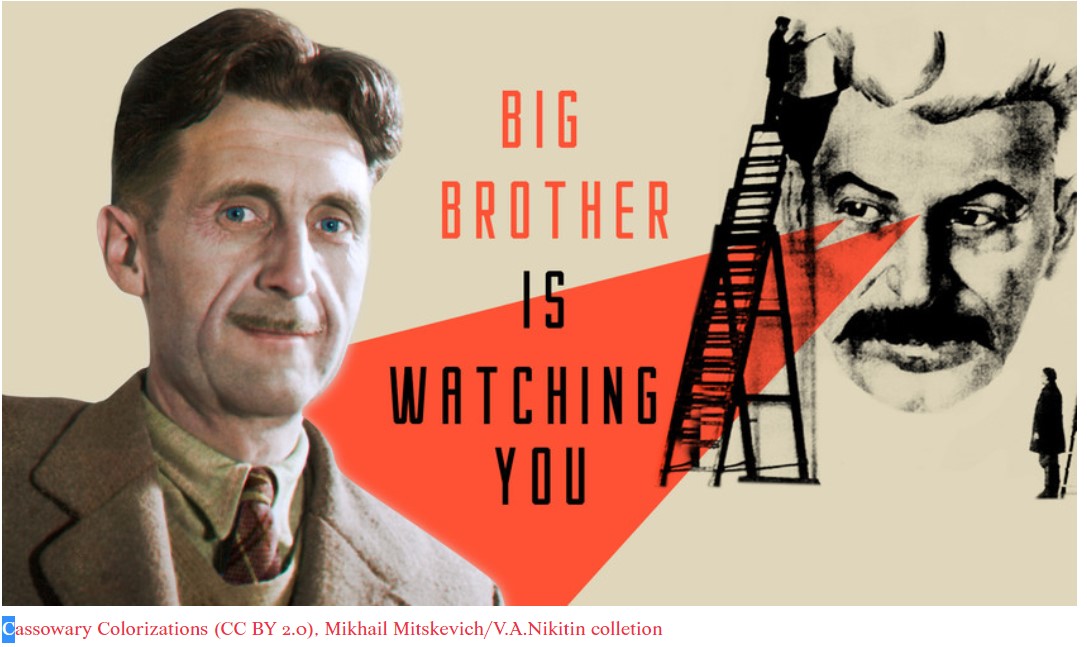
When the time comes, the Antichrist will seem like Orwell’s ‘Big Brother,’ a benign, helpful overseer of all that is good, when in reality the truth will be that he is a demon spawn from hell bent on forcing worship and won’t hesitate to kill anyone who objects. The ultimate dystopia.

Why DID God stop the world? Perhaps this time was meant to advance the plan of God forward in a huge and visible leap. All I want to say is, this pandemic time of COVID-19 has shown me at least, how easy it will be when the time comes for secular people to accept a one world government and to take the mark of the beast.

—————————–

Further reading

If you enjoy dystopian literature then see these:

EM Forster: (1909, novella) The Machine Stops, The story, set in a world where humanity lives underground and relies on a giant machine to provide its needs, predicted technologies similar to instant messaging and the Internet.

Article – Prophet or Futurist? 7 Technologies Jules Verne Predicted Leagues Ahead of His Time
Author (and inventor for some) Jules Verne created worlds in his stories that featured technology that is still relevant to this day. You might enjoy pairing his book Twenty Thousand Leagues Under the Sea, with the book or movie Ice Station Zebra, or his story Robur the Conqueror that predicted helicopters with the movies Black Hawk Down or Blue Thunder.

Book – One Second After by William Forschen, A post-apocalyptic thriller of the after effects in the United States after a terrifying terrorist attack using electromagnetic pulse weapons, which destroy all electronics and technology, rendering them useless.

Q&A – What is the Mark of the Beast, credible and biblical answers to this amazing and devastating period to come.

Posted in discernment, Uncategorized

Does your phone bless or curse those around you?

If you’ve ever been around people who drink alcohol, and you’re not drinking, you know how their increasing lack of sobriety looks and sounds. The person drinking thinks they are still in full possession of all their faculties, but to the sober observer on the sidelines, the story is completely the opposite. It’s a stark and un-pretty picture.

I used the drinking analogy to set up my main point. There are a lot of people who don’t drink, but it seems that there are few people who don’t have a cell phone anymore. I am one. I don’t have a cell phone, a smartphone, a mobile device, tablet, iPad, or portable technology of any kind. I am the one on the sidelines, watching the rest of the world get drunk on cell phone checking. It’s a stark and un-pretty picture.

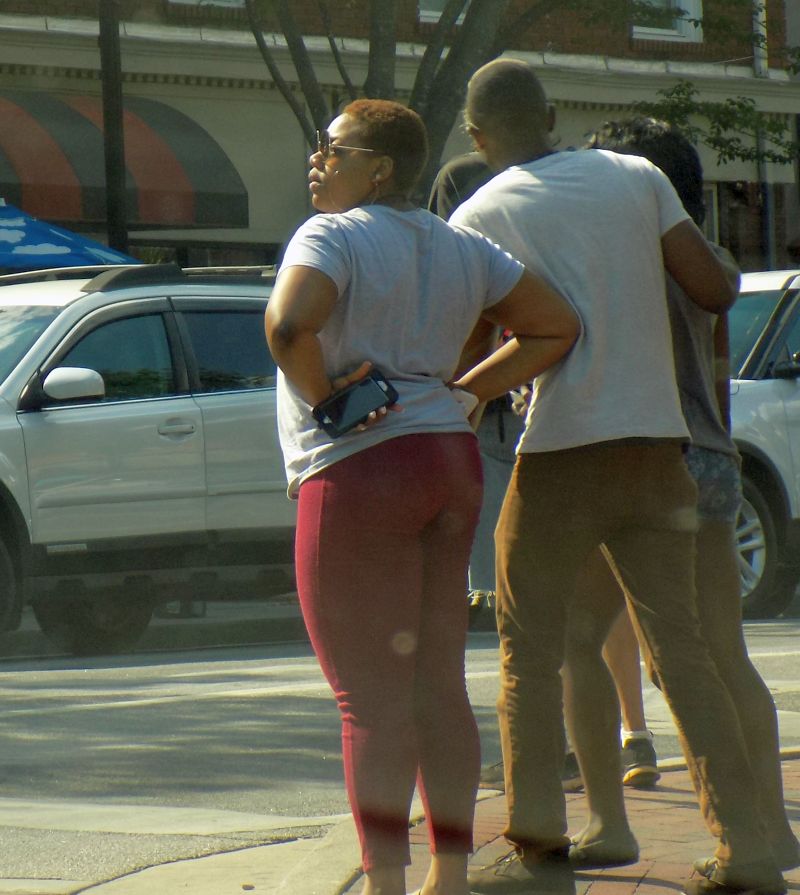
Never was the rising cell phone addiction so prevalent than when I went into the fray last weekend to do some street photography. Athens, GA is a college town, and very liberal. As with most cities, there are fringe characters, weird dressers, buskers, hucksters, panhandlers and regular folks ambling along the bustling streets. I went into the city on a Friday afternoon after school and was there until about 5:30 or 6:00. I was observing and photographing long enough to watch the night city come alive. The buskers set up, and panhandlers claimed their spots, and the frat boys began roaming the bars in packs. Time to go.

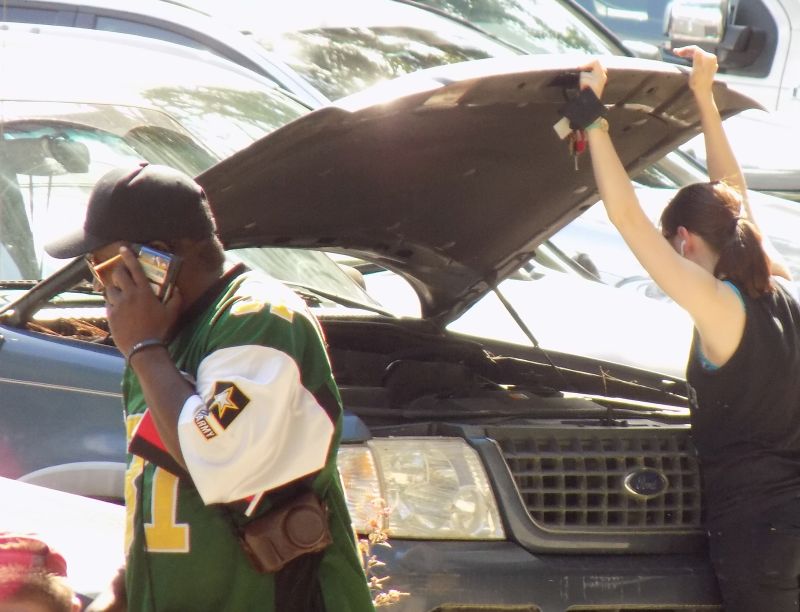
I went home and began processing my pics. Once you see it, you can’t unsee it. ALL my photos contained a plethora of people either looking at, dialing, or speaking on their phones. The ones who didn’t, had a phone in their hand. Period.

It was a warm and bright spring day. The trees and flowers were blooming. The skies were vivid azure and the sun was glowing with long shadows, making dappled leaf patterns on the sidewalks. The shops were open and the al fresco cafes were inviting. There was plenty to look at and notice, but one would think all that was invisible with a number of passersby who were enthralled with the tech world of their two-inch smartphone screens.

I’m old enough to have been an adult when cell phones came in. I remember walking down city streets all over the United States and the world, enjoying the day, people watching at the cafe. I’d enjoy the clouds, muse on people’s fashion choices, admire the architecture. Most of all, I’d talk to the person I was with, sharing these thoughts and observations and listening to theirs. We created common memories and enjoyed our shared experience.

Those says seem gone.

Author Tony Reinke expressed his concerns with the technological age epitomized by the smartphone in his book 12 Ways Your Phone Is Changing You. In his book he writes of concerns wth technology creating the Age of Distraction, but he also tempers his concerns with ideas and strategies to steward our time well and use the technology instead of it using us.

He wrote,

We check our smartphones 81,500 times each year, or once every 4.3 minutes of our waking lives, which means you will be tempted to check your phones three times before you finish this chapter.

My time photographing the street activity in Athens seems to bear this out. I stood in one spot for about ten minutes and this was the scene.

Concerns are with any device that distracts us from engaging with God’s world and His people. In fairness, Reinke also said this about cameras, which I think can be applied to philosophies about any device-

If the cameras in our pockets mute our moments into 2-D memories, perhaps the richest memories in life are better “captured” by our full sensory awareness of the moment- the later written down in journal.

Smartphones are here to stay. That ship has sailed. What we’re left with is not that we use our phones but how we use our phones. A title (I think) Westminster Books used in reviewing Reinke’s book was, “Is your phone a blessing or a curse to those around you?” For me, they are a curse.

Justin Taylor at The Gospel Coalition writes that Reinke’s book blurb convicted him. Nate Claiborne at Christ + Pop Culture wrote

Whether for advances in productivity (thanks to apps like Things and Evernote) or the pull of imminent distraction (thanks to Facebook, Instagram, and Twitter being accessible at all times), my daily life is no longer the same. Rather than treating technological advances as givens, we ought to think about the good as well as the potential bad they bring.

You can find this Tony Reinke book at Westminster Books, and elsewhere.