By Elizabeth Prata

The Parable of the Weeds
He put another parable before them, saying, “The kingdom of heaven may be compared to a man who sowed good seed in his field, but while his men were sleeping, his enemy came and sowed weeds among the wheat and went away. So when the plants came up and bore grain, then the weeds appeared also. And the servants of the master of the house came and said to him, ‘Master, did you not sow good seed in your field? How then does it have weeds?’ He said to them, ‘An enemy has done this.’ So the servants said to him, ‘Then do you want us to go and gather them?’ But he said, ‘No, lest in gathering the weeds you root up the wheat along with them. Let both grow together until the harvest, and at harvest time I will tell the reapers, Gather the weeds first and bind them in bundles to be burned, but gather the wheat into my barn.’” (Matthew 13:24-30)
Donald Grey Barnhouse, in his sermon “What is God Doing Today?” explained,
Now, the Lord Jesus Christ taught clearly that we are in this age to sow the seed – that is, to spread the Gospel. But we are to expect that only part of the seed will fall on good ground, that is, believing hearts. And that the rest will not produce good fruit. The fault is not with the seed, but with the hearts. Christ taught that satan would plant counterfeit believers in the midst of true believers so that it would be difficult to tell the real from the false. The true and the false, the real and the counterfeit grow together until the harvest which is the end of the age in which we live. These truths He taught in the Parable of the Sower and the Wheat and Tares. And he gave the explicit interpretation Himself, not leaving it to man’s imagination. The good and the bad are to grow together. Neither will destroy the other. God will take care of the separation.
Matthew Henry:
So prone is fallen man to sin, that if the enemy sow the tares, he may go his way, they will spring up, and do hurt; whereas, when good seed is sown, it must be tended, watered, and fenced.
 |
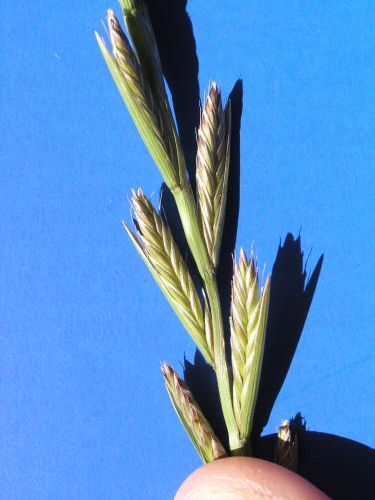
| EPrata photo |
What is a weed? It is useful to study the properties of the object of the agricultural metaphor which the Lord in His wisdom used to explain the parable to us. As we read these properties of weeds, let’s keep in mind how these properties mirror the properties of the unbeliever. At the Penn State Extension website, we read Introduction to Weeds,
–a plant growing where it is not wanted
–a plant whose virtues have not yet been discovered. (R.W.Emerson). [Ed note: i.e. a virtueless plant]
–plants that are competitive, persistent, pernicious, and interfere negatively with human activity (Ross, et. al.)
–No matter what definition is used, weeds are plants whose undesirable qualities outweigh their good points.
These qualities of weeds certainly mirror the unbeliever’s qualities. Unbelievers in the world interfere with our activity, in pernicious, persistent, and competitive ways. This is because they are sown by satan. To continue looking at weeds:
Certain characteristics are associated with and allow the survival of weeds. Weeds posses one or more of the following:
a) abundant seed production;
b) rapid population establishment;
c) seed dormancy;
d) long-term survival of buried seed;
e) adaptation for spread;
f) presence of vegetative reproductive structures; and
g) ability to occupy sites disturbed by human activities.
I was particularly struck by the notion that weeds engage in “rapid population establishment”. Satan does not rest. One weed soon leads to others.
Weeds are troublesome in many ways. Primarily, they reduce crop yield by competing for water, light, soil nutrients, and space.
The parable is fairly simple, as parables go. The field is not the church. The Lord said the field is the world. (Mt 13:38). If we interpret the field as the church, then we would have a conflict with Matthew 18:15-17, which says to put unrepentant sinners out of the church, i.e. uproot them. So the field is the world, and the unbelievers are sown by satan.
In this tolerant, all-inclusive age, some people chafe when we say that there are two kinds of people in the world, those who are children of the Kingdom and those who are children of satan. We hate to think that there is no middle ground, or love to think that there must be ‘some good’ in people, they’re kinda, almost, mostly good. But no. If a person is not under the control and sovereignty of the Lord Jesus, they are under the control and sovereignty of satan. Wheat or tares. There are no hybrids.
The parable is telling us that we believers are sown into the world by Jesus. Let’s stop there. How wonderful! To be specifically planted by Jesus in the time and in the place He desires us to be grown is a very comforting thought. Matthew Henry wrote the comment to the verse by saying, “when good seed is sown, it must be tended, watered, and fenced,” and how wonderful it is to know we are being grown, nurtured and tended by Christ Himself.
The last part of the parable reminds us that Christ will do the separating at the end of the age. Again, this does not mean pastors aren’t to pursue biblical correction or even excommunication for unrepentant church members. It means that the world’s harvest will be accomplished by Jesus, since He has the power and discernment to see men’s hearts.(John 2:24).
The tares’ fate is to be thrown into the fire, and a woeful moment that will be for them, but for believers it will be an honor to watch Jesus right everything and avenge His name. (Revelation 6:10, 19:2).
Angels if you notice are God’s ministers of judgment. They often carry out the judgments God pronounces. They did at Sodom, also, it was an angel of the Lord that struck Herod down, and throughout Revelation angels execute the dread judgments, to name a few examples. And at the end of the age, they are the harvesters.
The five worst words in the Bible in my opinion. “…and the earth was reaped”. It demonstrates the power and might of the Lord to easily punish men. It also shows the meager and measly efforts of man to thwart Him. It is not possible. It is a terrifying verse because at some point all things will not go on as they have been. There is an end day. It will end for the tares/weeds. But it will continue in glory for the wheat!
 the-end-time.org