
Posted in theology

“Lord, do you not care?”

By Elizabeth Prata

Podcast link-
https://podcasters.spotify.com/pod/show/elizabeth-prata/episodes/Episode-474-Lord–Do-You-Not-Care-e27knt2

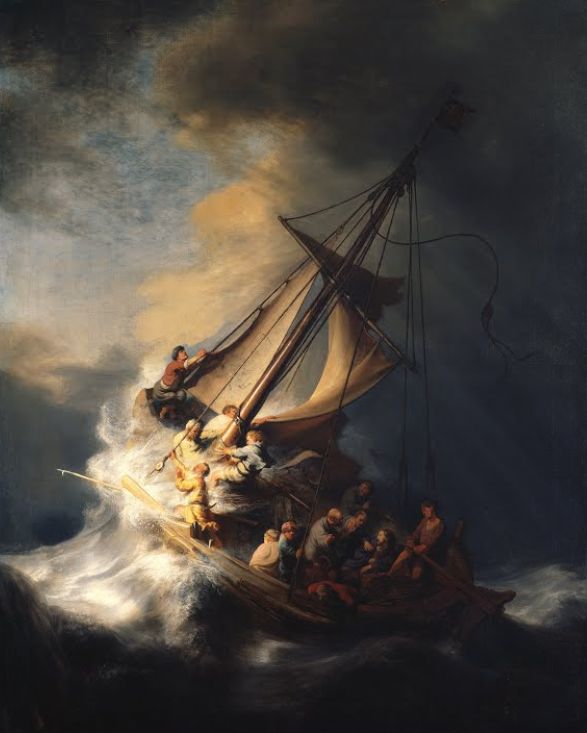
Storm on the Sea of Galilee, by Rembrandt

SCRIPTURE: “And on that day, when evening came, He said to them, “Let us go over to the other side.” And leaving the crowd, they took Him along with them in the boat, just as He was; and other boats were with Him. And a great windstorm arose, and the waves were breaking into the boat so that the boat was already filling up. And Jesus Himself was in the stern, sleeping on the cushion; and they got Him up and said to Him, “Teacher, do You not care that we are perishing?” And He woke up and rebuked the wind and said to the sea, “Silence! Be still.” And the wind died down and it became perfectly calm. And He said to them, “Why are you so cowardly? Do you still have no faith?” And they became very afraid and were saying to one another, “Who then is this, that even the wind and the sea obey Him?” (Mark 4:35-41).


A few things before I move on. These were seasoned fishermen, used to the sudden squalls particular to the sea of Galilee (which is 700′ below sea level). Winds would sweep down the mountain at speed and ruffle the waters of the Sea until the waves were towering and short spaced between each other. For these experienced fishermen to be this scared of a storm, the storm must have been especially ferocious.

But secondly, after Jesus calmed the storm with a word, they became MORE afraid (afraid…’very’ afraid). The word for very is megas, meaning “large, great, in the widest sense.” It’s where we get the word mega from. Their fear changed from a physical danger type fear of the storm to a spiritual fear.

Now for the second passage today, where afterward I’ll compare the two.

Luke 10:38-42: “Now as they were traveling along, He entered a village; and a woman named Martha welcomed Him into her home. And she had a sister called Mary, who was also seated at the Lord’s feet, listening to His word. But Martha was distracted with all her preparations; and she came up to Him and said, “Lord, do You not care that my sister has left me to do all the preparations alone? Then tell her to help me.” But the Lord answered and said to her, “Martha, Martha, you are worried and bothered about so many things, but only one thing is necessary, for Mary has chosen the good part, which shall not be taken away from her.”

Lord do you not care… that we are perishing?’
Lord, do you not care… that I’m overwhelmed and she’s lounging?’

Of course it is a silly question. We see that’s so, once the storm has passed, or once the frustration levels out. Of course the Lord cares. He had just spent the day with the disciples caring for the thousands of sick and possessed. He chose Mary, Martha, and Lazarus’ home because he loved them. Of course He cared. He was on earth because He cared. He faced the cross because He cared.

But aren’t we silly, in our moments of fear and frustration; we lash out at God.

In both those cases of ‘Lord, do you not care?’ the people asking it were looking at another person rather than God. The disciples were looking at each other ‘we are perishing!’ Martha was looking at Mary, not Jesus.

We care for ourselves physically, as does the Lord, but the Lord also wants us to take care of ourselves spiritually. He was gentle with Martha, telling her that Mary chose (CHOSE) to apply herself spiritually while she had the chance, letting the physical needs of cooking and cleaning and serving go by the wayside temporarily.

He was a bit harsher with the disciples. In Mark’s Gospel Jesus asked them why they were so cowardly. In all 3 Gospels where the story is recounted, (Matthew 8:23–27, Mark 4:35–41, and Luke 8:22–25) Jesus asked the men ‘where is your faith?’

The issue at the root of it is, do not let your physical needs, wants, or fears swamp your spiritual strength. If Jesus had intended for all the men to drown in the storm and immediately resurrect them, so be it. If He had intended for them to die and resurrect on Resurrection Day, so be it.

Of course it’s easier said than done. When we get cancer we might cry out “Lord, do you not care?” When the baby dies, “Lord, do you not care”? Our fear and our grief are so large it blots out reason, even sometimes, faith.

Gordon Lightfoot famously asked in his song “The Wreck of the Edmund Fitzgerald: “Does anyone know where the love of God goes when the waves turn the minutes to hours?”

Not that God withdraws His love. He never rescinds the love He has chosen to set upon His children, and for the ones who are not His children, common grace abounds. But that we, in our fear, anger, grief, our frustration, FEEL like God has withdrawn it.

Always choose the better portion. Jesus in effect said this to Peter, who had asked about John. “What about that guy?” Jesus said never you mind about Him, you, follow ME.’ (John 21:22)

We do not resolve our fears by looking to our surroundings or to what other people are doing, but by looking to Jesus.

Look unto me, and be ye saved, all the ends of the earth: for I am God, and there is none else. (Isaiah 45:22 KJV)

Posted in encouragement, Uncategorized

The Galilean fishermen and their boats (and calming of the storm)

One day he got into a boat with his disciples, and he said to them, “Let us go across to the other side of the lake.” So they set out, 23and as they sailed he fell asleep. And a windstorm came down on the lake, and they were filling with water and were in danger. 24And they went and woke him, saying, “Master, Master, we are perishing!” And he awoke and rebuked the wind and the raging waves, and they ceased, and there was a calm. 25He said to them, “Where is your faith?” And they were afraid, and they marveled, saying to one another, “Who then is this, that he commands even winds and water, and they obey him?” (Luke 8:22-25; also Matthew 8:23-27).

Sea of Galilee, at Tiberias. View of ruins at shore of Galilee. 1862.
Public Domain

The Calming of the Storm, a 33-minute sermon on the biblical text of  Luke 8:22-25 from Ligonier Ministries is very good.

The Sea of Galilee is an important location in the biblical history. Jesus displayed His sovereignty over creation on the sea of Galilee when He calmed the storm and rebuked the waves. ‘The wind and waves obey Him!’.

Don’t you find it interesting that seasoned fishermen were afraid for their lives? These were tough men who saw death on a daily basis. Between the high death rate in general in the first century, the daily animal sacrifices, and the naturally high mortality rate due to their profession, they were familiar with terror and the presence of death. Yet in this storm, they were afraid for their very lives.

What’s the Sea of Galilee like? Let’s get a mental picture.

The “sea” is really a freshwater lake. It ranges from 16 miles tall to 9 miles wide. By comparison, Lake Tahoe in the United States is 22 miles long and 12 miles wide. The Sea of Galilee has been given other names, including Lake Gennesaret, and Lake Tiberias.

City of Tiberias – Jewish Fishermen by the Sea of Galilee, Palestine,
a photograph by William H. Rau, 1903. Public domain

The storms on the Sea are legendary. This is because of its geography, which makes it prone to sudden, boiling storms and pitched waves. It sits about 640 feet below the level of the Mediterranean Sea, and it’s surrounded by towering hillsides. Ravines on the Sea’s west side funnel cool air into the basin. When the cool air rushes into hot air rising from the low sea level valley, the resulting clash can create sudden, fierce winds that stir up steep waves. These choppy waves can become big enough to swamp a boat. When you get a steep chop and no space for the waves to become rolling, there’s no time for the boat to climb up one wave and surf naturally down another. The waves simply pound down on its bow, and if caught broadside, the waves can capsize you in a moment. As a former yachtsman, I can attest that there is no worse situation for sailor and boat alike than high winds and a steep chop. The boat takes a severe pounding, as does the helmsman!

In Jesus’ time, a thriving fishing industry was one of the main ways men earned a livelihood in and around that area. Peter, James, and John earned their living as fishermen. The lake yielded many kinds of fish. Three of the most popular were Sardines, Biny fish, and Tilapia, now known as “St. Peter’s Fish”.  According to the Wiki Bible project, “Biny fish are easily identified by the “barbels” or whisker type flesh that hangs from around the mouth. These fish are a hardy fish that was popular for the Sabbath feasts. These Biny fish can usually be found near schools of sardines as they are predatory fish eating everything from snail and mollusks to sardines.”

‘The Storm On The Sea Of Galilee’ By Rembrandt van Rijn

We know that the fishermen were petrified for their lives during the terrible storm. But after Jesus calmed the storm, they became more petrified.

He said to them, “Where is your faith?” And they were afraid, and they marveled, saying to one another, “Who then is this, that he commands even winds and water, and they obey him?” (Luke 8:25).

The word in the verse for afraid is phobēthentes, the main word is phobéō or phobos. You will recognize the English use of the word in ‘phobia’. It means to put to flight, to terrify, frighten. If the men hadn’t been trapped in the boat in the middle of the sea they would have run away! Much like the men did in Daniel 10:7. It is a fearful thing to fall into the hands of the living God. (Hebrews 10:31).

The scene should stir in us an awe and a recognition that there is nothing more terrifying, even waves that swamp your boat, than the living God who created the waves and calms them at a word. The takeaway is that though the waves made the men were fearful for their lives, when Jesus displayed His sovereignty over the creation, they feared for their souls.

He is a great God, powerful, yet kind to His children. Praise His holy name.