By Elizabeth Prata
Say “magnolia” and people automatically think of the South. I grew up in New England I know I certainly did. Never once did I think I’d live in the south, and with a magnolia tree across from my front door no less!
It is a stately tree, solid and aristocratic. Kenneth W. Outcalt wrote about the magnolia grandiflora tree, “Southern magnolia (Magnolia grandiflora), also called evergreen magnolia, bull-bay, big-laurel, or large-flower magnolia, has large fragrant white flowers and evergreen leaves that make it one of the most splendid of forest trees and a very popular ornamental that has been planted around the world.“
The magnolia flower of the grandiflora tree is just as grand as its host. The petals are enormous but velvety and have a rich ivory color. I don’t have a sense of smell so I can’t tell you directly. Locals say it smells great. Apparently the scent varies, it can smell like lemons, or violets, or vanilla.
Like the magnolia blossom’s physical scent, we humans emit a spiritual scent.
And walk in love, as Christ loved us and gave himself up for us, a fragrant offering and sacrifice to God.” (Ephesians 5:2).
“But thanks be to God, who always leads us as captives in Christ’s triumphal procession and uses us to spread the aroma of the knowledge of him everywhere. For we are to God the pleasing aroma of Christ among those who are being saved and those who are perishing.” (2 Corinthians 2:14-15)
Magnolia blossoms are blooming now. The trees are so tall, and most of the blossoms are far above my head, making a close inspection difficult. However this year, there was one bloom that was at eye level. With the flowers being so large and beautiful and emblematic of an entire region of the south, and a blossom blooming literally before my eyes, I decided to photograph one blossom each day for its entire life cycle.
The blossom here as it appears initially is tightly wound, straight as an arrow, and contains no hints of the surprise inside.
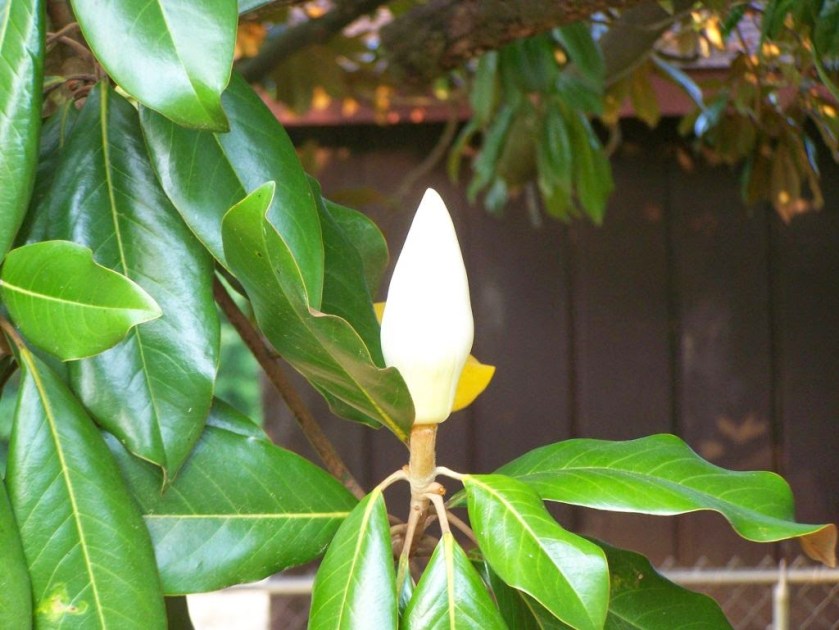
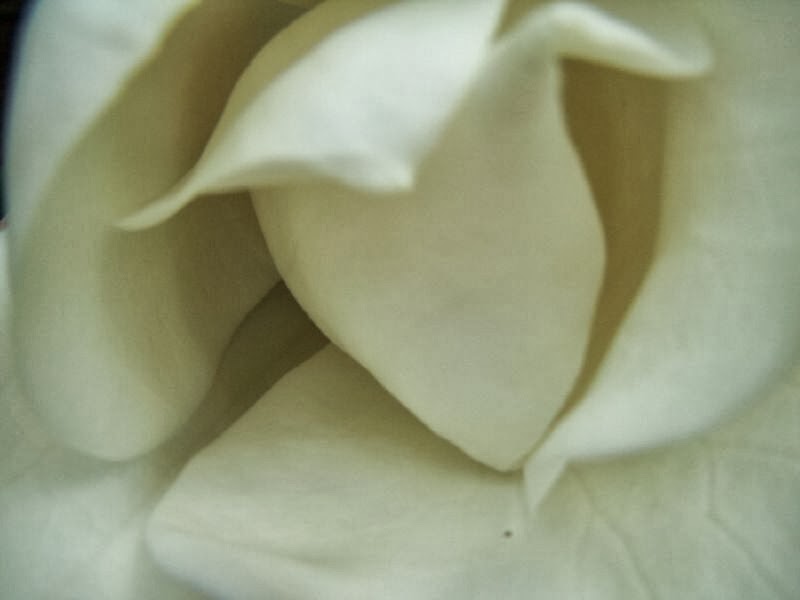
It popped open! Revealing more layers! How pretty!
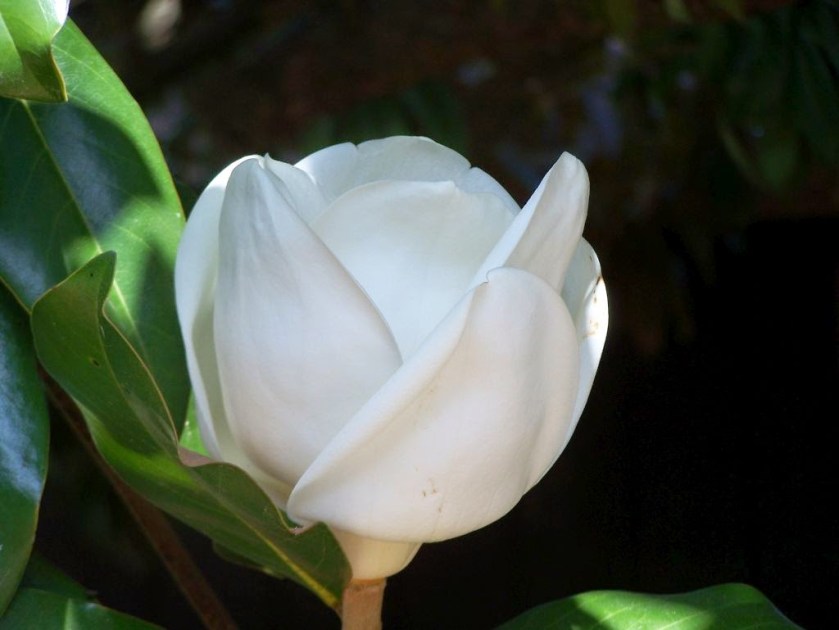
Each petal is larger than my entire hand. The color ranges from white to ivory and the entire blossom looks so stately.
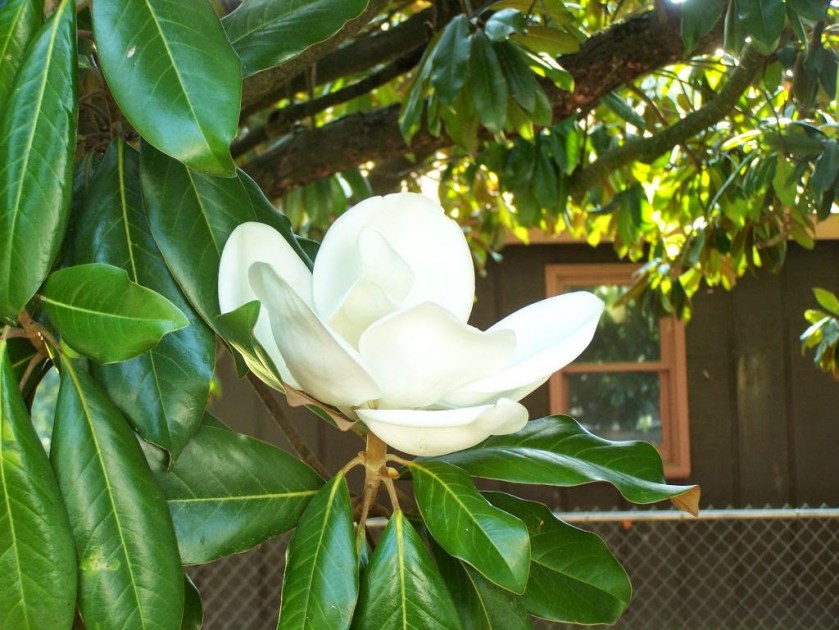
The petals are revealing a surprise inside!

The petals are velvet-y.
Now the petals are turning brown, barely hanging on to the stem, speckled on the edge with more brown. The leaves immediately under the blossom are dead. Bugs were crawling over the petals, looking for a good place to stake a claim to start munching.
Four days, that is all it took for the bloom to appear in its final form, open, live, and die. I was so surprised. There are many blooms on the tree, and I just assumed that they lasted a while. I’d never tracked just one. Its life is so short, a mere breath.
I was pondering that for a while today. What seemed so strong and beautiful was only a few days later fodder for death, decay, and insects. In addition, what was presented so starkly to me in the story of the magnolia is something that is repeated in our human body and our short lives. Most of us live more than 4 days, but to God, our life is a mere vapor, a mist.
“yet you do not know what tomorrow will bring. What is your life? For you are a mist that appears for a little time and then vanishes.” (James 4:14)
“You have made my days a mere handbreadth; the span of my years is as nothing before you. Everyone is but a breath, even those who seem secure.” (Psalm 39:5)
So what are we going to do with the time afforded us on our short time on earth?
“Therefore be careful how you walk, not as unwise men but as wise, making the most of your time, because the days are evil.” (Ephesians 5:15-16)
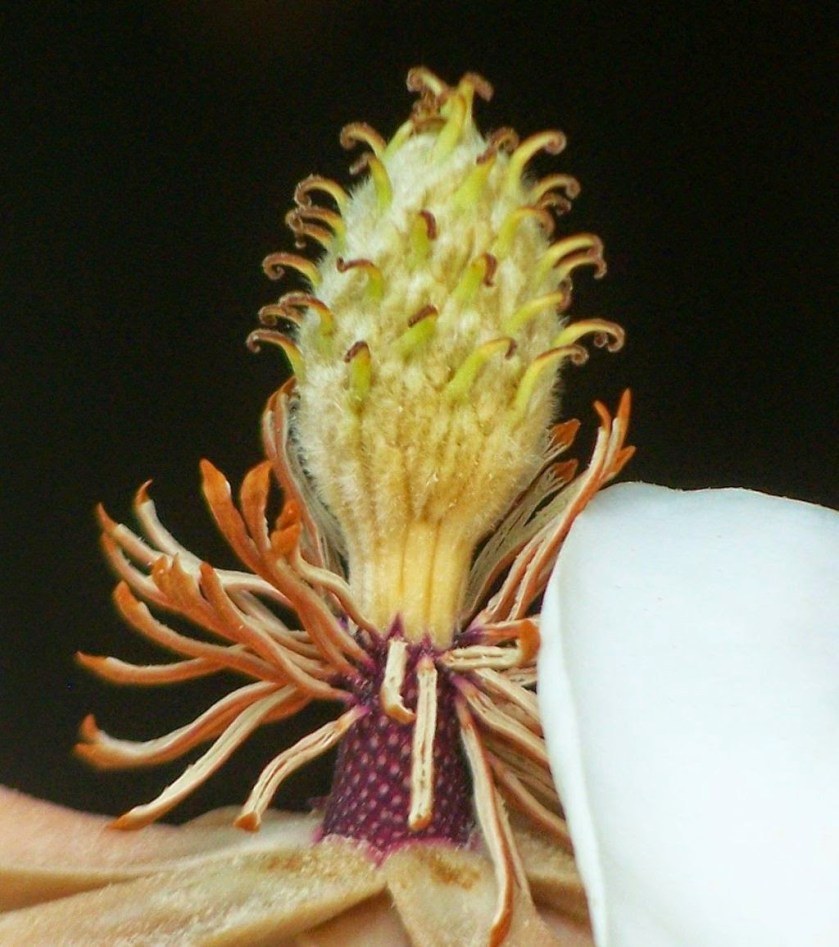
Once the petals fall away the seed inside is fully revealed. The magnolia fruit will continue to dry out, and eventually open, revealing tiny red seeds. These drop to the ground-
 |
| Mature Magnolia fruit just starting to open, with a few seeds visible. Wikimedia Commons |
One botanist wrote that it hardly seems credible that such a large tree could come from such a small seed.
Paul wrote about how our body is a seed, a mere kernel.
The Resurrection Body
“35But someone will ask, “How are the dead raised? With what kind of body do they come?” 36You foolish person! What you sow does not come to life unless it dies. 37And what you sow is not the body that is to be, but a bare kernel, perhaps of wheat or of some other grain. 38But God gives it a body as he has chosen, and to each kind of seed its own body. 39For not all flesh is the same, but there is one kind for humans, another for animals, another for birds, and another for fish. 40There are heavenly bodies and earthly bodies, but the glory of the heavenly is of one kind, and the glory of the earthly is of another. 41There is one glory of the sun, and another glory of the moon, and another glory of the stars; for star differs from star in glory.”
“42So is it with the resurrection of the dead. What is sown is perishable; what is raised is imperishable. 43It is sown in dishonor; it is raised in glory. It is sown in weakness; it is raised in power. 44It is sown a natural body; it is raised a spiritual body. If there is a natural body, there is also a spiritual body. 45Thus it is written, “The first man Adam became a living being”; the last Adam became a life-giving spirit. 46But it is not the spiritual that is first but the natural, and then the spiritual. 47The first man was from the earth, a man of dust; the second man is from heaven. 48As was the man of dust, so also are those who are of the dust, and as is the man of heaven, so also are those who are of heaven. 49Just as we have borne the image of the man of dust, we shall also bear the image of the man of heaven.” (1 Corinthians 15:35-49)
Dried out and used up, the small seeds inside the husk have all spilled out and are doing their job in planting themselves into the ground for the next cycle.

When the magnolia seed drops to the ground it is a bare kernel, it looks nothing like what it will become. It is red, the flower is white. It is small, the flower is large. It has no smell, the magnolia scent is lovely. The mature blossom lives a short time, bearing witness to the Creator, who is pleased with its beauty and scent, and then it dies. It endures decay and becomes bug-eaten and eventually, dust. (Ecclesiastes 3:20).
The parallel to people is the same. Our lives are short and ends in decay. While we are living we have a job to do, glorify the Creator and testify to His works. Will we redeem the time? Is our Lord pleased with our aroma? When we awaken to receive our final bodies, will it be to shame and contempt or to everlasting life? (Daniel 12:2).
“Do not be amazed at this, for a time is coming when all who are in their graves will hear his voice.” (John 5:28)
I pray you are awakened to eternal life, saved by thegrace of our Lord, working to redeem the time on His behalf. Because, it bears repeating,
And walk in love, as Christ loved us and gave himself up for us, a fragrant offering and sacrifice to God.” (Ephesians 5:2)


