Posted in theology

The Foundation of True Freedom

By Elizabeth Prata

John Witherspoon. Have you ever heard of him? I hadn’t either. I was reading the Chapel Library’s newsletter and the current issue of their Free Grace Broadcaster, #276 Summer 2026, and Witherspoon is mentioned.

He signed the Declaration of Independence, the only minister to do so. He was President of Princeton University, a Presbyterian, and insightful about the future of the fledgling nation. On May 17, 1776, Witherspoon preached a sermon at Princeton, titled “The dominion of providence over the passions of men.”

EPrata photo

He spent some time preaching individual repentance, then, knowing war loomed, went on to urge his listeners as to their duty as to public virtue and the pursuit of. We love our country by loving God and others:

What I have here in view is to point out to you the concern which every good man ought to take in the national character and manners, and the means which he ought to use for promoting public virtue, and bearing down impiety and vice. This is a matter of the utmost moment, and which ought to be well understood, both in its nature and principles.

Nothing is more certain than that a general profligacy and corruption of manners makes a people ripe for destruction. A good form of government may hold the rotten materials together for some time, but beyond a certain pitch even the best constitution will be ineffectual, and slavery must ensue. On the other hand, when the manners of a nation are pure, when true religion and internal principles maintain their vigour, the attempts of the most powerful enemies to oppress them are commonly baffled and disappointed. …

What follows from this? That he is the best friend to American liberty, who is most sincere and active in promoting true and undefiled religion, and who sets himself with the greatest firmness to bear down profanity and immorality of every kind. It is therefore your duty in this important and critical season, to exert yourselves every one in his proper sphere to stem the tide of prevailing vice, to promote the knowledge of God, the reverence of his name and worship, and obedience to his laws. —end Witherspoon excerpt.

EPrata photo

What IS our national character? A love of liberty foremost, coupled with a reverence for law and the order it brings-

The Declaration of Independence, Thomas Jefferson famously wrote, was “intended to be an expression of the American mind.” Although not intended as such, it was also an expression of the American character.Invoking the right to revolution, or its corollary—the right to civil disobedience—was, and should remain, a last resort. The American character delicately balances the love of liberty with a reverence for the law. We Americans, Tocqueville observed, are animated by “a virile love of order.” The elusive art of self-government lies in this capacity to prevent the spirited attachment to liberty from becoming unruly by reconciling it to the gentle yoke of the law. ~David Azerrad, at The Heritage Foundation

We see today that the delicate balance for personal liberty and a love of general order based on law is disrupted.

Azerrad continues:

Throughout human history, the two have rarely co-existed. Many have won their freedom. Few then succeeded in governing themselves. It is much easier to topple a dictator than to ingrain in the minds of people respect for the law and to cultivate their vigilant and manly spirit.

Yes indeed. This is true. And yet America has governed itself for 250 years this July. No doubt, however, we have degraded from the days of the Founding Fathers’ minds and hearts and wisdom…

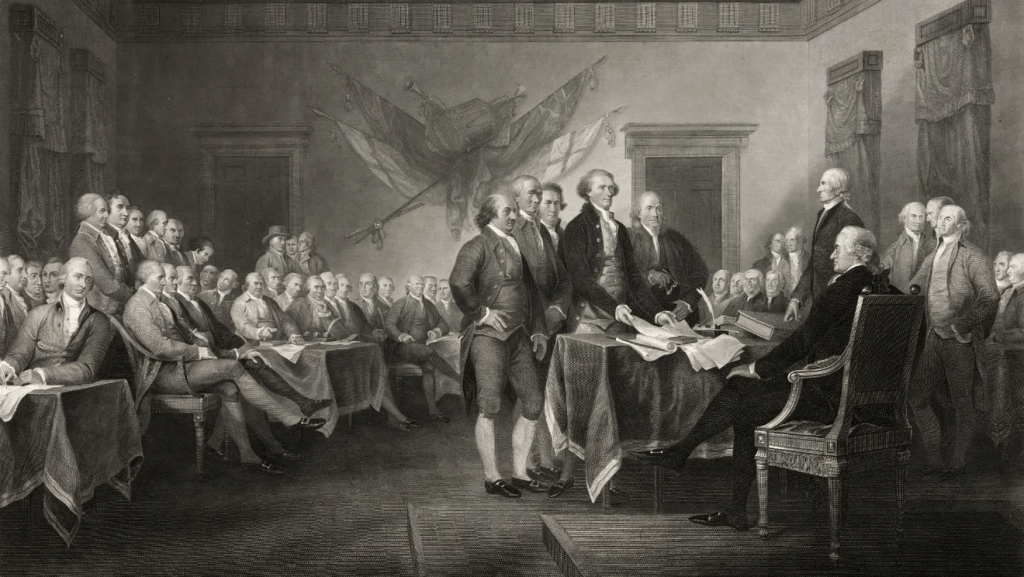
This image is of John Trumbull’s famous painting, Declaration of Independence, which depicts the five-man drafting committee presenting their draft to the Congress (not the actual signing). Here is a link to short bios of the 56 people who signed

Witherspoon reminds us, “Honest attention to the ravages of lawless power in history and the world today ought to humble us in the dust.

Will we never take the example of other countries what have fallen from vice and dissipation? George Santayana famously said that Those who cannot remember the past are condemned to repeat it.

Witherspoon mentioned the law.

The law of God is over all. We love God’s Law and we love God’s Gospel because we love Christ. Witherspoon preached: “In all of history, there is not a single example of civil liberty being lost while religious liberty was still completely preserved. If therefore we give up our temporal property, we at the same time deliver the conscience into bondage.

But Witherspoon reminded his hearers, many of whom would soon go into battle, to remember –

I believe pride and self-confidence are a terrible insult to God’s providence, and when it spreads and affects the attitude of a body of people, it is a forerunner of destruction.

We here in America have been blessed with protection from invasion, military might, given a flourishing economy, brilliant minds to invent comforts of life from which we all benefit. Witherspoon’s men fought and won this for us. And yet any one person dwelling in this here free and flourishing land is a captive, a slave, and certainly in bondage if their soul has not been liberated by Christ.

As Witherspoon’s men faced war and revolution and death, he begged them to remember their soul, saying,

As you advance in life, one sin may replace another and hold its place, but only the sovereign grace of God can produce the saving change of heart and disposition. Only the sovereign grace of God can make you fit for His very presence.

This is TRUE liberty. Liberty of the soul from its bondage to sin. If the soul is freed by Jesus, then despite any outward circumstance, we are genuinely free.

It was for freedom that Christ set us free; therefore keep standing firm and do not be subject again to a yoke of slavery. (Galatians 5:)

Posted in encouragement, Uncategorized

Praise for the Light

By Elizabeth Prata

Before I was saved I breathed in the air of common grace, grace that is filled with the creation knowledge of Him. It was poison to my lungs. I flopped around like a caught fish on the deck, breathing grace but longing for the murky waters to envelop me once again, the weeds wrapping around my head, because I loved the darkness. (cf Jonah 2:5b)

And this is the judgment: the light has come into the world, and people loved the darkness rather than the light because their works were evil. (John 3:19).

as it is written:

None is righteous, no, not one;
no one understands;
no one seeks for God.
(Romans 3:10)

And yet He loved me, a sinner, and set me upright, washed me, had given gave me common grace all my unsaved life and now added saving grace to my soul.

For the law of the Spirit of life has set you free in Christ Jesus from the law of sin and death.(Romans 8:2).

After salvation I breathe in the sweetness of special grace, the savor of Jesus and His sanctifying work of atonement. The Light came.

Posted in end of days, end of days. prophecy

When the Scales Fell: Meeting the Jesus Who Always Was

By Elizabeth Prata

Before I was saved, the whole Jesus thing was pretty mystifying to me. It seemed so complicated, and weird, too. I mean, the blood and everything. [shudder]. And I definitely did not agree with the doctrine of sin, that notion that I was a bad person from birth and that I did or said or thought wrong things? Come ONNNN, man. I’m a nice person, not one sin in me. Not like that person over there. Or there. Or there…

The thing I thought was most weird was Jesus. I used to wonder, God must be pretty lame to keep trying things that don’t work. Humanity was created and then right away, fell into depravity. They got so bad that He sent the flood. Then He tried the temple and the Law and that didn’t work. So finally He sent Jesus, hoping that would stick. I’m not kidding. Before I was saved, and the scales fell from my eyes, that is what I thought.

I never knew that Jesus was not first born 2000 years ago.

Therefore it is of particular joy to me that I revel in verses that illustrate that Jesus was from the beginning. He wasn’t non-existent then born on that cold night in Bethlehem when the angels proclaimed His arrival to the shepherds. He was with God from the beginning.

In the beginning was the Word, and the Word was with God, and the Word was God. He was with God in the beginning.” (John 1:1) How lovely to reflect the same language God used in Genesis 1: “In the beginning…”

“I was appointed from eternity, from the beginning, before the world began.” (Proverbs 8:23).

As Matthew Henry says, “The Son of God declares himself to have been engaged in the creation of the world. How able, how fit is the Son of God to be the Saviour of the world, who was the Creator of it! The Son of God was ordained, before the world, to that great work. Does he delight in saving wretched sinners, and shall not we delight in his salvation?” How wonderful that Jesus was anointed from the beginning to do the great and monumental work of saving humanity.

And he is before all things, and by him all things consist.” (Colossians 1:17).

Other versions say “in Him all things hold together.” He is not only before all things in honor and grandeur, but He is before all things in existence. Before the sun, before the earth, before the stars were made…He was, and is and is to come!

He is our timeless Jesus, who was before Abraham, before John (His forerunner), who was part of God’s plan since the beginning to redeem humanity to His bosom. Far from being a series of stumbling lurches toward the end of time, God and Jesus and the Holy Spirit are progressing in an orderly plan that is unfolding with humanity as its central work. His justice prepared this plan. His love has sustained this plan. His grace permeates this plan. His longsuffering has kept this plan. And in the end, His wrath will execute this plan.

THIS is the God I fully hurl myself toward, lovingly and fully, submitting to His attributes and His incomprehensible foreknowing. He knew I would. He knew that on the appointed moment I would become His. It was His plan all along.

He was since the beginning. You may be coming late to the party, but you still have time until you draw your last breath to become a knowing participant in His plan and to be saved from your sins by repenting of them. His love never fails.

For now we see in a mirror dimly, but then face to face; now I know in part, but then I will know fully just as I also have been fully known. But now faith, hope, love, abide these three; but the greatest of these is love.” (1 Corinthians 13:12-13).

Posted in encouragement, Uncategorized

Advent: Thirty Days of Jesus: Day 26, Jesus’ sinlessness

By Elizabeth Prata

This section of verses that show Jesus’ life are focused on His attributes. In His earthly ministry we’ve seen Him as servant, teacher, shepherd, intercessor, and healer. We then looked at His attributes of omniscience, His authority, and now His sinlessness.

He came from glory where righteousness reigns. He descended to an earth that’s cursed where every single human is depraved, thoroughly drenched with a sin nature. He lived among us, sinlessly and perfectly fulfilling the Father’s commands for righteous living. He did this at every moment in every way. Not one blot, not one thought, not one act of anything less than perfection.

For this, He was reviled, mocked, hated, and killed.

He did it for us.

thirty daysof jesus 26

~~~~~~~~~~~~~~~~~~~~

Further Reading:

The Cripplegate/Nate Busenitz: In what way was Jesus ‘made sin’ on the cross? Excerpt:

In what sense did Jesus become “sin on our behalf”? Does that phrase mean that Jesus literally became a sinner on the cross? …

Based on the above passages, we can safely determine what 2 Corinthians 5:21 does not mean. It cannot mean that Jesus became unrighteous, or that He became a sinner, or that He took on a sin nature, or that He literally embodied sin. … So, then what does it mean? This brings us to our third point. … 3. The best way to understand Paul’s statement (that Jesus became sin on our behalf) is in terms of imputation. Our sin was imputed to Christ, such that He became a substitutionary sacrifice or sin offering for all who would believe in Him.

GotQuestions: Why does Christ’s righteousness need to be imputed to us?

On the cross, Jesus took our sin upon Himself and purchased our salvation. We have “been justified by his blood” (Romans 5:9), and part of that justification is an imputation of His own righteousness. Paul puts it this way: “For our sake [God] made [Jesus] to be sin who knew no sin, so that in him we might become the righteousness of God” (2 Corinthians 5:21). Jesus is righteous by virtue of His very nature—He is the Son of God. By God’s grace, “through faith in Jesus Christ,” that righteousness is given “to all who believe” (Romans 3:22). That’s imputation: the giving of Christ’s righteousness to sinners.

Ligonier: Jesus’ Sinless Life
Jesus lived a representative life. Jesus lived a sinless life, and it was, therefore, a life of representative sinlessness. Our Lord’s obedience stands in the place of His people’s sin. His law-keeping is counted as the law-keeping of those who have faith in Him.

~~~~~~~~~~~~~~~~~~~~

Thirty Days of Jesus Series-

Introduction/Background

Prophecies:

Day 1: The Virgin shall conceive
Day 2: A shoot from Jesse
Day 3: God sent His Son in the fullness of time
Day 4:  Marry her, she will bear a Son

Birth & Early Life-

Day 5: The Babe has arrived!
Day 6: The Glory of Jesus
Day 7: Magi seek the Child
Day 8: The Magi Offer gifts & worship
Day 9: The Child Grew
Day 10- the Boy Jesus at the Temple
Day 11: He was Obedient

The Second Person of the Trinity-

Day 12: The Son!
Day 13: God is pleased with His Son
Day 14: Propitiation
Day 15: The Gift of Eternal Life
Day 16:  Kingdom of Darkness to Light
Day 17: Jesus’ Preeminence
Day 18: The Highest King
Day 19: He emptied Himself
Day 20: Jesus as The Teacher
Day 21: The Good Shepherd
Day 22: The Intercessor
Day 23: The Compassionate Healer

Attributes

Day 24: Jesus’ Omniscience
Day 25: Jesus’ Authority

Posted in advent, theology

Advent, Thirty Days of Jesus: Day 14, Propitiation

By Elizabeth Prata

Propitiation. A hard word to pronounce…and a hard word to understand, but we have to try, since today’s verse of 1 John 4:10 says this is the reason God sent His son.

In this is love, not that we loved God, but that He loved us and sent His Son to be the propitiation for our sins. (1 John 4:10).

PROPITIATION: An offering that turns away the wrath of God directed against sin. According to the NT, God has provided the offering that removes the divine wrath, for in love the Father sent the Son to be the propitiation (or atoning sacrifice) for human sin (1 John 4:10). Source: Pocket dictionary of theological terms (1996).

by which it becomes consistent with his character and government to pardon and bless the sinner. The propitiation does not procure his love or make him loving; it only renders it consistent for him to exercise his love towards sinners. In Easton’s Illustrated Bible Dictionary. (1893)

The Easton’s definition uses the word ‘consistent’. God is able to do anything but it would not be consistent with His holy character to abandon his promise to punish wrongdoers for their sin. He could turn away His wrath by deciding to do so, but it would destroy His perfectly just nature to be inconsistent. No, God is consistent, Jesus Christ is the same yesterday and today, and forever. (Hebrews 13:8). “For I the Lord do not change; therefore you, O children of Jacob, are not consumed“. (Malachi 3:6).

So He sent His Son to be that sacrifice and absorb God’s wrath for our sins, though Christ was sinless.

thirty days of jesus day 14 propitiation

Further Reading

GotQuestions: What is Propitiation?
The word propitiation carries the basic idea of appeasement or satisfaction, specifically toward God. Propitiation is a two-part act that involves appeasing the wrath of an offended person and being reconciled to him.

Ligonier Ministries: What Do Expiation and Propitiation Mean?
Let’s think about what these words mean, then, beginning with the word expiation. The prefix ex means “out of” or “from,” so expiation has to do with removing something or taking something away. In biblical terms, it has to do with taking away guilt through the payment of a penalty or the offering of an atonement. By contrast, propitiation has to do with the object of the expiation.

Bible Hub Topical Bible- Propitiation
That by which God is rendered propitious, i.e., by which it becomes consistent with his character and government to pardon and bless the sinner. The propitiation does not procure his love or make him loving; it only renders it consistent for him to execise his love towards sinners.

Posted in theology

Where is joy?

By Elizabeth Prata

EPrata photo

AW Pink wrote about Joy. He said in “The Scriptures and Joy

The ungodly are ever seeking after joy, but they do not find it: they busy and weary themselves in the pursuit of it, yet all in vain. Their hearts being turned from the Lord, they look downward for joy, where it is not; rejecting the substance, they diligently run after the shadow, only to be mocked by it. It is the sovereign decree of heaven that nothing can make sinners truly happy but God in Christ; but this they will not believe, and therefore, they go from creature to creature, from one broken cistern to another, inquiring where the best joy is to be found. Each worldly thing that attracts them says, “It is found in me”; but soon it disappoints. Nevertheless, they go on seeking it afresh today in the very thing that deceived them yesterday. If after many trials they discover the emptiness of one creature comfort, then they turn to another, only to verify our Lord’s word, “Whosoever drinketh of this water shall thirst again” (John 4:13).”

I have found this to be true. I searched for lasting joy unknowingly and then later, knowingly. I had achieved all my goals, graduated from college, was married, owned a home, had the job I wanted..but I was never lastingly happy. I could not figure out why.

Temporarily, yes. I’d be happy with a professional success, a compliment, joke. Unsaved people are happy, happiness is not foreign to humans. But where was true joy? A lasting joy that went down to the bones? Not to be found.

When I was approaching the cross, a process that took about two and a half years, I was also learning the craft of bookbinding. I found it easier to put my thoughts and feelings into picture form. Unknown to me, the Holy Spirit was starting to infuse biblical allusions and metaphors into my mind that came out in my art. Later after salvation when I read the Bible, I would constantly go, “Oh, so THAT’S what that meant!’ I used the metaphors of flies, shepherds, lions, angels, walk, transform, kingdom, etc.

I wrote a little picture book about a girl who was looking for the kingdom, who was always thirsty, who was unsatisfied but had nothing visible to be unsatisfied about, who tried to find the ‘map’ leading her to the kingdom but frustratingly could not find it.

I learned at the time of my repentance, of course, that the visible will not lead me to the Kingdom. Invisible sin is the problem, which I learned when the Lord sent some saved people into my life to explain the Gospel and answer questions I had about the Bible (mostly about Creation and the earth).

but whoever drinks of the water that I will give him shall never be thirsty; but the water that I will give him will become in him a fountain of water springing up to eternal life. (John 4:14).

Pink wrote:

It is not a carnal joy that we are here urging, by which we mean a joy that comes from carnal sources. It is useless to seek joy in earthly riches, for frequently they take to themselves wings and fly away. Some seek their joy in the family circle, but that remains entire for only a few years at most. No, if we are to “rejoice evermore,” it must be in an object that lasts for evermore.

Jesus and the word of God illuminated by the Holy Spirit is that joy.

I’ll finish with Pink-

The spring of joy is faith: “Now the God of hope fill you with all joy and peace in believing” (Romans 15:13). There is a wondrous provision in the gospel, both by what it takes from us and what it brings to us, to give a calm and settled glow to the Christian’s heart. It takes away the load of guilt by speaking peace to the stricken conscience. It removes the dread of God and the terror of death that weighs on the soul while it is under condemnation. It gives us God Himself as the portion of our hearts, as the object of our communion. The gospel works joy because the soul is at rest in God.


Bio of Arthur W. Pink (1886-1952).

Chapel Library’s mission statement: Our purpose is to humble the pride of man, to exalt the grace of God in salvation, and to promote real holiness in heart and life, by sending Christ-centered materials from prior centuries worldwide without charge.

Posted in theology

Essential Elements of the Gospel Message

By Elizabeth Prata

At an event broadcast worldwide recently, numerous speakers were said to have given the Gospel to the attendees and remote hearers by video. We rejoice when so many hear the Gospel. We pray after these events that seeds will take root and break stony hearts into soft, loving, faithful hearts.

Some presentations of the Gospel were given more eloquently and some less eloquently. A few contained most of the elements of the Gospel and some contained less. So, what are the elements of the Gospel? What is necessary for the unsaved to hear in order for the gospel message to do its work?

Continue reading “Essential Elements of the Gospel Message”
Posted in end time, prophecy

The Impact of Christ’s Conversation with the Samaritan Woman

By Elizabeth Prata

SYNOPSIS

The passage from John 4:1-42 highlights the woman at the well’s encounter with Jesus, emphasizing her past sins and His offer of redemption. This essay reflects on personal accountability before Christ, stressing that both believers and unbelievers must face Jesus their deeds. Believers are not judged, but are assessed for the quality of their works in Christ, which determines their rewards.

Continue reading “The Impact of Christ’s Conversation with the Samaritan Woman”
Posted in theology

The Grief and Reality Behind Burning Man’s Celebration

By Elizabeth Prata

SYNOPSIS

Burning Man, an annual event in Nevada’s Black Rock Desert, showcases a temporary city of self-expression and artistic endeavor, rooted in principles of radical participation and self-reliance. However, it also reveals deep spiritual emptiness, with many attendees searching for meaning and purpose, unaware of their need for spiritual fulfillment through Christ.

Continue reading “The Grief and Reality Behind Burning Man’s Celebration”