Posted in theology

Do you have any Grey Poupon? A Sailing Story

By Elizabeth Prata

I was watching the “Best Commercials Ever” show the other day. Such memories. I had forgotten all about the two guys in separate limos, one asked the other through rolled down window, “Do you have any Grey Poupon?” It reminded me of the time…

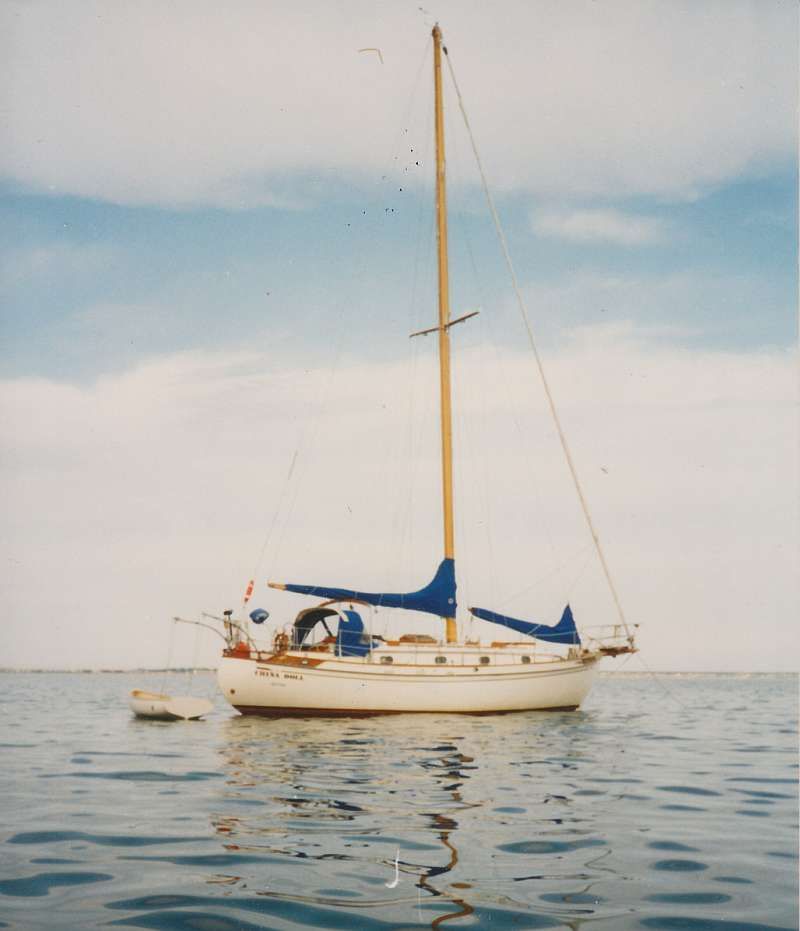
Our sailboat at anchor

…My former husband and I were live-aboard boaters, cruising the US coast and Bahamas. We were anchored in Inner Baltimore Harbor on a hot, hot Memorial Day morning. Baltimore is a nice little harbor but nearly 300 years of active marine use, combined with oozy, light Chesapeake mud, made for a very tenuous holding ground. We’d spent hours sweating and setting the anchor just right amid the growing number of boats also trying to find a spot to anchor. There was no breeze and the no-see-ums were eating us up. Safety, first, though. We finally got situated the way we wanted, appropriately distant from other boats and holding solidly. We went ashore to explore, walking around and heading for the city. I looked back one last time before the harbor disappeared from our view. “Who’s that on our boat!?”

A drunk houseboat driver had run over our anchor line and his prop was now snarled. He’d dislodged the anchor and now our two boats were drifting in tangled tandem. He had boarded our boat to try and untangle. It took us many hours to get things right, which included negotiating with an angry drunk, walking a long way to the boat store in 100 degree heat to buy another anchor line, and going through the re-anchoring process all over again, made harder since the harbor was more crowded now.

The harbor was afloat with many vessels, yachts, large and small power boats, jetskis, and those double seater paddle boats you can rent. It was festive, but busy. Finally we settled down with an ice tea under the sunshade. We breathed out and looked at each other, ready to declare this the most difficult and annoying anchorage ever. Then, THUNK. Jangled by our hard day, we scrambled to the bow where the noise came from. Looking over the railing we saw a rental paddleboat with two teenage boys who’d paddled UP our anchor line and were now half in and half out of the water, hanging on our just reset line. Innocently, they looked up at us and we looked back down at them. For a moment there was complete silence and held breaths. They broke the silence first, laughing, “Do you have any Grey Poupon?”

My husband didn’t think that was funny. But I did. (The Poupon question is a throwback to 1980s commercials for the French mustard).

I was cleaning up and organizing my computer files and found that story I’d written. That incident occurred before I was saved. But it got me thinking about the sin in others’ lives. We often speak of our own sin, and that is right and proper. But sometimes when we are walking well, secured, and dwelling in placid waters for a season, someone else’s sin disrupts us. We get entangled in their issue. We can drift.

Maybe (sadly) your spouse cheated. Maybe someone at work embezzled and you were accused for a time. Maybe a drunk driver smashed your car. Someone else sinned and you, though not innocent of all sin, for that moment, were living holy and walking right.

The impacts of someone else’s sin can entangle us, and can drag us into dangerous waters. We might become angry, resentful, bitter, jealous. We might begin to sin in other ways, justifying it because the origin of the negative circumstances was caused by someone else.

We live in a sinful world. Other peoples’ sin is going to impact us. I was proud of the way my husband handled it. (He wasn’t saved either). He didn’t get angry at the man, but persistently and doggedly stayed in communication until the drunk man’s wrong was made right. It did ruin our weekend though, caused us distress, and interrupted our safety for a time. And that was just a minor mishap. Never mind if the other person’s sin destroys a relationship, ends a life, or causes you to doubt God in anger.

How we handle negative impacts of other peoples’ sin is an indicator of the strength of our own walk. Have we absorbed enough scripture so that it will steady us when a life-comet hurtles into our own placid waters to interrupt the equanimity? Do we have a good prayer life so our first thought it so take it to Jesus and not take it out on the other person?

Do you have any Grey Poupon?

Further Resources

A trusted long time reader of my blog had it pop up hours after reading your essay, providential! Here is a short short from Pastor Adrian Rogers of the Ministry Love Worth Finding:

Sin Never Hurts Just One Person 

Posted in theology

Steady as a Rock at the Helm: A Sailing Story

By Elizabeth Prata

Valley of Vision, “Voyage”

VOYAGE

O LORD OF THE OCEANS,

My little boat sails on a restless sea,
Grant that Jesus may sit at the helm and steer me safely;
allow no adverse currents to divert my heavenward course,
let not my faith be wrecked amid storms and shoals;
bring me to harbor with flying pennants,
hull unbreached, cargo unspoiled.

I ask great things,
expect great things,
shall receive great things.

I venture on You wholly, fully,
my wind, sunshine, anchor, defense.

The voyage is long, the waves high, the storms pitiless,
but my helm is held steady,
Your Word secures safe passage,
Your grace wafts me onward,
my haven is guaranteed.

This day will bring me nearer home,
Grant me holy consistency in every transaction,
my peace flowing as a running tide,
my righteousness as every chasing wave.

Help me to live circumspectly,
with skill to convert every care into prayer,
Halo my path with gentleness and love,
smooth every asperity of temper;
let me not forget how easy it is to occasion grief;
may I strive to bind up every wound,
and pour oil on all troubled waters.

May the world this day be happier and better because I live.
Let my mast before me be the Savior’s cross,
and every oncoming wave the fountain in His side.

Help me, protect me in the moving sea
until I reach the shore of unceasing praise.

From The Valley of Vision, A Collection of Puritan Prayers and Devotions


The Bible is full of agricultural metaphors and references. Many of these are lost on me because I never gardened and I’m unfamiliar with animals. But researching them is fun and learning the meaning behind them gives greater meaning of the word of God. That’s a good thing.

However, when the Bible gives sailing metaphors, I am so happy because I have experience with those! I was a mariner for 2 years, living on our own 37′ sailboat. We sailed from Maine to the Bahamas and back, and then turned around and did it again. I’ve been in storms, wind, lee shores, drifted away, rocks, peril, calm seas, and all the rest.

We sailed about 12,000 nautical miles.

So I was preparing to launch off on our sailing voyage. I had a lot of experience with being on the water, having grown up in The Ocean State of Rhode Island. My grandparents had a house on the Bay and we were always messing about in boats. But they were rowboats or motorboats. I had little experience sailing. To prepare for our own voyage on the sailboat, I decided to take a sailing course from the Annapolis Sailing School. It was a four day journey from Tampa, Florida to the Dry Tortugas and back, captained by an experience sailor who would teach the students who signed up. I was the only woman, and there were 2 other guys plus the captain.

From Tampa to Dry Tortugas is about 150 nautical miles. We’d be making an overnight passage after pulling in to Venice, Fl for a short replenishment.

The area around the Dry Tortugas is shallow with shoals. That means we could go aground if we strayed from the navigable channel.

Source. Lighter blue water is shallower. It gets lighter blue until it’s white; which is shallowest of all, sand!
source. Not our boat. Landscape-about 2′ above sea level. Hard to see in the dark or even the daylight. Navigation needs to be precise or you’ll miss the island completely & be in Cuba before you know it

We ran into some technical trouble. My voyage was 33 years ago so I can’t quite remember what it was. The Global Positioning System (GPS) had been invented but it was military use only at that point. We relied on the old Loran, and as a backup, Radio Direction Finder (RDF).

The weather kicked up. Of course. Just as the boat was in trouble, the weather turned nasty. Waves piled up. Because we had to pull into Venice to get fixed, and took off again, we wound up approaching the Dry Tortugas at night. Not good.

I was steering. The captain talked me in to the harbor. The two men were on the bow as lookout for shoals and shallow water. The captain would take a reading (with the notoriously unreliable RDF) and tell me what compass direction to steer. It was hard because the waves and currents wanted to push me off.

We were white-knuckling it like that for a long time. At one point, the Captain gave me a compliment. It stands even 33 years later as one of the top compliments in my life:

“You’re steady as a rock at the helm.”

That meant a lot to me. I had worked hard to adhere to his guidance and directions in order to make harbor safely.

As with all my sailing stories, I try to compare to my Christian life. The experiences I had during my traveling years (the ones I call my Ecclesiastes, ‘striving after wind years’) were lessons. What lesson can I learn from the drama of the risky passage to the Dry Tortugas?

Unexpected things happen as we go through the days of our life. Shoals, storms, nightfall, rocks, boat failures…But I had a compass and a knowledgeable captain talking me in. Our Lord gave us His word and His Spirit to talk us in to safe harbor. What we need to do is steer by that. On our own, we hit the rocks, go aground, get in all sorts of trouble…the only reliable guide is Jesus. His harbor is small and the way is difficult and narrow. Usually there will be a storm…or two…or a hundred. There is only one way to get there. Abandoning His word for our own ideas on how to steer will only bring trouble. Be steady as a rock at the helm, relying on THE Rock!


OTHER SAILING STORIES

Anchor: A Sailing Story

Marooned with husband: A Sailing Story

The First Forced Isolation & Cabin Fever: A Sailing Story

The Storm of the Century: A Sailing Story

Dock Queens: A Sailing Story

Drifting Away: A Sailing Story

Night Passages: A Sailing Story

Following the North Star: a Sailing Story

Pay closer attention, lest we drift away: A sailing story

The Tongue is a Rudder: A Sailing Story

Humdrum to Terror: A Sailing Story

Posted in bible, encouragement, sailing

Our Captain of the Mighty Seas

By Elizabeth Prata

O Lord of the oceans,
My little bark sails on a restless sea,
Grant that Jesus may sit at the helm and steer me safely;
Suffer no adverse currents to divert my heavenward course;
Let not my faith be wrecked amid storms and shoals;
Bring me to harbor with flying pennants,
Hull unbreached, cargo, unspoiled.

Excerpt from ‘Voyage‘, The Valley of Vision: A Collection of Puritan Prayers and Devotions, Edited by Arthur Bennett


I simply love the Valley of Vision Puritan devotionals. They are so Jesus-centered. It’s refreshing to read and ponder written prayers devoid of anything from today’s toxic effects of me-centered, prosperity, self-esteem nonsense.

Our sailboat. EPrata photo

I lived aboard a small yacht for two years, and through that experience I have a deep appreciation for the biblical allusions related to anything nautical. The Lighthouse, the stormy seas, the waves, reefs, and lee-side are all familiar to me and I can deeply identify with them. I suppose it is the same with the believing farmers and fishermen regarding the agricultural or fishing metaphors. Not that one needs to have had a certain life experience before understanding, but the life experience Jesus causes us to have does deepen some aspects of the Word and we gravitate to them on a different level. It’s like when a person becomes a parent for the first time, they understand the biblical verses related to parenting on a different level then they did before.

Though our boat is at anchor in this photo, we spent many a day where the sea looked as calm and as flat as it is in the picture as we tried capturing wisps of wind flowing here and there and inching along over tiny waves.

The sailor is ever restless. We want to go and we thus pray for wind. The wind comes but it’s not enough, or it’s too much. When the boat finally settles on a loping rhythm up and down the waves, the sailor wishes he was in port. Of course the moment one is in port, one wishes for the freedom of the sea. And so it goes.

The frustration of no wind can’t be overstated. The luffing sails, slack and listless seem almost an affront. One cannot manufacture wind. One cannot control the wind. One only waits, hopes, prays, and looks. The sailor learns patience. The sailor learns to relinquish control.

The wind blows where it wishes, and you hear its sound, but you do not know where it comes from or where it goes. So it is with everyone who is born of the Spirit. (John 3:8)

The opposite is a problem, too. Too much wind can damage the boat, set the sailor off his course, or even swamp him and all will be lost at sea. The storms can be terrifying.

But the LORD hurled a great wind upon the sea, and there was a mighty tempest on the sea, so that the ship threatened to break up. 5Then the mariners were afraid, and each cried out to his god. (Jonah 1:4-5a)

Luke wrote of the travails Paul endured when he put on a ship that set forth too late in the year. In their part of the world, winter was a time when many storms brewed up and winds became contrary in a moment.

The Storm at Sea:
Now when the south wind blew gently, supposing that they had obtained their purpose, they weighed anchor and sailed along Crete, close to the shore. But soon a tempestuous wind, called the northeaster, struck down from the land. And when the ship was caught and could not face the wind, we gave way to it and were driven along. (Acts 27:13-15).

And putting out to sea from there we sailed under the lee of Cyprus, because the winds were against us. (Acts 27:4).

Sailors know the prevailing wind‘s direction given the time of year. Prevailing winds are winds that blow predominantly from a single general direction over a particular point on the Earth’s surface. They try to use islands as their shelter, making it a lee. This means if the prevailing wind comes from the east toward the west, if you sail or anchor on the west side, the island has blocked the wind and you will have more peaceful waters upon which to sail or sleep. Like this:

source

As the poet stated in Valley of Vision, “Bring me to harbor with flying pennants, hull unbreached, cargo, unspoiled.” That is always the sailor’s main objective- get to harbor. Sailors are not made to voyage permanently, or Christians are not made to pilgrimage permanently. We are all voyaging toward one and only one harbor, the feet of the risen Jesus in the safety of His harbor, the Kingdom of God.

Until then we have a great and powerful Captain, our Rock to shelter and protect us from the storms and winds that try to blow us off course or drown us. Our Lord is our ever-present and mightily capable Captain of safety. Thus, thanks to Jesus Christ, it is well with our sail soul.

Posted in theology

Anchor: A Sailing Story

By Elizabeth Prata

PODCAST LINK HERE

The deep blue sea. Davy Jones locker. The gloomy deep. The primordial sea. Vast and unplumbed. The dusky mystic ocean. All these and other phrases describing the sea are evocative and remind us that as we peer into the boundless murk, we cannot fathom its depths.

As a child of the ocean living in the Ocean State, I grew up on the sea. We loved the ocean, the bay, the inlets, creeks, and marshes. We scanned for pirates. We rode the waves like foamy horses. We took on spray and laughed. But we never could see to the bottom.

What was down there? What did it look like? Snorkeling the shallows was fun, but what was out there, deeper? There be dragons?

When you’re a boater you get used to setting an anchor. This is the item that attaches the boat to the ground underneath the waters, with a rope (called a rode) and the iron or metal anchor at the end of the rode. It takes a bit of skill to maneuver the boat in such a way that the anchor catches, and then remains dug in. If it doesn’t your boat will drift. It can drift far out to sea, or onto the rocks on shore. You do not want any nasty surprises as you relax with your lunch or sleep on your boat overnight. The anchor is important.

Reeling in the anchor at dawn, ready to cruise another day. This was an anchorage in Georgia and we and two other boats made a little flotilla

I lived on a sailboat for two years. We rarely docked at a marina, but usually found a secure bay or cove and set our anchor there. Sometimes we were alone, sometimes other sailboats would glide into the anchorage and set their anchor a distance away from us. You had to let out enough rode so that your boat could swing with any changes in the wind direction and not hit the other anchored boats, or could rise with the tide.

We had charts to let us know what kind of bottom it was. Is the area rocky? Full of sea grass? Sandy? Silty? Hard packed? We had to trust the information given on the charts. All these made a difference as to how we set the anchor or how secure we would allow ourselves to feel. Grassy areas were the hardest to use the anchor in. Grass is slippery and thick, it’s hard to get the anchor down to the actual ground underneath. It might feel securely driven in, but then a slight change in tide or wind and the anchor pops out and off you go. In 12,000 nautical miles of anchoring in all sorts of weather and ground conditions, the only time we drifted was in a grassy area. We really wished we could have viewed the bottom with our own eyes at that place!

The charts might let the mariner know about the anchorage this way: “North Cove is a special anchorage area designated by the Coast Guard with good holding in mud.”

Will the anchor hold? It was the ever-present question. We really wished we could see the anchor. But…we just had to rely on what we’d read on the charts and trust that the unseen anchor would hold.

When we got to The Bahamas, we were startled by the clear water! You could see all the way down! Fascinated, we watched starfish scud along the sand, fish darted here and there, lobster tentacles drifting out from the rocks. Coral! How pretty! Oh no, suddenly we noticed we had a kind of vertigo. Seeing the coral heads on the bottom, even though they were 20 feet or more down, looked like they were just at the surface. It was disconcerting. It seemed as if when we glided over them they’d rip our keel from stem to stern. Coral can do that. Coral heads are hard enough to rip the bottom off your boat like the top off a can of sardines.

One thing we enjoyed was seeing the anchor set. At last, we saw what we had not been able to see all the way from the North Atlantic down to the Gulf Waters! We could see the anchor when we snorkeled. We could see it when we viewed it from the bowsprit. We could even see it at night 20 feet down!

Nassau, anchor seen even in moonlight

It was a special sense of relief when we set the anchor and sat down from our vigilance from watching for hazards and watches to ensure we were on the right course.

for we walk by faith, not by sight— (2 Corinthians 5:7)

My time on the seas was so unique that I used to wonder quite frequently why I did it or what the purpose of it all was. I wasn’t saved, but I knew there had to be a purpose for things. Contemplating that there wasn’t any design to our lives or purpose in them was too monstrous of a thought.

Now from a 30-years-ago vantage point I know the purpose. There is a God. He has a purpose for each individual on earth that He creates, ultimately some for eternal wrath and some for eternal blessing. He “has many people in this city”, (Acts 18:10, i.e. people He plans to save but aren’t in the faith yet). He reserved me through many decades of sinful living until the time He brought me into his sheepfold. My memories of sailing all had a dual purpose. I understand the marine references in the Bible to a degree that perhaps landlubbers do not, just as farmers understand the agricultural metaphors more deeply than I do.

I live by trust, no longer trusting nautical charts to tell me what is down there that I cannot see, but the Bible to tell me what there is that I cannot see. Jesus is my anchor, not a piece of metal and a rope. O, what a day when my faith becomes sight. I will see my Anchor! My security holds fast to Him while navigating these turbulent waters on earth, but when I actually see Him, what a sense of relief! I can stand down from my night watches, my vigilance, my ever-present scouring the horizon for dangers, my internal checks in my spirit against sin. Friends, someday, perhaps soon, our faith will become sight!

For now we see in a mirror dimly, but then face to face; now I know in part, but then I will know fully, just as I also have been fully known. (1 Corinthians 13:12).

But the one who loves God is known by God. (1 Corinthians 8:3).

Hold fast to the anchor of Jesus Christ, immovable, unshakeable, impervious to man’s ditherings and nonsense. He is the Rock, standing firm for the Father, who is King of all.