SYNOPSIS I reflect on Jeremiah’s account of Israel’s idolatry, especially worship of the “Queen of Heaven,” noting how whole families participated. Drawing parallels to today, I warn that modern Christians similarly drift into false practices when men are passive and women exceed biblical roles, disrupting God’s intended balance.
Over two decades of Christian observation, I warn that modern media, conferences, and celebrity culture have blurred biblical boundaries for women’s roles. As popularity replaces pastoral authority, false teaching spreads. I urge a return to scriptural clarity and complementarian order. This is a 2-part series.
It’s spiritually grieving to see so much false teaching and wrong doctrine on Twitter (AKA “X”). Satan certainly does use social media to his advantage, doesn’t he.
One flavor of wrong doctrine these days has to do with women’s roles in the church. Feminism since the 1960s has crept into the church and led the way for people to disregard Godly roles and to pursue roles not ordained for us. And I’m not talking solely about women usurping men, but there are other roles that have been ignored by men, also. For example, the recently converted are not to take on leadership roles, lest they become conceited. Too many recent converts untested by time have vaulted into leadership roles, grown large platforms, and shipwrecked spectacularly.
Older women are to teach the younger and not be busybodies in everyone’s business. But many older women do not teach the younger and instead, especially after retirement, and speak of things not edifying of which to speak.
But back to women and godly roles. It is obvious from plain reading of the Bible that women are not to preach in church. We see in 1 Timothy 2:12,
But I do not allow a woman to teach or to exercise authority over a man, but to remain quiet.
And then to remove any discussion of present time or culture or temporariness, some common excuses, Paul cites the creation order, For it was Adam who was first formed, and then Eve.
He did so again in 1 Corinthians 11:8-9,
For man does not originate from woman, but woman from man. For indeed man was not created for the woman’s sake, but woman for the man’s sake.
No woman was a pastor of any church in the Bible. No woman had ongoing authority over any man (except Deborah, as Israel’s only female JUDGE, not preacher, was an exception to a normative rule, and was given the role likely to shame men- Isaiah 3:12.) No woman wrote any part of the Bible. No woman was a priest.
But it is interesting to see how today’s ladies who want to rebelliously twist the Bible into saying things it doesn’t. It would be funny to see all these pretzel verses, if it wasn’t so tragic.
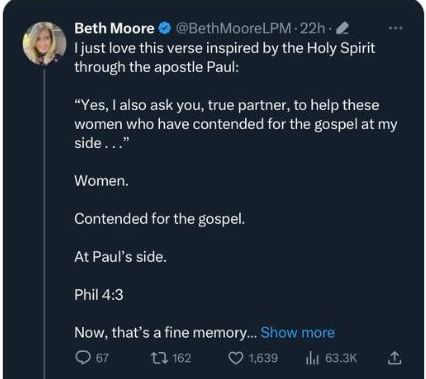
I saw on Twitter last week some women who Beth Moore whipped up and then flicked into off into fantasyland with outspoken but wrong ideas of women’s leadership in the early church. Beth does this so well, wind women up. Here is Beth’s tweet,
Notice the analytics. 63,000 people engaged with her tweet in one way or another. This is also tragic and it is why I write about her like this. She INFLUENCES negatively. A Mr. Robert Fletcher commented,
At best, @BethMooreLPM doesn’t seem to understand the difference between evangelism and teaching/having authority over men in the church. At worst, she does understand it, and she is purposefully drawing a straw man to further deceive her followers. Either way, she is eisegeting.”
The only options are Beth’s ignorance, or her deception. But women get whipped up when Moore disingenuously comments about women along these lines. One replied to Beth Moore,
Sarah went on to present verses about Chloe, Priscilla, Phoebe and ‘the elect lady’ who were allegedly “leading” the early church.
First of all, the Bible says women are not to lead. And don’t @me about Deborah. She was the clear exception to the rule, she wasn’t a king, Priest, or scribe, and she was installed to shame the men. It was about men’s weakness, not women’s strength or ability
The word “lead” is incorrectly used. We’ll start with Chloe. Chloe didn’t lead. We know next to nothing about this women. She actually was not even specifically named! The verse in 1 Corinthians 1:11 names only that some from her household let Paul know of strife at Corinth. That’s it. That is the sum total of Chloe. Oh and her name means green herb. How someone gets from that to Chloe being “an early church leader” is insane.
Priscilla was mentioned, too. We know she was married to Aquila, and we know she took Apollos aside along with her husband in order to teach Apollos more accurately.
Priscilla was mentioned 6 times, (Acts 18:2, 18, 26; Romans 16:3; 1 Corinthians 16:19; 2 Timothy 4:19). She is always mentioned along with her husband. They are a pair, and separating Priscilla in order to place her on an imaginary leadership pedestal would be to use a scalpel to excise Aquila from scripture. We cannot vault Priscilla to a leadership position any more than we could for Aquila.
Phoebe was also put on the list in this discussion of ‘early women leaders’ as a leader in the church. We do know from scripture she was a benefactor of the early church. Susannah was a benefactor too, but not claimed as a leader. Hmm. Phoebe was mentioned as having brought a letter to Rome, probably in a group of others since traveling alone as a female was dangerous. Phoebe was called a deaconess, meaning servant, and as such, could have been a teacher of all female inquirers of the faith, (because we know from 1 Timothy 2:12 she would not have been teaching the men). Or she could have been active in the helping the poor among the flock, since Paul called her a benefactor.
That’s it. Nothing in there to lead one to believe she was a leader of any type more than Mary and Martha, who opened their home and served those who came, and who were active in Jesus’ ministry as believers and followers.
The simple fact that some women are mentioned is far from proof they led. Dorcas/Tabitha was more than mentioned, an entire story revolves around Dorcas. She was even resurrected from the dead. Yet feminists do not call her a leader. I wonder why. Could it be because the Bible clearly limits her sphere of influence to sewing and widows, traditional female domains?
The stretch and twisting that feminist women give to these few Bible women and try to vault them into positions they clearly did not attain is startling. But when one has an agenda, one will go to lengths to prop it up.
Women’s position in society pre-Incarnation was as chattel, and invisible. They were equated with slaves as far as admissibility in testifying in court, which was a big NOPE. Public worship can take place in a synagogue only if at least ten adult Jewish males were there for a quorum. Women do not qualify as part of this quorum, which is likely why there was a group of women by the river (which included Lydia) that Paul found.
Jesus elevated the status of women by including them in his ministry. Susannah and Lydia and Phoebe were benefactors. Mary and Martha (and Lazarus) opened their home to Jesus. Philip’s daughters evangelized. Priscilla (and Aquila) taught. But their elevation into the mix of daily service does not mean they led in church. Many scriptures are clear that women are not to lead in services but to be silent participants. And to serve enthusiastically in all other places God has ordained and in the many roles we see women serving in the New Testament: financial support, evangelizing, hospitality, serving other women, teaching women, children, and grandchildren, and other background but critical service.
My greatest wish is for usurping women to finally become content with the roles Jesus has outlined for us in all spheres; church, home, and world. If they do not, Jesus will address this on the Day, which will be more uncomfortable and more embarrassing than accepting it here on earth.
It used to be that when I posted a discernment essay critiquing a teacher and showing through scripture that he or she was false, I’d receive a lot of heat, insults, and anger. Still do – a bit. But nowadays, it’s the posts about women’s roles (being at home as submissive wife/mom as the career) that generate anger, rejection of verses, curses and name calling.
Far from wanting to push back in similar anger, I just sadly look at their handles (many are crass), bios, (usually proud of a rebellion), or profile photo (many are immodest), yet these angry women claim to be Christian. My sorrow for them increases.
Since my conversion, a verse that always stood out starkly to me was Matthew 7:21-23, “Lord, Lord, didn’t we…?” I’ve researched it often. Greek for many here is “polýs (“much in number”) emphasizes the quantity involved; signifies ‘many, numerous’– i.e. great in amount.”
Hypocrisy and false belief is a heavy possibility for us all. Disobedience increases the likelihood of both.
Gill’s Exposition says of the Matthew 7:21-23 verse, “The word is repeated to show their importunity, sense of danger, the confusion they will be in, the wretched disappointment they will have; and therefore speak as persons amazed and confounded, having expected they would have been the first persons that should be admitted into heaven.”
I’ve heard in sermons that the number of the rejected will be astoundingly great. Their shock at learning the truth of their false belief will be unveiled before all. But it will be too late. This is a sobering truth- worthy of restraint and contemplation when dealing with a woman who may be on a path toward that side of the gulf.
How many professing Christian women will say ‘Lord, Lord, didn’t we make a wonderful career out of ministry? Didn’t we help many people? Didn’t we teach Bible to thousands? Didn’t we bring in a good income from my job? Splitting my time between job and kids wasn’t SO bad, was it? Even if the kids missed us a little, or ate frozen dinners too often, isn’t the ultimate balance a good one? Lord?’
No. It isn’t. The Bible is clear, a woman’s orientation is toward the home.
Ladies, I know Stay At Home Mom work isn’t glamorous. It’s dirty, boring, and repetitive. Raising kids is hard. It’s background work that seems to reap no public affirmation. Indeed, the public scorns housewifery. Even ‘Christian’ women mock it by claiming that just being a housewife isn’t enough, that a career outside the home is OK too. But staying in our roles God has ordained for us is ultimately for our good and reaps good. It’s our calling. Make it your joyful priority.
[I realize that circumstances mean some families make decisions that have the woman work outside the home. The young wife with no kids temporarily works to put her husband through seminary. The husband is deployed or on medical disability. She’s a widow, and so on. I am not making a general, blanket edict for ALL families.]
But… the Bible states that a woman’s primary goal should be to serve the home by helping her husband and raising the children at home (if the Lord blesses the couple with them). Serving the husband and her church if not.
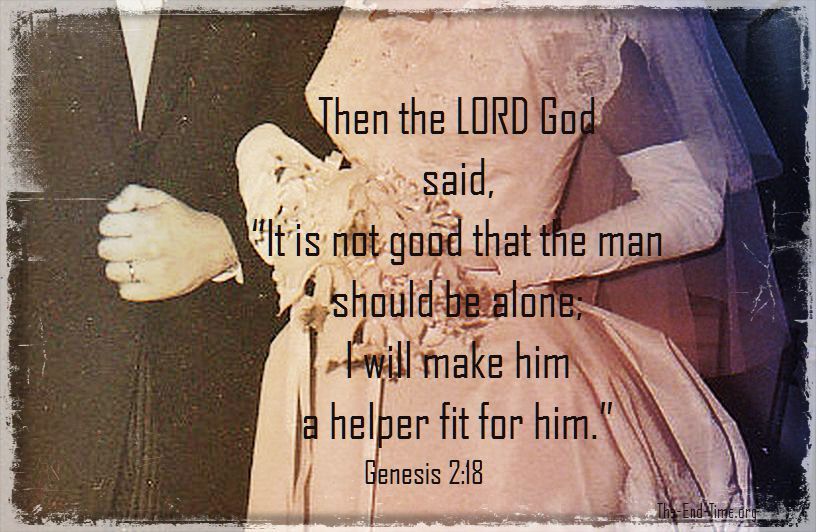
Then the LORD God said, “It is not good for the man to be alone; I will make him a helper suitable for him.” (Genesis 2:18).
Neither was man created for woman, but woman for man. (1 Corinthians 11:9).
Older women likewise are to be reverent in their behavior, not malicious gossips nor enslaved to much wine, teaching what is good, 4 so that they may encourage the young women to love their husbands, to love their children, 5 to be sensible, pure, workers at home, kind, being subject to their own husbands, so that the word of God will not be dishonored. (Titus 2:3-5).
There are two issues: understanding the concepts the Bible puts forth on this topic of gender roles, and obeying them. As for the former, the Bible is clear about a wife’s primary orientation. It’s the home. The verses above are easily interpretable. They’re not murky on the subject.
So the issue is not one of interpretation, it’s an issue of obedience. They read, know, and understand the verses, they just choose to reject them in willful rebellion. This is why their stance is so dangerous, and calls for rebukes ranging from gentle to pointed.
Lifestyle disobedience is disobedience. Here is a good resource from Dr. Michael Youssef, “Genuine faith can only be demonstrated by obedient action.” More here, titled Faith that leads to Obedience.
And have mercy on some, who are doubting; save others, snatching them out of the fire; and on some have mercy with fear, hating even the garment polluted by the flesh. (Jude 1:22-23).
Barnes’ Notes says on the Jude verse-
Save with fear – That is, by appeals adapted to produce fear. The idea seems to be that the arguments on which they relied were to be drawn from the dangers of the persons referred to, or from the dread of future wrath. It is undoubtedly true, that while there is a class of persons who can be won to embrace religion by mild and gentle persuasion, there is another class who can be aroused only by the terrors of the law. Every method is to be employed, in its proper place, that we “by all means may save some.”
Pulling them out of the fire – As you would snatch persons out of the fire; or as you would seize on a person that was walking into a volcano. Then, a man would not use the mild and gentle language of persuasion, but by word and gesture show that he was deeply in earnest.
The women who don’t have to work outside the home, who split their time between career and husband/kids/home for reasons of personal fulfillment are in disobedience, which means they either are not a Christian, or, they are in Christ and are spiritually conflicted. I know this because rebellion always brings discomfort. The Day will reveal whether it was a false belief or a willful disobedience.
It should be noted that if a woman is actually in Christ, persistent disobedience will bring chastisement and eventual repentance.
In the meantime, though some are warranted a harsh rebuke to instill the fear of God, others are due a gentle warning. Perhaps the rebuke or warning will be the mechanism He uses to bring repentance. I ask God, grant me the wisdom to know when to do which. In other cases, you ladies’ exemplary modeling of the lifestyle to which He has called us may be the mechanism that brings repentance.
Ladies, even though the day-to-day work of being a wife and mom may be a grind, even if you get tired or irritated, in the end do you feel a sense of joy at the humans you’re raising? Satisfaction with how you’re supporting your husband? Do you feel a sense of spiritual fulfillment that your obedience aligns with God’s desires for you? Does your knowledge of scripture for women’s roles give you a sense of purpose for your life? If not, examine yourself to see if you are one that will hear “Well done Good & faithful servant, enter into the joy of your master” or “Depart from me, you worker of iniquity. I never knew you!”
My earnest desire is for women to know and love the scriptures, to be satisfied with their role, and to greet Jesus in love on the side of Light on the Day.
Complementarianism is undergoing an all-out assault from everywhere but especially even the conservative quarters of the church. Complementarianism is the understanding from the word of God that men and women were made two distinct sexes, that marriage is one man and one woman, and that men and women have equal but different roles to fulfill under God and for the church. This includes women being restricted from operating in roles He assigned to men, such as pastor or teacher of men. The man has authority in the church and in the home, the women/wives are to be gladly submissive to this position, serving in other equally valued roles. Here is a more thorough summary of complementarianism (and egalitarianism) at the Council for Biblical Manhood and Womanhood.
I hold to the complementarian position.
This biblical stance is unpacked in a 3-minute video below, which explains it very well. The answer to the question in the title of this essay (Why does Paul forbid women to preach to men?) has more ramifications than you’d think. Huge implications. Far from being a secondary or tertiary issue, this issue strikes at the heart of the created order. Please enjoy the video.
In essence, the Christocentric hermeneutic attempts to find Christ as the subject or topic of every text. It desires to show that every text relates directly to Christ. Which is why some say it is the only true Christian preaching. The problem ensues when the Christocentric hermeneutic applies that mindset to texts that don’t call for it.
Jesus used a variety of approaches when speaking with unbelievers, depending on the individual or group (e.g., Nicodemus, Rich Young Ruler, Woman at the Well), but typically He identified who He was, confronted their sin, called them to repentance, called them to believe in Him, cautioned them to count the cost of discipleship, and admonished them to take up their crosses daily and follow Him. He didn’t state all those elements in every case, but collectively they constituted the thrust of His message
By way of contrast, Isa [Muslim version of Jesus] typically identifies who he is (or the dreamer instinctively knows who he is) and tells the dreamer he loves him and wants him (the dreamer) to follow him (Isa). Sometimes the dreamer is overwhelmed with a sense of love and peace just by being in Isa’s presence (which was never the case with unbelievers in the presence of Jesus). So the message that emerges is one of believing in Isa and following him apparently apart from the Holy Spirit convicting of sin, righteousness, and judgment (John 16:8).
~~~~~~~~~~~~~~~~~~~~~~~~~~~~
Do women have to submit to all men? How can we demonstrate that although the roles of men and women in the church (and the home) are very different, we are equal in value in the sight of God?
To answer your question, women are to submit to their husbands.
Wives, submit yourselves to your own husbands as you do to the Lord. (Ephesians 5:22)
All church members are to submit to their overseers.
Obey your leaders and submit to them, for they are keeping watch over your souls, as those who will have to give an account. Let them do this with joy and not with groaning, for that would be of no advantage to you. (Heb 13:17)
We are all to submit to God.
Submit yourselves therefore to God. Resist the devil, and he will flee from you. James 5:7.
We all have to submit to government. Romans 13:1-7; 1 Peter 2:13-17
Women do not have to submit to random males.
We believers are all of equal value in the sight of God. This value is from above, it is not attached to man-made standards of who has what role. We do not have to demonstrate this love, God already has.
So God created man in His own image; in the image of God He created him; male and female He created them (Genesis 1:27).
But God demonstrates His own love toward us, in that while we were still sinners, Christ died for us. (Romans 5:8).






 the-end-time.org