
Posted in theology

‘It was the best of times, it was the worst of times’: Two reviews of the new animated movie ‘David’.

By Elizabeth Prata

The animated film “David”, a Bible character and a film devoted to parts of David’s life, is in theaters now. There is some buzz about it, with some Christians saying it’s good, and others saying it has some good parts but contains serious biblical flaws. I present two reviews to you from two people who have a large Christian following: Alisa Childers and Pastor Gabe Hughes. My comments with three points are at the bottom.

Alisa Childers is an American Christian author, speaker, podcaster, and former CCM singer from the group ZOEgirl, and is known for her work in Christian apologetics. Alisa’s review is on Twitter/X. These are screen shots. [She later posted it on her Facebook page, here is the link to it.]
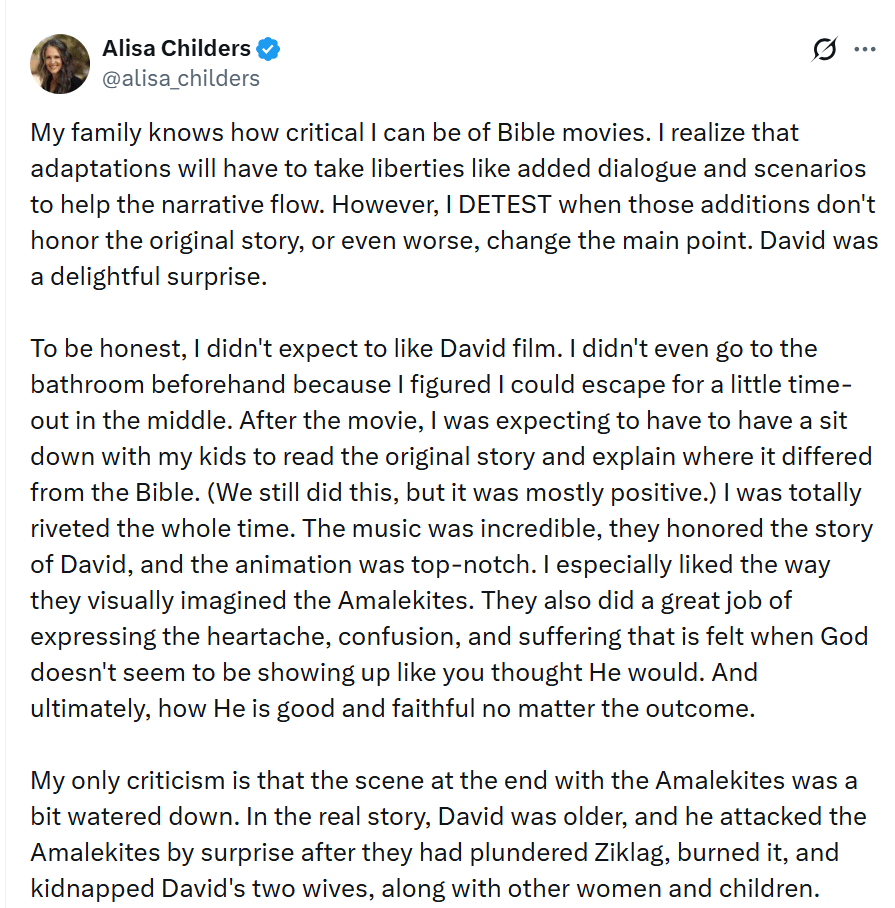
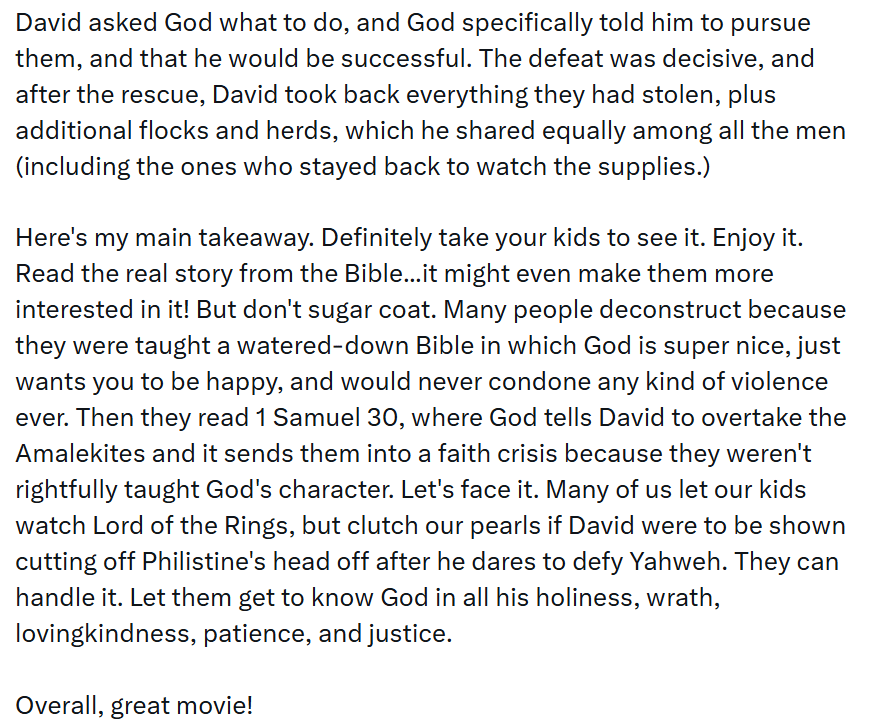
–end Alisa Childers review of animated film “David”.


Pastor Gabe Hughes is pastor of a church in Arizona and the long-running broadcaster of the online video/podcast When We Understand The Text (WWUTT). Here is his review of the movie. This is the link to the video of Pastor Gabe’s review if you would rather listen and watch than read:

https://youtu.be/dd0YFzRB09g?si=10c7JPKTbOj-xwcD

Pastor Gabe transcript of his review of the animated film, “David”:

I had the chance to see the computer animated film David. The animation was great. Can’t say the same for the rest of the movie though.

The movie simply entitled David and distributed by Angel Studios, owned by Mormons, is a musical epic of the life of David taken from the Bible story found in First Samuel chapter 16 through about chapter 31. It was hard to tell because that third act is a real mess. I’ll tell you what I liked about the movie, what I didn’t like, and then we’ll come back to that third act. So, you could call this the good, the bad, and the ugly.

The Good – What I Liked About the Movie

As I said, the animation looks great. The stylistic choices, set pieces, characterization, all were very good. And if we were just critiquing an animated musical, this was entertaining. But this is also a Bible story, and we must test all things according to the scriptures. It’s said in First Samuel 17:32 that David was ruddy and handsome. So, they make David a good-looking young man with reddish hair since ruddy means red. This David is charismatic and confident, much better than the David in this year’s Amazon series House of David, who was a wet blanket, scared of everything and even gets pinned to the ground by Goliath.

But this David, when he goes to face Goliath, he absolutely knows he will beat him. There is not a doubt in his mind because the battle belongs to the Lord. That’s much closer to the David that we have in the Bible. But they don’t remain consistent with this character. He gets much worse later.

The character of Saul is also well done. In First Samuel 9:2, we are told that Saul was taller than every man in Israel from the shoulders upward. So in this movie, we get a tall Saul. The actor who plays him has a great voice. And by the way, the acting in this film is all top tier, better than King of Kings, even though that movie had a cast of A-list actors.

The highlight of the movie is, of course, the battle between David and Goliath. The filmmakers made the decision not to show Goliath in any of the promotional materials, making his reveal all the more surprising. This might be the first depiction of Goliath with six fingers on one hand. That’s taken from First Chronicles 20. Another thing about Goliath is that he’s blonde and the whitest guy in the movie. Now, why did they do that? I have my speculations and I don’t think that any of it has to do with wokeness.

There is historical evidence that the Philistines had European ancestry, but that doesn’t mean that they were white and blonde. So, if I had to venture a guess, I would say that Goliath in this movie is actually an image of Hitler’s master race, the Aryan, who is killed by the anointed king of the Jews, whom Hitler hated and wanted to wipe out. But that’s just my theory.

One of my favorite lines from First Samuel is where David says of Goliath, “Who is this uncircumcised Philistine that he should defy the armies of the living God?” Yeah, that line is not in the movie. David and Goliath jaw back and forth, and it’s similar to what is recorded in First Samuel 17, except that in the Bible, David says that he’s going to cut off Goliath’s head. And of course, that’s not shown in the film. I think they still could have done that, though. After David knocks out the giant, he goes and draws his sword, and you see him swinging it without actually having to see the actual decapitation.

The battle with Goliath comes at about 40 minutes into the movie, and then everything starts to go downhill from there.

The Bad – What Does the Movie Get Wrong?

So, this is what I did not like about the film. Right after the Philistines are defeated, there’s this big parade and everyone is celebrating David. And he says, “No, no, don’t look at me. Look at God.” Except they keep celebrating David. So, he breaks out into this song that’s supposed to point everyone to God. Except it doesn’t. This is the signature song of the movie called Follow the Light. And the lyrics are not overtly Christian, nor do they point anyone to God. You could actually be agnostic and agree with everything in this song.

The movie has way too much of the follow your heart vibes that Disney movies have, except they’ve worded it as follow the light. The story does very little to point anyone to God. The biggest criticism with this film is that it deviates far too much from the biblical narrative.

I’ve seen people online saying, “Oh, they were so close to the Bible.” No, it’s really not. From the very opening scene, the movie begins with David defending his sheep from a lion, which he does not kill. The lion actually gets himself into a jam and David saves the lion’s life and lets it go. This is contrary to what he says in First Samuel 17:36 where he says, “Just as he killed the lion and the bear with his own hands, so will he also kill Goliath.”

Right after this, David is anointed by Samuel to be the next king. And when David comes into the room, Samuel says, “Are you ready for a great adventure?” Are you serious? What’s missing from this scene is one of the most well-known verses in the Bible. In First Samuel 16, when Samuel comes into the house of Jesse to anoint the next king of Israel, the oldest Eliab comes before him, and Samuel says, “Surely this is the Lord’s anointed.” But God says to him, “Do not look on his appearance or the height of his stature because I have rejected him. For the Lord sees not as man sees. Man looks on the outward appearance, but the Lord looks on the heart.”

That line is not in this film. God never speaks to anyone at all. It’s more about how people feel about God rather than knowing what he has actually said. And that again is the biggest problem with this movie. It doesn’t appear as if the filmmakers even care about what God has actually said. The first act is the most entertaining. The second act is much weaker. This is where David is running from Saul who’s trying to kill him, believing that David wants to take his throne. There’s not much to David’s friendship with Jonathan. David doesn’t marry Saul’s daughter as he does in the Bible.

So when we get to that third act when Saul and Jonathan are killed and a bunch of Israelites are kidnapped by the Amalekites, it doesn’t feel at all like the story in FIrst Samuel 30 and 31.

The Ugly That Messy Third Act and the Biggest Miss

This is where the movie really goes off the rails. David goes to rescue his people and he tries to beat the Amalekites with the power of song. Yes, I wish I was joking. This is not at all like the David who had defeated Goliath an hour earlier. David easily gets beaten up by the Amalekites. So, at least the storytellers have enough presence of mind to know this is not how you defeat bloodthirsty savages. The king of the Amalekites strings David up on ropes and is about to kill him when suddenly Eliab shows up in this Gandalfian-like appearance. The song Follow the Light plays again and the Amalekites are defeated by Eliab. Do you know how the Amalekites were actually defeated in First Samuel chapter 30? They were beaten by David who slaughtered Amalekites from sun up to sun down and recovered all that the Amalekites had taken.

In the movie, we went from this brave, courageous youth who fought Goliath to this ignorant singing fool who almost got himself and others killed with his music. And by the way, the music in this musical is really not good. And not because I don’t like musicals. I actually have a history in musical theater. I think making an epic about David and turning it into a musical is a great idea, but all the music in this film is modern contemporary Christian music. It’s not at all like the enduring God-exalting Psalms that we have in the Bible.

So, they took the most musical person in the Bible who wrote most of the songs in scripture and they did not use a single one of his songs. What a missed opportunity and a waste of a good story. I made a similar criticism of the film Journey to Bethlehem, a musical about Mary. Yet, the filmmakers did not use the song of Mary, the Magnificat, as found in Luke 1:46 to 55. That alone should tell you that the people who make these movies do not have a lot of reverence for the source material.

I will hear a lot of Christians say, “Well, we need to support movies like this so that they will make more of them.” No, I don’t want them to make more of them. If they’re going to take a story from the Bible and turn it into a movie, then it needs to be biblical. None of the creative liberties that they take with this movie tell a better story. Their own story falls apart by the end, and what we’re left with will lead people into error.

Closing Thoughts Needing the Gospel

I took three of my children to see this movie with me, and we talked about it when the movie was over. My 11-year-old daughter said that this movie needs the gospel. Well, I said to her, “The story of David happens a thousand years before Christ. So, how would you incorporate the gospel into this movie?” And this was her idea. She said the movie needed a narrator. And since the story is taken from Samuel, that narrator could have been Samuel. And at the end, he says that a king would come from the line of David who was even greater than David. He is the son of God, and he would die on the cross for our sins and rise again from the dead so that whoever believes in him will not perish but have everlasting life. That was her idea.

Kids can understand this stuff. Children don’t need the stories of the Bible to be dumbed down and rewritten. They need the truth of Jesus Christ. Whatever is good about the movie David couldn’t save it from the bad and the ugly. As the real David said of Christ in Psalm , “The Lord is at your right hand. He will shatter kings on the day of his wrath. He will execute judgment among the nations, filling them with corpses. Those who believe in Jesus will be saved from judgment.” When We Understand The Text.

Here is the video of Pastor Gabe’s review if you would rather listen and watch than read.

https://youtu.be/dd0YFzRB09g?si=10c7JPKTbOj-xwcD


I chose to present opposing reviews to you, dear readers, for two reasons. First, so you can read both from notable Christians, and make up your mind.

Secondly and more importantly, to highlight what I personally see as an ongoing issue with Alisa Childers’ discernment. Perhaps the superficial medium of X prevented a longer, more detailed review from Childers. That would be fair to say. But still, she thought about it, wrote it, and said “definitely take your kids to see it”, so there is the influencing part of her output.

What I liked about Pastor Gabe’s review is that he used a lot of scripture to point us back to. His response felt measured and considered. Alisa’s felt emotional and gushing, as well as less biblically knowledgeable than Gabe’s. It depends on what you look for in a Christian review, I guess, and in whom you have trust.

There was an issue with Mrs. Childers’ discernment capabilities recently. A few months ago as of this writing, Childers had indicated she will accept invitations to events where false teachers are present if she feels it’s a chance to reach the lost or call out error, a departure from her prior conviction to avoid such platforms. It is a stance fraught with biblical error and was a major disappointment for many who had followed her.

The third reason I presented the contrasting reviews is because of numbers. Mrs. Childers’ gushing, superficial, and error-ridden assessment reaches a quarter of a million subscribers on Youtube alone, not even counting her Instagram, Facebook, and popular podcast. I have nothing against Mrs Childers, and in fact she says a lot that is good despite some rising concerns I have regarding her discernment.

However, in her review, she urges parents to take their children to see the film. The nature of influence culture is that some, probably many, will see a review such as hers, or adhere to a stance such as hers on partnering with false teachers, and accept at face value without thinking it though further- meaning, not compare to the Bible. There’s influence for good and influence that is not healthy for the influenced.

It’s one reason I liked Gabe’s review more than Alisa’s, because when a person introduces numerous verses to their assessment of something- whether it be a movie, book, sermon etc, there is a confidence their opinion that produces trust in the recipient. You cannot instill more confidence than it being backed by scripture.

Anyway, food for thought, my dear readers and visitors.

Posted in theology

Netflix- My Life With the Walter Boys: A Review

By Elizabeth Prata

Watch or skip?

My Life with the Walter Boys is a Netflix television series based on Ali Novak’s 2014 novel of the same name. The premise is that high school sophomore Jackie Howard, who attends an expensive NYC prep school and is on the track to Princeton, is informed of a tragedy that killed her parents and older sister. According to an old will that had not been updated, Jackie is to go live with her mom’s best friend and her husband on a remote ranch in rural Colorado. The will was drafted when mom’s friend had 3 boys, but they now have 9 boys and a girl. Several of the boys are Jackie’s age.

As I watched episode 1, I noticed that the acting is good, and the production values were also good. The scenery is gorgeous. I could overlook the implausibility that Jackie’s wealthy and famous parents had failed to do something something as important as keep up their will regarding their children. The show needs a premise, OK fine.

As episode 2 went on, several things began to trouble me. The plot was setting up a love triangle between 2 of the oldest boys and Jackie. This is problematic. Firstly, the girl is grieving the loss of her entire family and her only known way of life. Even her desired future is at risk because her Colorado High School does not offer the necessary Advanced Placement courses she needs to keep up her GPA for an Ivy League school such as Princeton. Her grief needs to be dealt with.

However the guardian dad is too busy dealing with imminent bankruptcy of his ranch, the parasite invasion ruining his orchard, and the veterinarian mom is always busy also. They are depicted as caring, but not deeply involved and thus, unaware.

Full disclosure: I abandoned this series halfway through episode 3. There are ten episodes. So maybe the parents clue in later. I don’t know. I don’t care.

Secondly, setting up a premise of the character’s tension/problem being a love triangle is nauseating. The guardian parents and the elder brothers constantly reassure Jackie she’s “part of the family now.” Thus, any love triangle among them all living under the same roof has an incestuous tinge to it.

Oh but that’s not all that bothered me.

The actual ethnic make-up of Colorado is as follows, according to the US Census:

White alone, percent86.2%
Black or African American alone, percent(a)4.7%
American Indian and Alaska Native alone, percent(a)1.7%
Asian alone, percent(a)3.8%
https://www.census.gov/quickfacts/fact/table/CO/PST045223

However, the tv show forced a diversity into every scene with numerous characters of Hispanic, Indian, and Asian origin. The population looked more like New York City than rural Colorado. I am not against other ethnicities. Not at all. I am all for a melting pot. But if you’re going to set the story in a rural, mostly white area, but then force an ethic diversity that doesn’t exist in real life, it’s jarring. It’s woke. And it’s not believable.

If you desire to purposely show many ethnicities, set the show in San Antonio, or the state of Washington or outside Vancouver. There are options. (The show is actually filmed in Calgary, Canada).

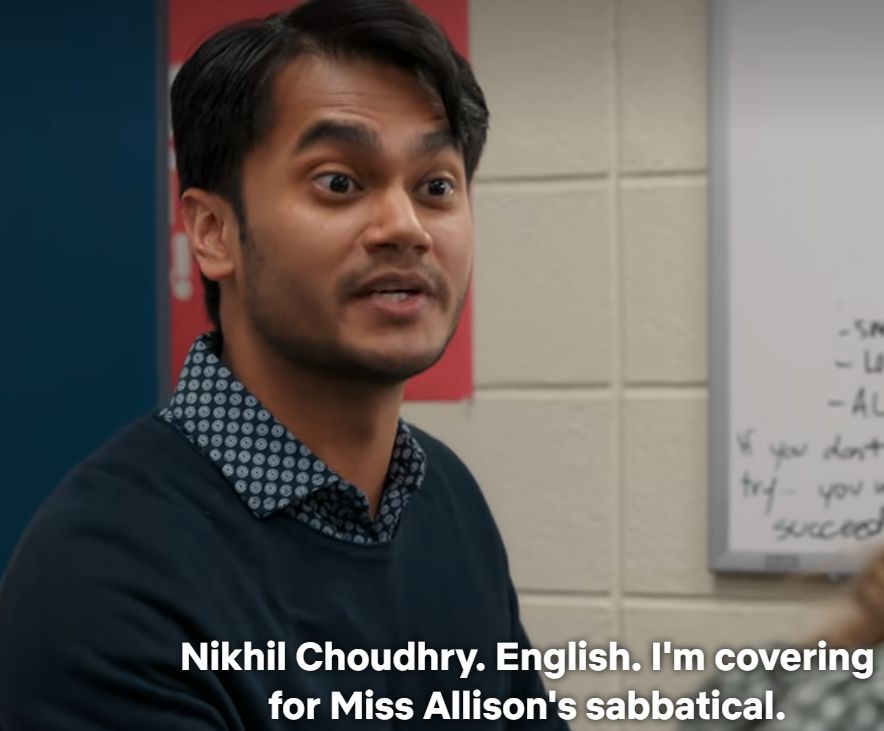
Below, the High School counselor meets a new substitute, who apparently is of Pakistani/Nepalese/Indian ethnicity. Sure. In Colorado.

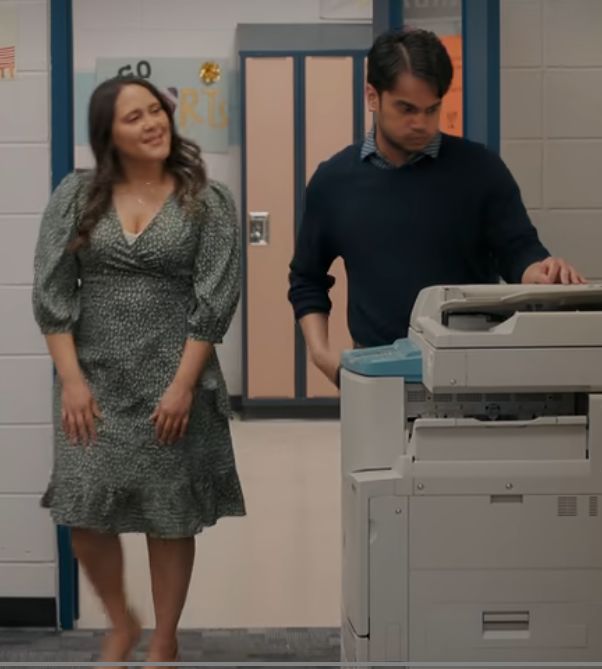
And that’s another problem, the counselor appears in every scene in which I saw her, wearing low cut dresses or blouses like she is below. In a High School? No. Boys of that age lust after dryer lint. Flaunting deep cleavage like that in a supposedly clean show is again, unnecessary. It’s also not believable that a High School staff member would dress that way.

And next up we have the homosexuality issue.

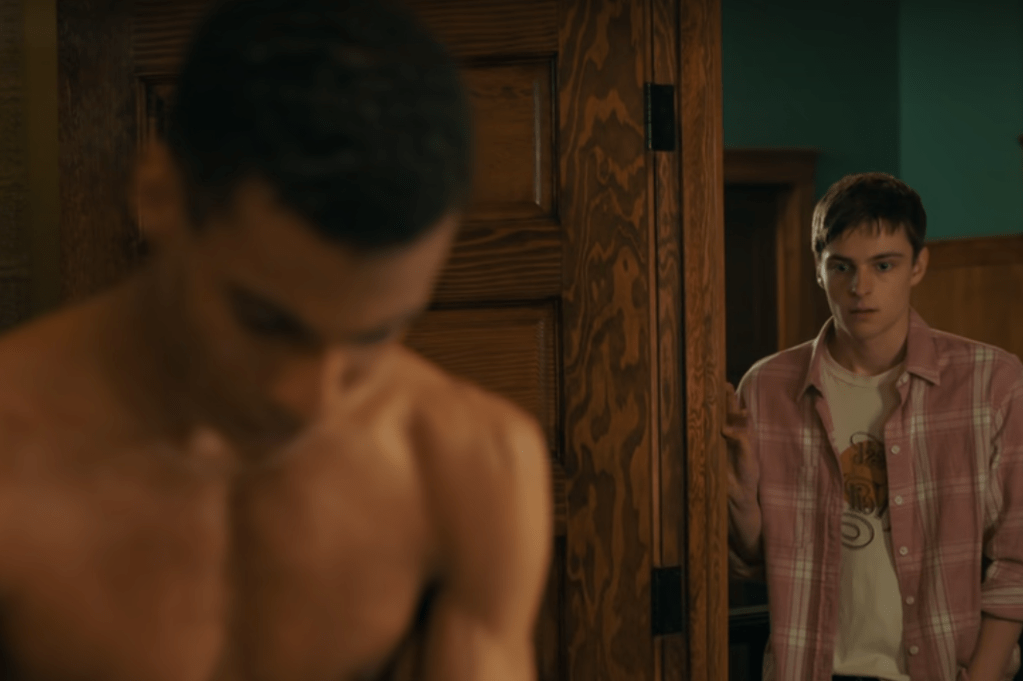
One of the Walter boys is secretly gay. I knew it the minute I saw the below scene, where he comes across a guest in their house washing paint off his shirt. The actor was so good in conveying his rush of lust in seeing the fit teen shirtless in the bathroom that I instantly knew. I looked up “Walter boys gay” and there it was, confirmed. Later in the series, the two share a kiss.

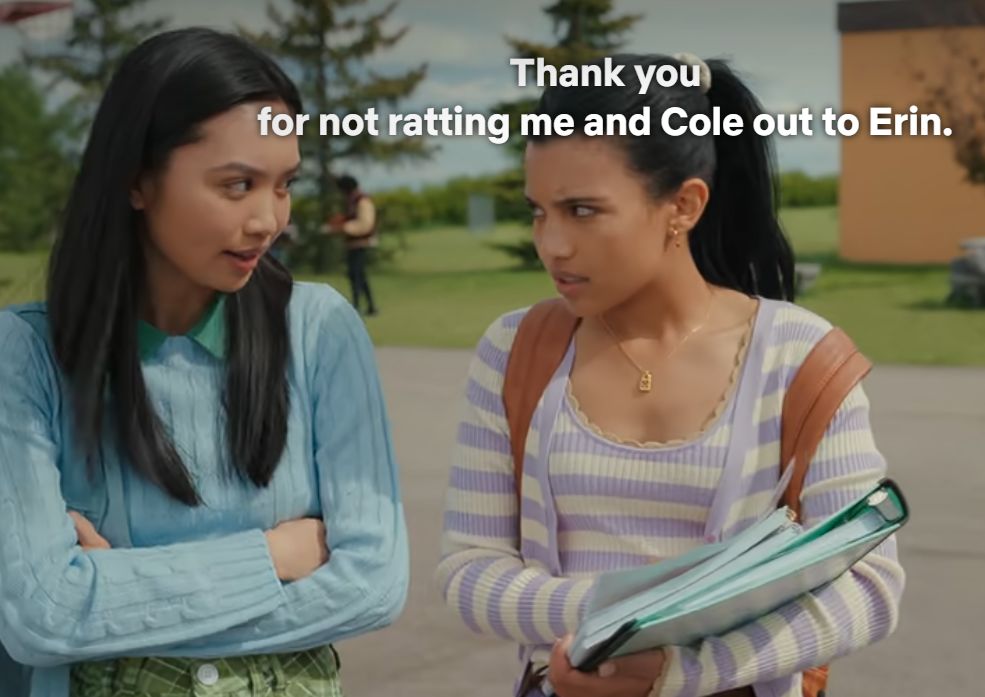
If that’s not enough, there is just one other issue I’ll raise. In the series, the second oldest boy, the oldest one living under the roof, and the one Jackie is in the triangle with, is a sexual exploiter. He plays the field, sleeping with girls who throw themselves at him because he supposedly has tons of magnetism the girls call “The Cole Effect.” Cole is in a dating relationship with one particular girl but he sleeps with whoever. So there’s fornication and ‘adultery’.

In one scene, Jackie leaves her room early in the morning to go for a run and bumps into a half dressed girl from school leaving Cole’s bedroom. And the girl is not his girlfriend. Cole is the boy Jackie ultimately chooses… the casual player, the known fornicator who cheats? Where’s the ’empowered grrl self-respect’?

Said the fornicating underage adulteress to the ingenue…

It seems that the focus on wokeness and diversity, and its hyper sexuality especially seen in the world’s desperation for everyone to be gay, eventually finds a home in media like TV. In most new shows, even the ones touted as “family friendly” issues like immodesty, sexual dalliance, and homosexuality will be present. I do not recommend it.

Netflix is notorious for presenting shows then canceling after one season. However, this particular show has already been renewed for season 2. Of course.

Updated later in the day:

I should put in a recommendation for Free Rein on Netflix. It has a similar plot- teen and younger sister visiting grandparents on a rural island off the coast of England, struggle to settle in, make friends, and deal with her parents’ separation from each other. The scenery is gorgeous, the acting is good and the struggles of the teen are realistic without being scary or overdramatic. The series is rated G. I saw the first season so I cannot vouch for succeeding seasons, but to my memory, the show is clean and actually family friendly.

Posted in movie review, Uncategorized

Movie Review: Hallmark’s Garage Sale Mystery with Lori Loughlin

Hallmark Movies & Mystery Channel features a series of movies in the “Cozy Mysteries” genre.

Cozy mysteries, also referred to as “cozies”, are a subgenre of crime fiction in which sex and violence are downplayed, and the crime and detection take place in a small, socially intimate community. Cozies thus stand in contrast to hardboiled fiction, which feature violence and sexuality more explicitly and centrally to the plot. The term “cozy” was first coined in the late 20th century when various writers produced work in an attempt to re-create the Golden Age of Detective Fiction. Wikipedia

Hallmark has adapted several cozy book mysteries into movies.

There are the Aurora Teagarden movies starring Candace Cameron Bure. These movies are based on a fictional character created by author Charlaine Harris, in a series of ten crime novels written from 1990 to 2017. “In the first book of the series, twenty-eight-year-old Aurora (Roe) Teagarden is a professional librarian and belongs to the Real Murders club, a group of 12 enthusiasts who gather monthly to study famous baffling or unsolved crimes.”

There’s the Flower Shop Mysteries based on Kate Collins’ books of the same series title. The series stars Brooke Shields as a “professional librarian and belongs to the Real Murders club, a group of 12 enthusiasts who gather monthly to study famous baffling or unsolved crimes.”

Garage Sale Mystery Image2
Source

In the Garage Sale Mystery, Lori Loughlin stars as a vintage store owner who scours garage sales and estate sales for items for her store, and stumbles across mysteries and murders along the way. This series is based on the books by Suzi Weinert. The executive producers of Garage Sale Mystery are also executive producers on the Hallmark television series When Calls the Heart, so the Garage Sale Mystery series features many of the same actors.

You might remember Lori Loughlin from the 1980s television family friendly series Full House. She also stars in When Calls the Heart, and other Hallmark productions.

I like a good caper movie, mysteries, and crime books and movies,  but I do not like the gore, psychological tension, or horrible/evil murders especially involving children. I also don’t like dark movies, either in psychology or in cinematography.

The Garage Sale Mystery (GSM) features none of that. The main character, Jennifer Shannon, lives in an affluent town in Virginia. The homes she visits throughout the movie and including her own, are beautiful mansions. If you remember the iconic series Columbo, his ‘clients’ were always in Beverly Hills, lived in gorgeous homes, and were from the upper class. If I’m going to watch a mystery, at least I’m not watching gutter dirty dark psychological thriller, but a tea drinking, well dressed attractive woman with a genial personality. In GSM there’s always lots of light and sunlight and bright colors in most every scene. The main character is in a happy, stable marriage with a movie-perfect husband and two movie-perfect teenage children. She is a good mom.  The children usually have some kind of sub-story.

Somehow, the way the movie is written, and despite the fact that a murder does occur and Jennifer is usually in life-threatening peril by the climax, the atmosphere isn’t heart-rending or dark. The writers maintain in Jennifer a hopeful innocence with a razor-sharp mind and a high-level ability to observe and remember. As a matter of fact, the last shot of each movie shows Jennifer in a close-up with a big smile. This is an enjoyable way to conclude a movie. The relationship Jennifer has with the co-owner of her store is a good one, always pleasant. No harsh words are spoken, even when Jennifer confronts the murderer. It’s a relief to watch a movie where all the interpersonal interactions are warm and polite.

It is a ‘cozy mystery’ to a Tee.

What I find amusing is that despite the fact that Jennifer seems to stumble on a dead body seemingly every time she leaves her house, the series avoids the claustrophobic feeling of the Cabot Cove Syndrome. This is a TV Trope named after the location in which fictional character Jessica Fletcher of the television series Murder, She Wrote lived. The television series aired for 12 seasons with 264 episodes from 1984 to 1996 on CBS. Angela Lansbury was the main character, and “murder occurred with such regularity in her vicinity that the term “Cabot Cove syndrome” was coined to describe the constant appearance of dead bodies in remote locations. Indeed, if Cabot Cove existed in real life, it would top the FBI’s national crime statistics in numerous categories, with some analysis suggesting that the homicide rate in Cabot Cove exceeds even that of the real-life murder capital of the world” (Wikipedia). The UK Daily Mail has more-

The most dangerous place on Earth is revealed to be… the fictional setting for TV series Murder, She Wrote

The idyllic seaside town of Cabot Cove looks at first glance like a pleasant and relaxing place to live.

In fact, it is the murder capital of the world and far more dangerous than the most violent parts of the globe, including Honduras in Central America. Thankfully, it is just the fictional New England setting for popular TV series Murder, She Wrote. Amateur detective Jessica Fletcher, played by Angela Lansbury, encountered a total of 274 killings in the small town in Maine, despite it having a population of just 3,500. This gives it an annual murder rate of 1,490 per million — more than 50 per cent higher than Honduras, where it is 910 per million.

The British mystery series, Agatha Raisin based on the books by M.C. Beaton, is another series that in my opinion suffered terribly from Cabot Cove Syndrome. There were several issues with the single-season series, and one of them was that the series is set in the British area of the Cotswolds. This is an area of outstanding natural beauty and much of it is protected, but the villages dotting the aforementioned beautiful hills are small. Very small. By the end of the one season that was broadcast, I surmise that the fictional death rate was even higher than in Cabot Cove.

Anyway, the confined feeling I got from Murder, She Wrote and Agatha Raisin is absent in Garage Sale Mystery. The series presents an aura that is expansive enough not to be claustrophobic but small enough to maintain the cozy atmosphere so important in this genre.

I also enjoy the garage sale aspect. I like a good hunt myself for just the perfect item that has a history behind it and is also a good deal!

I recommend the Garage Sale Mystery series. They’re clean. It can be seen on on Hallmark, Sling TV, an occasional older movie on Youtube, and elsewhere.

——————————————–

Further reading

Finding Wonderland, Review: The Deadly Room

Dove review: Garage Sale Mystery

Amazon Customer reviews: 215 reviews of this series (92% are 4 & 5-star)

Posted in encouragement, Uncategorized

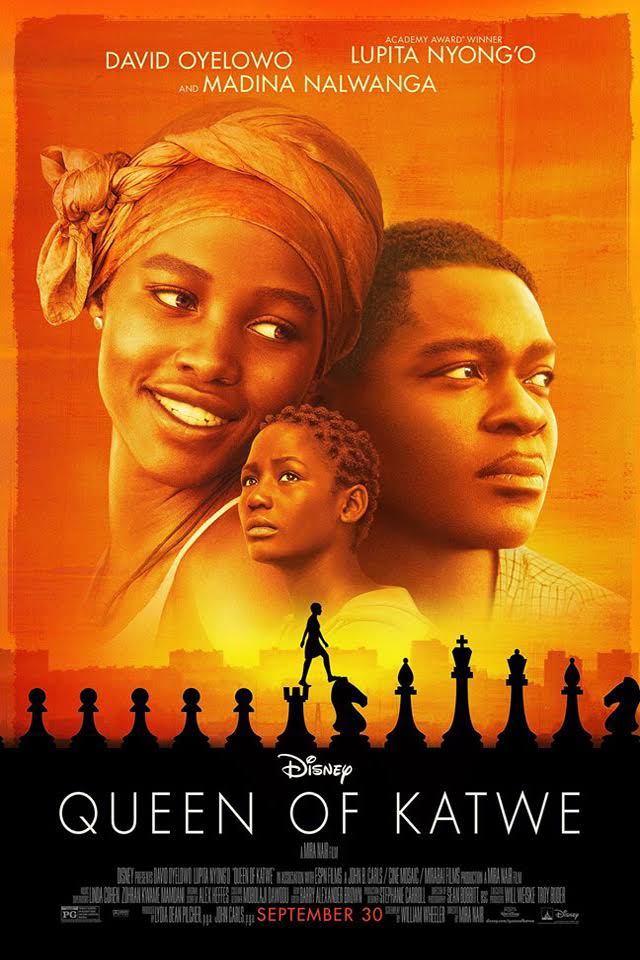
Movie Review: The Queen of Katwe

I spend almost more time looking for and reading reviews of movies than I do watching them. I don’t have the time to waste on a bad movie during the school year, and though I have more time at home during the summer never do I want to watch something that will be blasphemous, offensive, or pass before my eyes things I can’t unwatch. I know you feel the same.

Here is a synopsis and review of a movie I feel is worth watching for the entire family (tweens and up): Queen of Katwe. The movie summary says: A school-drop out named Phiona (pronounced like Fiona) living in the slum of Katwe sells maize along with her brother to help her family survive. Her older sister has already succumbed to the lure of being a kept women and the widowed mother is wearily but with dignity striving to instill in her remaining children hope where it seems that life is hopeless. At this moment in their family life Phiona is discovered to have an agile and highly advanced mind and is a genius at chess.

(Common Sense Media’s review & synopsis here.)

That this is a true story and in fact it has recently occurred, which makes it all the more compelling. At the end of the movie you will see each character and what has become of them. In addition to the themes noted above by Common Sense Media is one that is often overlooked: the cycle of poverty.

The slum outside Kampala Uganda known as Katwe is one of the largest and most dire of slums in that country. The overwhelming filth, poverty, and dense living conditions are not glossed over in this movie produced by Disney. As Phiona rises through the ranks in chess championships and her world gradually expands, eventually she must come to terms with who she is and if her origins define her character or if her character will define her character.

The interplay of rich v. poor, impoverished origins v. entitlement impact the girl greatly. It’s a similar theme shown in My Fair Lady. As Eliza Doolittle rises from Cockney impoverished flower girl to genteel lady she wonders where she belongs and who she is if she is no longer “poor” and has to struggle for survival. Will Phiona take the daring leap into the unknown or retreat into what she is used to, even though that means remaining a cog in the grinding cycle of poverty? At points, the outcome is by no means certain and the movie deftly shows why.

For family viewing, several scenes are mildly intense. Phiona’s brother is run over by a motorcycle and Phiona’s desperate near-helplessness to get him to a clinic and obtain the medical services he needs are gripping. Throughout the movie I’d wondered why the slum shacks are entered by walking over planks or pallets situated over a deep trench. The flood scene showed me. Monsoon rains are beyond heavy and Phiona’s toddler brother nearly dies in a flood that sweeps through their derelict home. I read later that Katwe’s seasonal floods are so bad that people sleep on their roofs – if they have a roof – so as not to drown at night.

The scene that most affected me is when the chess team has traveled to a fancy championship location and they are put up in dormitories for the night. The youth pastor who leads the sports ministry, including this chess team, is momentarily startled when he arrives at their room to tuck them in, all the beds are empty and all the bedding remained where it was at the first, neatly folded and piled on the end of each cot. A momentary panic rises in his eyes until he sees all of the children huddled up on the floor in the corner, slum family style, their own clothes and brought scarves and fabrics for covers. It was what they were used to.

The movie does not gloss over the entrenchment of the cycle of poverty the difficulties in rising out of it, and the lingering issues that haunt those who do, including prejudice of the entitled against the poor. Though one of the main characters is a youth pastor, and his chess club is part of a sports mission, no mention is made of Jesus or what denomination he is from or any religious discussions at all. However, he is depicted as a trustworthy man fighting for his charges with love and devotion. It’s produced by Disney so the production values are excellent. Recommended.