SYNOPSIS The Seven Thunders in Revelation remain mysterious, with John forbidden to record their message, possibly indicating terrifying judgments. While speculations abound, their essence reflects God’s authority and impending wrath. The essay emphasizes the chilling reality of the future Tribulation and urges readers to share the Gospel before these events unfold.
I reflect on my fascination with glimpses of heaven through biblical accounts from Ezekiel, Isaiah, and John. I illustrate their consistency. I contrast these with other modern claims of heavenly visions which are not consistent. I rejoice in the excitement and purity of heaven as believers’ eternal home.
“The Descent” follows the story of a small, tranquil community suddenly grappling with a series of horrifying attacks from mysterious creatures that have emerged from the depths of darkness.
The Great Tribulation of Revelation is one of the next prophetic events on God’s timeline. Many Christian filmmakers have made movies about this period in Earth’s life. Some were fairly successful, others not. The main issue people usually have with these kind of movies is the poor production values make some of these films nearly unwatchable. The Descent’s production values are excellent, stunning in fact.
The main issue with movies based on events in Revelation is that the prophesied events are so horrific, the worst of the horror genre movies cannot capture them realistically. Nor would we want to. Even Jesus said in Matthew 24:21,
For then there will be a great tribulation, such as has not occurred since the beginning of the world until now, nor ever will again.
The Descent is a film made by the Department of Cinema and Digital Arts from The Masters University, a Christian University. Its premise is that the Tribulation had begun three years ago, and now the Great Tribulation is beginning with the opening of the abyss to let out the demon horde. Here is the passage, which is read to several characters in a pivotal scene in the movie:
Then the fifth angel sounded, and I saw a star from heaven which had fallen to the earth; and the key to the shaft of the abyss was given to him. 2 He opened the shaft of the abyss, and smoke ascended out of the shaft like the smoke of a great furnace; and the sun and the air were darkened from the smoke of the shaft. 3 Then out of the smoke came locusts upon the earth, and power was given them, as the scorpions of the earth have power. 4 They were told not to hurt the grass of the earth, nor any green thing, nor any tree, but only the people who do not have the seal of God on their foreheads. 5 And they were not permitted to kill anyone, but to torment for five months; and their torment was like the torment of a scorpion when it stings a person. 6 And in those days people will seek death and will not find it; they will long to die, and death will flee from them!
Movie Recap (skip down to avoid spoilers)
The movie opens in stunning scenes of a spacewalk, displaying the Milky Way, the universe, and the Earth, the blue marble that sustains the only life. The character says in communication with ground control at Houston he is looking forward to returning to earth in a few days. As he is speaking, static enters the communication lines and soon all communication is lost. On Earth we see with numerous bombs going off that global war has erupted. The movie later calls this ‘Red Friday.’
The tension building in the cold open is excellent, as are the visual effects. Next we see a slick advertisement for the Unity program, “working toward the greater good” in a push for a rebuilding earth’s damage.
We see a montage of chaos and war and death in quick-flashing fashion. All the things you’d expect to see if the earth was at war with itself. It’s explained that though the world’s social and civic infrastructures were crumbling, there were small pockets of relative normalcy, and we soon join the characters in the US Northeast in one of those pockets.
The characters are meeting with an older man who is a leader in this global party called Unity. He is singing its virtues, and there is one character, Wyatt, who is hesitant to join, though his girlfriend Mia is all-in.
As they conclude the meeting the couple go outside to dispose of trash and they see a man sitting on his porch, whom they get a weird feeling about and try to avoid. This is Markus, a Tribulation saint (played by Jubilant Sykes). He later explains that his wife tried her best to evangelize him but he rejected her push to convert and didn’t listen. “The she was gone” he said, in a moment the earth’s remaining unsaved call “The Abductions.”
As characters in the neighborhood go about their business this night, they hear strange chattering sounds and the music builds the tension. One by one, ‘something’ takes them, and there are some scenes of screaming, and some blood, though the rating is (if I remember correctly) TV-14. Nothing gory is shown. Only parts of the creatures are shown, leaving the rest to the imagination. The tension builds as the creatures stalk and drag away characters, and this is effective. I did slide forward a bit, myself, to relieve the tension.
Jubilant Sykes is ‘Markus’, the tribulation saint who later explains to the curious (and wounded) characters what is happening and what will happen. The leader of Unity slowly descends into madness, the unsaved entrench further into their deception, and the fence-sitter Wyatt eventually parts with his stubborn girlfriend, and walks over to Markus’ house, presumably to learn more about Jesus.
The movie ends with ‘Wyatt’ deciding to join with Markus, not with Unity.
My Review
A critic who reviewed the movie was perplexed as to why the producers chose to call this movie The Descent. I was quizzical about that myself. He said that there is another, more famous horror movie with the same title, and people no doubt would get the two mixed up. Additionally, he said he didn’t see what the title had to do with the movie. Me either. Unless, since I know about the events in Revelation, that the world descends into chaos and sin?
Anyway, I am not a cinephile but I thought it was pretty well acted, and also the shot composition, camera placement, and pacing were good. Some complaints I have read say it has a lot of talking in rooms, and it does, but the conversations are interspersed with outside scenes of the creatures and other goings on.
My Conclusion
Rating: Cinematically: B+. Good job on the first feature length movie!
Rating theologically: F. There was a glaring error, omission, and flaw in this film. It is Gospel-less. None of the scenes where Markus is talking about his conversion or what was happening to the world contained the words sin, repent, wrath, grace, nothing.
Markus’ first conversation with seeker Wyatt was that Markus’ wife tried her best and she read the Bible and prayed every day, but Markus would not listen. After the ‘Abductions’, AKA the rapture, Markus read the Bible “and it all made sense.” WHAT made sense?
In another conversation Markus had with Wyatt and his girlfriend, he said the Bible is the “very word of God” and that these events are ripped straight from the Bible, “I heard the truth. I hadn’t listened to it. The Bible changed my life, man.” The Bible doesn’t change your life, it changes your position in front of Jesus the King from wrath-bound sinner to saved penitent rightly worshiping the Savior. It changes your eternity, your soul, and then, yes, your life.
“It’s all real, it’s all foretold,” Markus said. He said he’s “a Christ follower” but he never says what it takes to become one, nor WHY these events were happening (wrath for sin).
When Wyatt seemed ready to convert, that would have been the moment, but Markus simply gives Wyatt a Bible to read. It wasn’t even open to the Gospels, but to Revelation.
I didn’t hear the Gospel and this is a heinous omission. Even the self-identifying atheist reviewer I listened to gave the movie props for acting and a good job on a limited budget for its production values, but he said the the movie “doesn’t really give you a lot of context about what’s happening.” I agree. And who better than an atheist to hear the Gospel in context?
I recommend it as a watchable movie in itself, and as a well done thriller. The movie does a good job of showing the unsaved’s reactions to the events unfolding in front of them, and giving very plausible reasons, too. But theologically there is no excuse for the lack of gospel. For all the ‘talking in rooms’ in the film, just once I’d liked to have heard the gospel and the biblical explanation for the events happening. Shame on TMU for leaving this out.
In the beginning, God created the heavens and the earth
When God created the earth, He could have made it colorless. He could have used only His brush strokes of black, or gray, or brown. The world could look like this:
EPrata photo
Did you ever wonder why God graced us with a common grace of color? He has made the world beautiful in its time, says Ecclesiastes 3:11. This beauty includes the spectrum of colors which we enjoy in all its prettiness. I particularly enjoy colorful flowers.
EPrata photo
EPrata photo
EPrata photo
The Bible has in it of course, references to colors. It doesn’t, however, really explain if colors of the tabernacle meant anything, if they individually had a symbolism. Other colors do have a symbolism. Here is Baker’s Evangelical Dictionary’s entry on color:
Although the Bible contains relatively few references to individual colors, their symbolic associations are theologically significant. Colors usually symbolize redemptive and eschatological themes. The Bible is, however, silent on whether the colors used in the tabernacle, temple, and priestly garments held symbolic meaning.
Black signifies gloom, mourning, evil, judgment, and death (Lam 4:8; Micah 3:6; Zechariah 6:2 Zechariah 6:6; Revelation 6:5 Revelation 6:12). Its image is often one of dense, impenetrable darkness (Job 3:5; Isa 50:3). The terms “darkness” and “night” parallel this usage (Job 3:3-7; Joel 2:2; Zeph 1:15). Hell is the place of “blackest darkness” reserved for the godless (2 Peter 2:17; Jude 13).
The pale horse of Revelation 6:8 resembles the color of the terror-stricken and corpses (cf. Jer 30:6; Dan 10:8). The horse’s color matches the work of its rider. Its rider is called Death, who, with Hades, goes forth to kill a fourth of humankind.
An expensive dye, purple represents wealth and royalty (Judges 8:26; Est 8:15; Daniel 5:7, Daniel 5:16, Daniel 5:29; Luke 16:19); for this reason, idols were attired in purple (Jer 10:9). The purple dress of the harlot symbolized Roman imperial rank (Rev 17:4; Revelation 18:12, Revelation 18:16). Before his crucifixion, Jesus was robed in purple in mockery of him as “king of the Jews” (Mark 15:17, Mark 15:20; John 19:2, John 19:5; cf. Matt 27:28,; “scarlet robe”). Garments of purple suitably clothe a wife of noble character (Prov 31:22).
Red symbolizes blood. Israel’s sin as brilliant scarlet and deep-red crimson is analogous to the bloodstained hands of murderers (Isaiah 1:15 Isaiah 1:18). The images of red, blood-soaked garments of God as an avenging warrior (Isa 63:1-6) and the fiery red horse bringing slaughter through warfare (Zech 6:2; Rev 6:4) describe divine retribution against evildoers (see also Joel 2:31; Rev 6:12). The red color of the dragon (Rev 12:3) and beast (17:3) symbolizes the shedding of innocent blood (11:7; 16:6). The red heifer (Nu 19:1-10) and scarlet wool (Heb 9:19) symbolize the Old Testament means of purification through blood; the New Testament powerfully expresses the fullness of Christ’s atoning work through a contradictory color image: believers’ robes are washed pure white through the blood of the Lamb (Revelation 7:9 Revelation 7:13-14 ; 19:13-14).
White signifies purity and holiness. It depicts complete forgiveness of sin. David and Israel’s bloodguilt would be fully removed, leaving them whiter than snow/wool (Psalm 51:7; Isa 1:18). It represents the absolute moral purity of God (Da 7:9), Christ (Rev 1:14; Mark 9:3; pars.), angels (Mark 16:5 ; pars. Acts 1:10), and believers (Rev 2:17; 3:4-5; 4:4), and thus of the divine judgment of God (20:11) and Christ (14:14). It indicates the certainty of God’s conquest and victory over evil (Zechariah 6:3 Zechariah 6:6; Rev 6:2; 19:11).
H. Douglas Buckwalter, Bibliography. G. W. Thatcher, Hasting’s Dictionary of the Bible, 1:456-58; P. L. Garber, ISBE, 1:729-32; A. Brenner, Colour Terms in the Old Testament; “Color, ” BEB, 1:494-96.
Color is a common grace. Every person on the planet whether young or old, saved and acknowledging the creator or unsaved and worshiping the creation, enjoys the colors of this earth. Everyone can admire a sunset, colorful avian plumage, floral hues that delight the senses.
Common Grace refers to the grace of God that is common to all humankind. It is “common” because its benefits are experienced by the whole human race without distinction between one person and another, believers or unbelievers. It is “grace” because it is undeserved and sovereignly bestowed by God.
The Lord God created a world that is beautiful. Its beauty is enhanced by the colors He created for us (and Him!) to enjoy in our common grace. The painted desert, the lush tropics, the animals, insects, and fish in all their rich tones and hues are a joy. He didn’t have to but He did.
Behold, I stand at the door and knock. If anyone hears my voice and opens the door, I will come in to him and eat with him, and he with me. (Revelation 3:20).
Do you notice there is no latch or handle? The familiar picture, seen above in an artist’s rendition into an icon, is often interpreted as Jesus knocking at the door to our heart. But that would indicate He is begging or pleading with us to come into Him. Or, that He cannot open the door unless through an act of our will, we decide to do so.
Johnson said, “But is that an accurate interpretation of the verse—is Christ truly at the doorstep of each sinner’s heart, pleading to come in? And if not, on whose door is the Lord knocking? Let’s tackle those issues one at a time.“
The ‘Jesus knocking on the door of your heart’ has transformed over the years to “asking Jesus into your heart’ or even “make a decision for Jesus.’ We do not have the capacity to open that ‘door’ to heaven. We are spiritually dead. We can decide nothing, except to sin and sin some more.
I invite you to read the short blog explanation of what the Revelation verse really means. If you do, you’ll be urged to “Train yourself to think about the gospel in those terms, and you’ll insulate yourself from the influence of man-centered theology, and the temptation to reinterpret God’s Word.“
In the context of Revelation 3, then, Christ was standing at the door of the Laodicean church, eager to re-enter the congregation through the genuine repentance and salvation of its members.
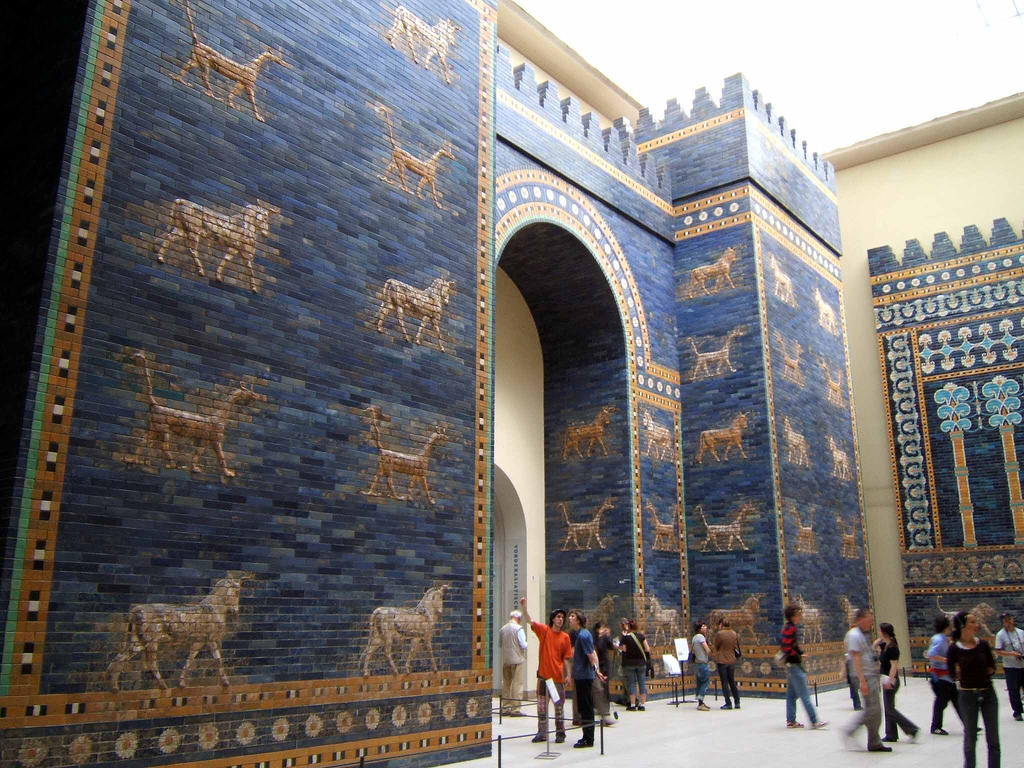
Babylon. City of mystery, history, prophecy. The very name Bab-iliu means “the gate of the gods” in Akkadian, which is the oldest recorded Semitic language and the most common language of the ancient Near East until the eighth century BC.
It was founded on the great river, Euphrates, about 200 miles north of where the Euphrates joins the Tigris and drains into the Persian Gulf, two of the 4 great rivers flowing out of Eden to “water the garden”. (Genesis 2:14).
Babylon was a sacred site dedicated to the (false) god Marduk, the city’s patron god. Often Marduk’s name is included with the title ‘Bel’ to Marduk’s name to indicate supremacy of all the gods. The city’s inhabitants celebrated Marduk at the start of their new year with a festival noting his ascension as king of all gods and his seating in his temple in the city.
Marduk was mentioned in the Bible in Jeremiah 50:1–2 where Yahweh ordered Jeremiah to declare:
‘Babylon has been captured; Bel has been put to shame; Marduk has been shattered; Her images have been put to shame; her idols have been shattered.’
For two thousand years Babylon dominated Mesopotamia.
The Lexham Bible Dictionary indicates that Babylon was a “cultural and political center of Mesopotamia during much of the second and first millennia BC. Located in modern-day Iraq along one branch of the Euphrates River, about 59 miles southwest of Baghdad.“
Babylon Past
Throughout the entire Bible, Babylon stands as a dominating presence as an actual historical empire but also as a symbol of spiritual apostasy and evil opposition to God and His people. Its name Babel is first found in Genesis 11:9,
Therefore is the name of it called Babel; because the Lord did there confound the language of all the earth’
Babylon is the Greek form of the name Babel. Babylon began its ascent in 2300 BC to greatness but really exploded in cultural and architectural wonders during the reign of Hammurabi in 1792 BC, the sixth king of his line. During his reign and later his son’s reign, numerous temples were built and irrigation channels were excavated. King Hammurabi also conquered all of the surrounding cities, including the famous city of “Ur” where Abraham had lived centuries before.
But like many cities, Babylon then began to decline, and this up and down swing continued until Assyria was finally defeated. It then reached another pinnacle during the reign of Nebuchadnezzar II and entrenched itself as one of the most important cities in the Near East.
“The empire had been founded by Nebuchadnezzar’s father Nabopolassar (r. 625-605 BCE) after his victories over the Assyrian Empire. Nebuchadnezzar II would go on to even greater things, including the capture of Jerusalem in 597 BCE. The Babylonian king then set about making his capital one of the most splendid cities in the world”. Source World History Encyclopedia
The most famous of these improvements to the city were the Hanging Gardens of Babylon, “ancient gardens considered one of the Seven Wonders of the World and thought to have been located near the royal palace in Babylon” says Encyclopedia Britannica. Though no one is quite sure where they were within the city, there were enough descriptions of them in classical literature to know that they likely existed, though no one is exactly sure of what they looked like.
The Gardens were said to be ‘hanging’ because perhaps they were perhaps on a tall ziggurat with terraces, “were set upon vaulted terraces. They were also described as having been watered by an exceptional system of irrigation and roofed with stone balconies on which were layered various materials, such as reeds, bitumen, and lead, so that the irrigation water would not seep through the terraces.”
In Daniel 4:30 we read the perhaps most famous story about Babylon, where King Nebuchadnezzar admires his city from his palace rooftop, saying “‘Is this not Babylon the great, which I myself have built as a royal house by the strength of my power and for the glory of my majesty?’”
Barnes’ Notes says: “He greatly enlarged the city; built a new city on the west side of the river; reared a magnificent palace; and constructed the celebrated hanging gardens; and, in fact, made the city so different from what it was, and so greatly increased its splendor, that he could say without impropriety that he had “built” it.“
Yet…the very next verse says that King Nebuchadnezzar’s pride and self-glorification was a mistake.
While the word was in the king’s mouth, there fell a voice from heaven, saying, O king Nebuchadnezzar, to thee it is spoken; The kingdom is departed from thee.
The city “under Nebuchadnezzar, who died B.C. 561 after a reign of forty-three years, attained great splendour. In the reign of Belshazzar the capital was taken by Darius the Median (Dan. 5:25–31), who entered it unexpectedly at the head of an army of Medes and Persians, as Isaiah (21:1–9) and Jeremiah (51:31) had predicted some 170 years before. Then began the decay and ruin of this proud city, and the kingdom of Babylon became a part of the Persian empire. In course of time the “great city” became “heaps,” and “an astonishment, and a hissing, without an inhabitant” (Jer. 51:37–58).
“Many of the Jews who had been carried captive to Babylon remained there, notwithstanding the decree of Cyrus. After the destruction of Jerusalem there was established at Babylon a school of Jewish learning of great repute.” Source– Easton’s(1893) In Illustrated Bible Dictionary and Treasury of Biblical History.
Babylon future
Babylon is mentioned in Revelation numerous times. We read in Revelation 14:8, “and another angel, a second one, followed, saying, “Fallen, fallen is Babylon the great, she who has made all the nations drink of the wine of the wrath of her sexual immorality.”
Babylon was not only a city in history, not only an empire that rose & fell, but the name Babylon is also figurative of an evil commercial-governmental system and an evil spiritual system.
Roy Gingrich interprets both the actual and the symbolic nature of Babylon:
“The fall of Babylon (Rev 14:8)-
“(1) The announcement—Another angel (other than the one in verse 6) announces the soon coming fall of Babylon. The “Babylon” mentioned here is not the religious system of chapter 17 -that “Babylon” was destroyed at the mid-point of “The Seventieth Week”. The “Babylon” mentioned here is the capital city of the political-religious-commercial system of chapter 18, which city and system will be destroyed when the Seventh bowl is poured out. God destroys her because she made the nations drink “the wine of the wrath of her fornication,” that is, because she caused them to commit spiritual fornication, which is punished by God’s wrath.” Gingrich, R. E. (2001). The Book of Revelation (p. 69). Riverside Printing.
Gingrich continues-
“The destruction of religious “Babylon” as an ecclesiastical system, chapter 17. In the days of Nimrod, Gen. 10:8–12, and his wife, Semiramis, around 200 years after the Flood, two great systems came into existence, a God-defiant political system and a God-defiant religious system, the one founded by Nimrod and the other founded by Nimrod through his wife, Semiramis. These two systems are often called Political Babylon and Religious Babylon because they had their beginnings in Babylon, the one in the building of the city of Babylon and the other in the building of the tower of Babylon. The city of Babylon is the symbol of organized political rebellion against God and the tower of Babylon is the symbol of organized religious rebellion against God.” Gingrich, R. E. (2001). The Book of Revelation (pp. 76–77). Riverside Printing
“These two systems in varying forms, have continued on side by side down through the centuries, hating one another but for the sake of self-advancement, exchanging favors with one another. During the Middle Ages, these two systems were seen in the Holy Roman Empire and in the Roman Catholic Church. Today, they are seen in the United Nations Organization and in the Ecumenical Church Movement. During the first half of Daniel’s Seventieth Week, they will be seen in the Revived Roman Empire [“the Scarlet-colored beast,” Rev. 17:3] and in the rejected Lacodicean church] [“the great whore,” Rev. 17:1]. It is very helpful in understanding Rev., chap. 17, to know that “the scarlet-colored beast” and “the great whore” of chapter 17 are the final forms of two great God-defiant systems which have been in existence for over 3,000 years.” Gingrich, R. E. (2001). The Book of Revelation (pp. 76–77). Riverside Printing.
–end Gingrich quote
Babylon both actual and spiritual offer many lessons for us. Whenever I think of Dickens’ “A Tale of Two Cities” I often think of ‘Babylon & Jerusalem’. In the NT Babylon is always mentioned negatively, as a seat of evil, ungodly power. It signifies the world and its forces in opposition to God. It is often contrasted with “New Jerusalem”, in which God will finally reign supreme with no opposition ever again.
We will live in the city GOD built, not a city made by man like Assyria’s Damascus, Caesar’s Rome or Nebuchadnezzar’s Babylon. It will be a pure city, devoid of anything detracting from the glory of Jesus and his Light.
Babylon present
Whatever became of the actual, historical city of Babylon? It no longer really exists. It is a ruin, though it was opened to tourists again in 2009. There is not much to see. It is estimated that only about 5% of the old city has been excavated.
Babylon would stay under the Persian Empire’s rule for two centuries before Alexander the Great then conquered Babylon in 331 BC. He had plans to make Babylon the capital of his empire but died there in 323 BC before his dream came into reality. Alexander’s generals divided his empire among themselves immediately after his death. This is how general Seleucus obtained the historical city of Babylon. Not long after, he moved most of the population to his new capital Seleucia, which left the city decaying and deserted.Source
Will Babylon the city rise again? Only the Lord knows. Babylon the metaphor for an economy and an ecclesiastical system will indeed rise again to uncontested dominance, and be part of the major events prophesied to occur in the future, if the Babylonian system even can be said to have disappeared in the first place. Yet “Babylon” actual and Babylon figurative will finally be squashed in the future when Revelation events occur and Jesus’ wrath wipes out the evil system. The Lord as always, reigns supreme.
There will be no king looking out from his own rooftop and congratulating himself on his achievements. There will be no pagan priests celebrating a false god on a mythical throne. There will be no garden except the one the LORD himself planted, meaning, the world. It will be pure, verdant, and full of peoples who acknowledge Jesus as the supreme Lord of Lords and King of Kings. What a day that will be!
Babylon. City of mystery, history, prophecy. The very name Bab-iliu means “the gate of the gods” in Akkadian, which is the oldest recorded Semitic language and the most common language of the ancient Near East until the eighth century BC.
It was founded on the great river, Euphrates, about 200 miles north of where the Euphrates joins the Tigris and drains into the Persian Gulf, two of the 4 great rivers flowing out of Eden to “water the garden”. (Genesis 2:14).
Babylon was a sacred site dedicated to the (false) god Marduk, the city’s patron god. Often Marduk’s name is included with the title ‘Bel’ to Marduk’s name to indicate supremacy of all the gods. The city’s inhabitants celebrated Marduk at the start of their new year with a festival noting his ascension as king of all gods and his seating in his temple in the city.
Marduk was mentioned in the Bible in Jeremiah 50:1–2 where Yahweh ordered Jeremiah to declare:
‘Babylon has been captured; Bel has been put to shame; Marduk has been shattered; Her images have been put to shame; her idols have been shattered.’
For two thousand years Babylon dominated Mesopotamia.
The Lexham Bible Dictionary indicates that Babylon was a “cultural and political center of Mesopotamia during much of the second and first millennia BC. Located in modern-day Iraq along one branch of the Euphrates River, about 59 miles southwest of Baghdad.“
Babylon Past
Throughout the entire Bible, Babylon stands as a dominating presence as an actual historical empire but also as a symbol of spiritual apostasy and evil opposition to God and His people. Its name Babel is first found in Genesis 11:9,
Therefore is the name of it called Babel; because the Lord did there confound the language of all the earth’
Babylon is the Greek form of the name Babel. Babylon began its ascent in 2300 BC to greatness but really exploded in cultural and architectural wonders during the reign of Hammurabi in 1792 BC, the sixth king of his line. During his reign and later his son’s reign, numerous temples were built and irrigation channels were excavated. King Hammurabi also conquered all of the surrounding cities, including the famous city of “Ur” where Abraham had lived centuries before.
But like many cities, Babylon then began to decline, and this up and down swing continued until Assyria was finally defeated. It then reached another pinnacle during the reign of Nebuchadnezzar II and entrenched itself as one of the most important cities in the Near East.
“The empire had been founded by Nebuchadnezzar’s father Nabopolassar (r. 625-605 BCE) after his victories over the Assyrian Empire. Nebuchadnezzar II would go on to even greater things, including the capture of Jerusalem in 597 BCE. The Babylonian king then set about making his capital one of the most splendid cities in the world”. Source World History Encyclopedia
The most famous of these improvements to the city were the Hanging Gardens of Babylon, “ancient gardens considered one of the Seven Wonders of the World and thought to have been located near the royal palace in Babylon” says Encyclopedia Britannica. Though no one is quite sure where they were within the city, there were enough descriptions of them in classical literature to know that they likely existed, though no one is exactly sure of what they looked like.
The Gardens were said to be ‘hanging’ because perhaps they were perhaps on a tall ziggurat with terraces, “were set upon vaulted terraces. They were also described as having been watered by an exceptional system of irrigation and roofed with stone balconies on which were layered various materials, such as reeds, bitumen, and lead, so that the irrigation water would not seep through the terraces.”
In Daniel 4:30 we read the perhaps most famous story about Babylon, where King Nebuchadnezzar admires his city from his palace rooftop, saying “‘Is this not Babylon the great, which I myself have built as a royal house by the strength of my power and for the glory of my majesty?’”
Barnes’ Notes says: “He greatly enlarged the city; built a new city on the west side of the river; reared a magnificent palace; and constructed the celebrated hanging gardens; and, in fact, made the city so different from what it was, and so greatly increased its splendor, that he could say without impropriety that he had “built” it.“
Yet…the very next verse says that King Nebuchadnezzar’s pride and self-glorification was a mistake.
While the word was in the king’s mouth, there fell a voice from heaven, saying, O king Nebuchadnezzar, to thee it is spoken; The kingdom is departed from thee.
The city “under Nebuchadnezzar, who died B.C. 561 after a reign of forty-three years, attained great splendour. In the reign of Belshazzar the capital was taken by Darius the Median (Dan. 5:25–31), who entered it unexpectedly at the head of an army of Medes and Persians, as Isaiah (21:1–9) and Jeremiah (51:31) had predicted some 170 years before. Then began the decay and ruin of this proud city, and the kingdom of Babylon became a part of the Persian empire. In course of time the “great city” became “heaps,” and “an astonishment, and a hissing, without an inhabitant” (Jer. 51:37–58).
“Many of the Jews who had been carried captive to Babylon remained there, notwithstanding the decree of Cyrus. After the destruction of Jerusalem there was established at Babylon a school of Jewish learning of great repute.” Source– Easton’s(1893) In Illustrated Bible Dictionary and Treasury of Biblical History.
Babylon future
Babylon is mentioned in Revelation numerous times. We read in Revelation 14:8, “and another angel, a second one, followed, saying, “Fallen, fallen is Babylon the great, she who has made all the nations drink of the wine of the wrath of her sexual immorality.”
Babylon was not only a city in history, not only an empire that rose & fell, but the name Babylon is also figurative of an evil commercial-governmental system and an evil spiritual system.
Roy Gingrich interprets both the actual and the symbolic nature of Babylon:
“The fall of Babylon (Rev 14:8)-
“(1) The announcement—Another angel (other than the one in verse 6) announces the soon coming fall of Babylon. The “Babylon” mentioned here is not the religious system of chapter 17 -that “Babylon” was destroyed at the mid-point of “The Seventieth Week”. The “Babylon” mentioned here is the capital city of the political-religious-commercial system of chapter 18, which city and system will be destroyed when the Seventh bowl is poured out. God destroys her because she made the nations drink “the wine of the wrath of her fornication,” that is, because she caused them to commit spiritual fornication, which is punished by God’s wrath.” Gingrich, R. E. (2001). The Book of Revelation (p. 69). Riverside Printing.
Gingrich continues-
“The destruction of religious “Babylon” as an ecclesiastical system, chapter 17. In the days of Nimrod, Gen. 10:8–12, and his wife, Semiramis, around 200 years after the Flood, two great systems came into existence, a God-defiant political system and a God-defiant religious system, the one founded by Nimrod and the other founded by Nimrod through his wife, Semiramis. These two systems are often called Political Babylon and Religious Babylon because they had their beginnings in Babylon, the one in the building of the city of Babylon and the other in the building of the tower of Babylon. The city of Babylon is the symbol of organized political rebellion against God and the tower of Babylon is the symbol of organized religious rebellion against God.” Gingrich, R. E. (2001). The Book of Revelation (pp. 76–77). Riverside Printing
“These two systems in varying forms, have continued on side by side down through the centuries, hating one another but for the sake of self-advancement, exchanging favors with one another. During the Middle Ages, these two systems were seen in the Holy Roman Empire and in the Roman Catholic Church. Today, they are seen in the United Nations Organization and in the Ecumenical Church Movement. During the first half of Daniel’s Seventieth Week, they will be seen in the Revived Roman Empire [“the Scarlet-colored beast,” Rev. 17:3] and in the rejected Lacodicean church] [“the great whore,” Rev. 17:1]. It is very helpful in understanding Rev., chap. 17, to know that “the scarlet-colored beast” and “the great whore” of chapter 17 are the final forms of two great God-defiant systems which have been in existence for over 3,000 years.” Gingrich, R. E. (2001). The Book of Revelation (pp. 76–77). Riverside Printing.
–end Gingrich quote
Babylon both actual and spiritual offer many lessons for us. Whenever I think of Dickens’ “A Tale of Two Cities” I often think of ‘Babylon & Jerusalem’. In the NT Babylon is always mentioned negatively, as a seat of evil, ungodly power. It signifies the world and its forces in opposition to God. It is often contrasted with “New Jerusalem”, in which God will finally reign supreme with no opposition ever again.
We will live in the city GOD built, not a city made by man like Assyria’s Damascus, Caesar’s Rome or Nebuchadnezzar’s Babylon. It will be a pure city, devoid of anything detracting from the glory of Jesus and his Light.
Babylon present
Whatever became of the actual, historical city of Babylon? It no longer really exists. It is a ruin, though it was opened to tourists again in 2009. There is not much to see. It is estimated that only about 5% of the old city has been excavated.
Babylon would stay under the Persian Empire’s rule for two centuries before Alexander the Great then conquered Babylon in 331 BC. He had plans to make Babylon the capital of his empire but died there in 323 BC before his dream came into reality. Alexander’s generals divided his empire among themselves immediately after his death. This is how general Seleucus obtained the historical city of Babylon. Not long after, he moved most of the population to his new capital Seleucia, which left the city decaying and deserted.Source
Will Babylon the city rise again? Only the Lord knows. Babylon the metaphor for an economy and an ecclesiastical system will indeed rise again to uncontested dominance, and be part of the major events prophesied to occur in the future, if the Babylonian system even can be said to have disappeared in the first place. Yet “Babylon” actual and Babylon figurative will finally be squashed in the future when Revelation events occur and Jesus’ wrath wipes out the evil system. The Lord as always, reigns supreme.
There will be no king looking out from his own rooftop and congratulating himself on his achievements. There will be no pagan priests celebrating a false god on a mythical throne. There will be no garden except the one the LORD himself planted, meaning, the world. It will be pure, verdant, and full of peoples who acknowledge Jesus as the supreme Lord of Lords and King of Kings. What a day that will be!
This week I wrote about the question where is heaven? Also I wrote about what we have to look forward to in heaven. In that essay I’d compared Genesis 1-2 and Revelation 21-22, noting that they were the only books of the Bible that were free of any description of sin. I’d also written that though Genesis 1-2 are wonderful for showing God’s power of His word in creation, Revelation 21-22 were even better.
I wanted to bask in that glorious vision a bit more so I kept mulling over the verses in Revelation 21-22. I was struck when I read Revelation 22:1-2, “The River and the Tree of Life”. Some things jumped out at me. You know how that happens, you read it a million times but THIS time, some things capture your attention in a huge way like you’ve never read it before?
The River and the Tree of Life
Then he showed me a river of the water of life, clear as crystal, coming from the throne of God and of the Lamb, in the middle of its street. On either side of the river was the tree of life, bearing twelve kinds of fruit, yielding its fruit every month; and the leaves of the tree were for the healing of the nations. (Revelation 22:1-2).
Though there are a LOT of things to ponder in just those two sentences, the two things that jumped out at me, were the tree’s location and the fruit.
EPrata photo
First, the tree. No matter the translation I read the verse in, it says the tree stood on either side of the river. How can THE tree, singular, stand on BOTH sides of a river? John Walvoord was puzzled too, and so are other commenters, according to him. He wrote:
“Interpreters have puzzled over this expression that the tree of life is on each side of the river. Some take this is as a group of trees. Others say that the river of life is narrow and that it flows on both sides of the tree. The tree of life was referred to in the Garden of Eden (Gen. 3:22, 24), where it was represented as perpetuating physical life forever. Adam and Eve were forbidden to eat of the fruit of this tree. Earlier in Revelation (2:7) the saints were promised the “right to eat from the tree of life, which is in the paradise of God.” Walvoord, J. F. The Bible Knowledge Commentary: An Exposition of the Scriptures (Vol. 2, p. 987). Victor Books.
We do know that Ezekiel 47 is another place where heaven is described. Trees are mentioned on the banks of this same river flowing out from the throne of God. In Ezekiel 47:12 we read,
And by the river on its bank, on one side and on the other, will grow all kinds of trees for food. Their leaves will not wither and their fruit will not fail. They will bear fruit every month because their water flows from the sanctuary, and their fruit will be for food and their leaves for healing. (Ezekiel 47:12).
But the Bible is consistent where the Tree of Life is mentioned, that it is A tree, or ONE tree, or THE Tree of Life.
But it could be that it’s as Ezekiel describes, a cluster of trees lining the banks of the River of Life. Or it could be as John describes in Revelation, ONE tree, on both sides of the river, possible since the eternal state does not necessarily have to abide by the laws of physics we have now. Or it could be as Roy Gingrich describes it below in his commentary on Revelation- the tree is in the river.
“A river of the water of life proceeds from the throne of God and of the Lamb down the middle of the city’s street. In the midst of the river is the tree of life with its branches hanging over each bank of the river.” Gingrich, R. E. (2001). The Book of Revelation (p. 94). Riverside Printing.
Whichever way it is when we see the configuration of the tree of life and the river of the waters of life, it’s a fantastic thing to think of, the Tree of Life and the river of the waters of life, crystal and pure, ever-flowing.
The other thing that struck me was the fruit.
This tree monthly bears twelve kinds of fruits. If the Tree of Life is indeed one tree, how can one tree bear different kinds of fruit? Doesn’t the vegetation bear only its own kind? We read in Genesis 1:12,
The earth produced vegetation, plants yielding seed according to their kind, and trees bearing fruit with seed in them, according to their kind; and God saw that it was good.
Luke 6:44 says, For each tree is known by its own fruit. For people do not gather figs from thorns, nor do they pick grapes from a briar bush.
However again, the dimension we will live in when we are glorified may not have the same laws of agriculture as we have now. Or perhaps since it is THE Tree of Life, it holds all life within it, including all kinds of seeds which bear all life-giving properties. It’s fun to think of.
By the way, the translation in the King James Version that we’re used to, that the tree’s leaves are for healing, doesn’t mean healing as in someone who is sick needs to get well. In the eternal state there will be no illness. As MacArthur said, rather than the leaves being medicine for healing, rather, they are like vitamins for flourishing. Both MacArthur and Gingrich commented that it may be more symbolic. That the expression used for tree and healing are anthropomorphic-
Its leaves are for the purpose of giving continuous health (not “healing,” K.J.V.) to the nations. The river represents the Spirit of God and the tree represents the Word of God. These two, the Spirit and the Word, keep the nations in perfect health. The variety of the fruit and frequency of the fruit picture God’s full and constant satisfaction of man’s religious and moral hunger. Gingrich, R. E. (2001). The Book of Revelation (p. 94). Riverside Printing.
MacArthur: Well, time has no part of eternity, but it does remind us that there are cycles. And it’s just another one of those anthropomorphic expressions to say something to us in terminology which we can understand. There will be a regular cycle of joyous provision, filled with variety, changing all the time … There’s going to be provided in heaven infinite variety, and there are going to be all kinds of things available in heaven, demonstrated by the symbolism of the leaves of that tree that are just going to energize life and just make it rich and full and exciting. (Source)
If you are feeling down, or troubled because of the times, firstly, avoid the secular news if you can. Secondly, pray to Jesus and lay your anxieties at His feet. Thirdly, read in the Bible of the wondrous things Jesus has in store for us. He is preparing that place and He will come back to retrieve His Bride from this polluted earth and play out His end plan. When it’s all over we have a glorious future ahead. The crystal River of the Waters of Life, Tree of Life, Street of Gold, no sin! And best of all, Jesus with us!
A reader kindly asked me a question from something she heard on my podcast. I appreciated the thoughtfulness which which she had asked, and also used scripture. Nothing makes me happier than this (except salvations and baptisms!) It’s the goal, constructive discussion on theological topics.
She said I was sharing that Beth Moore speaks of having (false) revelations and she wondered “if the Holy Spirit does not give His people revelations anymore? Especially on the Word of God, meaning enlightens us with deeper meanings or understandings about the Word? That He shines a brighter/clearer light on it, than say, perhaps what has been traditionally taught? Not negating it, necessarily, but being able to see, as enabled by the Holy Spirit of God, into the meaning of the written Word on a deeper level.“
“I do not support Beth Moore, or listen to her, but when you said one of the biggest problems with her was her receiving revelations from God, I wondered if you believe or not whether He gives them. I am thinking of the Scripture, of 1 Cor.14:26-“How is it then, brethren? Whenever you come together, each of you has a psalm, has a teaching, has a tongue, has a revelation, has an interpretation. Let all things be done for edification.”
The way she described revelation, I think she meant illumination. Her description was super, too. The description is just assigned to the wrong word, but it’s exactly what the Spirit does when opening our mind to understand God’s word.
As for revelation, that means new knowledge of God’s mind, word, intent, plans, etc. He speaks, and it’s revealed by Him. His speaking in the past was through angels, prophets, even a donkey. In this current age of the closed and finalized Bible, He spoke through His Son Jesus, and then He stopped speaking. All we need to know is already in the word. God declared it so:
Deuteronomy 4:2, You shall not add to the word which I am commanding you, nor take away from it, so that you may keep the commandments of the Lord your God which I am commanding you.
Revelation 22:18-19, I testify to everyone who hears the words of the prophecy of this book: if anyone adds to them, God will add to him the plagues that are written in this book; 19 and if anyone takes away from the words of the book of this prophecy, God will take away his part from the tree of life and from the holy city, which are written in this book.
Hebrews 1:1-2, God’s Final Word in His Son: God, after He spoke long ago to the fathers in the prophets in many portions and in many ways, in these last days has spoken to us in His Son, whom He appointed heir of all things, through whom He also made the world.
What we do have for revelation from God is sufficient. We do not need to ask for more, look for more, or expect more.
2 Timothy 3:16, All Scripture is inspired by God and beneficial for teaching, for rebuke, for correction, for training in righteousness;
What Beth Moore and others say is that God gives her NEW knowledge straight from Him, and even worse, she is to turn around and teach it. She quotes what He has supposedly said. This makes her a false prophetess. God is against people attributing things to Him that He did not say. (Jeremiah 23:21, Revelation 2:20).
However, revelation from God is different from illumination. The Spirit illuminates what is already revealed, applies it to our mind to transform it. He makes scripture clear, and brings scripture to mind. Illumination is the Spirit helping us to understand what has already been revealed. Revelation is the giving of new knowledge about God from God. As mentioned, what we know about God has already been revealed. But the Spirit goes on with helping us understand it.
Picture going into a dark room. There is a dimmer switch on the wall. The furniture is already there, but when you turn on the dimmer, a soft glow illuminates the outlines of the furniture. Then as you study, the the switch turns on more light. It gets brighter and you see more details in the room. Finally when we are glorified, then the light is on all the way and we know all that God had intended for us to know.
I know your works: you are neither cold nor hot. Would that you were either cold or hot! So, because you are lukewarm, and neither hot nor cold, I will spit you out of my mouth. For you say, I am rich, I have prospered, and I need nothing, not realizing that you are wretched, pitiable, poor, blind, and naked. I counsel you to buy from me gold refined by fire, so that you may be rich, and white garments so that you may clothe yourself and the shame of your nakedness may not be seen, and salve to anoint your eyes, so that you may see. Those whom I love, I reprove and discipline, so be zealous and repent. Behold, I stand at the door and knock. If anyone hears my voice and opens the door, I will come in to him and eat with him, and he with me. (Revelation 3:15-20)
Often forgotten in the prophecies are the warnings Jesus gives to the churches in Revelation. As with many prophecies, there is a near fulfillment that is and a far fulfillment. The 7 letters to 7 churches that open the Book of Revelation were actual letters sent to actual churches and actually read as warnings, encouragements or indictments against them. The second reason the letters were sent was to reveal seven different types of individuals/churches throughout history and instruct them in God’s truth.
The last verse is the one I want to point to. Jesus is not ‘knocking at the door of your heart’ in this verse. It is obvious he is knocking at the door of the church. The church had become (and will become, like it is now) so pale and non-Gospel oriented that Jesus is outside it! Just think of Joel Osteen’s church at Lakewood and you have a perfect fulfillment of the kind of church Jesus is warning about here. Mr Osteen never preaches sin or wrath or judgment because he doesn’t want to offend anyone, wanting to stay positive. But how can a person repent if they don’t know they are sinning? He refuses to put a cross on his stage, because it might prove an “obstacle to anyone who might come.” But if they are not coming to the cross, what are they coming to??? Jesus is standing outside Mr Osteen’s church, knocking to get in.
That sad indictment is repeated over many parts of the body of Christ today. I pray you find a good church that has solid beliefs, and participate there. Support your pastor, if he stands on the foundational principles of the faith, and preaches them. He is a rarity these days, and precious. Treat him like he is.
The decline of belief is symbiotic. If you attend a church like Lakewood for any length of time, then you will fade into lukewarmness because the fire of wrath and rebuke from a holy God has disappeared. With the full counsel of God being preached, His perfect message of sin & wrath/mercy & redemption is held up and you will grow in Christ-likeness. Without the cross preached, who are the Laodicean congregants growing into looking like? Man, not God.












 the-end-time.org