Posted in theology

Navigating Christian Romance Novels: What’s Acceptable? part 1

By Elizabeth Prata

part 2 here

Back in 1992 Bruce Springsteen published a song called 57 channels (and nothing on). It was during the time when streaming movie channels had gone to a 24 hour format, (yes, HBO hadn’t always been 24 hours), cable tv was expanding, and satellite television was coming in. In my day in the 1960s and early 1970s, we had 3 broadcast channels, and later Public TV added a 4th.

Many of us marveled at the expansion of available choices for personal entertainment, but shortly we were disappointed at the vapidity of them all and frustrated by the lack of quality. It was true, 57 channels and nothing on.

Thirty-three years later we have even more opportunities for our personal entertainment in not only streaming movies and TV, but music, internet content, podcasts and print media in books. Despite the widening of choices, Christian segments of each of those industries still remains small. What do we watch/listen to/read without our eyes/ears/heart becoming dispirited (or righteously offended) by the content? For readers, aren’t there ANY safe, well-written romance books? 57 Publishers and nothing to read…

Continue reading “Navigating Christian Romance Novels: What’s Acceptable? part 1”
Posted in theology

My 2024 Year in Books

By Elizabeth Prata

It’s taking stock time. It’s turning over last year’s leaf into a new leaf. It’s time to make decisions. It’s New Year 2025 (almost)!

I took a look at my Goodreads list. I’m not a huge fan of Goodreads, I find the site cumbersome and hard to use. But it is useful. I didn’t record all the books I read this year (2024) on it but I did keep track in my hard copy planner. [I’m old school- a chronicler from 1968, I prefer hard copy]. So I added the books from my planner to Goodreads and it calculated my Year in Reading.

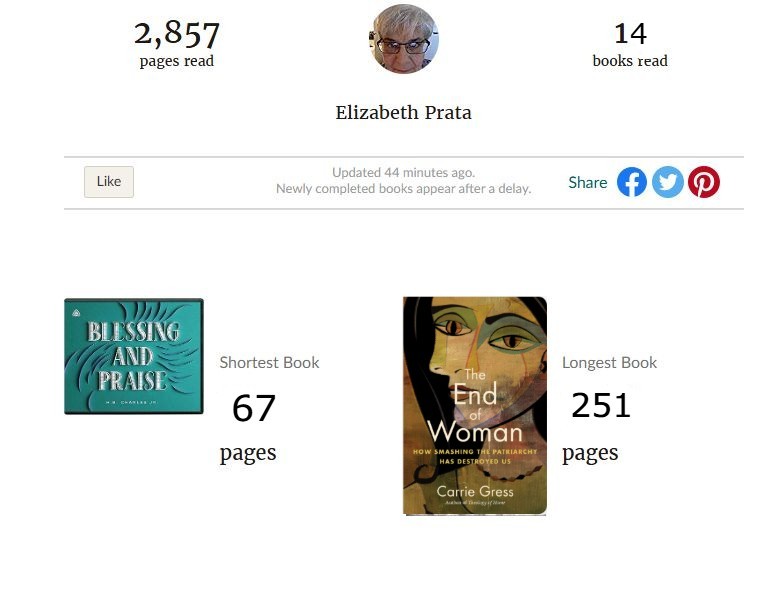
First of all, and I say this every year, I didn’t do as badly as I thought I did. I always consider myself a reading failure but that’s because I really don’t remember the books I’ve read. I read 14 books this year and that is about 10 more than I thought I did.

The book Blessings and Praise: Benedictions and Doxologies in the Bible is by HB Charles and it’s a workbook. It was part of a video study course I took from Ligonier earlier in the year. It is EXCELLENT! Highly recommended.

The other one is The End of Woman: How Smashing the Patriarchy Has Destroyed Us by Carrie Gress. It’s a thoroughly researched and extremely well edited book on the origins of feminism and their threads throughout the 1700s, 1800s, 1900s to the 2000s. When I say well edited, it’s because Gress researched voluminously, but crafted such a compelling narrative that puts in exactly the right facts and leaves out anything that would bog down the reader. With a massively researched topic spanning 300 years, it’s hard to know what to put in and what to leave out, and that is what an editor does- does those decisions which makes the story readable. By the way, feminism is evil, but WAY MORE evil than I thought. Ms Gress has the story.

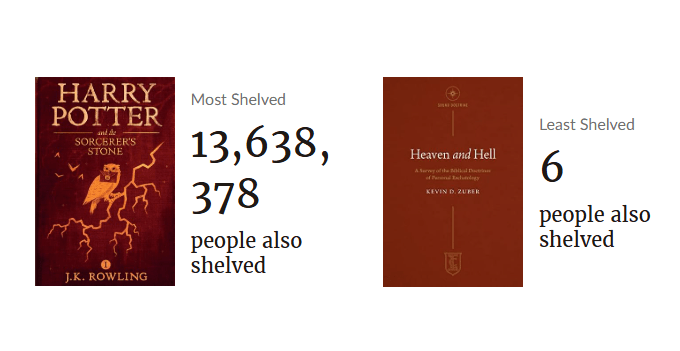
I picked up the Harry Potter book this past summer. I read the first two when they came out, now more than 20 years ago. This summer I thought, well, let me see if I connect with them again, or not.

I mentioned this online and holy guacamole, lots of people got hot under the collar right away, accusing me of all sorts, because Potter is occult! the witchcraft! it’s evil! Etc. I asked sincerely if HP was any different from Lord of the Rings with, you know, wizards and supernatural events and stuff, but they just kept complaining and harassing. So I ignored them and read the first two books again.

Interestingly, Samuel Sey of @slowtowrite asked the following question on Twitter/X and I enjoyed the discussion, which was pretty civil. That debate is here if you want to read it.

Samuel Sey, @SlowToWrite asked – “Are there still Christians who believe people should avoid the Harry Potter books/movies because of its depiction of witchcraft? If so, I’m truly curious: What makes the witchcraft in Harry Potter more acceptable than the witchcraft in Lord of the Rings?

I thought Harry Potter book was engaging enough because it’s well written, creative, and different. But halfway thru book I lost steam and put them aside. Just like 20 years ago. As for the most shelved vs least shelved books on Goodreads as seen above, it’s no surprise to me that HP is on many millions of shelves but Heaven and Hell is only on 6, lol.

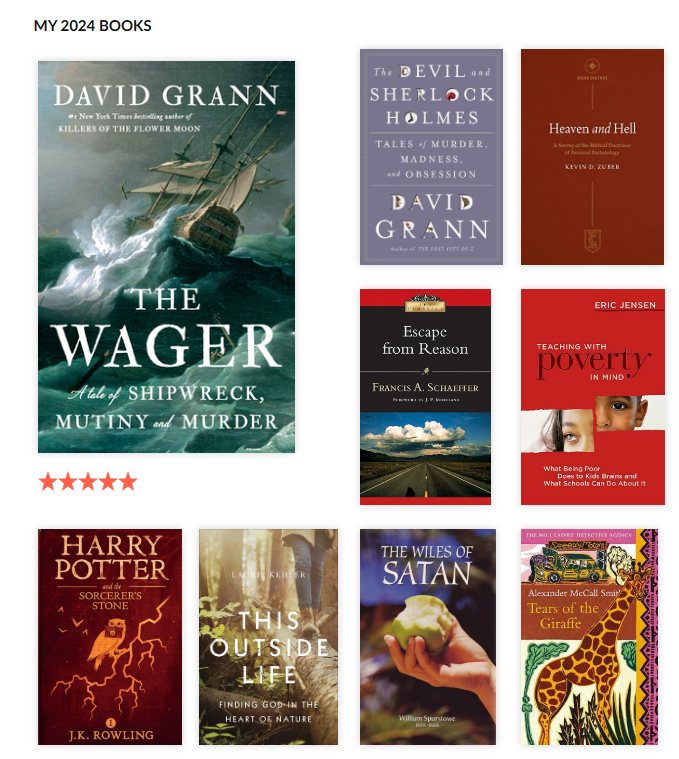
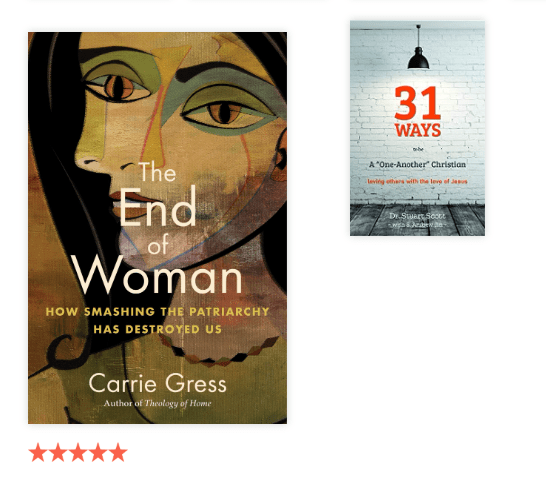
My books for 2024 are as follows

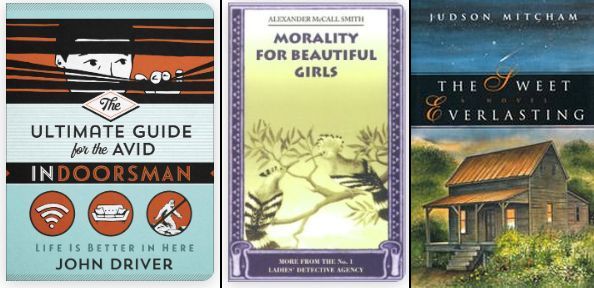
Confession- I have not read Morality for Beautiful Girls yet but I plan to read it today, so technically…

My goals for reading this year 2025 are to…read. I am increasingly tired when I get home from a full day of work as a reading interventionist in an elementary school. My eyes are tired too, they get dry and then they spasm. So I just want to keep the habit going without putting too much pressure on myself. I’ve enjoyed this Christmas break, and summer break I do read a lot, but absent a break, Saturdays seem to be the only day my mind is ready for reading.

I am reading the very long William Carey biography and I’ll continue that. Maybe the book on the ascension called Taken up to Heaven by Derek Thomas. I started Unlawful Killings by Wendy Joseph, a UK judge explaining about how the British court system works and reminiscing on her memorable cases. Beyond that I’ll see what comes up.

In 2023 I read The Art Thief: A True Story of Love, Crime, and a Dangerous Obsession, the one by Michael Finkel not the other similarly named book, and These is my Words: The Diary of Sarah Agnes Prine, 1881-1901 by Sarah Agnes Prine. Those two books were standout books, two of the best I’ve read in years. Absorbing and memorable. I’m still thinking of them over a year later. I hope I find a couple of books in 2025 equally as good as those.

If you are into Christian Reading Challenges, Challies always has a good one, you have to sign up for his newsletter but there is no cost involved and you can unsubscribe if you don’t like the newsletter. G3 has a reading challenge too. Reading challenges are when the organization sets a theme for the books they suggest you read, such as “Read a book over 100 years old” or “Read a book published this year”.

If you want a secular reading challenge, Barnes & Noble has one. Their themes are ones such as a selection of adventure books, meditative, dystopian. In their Empowerment suggestions, I’d avoid Rachel Hollis’s book, and in the Translated section I’d avoid Emily Wilson’s translation of The Iliad. I’d avoid the Memoir section completely. Secular books always come with risks. (Christian books too, but less so). Alternately, you could take just their categories and vet and select your own books.

It’s good to have a goal. Apparently last December 31 at Goodreads I’d set a goal of 13 books. I met it plus one. I find that absent a set goal, I fritter the time away and before I know it, I haven’t done much of anything. Having a Bible Reading Goal is good. I decided on the John MacArthur Daily Bible for my plan and I’ve included Dustin Benge’s Hearts Aflame Puritan reading devotional podcast, with a page of Valley of Vision Puritan prayer devotionals in the afternoon. Setting any goal is good, and setting it down in writing even better. Having set goals provides structure, limits, boundaries and it feels good to meet one’s set challenges.

Happy New Year and thank you for a great year and I pray your year of 2025 is in the Lord- now much else to say because all He does is good for those who love Him and for His glory!

Posted in theology

Why don’t adults read? Exploring reasons (screen time isn’t one of them), & a confession

By Elizabeth Prata

I love books! I love everything about them. I like inventorying them when I bring one home. I like looking at the ones on my shelves. I like my library room full of books. I like thinking about the ones I have read and the ones I want to read. I like the covers (I DO judge a book by its cover). I like the thrill of maybe finding a first edition (I have a 1st ed C.S. Lewis and a 1st Book Club edition of Dune). I like book bindings. I like antiquated books. I like the thrill of the hunt for books.

EPrata photo

Like this find delivered to the Metropolitan Museum. Maybe someday I’ll find a book like that!

I also like reading. I’ve always been a reader. I was weaned on 1960s Dick and Jane. I grew into Nancy Drew in 2nd grade, enjoyed Harriet the Spy as a 5th grader, got wrapped up in King Arthur as a High Schooler (The Once and Future King, The Crystal Cave, Le Morte d’Arthur), and the Classics. I loved the classics, like Huck Finn and Following the Equator from Mark Twain, The Great Gatsby from F. Scott Fitzgerald, Hemingway, Gabriel Garcia Marquez. I did go on a tear in my early 20s on South American literature’s Magic Realism from Marquez, Esquival, Allende, Neruda etc.

In my thirties I was living on the sailboat and also traveling a lot and the internet hadn’t come to the little people yet so I always had a book in hand. I liked at that time the traveling/adventure narratives such as A Year in Provence, Into Thin Air, Tim Cahill books, seafaring books and explorer books like The Lost City of Z.

In my 40s I was establishing my business of a local newspaper and read journalism books and books about civic society. In this era the book Bowling Alone stood out.

Reading is my identity as a person. It’s also my professional identity. My two education degrees revolve around literacy, so my professional days are to urge people to become better readers, to enjoy stories, to find the value of reading.

EPrata photo

In my 50s I still read but not as much. I went back to work in education, this time not a teacher but as a teacher’s aide. It is a demanding job and with my aging I found I was tired when I got home. But the frequent breaks from school still provided ample time to read, and I revisited the classics and some modern literature. I had also been saved by the grace of Jesus and I started reading theological books such as the Puritan Paperbacks and other religious topics.

Then I turned 60. I was still working, and the job had deepened into being a teacher’s aide PLUS doing interventions with struggling readers and keeping up with the data. Educators make as many decisions all day as an air traffic controller. Decision fatigue is real. The irony of aging is that as one gains seniority or more experience, she is given more responsibility. This is natural. However more responsibility comes at a time when the person is tiring mentally and physically. This is natural too.

I realized that I just don’t actually read much any more. My brain is tired when I get home from work. On weekends my eyes are weary, dry, and sometimes aching or throbbing. It’s tempting to just watch a screen when there are so many options for entertainment.

I berated myself for a long time for being weak-willed, for being lazy, for starting to become aliterate (unwilling to read, although able to do so).

But I DO want to read! It’s a habit I cherish. I’ve read so many good books. I’ve used books as escapism, I’ve learned so much, expanded my vocabulary, and sparked my imagination. Many of my travels had a goal to visit bookish places, such as the great bookstores of the world, or the homes of famous authors, or locations where famous book events happened.

Why, WHY don’t I read (as much) anymore?

Smith Family Photography source

I set about to find out and to solve my problem.

I came across a video where the host proposed Why Adults Don’t read…And How to Start Again from The Book Guy. I don’t know anything about the Book Guy but his video was articulate and well researched.

Here are his reasons. But don’t just read them and go ‘Oh yah’, there’s more to them than first appears.

For example, in No. 1, he gives information about 4 levels of literacy. As an educator, I found level 1 and 2 to be interesting when thinking of my students and the lack of literacy at home. It helped me be more informed and more sensitive.

No. 3, not having enough energy is definitely a major reason. Between old eyes, decision fatigue, mental weariness, it had become much easier to watch TV mindlessly than read a book engagingly. And reading is a habit, letting it go even for a while like I have, dulls the skill. It’s harder to pick up later.

No. 4 is more complex than one would think from the statement. It’s not just a bad experience, which does tend to turn some people off. It’s the pressure from others or pressure put on one’s self to read certain books.

EPrata photo

After I was saved in my early 40s I happily read lots of theology. As my 40s were left behind and then the 50s as well, I then realized I had put pressure on myself to read what I thought I SHOULD read rather than what I wanted to read. I had incrementally viewed fiction as ‘dessert’, only to be enjoyed after dutifully absorbing ‘better’ books or more worthy books. Now, don’t get me wrong. I LOVE the Puritan Paperbacks, Commentaries, Christian living books I’ve read. Many have impacted me deeply and added greatly to my life.

[From Death to Life: How Salvation Works, Blood Work: How the Blood of Christ Accomplishes Our Salvation, Valley of Vision, Pilgrim’s Progress are just a few!).

I felt also that if I had time and inclination I should be reading the Bible. Was I letting Jesus down by not spending MORE time in the word if I had the chance?

But reading fiction is instructive in its own way. It’s not dessert. I’m amazed that as a younger adult all I read was fiction and now all I read is non-fiction. Did I become a snob? Perhaps.

Fiction IS instructive. It teaches us languages skills and communication; fiction teaches us empathy, as explained more thoroughly in Neil Gaiman’s transcripted talk Why our future depends on libraries, reading and daydreaming.

I decided to get a fiction book from the Library that had been recommended to me. I pushed my computer away and got up to snuggle in my chair under a quilt, and read it. It was so relaxing. I sort of gave myself permission to indulge, and I even had a sink full of dishes, too.

Buying more books. EPrata photo

There are a few lessons for me here. First is just because I’ve been a reader all my life, I took the SKILL of reading for granted. As I transition to a slower season of life, I can’t take anything for granted- not energy, not skills, not time.

Second, read what you want. I will continue to read solidly theological books, but I will intentionally fold in fiction to the pile, and not feel guilty.

Third, just do it, as the saying goes. If I want to read, and I do, then just do it. Resist the temptation to first do the dishes, fold the laundry, and dust before, only to be too tired after. If it is important to me, then make the time.

So that’s my confession, my search for answers, and my resolve. Now if you will excuse me, I have a book to finish.

Posted in prophecy, theology

Why Read Dystopian Fiction?

By Elizabeth Prata

Tim Challies is a reader and a book reviewer. He is the author and promoter of the Annual Christian Reading Challenge, in which I have participated in the past.

I was glad to see this article by by Jon Dykstra linked from Tim Challies’ site. I’d add the eerily prescient 1914 novella from EM Forster, “The Machine Stops“, which predicted, well, pretty much where we are now regarding media, internet, imagination, ideas, social contact and more. Pretty amazing for a hundred-year-old novella.

Here is Dykstra’s essay- Why Is Dystopian Fiction Worth Reading?

Dystopian is a word from Greek meaning ‘bad place’ according to the article. It’s the opposite of Utopian, meaning ‘perfect place’.

Dystopian fiction is a genre that describes people surviving or trying to, after a holocaust of some kind, or a societal collapse, or a nuclear war, and the like. The article speaks of this kind of fiction being worthwhile because it helps us in predictive prophecy of the secular kind, in connecting the dots to see a current credible future threat. The author Dykstra’s point was that this kind of fiction spins a credible threat into scenarios that help us understand where these threats may lead us.

This is a genre well worth exploring, though with care and caution. It’s a big blank canvas that insightful writers can use to paint pictures of grim futures, all in the hopes that they, and we, will ensure such futures never come to be.

Of course, the mightiest and truest prediction of all is what God has said will come, via His word in scripture. Nothing outsmarts, outpaces, outdoes God’s prophecies.

EPrata photo

I enjoy this fiction but had felt mildly guilty about it, as though I needed to be doing something more productive. I’d wonder, ‘Am I a ghoul?’ ‘Why do I find this absorbing?’

Mr Dykstra helped me see my interest in it was to go where my own imagination lacked facility, to ‘see’ a future that is all too real in some cases, and to develop opinions and thoughts to guard against it. EM Forster’s The Machine Stops is a future that is practically already here, as is Stephen King’s The Running Man. Chilling.

The most famous work of dystopian fiction is George Orwell’s 1984, which the article mentions. That work was published in 1949. Another famous work of dystopian fiction is Aldous Huxley’s Brave New World. Other classic dystopian books are PD James’s Children of Men, which discusses the childlessness of all the nations and certain doom as the already born die off with no new births coming up to replace them. In fact, birth rates are ranging from declining to collapsing all over the world right now.

Of course there’s the famous Canadian book The Handmaid’s Tale. Dystopian fiction is good where it helps us see ahead and cope with credible current or near current threats and that book’s twisted version of Christianity isn’t a credible threat.

I mentioned I’ve participated in the Challies’ Christian Reading Challenge, at the “Avid Level” (26 books to read in a year.) I added several others of my own choosing to Challies’ list, making myself a separate genre nook of dystopian books I wanted to read. They included The Running Man, The Machine Stops, and It Can’t Happen Here by Sinclair Lewis about the rise of fascism in the US.

FYI, in Stephen King’s The Running Man (1982)- The end is absolutely chilling, because the final action the main character takes has already come to pass. Remember, in Dykstra’s essay, dystopian fiction that presents credible threats help us formulate our own reactions and imaginations, and that ne came true, for sure.

William Forschen’s book One Second After (2009) depicted the effect upon America from an EMP, (electro-magnetic pulse), and the nation’s societal collapse and resulting high death rate. The author consulted with psychologists, economists, and sociologists to base his fiction on real scenarios those experts stated would most likely happen if we suffered an EMP. It was well written and horrible to think of it occurring, as the Bible hints in some form, it will.

Pat Frank’s book Alas, Babylon (1959)-

-was one of the first apocalyptic novels of the nuclear age and has remained popular more than half century after it was first published, consistently ranking in Amazon.com’s Top 20 Science Fiction Short Stories list. The novel deals with the effects of a nuclear war on the fictional small town of Fort Repose, Florida, which is based upon the actual city of Mount Dora, Florida. The novel’s title is derived from the Book of Revelation: “Alas, alas, that great city Babylon, that mighty city! for in one hour is thy judgment come.”

Nuclear winter wasn’t a very known or understood event back then, so the survival rate of the population in Alas, Babylon, this initial entry into the American dystopian nuclear fiction isn’t realistic, but most of the rest of the book is.

As predictive or as absorbing as dystopian fiction might be for some people, the only true prediction is what the prophetic books of the Bible tell us will happen in the future, in God’s timing.

With the US election mere days away, many on both sides are saying ‘if the other side wins it will be the end of us’… Maybe, maybe not. It might tell us a bit about God’s judgment, though, or it might just tell us that we go on living long after the thrill of living is gone, as John Cougar Mellencamp sang.

People, the Tribulation is unthinkable. But we must think on it, the Lord’s wrath already hangs over the unsaved. Thoughts of the dystopian future and reading it now in His word should should spur us to witness with eagerness and fervor.

I don’t think a steady diet of this kind of material should be on our plates, but books like this can be a legitimate addition to our bookshelves or movie queue, for the reasons stated above. Happy reading…or in this case, unhappy reading.

hammer mural1

Posted in theology

Keep our creativity going! Read, write, draw

By Elizabeth Prata

Often as a new year approaches, people start thinking about their New Year’s resolutions. Many of those resolutions are vows to take better care of our bodies, by eating well or losing weight or exercising more.

But do we ever resolve to take care of our mind?

Christianity is a religion of the mind. We have the mind of Christ. (1 Corinthians 2:16). The Spirit transforms us by the renewing of our mind. (Romans 12:2). The mind governed by the Spirit is
life and peace, as Romans 8:6 says. Mark reminds us in verse 12:30 that we must ‘Love the Lord your God with all your heart and with all your soul and with all your mind and with all your strength.’

Start looking in the New Testament and the Psalms and Proverbs for the ‘mind’ and you may be surprised at how many times it’s mentioned.

The Internet was commercialized and came into widespread use in the US by 1995 or so, making the generation in their 30s now the first generation to live post-Internet. The rest of us, like me in my 60s, have used some version of the Internet for most of my adult life. I’ve been an Amazon customer since 1997. My final email address was established in 1998 and it has remained the same ever since.

As the Internet grows, our mind diminishes. You might think I am overstating the case, but the Internet, while having many boons and pluses, has served to make our thinking more shallow. 21st century media has pummeled our minds and not in a good way. We listen in sound bites and read in tweet-length script. Yet the two greatest books ever written, the Bible and The Pilgrim’s Progress, are old.

The Bible has a variety of literature within it, many genres, difficult concepts, and is a demanding read. It requires study.

Pilgrims’ Progress by John Bunyan is the single best selling English language book in the world, after the Bible. It was written in 1678 and uses antiquated language. Even if you read a modernized version, it is a book that even still, demands the reader’s attention and requires lengthy thought.

Our minds are being trained away from that kind of reading. The kind of thinking we are commanded to do in the Bible is the opposite, it’s the kind of reading that edifies us. Not to mention reading the ancients and the Puritans are, every day, getting out of reach because they demand attention spans that nearly don’t exist any more.

I myself do not read as much as I’m used to.

I write essays that range from 500 words to 2000 words. I remember the first time on the blog a reader commented “TLDR”. I had to look it up. It stands for ‘Too Long, Didn’t Read.’ I was irked and shocked. 2000 words is only about 4 single spaced pages long.

I’m speaking to myself here, not just you. As I get older and I come home from a busy day of work, all I want to do is make a cup of tea, sit down, watch a comedy, then go to bed. I have to work at keeping the energy up so that I can have a clear mind to absorb Christian classics and other great material.

I’m fairly aghast at myself, because reading didn’t used to be this hard. But now I’m nearing 65, and my mind is balking at difficult material. Reading Moby Dick a few summers ago was hard. I was surprised at how hard. My mind is a terrible thing to waste.

I don’t want to waste it. It’s the mind of Christ.

I feel it’s important to keep our mind active and our creativity up. When we spend time in the creative side of our mind different things happen. Here are a few resources along these lines:

3 Reasons Why You Should Read More Classic Literature in 2019
Why Great Literature, Especially Old Literature, Has Become Essential Medicine In the Age of Social Media

Call me Ishmael.

The famous opening sentence of Moby Dick, so short and provocative, is welcoming and familiar to the 21st century reader, who is accustomed to snappy prose with short sentences and lots of white space. A few sentences later in Melville’s masterpiece we get a sentence that’s more representative of the novel to come. In just a bit I’m going to quote that sentence, and insist that you read it.

My own personal reading challenge was to read these classics:

  • Sense & Sensibility By Jane Austen
  • It Can’t Happen Here by Sinclair Lewis
  • The Running Man Stephen King
  • The Machine Stops, E.M. Forster
  • The Decameron, Boccaccio
  • Heart of Darkness by Joseph Conrad

I did read end up reading Heart of Darkness, Running Man, Can’t Happen Here, and The Machine Stops. I didn’t like Can’t Happen Here and I quit in the middle.

The Classics Spin is an activity from an online book club devoted to the classics. Readers list the top 20 classics they would like to read, sometimes the game is along the lines of a theme (Shakespeare challenge, Really Huge Book challenge) and other times not. They pick a number at random and you read that book. Since the Club is a community, the Admins of the site say,

We know it can be hard to stay on track and enthused about your Spin Book for the whole journey. We plan to provide support and encouragement to all our CC Spinners via twitter, fb, instagram and goodreads. We hope you can join us in cheering everyone on to finish another fabulous classics reading experience!

Four Good Reasons to Read Good Books
Tim Challies lists 4 reasons, here’s one of them-

Identify areas of weakness and read books to strengthen yourself there. This may be weakness of knowledge, weakness of character, or weakness of understanding. If you have too low a view of God, read The Holiness of God by R.C. Sproul. If you are struggling with parenting, read Gospel-Powered Parenting by William Farley. If you struggle with making decisions, read Decisions, Decisions by Dave Swavely. If you don’t know where you are weak, read a book on humility. Whatever your weakness, there is almost definitely a book that answers it specifically and well.

Colin Adams, the Unashamed Workman, goes Challies 16 better and lists 20 good reasons to read good Christian books. Here are a few of them

–You will be forced to cease from incessant activity and think
–You will receive a historical perspective on current problems and spot present day blindspots
–You will have some of your questions answered and confront other questions you hadn’t even thought of
–You will be able to practically apply Paul’s command to think upon “wholesome” things

Do you like Bible journaling, sketching things that Bible reading or Christian classics bring to mind? I’m a visual person too. I see all these magnificently illustrated journals and theologically rich blogs and I get intimidated and when I’m intimidated I quit before I start. So if you’re like me, scared of generating huge or fabulous content, write one sentence or sketch one quick scene. Everyone can do that. Even me! Here are two ‘challenges’ along those lines-

The Sketchbook Challenge is a daily draw where you draw, paint, or sketch one quick scene from your day that stands out to you. I think this is a good way to both practice your skills and keep the creativity going. You can adapt this to a quick sketch of a Bible visual. Whatever helps the brain keep flowing! 

Gretchen Rubin wanted to enhance her writing skills, and all writers know that to be a good writer you need to write every day. But she worked and had kids. Busy! So she developed the one-sentence journal. Gretchen says

Instead, each day, I write one sentence (well, actually, I type on the computer) about what happened that day to me, the Big Man and the girls.

She suggests that you can even do a one-sentence journal on a particular topic, your day at work, your divorce, a catastrophic event. In like manner, you can keep a one-sentence journal of your spiritual reactions or insights as you read the Bible or a Christian classic. By the end of the year you’ll have 365 sentences or around 15-20 pages.

Let this be the year you spent 21 days developing a new habit (some say that is how long it takes, others say that it takes longer, but I stick with the 3 weeks because it’s not as intimidating). Read, write, draw, whatever kind of activity you know enhances your mind is the one.

Let’s train and protect our bodies, but also let’s take care of the mind.

What am I to do? I will pray with my spirit, but I will pray with my mind also; I will sing praise with my spirit, but I will sing with my mind also. (1 Corinthians 14:15).
Posted in theology

Reading Challenge 2023: Are reading challenges any good?

By Elizabeth Prata

As every new year comes around so do the ‘Reading Challenges’. And every year I commit to a reading challenge, and every year I fail. Or I think I do. I come home from work wiped out, mind bleary and only able to absorb kitten or thrifting videos … picking up but then putting aside the book I’m reading “until tomorrow”. Until suddenly it’s December and the same book is still staring dolefully at me from the same place I’d put it down.

So this year I vowed to ignore all Reading Challenges.

Then GoodReads sent me a link to “My Reading Activity” this year. I put my hand over my eyes like I was watching a horror film and clicked…but it wasn’t so bad. Hey! I read more books than I thought I did! I perked up and took a good look at the stats.

Twenty-four books, not so bad. I didn’t finish a couple, like the Trueman book, but I did skim the rest of it after I read the first chapters. I put down the “Book Lovers” book because it was supposed to be a romantic comedy but it was filled with rough language (f-bombs). Like, why do that? So I quit that one pretty early. Not all books are winners.

My favorites were A Night To Remember, A Sheep Remembers, Puritan, and Johnny Cash’s bio of the Apostle Paul, Man in White. Y’know, those were GOOD BOOKS! I’m glad I read them! So that is number 1 reason to dive into a reading challenge, you end up reading good books! Maybe not as many as I’d wanted, but some!

Looking back, another value of the reading challenge for me was that I know I would not have read Treasure Island unless I’d been challenged to. It is a classic and I like to read the classics, but I always put them off in favor of some other book, either an easy fiction or a spiritual book. Not so this time, and I completed the book. I’m glad I did. It was haunting and interesting and truth be known, challenging to read. So that’s good.

Another value of the Reading Challenge is that I tend to track my progress at GoodReads. I know in addition to the 24 books listed I read a few other booklets from Chapel Library, but now I do not remember which ones. At least I have these I’d tracked thanks to GoodReads.

And the value of tracking is not only to help me remember what I’ve read (either to revisit my enjoyment of the book or to continue to apply edification of the book’s concepts to my heart and mind) but to help me stop beating myself up for ‘failing’ to meet some goals. Now can objectively assess my reading progress rather than through the veil of “I’m too tired” and “I’m a failure”.

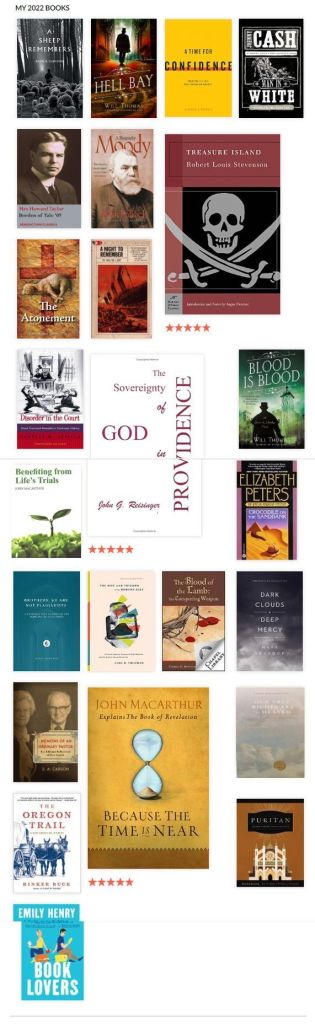
Hm, I guess there is value in doing a reading challenge after all. So far I’ve counted 4 valuable lessons for participating in one, with a 5th below. Here are the books I read in 2022.

  • A Sheep Remembers Calhoun, David B. Jan 2022
  • Hell Bay (Barker & Llewelyn, ) Thomas, Jan 2022
  • A Time for Confidence: Trusting God in a Post-Christian Society Nichols, Stephen J. Jan 2022
  • Man in White Cash, Johnny Jan 2022
  • Borden of Yale ’09 Taylor, Geraldine Guinness Apr 2022
  • Moody: A Biography Pollock, John Charles Apr 2022
  • The Atonement Murray, John May 2022
  • Treasure Island Stevenson, Robert Louis May 2022
  • A Night to Remember Lord, Walter May 2022
  •  Disorder in the Court: Great Fractured Moments in Courtroom History
  • Sevilla, Charles M May 2022
  • The Sovereignty of God in Providence Reisinger, John G. May 2022
  • Our True Riches in Heaven MacArthur Jr., John F. Jun 2022
  • Blood Is Blood (Barker & Llewelyn, ) Thomas, Will Jun 2022
  • Crocodile on the Sandbank (Amelia Peabody ) Peters, Elizabeth Jun 2022
  • Brothers, We Are Not Plagiarists: A Pastoral Plea To Forsake The Peddling Of God’s Word Schrock, David Jul 2022
  • The Rise and Triumph of the Modern Self: Cultural Amnesia, Expressive Individualism, and the Road to Sexual Revolution Trueman, Carl R. Jul 2022
  • The Blood of the Lamb: The Conquering Weapon Spurgeon, Charles Haddon Jul 2022
  • Dark Clouds, Deep Mercy: Discovering the Grace of Lament Vroegop, Mark Aug 2022  
  • Memoirs of an Ordinary Pastor: The Life and Reflections of Tom Carson Carson, D.A. Aug 2022
  • Because the Time is Near: John MacArthur Explains the Book of Revelation MacArthur Jr., John F. Nov 2022
  • The Oregon Trail: A New American Journey, Buck, Rinker Dec 2022
  • Benefiting From Life’s Trials: [James 1:2-18] (John MacArthur’s Bible studies) MacArthur Jr., John F. Dec 2022
  • Book Lovers Henry, Emily Dec 2022
  • To God’s Glory: Lessons on Puritanism: Puritan DVD Workbook, by Joel Beeke Dec 2022

Right-click to see larger in new tab.

I see my pattern. I started off gangbusters in January, fresh from the new year, entering a new challenge. Then not much (at least not recorded) in Feb-March. April we have a week-long break so I read at home then. And of course as the end of May, June, July came I am on summer break, so I see I resumed then. September and October I’m in the flush of a new school year and consumed with that, so I see the reading dropped off. Then as November’s Thanksgiving and December’s Christmas school break approached and with it, the end of the year, I resumed my gangbusters attitude to try and meet the Challenge goals.

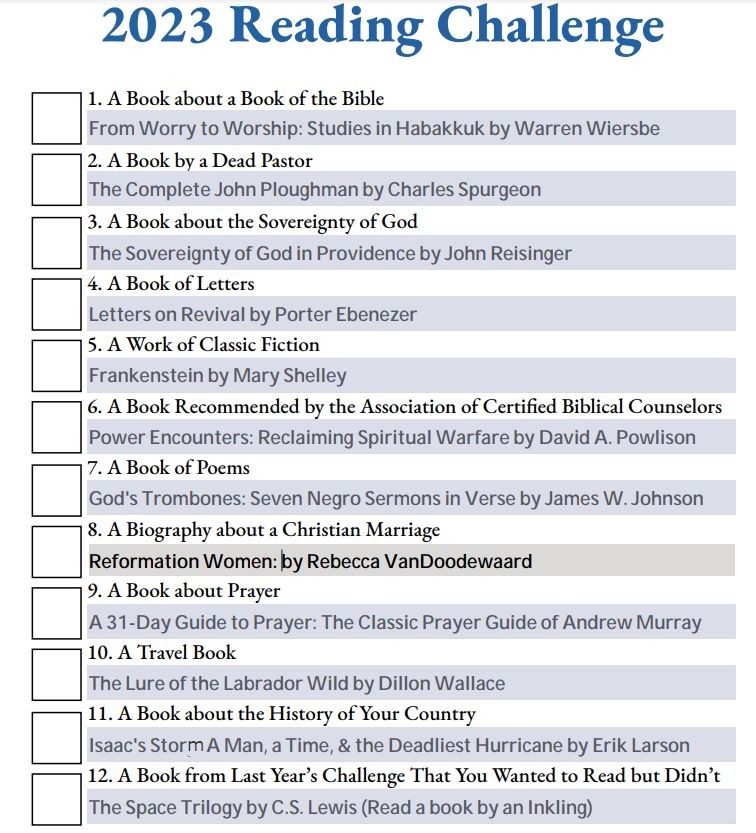
I decided to go ahead and do another Reading Challenge. I picked the G3 Reading Challenge again, because I like those guys and because I’m attending the National Conference this September. Below are the suggested books and the ones I chose under each suggested category. The Reformation Women book by VanDoodewaard isn’t strictly a marriage biography, but first, I own it already, and second, I want to see how these women, if they were married, managed in making such a global impact while married and attending to their home duties.

And that’s the other thing, I own these books already, except for Powlison’s Power Encounters. There is time enough to find that one either at a library or a book sale, or at the least, Amazon when the time comes to read it. That’s another benefit a Reading Challenge does for me, makes me take a hard look at my shelves, and focus on reading the books I already own.

So here is my checklist of books I’ve picked for the G3 2023 Reading Challenge:

I was glad to review my reading throughout the year because it helped me see my patterns. I don’t want to let two months go by without absorbing some good material. Of course, it isn’t a total black hole, I’m reading the Bible, and also stuff given out in Sunday School class, but still, it’s too long to just sink into a routine of only watching media and not reading.

I’m looking forward to this year’s books. What are your thoughts on Reading Challenges and such? Do you have reading goals for the New Year?

Posted in theology

What are some good biographies to read?

By Elizabeth Prata

I like to read Christian biographies, especially missionary bios. I am currently reading the biography of William Borden, and I like it very much. Someone had asked me what were some good biographies, and I compiled a list. Some of these I have read and can recommend. Others come recommended from trustworthy sites.

Moody: A Biography, by John Charles Pollock

John MacArthur: Servant of the Word and Flock, by Iain H. Murray

Reformation Women: Sixteenth-Century Figures Who Shaped Christianity’s Rebirth, by Rebecca VanDoodewaard (a 100-page book, each short chapter is a bio of one of the women)

The Little Woman by Gladys Aylward (Author), Christine Hunter (Contributor). There is another book named almost the same thing, not by Gladys herself. Get this one.

The Life of Moses: God’s First Deliverer of Israel, by James Montgomery Boice

Marriage to a Difficult Man: The Uncommon Union of Jonathan & Sarah Edwards by Elisabeth D. Dodds. As a side note, I really enjoyed Ligonier’s short series by Steve Nichols of the Life of Jonathan Edwards. It was fascinating and interesting and worth it! Here is a link to a summary of the 6-part series. The teaching series is here.

Susie: The Life and Legacy of Susannah Spurgeon, wife of Charles H. Spurgeon, by Ray Rhodes Jr.

Newton on the Christian Life: To Live Is Christ, by Tony Reinke

Amy Carmichael: Beauty for Ashes by Iain Murray. A short but packed little biography of an important figure. Iain Murray wrote several other biographies, too.

Borden of Yale ’09 by Mrs Howard Taylor

Biography Recommendations according to Tim Challies, book reviewer: “Christians you should know”-

Fearless Pilgrim: The Life and Times of John Bunyan by Faith Cook. A fast-paced and interesting account of Bunyan’s life.

Faith Cook is a well-known biographer who also wrote, Lady Jane Grey – the short, tragic life of Lady Jane Grey.

Eric Liddell: Pure Gold: The Olympic Champion Who Inspired Chariots of Fire, by David McCasland. An Olympic hero who left it all behind and died on the mission field.

"Reading is an important activity for the Christian. The way we are accustomed to taking in information on our phones, tablets, and computers has impacted how we approach reading books, too. Reinke wonders if Christians “will be patient enough to find meaning embedded in words” instead of surrendering to the idleness that entertainment affords. But Christians of all people should absolutely be patient enough. Not only is patience a fruit of the Spirit, but Christians are a reading people," says Andy Cassler. 
"I encourage you to make reading a priority in your life. Resolve to not only love God and your neighbor, but to love God with the mind He gave you. Exercise the life of the mind in your loving of God", says Dave Jenkins. 

What is one of the benefits of reading? Tony Reinke says that constantly swimming in social media fragments his mind and results in less ability to concentrate. He chooses classic books to read in order to combat this: Reinke says,

"I pick up Shakespeare’s works (the Jonathan Bate edition). In order for me to track with his works, I must pause at every antiquated word and look up the definition at the bottom of the page until the meaning becomes clear. To do this requires that I slow myself down and read with sustained concentration for 20-60 minutes. Rushing is not an option. As a result, I find that when I turn to read my Bible, I read it with much greater care and attention, able to once again focus my attention more carefully on each word and phrase that I read. So Shakespeare recalibrates my reading pace, restores my fragmenting brain, forces me to slow down, and ultimately helps me to read my Bible more carefully".

I myself feel that fragmentation. When I get home I’m tired and tend to scroll rather than read. My concentration suffers, and this spills over to Bible reading. With school nearing its year’s end I’ll have time to delve with concentration and energy this summer when I’m not working.

I hope these suggestions for good books and this little encouragement helps you think about spending some time during your day reading. Even if it’s 10 minutes, if it’s with concentration that is so much better than half an hour of mindless scrolling. I’m preaching to myself now!

Posted in summer reading, theology

Why you should read Pilgrim’s Progress, and Summer Book-A-Palooza sites

By Elizabeth Prata

I love the book The Pilgrim’s Progress. I have a hard time with allegory and symbolism, being so literal, but I love the book and many of its scenes stick with me in my mind. If you’ve been wanting to read the book but are unsure of which edition to choose, or are intimidated like I was for so long, here are some helps and guides to spur you in reading this marvelous book. Spurgeon read it over 100 times! That’s something, right?!

At the bottom I offer a list of fiction Christian books, too. Continue reading “Why you should read Pilgrim’s Progress, and Summer Book-A-Palooza sites”

Posted in encouragement, theology

I’ve heard of wine pairings, or even tea pairings, but book pairings?

By Elizabeth Prata

You know how, in the foodie world, they pair different foods or drinks together for the eater to enjoy maximum flavor? “Sauvignon blanc is the classic wine pairing for goat cheese, but you could also try a crisp dry Provençal rosé…” Or, “This Sencha Green tea would be lovely with Arugula and lightly steamed vegetables…”

I do book pairings. If a book is a difficult one, I pair it with a modern treatment. Not modernized language, though that sometimes helps, but pairing an older author and a modern author who wrote about the same subject. Or simply read books by two modern day authors writing about the same subject.

I think these would be good pairings:

Work: Its Purpose, Dignity, and Transformation by Daniel M. Doriani
and
Work and Our Labor in the Lord (Short Studies in Biblical Theology), by James M. Hamilton Jr.

I’ve read the Hamilton book. Challies recommended the Doriani book yesterday in his 10 New and Notable Books for April blog essay, and I think that would be fun to read it and compare to the way Hamilton treated the subject.

This might also be a good pairing:

The Power of Christian Contentment by Andrew M. Davis
and
The Rare Jewel of Christian Contentment, by Jeremiah Burroughs

The Burroughs book was first published in 1648. Burroughs was an English Puritan preacher. His book on contentment is considered to be one of the gold standards on the topic, but the language is somewhat antiquated. Pairing the Burroughs book with the Davis tome (which I have not read) might be a good idea.

As a matter of fact, last summer I did pair a Puritan book with a more recently written book and it was very helpful to me in understanding the older one. I read –

The Enemy Within: Straight Talk about the Power and Defeat of Sin by Kris Lundgaard
and
Mortification of Sin in Believers by Puritan John Owen

The Lundgaard book drew heavily on the original Owen works on indwelling sin and the mortification of sin. Reading a chapter of Lundgaard’s book one day and then Owen the next helped my brain prepare for Owens’ more complex treatment of the subject in his Puritan language.

I’ve paired these and I am enjoying the double treatment of how to critically read a book-

Lit!: A Christian Guide to Reading Books by Tony Reinke is

A practical guide built on the gospel, Lit! models the skills needed to build a balanced reading diet of Scripture, theology, and devotional books, but without overlooking important how-to books, great stories, and books meant to be enjoyed for pleasure.

How to Read a Book: The Classic Guide to Intelligent Reading by Mortimer J. Adler and Charles Van Doren

Wikipedia’s blurb explains Adler’s 1940 book. “Adler co-authored a heavily revised edition in 1972 with Charles Van Doren, which gives guidelines for critically reading good and great books of any tradition. The 1972 revision, in addition to the first edition, treats genres, inspectional and syntopical reading.”

Adler’s book goes into much depth. Reinke’s book is a bit lighter. I like to read Reinke’s book and then the next day read Adler’s.

You might wonder, why go through all this trouble to ‘pair books’?

Because doing so helps train us, specifically in three higher order thinking skills: Analysis, Synthesis, and Evaluation.

  • Analysis refers to the ability to break down material into its component parts so that its organizational structure may be understood
  • Synthesis refers to the ability to put parts together to form a new whole
  • Evaluation is concerned with the ability to judge the value of material (statement, novel, poem, research report) for a given purpose. (Source)

We employ those skills when we read the Bible. We need to analyze the passages. We synthesize when we examine the different gospels, comparing them to each other. We synthesize when we strive to understand eschatology from different passages in the Old and New Testaments. Evaluation is an important skill in discernment- if we lack the ability to judge material for the purpose of edification of souls, then we open ourselves much that is false.

The Holy Spirit illuminates the scriptures’ meaning. But we still have to put in the hard work.

But solid food is for the mature, for those who have their powers of discernment trained by constant practice to distinguish good from evil.  (Hebrews 5:14).

Have nothing to do with irreverent, silly myths. Rather train yourself for godliness; (1 Timothy 4:7).

colbert windows
Pair up two books and see what you think

——————————————————-
Further Reading:

I’ve written two other essays about the ‘how to read’ issue.

One of them is here

The other one is here

Posted in prophecy, theology

The Usefulness of Dystopian Fiction

By Elizabeth Prata

Tim Challies is a reader and a book reviewer. He is the author and promoter of the Annual Christian Reading Challenge, in which I participate.

I was glad to see this article by by Jon Dykstra linked from Tim Challies’ site:

Why Is Dystopian Fiction Worth Reading?

Yay! Someone else is a fan of dystopian fiction.

Dystopian is a word from Greek meaning ‘bad place’ according to the article. It’s the opposite of Utopian, meaning ‘perfect place’.

Dystopian fiction is a genre that describes people surviving or trying to, after a holocaust of some kind, or a societal collapse, or a nuclear war, and the like. The article speaks of this kind of fiction being worthwhile because it helps us in predictive prophecy of the secular kind, in connecting the dots to see a current credible future threat. The author’s point was that this kind of fiction spins a credible threat into scenarios that help us understand where these threats may lead us.

This is a genre well worth exploring, though with care and caution. It’s a big blank canvas that insightful writers can use to paint pictures of grim futures, all in the hopes that they, and we, will ensure such futures never come to be.

I enjoy this fiction but had felt mildly guilty about it, as though I needed to be doing something more productive. I’d wonder, ‘Am I a ghoul?’ ‘Why do I find this absorbing?’

Mr Dykstra helped me see my interest in it was to go where my own imagination lacked facility, to ‘see’ a future that is all too real in some cases, and to develop opinions and thoughts to guard against it. EM Forster’s The Machine Stops is a future that is practically already here, as is Stephen King’s The Running Man. Chilling.

The most famous work of dystopian fiction is George Orwell’s 1984, which the article mentions. That work was published in 1949. Another famous work of dystopian fiction is Aldous Huxley’s Brave New World. Other classic dystopian books are PD James’s Children of Men, and the Canadian book The Handmaid’s Tale. Of this last one, the author of the article discounts it as predictive or even helpful as understanding a credible threat, though a good yarn, because it was Chrfistianity that led to the dystopian society being described in the fictional account. Dystopian fiction is good where it helps us see ahead and cope with credible current or near current threats.

I mentioned I’m participating in the Challies’ Christian Reading Challenge, at the “Avid Level” (26 books read this year.) I added several others of my own choosing to Challies’ list, making myself a separate genre nook of dystopian books I wanted to read. They included The Running Man, The Machine Stops, and It Can’t Happen Here. I’d like to add these and some other dystopian material to you as recommended. I’ve read most of these and have watched the movies.

Stephen King’s The Running Man (1982)-

is a science fiction novel by American writer Stephen King, first published under the pseudonym Richard Bachman in 1982 as a paperback original. It was collected in 1985 in the omnibus The Bachman Books. The novel is set in a dystopian United States during the year 2025, in which the nation’s economy is in ruins and world violence is rising.

The end of The Running Man is absolutely chilling, as the final action the main character takes has already come to pass.

EM Forster’s The Machine Stops. (1909). Amazingly prescient, predicting the rise in technology that impacts both individuals and society, this novella is a short but chilling read. In many ways, we are living Forsteer’s future now.

William Forschen’s book One Second After (2009) depicted the effect upon America from an EMP, (electro-magnetic pulse), and the nation’s societal collapse and resulting high death rate. The author consulted with psychologists, economists, and sociologists to base his fiction on real scenarios those experts stated would most likely happen if we suffered an EMP.

Pat Frank’s book Alas, Babylon (1959)-

-was one of the first apocalyptic novels of the nuclear age and has remained popular more than half century after it was first published, consistently ranking in Amazon.com’s Top 20 Science Fiction Short Stories list. The novel deals with the effects of a nuclear war on the fictional small town of Fort Repose, Florida, which is based upon the actual city of Mount Dora, Florida. The novel’s title is derived from the Book of Revelation: “Alas, alas, that great city Babylon, that mighty city! for in one hour is thy judgment come.”

Nuclear winter wasn’t a very known or understood event back then, so the survival rate of the population in Alas, Babylon, this initial entry into the American dystopian nuclear fiction isn’t realistic, but most of the rest of the book is.

Sinclair Lewis’s It Can’t Happen Here. (1935). I have not read this book but it is on deck to be started this weekend. I’ve read three pages so far so I can’t review it, lol. Not yet. The synopsis seems like we are living it now…

Here is Wikipedia’s synopsis of Lewis’ book-

Published during the rise of fascism in Europe, the novel describes the rise of Berzelius “Buzz” Windrip, a demagogue who is elected President of the United States, after fomenting fear and promising drastic economic and social reforms while promoting a return to patriotism and “traditional” values. After his election, Windrip takes complete control of the government and imposes a plutocratic/totalitarian rule with the help of a ruthless paramilitary force, in the manner of Adolf Hitler and the SS. The novel’s plot centers on journalist Doremus Jessup’s opposition to the new regime and his subsequent struggle against it as part of a liberal rebellion

With the current rise in tensions between nuclear powers India and Pakistan, these two movies might be worth a look.

Threads. I watched this 1982 film a few years ago. I wrote a review of it below. It affected me greatly.

The most unrelentingly horrific and unsettling apocalyptic movie you will ever watch that comes the closest to what the Tribulation will be like: “Threads.

The Wikipedia synopsis of the film states:

Threads is a 1984 British apocalyptic war drama television film jointly produced by the BBC, Nine Network and Western-World Television Inc. Written by Barry Hines, and directed and produced by Mick Jackson, it is a docudrama account of nuclear war and its effects on the city of Sheffield in Northern England. The plot centres on two families as a confrontation between the United States and the Soviet Union erupts. As the nuclear exchange between NATO and the Warsaw Pact begins, the film depicts the medical, economic, social and environmental consequences of nuclear war.
Shot on a budget of £400,000, the film was the first of its kind to depict a nuclear winter. Certain reviewers nominated Threads as the “film which comes closest to representing the full horror of nuclear war and its aftermath, as well as the catastrophic impact that the event would have on human culture”.

And even then, the film, though it comes near to depicting the horror of the Tribulation, doesn’t even come close to its actuality. But Threads is as close as I’d want to see it anyway. Our minds can’t fully comprehend the full evil that will occur at that point in history. As this reviewer said, in his article, ‘Threads’ Is One of the Most Horrifying Films I’ve Ever Seen: This BBC docudrama scarred a generation,

Threads absolutely forces you to face the unthinkable.

People, the Tribulation is unthinkable. But we must think on it, the Lord’s wrath already hangs over the unsaved. Things like this should spur us to witness with eagerness and fervor.

The War Game (1965) is another film that horrified audiences. Created in 1965, it was deemed TOO horrifying to be released widely. See below-

The War Game is a 1965 television drama, filmed in a documentary style, that depicts a nuclear war. Written, directed and produced by Peter Watkins for the BBC’s The Wednesday Play anthology series, it caused dismay within the BBC and also within government, and was subsequently withdrawn before the provisional screening date of 7 October 1965. The corporation said that “the effect of the film has been judged by the BBC to be too horrifying for the medium of broadcasting.

I don’t think a steady diet of this kind of material should be on our plates, but books or movies like this can be a legitimate addition to our bookshelves or movie queue, for the reasons stated above. Happy reading…or in this case, unhappy reading.

hammer mural1