Posted in theology

Jerusalem part 2: The Nation

By Elizabeth Prata

Jerusalem: Intro
Jerusalem: part 1- The Land

Jerusalem part 3: Its glorious spiritual future

Jerusalem! It is the eternal city, (Psalm 46:4Revelation 3:12) God’s city where He has set His name, (1 Kings 11:362 Chronicles 12:13) and is the city in which Immanuel (Matthew 1:23) will dwell in all His glory, (Zechariah 8:3) calling it Jehovah Shammah, The Lord is There. (Ezekiel 48:35). It is the nickname He uses when he calls His people. (Zechariah 3:2). It is a place that it figures solely as the most important land, city, and people in the history of the earth. All of history is dwindling down to one focal point: Jerusalem. So let’s take a look at this incredible place.
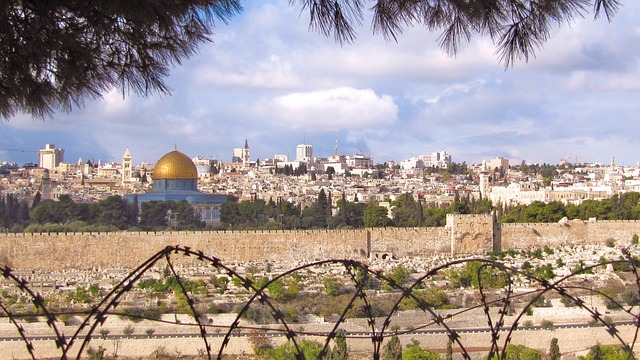
God chose a people and a land to bring unto Himself. These are the Israelites and His land is Israel. Its city is Jerusalem. He made this promise to Abram in Genesis 12. God was actually delivering three distinct promises to Abram, later re-named Abraham. God made a land promise, a national promise, and a spiritual promise. In part 1 we looked at the land promise. Here is the verse–

“Now the Lord said to Abram, “Go from your country and your kindred and your father’s house to the land that I will show you. And I will make of you a great nation, and I will bless you and make your name great, so that you will be a blessing. I will bless those who bless you, and him who dishonors you I will curse, and in you all the families of the earth shall be blessed.” (Genesis 12:1-3).

Was Israel a great nation? Yes. Militarily secure (for a while) incredibly wealthy (for a while) and led by the wisest king ever to walk the earth (for a while). Israel as a nation has certainly had its ups and downs.

Is Israel a great nation now? Well, yes. It has developed some of the world’s most wonderful technology. It has changed an arid place into a garden, and now most of the world’s fruit is exported from there. It is a military nation, strong and mighty. It is a tiny nation, having given away land during successive political parliaments. It is only the size of New Jersey, but it is incredible in that it simply did not exist for 1900 years and then one day it did! No other nation can boast that history.

However as much as Christians bless the nation, and pray for its deliverance, we have to be realistic. This is from a sermon titled “The Cleansing of Israel,” delivered by John MacArthur in 1977. Not much has changed since then-

“Israel is not a religious nation. I would have to say that I doubt whether been in a more irreligious nation in my life than Israel. It’s an irreligious nation. Their god is the god of armies, the god of strength, the god of surprise, the god of might, the god of racial identity, which is the big thing, but not the God of Abraham, Isaac, and Jacob and not the Lord Jesus Christ, the Son of God.”

Jerusalem is referred to as ‘Salem in Genesis 14:18, when Abram honored Melchizedek, King of Salem and priest of the God Most High (unusual that this one is King AND Priest, something banned later in Israel’s history. Priests always came from the tribe of Levi and Kings from the tribe of Judah). 

Below, The meeting of Abraham with Melchizedek

 The meeting of Abraham with Melchizedek

Ezekiel 21:25-27 prophesied the end of the kings and there has been no king rightfully officiating over Israel since King Jehoiachin in about 600BC, shortly after Ezekiel’s pronouncement. There has been no priest in Israel since the last High Priest serving when the Roman army came and overthrew the Temple in 70AD since Phannias ben Samuel and he wasn’t even from a priestly family, he was just a revolutionary. He died during the Roman overthrow.

There is still no king or priest over Israel today. And of course, no prophet since John The Baptist and then Jesus who is ultimate Prophet. There was not even any nation Israel between 70AD and 1948. By this standard, the Israel of today is merely a political entity, led by a Prime Minister, a President, and a Parliament (Knesset) and sadly, a spiritual desert.

Even during the period between May 1948 and June 1967, Jerusalem was not in Israel’s hands. Israel won East Jerusalem back during the Six Day War of June 1967, wresting it from the Jordanians who were occupying it. Later that month the Israeli Knesset declared Jerusalem unified. On July 30, 1980, the Knesset passed a law declaring the City of Jerusalem to be ‘eternal and indivisible.’” The United Nations promptly condemned the action.

There is still contention today. For example, what are the city’s borders? You can search for that answer online and you’ll come up with millions of maps with dotted lines, position papers, and news articles, but no borders.

Why does the world insist on calling Israel a state, and not a nation? The roots of the political conflict with Jerusalem and Israel lay in the fact that the Arab world refuses to declare it a national state for the Jewish people. This goes back to the original enmity between Israel as God’s selected people and the world that hates God. This is especially true of the Philistines who hated the Jews and their descendants are the Palestinians who are currently at war with Israel.

The upshot is that Israel, and Jerusalem, is a political entity. It surely is a great nation, but it is without paying homage to her God. God is still with her, and will protect her to the end. She will be ravaged, for it has been the times of the Gentiles since Jesus ascended. Only gentile Kings ruled Israel, such as Cyrus, Nebuchadnezzar, etc. Even now she is without a king, only a Prime Minister.

Today’s Israel is a politically buffeted nation without a king or a priest or world regard. The world is against it.

This was an Opinion Editorial in Israel National News 11 years ago by Guilio Meotti. “How did 150,000,000 Europeans Come to Hate Israel?” Anti-Semitism has risen markedly even since then.

Meotti ended his piece this way, “Europe’s public opinion has been persuaded to believe that Israel is a state that ought to be dismantled forthwith. Europe’s population count today is 730,000,000 citizens. What would happen if the anti-Semitic worm infected the mind of all of them? Can Israel really remain immune from that eruption of psychotic anti-Jewish illness?

Yes. and No. Political Israel’s days are numbered. The world is coming against it as Zechariah showed in the prophecy. The psychotic illness that is hate against Israel is satan’s contribution to his plan to thwart God. In the end of the end the world will gather against Israel and surround Jerusalem. In this regard, the Italian journalist’s question is consistent with prophecy.

Behold, I am going to make Jerusalem a cup that causes staggering to all the peoples around; and when the siege is against Jerusalem, it will also be against Judah. It will come about on that day that I will make Jerusalem a heavy stone for all the peoples; all who lift it will injure themselves severely. And all the nations of the earth will be gathered against it.” (Zechariah 12:2-3).

Things do not look good for the nation Israel and the city Jerusalem, now or in the future. And they aren’t. But the Lord will come and save His nation, His people, and His city. The third part of the series on Jerusalem will look at its glorious future! And it IS glorious! They will go through a dark time, but then things become very bright, as bright as the glory of the LORD himself!

Posted in encouragement, Uncategorized

Advent: Thirty Days of Jesus, Day 2; He will come!

By Elizabeth Prata

Thirty days of exalting Jesus through selected verses with pictures representing the prophecy, life, death, resurrection, and Second Coming of our Savior.

More information and background on this series, here

thirty days of jesus verse 2

Day 1: The Virgin Shall Conceive

Ligonier: A Shoot from Jesse’s Stump: Devotional

History tells us this is exactly what happened, with David’s royal dynasty all but dying out as a result of God’s judgment of His people through Assyria and Babylon. Nevertheless, Isaiah also saw that while the Davidic line would seem to be dead, life would remain within the stump. A shoot—life barely detectable at first—would emerge. But once this shoot went forth, it would become a mighty tree.

Matthew Henry’s Commentary on Isaiah 11:1

 He comes forth out of the stem, or stump, of Jesse. When the royal family, that had been as a cedar, was cut down, and only the stump of it left, almost levelled with the ground and lost in the grass of the field (Dan. 4:15), yet it shall sprout again (Job 14:7); nay, it shall grow out of his roots, which are quite buried in the earth, and, like the roots of flowers in the winter, have no stem appearing above ground. The house of David was reduced and brought very low at the time of Christ’s birth, witness the obscurity and poverty of Joseph and Mary. The Messiah was thus to begin his estate of humiliation.

All the Named Men of the Bible: Jesse

Jesse [Jĕs’se]—jehovah exists or firm. The son of Obed and father of David, and grandson of Boaz and Ruth, and an ancestor of Christ (Ruth 4:17, 22). Jesse had eight sons and two daughters by different wives (1 Sam. 17:12-14, 25). Isaiah speaks of “the stock of Jesse,” a phrase indicating that it was from Jesse the Messiah would come. The humble descent of the Messiah is contrasted with the glorious kingdom He is to have (Isa 11:1).

Introduction/Background
Advent: Thirty Days of Jesus; Day 1

Posted in theology

Don’t shy away from the prophetic books

By Elizabeth Prata

Prophecy gives us urgency. It reveals God’s plan and offers us the wonder of seeing it fulfilled to the jot and tittle, from the past by reading the Bible, and the future as we await His return. Prophecy shows us His holy anger, of which we must fear. We gain comfort and hope- think of Simeon and Anna in the temple, eagerly awaiting the Consolation of Israel, their hope and comfort fulfilled before their eyes as Mary and Joseph came to present the babe. (Luke 2).

I like being heavenly minded. I think of seeing the face of Jesus, singing to Him with all the redeemed. I think of the street of gold, the saints of the past I’ll get to know, and so much more. Being heavenly minded also means seeing the justice of God as He renders it in the final judgments. Judgment, wrath, and hell. There but for the grace of God go I… He took my ragged and pitifully polluted life and turned it into something glorious for the Father. He put in me a new heart and my soul daily being cleansed of sin.

In all the ways above and many more, prophecy demonstrates His glory.

I encourage you all to read and study the Book of Revelation. It is not difficult, and the Spirit will make it clear. You know, it is written in that book that we receive a blessing if we read the Book of Revelation. Zechariah has as much prophecy in it related to the final days on earth as Revelation does, if not more. I enjoyed Steve Hadley’s verse-by-verse sermons from Zechariah. There is so much prophecy in the Old Testament. I guess I should just say that the entire Bible is wonderful. Some say that a quarter of the whole Bible is prophetic. There is history, Law, narrative, poetry, wisdom, and prophecy. Something for everyone! So get to it today, don’t shy away from prophecy, especially Revelation.

Prophecy puts me in my place. I am a crumb, saved by grace, and at His perfect appointed time, placed within the Age of Grace to do His will, and perhaps gloriously see His return while I’m alive. What a privilege. Share Jesus with another, His prophetic timetable is moving quickly toward the climactic moments on earth.

Posted in theology

The voluminous activity of satan and how he creates ‘acceptable sorceries’

By Elizabeth Prata

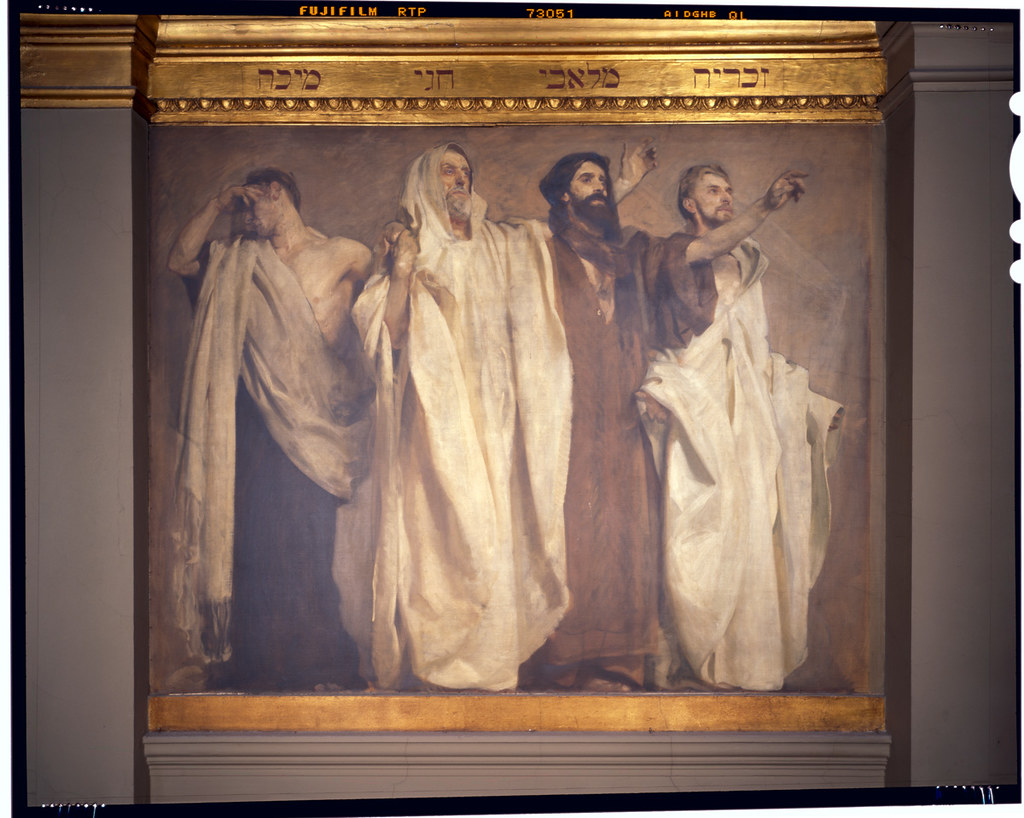
 Frieze depicting the Prophets Micah, Haggai, Malacchi, and Zechariah. By John Singer Sargent, Boston Public Library, CC Some rights reserved

Did you ever wonder how the Old Testament Prophets prophesied? Did you ever wonder about the false prophets and their unholy business? Well stay tuned, it’s a prophet-a-palooza today!

The Old Testament contains 39 books. Of these, they are generally divided as Pentateuch (the 1st five), Historical Books, Poetic & Wisdom Literature, and the Prophets. Of the 39 books, 41% are written by Prophets or contain major prophecies. 1 and 2 Samuel are part of the Historical section of the OT but Samuel was Israel’s first prophet and the books describe his emergence and activities as a prophet. (I did not include Lamentations as one of the prophetical books, but some do). Thus, the Old Testament is heavy with Prophets.

The Major Prophets are Isaiah, Jeremiah, Ezekiel, and Daniel. They are called ‘major’ due to their length and broadness of scope, not because of the content. The Minor Prophetical books are considered to be Hosea, Joel, Amos, Obadiah, Jonah, Micah, Nahum, Habakkuk, Zephaniah, Haggai, Zechariah, and Malachi. They are dubbed ‘minor’ not due to their content but because these books are shorter and have a narrower focus.

Prophets foretold the future as given by God, but that is not ALL they did. Prophets were designated as a representative of God before the people. Sometimes, when they received God’s message they proclaimed it to the king of Israel. Another task they performed was to remind the people of their covenant with God as delivered by Moses. I know we’re all familiar with this one- Prophets told the people that there would be a coming judgment if they rebelled, but they also told of a coming blessing if they were obedient. They called the people to repent and return to God. They taught the people the Law. They were watchmen. So, not everything the Prophets did involved fore-telling. Sometimes they engaged in ‘forth-telling’ too.

A few common refrains in the prophetic books are “Thus sayeth the LORD,” which was the Prophets’ way of affirming that the prophecy was from God and not their own made-up speech; and “The word of the LORD came to me”. A seminary friend believes that when we read ‘the word of the LORD came to me’, as we see in Jeremiah 1:4, that it was Jesus coming to speak to the prophet in a pre-incarnate appearance. This made sense to me. After all, Jesus IS the Word (John 1:1). Whichever way it happened, the Prophetical words when they were delivered, were accepted as having come from God. Whether they liked the message or not!

Anyway, the true prophets operated in myriad ways. Sometimes they spoke a word that was given to them as I just mentioned. Sometimes they became a symbol, or acted out a symbol. Hosea’s marriage to Gomer was a symbol of Israel’s adulterous relationship with false gods. Ezekiel in particular was called to perform ‘sign-acts’ or symbolical actions. He was tasked with laying on his side for a year in front of a model of a siege mound. Jeremiah was tasked with smashing clay pots in front of the audience who came to seek the word. (Jeremiah 19:10-13). Isaiah was told to preach barefoot and (nearly) naked. (Isaiah 20:1-2).

Satan is relentlessly active. So there were many false prophets, too. They had other methods of gaining information from the gods. Of course, there are no other gods. And the One True God wasn’t speaking to them, so they needed to devise other ways of appearing to have inside wisdom. The Bible speaks against many of these. I went and found all the verses condemning their practices and I was surprised to see there were so many! Many verses and many practices!

The Bible speaks against: soothsayers, magicians, necromancers, witches, mediums, fortune-tellers, sorcerers, sorceresses, omen-interpreters, charmers, one who inquires of the dead, diviners, dreamers… phew! That’s a lot of demonic activity! (Verses here)

In Exodus 7:10-12 we see that some of these magicians did actually possess dark powers. Satan is a powerful angel, capable of masquerading as an angel of light. He caused winds to destroy Job’s house. He caused lighting to fall. (Job 1:16, 18-19). Therefore, to a point, the magicians had powers to replicate Moses and Aaron’s miracles from God. But in the end, Aaron’s rod swallowed up the magicians’ rods and the limited extent of their power was reached.

In Deuteronomy 13:2 we see that occasionally a prophet or dreamer will predict some sign or wonder that does come to pass, in those cases, one must detect, the verse says, if they are leading you away from God.

The warning for us is that when we dabble, (more on that below), there actually does exist a darkness with powers that you will be inviting into your home, heart, or mind.

DEFINITIONS (from Logos 9: Factbook & Dictionaries)

Soothsayers: A phrase used in some English translations to describe one who practices divination, fortune-telling, or astrology. An example is Balaam.

Magician: One who attempts to manipulate one’s environment through incantations, spiritual assistance (or manipulation), curses, or blessings. Magicians of Nebuchadnezzar- were a group of men who served Nebuchadnezzar as magicians. Nebuchadnezzar favored Daniel and his friends over them.

Necromancer: “one who interrogates the dead,” as the word literally means, with the view of discovering the secrets of futurity (comp. 1 Sam. 28:7).

Diviner: Ritual action employed by someone to determine the will, knowledge, or plans of deities.

Fortune-teller: See Diviner, it is a synonym. “foretelling future events, or discovering things secret by the aid of superior beings, or other than human means.” Source- Easton’s Bible Dictionary.

Witch: Or sorceress, a female whose work was in divination and magic. Also, someone who dealt with drugs or herbs for occult purposes. Also, conjurer, someone who interprets omens. See 1 Samuel 28 about the witch of Endor. Trivia: If you’re familiar with the television show from the 1960s called Bewitched, Samantha the witch’s witch mother was named…Endor-a.

Sorcerer, sorceresses: from the Latin sortiarius, one who casts lots, or one who tells the lot of others. In Dan. 2:2 it is the rendering of the Hebrew mekhashphim, i.e., mutterers, men who professed to have power with evil spirits. The practice of sorcery exposed to severest punishment (Mal. 3:5; Rev. 21:8; 22:15). Easton’s Illustrated Bible Dictionary.

Mediums: One possessed by (Lev. 20:6) or consulting (Deut. 18:11) a ghost or spirit of the dead, especially for information about the future. Acting as a medium was punishable by stoning (Lev. 20:27); consulting a medium, by exclusion from the congregation of Israel (Lev. 20:6). The transformation of Saul from one who expelled mediums (1 Sam. 28:3) to one who consulted a medium at En-dor (28:8–19) graphically illustrates his fall. Source: Holman Illustrated Bible Dictionary.

Omen-interpreter:  An omen is a phenomenon that is perceived to indicate something else, but especially something about future events. It’s also known as a sign. Omens are considered divine signs solicited and/or interpreted for the purpose of guiding human action. Observance of omens is well-attested as a practice in the ancient Near East—along with the corresponding practice of divination, which was used to discern the meaning of omens. Source-The Lexham Bible Dictionary. The Bible forbids the Israelites from interpreting omens.

See a cardinal and say it’s an omen from a departed relative? DON’T- it’s augury and it’s a forbidden dark practice. A bird is just a bird. EPrata photo

Charmer: one who practises serpent-charming (Ps. 58:5; Jer. 8:17; Eccl. 10:11). It was an early and universal opinion that the most venomous reptiles could be made harmless by certain charms or by sweet sounds. Easton’s Bible Dictionary

Dreamers: The visual and aural sensations that a sleeping person experiences. Dreams in the Bible are often a vehicle for divine oracles. A dreamer is a person who experiences unreal events that occur in the mind of a person during sleep. In ancient times dreams were often associated with messages from deities. Deuteronomy 13:3 says not to listen to dreamers.

The demonic activity in its various permutations is astonishing. Did you realize there had been so much?

W. L. Liefeld named and listed many of the demonic acts:

(1) chresmology, the “prognostication by seers and through oracles;”
(2) oneiromancy, the “practice of predicting future through the interpretation of dreams;”
(3) astrology, by the observation and interpretation of the planets and stars described in the horoscope;
(4) necromancy, the “consultation with the dead;”
(5) haruspicy, the “study of the entrails of animals;”
(6) augury, the “analysis of the movement of animals, and especially the birds;”
(7) omens and portents, the interpretation of different events in the natural world; and
(8) mechanical means, which include the interpretation of hydromancy (divination b)y means of water, including the color, ebb and flow, or ripples produced by pebbles dropped in a pool, pyromancy (divination by means of fire or flames), and cleromancy (casting of lots).

Annnd… still more-

There were multiple techniques used to solicit omens, including lecanomancy (observing the pattern of oil poured onto water) and libanomancy (observing smoke generated by a censer), but haruspicy (looking at the entrails of an animal) was the most prevalent (Farber, “Witchcraft, Magic and Divination,” 1904; Starr, The Lexham Bible Dictionary.

INTERESTING history of the Ouija Board here! Ouija also sparked the craze for ‘automatic writing’ that so many professing Christians engage in today.

From excavated texts we learn that the ancient world was filled with individuals who predicted future events or future courses of action by dreams, use of a divining rod, shaking marked arrows (in a quiver), consulting teraphim (figurine idols- remember, Rachel stole her father’s teraphim, Genesis 31:19), or examining animal livers (hepatoscopy).

The British Museum is filled with ancient Near Eastern texts about astrologers who observed signs in the heavens (eclipses, configurations of planets, sun and moon, stars with coronas and tails, stars forming the sign of the zodiac), or saw omens—both good and bad—in the heavens and on the earth (storms, earthquakes, the flight of birds, screaming hens, odd births, when a house begins to look old, etc.). Such persons are not prophets.

I post these at length to illustrate the past and current exceedingly active doings of satan and the demons he inspires to do evil in the world.

Are these practiced today? Absolutely! Do you read your horoscope in the newspaper? That’s astrology. Try to find water by dowsing? That’s divination. Do we say ‘knock wood’ or shudder if a black cat crosses our path? Do we say that the cardinal is a happy departed family member? Or the hoot of an owl means someone is going to die soon? You’re practicing augury. Magic 8 Ball, Ouija Board…none of these are acceptable because they are all forbidden by the Bible.

Have these become “Acceptable Divinations” in your life (with apologies to Jerry Bridges for paraphrasing his “Acceptable Sins” motif)?

The Magic 8 Ball, you asked ‘it’ a question, shook the ball and waited to see what answer would float up.

Many people publicly practice these today, even people who profess to be Christian. There are witches abounding who use Tarot cards to tell your fortune. ‘The Bible‘ and ‘Touched by an Angel‘ Actress Roma Downey engaged in necromancy on live TV by calling up her dead mother using a medium. Bethel Redding church & college, which professes to be Christian, teaches dream interpretation in their School of Prophets. So, they are dreamers according to the Bible, thus are in God’s bad books. Praying to the saints or to Mary is inquiring of the dead, AKA necromancy. Professing Christian Beth Moore tells of her dreams and visions, indulges in chresmology- she prognosticates future events, does automatic writing, and acts as a prophet and seer. Her condemnation is looming. Many other women of her ilk claim to hear words directly from God, thus claiming to be prophets.

Speaking of the Bethel School of Prophets, everything new was old once before. There seemed to be a cult of (false) prophets at Mari, at the Syrian – Iraq border. Balaam is associated with the activity here, according to texts unearthed in 1933 and 1967. These prophecies were normally delivered only to the King, not to the people, and were generally mild-to-favorable. There is no evidence that this cult of prophets and their alleged prophetic activity gave messages related
to the moral life of the nation or even the king.

If the Mari-area prophets chastised, they were gentle and minor. This is a big contrast with the difficult messages the Biblical prophets were instructed to give, sometimes at peril of their life!

Although Numbers 22:7 uses the noun “omen” and the word that has been translated “fees for divination”, Balaam is far from the standard role of a prophet in biblical literature. Joshua 13:22 views Balaam as one “who practiced divination.” The Lexham Bible Dictionary. Lexham Press.

The only reliable prophetical information we have at present is in the BIBLE. Avoid all forms of sorcery, even those that have become so mundane in modern life it feels like they are acceptable. They’re not.

Posted in theology

The Great Cities of the Bible #2: Babylon

By Elizabeth Prata

Great Cities of the Bible #1: Damascus
Great Cities of the Bible #2: Babylon
Great Cities of the Bible #3: Rome
Great Cities of the Bible #4: Jerusalem
Great Cities of the Bible #5: Capernaum

Ruins at Babylon. By Osama Sarm – Own work, CC BY-SA 4.0, https://commons.wikimedia.org/w/index.php?curid=48596563

Babylon. City of mystery, history, prophecy. The very name Bab-iliu means “the gate of the gods” in Akkadian, which is the oldest recorded Semitic language and the most common language of the ancient Near East until the eighth century BC.

It was founded on the great river, Euphrates, about 200 miles north of where the Euphrates joins the Tigris and drains into the Persian Gulf, two of the 4 great rivers flowing out of Eden to “water the garden”. (Genesis 2:14).

Babylon was a sacred site dedicated to the (false) god Marduk, the city’s patron god. Often Marduk’s name is included with the title ‘Bel’ to Marduk’s name to indicate supremacy of all the gods. The city’s inhabitants celebrated Marduk at the start of their new year with a festival noting his ascension as king of all gods and his seating in his temple in the city.

Marduk was mentioned in the Bible in Jeremiah 50:1–2 where Yahweh ordered Jeremiah to declare:

Babylon has been captured;
Bel has been put to shame; Marduk has been shattered;
Her images have been put to shame; her idols have been shattered.’

For two thousand years Babylon dominated Mesopotamia.

The Lexham Bible Dictionary indicates that Babylon was a “cultural and political center of Mesopotamia during much of the second and first millennia BC. Located in modern-day Iraq along one branch of the Euphrates River, about 59 miles southwest of Baghdad.

Babylon Past

Throughout the entire Bible, Babylon stands as a dominating presence as an actual historical empire but also as a symbol of spiritual apostasy and evil opposition to God and His people. Its name Babel is first found in Genesis 11:9,

Therefore is the name of it called Babel; because the Lord did there confound the language of all the earth’

Babylon is the Greek form of the name Babel. Babylon began its ascent in 2300 BC to greatness but really exploded in cultural and architectural wonders during the reign of Hammurabi in 1792 BC, the sixth king of his line. During his reign and later his son’s reign, numerous temples were built and irrigation channels were excavated. King Hammurabi also conquered all of the surrounding cities, including the famous city of “Ur” where Abraham had lived centuries before.

Hammurabi (standing) receiving his royal insignia from Shamash (or possibly Marduk) By Mbzt – Own work, CC BY 3.0, https://commons.wikimedia.org/w/index.php?curid=59794940

But like many cities, Babylon then began to decline, and this up and down swing continued until Assyria was finally defeated. It then reached another pinnacle during the reign of Nebuchadnezzar II and entrenched itself as one of the most important cities in the Near East.

“The empire had been founded by Nebuchadnezzar’s father Nabopolassar (r. 625-605 BCE) after his victories over the Assyrian Empire. Nebuchadnezzar II would go on to even greater things, including the capture of Jerusalem in 597 BCE. The Babylonian king then set about making his capital one of the most splendid cities in the world”. Source World History Encyclopedia

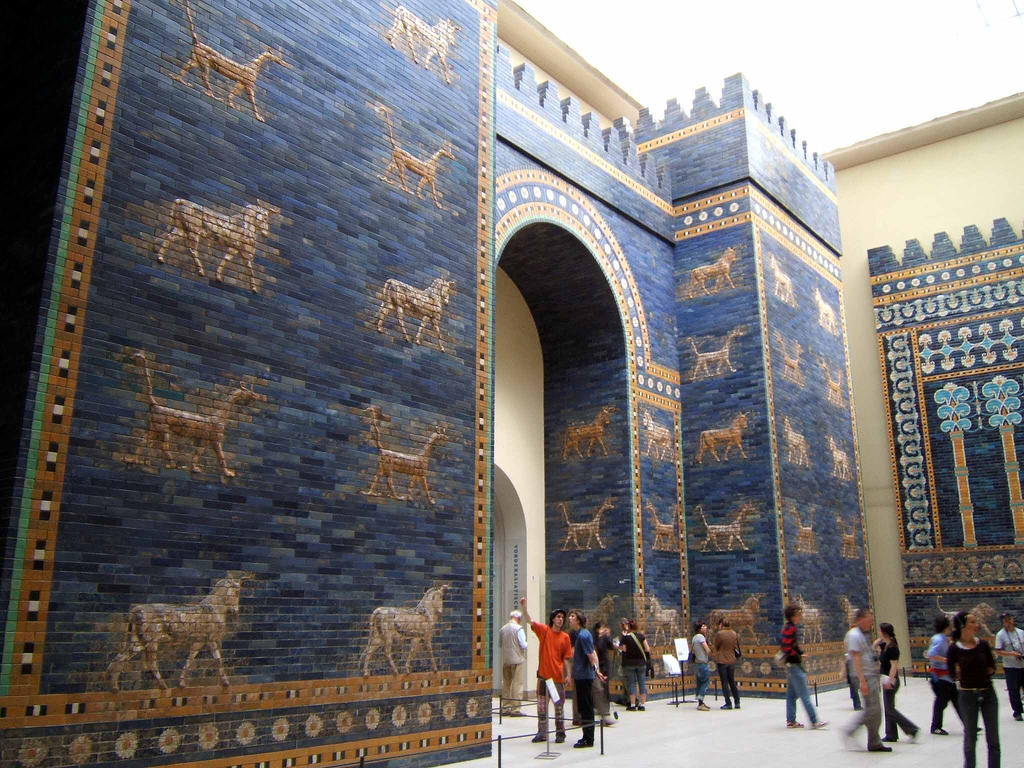
A reconstruction of the blue-tiled Ishtar Gate, which was the northern entrance to Babylon. It was named for the goddess of love and war. Bulls and dragons, symbols of the god Marduk, decorated the gate.
By Rictor Norton – https://www.flickr.com/photos/24065742@N00/151247206/, CC BY 2.0, https://commons.wikimedia.org/w/index.php?curid=1409322

Hanging Gardens

The most famous of these improvements to the city were the Hanging Gardens of Babylon, “ancient gardens considered one of the Seven Wonders of the World and thought to have been located near the royal palace in Babylonsays Encyclopedia Britannica. Though no one is quite sure where they were within the city, there were enough descriptions of them in classical literature to know that they likely existed, though no one is exactly sure of what they looked like.

The Gardens were said to be ‘hanging’ because perhaps they were perhaps on a tall ziggurat with terraces, “were set upon vaulted terraces. They were also described as having been watered by an exceptional system of irrigation and roofed with stone balconies on which were layered various materials, such as reeds, bitumen, and lead, so that the irrigation water would not seep through the terraces.”

A short video about the Gardens-

https://www.britannica.com/video/179976/creation-Nebuchadrezzar-II-designs-structure-video-Hanging

In Daniel 4:30 we read the perhaps most famous story about Babylon, where King Nebuchadnezzar admires his city from his palace rooftop, saying “‘Is this not Babylon the great, which I myself have built as a royal house by the strength of my power and for the glory of my majesty?’”

Barnes’ Notes says: “He greatly enlarged the city; built a new city on the west side of the river; reared a magnificent palace; and constructed the celebrated hanging gardens; and, in fact, made the city so different from what it was, and so greatly increased its splendor, that he could say without impropriety that he had “built” it.

Yet…the very next verse says that King Nebuchadnezzar’s pride and self-glorification was a mistake.

While the word was in the king’s mouth, there fell a voice from heaven, saying, O king Nebuchadnezzar, to thee it is spoken; The kingdom is departed from thee.

The city “under Nebuchadnezzar, who died B.C. 561 after a reign of forty-three years, attained great splendour. In the reign of Belshazzar the capital was taken by Darius the Median (Dan. 5:25–31), who entered it unexpectedly at the head of an army of Medes and Persians, as Isaiah (21:1–9) and Jeremiah (51:31) had predicted some 170 years before. Then began the decay and ruin of this proud city, and the kingdom of Babylon became a part of the Persian empire. In course of time the “great city” became “heaps,” and “an astonishment, and a hissing, without an inhabitant (Jer. 51:37–58).

“Many of the Jews who had been carried captive to Babylon remained there, notwithstanding the decree of Cyrus. After the destruction of Jerusalem there was established at Babylon a school of Jewish learning of great repute.” SourceEaston’s (1893) In Illustrated Bible Dictionary and Treasury of Biblical History.

Babylon future

Babylon is mentioned in Revelation numerous times. We read in Revelation 14:8, “and another angel, a second one, followed, saying, “Fallen, fallen is Babylon the great, she who has made all the nations drink of the wine of the wrath of her sexual immorality.

Babylon was not only a city in history, not only an empire that rose & fell, but the name Babylon is also figurative of an evil commercial-governmental system and an evil spiritual system.

Roy Gingrich interprets both the actual and the symbolic nature of Babylon:

“The fall of Babylon (Rev 14:8)-

“(1) The announcement—Another angel (other than the one in verse 6) announces the soon coming fall of Babylon. The “Babylon” mentioned here is not the religious system of chapter 17 -that “Babylon” was destroyed at the mid-point of “The Seventieth Week”. The “Babylon” mentioned here is the capital city of the political-religious-commercial system of chapter 18, which city and system will be destroyed when the Seventh bowl is poured out. God destroys her because she made the nations drink “the wine of the wrath of her fornication,” that is, because she caused them to commit spiritual fornication, which is punished by God’s wrath.” Gingrich, R. E. (2001). The Book of Revelation (p. 69). Riverside Printing.

Gingrich continues-

The destruction of religious “Babylon” as an ecclesiastical system, chapter 17. In the days of Nimrod, Gen. 10:8–12, and his wife, Semiramis, around 200 years after the Flood, two great systems came into existence, a God-defiant political system and a God-defiant religious system, the one founded by Nimrod and the other founded by Nimrod through his wife, Semiramis. These two systems are often called Political Babylon and Religious Babylon because they had their beginnings in Babylon, the one in the building of the city of Babylon and the other in the building of the tower of Babylon. The city of Babylon is the symbol of organized political rebellion against God and the tower of Babylon is the symbol of organized religious rebellion against God.” Gingrich, R. E. (2001). The Book of Revelation (pp. 76–77). Riverside Printing

“These two systems in varying forms, have continued on side by side down through the centuries, hating one another but for the sake of self-advancement, exchanging favors with one another. During the Middle Ages, these two systems were seen in the Holy Roman Empire and in the Roman Catholic Church. Today, they are seen in the United Nations Organization and in the Ecumenical Church Movement. During the first half of Daniel’s Seventieth Week, they will be seen in the Revived Roman Empire [“the Scarlet-colored beast,” Rev. 17:3] and in the rejected Lacodicean church] [“the great whore,” Rev. 17:1]. It is very helpful in understanding Rev., chap. 17, to know that “the scarlet-colored beast” and “the great whore” of chapter 17 are the final forms of two great God-defiant systems which have been in existence for over 3,000 years.” Gingrich, R. E. (2001). The Book of Revelation (pp. 76–77). Riverside Printing.

–end Gingrich quote

Babylon both actual and spiritual offer many lessons for us. Whenever I think of Dickens’ “A Tale of Two Cities” I often think of ‘Babylon & Jerusalem’. In the NT Babylon is always mentioned negatively, as a seat of evil, ungodly power. It signifies the world and its forces in opposition to God. It is often contrasted with “New Jerusalem”, in which God will finally reign supreme with no opposition ever again.

We will live in the city GOD built, not a city made by man like Assyria’s Damascus, Caesar’s Rome or Nebuchadnezzar’s Babylon. It will be a pure city, devoid of anything detracting from the glory of Jesus and his Light.

Babylon present

Whatever became of the actual, historical city of Babylon? It no longer really exists. It is a ruin, though it was opened to tourists again in 2009. There is not much to see. It is estimated that only about 5% of the old city has been excavated.

Babylon would stay under the Persian Empire’s rule for two centuries before Alexander the Great then conquered Babylon in 331 BC. He had plans to make Babylon the capital of his empire but died there in 323 BC before his dream came into reality. Alexander’s generals divided his empire among themselves immediately after his death. This is how general Seleucus obtained the historical city of Babylon. Not long after, he moved most of the population to his new capital Seleucia, which left the city decaying and deserted. Source

Will Babylon the city rise again? Only the Lord knows. Babylon the metaphor for an economy and an ecclesiastical system will indeed rise again to uncontested dominance, and be part of the major events prophesied to occur in the future, if the Babylonian system even can be said to have disappeared in the first place. Yet “Babylon” actual and Babylon figurative will finally be squashed in the future when Revelation events occur and Jesus’ wrath wipes out the evil system. The Lord as always, reigns supreme.

There will be no king looking out from his own rooftop and congratulating himself on his achievements. There will be no pagan priests celebrating a false god on a mythical throne. There will be no garden except the one the LORD himself planted, meaning, the world. It will be pure, verdant, and full of peoples who acknowledge Jesus as the supreme Lord of Lords and King of Kings. What a day that will be!

Posted in theology

The Great Cities of the Bible #1: Damascus

By Elizabeth Prata

Great Cities of the Bible #1: Damascus
Great Cities of the Bible #2: Babylon
Great Cities of the Bible #3: Rome
Great Cities of the Bible #4: Jerusalem
Great Cities of the Bible #5: Capernaum

This begins a 4-part look at some of the Great Cities of the Bible. Cities are cities, but they are also seats of Empires, also they can be backdrops or even characters in the Biblical narrative. I chose the cities of Damascus, Babylon, Rome, and finally, Jerusalem to take a closer look at.

Damascus is one of the first cities mentioned in the Bible and the oldest continuously lived-in city in the world. Babylon dominated the Near East during its time, but also is symbolic of the struggle since the Fall of man vs. God. Its backdrop flows from Genesis to Revelation! Rome was at its height during the New Testament times, was the site of 4 Epistles written there, and perhaps will be at another height again if the prophecy about a Revived Empire will indeed be Rome as many interpret. And of course I chose Jerusalem because God set His name upon it, and it will be remade new as our eternal future home!

Modern Day Damascus is in Syria. It is the capital of Syria, and people have been living there since about 8000BC. When the Arameans arrived in about 3000 BC it went from villages to a notable city. That’s old!

We may think of that area of Asia as dry and dusty desert, but Damascus is considered one of the most beautiful cities in the world, as well as being ancient and notable. It is a UNESCO World Heritage site. To be sure, its dry and desert-y east is bordered by the Syrian-Arab desert and the west is bordered by the mountains of Lebanon. The mountains bar much rain from dropping on Syria. The mighty Euphrates, which represents more than 80 percent of Syria’s water resources, flows through far to the east of Damascus. Therefore, for Damascus to stay hydrated, the even more important river Barada River is the river on which the city of Damascus relies. Irrigation from the Barada River by aqueducts built during Roman times helps things along.

This river is divided into numberless channels and is distributed throughout Damascus and the region immediately about it. In almost every house there is a fountain, and one can stand still almost anywhere and listen to the murmur of the hidden streams that pass under and through the city. Source: Earthly Footsteps of the Man of Galilee, p. 274.)
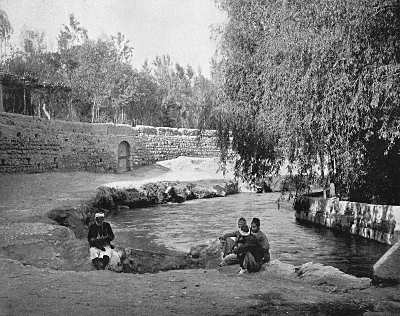
Barada river, Damascus. Shadi Hijazi photo, CC use

Barada is identified as Abana. This river is mentioned in the Old Testament (2 Kings 5:12), when Naaman argued that its waters would be better than the Jordan for curing his leprosy.

The International Standard Bible Encyclopaedia for the ‘Abanah’ AKA Barada says-

A few miles southeast of Suk Wady Barada the volume of the stream is more than doubled by a torrent of clear, cold water from the beautifully situated spring ‛Ain Fijeh (Greek, “fountain”), after which it flows through a picturesque gorge till it reaches Damascus, whose many fountains and gardens it supplies liberally with water. In the neighborhood of Damascus a number of streams branch off from the parent river, and spread out like an opening fan on the surrounding plain”.

Speaking of those gardens, we read from the 1894 book “Earthly Footsteps of The Man of Galilee and the Journeys of His Apostles”:

“No wonder the Moslems look upon Damascus as an earthly paradise. It is encompassed by gardens and orchards. These cover an area of over twenty-five miles in circumference. Here grow olive, fig, walnut, apricot, poplar, palm, cypress and pomegranate trees. In the above view we have a scene taken from the Jerusalem road in the western part of the city, and looking to the north a ridge of Anti-Lebanon is seen straight before us. In the richness of its soil, in the salubrity and semi-tropical character of its climate, in its varied vegetation, we find the reason for the constant association of Damascus with the thought of gardens.”

“It has been for four thousand years a garden. It is surrounded for miles with this splendor of verdure. Its gardens and orchards and far-reaching groves, rich in foliage and blossoms, wrap the city around like a mantle of green velvet powdered with pearls. The apricot orchards seem to blush at their own surpassing loveliness, and the gentle breezes that rustle softly through the feathery tops of the palms are laden with the perfume of the rose and the violet. Tristram, in his account of what he saw, says:”

“Tall mud walls extended in every direction under the trees, and flowing streams of water from the Barada everywhere bubbled through the orchards, while all was alive with the song of birds and the hum of bees. The great apricot trees were laden and bent down under strings of ripe golden fruit.” Whatever changes may be made by the hand of man in Damascus, whatever changes in government and in commercial activities, the city is sure to be for all time a paradise of fertility and beauty.”

In the Bible, Damascus is first mentioned in a casual comment in Genesis 14:15 (early!). It was the situation when Lot was taken prisoner and Abram had to go rescue him.

And he divided his men against them by night, he and his servants, and struck them and pursued them as far as Hobah, which is north of Damascus.

Damascus is mentioned again in the very next chapter, Genesis 15:2. Abram noted that the only heir he had was his servant Eliezer. And Abram said, “O Lord Yahweh, what will You give me, as I go on being childless, and the heir of my house is Eliezer of Damascus?

I mentioned the Arameans above, that Damascus in Syria didn’t become notable as a city until the Arameans settled it. According to Pulpit Commentary, “The Syrians of Damascus are known in the Hebrew, AramDammesek; that is, Aram-Damascus. The inhabitants of these regions and of Mesopotamia were descended from Aram, the son of Shem, son of Noah. (Genesis 10:22)”. See how old this region is? It is really amazing.

Damascus in mentioned frequently throughout the Old and New Testaments. Damascus played a major role in waging wars against Israel. From around 900 to 721 BC Syria was a terrible fearful opponent of Israel David was much occupied with subduing uprisings and incursions from Damascus, Syria throughout his Kingship. He eventually subjugated the Arameans but they rose again after the death of Solomon.

At various times, Israel and Judah made pacts with those who controlled Damascus (1 Kgs 15:18–20). War between Asa of Judah and Baasha of Israel led Asa to use the treasury of the temple and his personal wealth to pay for the support of Damascus against Israel (1 Kgs 15:19, 20).” Source The Lexham Bible Dictionary. Lexham Press.

When you look at the city in terms of the entire history of the Old Testament, you see how much of a role the Lord had Damascus play in the intertribal wars, alliances, rising and falling of kingdoms, and all impacting the Israelites. In fact, Damascus and Israel joined forces around 734 BC to attack Judah. The war almost destroyed Jerusalem, and evil King Ahaz of Judah asked Assyria’s king Tiglath-pileser to come defend Judah from the attack.

Eventually, Damascus was conquered by Alexander the Great and the city’s fortunes declined. It was taken over in 64BC in Roman times by Pompey. That is when the aqueducts were built that shuffled water from the critically important Barada river to water the great gardens and continue cultivating the crops.

In the New Testament Damascus is mentioned several times but always relative to Saul/Paul, his trip to Damascus, and his conversion. (Acts 9:1–25; 22:5–11; 2 Cor 11:32, 33)

However, despite the 8000 years of history we can trace back to Damascus and the nation of Syria itself, there is one stark piece of prophecy which we can possibly say has not come to pass within all that history yet: Isaiah 17:1 says that Damascus will be destroyed. Never has that ancient city been uninhabited. The prophecy says that the city will be razed and made into rubble, so that no one will live there.

Behold, Damascus will cease to be a city and will become a heap of ruins. The cities of Aroer are forsaken: they shall be for flocks, which shall lie down, and none shall make them afraid.(Isaiah 17:1-2).

Was this prophecy completely fulfilled during 732 B.C. when the Assyrians under Tiglath-pileser subjugated Syria? Has the city ever been so deserted that wild animals feel safe to wander about and even lie down?

Or was it a partial fulfillment, the rest to come at a future time? Whatever the answer, we know that 2 chapters later, the Lord promised good to that region of the world. In that day…Isaiah 19:24-25 says,

In that day Israel will be the third party with Egypt and Assyria, a blessing in the midst of the earth, whom Yahweh of hosts has blessed, saying, “Blessed is Egypt My people, and Assyria the work of My hands, and Israel My inheritance.”

Barnes’ Notes, “That is, the three shall be united as one people. Instead of being rival, hostile, and contending kingdoms, they shall be united and friendly; and instead of having different and jarring religions, they shall all worship the same God. The prophecy rather refers to the spread of the true religion, and the worship of the true God.”

And what a day that will be! The tumultuous epochs of this ancient, beautiful but war-like city shall finally find peace, and so shall all the inhabitants of the earth.

Posted in end time, prophecy, the end

Doomsday clock moves 10 seconds closer to midnight

By Elizabeth Prata

Headline this week! “A time of unprecedented danger: It is 90 seconds to midnight“. The lede says- “The Clock now stands at 90 seconds to midnight—the closest to global catastrophe it has ever been.”

Oh noes! Is we doomed?

The Doomsday Clock is a symbolic clock depicting how close our planet is to complete annihilation, based on factors the scientists calculate that will result in planetary doom. It is only symbolic.

The Doomsday Clock and its annual warnings about the imminency of annihilation have generated some skepticism over the years and prompted debate over its purpose. Source

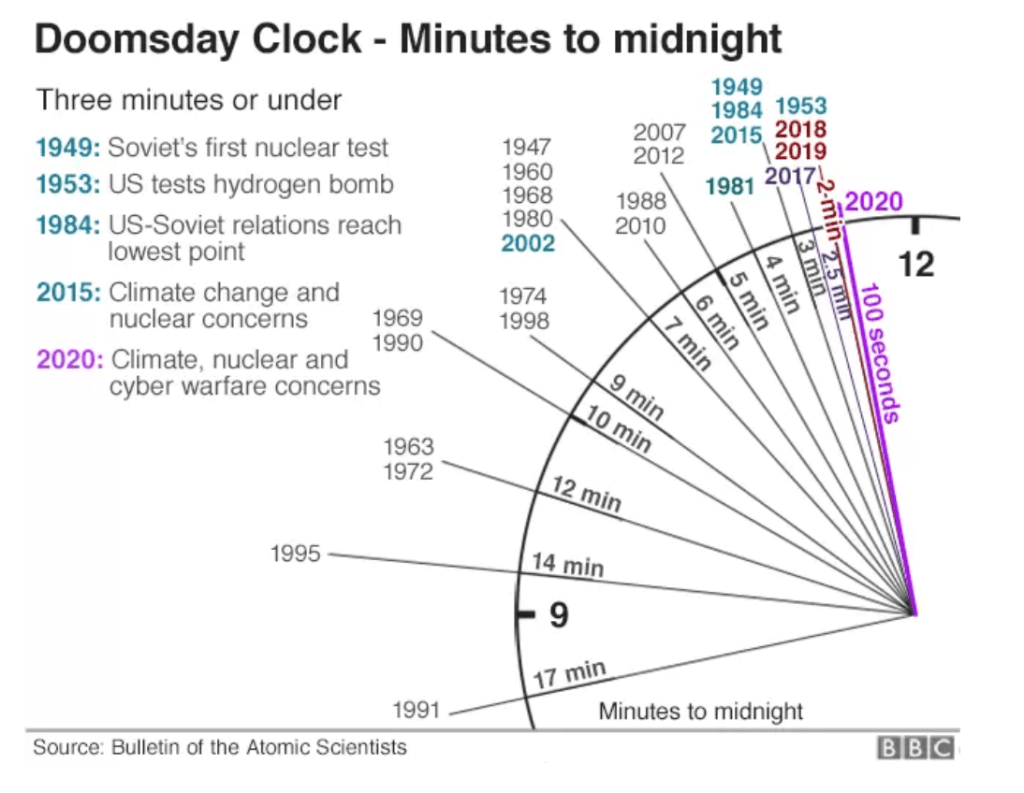
It was moved in 2017, 2019, 2020. In 2020, the scientists moved it ahead to 100 seconds before “midnight,”— the closest the clock had been to Doomsday since 1953. In 1953 they’d moved it ahead due to the United States’ test of its first thermonuclear device, followed months later by the Soviet Union’s hydrogen bomb test. People were legitimately scared in 1953, thermonuclear landscapes were a new and frightening horizon to deal with.

This graphic from the BBC shows the times the ‘clock’ was moved.

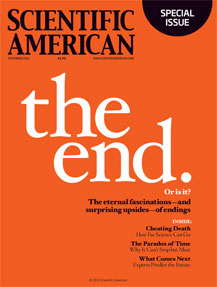
Scientific American devoted their entire magazine some years ago to our fascination with ‘the end.’ According to the scientists, we focus on the end because of our pattern seeking brains, and also to feel special. In the September 2010 issue, the editors and writers take a hard look at all kinds of finales, including doomsday scenarios. The magazine presents 18 stories all devoted to the end, finality, sustainability, catastrophe, and doomsday. They opened with an editor’s note, below:

Eternal Fascinations with the End: Why We’re Suckers for Stories of Our Own Demise
“Welcome to “The End,” at least as we know it. The features here, from the September 2010 issue, cover a range of topics, such as the decomposition of human flesh, the disappearance of cultures, the Earth’s remaining natural resources, and apocalypse scenarios. Once again, the world is about to end. The latest source of doomsday dread comes courtesy of the ancient Mayans, whose calendar runs out in 2012, as interpreted by a cadre of opportunistic authors and blockbuster movie directors. Not long before, three separate lawsuits charged that the Large Hadron Collider would seed a metastasizing black hole under Lake Geneva. Before that, captains of industry shelled out billions preparing for the appearance of two zeros in the date field of computer programs too numerous to count; left alone, this tick of the clock would surely have shaken modern civilization to its foundations.”

Remember the 2012 doomsday scenario? I do. It was hectic!

The secular world has always been fascinated with life endings, planet endings, universe endings… They claim that Christians, with our book of Revelation, are the ones fascinated by it, but in reality the constant barrage of “climate change doom”, “sinking continents doom”, “melting ice caps doom”, “asteroid doom”, “famine doom” – and never mind “alien doom!” and the like, illustrate they are the ones really fascinated by it. Shows like “End Day” and “Life after People” bring in the high ratings.

I used to wonder this question often myself, before I was saved, about the end of life on the planet. In my 20s I used to be scared of the warnings of a solar ray doom crisping the planet. It’s normal to muse on the eternal question, ‘is this all there is? Or is there something else?’ Those who are not saved always wonder what comes after death, even death of the planet.

In 1970 we ‘celebrated’ our first Earth Day. Earth Day is a day that is intended to inspire awareness and appreciation for the Earth’s natural environment. Not the God who made the earth, but the environment, the result of His works. Romans 1:22-23 come to life: “Professing to be wise, they became fools, and exchanged the glory of the incorruptible God for an image in the likeness of corruptible man and of birds and four-footed animals and crawling creatures.”

There is the sense of the eternal placed in all humans’ hearts, they know instinctively that the planet will end. But not the way they surmise.

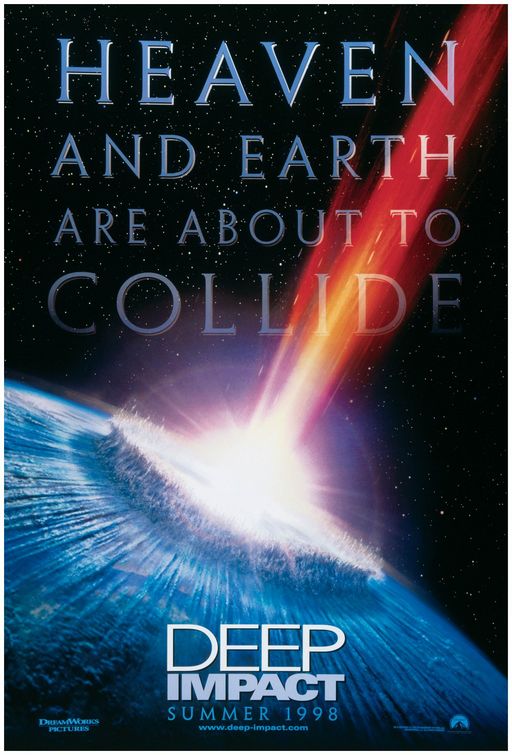
That early focus on environmental appreciation turned to hysteria, and doomsday movies centered around population explosion and earth sustainability came along, notably Soylent Green. This award-winning and popular movie depicted the investigation into the brutal murder of a wealthy businessman in a dystopian future suffering from pollution, overpopulation, depleted resources, poverty, dying oceans and a hot climate due to the greenhouse effect. (That was what they called “climate change” before they called it climate change.)

In the movie, much of the population survives on processed food rations, including “soylent green.” Tune out now if you do not want to know the ending of this movie. OK, here comes the spoiler. The processed food named ‘soylent green’ is people, it is made from human flesh. The film ends with the main character Charlton Heston screaming, “Soylent Green is people!” It became a catchphrase throughout the 70’s.

In this article from the Scientific American issue devoted to “The End”, “Laying Odds on the Apocalypse: Experts Assess Doomsday” the writers ask “Could modern civilization really come to an end? Experts take stock of eight doomsday scenarios.”

See? The secular world is just fascinated with the end.

Yes, civilization really will come to an end. The unsaved with their fascination with the end, yet at the same time denying they have a fascination with it. The Bible says “Know this first of all, that in the last days mockers will come with their mocking, following after their own lusts, and saying, “Where is the promise of His coming? For ever since the fathers fell asleep, all continues just as it was from the beginning of creation.” (2 Peter 3:3).

I think it is an interesting dichotomy. On the one hand our culture constantly depicts ‘the end’ in movies, TV shows, and films, and the public gobbles them up. On the other hand, mockers and scoffers mock and scoff at the notion when Christians proclaim that the world really will end, sneering that the world always has gone on and it always will.

As for eschatological Christians, that is, Christians who study the branch of theology that is concerned with the end of the world or of humankind, are fascinated with the end for a reason: it IS the end. And we will see Jesus, the author of the beginning and the end because He is the Alpha and the Omega.

Atomic scientists of the Doomsday Clock, Scientific American, and others, can look no further than the Bible to discover what has happened, what is happening, and what will happen, even at the end. Here is a summation of all the prophetic verses in the Bible:

The ungodly will rebel, they will refuse Jesus’ nail scarred hand of salvation, and they will meet their end. The end will come, not by overpopulation or asteroid or global warming. The end will come, and it won’t be as stimulating as comfortable intellectual discussions from ivory tower editors and scientists publishing theories in magazines. The end will come, and it won’t be as sexy as when they watched it in the movie theatres with fancy graphics and computer generated people. All one needs to do is look at the bible, and believe what it says. The end is there:

“looking for and hastening the coming of the day of God, because of which the heavens will be destroyed by burning, and the elements will melt with intense heat!” (2 Peter 3:12)

“The earth is broken up, the earth is split asunder, the earth is thoroughly shaken.” (Isaiah 24:19)

“The mountains melt beneath him and the valleys split apart, like wax before the fire, like water rushing down a slope (Micah 1:4)

“By the same word the present heavens and earth are reserved for fire, being kept for the day of judgment and destruction of ungodly men.” (2 Peter 3:7)

It is the end for the ungodly, but that is not the end! It is not the end for the Godly! Believers in Jesus will see the earth renewed! We will live!

Rev 21:1-6 – “Then I saw a new heaven and a new earth, for the first heaven and the first earth had passed away, and there was no longer any sea. I saw the Holy City, the new Jerusalem, coming down out of heaven from God, prepared as a bride beautifully dressed for her husband. And I heard a loud voice from the throne saying, “Now the dwelling of God is with men, and he will live with them. They will be his people, and God himself will be with them and be their God. He will wipe every tear from their eyes. There will be no more death or mourning or crying or pain, for the old order of things has passed away.” He who was seated on the throne said, “I am making everything new!” Then he said, “Write this down, for these words are trustworthy and true.” He said to me: “It is done.”

So. It is the end and it is the beginning. It is an Alpha and an Omega. Repentance of your sins and believing in Jesus will secure for any person an eternally bright future in bliss and joy and in glory. The earth will be remade new, and His people will dwell on it forever. No doom ever again, just joy. Who wouldn’t be fascinated by THAT!

Posted in encouragement, Uncategorized

Advent: Thirty Days of Jesus, Day 3; ‘Perfect Timing’

By Elizabeth Prata

We are in the section of my Advent thirty day flow where we examine PROPHECY, ARRIVAL, and EARLY LIFE of Jesus.

In this section I chose verses that reflect the prophecies that predict His coming. Prophecy warns of coming judgment but it also comforts in that it foretells the holy and wonderful resolution of all things for the believer. This resolution didn’t begin with Jesus’ incarnation as a babe in the manger, it began before the foundation of the world when the God-head held an intra-council discussion and Jesus voluntarily chose to become the sacrificial Lamb.

Introduction & Background to this series here

thirty days of jesus verse 3

Introduction/Background
Day 1 post
Day 2 post

Ten Bible verses about God’s Timing

As we go about our daily lives, we often become discouraged by the many difficulties and challenges we face. Life can be stressful sometimes, posing unprecedented demands on our faith and trust in God. You might find yourself wondering how things could be different – why God has put certain obstacles in your path. Why this, why now? Bible verses offer all the answers. This post covers useful Bible verses about God’s timing to help you cope during difficult times. 

Challies: Five verses on adoption

The word “adoption” (Greek huiothesias) occurs only a few times in the New Testament, and each time it refers to God choosing a people for himself. Though there are not a lot of references to this word, there is a good deal we learn from them about the doctrine of adoption.

Ligonier: Adoption into God’s Family by Iain Campbell

Among the blessings God bestows on us in Christ is the blessing of adoption. We have been brought into God’s family and made God’s children. From God we have received “the Spirit of adoption as sons, by whom we cry, ‘Abba! Father’” (Rom. 8:15). As far as our status is concerned, we are no longer “strangers and aliens” to the people of God but “members of the household of God” (Eph. 2:19). The Christians in Ephesus may have no natural affinity to the descendants of Abraham, but God in His grace has addressed the issue of their spiritual alienation from His covenant by making them His sons and daughters.

Answers In Genesis: Adopted into God’s Family by Rod Martin

Every once in a while, I am asked, “What’s it like to be adopted?” I was two days old when my parents chose me to be their son. Being adopted is an amazing thing. I was taken from a situation that probably would not have turned out well and was given the opportunity to grow up in a loving Christian home. I became a member of a new family. I had a new identity, a new name, a new opportunity, and eventually a new inheritance. I was chosen!

Editor Note: All scripture-pictures were made by me, photos in the series are mine with just 3 exceptions.

Posted in encouragement, Uncategorized

Advent: Thirty Days of Jesus, Day 2; He will come!

By Elizabeth Prata

Thirty days of exalting Jesus through selected verses with pictures representing the prophecy, life, death, resurrection, and Second Coming of our Savior.

More information and background on this series, here

thirty days of jesus verse 2

Day 1: The Virgin Shall Conceive

Ligonier: A Shoot from Jesse’s Stump: Devotional

History tells us this is exactly what happened, with David’s royal dynasty all but dying out as a result of God’s judgment of His people through Assyria and Babylon. Nevertheless, Isaiah also saw that while the Davidic line would seem to be dead, life would remain within the stump. A shoot—life barely detectable at first—would emerge. But once this shoot went forth, it would become a mighty tree.

Matthew Henry’s Commentary on Isaiah 11:1

 He comes forth out of the stem, or stump, of Jesse. When the royal family, that had been as a cedar, was cut down, and only the stump of it left, almost levelled with the ground and lost in the grass of the field (Dan. 4:15), yet it shall sprout again (Job 14:7); nay, it shall grow out of his roots, which are quite buried in the earth, and, like the roots of flowers in the winter, have no stem appearing above ground. The house of David was reduced and brought very low at the time of Christ’s birth, witness the obscurity and poverty of Joseph and Mary. The Messiah was thus to begin his estate of humiliation

All the Named Men of the Bible: Jesse

Jesse [Jĕs’se]—jehovah exists or firm. The son of Obed and father of David, and grandson of Boaz and Ruth, and an ancestor of Christ (Ruth 4:17, 22). Jesse had eight sons and two daughters by different wives (1 Sam. 17:12-14, 25). Isaiah speaks of “the stock of Jesse,” a phrase indicating that it was from Jesse the Messiah would come. The humble descent of the Messiah is contrasted with the glorious kingdom He is to have (Isa 11:1).

Introduction/Background
Day 1: The Virgin shall conceive

Posted in end time, florence chadwick, prophecy

Keep persevering – with keeping the prophetic finish line in sight

By Elizabeth Prata

This example is used a lot in sermons and devotionals. It is an oldie but a goodie.

Florence Chadwick was a young woman in 1952 but had already swum the English Channel, both ways, and broke records doing it. One morning in 1952 she stood on the shores of California with intent to swim the 26 miles to Catalina Island. It was foggy. She was used to fog, rough water, and cold, having swum in these conditions since when was 11 years old so she was prepared for any conditions that may beset her on the long swim. It was so foggy that Florence could not see the support boats motoring around her to scare away the sharks. However after 15 hours of rough water stroke after stroke, she felt like she wasn’t getting anywhere. Despite encouragement from her mother and others in the support boat next to her, Florence wearied and asked to be taken out of the water. She soon discovered that she was half a mile from her goal.

The Lubec Maine shoreline. There’s a lighthouse in the photo. Can you see it? EPrata photo

At a news conference the next day Florence said, “All I could see was the fog.…I think if I could have seen the shore, I would have made it.”

Florence tried again two months later. This time, she made it! What made the difference? She said that she kept a mental image of the shoreline in her mind while she swam.

This is the same scene as above after the fog rolled away. [Photo by EPrata]

Prophecy is not meant to BE the fog. It is knowable, profitable, and given to us for all education. It is a light to keep in our heart as to the immutable existence of God, His eternal promises, and the goal for every believer, to reach the eternal Lighthouse.

There are end of time prophetic utterances in much of the Old Testament and in every book of the New except for four. And three of those four are single-chapter letters to one individual. Jesus meant prophecy to be the mental image for us to hold dear as to the goal. Do not give up half a mile from the finish line!

He is near, He is coming. Do not wander, drift, be swept away by currents taking you far from the goal. May every stroke of your swim toward eternity be as vigorous as the one before. Pray for that vigor. The Holy Spirit is there to help us:  “And I will pray the Father, and he shall give you another Comforter, that he may abide with you for ever;” (John 14:16)

If you knew that Jesus was returning tomorrow would it change your decision not to study the Bible today? Not to pray? Not to help someone? If you knew it was next week, or next year, how differently would you act as a Christian? You’re tired. We are all tired. The wages of sin splash up on us, and sometimes splash into us. It is wearying holding firm against the current. But keep the goal in mind! Envision scenes the Bible gives us of that happy Day.

behold, a throne was standing in heaven, and someone was sitting on the throne. And He who was sitting was like a jasper stone and a sardius in appearance; and there was a rainbow around the throne, like an emerald in appearance. Around the throne were twenty-four thrones; and upon the thrones I saw twenty-four elders sitting, clothed in white garments, and golden crowns on their heads…Revelation 4:2-4.

Worthy are You, our Lord and our God, to receive glory and honor and power; for You created all things, and because of Your will they existed, and were created. (Revelation 4:11)

The River and the Tree of Life: And he showed me a river of the water of life, clear as crystal, coming from the throne of God and of the Lamb, in the middle of its street. (Revelation 22:1).

Keep persevering – with keeping the prophetic finish line in sight!