Thirty days of exalting Jesus through selected verses with pictures representing the prophecy, life, death, resurrection, and Second Coming of our Savior.
We are in the flow of verses that prophesied his coming.
History tells us this is exactly what happened, with David’s royal dynasty all but dying out as a result of God’s judgment of His people through Assyria and Babylon. Nevertheless, Isaiah also saw that while the Davidic line would seem to be dead, life would remain within the stump. A shoot—life barely detectable at first—would emerge. But once this shoot went forth, it would become a mighty tree.
He comes forth out of the stem, or stump, of Jesse. When the royal family, that had been as a cedar, was cut down, and only the stump of it left, almost levelled with the ground and lost in the grass of the field (Dan. 4:15), yet it shall sprout again (Job 14:7); nay, it shall grow out of his roots, which are quite buried in the earth, and, like the roots of flowers in the winter, have no stem appearing above ground. The house of David was reduced and brought very low at the time of Christ’s birth, witness the obscurity and poverty of Joseph and Mary. The Messiah was thus to begin his estate of humiliation.
Jesse —jehovah exists or firm. The son of Obed and father of David, and grandson of Boaz and Ruth, and an ancestor of Christ (Ruth 4:17, 22). Jesse had eight sons and two daughters by different wives (1 Sam. 17:12-14, 25). Isaiah speaks of “the stock of Jesse,” a phrase indicating that it was from Jesse the Messiah would come. The humble descent of the Messiah is contrasted with the glorious kingdom He is to have (Isa 11:1).
“This is the famous text that foresees a shoot coming forth from “the stump of Jesse,” a shoot whose reign would destroy all evil and bring peace to the earth (Isa. 11:1–11).”
I discuss the necessity of spiritual discernment, wisdom, and readiness in today’s challenging times. Believers should be rooted in scripture, cherish their relationship with Jesus, and remain vigilant. Encouragement, kindness, and sharing faith are crucial as we navigate difficulties, anticipating Christ’s return and the opportunities to reflect His love amidst despair of the lost.
The post emphasizes the significance of prophecy in Christianity, highlighting its role as a movement toward fulfillment, particularly regarding the lineage of Jesus. It illustrates God’s divine providence in governing all aspects of life and underscores the importance of prophecy as a testament to God’s sovereignty and the accuracy of the Bible.
Lately online the most disagreements among the women I engage with involve the fact that they believe God is speaking to them directly.
He isn’t.
But crickey, is this truth resisted. Friends, the canon is closed and all scripture as given is sufficient for our life and growth in sanctification. All moral guidance, spiritual guidance, and wisdom is in the Bible. For anything we need to know or do that isn’t in the Good Book, we just decide. Yes, decide. I’ll be writing an essay about deciding later this week.
For now, let’s see about oracles.
The Lexham Bible Dictionary defines oracle as
A divine message communicated through a human mediator to one or more human recipients. Wells, S. (2016). Oracle. In The Lexham Bible Dictionary.
And Balaam lifted up his eyes and saw Israel camping tribe by tribe. And the Spirit of God came upon him, and he took up his discourse and said, “The oracle of Balaam the son of Beor, the oracle of the man whose eye is opened.” (Numbers 24:2 ESV).
So how is an oracle different from a prophecy? Technically they both are divine messages delivered from God to man.
However, oracles were usually something that humans sought from God, instead of Him delivering a message to and through a Prophet, unprompted by human inquiry, as usually happened with prophecy. These oracles were specific, someone was seeking an answer to a specific question.
Many oracles were sought by kings and leaders for political purposes (“Will I win this battle?”) but the lay-people could ask God in an oracle too. (e.g. 1 Kings 22:1-7)
Some prophets or seers received compensation for oracles, like Balaam, but sadly the tendency was then to deliver favorable oracles so the money would keep flowing.
“Anyone who has read about ancient Greece and Rome has heard about the “oracles.” Two famous oracles were the oracles of Apollos at Delphi and Zeus at Dodona. The Greeks and Romans believed that the gods took a personal interest in their lives, so they would go to these places to seek advice from the gods about their lives. The gods were supposed to answer them through these oracles. But the oracles were often very difficult to interpret, even for the priests of the temples. The expression “oracle of God” shares some of the same denotations, with one major exception: it is the one and only God who speaks—and He does so clearly”. In Holman treasury of key Bible words.
Delphi: A Greek city and sanctuary famous throughout the Graeco-Roman period for its temple of Apollo, which housed the oracle of Apollo. Photo by Sergio García on Unsplash
Are there oracles in the New Testament? Yes, oracles are mentioned.
When we come back to the New Testament, we see that Christian teachers, functioning as prophets, also spoke the “oracles” of God. Peter said, “Whoever speaks, let him speak, as it were, the oracles of God” (1 Pet. 4:11 ESV). The author of Hebrews also used the word oracles to describe the words of God that had originally been communicated to the believers (Hebrews 5:12 ESV). Source: In Holman treasury of key Bible words
You might remember the Magic 8 Ball. It was a black ball made of hard plastic that a child could hold in two hands. It had a clear window at the top and you asked it a question, shook the ball, and waited until an icosahedron floated to the window with a message in it. The answers always disappointed me as a kid. “Try again later,” or “Maybe.”
Wikipedia says “Oracles were thought to be portals through which the gods spoke directly to people“. Frustratingly, when seekers arrived and asked the oracle a question, answers that came were often vague. So if you were frustrated as a kid receiving vague answers from the Magic 8 Ball, imagine the seekers at Delphi or Dodona! Yet still, many thousands still came to seek answers from the ‘gods.’
“To look at it simply, a Magic 8 ball online is a fortune telling tool that has made its way into popular culture as a game or novelty item.” source https://magic-8ball.com/
“Preserved Assyrian oracles from Nineveh include the deity’s name, the recipient’s name, and the name and gender of the prophetic mediator. Most oracles are uttered on behalf of the goddess Ishtar.” The Lexham Bible Dictionary. Lexham Press.
Wow, the Assyrians were dedicated to their oracles, weren’t they! Well preserved, each and every one, to this day. Yet as Christianity took hold, the other ‘oracles’ fell silent.
In the New Testament, the Apostles sought God’s direction, of course. Earlier on, they might hear back in an audible voice or a tangible way (dream, vision, angel…). But as time went on the Apostles’ questions were answered through God using other people, such as Ananias to Saul/Paul, or when Cornelius (at an angel’s prompting) sent for Peter via his men.
In these days, Jesus said that He knows we need food and clothes and financial support. It pleases Him when we ask Him in trust and do not doubt. It pleases Him so much more when we ask for wisdom, discernment, the meaning of a passage, or a growth in sanctification, because tangible things are needed, but temporary. Our spiritual life is permanent. But do not expect a visible, audible reply back. His oracle is now the Bible, and everything in it is sufficient for us.
Of course, there is only one God. Only God knows the future, because He is the creator of the universe, the originator of time, and the architect of history. Seek answers from His word and trust that He hears your questions and concerns in prayer.
I’ve been thinking a lot about the rampant issue in evangelicalism concerning “God told me.” So many men and women are running around with alleged prophecies and all sorts of messages the ‘voice’ supposedly told them.
Even more sad is the number of people that believe that God is speaking to these so-called prophets. If God is speaking now outside of the Bible, it makes the Bible INsufficient for all teaching, reproof, correction, and training in righteousness, and makes 2 Timothy 3:16-17 which says it is sufficient, into a lie.
That scriptural fact notwithstanding, there is another issue with the people who claim God is telling them things, whispering things, and/or promising them things outside of the Bible. The news He is allegedly bringing is never the kind that is spoken of in the Bible. Like, what kind, you ask? Well,
When Jesus was commissioning Ananais to go to Saul/Paul, Ananias balked a little, saying that Saul has been persecuting everyone all over the place. Jesus replied and told Ananias how much Paul must suffer for the sake of His name. Here is what was said,
But the Lord said to him, “Go, for he is a chosen instrument of Mine, to bear My name before the Gentiles and kings and the sons of Israel; 16 for I will show him how much he must suffer in behalf of My name.” (Acts 9:15-16).
I remember people oohing and ahhing over the testimony of HGTV’s Fixer Upper co-host Joanna Gaines. Did God tell Joanna that she will suffer much for His name? No. Was her prophecy something like this-
But the Lord said to her husband Chip, “Go, for she is a chosen instrument of Mine, to bear My name before the Gentiles and kings and the sons of Israel; for I will show Joanna how much she must suffer in behalf of My name.“
Somehow, suffering for the Lord is never part of the ‘prophecies’ or conversations these ladies purport to have in these conversations with God. What DID ‘Jesus’ allegedly promise Joanna Gaines?
“I hear God say very clearly, he said, ‘Joanna if you trust me with your dreams I’m going to take Magnolia further than you could have ever dreamed so just trust me.’“
Sure. Sure. It always seems like ‘God’ says he will give the lady a comfy life and make all her dreams come true.
Isaiah was a true prophet of God. God raised Isaiah either bodily or in a vision to the throne room.
Then one of the seraphim flew to me with a burning coal in his hand, which he had taken from the altar with tongs. He touched my mouth with it and said, “Behold, this has touched your lips; and your guilt is taken away and atonement is made for your sin.” (Isaiah 6:7)
How lovely is this. It brought tears to my eyes. Isaiah was gifted with a vision of the throne room. Aghast that a worm such as he would be near the holy God, the angel flew to him and touched his lips with a burning coal and says his sins were atoned for. Isaiah lived 700 years BEFORE the cross. In heaven there is no time. Isaiah’s sins were atoned for even though on earth Jesus had not incarnated and died yet. But God’s word is SO SURE that Isaiah’s sins were atoned for even though the event had not occurred yet in our time.
EPrata photo
But isn’t it curious how these women who claim ‘God’ comes to them never seem to have the same reaction other people in the Bible have when confronted with the presence of the actual Jehovah? Which is to cower in fear and despair that His holiness shows up the depth of our sin?
But God was not giving Isaiah this vision just to offer a tour of heaven. God had a message for Isaiah. He was calling Isaiah to be God’s prophet! What exciting personal news did Isaiah receive? It was that Isaiah was going to speak God’s word, but no one would pay attention.
Isaiah wondered how long this dire circumstance would be his calling.
Then I said, “Lord, how long?” And He answered, “Until cities are devastated and without inhabitant, Houses are without people And the land is utterly desolate, 12The LORD has completely removed people, And there are many forsaken places in the midst of the land. (Isaiah 6:11-12).
Gulp. Not so cheery is it? It is one of the most supremely majestic scenes in the Bible. And yet the news was not so personally beneficial to Isaiah, as these conversations nowadays always seem to be with the claims of conversations with God.
In this scene, all is spoken in august language, reverentially, mindful of the Holy One of Israel, the Ancient of Days whose robe filled the temple.
Now we turn to a prophecy and vision Beth Moore supposedly had. She was lifted up too! She even went farther than Isaiah in that Jesus showed her things as HE sees them, not as Isaiah sees them, which is that we are undone before a holy God. No, Beth Moore was given a peek at how Jesus sees the church, and in another dimension no less!
Beth said, “You know what He said just a few days ago? “Honey, I just want you to know we’re just beginning.”
Honey?
And it was as if I was raised up looking down on a community, as I saw the church in that particular dimension- certainly not all dimensions, not even in many, but in what we will discuss tonight, the church, as Jesus sees it, in a particular dimension. Oh, glory! That meant I had begun. Hallelujah! But He was telling me, “When this ends, we ain’t done with this. Honey, this is what we do for the rest of your life.” And He said those words to me over and over again: “Believe Me. Believe Me.”
God said ‘We ain’t done with this honey’? Really?
Sure, sure.
God told Peter when he was old, that he’d stretch out his hands and go where he did not want, a prophecy most interpret as Peter’s crucifixion-martyrdom.
Contrast this to today’s prosperity prophecies. When God speaks it’s to tell women they are enough, they are a princess, so beautiful, will have a platform, will do wonderful things. God has a wonderful plan for your life, God is going to do amazing things. It’s always centered around something pleasant for the woman, not so much about advancing God’s holy plan.
Will He do as amazing as a thing as render all Israel a desolate land? An agonizing death? A suffering life? An ignored Prophet? These were actual prophecies in the Bible.
The canon is closed. God’s new revelation ended with Revelation 22. I’m not saying God CAN’T speak now, of course He can. It’s just that He closed the Bible with a warning not to add to the book nor take away from it. He said that at the present time, He would not be speaking. It’s not a question of His ability, it’s a question of His consistency.
Think carefully about the prophecies (conversations, whispers, voices) are saying to these women (and men). The content of these conversations is inconsistent with God’s previously delivered word. The language use is inconsistent with God’s previously given word. Compare to the Bible. They all come up short, because the canon is closed and the word as given is sufficient.
Study your Bible to “hear” God’s voice. His word is God-breathed.
Thirty days of exalting Jesus through selected verses with pictures representing the prophecy, life, death, resurrection, and Second Coming of our Savior.
We are in the flow of verses that prophesied his coming.
History tells us this is exactly what happened, with David’s royal dynasty all but dying out as a result of God’s judgment of His people through Assyria and Babylon. Nevertheless, Isaiah also saw that while the Davidic line would seem to be dead, life would remain within the stump. A shoot—life barely detectable at first—would emerge. But once this shoot went forth, it would become a mighty tree.
He comes forth out of the stem, or stump, of Jesse. When the royal family, that had been as a cedar, was cut down, and only the stump of it left, almost levelled with the ground and lost in the grass of the field (Dan. 4:15), yet it shall sprout again (Job 14:7); nay, it shall grow out of his roots, which are quite buried in the earth, and, like the roots of flowers in the winter, have no stem appearing above ground. The house of David was reduced and brought very low at the time of Christ’s birth, witness the obscurity and poverty of Joseph and Mary. The Messiah was thus to begin his estate of humiliation.
Jesse [Jĕs’se]—jehovah exists or firm. The son of Obed and father of David, and grandson of Boaz and Ruth, and an ancestor of Christ (Ruth 4:17, 22). Jesse had eight sons and two daughters by different wives (1 Sam. 17:12-14, 25). Isaiah speaks of “the stock of Jesse,” a phrase indicating that it was from Jesse the Messiah would come. The humble descent of the Messiah is contrasted with the glorious kingdom He is to have (Isa 11:1).
I wish prophecy wasn’t so manhandled and misused. I love it. It is an amazingly perfect display of God’s sovereignty, mercy, and wrath. Prophecy sparks hope that His future promises will come true, because His past promises did.
It is noteworthy that in no other religious writings in the world do we find any specific predictive prophecies like we find in the Scripture. You will find no predictive prophecies whatsoever in the writings of Buddha, Confucius, Mohammed, Lao-Tse, or Hinduism. Yet in the Scripture there are well over two thousand prophecies, most of which have already been fulfilled.
Though the Bible has been attacked at every other place, the one place where God rests His inspiration is that the things He foretells come infallibly to pass.
The Bible prophecies are altogether unexpected! I know of no one ever prophesying that any other human being would rise from the dead and ascend into heaven. That is exceedingly improbable. The chance of it happening by coincidence is incalculable. No, the Bible is not merely a book written by men; it is a book written by God through men, and the heart of its prophetic message is Jesus Christ.
Kennedy, D. J., T. Cabal (2007). Christ: The Fulfillment of Prophecy.
Truly I have spoken; truly I will bring it to pass. I have planned it, I will certainly do it. (Isaiah 46:11b)
“God is not a man, that He would lie, Nor a son of man, that He would change His mind; Has He said, and will He not do it? Or has He spoken, and will He not make it good?” (Numbers 23:19)
He has said he will never leave us, that He will comfort us, that He will provide for us, that He will bring us to His home in heaven, that He will hear our prayers, that we may approach the throne of God without fear or hesitation, that we will be blessed with the presence of Jesus all our days in eternity – and so much more!
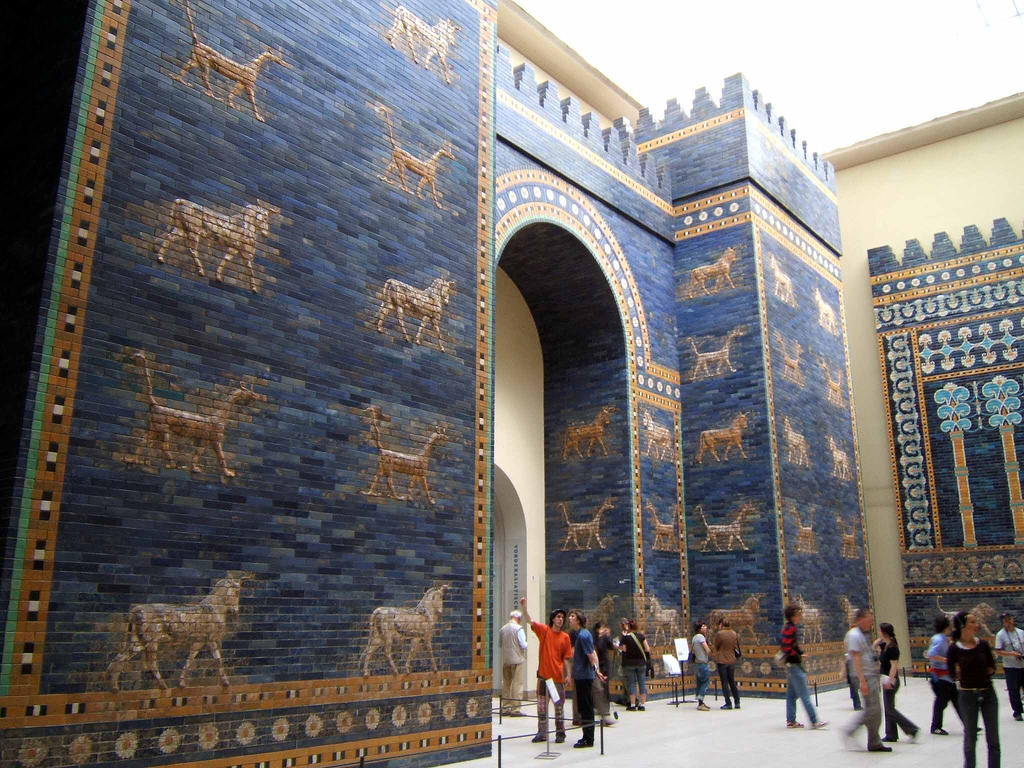
Babylon. City of mystery, history, prophecy. The very name Bab-iliu means “the gate of the gods” in Akkadian, which is the oldest recorded Semitic language and the most common language of the ancient Near East until the eighth century BC.
It was founded on the great river, Euphrates, about 200 miles north of where the Euphrates joins the Tigris and drains into the Persian Gulf, two of the 4 great rivers flowing out of Eden to “water the garden”. (Genesis 2:14).
Babylon was a sacred site dedicated to the (false) god Marduk, the city’s patron god. Often Marduk’s name is included with the title ‘Bel’ to Marduk’s name to indicate supremacy of all the gods. The city’s inhabitants celebrated Marduk at the start of their new year with a festival noting his ascension as king of all gods and his seating in his temple in the city.
Marduk was mentioned in the Bible in Jeremiah 50:1–2 where Yahweh ordered Jeremiah to declare:
‘Babylon has been captured; Bel has been put to shame; Marduk has been shattered; Her images have been put to shame; her idols have been shattered.’
For two thousand years Babylon dominated Mesopotamia.
The Lexham Bible Dictionary indicates that Babylon was a “cultural and political center of Mesopotamia during much of the second and first millennia BC. Located in modern-day Iraq along one branch of the Euphrates River, about 59 miles southwest of Baghdad.“
Babylon Past
Throughout the entire Bible, Babylon stands as a dominating presence as an actual historical empire but also as a symbol of spiritual apostasy and evil opposition to God and His people. Its name Babel is first found in Genesis 11:9,
Therefore is the name of it called Babel; because the Lord did there confound the language of all the earth’
Babylon is the Greek form of the name Babel. Babylon began its ascent in 2300 BC to greatness but really exploded in cultural and architectural wonders during the reign of Hammurabi in 1792 BC, the sixth king of his line. During his reign and later his son’s reign, numerous temples were built and irrigation channels were excavated. King Hammurabi also conquered all of the surrounding cities, including the famous city of “Ur” where Abraham had lived centuries before.
But like many cities, Babylon then began to decline, and this up and down swing continued until Assyria was finally defeated. It then reached another pinnacle during the reign of Nebuchadnezzar II and entrenched itself as one of the most important cities in the Near East.
“The empire had been founded by Nebuchadnezzar’s father Nabopolassar (r. 625-605 BCE) after his victories over the Assyrian Empire. Nebuchadnezzar II would go on to even greater things, including the capture of Jerusalem in 597 BCE. The Babylonian king then set about making his capital one of the most splendid cities in the world”. Source World History Encyclopedia
The most famous of these improvements to the city were the Hanging Gardens of Babylon, “ancient gardens considered one of the Seven Wonders of the World and thought to have been located near the royal palace in Babylon” says Encyclopedia Britannica. Though no one is quite sure where they were within the city, there were enough descriptions of them in classical literature to know that they likely existed, though no one is exactly sure of what they looked like.
The Gardens were said to be ‘hanging’ because perhaps they were perhaps on a tall ziggurat with terraces, “were set upon vaulted terraces. They were also described as having been watered by an exceptional system of irrigation and roofed with stone balconies on which were layered various materials, such as reeds, bitumen, and lead, so that the irrigation water would not seep through the terraces.”
In Daniel 4:30 we read the perhaps most famous story about Babylon, where King Nebuchadnezzar admires his city from his palace rooftop, saying “‘Is this not Babylon the great, which I myself have built as a royal house by the strength of my power and for the glory of my majesty?’”
Barnes’ Notes says: “He greatly enlarged the city; built a new city on the west side of the river; reared a magnificent palace; and constructed the celebrated hanging gardens; and, in fact, made the city so different from what it was, and so greatly increased its splendor, that he could say without impropriety that he had “built” it.“
Yet…the very next verse says that King Nebuchadnezzar’s pride and self-glorification was a mistake.
While the word was in the king’s mouth, there fell a voice from heaven, saying, O king Nebuchadnezzar, to thee it is spoken; The kingdom is departed from thee.
The city “under Nebuchadnezzar, who died B.C. 561 after a reign of forty-three years, attained great splendour. In the reign of Belshazzar the capital was taken by Darius the Median (Dan. 5:25–31), who entered it unexpectedly at the head of an army of Medes and Persians, as Isaiah (21:1–9) and Jeremiah (51:31) had predicted some 170 years before. Then began the decay and ruin of this proud city, and the kingdom of Babylon became a part of the Persian empire. In course of time the “great city” became “heaps,” and “an astonishment, and a hissing, without an inhabitant” (Jer. 51:37–58).
“Many of the Jews who had been carried captive to Babylon remained there, notwithstanding the decree of Cyrus. After the destruction of Jerusalem there was established at Babylon a school of Jewish learning of great repute.” Source– Easton’s(1893) In Illustrated Bible Dictionary and Treasury of Biblical History.
Babylon future
Babylon is mentioned in Revelation numerous times. We read in Revelation 14:8, “and another angel, a second one, followed, saying, “Fallen, fallen is Babylon the great, she who has made all the nations drink of the wine of the wrath of her sexual immorality.”
Babylon was not only a city in history, not only an empire that rose & fell, but the name Babylon is also figurative of an evil commercial-governmental system and an evil spiritual system.
Roy Gingrich interprets both the actual and the symbolic nature of Babylon:
“The fall of Babylon (Rev 14:8)-
“(1) The announcement—Another angel (other than the one in verse 6) announces the soon coming fall of Babylon. The “Babylon” mentioned here is not the religious system of chapter 17 -that “Babylon” was destroyed at the mid-point of “The Seventieth Week”. The “Babylon” mentioned here is the capital city of the political-religious-commercial system of chapter 18, which city and system will be destroyed when the Seventh bowl is poured out. God destroys her because she made the nations drink “the wine of the wrath of her fornication,” that is, because she caused them to commit spiritual fornication, which is punished by God’s wrath.” Gingrich, R. E. (2001). The Book of Revelation (p. 69). Riverside Printing.
Gingrich continues-
“The destruction of religious “Babylon” as an ecclesiastical system, chapter 17. In the days of Nimrod, Gen. 10:8–12, and his wife, Semiramis, around 200 years after the Flood, two great systems came into existence, a God-defiant political system and a God-defiant religious system, the one founded by Nimrod and the other founded by Nimrod through his wife, Semiramis. These two systems are often called Political Babylon and Religious Babylon because they had their beginnings in Babylon, the one in the building of the city of Babylon and the other in the building of the tower of Babylon. The city of Babylon is the symbol of organized political rebellion against God and the tower of Babylon is the symbol of organized religious rebellion against God.” Gingrich, R. E. (2001). The Book of Revelation (pp. 76–77). Riverside Printing
“These two systems in varying forms, have continued on side by side down through the centuries, hating one another but for the sake of self-advancement, exchanging favors with one another. During the Middle Ages, these two systems were seen in the Holy Roman Empire and in the Roman Catholic Church. Today, they are seen in the United Nations Organization and in the Ecumenical Church Movement. During the first half of Daniel’s Seventieth Week, they will be seen in the Revived Roman Empire [“the Scarlet-colored beast,” Rev. 17:3] and in the rejected Lacodicean church] [“the great whore,” Rev. 17:1]. It is very helpful in understanding Rev., chap. 17, to know that “the scarlet-colored beast” and “the great whore” of chapter 17 are the final forms of two great God-defiant systems which have been in existence for over 3,000 years.” Gingrich, R. E. (2001). The Book of Revelation (pp. 76–77). Riverside Printing.
–end Gingrich quote
Babylon both actual and spiritual offer many lessons for us. Whenever I think of Dickens’ “A Tale of Two Cities” I often think of ‘Babylon & Jerusalem’. In the NT Babylon is always mentioned negatively, as a seat of evil, ungodly power. It signifies the world and its forces in opposition to God. It is often contrasted with “New Jerusalem”, in which God will finally reign supreme with no opposition ever again.
We will live in the city GOD built, not a city made by man like Assyria’s Damascus, Caesar’s Rome or Nebuchadnezzar’s Babylon. It will be a pure city, devoid of anything detracting from the glory of Jesus and his Light.
Babylon present
Whatever became of the actual, historical city of Babylon? It no longer really exists. It is a ruin, though it was opened to tourists again in 2009. There is not much to see. It is estimated that only about 5% of the old city has been excavated.
Babylon would stay under the Persian Empire’s rule for two centuries before Alexander the Great then conquered Babylon in 331 BC. He had plans to make Babylon the capital of his empire but died there in 323 BC before his dream came into reality. Alexander’s generals divided his empire among themselves immediately after his death. This is how general Seleucus obtained the historical city of Babylon. Not long after, he moved most of the population to his new capital Seleucia, which left the city decaying and deserted.Source
Will Babylon the city rise again? Only the Lord knows. Babylon the metaphor for an economy and an ecclesiastical system will indeed rise again to uncontested dominance, and be part of the major events prophesied to occur in the future, if the Babylonian system even can be said to have disappeared in the first place. Yet “Babylon” actual and Babylon figurative will finally be squashed in the future when Revelation events occur and Jesus’ wrath wipes out the evil system. The Lord as always, reigns supreme.
There will be no king looking out from his own rooftop and congratulating himself on his achievements. There will be no pagan priests celebrating a false god on a mythical throne. There will be no garden except the one the LORD himself planted, meaning, the world. It will be pure, verdant, and full of peoples who acknowledge Jesus as the supreme Lord of Lords and King of Kings. What a day that will be!
This begins a 4-part look at some of the Great Cities of the Bible. Cities are cities, but they are also seats of Empires, also they can be backdrops or even characters in the Biblical narrative. I chose the cities of Damascus, Babylon, Rome, and finally, Jerusalem to take a closer look at.
Damascus is one of the first cities mentioned in the Bible and the oldest continuously lived-in city in the world. Babylon dominated the Near East during its time, but also is symbolic of the struggle since the Fall of man vs. God. Its backdrop flows from Genesis to Revelation! Rome was at its height during the New Testament times, was the site of 4 Epistles written there, and perhaps will be at another height again if the prophecy about a Revived Empire will indeed be Rome as many interpret. And of course I chose Jerusalem because God set His name upon it, and it will be remade new as our eternal future home!
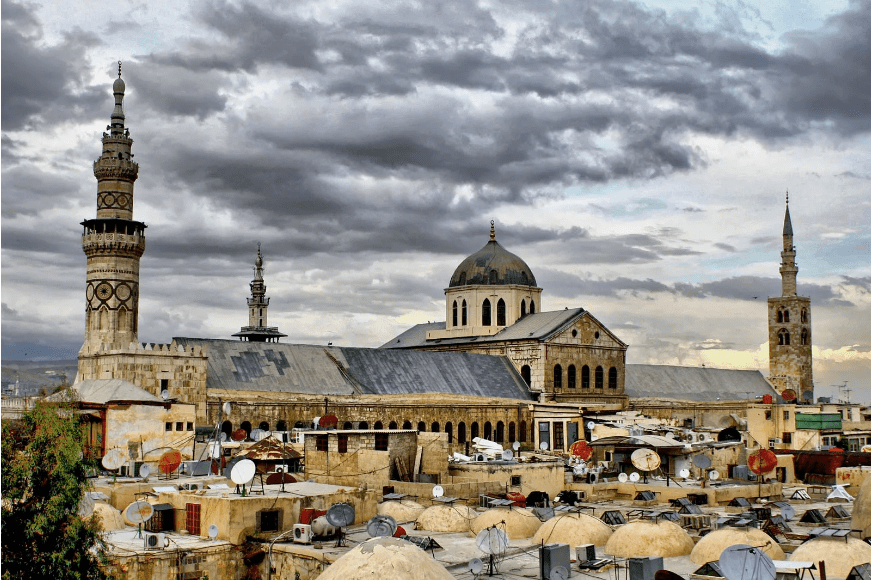
Modern Day Damascus is in Syria. It is the capital of Syria, and people have been living there since about 8000BC. When the Arameans arrived in about 3000 BC it went from villages to a notable city. That’s old!
We may think of that area of Asia as dry and dusty desert, but Damascus is considered one of the most beautiful cities in the world, as well as being ancient and notable. It is a UNESCO World Heritage site. To be sure, its dry and desert-y east is bordered by the Syrian-Arab desert and the west is bordered by the mountains of Lebanon. The mountains bar much rain from dropping on Syria. The mighty Euphrates, which represents more than 80 percent of Syria’s water resources, flows through far to the east of Damascus. Therefore, for Damascus to stay hydrated, the even more important river Barada River is the river on which the city of Damascus relies. Irrigation from the Barada River by aqueducts built during Roman times helps things along.
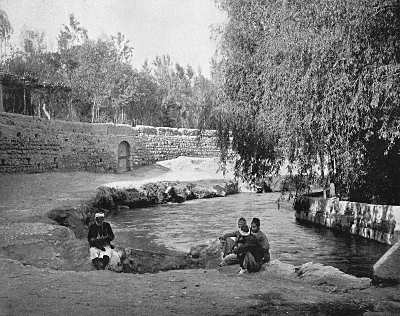
This river is divided into numberless channels and is distributed throughout Damascus and the region immediately about it. In almost every house there is a fountain, and one can stand still almost anywhere and listen to the murmur of the hidden streams that pass under and through the city. Source: Earthly Footsteps of the Man of Galilee, p. 274.)
Barada river, Damascus. Shadi Hijazi photo, CC use
Barada is identified as Abana. This river is mentioned in the Old Testament (2 Kings 5:12), when Naaman argued that its waters would be better than the Jordan for curing his leprosy.
The International Standard Bible Encyclopaedia for the ‘Abanah’ AKA Barada says-
“A few miles southeast of Suk Wady Barada the volume of the stream is more than doubled by a torrent of clear, cold water from the beautifully situated spring ‛Ain Fijeh (Greek, “fountain”), after which it flows through a picturesque gorge till it reaches Damascus, whose many fountains and gardens it supplies liberally with water. In the neighborhood of Damascus a number of streams branch off from the parent river, and spread out like an opening fan on the surrounding plain”.
Speaking of those gardens, we read from the 1894 book “Earthly Footsteps of The Man of Galilee and the Journeys of His Apostles”:
“No wonder the Moslems look upon Damascus as an earthly paradise. It is encompassed by gardens and orchards. These cover an area of over twenty-five miles in circumference. Here grow olive, fig, walnut, apricot, poplar, palm, cypress and pomegranate trees. In the above view we have a scene taken from the Jerusalem road in the western part of the city, and looking to the north a ridge of Anti-Lebanon is seen straight before us. In the richness of its soil, in the salubrity and semi-tropical character of its climate, in its varied vegetation, we find the reason for the constant association of Damascus with the thought of gardens.”
“It has been for four thousand years a garden. It is surrounded for miles with this splendor of verdure. Its gardens and orchards and far-reaching groves, rich in foliage and blossoms, wrap the city around like a mantle of green velvet powdered with pearls. The apricot orchards seem to blush at their own surpassing loveliness, and the gentle breezes that rustle softly through the feathery tops of the palms are laden with the perfume of the rose and the violet. Tristram, in his account of what he saw, says:”
“Tall mud walls extended in every direction under the trees, and flowing streams of water from the Barada everywhere bubbled through the orchards, while all was alive with the song of birds and the hum of bees. The great apricot trees were laden and bent down under strings of ripe golden fruit.” Whatever changes may be made by the hand of man in Damascus, whatever changes in government and in commercial activities, the city is sure to be for all time a paradise of fertility and beauty.”
In the Bible, Damascus is first mentioned in a casual comment in Genesis 14:15 (early!). It was the situation when Lot was taken prisoner and Abram had to go rescue him.
And he divided his men against them by night, he and his servants, and struck them and pursued them as far as Hobah, which is north of Damascus.
Damascus is mentioned again in the very next chapter, Genesis 15:2. Abram noted that the only heir he had was his servant Eliezer. And Abram said, “O Lord Yahweh, what will You give me, as I go on being childless, and the heir of my house is Eliezer of Damascus?“
I mentioned the Arameans above, that Damascus in Syria didn’t become notable as a city until the Arameans settled it. According to Pulpit Commentary, “The Syrians of Damascus are known in the Hebrew, Aram–Dammesek; that is, Aram-Damascus. The inhabitants of these regions and of Mesopotamia were descended from Aram, the son of Shem, son of Noah. (Genesis 10:22)”. See how old this region is? It is really amazing.
Damascus in mentioned frequently throughout the Old and New Testaments. Damascus played a major role in waging wars against Israel. From around 900 to 721 BC Syria was a terrible fearful opponent of Israel David was much occupied with subduing uprisings and incursions from Damascus, Syria throughout his Kingship. He eventually subjugated the Arameans but they rose again after the death of Solomon.
“At various times, Israel and Judah made pacts with those who controlled Damascus (1 Kgs 15:18–20). War between Asa of Judah and Baasha of Israel led Asa to use the treasury of the temple and his personal wealth to pay for the support of Damascus against Israel (1 Kgs 15:19, 20).” Source The Lexham Bible Dictionary. Lexham Press.
When you look at the city in terms of the entire history of the Old Testament, you see how much of a role the Lord had Damascus play in the intertribal wars, alliances, rising and falling of kingdoms, and all impacting the Israelites. In fact, Damascus and Israel joined forces around 734 BC to attack Judah. The war almost destroyed Jerusalem, and evil King Ahaz of Judah asked Assyria’s king Tiglath-pileser to come defend Judah from the attack.
Eventually, Damascus was conquered by Alexander the Great and the city’s fortunes declined. It was taken over in 64BC in Roman times by Pompey. That is when the aqueducts were built that shuffled water from the critically important Barada river to water the great gardens and continue cultivating the crops.
In the New Testament Damascus is mentioned several times but always relative to Saul/Paul, his trip to Damascus, and his conversion. (Acts 9:1–25; 22:5–11; 2 Cor 11:32, 33)
However, despite the 8000 years of history we can trace back to Damascus and the nation of Syria itself, there is one stark piece of prophecy which we can possibly say has not come to pass within all that history yet: Isaiah 17:1 says that Damascus will be destroyed. Never has that ancient city been uninhabited. The prophecy says that the city will be razed and made into rubble, so that no one will live there.
Behold, Damascus will cease to be a city and will become a heap of ruins. The cities of Aroer are forsaken: they shall be for flocks, which shall lie down, and none shall make them afraid.(Isaiah 17:1-2).
Was this prophecy completely fulfilled during 732 B.C. when the Assyrians under Tiglath-pileser subjugated Syria? Has the city ever been so deserted that wild animals feel safe to wander about and even lie down?
Or was it a partial fulfillment, the rest to come at a future time? Whatever the answer, we know that 2 chapters later, the Lord promised good to that region of the world. In that day…Isaiah 19:24-25 says,
In that day Israel will be the third party with Egypt and Assyria, a blessing in the midst of the earth, whom Yahweh of hosts has blessed, saying, “Blessed is Egypt My people, and Assyria the work of My hands, and Israel My inheritance.”
Barnes’ Notes, “That is, the three shall be united as one people. Instead of being rival, hostile, and contending kingdoms, they shall be united and friendly; and instead of having different and jarring religions, they shall all worship the same God. The prophecy rather refers to the spread of the true religion, and the worship of the true God.”
And what a day that will be! The tumultuous epochs of this ancient, beautiful but war-like city shall finally find peace, and so shall all the inhabitants of the earth.
I’ve been a Christian for only 20 years, but I’ve been alive for 63. Even as a youngster, I asked the eternal question to myself, “Why is the world like this?”
Young people, the unsaved, adults, no matter your age, location, or spiritual status, anyone, can see that the world is broken. People are crazy. Just watch the news, if you dare.
The world has always been filled with sinners seeking to fulfill their own desires. A sinner’s desires are completely corrupt and unholy. (Genesis 6:5). They will seek to fulfill these desires by any means they can find, and will eventually resort to graft or deception or bullying or anger, etc.
But it seems lately that the percolating anger in sinners is closer to the surface than ever. Sin makes people insane and they do insane things. That is what having a reprobate mind means. (Romans 1:28-32). I means that people are so darkened that they can’t think straight. For moral and spiritual purposes, they’re effectively insane.
It used to be that people seemed to be held in check from expressing their baser desires by cultural pressure. Even though we in America have never really been a Christian nation, people acted Christian. The veneer of morality prevented things from being said, acts from being done. Over time though, the social-moral fabric has frayed. Badly.
But… Jesus is alive and in control. He sees this foolishness and He will come back to take care of it.
The Great Day of the LORD “I will stretch out My hand against Judah, And against all the inhabitants of Jerusalem. I will cut off every trace of Baal from this place,” (Zephaniah 1:4)
This was a prophecy against Judah. Do you see that? EVERY TRACE of Baal will be gone!
“Therefore wait for Me,” declares the LORD, “For the day when I rise up as a witness. Indeed, My decision is to gather nations, To assemble kingdoms, To pour out on them My indignation, All My burning anger; For all the earth will be devoured By the fire of My zeal.” (Zephaniah 3:8).
And He rose from the dead so that He could conquer death and atone for our sins and to fulfill all the promises since Genesis! He is risen! He lives! He loves! He is with us in our time of trouble and He will come for His beloved! He will rectify the wrongs and rid the world of polluted governments and wretched religions, the Baals and the Molechs and the Mammons will be banished from the earth forever!
“and if Christ has not been raised, your faith is worthless; you are still in your sins.” (1 Corinthians 15:17)
But He IS risen, and we are with Him, “having been buried with Him in baptism, in which you were also raised with Him through faith in the working of God, who raised Him from the dead.” (Colossians 2:12).
No more sin, ever!
Then Death and Hades were thrown into the lake of fire. This is the second death, the lake of fire. (Revelation 20:14)
Mighty is our God who raises from the dead, justifies our sins through Jesus, and Who sets all prophecies down so we may see what must come to pass. Prophecy shows that no matter how crazy the culture gets, Jesus is always in control.







 the-end-time.org