Posted in theology

Why doesn’t God answer my prayer? Should I quit praying it?

Elizabeth Prata

We pray for things near to our heart. We pray and pray and pray. Years go by. There is no answer. Does God listen? I’m feeling hurt, is that OK? Do I keep praying?

These are questions many women ask, think about, or feel. What do we do when God seemingly isn’t hearing our pleas?

Ladies, I am sorry if your prayer has not been settled in your mind and heart with an obvious answer as yet. It’s especially hard when our petitions to Jesus are aligned with what would please Him, such as salvation for another, or to strengthen a husband, or a stronger faith in one’s self; something along clear biblical lines.

The first thing we should do is, reassess your petition. Ensure it is something the Lord would bless and/or something that would bring Him glory. Is it near and dear to HIS heart? If it is, no worries:

And this is the confidence which we have before Him, that, if we ask anything according to His will, He hears us. And if we know that He hears us in whatever we ask, we know that we have the requests which we have asked from Him. (1 John 5:14-15)

Then make sure of your motivations. Are you praying like the Pharisees did, to be seen by others? Are you making long prayers for a show?

Woe to you, scribes and Pharisees, hypocrites, because you devour widows’ houses, and for a pretense you make long prayers; therefore you will receive greater condemnation. (Matthew 23:14).

Next, don’t worry about the time it seems to be taking for your prayer to be fulfilled. With the Lord, a thousand years as if a day, and a day as if a thousand years…so 2 years or 4 years or decades is long to us but mere “seconds” in time for the Lord…His timing is always perfect.

Anna was widowed at a young age, probably around 21, and decided to remain at the temple and praying and fasting night and day, at age 84 speaking to one and all who were also waiting for the redemption of Israel. “She never left the temple, serving night and day with fastings and prayers” says Luke 2:36-38. We all can’t literally be Anna, devoting ourselves totally to praying, fasting and looking up for our redemption, but the concept is there:

PERSIST.

Marie Durand was a Huguenot who was imprisoned in 1738 for 38 years in the Tower of Constance for her faith. The powers-that-be wanted her to recant Christianity and turn Roman Catholic. Every single day for 38 years they came to her cell and asked her to recant. Every single day for 38 years, she didn’t. She even scratched RESISTEZ on the wall of her cell with a knitting needle.

We hear much from sermons, memes, quotes and of course the Bible about persevering. “The Perseverance of the Saints” is a phrase we are familiar with. Prayer IS perseverance. If you are still praying, you are still persevering. Keep praying!

In the Parable on Prayer in Luke 18, the “Persistent Widow” was lauded. She kept after the Judge asking for justice. Jesus said in His conclusion to that parable,

“Now, will God not bring about justice for His elect who cry to Him day and night, and will He delay long over them? I tell you that He will bring about justice for them quickly. However, when the Son of Man comes, will He find that faith on the earth?” (Luke 18:7-8).

Meaning, don’t give up. Don’t stop praying in despair or discouragement that God isn’t listening, or somehow doesn’t care about your issue. Have faith.

Look up the verses that discuss prayer. You can go to Bible Gateway and search for “prayer” and Old Testament and New Testament verses will come up, all organized into the books of the Bible that mention it. Then read up from the verse and down from the verse to get the context, and then believe.

God delights in the prayers of the upright- Proverbs 15:8. So as long as you are praying you are persevering. You are also pleasing Him!

Pursue God relentlessly. Prayer is part of that pursuit.

Prayer is a mechanism thru which He promised to reward us. Matthew 6:6->
But as for you, when you pray, go into your inner room, close your door, and pray to your Father who is in secret; and your Father who sees what is done in secret will reward you.

Our Intercessor brings those prayers to the Father. No matter if it is yes, no, or wait, our prayers keep us submitted to Him (the very act of praying signals that we know we need Him), delights Him, He acts as intercessor on our behalf…

The answer might be YES in 10 years or tomorrow. it might be NO in ten years or tomorrow. We just don’t know. But everything He does is good and is for our good, says Romans 8:28. So even this time of praying and waiting IS for our good. He heard the cry of Hagar in the wilderness and He hears your cry, too. And He has compassion for it.

Here are some good resources:

Praying With Perseverance

Ligonier devotional: Consistent, persevering prayer

Ephesians 6:18
praying at all times with all prayer and petition in the Spirit, and to this end, being on the alert with all perseverance and petition for all the saints,

Posted in encouragement, Uncategorized

Was Achsah’s request too bold?

By Elizabeth Prata

You do not have, because you do not ask. (James 4:2b)

So if you who are evil know how to give good gifts to your children, how much more will your Father in heaven give the Holy Spirit to those who ask Him! (Luke 11:13)

The second scripture above from Luke is a story Jesus delivered just after teaching the disciples ‘The Lord’s Prayer’, in the section on how to pray.

We know of the more familiar examples of Bible people asking things boldly. David, Jeremiah Habakkuk, Job, Hannah…they all asked for things of the Lord and did so honestly, with raw intensity. There is no doubt that they were sincere believers who felt awe and reverence for God. They feared Him. Yet when it came time to pour out their heart in naked emotion or bold prayer requests, they did.

Here is a less well known example of someone in the Bible asking for something of her (earthly) father, boldly. Achsah. Here she is in scripture, Judges 1:12-15,

Toshiba Exif JPEG
EPrata photo

And Caleb said, “He who attacks Kiriath-sepher and captures it, I will give him Achsah my daughter for a wife.” 13And Othniel the son of Kenaz, Caleb’s younger brother, captured it. And he gave him Achsah his daughter for a wife. 14When she came to him, she urged him to ask her father for a field. And she dismounted from her donkey, and Caleb said to her, “What do you want?” 15She said to him, “Give me a blessing. Since you have set me in the land of the Negeb, give me also springs of water.” And Caleb gave her the upper springs and the lower springs.

Was Achsah too bold? Was she greedy? Was she rebellious in her asking when she should have remained meek and submissive? The Jamieson Fausset Commentary explains it this way

that is, when about to remove from her father’s to her husband’s house. She suddenly alighted from her travelling equipage—a mark of respect to her father, and a sign of making some request. She had urged Othniel to broach the matter, but he not wishing to do what appeared like evincing a grasping disposition, she resolved herself to speak out. Taking advantage of the parting scene when a parent’s heart was likely to be tender, she begged (as her marriage portion consisted of a field which, having a southern exposure, was comparatively an arid and barren waste) he would add the adjoining one, which abounded in excellent springs. The request being reasonable, it was granted; and the story conveys this important lesson in religion, that if earthly parents are ready to bestow on their children that which is good, much more will our heavenly Father give every necessary blessing to them who ask Him.

The last sentence of the commentary explanation harks back tot he verse from Luke above. And here is another short explanation of this small incident from Judges about Achsah, it is Matthew Henry from his Complete Commentary. The tenth commandment was “Do Not Covet.”

From this story we learn,

1. That it is no breach of the tenth commandment moderately to desire those comforts and conveniences of this life which we see attainable in a fair and regular way.

2. That husbands and wives should mutually advise, and jointly agree, about that which is for the common good of their family; and much more should they concur in asking of their heavenly Father the best blessings, those of the upper springs.

3. That parents must never think that lost which is bestowed upon their children for their real advantage, but must be free in giving them portions as well as maintenance, especially when they are dutiful. Caleb had sons (1 Chr. 4:15), and yet gave thus liberally to his daughter.

Ye have not because ye ask not! Now, just because we ask, doesn’t mean we will get what we ask. God is not a magic genie, bestowing upon us all that we desire. There are conditions to asking boldly of our Father in prayer. First, the rest of the James verse explains that sometimes we do not receive because we ask wrongly. If we are asking in order to indulge our passions, it will not be granted. If we regard iniquity in our heart, prayer will not be heard. (Psalm 66:18). There are other conditions, too, which if in place mean the prayer will not be heard, no matter how bold it is. (source with scriptures here,please look at the list).
Conclusion:

Prayer: Nothing is too great and nothing is too small to commit into the hands of the Lord!
— A. W. Pink

Our Father who is holy, will give good gifts. Be bold in prayer, be diligent in asking, be sure of the result.

———————————————————

Further resources:

Sermon “Pray Boldly“, here John MacArthur explains the weird scene from Luke 11
jmac sermon “don’t be afraid to ask’

Charles Spurgeon’s sermon Have not because ye ask not? exposits the scene with Achsah.

Thomas Watson quotes on prayer, here at Grace Gems

Valley of Vision, The Prayer of Love

Posted in theology

Jesus intercedes for us

By Elizabeth Prata

When you were in grade school no doubt you had friends who helped you if you fell down on the playground, or picked you to be on their team at recess. In High School, you were probably in some clique, that’s what we called them back then, a group of kids who always hung out together, helped each other with homework, had your back. As you grew up you had family who would go to bat for you in any situation.

It feels good to know there’s people behind you. They’re on your side no matter what. It is a relief to have this support. It’s part of relationships to love someone by offering the gifts of loyalty and protection.

Now multiply that feeling 100 times infinity…

And in the same way the Spirit also helps our weakness, for we do not know how to pray as we should, but the Spirit Himself intercedes for us with groanings too deep for words; and He who searches the hearts knows what the mind of the Spirit is, because He intercedes for the saints according to the will of God. (Romans 8:26-27)

Who will bring a charge against God’s elect? God is the one who justifies; who is the one who condemns? Christ Jesus is He who died, yes, rather who was raised, who is at the right hand of God, who also intercedes for us. (Romans 8:33-34)

We see that word “intercede” three times in rapid succession in Romans! The Spirit and the Christ intercede for us!

Holman treasury of key Bible words defines and explains the word intercedes here-

“The New Testament writers borrowed the Greek term enteuxis to describe Christ’s heavenly ministry of “intercession.” After Christ offered Himself on the cross as the sacrifice for sins, He ascended to the Father and entered the heavenly sanctuary where He now represents His people (Heb. 7:25). The letter to the Hebrews depicts Christ as a Priest engaged in His continuing ministry of intercession. Christ’s heavenly intercession is a sequel to His earthly sacrifice accomplished once for all (Heb. 10:10–18). Jesus said, “Everyone therefore who shall confess Me before men, I will also confess him before My Father who is in heaven” (Matt. 10:32, NASB). His continuing intercession is recognized in such New Testament phrases as “through Jesus Christ” (Rom. 1:8; 16:27; 1 Pet. 2:5) and “through Him” (Col. 3:17; Heb. 13:15).”

“The doctrine of Christ’s heavenly “intercession” is explicitly affirmed in four New Testament texts. The apostle Paul spoke of Christ, “at the right hand of God, who also intercedes for us” (Rom. 8:34, NASB). The writer of Hebrews affirmed that Christ “is able to save forever those who draw near to God through Him, since He always lives to make intercession for them” (Heb. 7:25, NASB). Further, Christ has entered “into heaven itself, now to appear in the presence of God for us” (Heb. 9:24, NASB). The apostle John also described that ministry: “If anyone does sin, we have an Advocate with the Father, Jesus Christ the righteous” (1 John 2:1, NASB). The Greek word for “advocate” meant a legal counselor who appeared before a magistrate to plead a client’s cause. John thus pictured the ascended Lord as appearing before God on behalf of His people.”

(Source: Carpenter, E. E., & Comfort, P. W. (2000). In Holman treasury of key Bible words: 200 Greek and 200 Hebrew words defined and explained (p. 312). Broadman & Holman Publishers.)

I don’t know who feels alone at this moment. Maybe a mom, folding laundry alone in the house except for the baby who’s fussing. Or a young woman alone in a dorm room trying to study and having a hard time adjusting to the hectic pace of college or the military. Or an older woman whose grown kids are scattered and gone and feeling like she’ll face a long widowhood alone.

But if you are in Christ, then the Spirit of God is in you. Jesus is physically in heaven, interceding for you. That means offering help, making peace, listening to the Spirit translating your groanings that you can’t even articulate, to the Father. You have HELP. You have support, aid, attention. You have a group, a posse, clique, in the form of the Three-In-One God! You are not alone.

Put your hands together and pray. He is a God who hears your prayers and supplications and petitions and even groanings. Open your eyes and read the sweet promises in the Word. In Psalm 17:6, when we ask this,

I have called on you, for you will hear me, O God: incline your ear to me, and hear my speech.

He will listen. 1 John 5:14 says,

And this is the confidence that we have toward him, that if we ask anything according to his will he hears us.

He intercedes. If you are born-again believer, you have the biggest most perfect, wise, and loving support in the universe.

You are not alone.
Photo by Keenan Constance on Unsplash
Jesus and the Spirit hear you and the Spirit and the Lord intercede for you.
Photo by Tom Barrett on Unsplash
Posted in theology

ACTS: A prayer method

By Elizabeth Prata

EPrata photo

Here are some listening and reading encouragements: starting with prayer in the ACTS format. ACTS is a method our Elders are leading us in through our congregational prayer as we begin our services. ACTS stands for Adore, Confess, Thanks, Supplicate.

It follows what Jesus said to the Disciples when they asked Jesus to teach them to pray. (Luke 11).

A: (adore). Opening a prayer with adoring God is a good thing. The souls in heaven are saying/will say: “every creature in heaven and on earth and under the earth and in the sea, and all that is in them, saying, “To him who sits on the throne and to the Lamb be blessing and honor and glory and might forever and ever!” Revelation 5:13.

“Worthy are You, our Lord and our God, to receive glory and honor and power; for You created all things, and because of Your will they existed, and were created.” (Revelation 4:11)

C: (Confess) I confess to You Lord that though my spirit was willing to be productive today, my flesh was weak. I confess to your Lord I did not give you as much glory as you well deserve, forgive me. Lord I confess to you___ and ask your forgiveness for ___

I prayed to the LORD my God and confessed, and said, “Oh, Lord, the great and awesome God, who keeps His covenant and faithfulness for those who love Him and keep His commandments, we have sinned, we have done wrong, and acted wickedly and rebelled, even turning aside from Your commandments and ordinances. (Daniel 9:4-5).

T: (thanksgiving)I am grateful that Therefore, since we receive a kingdom which cannot be shaken, I proclaim my gratitude, by which I may offer to You an acceptable service with reverence and awe; (Hebrews 12:28).

I am so grateful for you Lord, that “The Lord’s acts of mercy indeed do not end, For His compassions do not fail. They are new every morning; Great is Your faithfulness. (Lamentations 3:22-23).

S: (Supplication) Please Lord hear my request, “Incline Your ear, O LORD, and answer me, for I am poor and needy.” (Psalm 86:1).

Be merciful to me, O Lord, for I call to You all day long. Bring joy to Your servant, for to You, O Lord, I lift up my soul. (Psalm 86:3-4)

Further resources

READING MATERIAL

Sometimes during pregnancy, our emotions can play havoc with us, or the exhaustion makes us not want to pray. Here are two articles aimed at women during pregnancy to help combat this:

A Pregnant Woman’s Defense Against the Schemes of the Devil

Growing in your love for God during pregnancy

PODCAST

Ep. 124: An Interview with the Author of “Heart & Habits: How We Change For Good” The Women’s Hope Podcast, part of The Master’s Seminary, By Kimberly Cummings and Dr. Shelbi Cullen. Shelbi and Kim interview Greg Gifford about his book, “Heart & Habits: How We Change For Good.” Gifford, a TMU biblical counseling professor, offers insight on the relationship between our frequent practices and spiritual growth.

Posted in theology

How’s your prayer life?

By Elizabeth Prata

We always pray for the weak and the hurting. That is good. But please also pray for the strong, whom the weak lean on and don’t usually ask to be prayed for. As more people hurt, more people go to the strong. In other words, let’s all pray for each other.

I finished my Institute for Church Leaders course on the Practice of Prayer. It was excellent, so excellent! The ICL is online and part of The Master’s Seminary. Anyone can take classes, or take a certificate track (usually of 4 classes). The classes run $70 but at the end you take a survey and usually they give you $25 off the next one. Some classes are free. Other times they run a half-off sale. It is not financially burdensome to take any ICL course!

The idea is to help pastors raise up men for leadership, or lay-people interested in strengthening their walk. My prayer course was with Brad Klassen and was rich with truth and wonderful insights.

My next class I’m taking in the Christian Living Track for a certificate, will be Biblical Manhood and Womanhood taught by John Street.

Here are a few thoughts on Prayer. Even with all the joy I felt while learning these things, and the wonder of our opportunity to commune with the Triune God, and the conviction I felt that I don’t pray enough, I still don’t pray enough! But I want to be better.

Praying at all times in the Spirit, with all prayer and supplication. To that end keep alert with all perseverance, making supplication for all the saints,” (Ephesians 6:18).

What does prayer do? So MUCH. But here are a few:

It effects forgiveness and cleanses the conscience.

Prayer promotes holiness and mortifies sin.

Prayer taps God’s strength to meet daily needs.

Prayer gives opportunity to experience God’s goodness. (Gulp, this one really convicted me.)

JI Packer used to say, “The best way to diagnose one’s spiritual condition is to ask, ‘How’s your prayer life?'”

Prayer is not:

  • a wish
  • magic that “releases” God
  • mystical meditation
  • positive confession
  • self-help
  • a way to receive revelation

The impulse to pray is innate in humans and only in humans. We were created to have communion with God on a personal level. What a gift! What an opportunity!

We pray in gratitude for this great salvation, for a very present help in times of need, for our future with God… Prayers of gratitude in the Bible are–

2 Samuel 22:47-51, “The Lord lives, and blessed be my Rock; And exalted be my God, the rock of my salvation, 48 The God who executes vengeance for me, And brings down peoples under me, 49 Who also brings me out from my enemies; You also raise me above those who rise up against me; You rescue me from the violent person. 50 Therefore I will give thanks to You, Lord, among the nations, And I will sing praises to Your name. 51 He is a tower of salvation to His king, And shows favor to His anointed, To David and his descendants forever.”

Daniel 2:23, To You, God of my fathers, I give thanks and praise, For You have given me wisdom and power; Even now You have made known to me what we requested of You, For You have made known to us the king’s matter.

Psalm 7:17, I will give thanks to the Lord according to His righteousness And will sing praise to the name of the Lord Most High.

Psalm 9:1, I will give thanks to the Lord with all my heart; I will tell of all Your wonders.

Romans 1:8, First, I thank my God through Jesus Christ for you all, because your faith is being proclaimed throughout the world.

1 Corinthians 1:4, I thank my God always concerning you for the grace of God which was given you in Christ Jesus,

Ephesians 1:15-16, For this reason I too, having heard of the faith in the Lord Jesus which exists among you and your love for all the saints, 16 do not cease giving thanks for you, while making mention of you in my prayers;

I think I’ll end this here, so that I can go…pray!

Posted in theology

Prayer: What is it, how do we do it? A Tutorial

By Elizabeth Prata

EPrata photo

Yesterday I posted a critique of Beth Moore’s Instagram tutorial on prayer. There was some that was good in it and much that was concerning. That critique is here. Today I’m posting information I’ve learned from a course I’m taking at The Master’s Seminary track called Institute for Church Leadership. It is titled The Practice of Prayer and Dr. Brad Klassen is leading it. The class provides lay training for the local church. Previously I completed one track and earned a certificate in Sound Doctrine. Now I’m taking classes in the track in Christian Living.

The class is so rich with biblical concepts, practical guidelines, and is so highly exalting of Jesus that I wanted to share some of what I am learning. I’m 50% finished with the class so there is more to go, but of what I’ve learned so far, it’s tremendous.

I don’t think anyone, if asked, would answer a query about their prayer life with “It’s perfect! No need to improve!” We all can do better in praying. This infographic from Crossway asked 14,000 people about the state of their prayer life. Here are the results:

Source. Data collected in 2019.

Jesus prayed. The New Testament shows him constantly slipping off to a place by himself to pray, as seen in Mark 1:35, Luke 5:16, Matthew 14:23. Jesus is the model for us in all things, since we are to pursue being Christ-like. If He pursued prayer, we should too. Therefore prayer should be a priority for us. In addition, there are many benefits to prayer for the willing and disciplined Christian:

  • Foremost, it effects forgiveness of sin unto salvation. It also cleanses the conscience of the penitent.
  • Prayer promotes holiness and mortifies sin, not just unto salvation but for every and any Christian afterwards.
  • Prayer taps God’s strength to meet daily needs.
  • Prayer gives opportunity to experience God’s goodness.
  • Prayer submits us to the will of God and acknowledges His sovereignty.
  • Prayer expresses true love for others; our hearts follow what we pray for.
  • Prayer acknowledges dependency for success in ministry.
  • Prayer renders the study of scripture effective.
  • Prayer indicates the condition of one’s soul.
  • Prayer gives God glory!

So, prayer is important. But what IS prayer? It’s not just slapping two hands together in thoughtless requests as you distractedly think of all the stuff you have to do that day. It’s not a mumbled request for traveling mercies as you hurtle down the driveway, late for work. All too often we relegate prayer to the last item on the list and then it gets short shrift, if we do it at all. I’m guilty of this.

Prayer is not a wish, magic that ‘releases’ God, a mystical meditation, or a way to receive revelation. We were created in the image of God to have communion with our Creator on a personal level, therefore prayer is natural to us. However, the Fall and the original sin has distorted our innate impulse to commune with the true God. (Romans 1:21, 25). We need to have a biblical concept of prayer.

As the creature communes with his Creator, he also fastens it to the assistance of the Holy Spirit, to the Intercession of Jesus Christ, and to the bedrock of the Word of God.” ~Dr. Brad Klassen, The Practice of Prayer.

We’ve looked at the importance of prayer, the benefits of prayer, what prayer is and is not. Now we look at the components of prayer.

In my class, Dr. Klassen recommended the ACTS approach. A stands for Adoration, C = Confession, T = Thanksgiving, S = Supplication. It follows the concept Jesus gave in the Lord’s Prayer.

Components of prayer ACTS: Adoration

Adoration renders to God the reverence, trust and love He deserves. Biblical prayers of adoration include Moses’ prayer in Deuteronomy 32:1-4; Job’s prayer in Job 42:1-6; Solomon’s prayer in 1 Kings 8:22-24, and Daniel’s prayer in Daniel 9:4. You can review those prayers to see what adoration is and how these men structured their prayer. You can even use these prayers as a basis for speaking scripture back to God, something He loves. When we use God’s own verses by praying Scripture to Him, what we are doing is aligning ourselves with His heart and praying according to His will.

You can use those biblical prayers and others I’ll share under the C, T, and S acronyms,, by re-stating it, reading it directly to Him, allowing its concept to form a picture in your mind, or just meditate on the verse before you begin your prayer.

Components of Prayer ACTS: Confession

Confession is to express our agreement with God’s revelation of Himself and His assessment of us. Our confessions must be based on what God has already revealed in scripture about that sin. Don’t be general about your sin, saying , ‘O Lord, forgive my many sins…’ I’m guilty of this. I gloss over the sin and use generalities, as of it makes it less ugly to God. We’re not fooling God. He already knows about our sin. Confession is to acknowledge His sovereignty and omniscience by aligning our heart and mind with the ugliness He sees in that specific sin. So be specific in showing your hatred for that sin as it is expressed in His word.

We also confess Jesus is the Christ, the Son of God, God incarnate, as in Matthew 16:16, John 20:28, Romans 10:9, 1 John 4:15.

Biblical confessions include the negative (our own sins) and positive (who Jesus is). Biblical confessions of sin can be seen in many Psalms, and also Psalm 32:5 and Daniel 9:13-20.

Components of Prayer ACTS: Thanksgiving

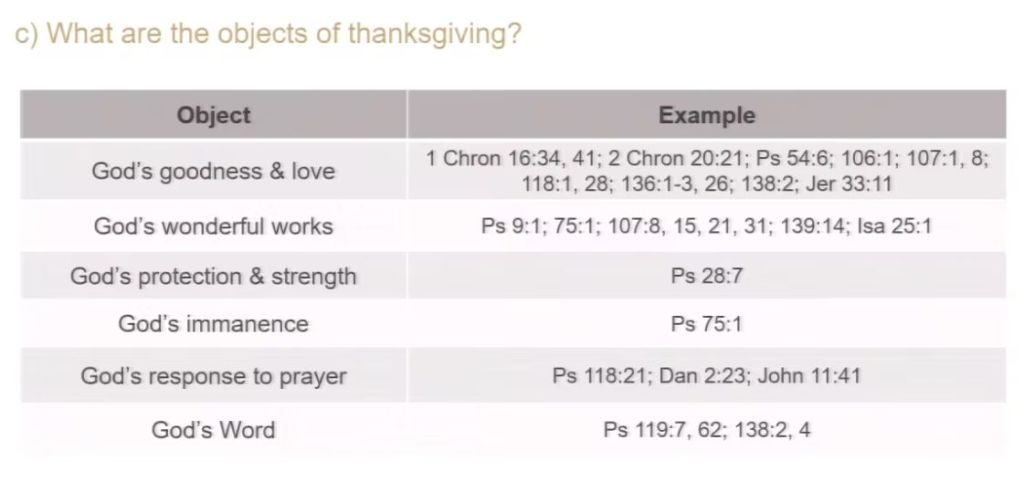
What can we thank God for? So many things! From ICL Class The Practice of Prayer

A definition of biblical thanksgiving (gratitude) is to “express our appreciation for the benefits or blessings to the one who is the source of such gifts, in a humble spirit of dependency.” ~Dr. Brad Klassen

Synonyms for thanksgiving are; appreciate, acknowledge, contentment, or ‘to bless’. Praying our gratitude to God cultivates an awareness, or an alertness, to intentionally observe the goodness of God and His undeserved mercies on us, the creatures, in our lives.

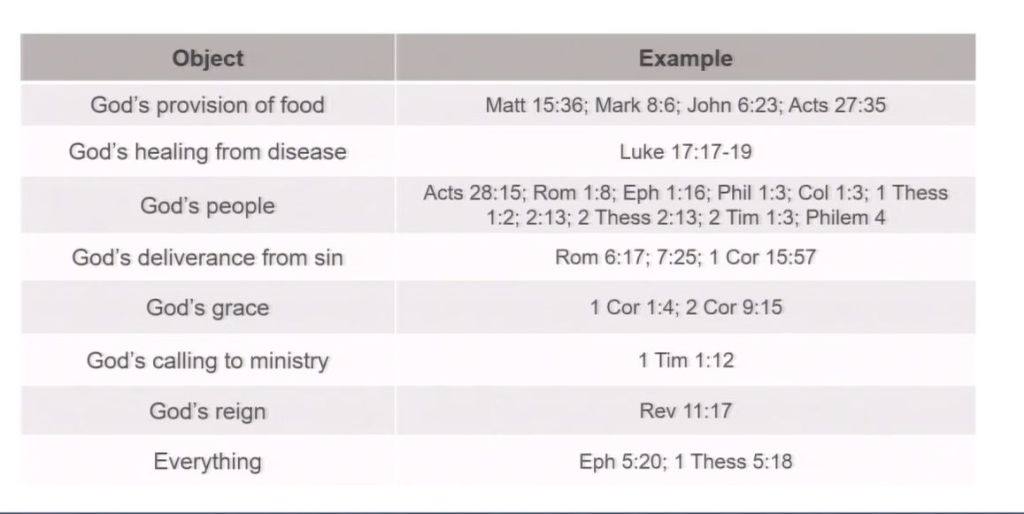
Biblical prayers of thanksgiving include 2 Samuel 22:47-51, Daniel 2:23, Daniel 6:10, Psalm 7:17, Romans 1:8, 1 Corinthians 1:4, Ephesians 1:15-16, and I’m sure you will find many more!

We are thankful for so MANY things! From ICL Class The Practice of Prayer

Components of Prayer ACTS: Supplication

Supplication or petition means bringing our requests for the needs of others and ourselves to God. Supplication is not only physical needs, for God knows what we need before we even ask Him. He is mindful of our physical needs (Matthew 6:25-32), though we certainly can and should ask for help with food, clothing, housing, and the like. It’s OK to bring our physical needs to Him in prayer. But don’t stop there. Ask Him to aid you in pursuing holiness, in sanctifying your walk, in being diligent in ministry, etc. As it’s said in Matthew 6:33,

But seek first His kingdom and His righteousness, and all these things will be provided to you.

Biblical prayers of petition or supplication include, Philippians 4:6, Ephesians 6:18, 19,
I Timothy 2:1-4, 1 Kings 8:45, Psalm 28:2
, and many others.

Conclusion

I hope you have enjoyed my quick tutorial on prayer. We looked at what prayer is & isn’t, the importance of the discipline, praying God’s word back to Him, the components of prayer using the acronym ACTS, and verses of prayer we can read, meditate on, and model.

Below please find good resources on prayer that may help you further as you engage with God in prayer. I hope you do. I hope I do! Personal communion with Him is a privilege, and a duty, and a loving act to a good and gracious Father.

Bibliography

Ten Reasons We Should pray Scripture to God

EM Bounds is known for his classics on prayer. Here is one that happens to be online. E.M. Bounds on Prayer

Simplify your Spiritual Life: Spiritual Disciplines for the Overwhelmed, book, Don Whitney

Valley of Vision: A Collection of Puritan Prayers, book, compiled by Arthur Bennett, Editor. Also online: here

Tim Challies’ chart in visual theology, 25 Attributes of God. You can include acknowledgement of these attributes day by day in your prayers as part of your adoration.

The Hidden Life of Prayer, David McIntyre, book available at Amazon etc., but also online for free.

The Doctrine of Repentance, Thomas Watson. A Puritan Paperback.

A Method for Prayer, Matthew Henry, online here updated in modern language, also available as a book to buy.

Susan Heck video tutorial, James Lesson 23 – Becoming a Woman of Prayer – James 5:13-18.

Susan Heck audio lessons: With the Master – (Prayer) On Our Knees

How to Pray, John MacArthur sermon.

Posted in theology

This is a funny scene in Acts

By Elizabeth Prata

Herod had arrested Peter. He was chained between two soldiers inside his cell, and guarded by a rotating squadron of soldiers at the door of his cell. When the Passover concluded that night, he was due for sentencing.

Meanwhile, “Peter was kept in the prison, but prayer for him was being made fervently by the church to God.” (Acts 12:5). The word fervently here means stretched to the limit, completely taut (like a stretched out muscle), or full potential. Fervently means these church folks were praying with all they had to the bottom of their soul.

Back at the prison, note that Peter was sleeping and so were the guards. So, this was the middle of the night, maybe 2:00 in the morning. An angel appeared inside the prison cell, shining his light all over, and Peter did not wake up. The angel had to smack him to wake him up. (Acts 12:7).

Continue reading “This is a funny scene in Acts”
Posted in theology

Do you get distracted when you pray?

By Elizabeth Prata

Do you ever get distracted when you pray? I do. I pray out loud to help me stay on course, but even then… lol. We are weak people. The spirit is willing but the flesh is so weak (Matthew 26:41).

On the next day, as they were on their way and approaching the city, Peter went up on the housetop about the sixth hour to pray. But he became hungry and was desiring to eat; but while they were making preparations, he fell into a trance; (Acts 10:9-10).

The sixth hour is noon. The word hungry here in the Greek is “very hungry”. Perhaps Peter had been busy all day preaching and teaching, and hadn’t eaten, and suddenly realized his hunger during the quiet moment of prayer. He was desiring to eat. Maybe Peter had requested someone make him a lunch, or he heard the hosts were preparing it below in the house because it’s a normal time to eat. In any case, Peter was praying but he was also distracted by thinking about food.

Continue reading “Do you get distracted when you pray?”
Posted in theology

Back to Basics: What is prayer?

By Elizabeth Prata

Prayer is a privilege and a responsibility for every Christian. Why? It is the way Jesus taught us to communicate with Him.

Rather than the wrathful gods of the Aztec era of human sacrifice, or the ancient Middle East where child sacrifice was required, or the Muslim god who is demanding but mercurial and untrustworthy, the One True God creates us to have a love relationship with Him. He wants to redeem us from our sinful state to dwell with Him in heaven. His Holy Word tells us who He is and how to love Him back, and His promises never fold.

In His Bible, He explains how to communicate with Him. Unlike the gods of old, all other gods as a matter of fact, (who are no gods at all) we can speak with Him at any time. He has told us He listens. From Genesis to Isaiah to Philippians, we’re told to pray to God.

“And he removed from thence unto a mountain on the east of Bethel, and pitched his tent, having Bethel on the west, and Hai on the east: and there he builded an altar unto the LORD, and called upon the name of the LORD” (Genesis 12:8)

“Seek ye the LORD while he may be found, call ye upon him while he is near:” (Isaiah 55:6)

“Be careful for nothing; but in every thing by prayer and supplication with thanksgiving let your requests be made known unto God.” (Philippians 4:6)

So what IS prayer, exactly? Why do we pray? How do we pray?

As Christian Research and Apologetics Ministry (CARM) explains, “Prayer is the practice of the presence of God. It is the place where pride is abandoned, hope is lifted, and supplication is made. Prayer is the place of admitting our need, of adopting humility, and claiming dependence upon God. Prayer is the needful practice of the Christian. Prayer is the exercise of faith and hope. Prayer is the privilege of touching the heart of the Father through the Son of God, Jesus our Lord.”

Why pray? “For one thing, prayer is a form of serving God (Luke 2:36-38) and obeying Him. We pray because God commands us to pray (Philippians 4:6-7). Prayer is exemplified for us by Christ and the early church (Mark 1:35; Acts 1:14; 2:42; 3:1; 4:23-31; 6:4; 13:1-3). If Jesus thought it was worthwhile to pray, we should also. If He needed to pray to remain in the Father’s will, how much more do we need to pray?”

He has made Himself known in three Persons, God, Jesus the son, and Holy Spirit. We can pray to all three or to one or to two. He is all the same. Any or all are appropriate to pray to. However, the Triune God is the ONLY appropriate person to pray to. The first Commandment says that He is the one true God and we shall have no other gods before Him (Exodus 20:2-3). We do not pray to angels. (Revelation 22:8-9). We do not pray to saints such as the Catholic Church worships. (1 Timothy 2:5) We do not pray to Mary the mother of Jesus. (Luke 11:27-28). We do not pray to the dead, whose final condition is fixed. (Luke 16:19-31; Hebrews 9:27). We pray to God only.

How, then, shall we pray? Jesus answered this exact question in Matthew 6:9-13.

“Pray, then, in this way:
‘Our Father who is in heaven,
Hallowed be Your name.
10 ‘Your kingdom come.
Your will be done,
On earth as it is in heaven.
11 ‘Give us this day our daily bread.
12 ‘And forgive us our debts, as we also have forgiven our debtors.
13 ‘And do not lead us into temptation, but deliver us from evil. [For Yours is the kingdom and the power and the glory forever. Amen.’]”

It is not to say that unconscious repetition of this exact phraseology is the way to pray. Jesus pray ‘in this way‘. He began with a statement to whom He was addressing. He led with a praise. It is always proper to praise the Lord at any time but especially in prayer because it sets our heart condition rightly and reminds us of our position as submissive supplicants. This reminder helps us when the prayers are answered in a way we do not expect or in a timing we are uncomfortable with.

Give us this day our daily bread is a statement from Jesus telling us it is all right to ask for things to sustain us while we are living on earth. (Matthew 6:32-33). But you notice the prayer doesn’t say pray in a way where you ask for surplus, He is asking for daily bread. Not weekly bread. The manna that was given to the Hebrews in the desert was given daily. Asking for daily bread helps us not become greedy hoarders, too self-reliant, and it also is a way for the Lord to bless us daily!

Asking the Lord to forgive our sins is a way to remind us that before any prayer can be answered we need to ensure we are on the right side of God and not accumulating sins, and also that if we forgive others we are also on the right side of God. (Matthew 6:14-15; Mark 11:25). Why should He bless a bitter heart? He will not. (1 John 2:9).

“Lead us not into temptation” must be understood correctly. Barnes Notes: “God tempts no man. See James 1:13. This phrase, then, must be used in the sense of “permitting.” Do not “suffer” us, or “permit” us, to be tempted to sin. In this it is implied that God has such control over the tempter as to save us from his power if we call upon him.

 So don’t mindlessly repeat Jesus’ prayer exactly but let the power behind the concepts conform your heart to your own words. Know to Whom you are praying. Praise Him. Understand you position before Him as penitent, His kingdom within you and also your external destination someday. Ask for what earthly provision you need in humility, trusting Him to answer in faith.  Ask for unearthly provision such as release from temptation or protection from temptation.

Is there a proper bodily position in which we pray? Some prefer head bowed, others prefer to look up. Some pray with eyes closed, others keep them open. Still others pray silently, some prefer aloud. Standing, sitting, kneeling, walking,…all these postures are in the Bible. Here is a very short answer to the question of whether there is a commanded posture for prayer, at Grace to You.

The most important thing about prayer is that in order to communicate this way with God, you must be saved he does not listen to nor answer the prayers of the unsaved. (John 9:31; 1 Peter 3:12). The entire Christian faith is based on the fact that Adam’s sin separated us from our holy and righteous God. That separation includes communication and intimacy, including prayer. The most important utterance you will ever emit is the confession to Jesus, plea, or prayer for forgiveness of your sins God WILL hear that one.

that if you confess with your mouth, “Jesus is Lord,” and believe in your heart that God raised Him from the dead, you will be saved. (Romans 10:9)

If you are new to prayer, don’t worry about fancy words or proper phrases. That is the utter beauty of our God. He hears the heart cry, understands the motivation behind what we are asking. He listens to all words fancy or not, as long as they are sincere. Don’t worry, just pray! It is a way to talk with Him. He doesn’t change by your prayer, but you are changed by praying. So don’t put it off another minute!

Further Resources

Praying the Bible by Donald S. Whitney

The Valley of Vision: A Collection of Puritan Prayers & Devotions by Arthur Bennett (Editor)

Spurgeon Quotes on Prayer, selected quotes from his sermons

Posted in theology

Pray for the strong as well as the weak

By Elizabeth Prata

We always pray for the weak and the hurting. That is good. But please also pray for the strong, whom the weak lean on and don’t usually ask to be prayed for. As more people hurt, more people go to the strong. In other words, let’s all pray for each other.

Praying at all times in the Spirit, with all prayer and supplication. To that end keep alert with all perseverance, making supplication for all the saints,” (Ephesians 6:18).