Posted in agriculture, donkey

All about the Donkey

By Elizabeth Prata

Studying the natural history of the Bible is a good thing to do. Plants, places, and animals are constantly mentioned in God’s Word. Processes such as wine-making and agricultural endeavors like threshing and irrigating are mentioned too. Knowing what the references mean helps deepen our understanding of such verses when we study them. For example in Psalm 21:1, it is stated,

The king’s heart is a stream of water in the hand of the LORD; he turns it wherever he will.

This is a vivid metaphor that anyone can understand. But knowing that in ancient times and even today, Egyptian farmers by the Nile dig complicated channels in the earth and board the source of each one, and by lifting a certain board at any given time they could precisely direct the channel to a row of crops as they will. Now you have an even more clear picture of the metaphor. (More here)

Or this regarding passing under the rod. In Ezekiel 20:37 it says,

And I will cause you to pass under the rod, and I will bring you into the bond of the covenant:

which Jamieson/Fausset/Brown’s Commentary says,

pass under the rod—metaphor from a shepherd who makes his sheep pass under his rod in counting them (Le 27:32; Jer 33:13).

As the shepherd bunked down nightly, he would count each sheep to ensure they were all collected. As each one passed under his rod entering the sheepfold he would count them. Knowing these things could develop into a deeper study of agricultural practices in order to provide background context for scripture study, or simply knowing a little bit about what the rod or the channels of water helps provide  a better understanding of the verse.

EPrata photo

There are many animals in the Bible either used in fact or referred to as symbols (like the ant in Proverbs 6:6). Donkeys are an animal mentioned frequently and used as beasts of burden to carry goods or people.

So Abraham rose early in the morning, saddled his donkey, and took two of his young men with him, and his son Isaac. And he cut the wood for the burnt offering and arose and went to the place of which God had told him. (Genesis 22:3)

Donkeys were part of the Law.

If you meet your enemy’s ox or his donkey going astray, you shall bring it back to him. (Exodus 23:4)

There are some famous donkeys in the Bible. Balaam’s donkey for example, spoke. Or was it God speaking through the beast?

EPrata photo

Jesus’ Triumphal entry was on the back of a donkey. John 12:14 records,

And Jesus found a young donkey and sat on it, just as it is written, “Fear not, daughter of Zion; behold, your king is coming, sitting on a donkey’s colt!”

Initially, people who could afford them rode donkeys, such as Judges. (Judges 5:10). After that time, though, horses were imported, and high officials enjoyed riding white horses more than donkeys so they left the donkeys to the poorer folk. When Jesus rode in to Jerusalem on a donkey it was demonstrating his humility and meekness.

Donkeys were a beast of burden used frequently as the preferred animal because they were stoic and patient, and tended to panic less easily than horses. Physically,

Donkeys’ feet have a number of differences, including being more elastic, narrower in shape, and more upright than a horse’s. Donkeys can be prone to developing very long hooves as they do not chip and breakaway as a horse’s would do. The donkey’s digestive system is considerably more efficient than that of a similar sized pony. … Donkeys in general have a very efficient walking pace and to be honest, in most situations it is easier to walk at the donkeys pace rather than try and make them go at ours.  (source)

A boy and his donkey. This is in the town of Papallacta, high in the Andes. The type of saddle has been in use since Incan times. EPrata photo

Rejoice greatly, O daughter of Zion; shout, O daughter of Jerusalem: behold, thy King cometh unto thee: he is just, and having salvation; lowly, and riding upon an ass, and upon a colt the foal of an ass. (Zechariah 9:9).

PS: There is actually no Bible verse that says Mary rode a donkey on her way to Bethlehem with Joseph. More on that in an upcoming blog!

Further Reading

Bible topics: The Domestic Ass.
Posted in theology

Short Shots: Mint/dill/cumin

By Elizabeth Prata

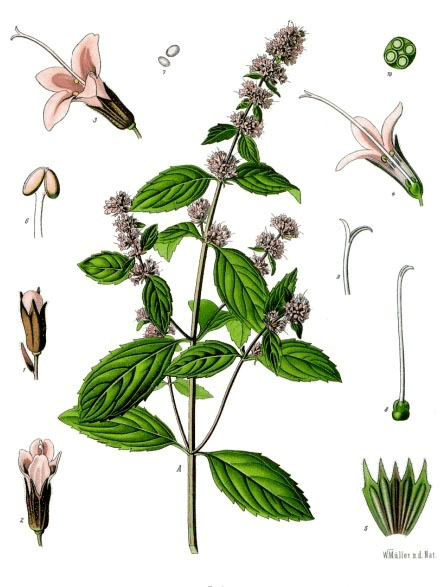
‎This photo of a nineteenth-century German engraving shows a peppermint stalk and leaves with close-up views of flower components. Peppermint (Mentha x piperita) has been prized since ancient times for its flavor and for medicinal qualities. Experiments show that peppermint oil inhibits the growth of many pathogenic microbes. The plant was widely cultivated in first-century Galilee and Judea. In his dispute with his opponents over tithing, this was one of the mint species Jesus had in mind.
‎Matt 23:23, Luke 11:42
‎Image by Franz Eugen Köhler, botanist and illustrator, from Wikimedia Commons. License: Public Domain

Jesus pronounced woe upon the Pharisees, saying

“Woe to you, scribes and Pharisees, hypocrites! For you tithe mint and dill and cumin, and have neglected the weightier provisions of the Law: justice and mercy and faithfulness; but these are the things you should have done without neglecting the others.” (Matthew 23:23).

Becuase I like the natural history of the Bible plants and animals, today just take a quick let’s look at what herbs Jesus is speaking of rather than the spiritual import of his pronouncement.

Holman Bible Publishers explains MINT AND CUMIN: Mint is a sweet-smelling herb used to season food. Cumin is a carawaylike herb Judaism also used in seasonings and in medicine. Jesus named mint, dill, and cumin as He criticized the Pharisees for requiring the tithe of the herbs while ignoring more important matters of the Law (Matt. 23:23). Mint and Cumin. In Holman Illustrated Bible Dictionary (p. 1135). Nashville, TN: Holman Bible Publishers.

Image from Faithlife

Isaiah 28:23-27 gives insight on how each of these herbs were harvested:

Listen and hear my voice, Pay attention and hear my words. 24Does the farmer plow continually to plant seed? Does he continually turn and break up his ground? 25Does he not level its surface And sow dill and scatter cumin And plant wheat in rows, Barley in its place and rye within its area? 26For his God instructs and teaches him properly. 27For dill is not threshed with a threshing sledge, Nor is the cartwheel driven over cumin; But dill is beaten out with a rod, and cumin with a club.

The spiritual explanation Isaiah is trying to get across to the stiff-necked people is that the farmer doesn’t do nothing but plow. Farers use a variety of methods to yield their crop. And so would not God do the same, but perfectly and in higher ways? But for the point here today, we see that Isaiah helps us city-dwellers understand the ancient ways of harvesting the spices that Jesus mentions 700 years later in his speech about the Pharisees.

MINT: The Greek word heduosmon, or heduosmos, which means “having a sweet smell,” occurs in two passages of the New Testament, Matthew 23:23, and Luke 11:42, and has been translated “mint.” It corresponds with the Latin mentha. The species of mint most common in Syria is that represented in the figure, and called by botanists Mentha sylvestris. It is often cultivated in gardens, and it is generally distributed over Europe, and reaches even to Kashmir. It is likewise found in Britain. The plant belongs to the natural order Labiatæ. It is an erect plant, with opposite, nearly sessile, ovate, lanceolate, and downy leaves, which are whitish below. The spikes of flowers are dense, and have a conically-cylindrical form. Another species is also common in Palestine, and is called field-mint (Mentha arvensis). The species of mint have all carminative qualities. (i.e. it relieves flatulence!) They grow usually in damp places, and have reddish flowers arranged in spikes or whorls. Mint was much used as a condiment. Source: Balfour, J. H. (1885). The Plants of the Bible (pp. 173–174). London; Edinburgh; New York: T. Nelson and Sons.

So often, people who deride the Bible as simply ‘an ancient document written by shepherds’ would do well to study the ingenious methods the ancients used to yield product from the land and from their animals. The ancients built the pyramids, after all. The farming methods of the ancients, their crops, and their animals are fascinating to me. Below are some other essays I’ve written about plants and animals of the Bible days.

Donkey milk? Yes, Donkey Milk

What is an Almug tree?

Short Shots: fish, barley, mustard seed, sycamore tree

The beauty of the almond tree

Acacia wood

Consider the sparrow

Four Hundred pomegranates!

Posted in encouragement, Uncategorized

Natural History lesson, Acacia wood

I mentioned before about Bible reading plans. I have been following a plan of ‘Read the Bible in 90 days”. I’ve read through Genesis and Exodus so far.

In Exodus, you can’t swing a cat and not read that God ordered someone (usually Moses) to build something or other (always for the tabernacle) out of acacia wood. After so many mentions of acacia wood, I decided to look it up.

11527335486_c18f6c28d9_z

Above: Acacia Tree Straw beehives dangle from the branches of an acacia tree south of Arba Minch, Ethiopia. David Stanley photo, Creative Commons.

Sometimes it helps just to look up the plants, animals, processes, and materials mentioned so frequently in the Bible. I’ve done a study on ancient linen making, onions of ancient Egypt, how grain was threshed, wine-making, sheep, almond blossoms, and more.

So here is a short study on acacia wood. First, some verses-

[ The Ark of the Covenant ] “They shall make an ark of acacia wood. Two cubits and a half shall be its length, a cubit and a half its breadth, and a cubit and a half its height.” (Exodus 25:10)

[ The Table for Bread ] “You shall make a table of acacia wood. Two cubits shall be its length, a cubit its breadth, and a cubit and a half its height.” (Exodus 25:23)

[ The Bronze Altar ] “You shall make the altar of acacia wood, five cubits long and five cubits broad. The altar shall be square, and its height shall be three cubits.” (Exodus 27:1)

And so on. What IS acacia wood? What are its properties? What is is about those properties that made it such a good selection for the task at hand? These are the kind of questions one can ask as they read. As I told my second graders today, ‘good readers think’, and ‘good readers ask questions’.

ACACIA: Hard wood with a beautiful fine grain or close grain, which darkens as it ages. Insects find the taste of acacia wood distasteful, and its density makes it difficult for water or other decaying agents to penetrate. The Israelites pitched their tents by Jordan, from Beth-jesimoth as far as Abel-shittim, translated “meadow of the acacias” (Numbers 33:49). Holman Illustrated Bible Dictionary (p. 15).

Ahhh, so that’s it. The wood had properties within it that made it super resistant to decay. Well, that makes sense because the tabernacle was assembled, disassembled, moved, and used by the Israelite priests for over 400 years.

Moses received the instructions for the building of the tabernacle on Mount Sinai (Exod. 25–35), in the Arabian Desert (Gal. 4:25) where acacia is among the larger of the few timber species to be found. Items constructed for the tabernacle of acacia (shittim) wood include: the ark of the covenant and its poles; the table of showbread and its poles; the brazen altar and its poles; the incense altar and its poles; and all the poles for the hanging of the curtains and the supports (Exod. 36:20, 31, 36; 37; 38).

The acacia wood was so precious that Exod. 25:5 says that besides the offering of silver and brass, every man who had acacia (shittim) wood brought it for the Lord’s offering. In Joel 3:18 Judah will be blessed “in that day” with a spring that will water the valley of Shittim. Holman Illustrated Bible Dictionary (p. 16)

Acacia wood (a branch). The International Standard
Bible Encyclopaedia (Vol. 1–5, p. 27)

Bible trivia:

SHITTIM (שִׁטִּים, shittim). City in the plains of Moab located just east of the Jordan River. The Hebrew city name Shittim means “acacia trees.” The city was likely named after a great quantity of the trees present at its location. Acacia wood was a valuable commodity in the ancient Near East, and Shittim would have been a key locale for trade and commerce. The Lexham Bible Dictionary. Bellingham, WA: Lexham Press.

The yellow blooms of a modern variety of the acacia (shittim)
tree in Israel. In Holman Illustrated Bible Dictionary (p. 1495).

Ten Things you didn’t know about African Acacia Trees

They protect themselves

The African acacia is self-protecting in many ways. First, most species have long, sharp thorns, which prevent (most) animals from eating their leaves. Second, sometimes stinging ants live inside hollowed-out thorns, which provides another disincentive for predators. And furthermore, the trees create poisonous chemicals when they detect an “assault.” Not only can these chemicals be fatal to animals, but the trees “warn” nearby acacias to start making their own poison. How it works: When the leaves begin to fill with poison, they release ethylene gas, which drifts out of their pores and toward other acacias (within 50 yards). In response, the nearby trees begin to manufacture poison themselves.

So that is a quick lesson on acacia, its location, its uses, properties, and how it looks. It is the iconic tree of Africa, and remember, Africa is where the Israelites were released from as they fled Pharaoh and crossed the Red Sea on dry land.

God is good!

Posted in Uncategorized

Consider the Sparrow


I haven’t done a natural history essay for a while. Paying attention to the plants, animals, and agricultural processes of the Bible is worthwhile because knowing more about them enhances our understanding of the context in which the particular verse is delivered to us. I’ve written of other natural history topics previously, and the links are below, if you’re interested.

In Matthew 10:29-31 we read that the sparrow is considered the least of birds. The Cornell Ornithology lab describes a sparrow this way,

You can find House Sparrows most places where there are houses (or other buildings), and few places where there aren’t. Along with two other introduced species, the European Starling and the Rock Pigeon, these are some of our most common birds. Their constant presence outside our doors makes them easy to overlook.

Even more specifically, the Bible Encyclopedia describes the sparrows of Israel thus,

The Hebrew tsippor seems to have been a generic name under which were placed all small birds that frequented houses and gardens. The word occurs about 40 times in the Bible, and is indiscriminately translated “bird” “fowl” or “sparrow.” … Sparrows are small brown and gray birds of friendly habit that swarm over the northern part of Israel, and West of the Sea of Galilee, where the hills, plains and fertile fields are scattered over with villages. They build in the vineyards, orchards and bushes of the walled gardens surrounding houses, on the ground or in nooks and crannies of vine-covered walls. They live on seeds, small green buds and tiny insects and worms. Some members of the family sing musically; all are great chatterers when about the business of life. (source)

I watch, and am become like a sparrow That is alone upon the housetop. (Psalm 102:7)

A sparrow is such a friendly bird that if it were on the housetop it would be surrounded by half a dozen of its kind; … In an overwhelmed hour the Psalmist poured out his heart before the Almighty. The reason he said he was like a “sparrow that is alone upon the housetop” was because it is the most unusual thing in the world for a sparrow to sit mourning alone, and therefore it attracted attention and made a forceful comparison. It only happens when the bird’s mate has been killed or its nest and young destroyed, and this most cheerful of birds sitting solitary and dejected made a deep impression on the Psalmist who, when his hour of trouble came, said he was like the mourning sparrow–alone on the housetop. (source)

From Manners & Customs of the Bible by Freeman and Chadwick, we read,

Greek strouthion, (stroo-thee’-on); diminutive of strouthos, (a sparrow); a little sparrow. Sparrows are mentioned among the offerings made by poor. Two sparrows were sold for a farthing, and five for two farthings (Luke 12:6). The Hebrew word thus rendered is tsippor, which properly denotes the whole family of small birds that feed on grain (Leviticus 14:4; Psalms 84:3; 102:7). 

From Henry Hart’s The Animals Mentioned in the Bible (1888) we read the following-

The word tsippor has been already dealt with in most of the passages where it occurs, in which it is translated ‘bird’ or ‘fowl.’ In two passages in the Psalms, however, it is rendered ‘sparrow,’ and the term appears perhaps to refer to a particular species. Elsewhere it is generic. In Ps. 84:3 we read, ‘The sparrow hath found an house, and the swallow a nest for herself, where she may lay her young, even Thine altars, O Lord of Hosts, my King, and my God.’ Here the metaphor is one of rejoicing; and the Psalmist pours forth his heart in glad and beautiful verse, full of the hope that he too may be permitted to dwell in the house of his God.

Canon Tristram considers that the latter ‘sparrow’ may be the ‘blue thrush’ (Monticola cyanus), which is a common and conspicuous bird in Palestine and Southern Europe, solitary in its habits, and fond of sitting on a roof or any conspicuous eminence while uttering a plaintive cry.  It breeds in the ruins about the temple at Jerusalem. Other species of sparrow are found in the Jordan Valley, as the marsh sparrow (P. Hispaniolensis) and the Moabitish sparrow of Tristram (P. Moabiticus).

Hart, H. C. (1888). The Animals Mentioned in the Bible (p. 203). London: The Religious Tract Society.

It was common in the Middle East to catch sparrows (and most small birds) and skin them and roast them to sell for a tidbit. Thus we have the mention of them where the Lord says He notices each and every fall of the sparrow and thus we should be comforted because we are much more valuable than these small, commonly sold tidbit birds.

Are not two sparrows sold for a penny? And not one of them will fall to the ground apart from your Father. But even the hairs of your head are all numbered. Fear not, therefore; you are of more value than many sparrows.

What a gracious and loving God!

—————————————–

Further Reading

Onions

Pomegranates

Making wine

Wheat v. darnel

Linen

Further Reading

Onions

Pomegranates

Making wine

Wheat v. darnel

Linen