
By Elizabeth Prata
Philip found Nathanael and said to him, “We have found him of whom Moses in the Law and also the prophets wrote, Jesus of Nazareth, the son of Joseph.” Nathanael said to him, “Can anything good come out of Nazareth?” (John 1:45-46a)
This verse is from chapter 1 of the Gospel of John. The context is that Jesus has begun calling His disciples, who would become the Apostles later. In the previous verses, He had called Andrew and his brother Simon (who shall be called Peter). Now, Philip who was from Bethsaida, went to Cana where Nathanael was from, to tell him the news.

Nathanael’s skepticism rested on the fact of Jesus’ origins, which were from Nazareth, a backwater. So Nathanael’s skepticism revolved around the location, not the Person. Though we often focus on the part of the verse that says “from Nazareth?!” let’s focus on the part before that. Note Nathanael said, “can anything GOOD…” This shows that Nathanael knew of the Messiah and was looking for Him. He knew His appearance would be GOOD. Nathanael believed.
Nathanael had a seeking heart because he truly studied the scriptures. As verse 45 shows, Philip and Nathanael studied the Law, Moses and the Prophets. As for Nathanael’s character, in verse 47 when Jesus saw Nathanael coming toward Him, Jesus said there was no deceit in Nathanael and that he was a true Israelite.
Nathanael was a simple man, indeed from a similar backwater than Nazareth (Cana), in a backwater district, in a time of apostasy. Not many people around him believed the truth. The Samaritans believed a blended religion, the Pharisees believed a works religion, the Sadducees didn’t believe in supernatural resurrection or angels and were against the Pharisees who did, and most regular people were either unknowing, hypocrites, or apathetic. As a matter of fact, Luke 4:33-34 records Jesus at Capernaum teaching at the synagogue. A demon-possessed man in the synagogue cried out when Jesus taught, because of His authority in His proclamation of the truth of God. Jesus cast him out, His first exorcism. Can you imagine a synagogue so devoid of truth that before Jesus’ arrival, the demon inside the man felt so secure he had never cried out before? Demons should never feel comfortable in church!
It was a time of apostasy, God hadn’t spoken in 400 years. He had sent no prophet since Malachi (until John the Baptist). God had done no miracles. He had been silent.
Synagogues in the small towns had limped along, (with demons in them), the Temple in Jerusalem grew bloated with wares, graft, and hypocrisy thanks to the religious hierarchy.
And yet, among all this, there was faithful Simeon, and Anna, there was Zacharias and Elizabeth, Joseph and Mary, John the Baptist, and the men who would become the Apostles. And there was Nathanael, who was looking for something GOOD (just had a hard time believing it would come from Nazareth, lol).
In this current time of apostasy (when wasn’t the world apostasizing?!) we look at our leaders and sometimes we are greatly disappointed. Just as those regular people of Nathanael’s time were looking at the hypocritical Pharisees, the corrupt Annas or Caiaphas, the arrogant and zealous Saul (later, Paul), the ordinary people must have felt let down by those who were in charge of leading them in the truth just as we are let down by many of our leaders today. There has always been a shepherd problem.
“Woe to the shepherds who are destroying and scattering the sheep of my pasture!” declares the LORD. (Jeremiah 23:1)
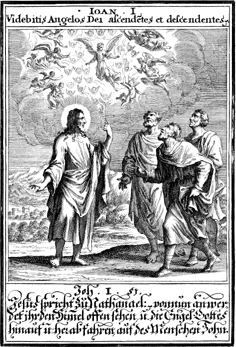
WEIGEL, Johann Christoph 1695, Woodcut. Source
Yet there were simple people in small towns, laboring diligently during the week and on Sabbaths, attending synagogue to learn about the promised Messiah. Who was the first person Philip went to tell the good news that Messiah had been found, the priest in their local synagogue? No! Philip went immediately to tell his friend, Nathanael. These first century men and women persevered, they believed with a child-like faith, simple and in which there was no deceit. There were no layers of corruption to the faith that Nathanael evidenced, no arrogance. With seeking heart he and his friend Philip must have gone to hear John the Baptist, and when Jesus arrived, and said ‘Follow Me,’ they did.
And we should do the same. We labor during the week, we worship on Sunday, we follow Jesus as He commanded. His word is in the Bible now, not spoken to us on a hillside at Bethsaida, but we believe. No matter what our leaders do, we trust the promises in His word just as Nathanael and Philip did in that long-ago apostate time. We follow, seek, trust. Nathanael was looking for something GOOD, and He came. We should also have seeking hearts. Are you looking for He who was written of in Moses and the Prophets? Like Nathanael during a time of low worship and little truth, we are also looking forward to something GOOD. He will come again
in a moment, in the twinkling of an eye, at the last trumpet; for the trumpet will sound, and the dead will be raised imperishable, and we will be changed. For this perishable must put on the imperishable, and this mortal must put on immortality…(1 Corinthians 15:52-53)


