Posted in theology

Lectio Divina is not a harmless Bible reading practice. Here’s why

By Elizabeth Prata

You are at risk. Every minute. IF you are in Christ, that is.

EPrata collage

Satan seeks those whom he may devour. He does not rest. He got Peter, didn’t he? Peter had been with the Lord day and night for three years. Seen all the healings, miracles, heard all the lessons. Peter knew Jesus was the Christ. (Matthew 16:16). Yet when the moment of highest pressure came, Peter denied Jesus. Succumbing to his/our corrupt nature, he opted for self preservation.

Satan is subtle (Genesis 3:1), relentless (1 Peter 5:8), bold (Matthew 4), has an evil, prideful agenda (Isaiah 14:13), deceitful (Ephesians 6:11) and more.

Satan masquerades as an angel of light. (2 Corinthians 11:14). A masquerade is someone dressing as someone else, in costume and with a mask so as to hide their true self.

HOW does satan deceive? By promoting error and undermining. Matthew Henry says,

They would be as industrious and as generous in promoting error as the apostles were in preaching truth; they would endeavour as much to undermine the kingdom of Christ as the apostles did to establish it.

By promoting error and undermining.

Satan’s subtlety and his masquerade means that something that’s deadly will be hidden as something good, religious, even. The error won’t look like error. It’s hidden behind a mask, remember? But it hides its true nature behind the mask, and will eventually damage you.

One example of his subtle evil is when he inserted Lectio Divina (LD) into the true church. LD is a Roman Catholic/Mystical practice, so it comes from the false church. It is a practice that on its surface, seems good, holy, proper. But satan masquerades, remember. LD only has a veneer of goodness to it. Take the mask off and you can see its true nature.

Many people these days refuse to look beyond the mask. Ephesians 6:11 says to

Put on the full armor of God, so that you will be able to stand firm against the schemes of the devil.

Satan has schemes. Many people these days also refuse to even put ON their armor, never mind look into these things to see IF there is a mask and if so, to see what is lurking behind it.

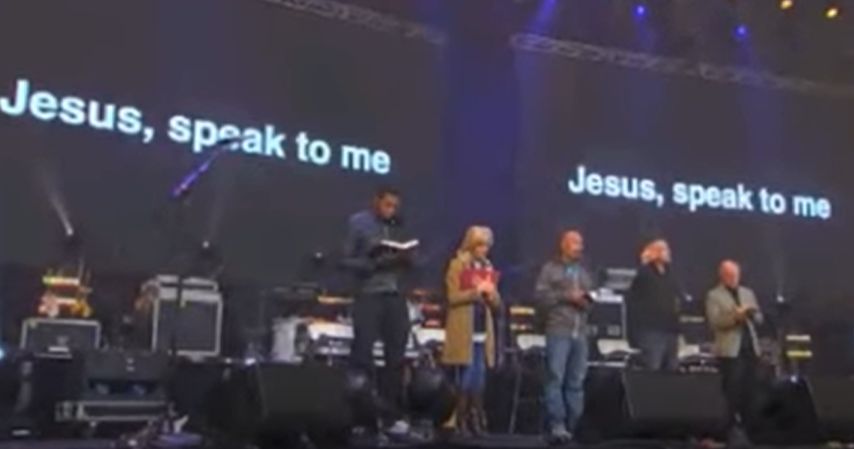
screen shot from Passion 2012 segment where Lectio Divina (lite) was taught to 16,000 attendees.

LD arose over ten years ago and immediately became popular when Francis Chan, Beth Moore, Louis Giglio, Lecrae (I think), and John Piper taught 16000 impressionable youths at the Passion Conference a version of how to do it. The lesson became seeds of false doctrine that the youths returned to their churches to plant. This is both error and undermining, satan’s tactics.

The panel stood on stage before the youths and one by one went through what seems to be a modification of the full LD process, and all the while, a 30 foot high billboard behind them was emblazoned not once but twice with the mantra, “Jesus, speak to us”. Asking Jesus to speak outside his word is error, and it underme the sufficiency of scripture.

Does God still give revelation?

Beth Moore, for example, read a passage from the Bible, and then urged the youths to “be still and ask Jesus to speak his word to us.”

No. The audience had just heard Jesus speak His word. (Hebrews 1:1-2). She had JUST read His word to them. Jesus IS the Word. (John 1:1). The prayer should not be, ‘Jesus speak your word to us’, but ‘Holy Spirit illuminate the word to us.’

What is the biblical doctrine of illumination?

those eyes…

Though these kind of practices are fads negatively impacting the global church, and some fade quickly, LD is still kicking around. I saw women on Twitter defend Lectio Divina this week. One defender said:

Here. Here is where we get these ideas. Brad Klassen explains what Lectio Divina is and why we should stay away from practicing it.

The Bible and Lectio Divina: A Helpful Tool or a Dangerous Practice?

It’s a good article, just a 10-minute read. Klassen proposes 4 reasons why Lectio Divina is harmful to your walk with Christ.

Lectio Divina is dangerous due to-
-Its historical origin and development
-Its alienation of the human writer
-Its eisegesis
-Its subjectivity

After explaining the 4 reasons, Klassen concludes,

While more reasons [not to do LD] could be listed, these suffice. Lectio divina—the “sacred reading” of the Bible—is not just one more instrument that the Christian can add to his spiritual toolbox to better read the Word of God. Inherent to its practice are elements that lead the reader away from the meaning of the text and toward the reader’s own subjective intuition.

I encourage you to read his article.

Satan is subtle. You need to be wary of a fad that enters the church and is almost eagerly accepted, even if it seems to be everywhere, even by people on stages you might look up to. Your faith needs to remain as pure as possible. So, put on the armor, look behind the mask, and pray for illumination.


Further Resources

Discernment review: The mystical practice of Lectio Divina

Why I no longer follow John Piper or Desiring God ministry

When Study Isn’t Study

No Shortcuts to Growth

Posted in theology

Medieval mystics: Conclusion

By Elizabeth Prata

Last week I’d explored excerpts from visions of four famous Medieval Mystics of the Catholic Church:

Introduction
Julian of Norwich
 (1343 – after 1416) Book: The Showings of Divine Love
Catherine of Siena (1347 – 1380). Book: The Dialogue of St. Catherine of Siena
Hildegard of Bingen (1098 – 1179). Book: Scivias
Bridget of Sweden (c. 1303 – 1373) Book: Celestial Revelations

We have quite a few women running around today claiming they have been given special revelations directly from Jesus, apart from the Bible. They’ve ‘taught’ through these visions, they have written books about what they’ve learned from these visions, they go on speaking tours telling about these visions, and they preach, even to men, with these visions.

In the past I have often written against these women and against this activity. It is blasphemous, it is wrong, it is immoral, and it is sin. The point of the series was to alert Christian ladies as to who these medieval women are and to show from the Bible why their visions were error. Why? AW Tozer had praised one of them in a recent devotional posted on social media. In Three Little Wounds Tozer wrote that because of mystic Julian of Norwich “England was a better place because this little lady lived” and her book of visions was a “great spiritual contribution to the world.”

No.

Now, it grieves me that women unaware of Julian’s blasphemies would forge ahead on the basis of Tozer’s or any other person’s fervent recommendation, and then begin to think that receiving visions and revelations was all right. It happens. More frequently than one might think. And that is the way that the devil likes it. He laughs because it is not God speaking to these women, but one of his dastardly demons, masquerading as ministers of righteousness. (2 Corinthians 11:15). Either that, or the mystic’s visions are just flat out lies.

So I write against direct revelation and will do so again. It was not all right in the Bible days of Revelation. In Revelation 2, Jesus spoke against a false teacher metaphorically named Jezebel. He said she was teaching unbiblical things, leading His children astray and calling herself a prophetess. He said if she did not repent, He would kill her and her children. (Revelation 2).

God has never been accepting of people who claim to speak in His name when He has not spoken to them. It is an emptying of His name, a way of taking His name in vain. Worse, they want something, usually unbiblical and women (or men) co-opt Christ in their sin. For example, Bridget wanted the pope to stay in Rome and not move back to Avignon, so she claimed to have had a vision from the Virgin Mary that told off the Pope. Or Hildegard, when she wanted permission to move to another monastery and was denied permission, fainted into her bed with paralysis until her Abbott relented. “Hildegard attributed the condition to God’s unhappiness at not following his will regarding moving the monastery. The abbot relented and granted his permission for the move, and she recovered shortly thereafter.” (Source FaithMag). What a miracle, right? Well if God says so, I better comply! USING God to get your way is an utmost sin against His Holy Name. It literally breaks the Fourth Commandment. (Exodus 20:7).

Reformer Martin Luther pre-conversion was initially interested in these women’s visions, especially Bridget, and of their revelations because of their criticism of popes and of the Church. But as he studied them, he later dismissed Bridget and the others’ revelations as “mere ravings”.

We read of these Medieval mystics women today and might wonder over their popularity. Their hyper-focus on the bloodier parts of the Passion, their sensuous mystical union with Christ as Man and them as Bride, consummating in ecstasy, their acceptance of supposed revelations in direct opposition to what the Bible says, their usurping behavior calling out authorities and using illnesses to get their way…so easy to look back and say goodness, reject these ladies!

But aren’t the revelators of today much the same? Doesn’t Beth Moore preach to men, call out authorities, use hyper emotionalism to get her way like Julian did? Doesn’t Anne Voskamp present poetical writings in her books like Hildegard did in her lyrical songs, as a sensuous union with a mystical Christ? Doesn’t Joanna Gaines announce that the ‘Lord’ promised her fame and success, like he did to Catherine of Siena, so Catherine could do great things?

There was some sort of altruistic impetus in each of these women, and they did help the poor and the sick. But their motivations were suspect as their later life bore out.

They were also ritualistic. Aren’t Bridget’s alleged lesson from Jesus of saying 15 Our Fathers and 15 Hail Marys along with the 15 Oes, repeated over and over is supposed to honor His wounds (how about honoring HIM?), against what he said to do in Matthew 6:7? Isn’t Joel Osteen just as ritualistic when he holds his Bible aloft at the opening of all his speeches and says a certain unchanging mantra?

Ladies, all direct revelation post-canon closing is of the devil. All of it. Though some of the mystics were more ‘out there’ than others (Catherine of Siena comes to mind), anyone claiming direct revelation is deceitfully deceived. It’s either satan, bad burrito dreams, or a flat out lie. Any way you slice it, claiming direct visions from Jesus in violation of Hebrews 1:1-2, or accepting them from someone else is sin.

The Bible says the canon is closed, Jesus spoke. (Hebrews 1:1-2). He declared the Bible totally sufficient for all life. (2 Timothy 3:16). He has revealed to us all He wants us to follow. (Deuteronomy 29:29). Romans 15:4 says For everything that was written in the past was written for our instruction, so that through endurance and the encouragement of the Scriptures, we might have hope.

Direct revelation was wrong then (when it wasn’t from God) and since the canon closed, it’s wrong now. I mention these mystics even though they are Catholic, thus not of the faith, because they are praised with veneration and feast days in the Lutheran and the Anglican church. Please be wary, and remember, the best way to spot a counterfeit is by knowing the real thing. Stay close to Jesus and His word, and you will be blessed.

Julian, Catherine, Hildegard, Bridget, medieval Mystics still famous today, sadly!

Posted in theology

The old Christian Mystics: Introduction

By Elizabeth Prata

Introduction
Julian of Norwich
 (1343 – after 1416) Book: The Showings of Divine Love
Catherine of Siena (1347 – 1380). Book: The Dialogue of St. Catherine of Siena
Hildegard of Bingen (1098 – 1179). Book: Scivias
Bridget of Sweden (c. 1303 – 1373) Book: Celestial Revelations

I read a devotional by AW Tozer who I generally like, who lauded Julian of Norwich, who I don’t like. Julian, a woman, was a mystic. She lived in the 1300s and claimed to have had extensive audible experiences with God. When a fairly credible person like Tozer quotes a totally non-credible person like Julian, things get confusing.

I also wrote the other day about the two things in Christianity that really bug me: heavenly tourism (where people claimed to have been lifted to heaven and walked around touring the place), and direct revelations from God.

When the Tozer issue came up the other day I got to thinking how the problem of direct revelation certainly isn’t new. Mystics have always populated the faith. We read of Jesus chastising the church at Thyatira and calling out the metaphorically named Jezebel for prophesying things He never said. (Revelation 2:20).

After the Fall, God cursed the woman with wanting to usurp her husband, we’ve had it in us ever since. We want to usurp our husbands, our pastors, and God’s word.

I’ve written frequently about the of female usurpation vs. female contentment in our roles. I’ve also written about specific women’s claims of direct revelation (Jackie Hill Perry, Beth Moore, Joanna Gaines, Sarah Young, Jennie Allen, Priscilla Shirer etc).

But did you know in the medieval era there was a whole cottage industry of women cementing their place as prophetesses? These women claimed constant, deep, and frequent revelation from God. They wrote their revelations down and they personally, and their books, became famous. We can read them to this day. Julian of Norwich was one of the most famous of these prophetesses, the one Tozer quoted. Others were Catherine of Siena, Birgitta (Bridget) of Sweden, and Hildegard of Bingen. Their “contributions” to the faith were not solely restricted to writings, because these women also shaped art and music of their day and to this day. It’s safe to say they were medieval “Influencers”!

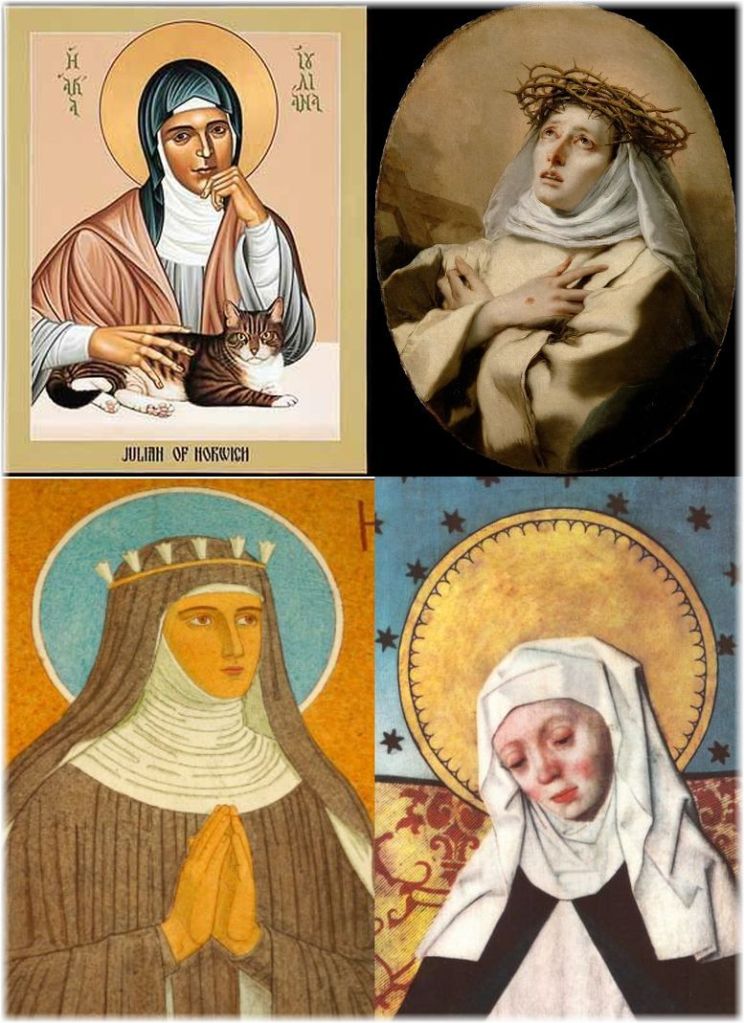
Clockwise: top left, Julian of Norwich, Catherine of Siena, Bridget of Sweden, and Hildegard of Bingen

This week I’m going to explore each of these women who were so vastly influential. I’ll take a look at their most popular ‘visions’ and revelations.

A few years ago I read Memoirs of a Medieval Woman by Margery Kempe, translated by Louise Collis. It’s hilarious, packed full of history, and gives a wonderful context for all this mystical, ecstatic revelation from these more famous mystical women whom Margery emulated and competitively tried to surpass. She is today acknowledged as a mystic in the Anglican church but not canonized as a Catholic saint. Margery lived at the end of the 1300s into the early 1400s. She actively sought to become famous through revelations, similar to today when less famous women wanting to elevate their platform, then emulate the famous influencers.

Margery was pretty insufferable, even her traveling companions along the way on their pilgrimage to the Holy Land tried to dump her again and again. Margery had 14 children and was married, but still decided she had to make a pilgrimage to Jerusalem. That was the thing of the day back in Medieval times, mysticism and pilgrimages. Though admittedly it was unusual for a wife and mother to gallivant off to faraway lands by herself, but that was Margery!

It just goes to show, that from the start women sought places the Bible denied them, that the more accepted or popular bad examples of females in unbiblical roles will always stand as an inspiration for other sinful women coming up to follow in their footsteps, and that having a weak and unassertive husband more easily allows a wife to go off the rails in many different ways (as Margery’s husband was and did).

So take a trip with me this week looking at famous mystics Julian, Catherine, Hildegard, and Bridget, so that when someone like Tozer or someone else quotes them, you will know not to absorb the material, but reject it. I’m also hoping to achieve the goal of showing that female mysticism is nothing new, because sin is nothing new. You know what’s coming next:

What has been, it is what will be,
And what has been done, it is what will be done.
So there is nothing new under the sun.

Ecclesiastes 1:9

So stay tuned this week for “Female Mystics Week”!

Posted in discernment, Uncategorized

Discernment review: The mystical practice of Lectio Divina

lectio

Several mystical practices have been making their way into the more conservative quarters of the faith. One has been contemplative prayer, or centering prayer. Another practice that crept in from the mystical religions was Lectio Divina.

First, what do we mean by ‘mysticism’? GotQuestions looks at the blending of the faith with mystical practices, called Christian Mysticism:

The term “Christian mystic” is an oxymoron. Mysticism is not the experience of a Christian. Whereas Christian doctrine maintains that God dwells in all Christians and that they can experience God directly through belief in Jesus, Christian mysticism aspires to apprehend spiritual truths inaccessible through intellectual means

Any practice that urges the adherent to avoid the intellect is not to be trusted. Christianity is a religion of the mind. I can’t stress this fact strongly enough. It is a thinking religion.

Paul said in Romans 12:2, Be transformed by the renewing of your mind,  not by ‘the subjective impulses of the heart’.

Paul also said in 1 Corinthians 2:16, ‘we have the mind of Christ’, not that ‘some have the mind of Christ and if you adopt their mystical practices you, too, can know truth‘.

We read in 2 Corinthians 10:3-6,

For though we walk in the flesh, we are not waging war according to the flesh. For the weapons of our warfare are not of the flesh but have divine power to destroy strongholds. We destroy arguments and every lofty opinion raised against the knowledge of God, and take every thought captive to obey Christ, being ready to punish every disobedience, when your obedience is complete.

See? We destroy mind-strongholds, we take thoughts captive, destroy base opinions, and seek knowledge. This is all about the mind.

So the first thing mystical, anti-Christian practices will do is the opposite of what the Bible tells us. The teachers of such practices will tell you to clear you mind, empty your mind, or not to rely on the mind.

A second thought to introduce this review. I am doing a follow-up on the not-new-news of Lectio Divina because of the way satan works. He will creep in, and introduce extra-biblical practices antithetical to our growth. These will be discovered sooner or later, and there will be an outcry. Then the outcry will die down. What the outcry does is two-fold, only one of which is actually helpful to us.

First, an outcry against anti-biblical practices raises the alarm and lets the faithful know an intrusion is underway. Such an outcry occurred at the 2012 Passion Conference when several leading members of the faith taught 60,000 youths a version of Lectio Divina and called on them to stand still, be quiet, and listen actively for a response. That rightly caused an outcry. More on that in a moment.

But secondly and sadly, not everyone is as vigilant a Christian soldier as they should be. The outcry serves to allow the terms of the false practices become familiar to us. We actually get used to the terms, like ‘contemplative prayer,’ or ‘Lectio divina’ or ‘impression on my heart’ and once used to the terms, without vigilance and knowledge, we accept them. We become inured to them, which means, “to accustom to accept something undesirable.” We’ve heard the terms, but without constant reminder and instruction against them, a new person to the fray might think they are acceptable practices, simply on the basis of their familiarity with the terms but not the content.

Lectio Divina is a Catholic practice. It is supposedly something innocuous-sounding, it’s just ‘praying with scripture.’ Lectio Divina actually teaches you to listen with your heart, not your mind. It teaches you to experience the text, not to understand the text.

In researching this essay I’d gone back to ground zero of Lectio Divina in its original intrusion into the evangelical faith. In 2012, three of then-Christendom’s most popular leaders taught and practiced Lectio Divina at the Passion conference with 60,000 youths in attendance. John Piper, Beth Moore, Francis Chan, and one or two others on stage led the youths in attendance through a lectio practice.

Subsequently, there was an outcry. What were these respected teachers doing at an evangelical conference showing youths how to do a Catholic mystical practice? Todd Friel of Wretched Radio did a spot answering these and other questions the incident raised, and thoroughly explained the pitfalls of Lectio Divina.

Essentially, the difference between proper study and the Lectio mystical way of study is that the evangelical student studies the text using proper cognitive methods, the Lectio student attempts to experience the text. Here’s John MacArthur on Lectio Divina and other mystical practices, When Study Isn’t Study

For many leaders in the spiritual formation movement, Bible study doesn’t really involve study at all. Instead, it’s an attempt to experience the text.

Many spiritual formation gurus advocate various meditative Bible-reading methods, most of them adapted from a Catholic Church practice called lectio divina. Regardless of the name they apply to it, the pattern is usually the same—slow, methodical, repetitive reading, with an eye toward words and phrases that pop out to the individual reader. It’s through those individual words and phrases, we’re told, that the Lord speaks directly to us.

Bible study, then, is not a question of digging deep into God’s Word but letting your imagination and intuition guide your own personal understanding of the text.

Dear sisters, avoid Lectio Divina and other mystical practices. As was said earlier today on Twitter,

Scripture never commands us to tune into any inner voice. We’re commanded to study and meditate on Scripture.

~~~~~~~~FURTHER READING~~~~~~~~


A teacher or leader may be teaching you Lectio Divina without calling it that. Here’s GotQuestions explaining it, so you’ll know if it appears in your lessons, Sunday School, book you’re reading, conference, etc.

Heroes of the faith that sadly allowed themselves to be led by subjective promptings AKA ‘woeful delusions’ and fancies:
When Fancy Is Mistaken for Faith

So how are we to determine God’s will, since indeed the Spirit does lead us?
Subjectivity and the Will of God

Posted in discernment, Uncategorized

Book Review: Memoirs of a Medieval Woman (Margery Kempe)

In doing my New Year reading challenge, my first book was one called Memoirs of a Medieval Woman, written by historian Louise Collis.

The medieval woman in question was Margery Kempe. Margery was born around 1373 and died sometime after 1438. She was a wife, daughter of a noted mayor, then a mystic, pilgrim, and finally, through her autobiography which she dictated, a commenter on medieval mores and religion. She had become a Catholic Mystic during the time of the rise of Wycliffe and his followers, the Lollards. She was a contemporary of another noted female mystic, Julian of Norwich.

The Freelance History Writer has a synopsis of the book at
her page here

Hers is an interesting book on socioeconomic, cultural, and religious insights. The Book of Margery Kempe is considered to the first autobiography in the English language. It’s also written in middle English and is nearly incomprehensible.

That’s where Collis comes in. She writes about Margery in her book Memoirs of a Medieval Woman, and uses a healthy sprinkling of Margery’s original words, but fills in the background with historical contexts and explanations. Collis never intrudes on Margery’s voice, but Collis’ writing enhances the contextual picture we get of Margery as she goes about her extraordinary life during a turbulent political and religious time.

Though there are many aspects from which we can jump off in delving into Margery’s life, I was struck by the religious contexts. Margery lived in The Late Middle Ages (c. 1301–1500). Wikipedia synopsizes the period thus,

Around 1300, centuries of prosperity and growth in Europe came to a halt. A series of famines and plagues, including the Great Famine of 1315–1317 and the Black Death, reduced the population to around half of what it was before the calamities. Along with depopulation came social unrest and endemic warfare. France and England experienced serious peasant uprisings, such as the Jacquerie and the Peasants’ Revolt, as well as over a century of intermittent conflict in the Hundred Years’ War. To add to the many problems of the period, the unity of the Catholic Church was shattered by the Western Schism. Collectively these events are sometimes called the Crisis of the Late Middle Ages.

Frustration with the Roman Catholic Church, empty pocketbooks, demands for excessive tithes and indulgences to Rome, the rise of the Lollards (Wycliffe followers), the Church’s reaction by burning them at the stake, the Council of Constance, all formed the dominating religious landscape in which Margery lived.

As for the Council of Constance, this was a pivotal moment in Catholic church history. Jan Hus was a forerunner to Wycliffe and both men are considered the first, early reformers of the Church prior to Martin Luther. Hus had preached against the excesses of Rome and had used Wycliffe’s writings from the pulpit. These incendiary preachings came at a time during Margery’s life when the great Papal schism occurred. There were three popes at one time and the church was under heavy attack, splintered and staggering under its corruption and lack of direction. The Council of Constance was the RCC’s answer to this attack on its power. Remember, the Roman Catholic Church was a governmental authority, not just ecclesiastical. Kings and Popes were in league.

The Council of Constance is the 15th century ecumenical council recognized by the Roman Catholic Church, held from 1414 to 1418. The council ended the Western Schism, by deposing or accepting the resignation of the remaining papal claimants and electing Pope Martin V.  The Council also condemned Jan Hus as a heretic and facilitated his execution by the civil authority. source

Against that backdrop, we read in Collis’ book some reasons why Mystics had become so popular,

The king used the church as a way of paying the civil service. As [ecclesiastical] incumbents were often ambassadors, ministers, or secretaries, deputies had to be found to look after the souls theoretically in their care. Perhaps, in some cases, the deputies were good and conscientious servants, but such a system made the church seem even more distant, wrapped away in a huge organization, far from everyday needs. 

Under these circumstances, the late medieval mystics on the one hand, and the Lollards on the other, became very popular. They brought God close to the individual. One could communicate with Him directly. He would listen to one’s troubles in a sympathetic manner. Advice could be obtained, the tedious and often incomprehensible rituals of the church could be by-passed. Private devotions became a habit amongst many of the new middle class, to which Margery belonged. Such people were accustomed to rely on their own judgment in the business world. 

There had always been a place in the church for the hermit or anchorite. [Anchorites remained in their cells, studying and praying. They spoke only through a window. Hermits came out to preach and were often responsible for the upkeep of a bridge or a piece of road.] Anyone could apply to be enclosed. Their prayers brought them near to God. Sometimes they could foretell the future, or heal diseases. They could guide their disciples toward those visions which were a foretaste of paradise. Their doctrine was personal and emotional. One must adore God  with all the strength of one’s being and meditate steadily on the Passion, that example of Christ’s love of man. By means of assiduous prayer, fasting and contemplation, some reached a stage where they heard strange melodies played, as it were, in heaven by the angels. Others felt an extraordinary warmth, as of divine fire, suffuse them. Others wept uncontrollably. 

A few, who were capable of further progress, despised these outward symptoms as mere irrelevance. For God had whispered to them in words they tried afterwards to understand and never quite explained. They only knew they had somehow stumbled on a transcendent happiness. [pp. 24-25]

If the descriptions of the Mystics’ experiences of hearing voices & whispers, singing, and feeling a warmth running through their body sound familiar, it is because the modern day mystics such as Sarah Young (author of Jesus Calling) et al have said they experienced those exact things too. Satan does not vary his schemes, though a solid Christian is aware of them. (2 Corinthians 2:11).

The RCC had become so remote and distant, so cold and demanding, so corrupt and perverse, that the people didn’t equate the Church with divine solace or a relationship with Jesus at all. They still desired a personal relationship with God, though, because it is in man to worship…something. (Ecclesiastes 3:11).

In Collis’ explanation of the people’s medieval search for God, we read there were those who were interested in Wycliffe’s approach, and there were those who were Mystics or who followed Mystics. As the Bible says, there are the two paths, one leading to perdition and punishment, and the other to Jesus and eternal peace. We can see how the Lord prepared the ground to receive Wycliffe and Hus’ appeals to read the Bible directly in order to know God. We can also see why Mystics (and anchorites and hermits) had become so popular. They filled the roles of fellowship and wisdom the people needed, as wrong-headed as these all were. The Mystics offered a personal religion so different from the incomprehensible rituals and coldness of the Church. It’s no wonder people were drawn to them.

In Margery’s case, pride and vanity had been her besetting sins prior to her demonically led mystical life. In her book she at times mused that she hoped she would become more famous than Julian of Norwich or as well-regarded as a Mystic who had lived in an earlier time, Bridgit of Sweden. She was obsessed with accumulating relics. Relics were the religious items sold at holy sites which purported to be, for example, a splinter from the true cross, John the Baptist’s true finger, a brick from the true home in which Mary lied, Jesus’ actual blood, and so on.

Margery exuded enough holiness to the authorities to have received their blessing and support. She was tried several times for heresy but always found innocent. However, the lay-people were split. Some said she was demon-possessed, others admired her seeming sincerity. And she was sincere, but sincerely misguided. Her fits of crying and constant blunt exhortations to all hearers to straighten up their lives and live right, grated. She was evicted from her traveling group on pilgrimage many times yet these evictions never altered her unteachable spirit to become more introspective.

The Lollards on the other hand were well-regarded by the people. They preached the word, lived simply and honestly, and went about on the true pilgrimage with all love and appeals to win people to Christ. Margery Kempe was definitely a force to be reckoned with. She was loud, noisy, rebellious to the true Christ, intrepid, fearless, and most likely totally shocked when she died at a healthy old age (unusual for medieval times) and faced the true Christ.

Aside from learning of the ripe ground onto which Wycliffe and Hus’ blood spilled in their effort to bring God’s word to the people, I learned just how persevering the devil is in getting someone to believe they are truly saved and then gets them to move mountains. Margery was an anti-Lydia, and anti-Dorcas. She accomplished much for satan’s kingdom, turning the lives of all she encountered upside down. If we who have the Spirit in us were half as single-minded and dedicated to the true cause as Margery was to her false cause, we would all turn our worlds upside down.

Memoirs of a Medieval Woman: recommended