Posted in theology

Missionary stories: The Good, the Bad, the Ugly

By Elizabeth Prata

I was surfing around social media and came across a ‘Suggested post’ on Facebook that extolled the virtues of the book “Christy” by Catherine Marshall. I remember reading that book as an older teen, and then again as an adult post-salvation.

As a teen, I hadn’t realized it was a missionary book, written in 1967 by the missionary’s daughter Marshall about her mother’s time in the mountains teaching the impoverished children of Appalachia. Her mother was Leonora Whitaker. Though many of the scenes were taken from her mother’s life and times in the mountains in 1912, several weren’t related to her life but were accurate to the times in general. That is why the book is listed as a novel and not a biography.

It takes some doing for an author to write a book of faith and the unsaved person not to notice or be bothered in spirit by the theology inside the book.

Christy has a number of false theologies it introduces. There’s mysticism, Quakerism, direct revelation, biblical errancy, social justice, moralism, and more. I reviewed it at my link below.

The issue got me thinking about missionary biographies. There are wonderful missionaries of the true God, and there are wayward missionaries who spread false doctrine to the unfortunate recipients. Here are some missionary biographies I can recommend. Reading about them is inspirational.

One thing the missionary bios show is God’s forward providences in a future missionary’s life, that the future missionary cannot envision at the time they are living it, but hindsight when we read about them afterwards, shows His care and precision in raising up those whom He has marked for this ministry.

Here are some missionary biographies or autobios I recommend-


Gladys was a Cockney maid in a British Lord’s house. She used to rue the day that she was created so short with such black hair. But she found after salvation and when she arrived in China, that her size and coloring allowed her to blend right in with the Chinese around her! She was less intimidating and the Chinese people warmed up to her faster.

Gladys Aylward The Little Woman. Blurb- “With no mission board to support or guide her, and less than ten dollars in her pocket, Gladys Aylward left her home in England to answer God’s call to take the message of the gospel to China. With the Sino-Japanese War waging around her, she struggled to bring the basics of life and the fullness of God to orphaned children.”


The scene where John leaves his beloved dad, likely never to see him again (he was going halfway around the world from Scotland to Vanuatu) made me cry.

Thirty Years with South Sea Cannibals: Autobiography of John G. Paton. “John G. Paton’s accounts of evangelism among the South Sea Cannibals are extraordinary, but what sets this book apart is that it contains one of the finest testimonies of multi-generational love and devotion between a father and son found outside the Scriptures. In this autobiographical account, Paton describes how his father’s love and training prepared him to endure bitter hardship, to persevere against unspeakably difficult circumstances, and to resist sin. Because of his father’s faithful example, Paton was able to love and lead to Christ the very people who tried to eat his wife and child.


BTW this one is John MacArthur’s favorite missionary book and one of his top books of any kind. I’m reading it now and it is just so well written!

William Carey by S. Pearce Carey. “A beautifully written biography of the ‘father of modern missions’. S. Pearce Carey’s compelling pages convey the very atmosphere of that extraordinary period of missionary advance. This life of Carey is structured around a series of remarkable events, always unplanned and unexpected, which opened the way to undreamed of achievements. Carey and his colleagues overcame mountainous obstacles to become the most productive church planters and Bible translators of all time. No other work compares with this moving treatment.


I haven’t read the book but I did see the movie. What a commitment those 5 men made! If you never knew about the strange occurrence at the end. The Waodani who speared Elliot and the other men claimed to have heard strange music, and light-figures floating above the trees. Mincayani, the man who speared Elliot, told Elliot’ son that he saw his father ‘jump the great boa’, others interpret the scene to say it was angels bringing the missionaries home. Scene here. Story here.

Shadow of the Almighty: The Life and Testament of Jim Elliot by Elisabeth Elliot. “It is the life and testament of Jim Elliot, as told by Elliot’s widow, author and evangelist Elisabeth Elliot Gren. Shadow of the Almighty is the true account of Elliot’s martyrdom, along with four fellow missionaries, at the hands of Ecuador’s Huaorani Indians. About this important and enlightening book, Eugenia Price writes, “It proves that Jesus Christ will bring bright creativity out of any shadow which might fall across any life and any love.” A story that has inspired Christian readers for more than half a century, it poignantly recounts a tragic event that was presented from Huaorani perspective in the 2006 feature motion picture, End of the Spear.

We serve a great God. He raises up men to be husbands and lead families in obscure corners of the world, some He raises up to be preachers to teach His word to the people, others He raises up to be evangelists who travel to far flung places and bring the word then return. And still others are missionaries who go to a people or tribe and live among them as a witness to preach and teach.

We do not know the stories of most of the people Jesus raises up. We simply live our lives under His wing and then pass away to heaven. We can learn their stories of service in heaven. But of the ones we do know about because their deeds have been recorded in books, let’s honor them and the great God who raised them and see their witness on this side of the veil even long after they have passed on.

Posted in missionaries, theology

Lottie Moon- Famous Single Woman Missionary, or Proto-Feminist?

By Elizabeth Prata

God does a powerful and magnificent thing by raising up missionaries. He not only regenerates hearts but He establishes some to go to the hard places, live a hard life, and some even to die for His name. The selfish will of the natural man would never do that. The self-sacrificing heart of a regenerated Christian, would.

I think of many woman missionaries who lived and died for His Gospel. One of my favorites is Gladys Aylward, missionary to China. We remember the female missionaries of the 1800s and early 1900s who first went places, like Lottie Moon, Amy Carmichael, Annie Jenkins Sallee, Mary Slessor, and Isabel Crawford… among many others.

This week and last week I’ve presented essays about a few of these female missionaries, including Elisabeth Elliot, Amy Carmichael, and Gladys Aylward. These are ladies who seem to have done “missionary” right.

There are some women who have not behaved well on the mission field, or whose motives for going became obvious via their words or their letters.

We might be inclined to even think of them like super-Christians, given extra strength or morality or character, or who were extra spiritual. LOL, they were simply women, with the same sins, tendencies, and foibles as the rest of us.

In fact, you might be surprised to find that some female missionaries may have possessed extra doses of foibles and struggles as they considered the mission field. Some of them may have mixed their motives for going, struggling with the exact same issues we do today- feminism and being conflicted about prescribed gender roles.

After William Carey, missionary to India and considered the Father of Modern Missions, died in 1834, a fervor arose among the faithful. He had founded the Baptist Missionary Society, spent 41 years in India (without a furlough) and raised consciousness among Christians of the need for bringing the Gospel to the nations. Missions exploded.

In addition to the missions movement powerfully springing up in the mid 1800s, in which many Christians desired to go, another powerful movement sprang up too- First Wave Feminism. (1848-1920). Whereas previously, the only credible careers available to women were teaching or nursing, now, many women found that a missionary life afforded them a chance at a fulfilling career and even leadership opportunities on the foreign field that would not have happened back home. The Civil War had helped with that, either with women handling the homestead or the business while the men were gone, or serving in the army itself as doctors. Once bitten by the independence bug, many women found that missions offered similar opportunity to lead an independent life free from most of the societal restrictions that squelched their more forward ambitions.

In 1834, New York businessman’s wife, Sarah Doremus, heard a sermon about the need for women on the field in China, in order to reach Chinese women. She tried to get an organization going, but it went nowhere. By the time of the Civil War in 1861, there was less opposition to females singly joining men on the foreign mission field. Doremus’ organization was finally founded in 1861 with success: the Women’s Union Missionary Society (WUMS). It proposed to send out only single women, and indeed it became the first American organization to send single women to the foreign mission field. Early results were sending two medical missionaries, Dr. Sara Seward and Dr. Mary Seelye to India, who in 1871 established a children’s hospital in Calcutta.

Let’s look at one of the famous missions ladies.

800px-lottie_moon-1

Charlotte ‘Lottie’ Moon (1840-1912) Missionary to China.

One of the earliest and easily the most famous single female missionary, Lottie Moon, seems to have been a relentless advocate for expanded women’s roles, a proto-feminist.

Lottie was indifferent to the Baptist religion of her parents until age 18, when she experienced an awakening during a series of revivals. She then attended Virginia Female Seminary and Albemarle Female Institute in Charlottesville, Virginia graduating in 1861 with the first master of arts degrees awarded to a woman by a southern institution.

Lottie taught at home for a while, but then responded to a call from her sister Edmonia in 1871 who had already been approved for the China mission field and had been there a year. Lottie’s other sister Orianna had previously served in the Confederate Army as a Doctor in the US Civil War.

Foreign missions often encountered an issue of gender. In many nations, only women could reach women. Men counseling or giving the Gospel or interacting in general with women presented a scandalous problem. The teaching career having palled for Lottie, she responded to her sister’s call and went to China to “go out among the millions” as an evangelist. Instead she wound up in the same work-situation as she had been back home, teaching what she termed as “unstudious children” in China and feeling like an oppressed class of single women missionaries. She complained about this. A lot.

In an article titled “The Woman’s Question Again,” published in 1883, Lottie wrote:

Can we wonder at the mortal weariness and disgust, the sense of wasted powers and the conviction that her life is a failure, that comes over a woman when, instead of the ever broadening activities that she had planned, she finds herself tied down to the petty work of teaching a few girls?

Lottie had planned it all out, did she?

I know, O LORD, that a man’s way is not his own; no one who walks directs his own steps. (Jeremiah 10:23)

It is sad how Lottie viewed women missionaries teaching children on the mission field. It was “petty work” to her.

Lottie Moon was in fact ardent activist for women’s rights and a tireless supporter for an expanded sphere for women’s evangelistic work, despite what the Bible said women’s roles are to be. Her specific directive from the SBC Missions Board was to teach women, not to plant churches, evangelize, or teach men. Rebelling, Lottie did all three, loudly. She decided that to make a lasting impact she had to reach the men of the community. So she incited curiosity in showy ways, so that the curious men would attend her teaching meeting, and Lottie ‘innocently’ said that she was just mainly preaching to women but would not send the men away if they chose to come. That attitude was similar to Beth Moore’s stance a hundred years later,

Being a woman called to leadership within and simultaneously beyond those walls [of an SBC church] was complicated to say the least but I worked within the system. After all, I had no personal aspirations to preach nor was it my aim to teach men. If men showed up in my class, I did not throw them out. I taught. ~Beth Moore

Lottie wrote,

“Simple justice demands that women should have equal rights with men in mission meetings and in the conduct of their work.”

Lottie did receive criticism from both men and women for her opinions, one of which included women entering the missions field in order to do the “largest possible work,” but other women abhorred Lottie’s “disorderly walk” and one Mrs. Arthur Smith called for her to stop her “lawless prancing all over the mission lot.” Lottie didn’t.

Lottie: “What women want who come to China is free opportunity to do the largest possible work…. What women have a right to demand is perfect equality.” Mission Frontiers

She found it easier to advance her expanded view of female missionary work on the foreign field. When no men were available to preach, she did. Around 1885 Lottie decided on her own without permission from the home Board, to move to China’s interior, P’ingtu. Her heart was burdened for the many who were ‘groping ignorantly for God,’ and where incidentally there was also less Board oversight.

By 1886, Lottie had completely abandoned the “woman’s work for women” policy that had she had agreed to in order to receive her appointment as a Southern Baptist missionary to China. Her move to P’ingtu accomplished, she had no male protection, no male supervision, and evangelized as she saw fit, experimenting with various methods.

And of her Field Director’s attempts to redirect her efforts toward the call to which she agreed, teaching, she wrote-

“[His plans] would make him, through the Board, dictator not only for life but after he had passed from earthly existence. If that be freedom, give me slavery.”

Forgoing biblical submission, she threatened resignation. Lottie Moon was an egalitarian who did much to erode the SBC’s stance on complementarian roles for men and women. Her rebelliousness resonates to this day.

Lottie remained unmarried to her death. As regards her death, the common story is that Lottie gave away all her money and gave her food to starving Chinese during a famine, dying a board a ship at Kobe Harbor weighing 50 pounds. Other documents indicate Moon suffered from an infection located behind her ear, which the missions doctor theorized had invaded her spinal column and caused dementia. Part of Moon’s end-of-days dementia included fixations on lack of money and refusal to eat.

While some see Lottie Moon as a lover of the Gospel and a lover of souls, she was certainly a rebellious and relentless campaigner for ‘women’s rights’ within the SBC, spending many years fighting the SBC (once safely out on the field), rights that went far outside the bounds of biblical roles.

Mary Slessor 1848–1915
Annie J. Sallee (1877-1967)

There were others also who wrestled with the biblical roles for women and found ‘independence’ and ‘freedom’ on the mission field, such as Mary Slessor (L)(Nigeria) and Annie Jenkins Sallee (R). (China).

As the missionary fever caught on the earnest people went out, many at risk to their lives or at the least, knowing they would never see near family again. There were others who were more led by personal passions than the glory of God. Some women went forth using Jesus as a vehicle to satisfy their aspirations, with a secondary consideration for His glory. No doubt many of these ladies did good. They healed, adjudicated, salved, built…but when unholy motivations factor in, the entire endeavor becomes tainted.

We praise God for the women and men missionaries who served well. As for the others, we leave it to Jesus to sort them out.

Posted in praise songs, theology

We are a singing people

By Elizabeth Prata

Continuing my mini-missionary series, picking up from where I left off a few days ago, today we learn of a certain moment in China missionary Gladys Aylward’s life. Previous missionary stories are linked at bottom.

music1.jpg
Photo: EPrata

We as believers are a singing people. In lesson 2 of RC Sproul’s teaching video series “What Did Jesus Do?: Understanding the Work of Christ” (free at Ligonier) Sproul talks of the Songs in the Bible; OT’s Song of Moses, Miriam, Deborah, and in the NT, the Infancy Hymns of Mary, Simeon, and Zacharias, and also Revelation’s New Song. He explained that whenever God does a huge act of redemption, gratitude and awe springs forth in praises in hymn of the great God. These are recorded in His word, these songs of praise and thankfulness being a beautiful segment of our faith.

Continue reading “We are a singing people”
Posted in theology

The reality of missions to a dangerous place: Adoniram Judson

By Elizabeth Prata

I’ve been posting some missionary bios the last few days. The links to previous essays are at the end.

I post mission-minded posts, to remind us of the importance of evangelizing the lost not just near, but far. The letter from Judson to Ann’s father was extremely touching and reminded me once again of the danger that missionaries then and now face every day.

When missions began in earnest, missionaries often sent more ‘glowing’ letters back to the home church or overseeing Board. They needed support (translate, $$) and knew that people reading more positive reports tended to give more. Amy Carmichael didn’t do that and in fact, her accounts of the reality of the darkness she faced horrified readers. Her reports were rejected with notes to positive it up a little. She replied with a book titled “Things as They Are”.

John G. Paton knew he’d never see his father again, and Paton’s account of saying goodbye to him as Paton sailed for the South Pacific from Scotland was extremely touching. Below, Judson wrote clear-eyed to his fiancé’s father. We we a debt to the missionaries who submitted their lives to discomfort, danger, snares, seemingly fruitless toil, betrayals, sleepless nights, and hardship unimaginable.

illustration of Judson and wife Ann

In 1813, Adoniram Judson sailed to Burma from America with his wife Ann.

Before they married, Judson wrote a letter to Ann’s father asking for his blessing in marriage. This is what he wrote in the letter:

“I have now to ask whether you can consent to part with your daughter early next spring, to see her no more in this world?

Whether you can consent to see her departure to a heathen land, and her subjection to the hardships and sufferings of a missionary life?

Whether you can consent to her exposure to the dangers of the ocean; to the fatal influence of the southern climate of India; to every kind of want and distress; to degradation, insult, persecution, and perhaps a violent death?

Can you consent to all this, for the sake of perishing immortal souls; for the sake of Zion and the glory of God?

Can you consent to all this, in hope of soon meeting your daughter in the world of glory, with a crown of righteousness brightened by the acclamations of praise which shall resound to her Saviour from heathens saved, through her means, from eternal woe and despair?”

Soon after accepting Judson’s proposal of marriage and the life of a missionary, Ann wrote to a friend where she said the following:

“I feel willing, and expect, if nothing in providence prevents, to spend my days in this world in heathen lands. Yes, Lydia, I have about come to the determination to give up all my comforts and enjoyments here, sacrifice my affection to relatives and friends, and go where God, in his providence, shall see fit to place me.”

Ann became sick and died only a few years into their ministry.

Judson spent 38 years there until his death at 61.

Judson organized and published the Burmese dictionary.

Judson translated the Bible into the Burmese language.

Judson wrote gospel tracts and distributed tens of thousands in the first 6-years before seeing his first convert.

Judson preached the gospel faithfully.

Judson, along with his wife Ann, demonstrated what it was like to deny yourself, take up your cross daily, and follow Christ (Luke 9:23).

*Quotes taken from Courtney Anderson’s book: “To the Golden Shore: The Life of Adoniram Judson”

Further Reading:

“Missionary life is simply a chance to die” – Amy Carmichael

Missionary Moment: 20th century Martyrs Phil Masters and Stan Dale, a story of the Yali and Kimyals

Missionary Elisabeth Elliot: “Under the Shadow of the Almighty”

IMB: Missionaries You Should Know: Adoniram Judson

Posted in Amy Carmichael, India, missionary, Tamil

"Missionary life is simply a chance to die" – Amy Carmichael

By Elizabeth Prata

I’m taking a look at some missionaries this week. It’s refreshing to the soul, I believe, to honor the memory of those who heeded the call to go to strange lands, and devote their life ministering to a strange people. Some did it well (John G. Paton) and some did it poorly (Lottie Moon). There are others who just did it – with obvious results in their life, and others who labored and didn’t have obvious results until they had passed. Some set off for the mission field but died on the way (William Whiting Borden), others spent their decades on the field and never returned home. Some died right away (John Williams and James Harris from the London Missionary Society in 1839, killed and eaten by cannibals on the island of Erromanga only minutes after going ashore). Others spent their entire life being poured out as a drink offering.

The Lord reigns, over the lives of the lost and over the lives of those He specifically commissions to bring the precious cargo of the Gospel Good News to faraway lands.

Amy Carmichael (1867-1951) was a missionary to India. Her mission was to women and children of India and she labored during the first half of the twentieth century.

She was born in Ireland to a well-to-do family, who raised her as a Christian (Presbyterian). In her Methodist boarding school as a young teenager she accepted Christ as savior. Shortly after, her family’s circumstances changed when her father died and the family’s finances were severely reduced.

Amy Carmichael As a young woman.
From AmyCarmichael.org

Amy Carmichael As a young women.
From AmyCarmichael.org

She and her mother moved to Belfast, and Amy began visiting in the slums and saw the women there who worked in the factories…or who didn’t work at all. Women who worked in the factories wore shawls instead of hats, and were pejoratively called ‘shawlies.’ Amy’s heart went out to them, and she began a ministry for them in care and love, and fully dependent on the Lord to provide. The church crowd looked down on Amy’s ministry to the slum women and the shawlies and in fact were rather shocked.

A few years later she moved to Manchester from Belfast and formed another ministry to the young women in the factories and the slums. Amy received a call to be a missionary in Japan. However, Amy was not a well women, suffering from neuralgia. She went anyway, but the language was difficult for her. After a period of disappointment in the behavior of the missionaries there and more illness, 15 months later, Amy sailed for Ceylon and then for home, convinced that Japan was a mistake. After a lengthy recuperation, at age 28, she sailed for India.

Once again, Amy became ill, this time with dengue fever, and again, disappointed that the missionary ladies’ meetings were simply tea-drinking gossip-fests. She felt not solely disappointment this time, but despair. However, her early convictions of the Lord’s provision, sovereignty, and love sustained her, and falling to her knees in submission, Amy trusted that the Lord would not leave her desolate.

He didn’t.

Amy Carmichael with Indian children. From “Things As They Are”

Feeling led to move to the very south of India, Amy lived with a Christian missionary family and began an itinerant mission among the people of the slums, just as she had in Belfast and Manchester. Hinduism was very strong there, and with it, temple prostitution of children. Many, many girls were sold to the temples for the ritual perverted prostitution. In 1901, Amy met her destiny.

A young temple prostitute, 7 years of age, had been sold to the temple priests but repeatedly ran away. On this particular time, an older Indian woman brought the runaway to Amy, by then, known as a loving and understanding woman. The girl’s name was Preena, and as she sat in Amy’s lap and talked of the perverted rituals done to her by using the rag doll Amy had given her to demonstrate, Amy became shocked. Upset beyond words, she resolved to love these children sacrificially, and Amy’s mission became clear. She had found her place of service. It was 1901.

For the next 55 years, without furlough, Amy Carmichael rescued young children and women from temple prostitution or from being sold to the gods and goddesses. A few years later, she began rescuing boys, many of them born to the girls who had been prostituted. Once again, as in Manchester, Belfast, and Japan, some of the other missionaries looked down on Amy for loving the unlovable.


Old India, from Carmichael’s “Things As They Are”

Influenced and inspired by George Muller, Amy opened an orphanage, the Dohnavur Mission Orphanage which still ministers today. Many children were thus rescued, taught the Gospel, and loved by Amy and the staff. Soon, Amy was called Amma, which means mother in the native language. She loved sacrificially and constantly.

In addition to her mission work among the children of India, Amy was also known as a poet and a writer. In one of her books, she was so realistic about mission work that her manuscript was rejected. The editor’s note requested a rosier picture. Instead, she didn’t change a thing, but simply re-titled the manuscript, “Things As They Are” and pursued publication with renewed vigor. Of course, the book was eventually published. (You can read it here on Project Gutenberg or order through Amazon).

Even at that, within a few weeks of the publication of Things as They Are, some in England doubted its truth, and notes were sent from different parts of India seeking confirmation of the truths that Amy was sharing about life in the slums, the caste system, ritual temple prostitution, and more.

Here is one such confirmatory note, proclaiming the truths of the ‘more pessimistic’ side of missionary work.

From Rev. T. Stewart, M.A., Secretary, United Free Church Mission, Madras.

This book, Things as They Are, meets a real need—it depicts a phase of mission work of which, as a rule, very little is heard. Every missionary can tell of cases where people have been won for Christ, and mention incidents of more than passing interest. Miss Carmichael is no exception, and could tell of not a few trophies of grace. The danger is, lest in describing such incidents the impression should be given that they represent the normal state of things, the reverse being the case. The people of India are not thirsting for the Gospel, nor “calling us to deliver their land from error’s chain.” The night is still one in which the “spiritual hosts of wickedness” have to be overcome before the captive can be set free. The writer has laid all interested in the extension of the Kingdom of God under a deep debt of obligation by such a graphic and accurate picture of the difficulties that have to be faced and the obstacles to be overcome. Counterparts of the incidents recorded can be found in other parts of South India, and there are probably few missionaries engaged in vernacular work who could not illustrate some of them from their own experience.

Missionary Elisabeth Elliot and her husband Jim were greatly inspired by Carmichael. I wrote of the Elliots and their missionary work in the jungle of Papua New Guinea recently. In an Elisabeth Elliot newsletter from 2002, Elisabeth quoted Amy Carmichael’s realistic challenges of missionary work. She wrote,

“I would never urge one to come to the heathen unless he felt the burden for souls and the Master’s call, but oh! I wonder so few do. It does cost something. Satan is tenfold more of a reality to me today than he was in England, and very keenly that awful home-longing cuts through and through one sometimes—but there is a strange deep joy in being here with Jesus. “Praising helps more than anything. Sometimes the temptation is to give way and go in for a regular spell of homesickness and be of no good to anybody. Then you feel the home prayers, and they help you to begin straight off and sing, ‘Glory, glory, Hallelujah,’ and you find your cup is ready to overflow again after all.”

From her own eye-opening experience of personally reduced circumstances, to further eye-opening first-hand visits to the slums of Belfast, to the disappointments of fellow missionaries and church goers too well-to-do to help the poorest or most downtrodden, to Japan to Ceylon to England to India, which eventually brought her to Tamil region of south India, Amy Carmichael is a picture of sacrificial love and strength through God’s grace and provision. At the end of her life, Amy was bedridden for a period of years. It was at this time she flourished in writing her devotionals and poems and books. There are so many publishers have lost count even as the originals have disappeared. A standard number is that Amy wrote 35 books.

In a letter from a prospective missionary, one young woman asked Amy what it was like to be a missionary. Amy wrote back, “Missionary life is simply a chance to die.”

Amy never returned to England. She remained in India and it was there where she died in 1951. She did not want an elaborate grave nor a tombstone. Her place of bodily rest is marked simply with a birdbath the children erected, and a single word. Amma.

Of Amy Carmichael’s struggles, a very few recounted here. This short essay of a remarkable life does not include the illnesses, riots, rumors, prison threats, arsons against her, and much more. Amy better than anyone knew that missionary life many times meant death, threat of death, or near-death. The Tamils were NOT hungry for the Gospel and in fact called Amy a “soul-stealing woman.” She endured the earthly worst.

However, Amy also exemplified the spiritual best. Every day in India, Amy died to self and sacrificially cared for the country’s cast-offs, abused, neglected and poor. She endured with God’s strength and provision, and she left a legacy that inspired a new generation of missionaries. God always raises up a banner for His name, and for half a century in India, His banner was named Amy Carmichael.

~~~~~~~~~~~~~~~~~~~~~~~~~

Further Reading:

HeartCry Missionary Society: Retrospective on Amy Carmichael’s mission (downloadable .pdf)

Amy Carmichael—A Portrait of Sacrifice

Amy Carmichael: the Torchlighters episode for children

Posted in encouragement, martyr, missionary, phil masters, stan dale

Missionary Moment: 20th century Martyrs Phil Masters and Stan Dale, a story of the Yali and Kimyals

By Elizabeth Prata

in 1855 two German-born missionaries, Carl Wilhelm Ottow and Johann Gottlob Geissler, with the support of Dutch Christians, sailed for the forbidding lands of Dutch New Guinea.

After both the Dutch Indies government and the Sultan of Tidore had given permission, Ottow and Geissler left their schooner Ternate in January 1855. It was there they reportedly fell on their knees to pray and called out: “Im Namen Gottes betreten wir dieses Land” (“In God’s name do we set foot on this land”); after that they went across to the mainland to look at another site, then returned to the ship. Early in the morning of Monday, 5 February, the Ternate anchored off Manaswari to drop them off with their belongings. To this day that date is celebrated as marking the beginning of the Protestant mission in (formerly) Dutch New Guinea. (source)

One hundred years later, missionary work was still going apace in the Dutch New Guinea islands. Yet even by 1955, there were still peoples who had not even been contacted, who had not met with the outside world at all. Several missionaries resolved to correct this.

In 1968, in the same area but with a new name, now called Irian Jaya, Indonesia, two missionaries prepared to leave their mission base and penetrate the Snow Mountains. The Snow Mountains were home to one of the most feared tribes of the area, the Yali. This Stone Age tribe was heavily animistic, deeply superstitious, practiced human sacrifice, and they were cannibals. Very few men had met them and come out alive.

The two missionaries preparing to leave base were Phil Masters from America and Stan Dale from Australia, who had been working out of Korupoon for the previous 6 years. Though progress had been slow, the missionaries had seen some conversions from other tribesmen who had come to faith. For example, Masters’ work with the Kimyal (Kimjal) people had yielded some conversions in 1963 when several of the Kimyal chieftain’s sons had converted. Dale’s work with the Dani had led to conversions also. But not the Yali. They resisted, fiercely.

In this note Stan Dale wrote to his support personnel back in Australia, he said-

“Please continue to remember us in prayer. Unfortunately, there is not much interest where the visible results are small. We trust that something will happen in our areas that will bring glory to God, even though we may be unknown.”

The Yali were a short tribe of people, what we used to call pygmy. The Yali men grew to less than 5 feet, the women a bit shorter. Despite their diminutive stature, they were the most feared tribe in the mountains. They were savage and aggressive, cannibalistic toward other tribesmen not only during in war but sometimes hunting humans just for meat. After killing a person they would chop them, grind their bones and scatter the dust, in order to prevent the person from ‘returning’. As a result of their fearsome demeanor and ferocious acts, the mountain tribes rarely interacted with each other.

However, the language of the Gospel is universal, and while some tribes, like the Kimyal, had been somewhat receptive, Stan and Phil were determined to reach the Yali peoples too. In 1961 on a former trek where the Gospel had been preached to the Yalis along by Stan with fellow missionary Bruno de Leeuw, Stan had been shot with five arrows, and the duo retreated. Now Stan wanted to try again, this time Phil Masters would be his companion. The two men were propelled by an equally fierce conviction that the Yalis needed Jesus, even if at the expense of their own lives.

It was a grueling journey. The geography of the region was challenging, rugged, and isolating. Trekking was arduous. Though the native people would clamber through the dense jungle and trot barefoot up inclines in the rugged terrain, never slipping, the going was harder for the missionary men and their carriers from the Dani tribe. There was one friendly Yali with them.

As the group reached Yali territory, warriors came out of their huts, and menacingly waved their arrows. Undaunted, the group of missionaries and carriers continued. The Yali tribesman with the group observed that a sign had been given that they were to be killed. The group turned around and began trekking back. When they came upon a small, level river beach with rugged mountains towering over them, the Yali let loose a volley of arrows. Stan was hit numerous times, but amazingly, he simply stood. He tore the arrows out of his body, one by one. The volley of arrows continued and still, Stan yanked them out. The Yali became fearful, knowing these men served another God. Their volley of arrows became more intense, fearing more and more the God they served and wanting the men to die so they could quickly escape the area in case there was divine retribution.

Phil was spurred on by Stan, and the two men, who supernaturally had been withstanding an incredible onslaught, finally became too weak to pull out their arrows, and they fell. Several of the carriers were killed also. The Yali chopped the men and ate them, and scattered their ground-up bones so they could not be “resurrected,” a term they had heard before when Stan had shared the Gospel in 1961.

The LeMars Daily Sentinel, September 1968:

PHIL MASTERS REPORTED MISSING ON TREK INTO INDONESIAN JUNGLE  

Phil Masters, author of the Daily Sentinel’s Missionary Diary, is reported missing in the interior of West Irian, Indonesia. A missionary for the Regions Beyond Missionary Union, Phil and his family have spent some six years in the primitive areas of what was once the island of Dutch New Guinea. The island was taken over by Indonesia over three years ago. Mrs. Masters is the former Phyllis Wills, daughter of Mr. and Mrs. Hollis Wills, Seney. It was reported by Phil’s parents, Mr. and Mrs. Tom Masters, Mapleton, were notified Monday morning by telegram that Phil is overdue from a trek into the interior. Although all the details have not been learned, it is believed Phil and another missionary went into the jungle to visit a neighboring village and haven’t been heard from since.

MRS. MASTERS DECIDES TO STAY ON ISLAND; BODIES AREN’T FOUND

Mrs. Ron Severson, LeMars, has received a news release from the Regions Beyond Missionary Union, Philadelphia, with more information about Rev. Phil Masters. The Severson family was one of the interested in LeMars area families in the work of Phil Masters. The union reported the deaths of two of its missionaries in the eastern highlands of West Irian, former Dutch New Guinea, Wednesday, Sept. 25. The date had not been reported previously. Rev. Philip Masters and Rev. Stanley Dale were killed instantly in an ambush by hostile tribes while on an evangelistic trek between the RBMU outposts of Koruppun and Ninia, the missionary union source said.

The society is one of several mission groups working in the interior of West Irian among tribes just emerging from a stone-age culture. A phenomenal response to the message of the Gospel has been witnessed among some of those warring cannibal tribes. Notably, in the Swart Valley alone, since 1960, some 8,000 of the Dani tribe have become Christians, weapons and fetishes have been discarded and literacy has become widespread.

One of the last communications received by the home office from Mr. Dale carried this significant comment—“I have a burden for these places where the way is hard. Please continue to pray for the people of the Holuk that they may break free from their fetishes and declare themselves wholly on the Lord’s side. Please continue to remember us in prayer, for we still carry some heavy burdens that are not burdens of work.”

The Lord blessedly answered the missionaries’ prayers. The various peoples of the Seng Valley in Indonesia have been released from their shackles to a ritualistic and demonic system of fear and death. They are joyously free. Though the burdens Stan and Phil (and Bruno, and the Wilsons who are still there) carried were heavy, they were temporary. The massacred missionaries are now enjoying freedom from their earthy tent of a body and dwell in glory with Christ. The day will come when the two men, shot through with arrows and ignominiously eaten, will receive new glorified bodies and eagerly and joyously greet their brethren the Yalis in heaven. Only the Gospel of Jesus Christ can cause such warm love and dramatic transformational change.

The Lord Jesus Christ loves His people, all peoples, and He died and rose again to bring a message of light and hope to all men. He sends His Spirit to indwell men and some of those, Jesus has set them apart for missionary work to bring the Gospel message to those who are in deepest darkness.

The Korowai people of that area did not emerge into the 20th century nor had they been contacted by any Westerner until 1974. Wikipedia: “The first documented contact by Western scientists with members of a band of western Korowai (or eastern Citak) took place on March 17–18, 1974.”

We are not talking long ago times of unreached people groups. Dutch Christian missionaries immediately began living among the Korowai and the first converts came to Christianity in the late 1990s. You see that the fields are white, the need is deep. These cannibalistic, stone age tribes are still emerging into the present day.

And before the Wilsons who live there now, there was Dale and Masters, and before that Bruno de Leeuw and before that Carl Wilhelm Ottow and Johann Gottlob Geissler…and before that Apostle Paul and before that…JESUS. No matter where one extends the unbroken line of missionaries back, it always ends, or begins, with the first missionary. He left His holy habitation of pure glory to descend to depraved man, bringing the Light and the Hope of the Gospel.

Thankfully, some tribes already have emerged into the Light. Here is a wonderful video of the Kimyal people, whom Phil had worked with, rejoicing when a small plane brought to them their first Bibles in their own language. Below that, the Yali themselves commemorate the day that Bruno and Stan brought the Gospel to them in 1961, which has become their TRUE Independence Day.

The Kimyal Tribe of Papua, Indonesia celebrate the arrival of the New Testament Bible in the Kimyal language:

Youtube summary of video below:
“On May 21, 1961, Stan Dale and Bruno de Leeuw made first contact with the Yali tribe in what is now Papua, Indonesia. In the week of May 16, 2011, the Yali held the Yubileum, or Jubilee: they celebrated fifty years since the coming of the Gospel to their tribe, and fifty years of its transformational impact on their society. This video captures some of the highlights of that celebration, as well as the Holuwon Yalis’ welcome of John and Gloria Wilson and their family, who had lived among them for twenty years:”

~~~~~~~~~~~~~~~~~~~~~~~~~~~

Further Reading

Challies DVD review of The Yali Story

Elisabeth Elliot: Under the Shadow of the Almighty 

Posted in theology

Sunday Martyr Moment: Davy and Natalie Lloyd, Missionaries to Haiti, Update

By Elizabeth Prata

I write earlier today about two missionaries in Haiti who were beaten, killed and burned by a vicious gangs in Haiti. In the first of two incidents on Thursday, May 23, a roving vicious gang entered the compound, tied up Davy adn Natalie, and also Jude Montis, the mission’s leader. They were beaten, and their belongigns from the Lloyd’s house and around the comploud were loaded onto a truck and stolen. Stafferes untied the thrio after the gang left.

However, a short time later, a second, even more vicious gang overcame the barricades the leaders had erected, and killed the couple. Also killed was Jude Montis. The men’s bodies were burned.

Natalie Baker Lloyd is the daughter of Missouri state Rep. Ben Baker.

On his Facebook page, Rep. Baker announced the news of the young couple’s murder. Davy was 23 years old and Natalie was just 21. The two were married in June 2022. The compound, which hosts a dormitory, bakery, dorms, home, and a church, was built and maintained by the mission, which is Missions in Haiti, founded in 1998 by Davy’s father, David Lloyd II and his wife Alicia.

David LLoyd wrote on the night in question that he had been on the phone with his son Davy when the gang arrived. Mr Lloyd Senior wrote,

Davy, Natalie and the kids were coming out of Youth at the church they were ambushed by a gang of 3 trucks full of guys. Davy was taken to the house tied up and beat. The gang then took our trucks and loaded everything up they wanted and left.

This first gang left. But another one soon arrived.

So they are holed up in there, the gangs has shot all the windows out of the house and continue to shoot. Their lives are in danger. I have been trying all my contacts to get a police armored car there to evacuate them out to safety but can’t get anyone to do. I also am trying to negotiate with the gang so how much $ to stand down and let them leave and get to safety. PLEASE PRAYit’s going to be a long night

Little did Davy’s father know how long. The worry for their children so many thousands of miles away must have been wrenching for the family.

We know from reports that Davy left the phone conversation with his dad to go see what the commotion was by the gate. That was the interruption in the conversation that later ended his life.

Rep. Baker had written that if you see a link to the bodies of Davy, Natalie, and Jude, PLEASE do not view it. An update from the family posted on Rep. Baker’s Facebook page states,

Things are looking very positive for the transport home for Davy and Natalie. There are two very good options for the family to choose from, mostly settled. Prayers for their discernment in their choice, and then for all of the logistics to be worked out smoothly as planned. Rough timeline seems to be about mid to late next week, best case scenario. Dealing with a foreign country presents its unforeseen challenges, but we are all hopeful. Another reminder that there are only 2 officially sanctioned GoFundMe pages out there, one by Jeremie Bridges, and another by Dirk Deaton and Chris Slinkard. Please report any social media posts that are advertising anything but those two.

Jeremie Brodges GoFundMe: Support for Davy and Natalie’s Funeral Expenses

Chris Slinkard GoFundMe: Support for Baker & Lloyd Families

Davy had loved Haiti all his life. He learned Creole as a tot and was eager to return from Bible college and begin serving, which he did in 2022. He ‘knew’ he would serve the Lord there even when he was a young boy. Davy wanted only to marry a woman who would joyfully serve in Haiti with him, and he found that mate in Natalie.

As Natalie’s father, Missouri state Rep. Ben Baker said in a Facebook post. “They went to Heaven together.”

Yet you do not know what your life will be like tomorrow. For you are just a vapor that appears for a little while, and then vanishes away. James 4:14.

They were there, and then they were not. The Lord took them. The Lord is good.

Source Natalie’s reel on Instagram from their wedding album
Posted in theology

Sunday Martyr Moment: Haitian Missionaries Davy and Natalie Lloyd

By Elizabeth Prata

Updated with more information here

Sundays are a good time to think about those who preceded us in death for the cause of Christ. In this series, all the past essays have presented honor to those who were persecuted unto death from Paul’s time through the first waves of persecutions, ending with persecutions under Marcus Aurelius in 162AD, with one essay leaping forward in time to present honor to the martyr Jan Huss who was killed in 1415.

Today I bring you sad news of a current persecution unto death for the name of Christ. On May 23, 2024, three missionaries, including an American couple, were killed by gang in Haiti

The CNN news reports, linked above, states,

Three missionaries, including a married couple from the US, were killed in Haiti’s capital, Port-au-Prince, on Thursday evening. Davy and Natalie Lloyd “were attacked by gangs this evening and were both killed,” Natalie Lloyd’s father, Missouri state Rep. Ben Baker, said in a Facebook post. “They went to Heaven together.”

“Please pray for my family we desperately need strength. And please pray for the Lloyd family as well,” Baker said. Mission director Jude Montis, 45, was also killed. All three worked for Missions in Haiti, Inc., which has been operated by Davy Lloyd’s parents for more than two decades, according to the group’s website.

Davy Lloyd, 23, had a “love for Haiti,” his father David Lloyd told CNN. “His first language was Creole. He used to tell us when he was little that someday he was going to be a missionary in Haiti.” He and Natalie Lloyd, 21, were ambushed as they left church in Port-au-Prince on Thursday evening, according to David Lloyd.

This photo provided by Brad Searcy Photography shows Davy and Natalie Lloyd. 
Brad Searcy Photography via AP

The situation in Haiti had become volatile and excessively dangerous. In fact, the airport at Port-Au -Prince had been closed for three months due to gang violence and chaos. When it reopened last week, Davy’s father David Lloyd, who ran the mission from the US, asked if Davy and his wife Natalie wanted to leave. They said no, because there were children they were taking care of. They loved Haiti and the Haitians, and wanted to continue serving them in the name of Jesus, despite the fact that violence had severely escalated, and kidnappings were rampant, especially targeting Missionaries.

Davy was actually on the phone with his father David when the attacks occurred. He and Natalie had been beaten, but survived the first wave of attacks. But the gang returned, and shot Davy and Jude and set their bodies on fire. They also killed Natalie. The US Embassy eventually obtained the bodies of the two Americans and are currently searching for a plane that will return them home.

Though their bodies have not yet found eternal rest, their souls are now safe in the arms of Jesus, with eternal peace and a crown for their gift of life given to Him for His name.

No doubt hearing ‘Well done, good and faithful servant’ upon their co-arrival to heaven.

James 1:12 and Revelation 2:10

Blessed is a man who perseveres under trial; for once he has [a]been approved, he will receive the crown of life which the Lord has promised to those who love Him. James 1:12

Do not fear what you are about to suffer. Behold, the devil is about to cast some of you into prison, so that you will be tested, and you will have tribulation for ten days. Be faithful until death, and I will give you the crown of life. Revelation 2:10

Posted in theology

What is an ‘Indian praying town’ and who was John Eliot?

By Elizabeth Prata

Portrait of John Eliot 1604 – 1690

When I was researching for my series on Puritan Wives entry on Margaret Winthrop, I read this in a footnote and followed it up to the source. “In 1640, Margaret Winthrop was deeded 3,000 acres of land at the mouth of the Concord River, which was later sold for establishing Wamesit, an Indian Praying Town.” Source

Wait, wut?! An Indian Praying Town? I need to know more about this please. It all starts with Puritan John Eliot.

Eliot left England, the land of his birth, in 1631 as a young Puritan pastor. He worked in Boston for a year, then established a church five miles away in Roxbury, where he remained for 58 years, until his death. From the beginning he established an excellent relationship with the Narragansett Indians in the area and gradually also with other peoples speaking related languages.Source

It seems that shortly after settling in Massachusetts, the Puritans recognized the need to evangelize the Native Americans. The language barrier was a difficulty, though. John Eliot was particularly burdened for these souls, and attempted a sermon in 1646 which was a failure, mainly due to the butchered language. Nevertheless, Eliot continued to meet with the leader (sachem) of the Massachusetts tribe, Cutshamekin, and soon he converted.

But the language barrier bothered Eliot, and he decided to do something about it. The Pequot Cockenoe, who had been captured in the 1637 Pequot War between the colonists and the Indians, served Eliot as translator and teacher. In return, Eliot taught Cockenoe how to write. The first things Eliot transliterated was the Lord’s Prayer and the Ten Commandments, plus some other prayers. By the late 1640s, Eliot was preaching to the Indians in their language. The earliest converts were from Eliot having conducted sermons and visited Native American homes, these were the earliest ways of propagating the gospel. But it was slow and cumbersome, and there was only one of Eliot.

Eliot wrote to England for help. In 1649, the government in England chartered the “Corporation for the Promoting and Propagating the Gospel of Jesus Christ in New England”. The Act endowed the parties with an official Corporation, complete with President and Treasurer. It was allowed to collect and send money to the Puritans in New England for the purpose of missions to the indigenous peoples on this side of the Atlantic. They raised 12,000 English pounds! That is equivalent to 2million dollars in today’s currency (according to one history calculator).

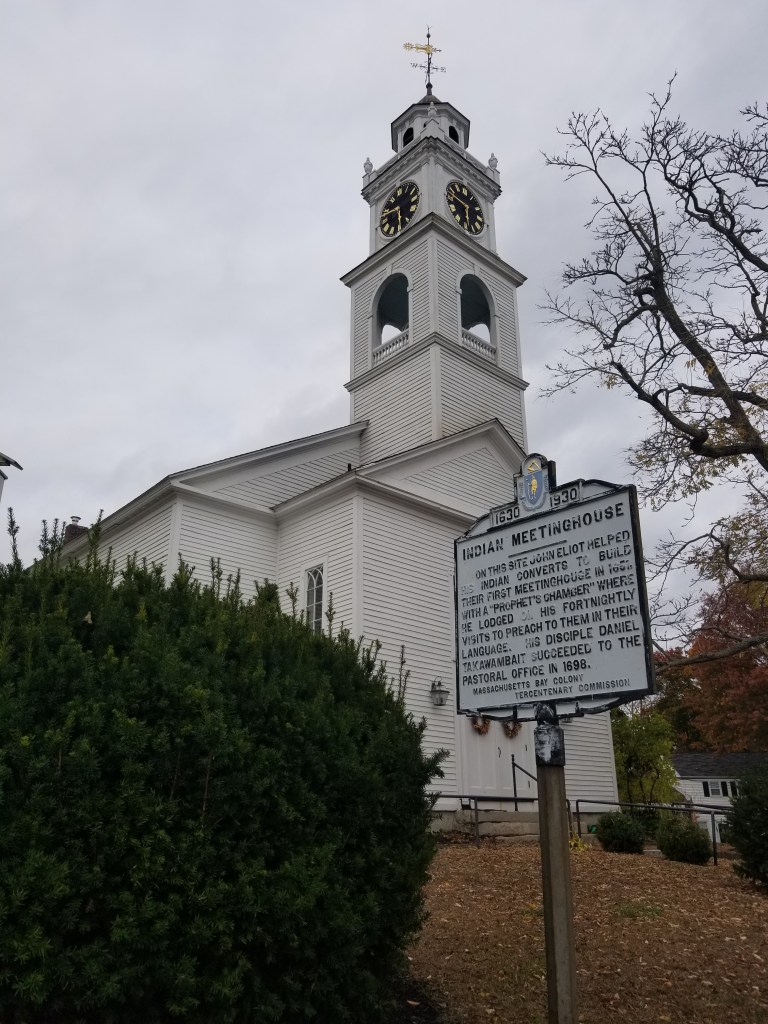
As converts increased, Eliot then set about finding acreage for these newly converted Indians to live, called “praying Indians”. He wanted to separate them from their tribal obligations and mode of dress, and reduce temptations. He also wanted to have the Native Americans and Colonists mix more.

This is where the acreage mentioned at the top of this essay comes in. The Winthrop acreage established an “Indian Praying Town”. It was and to this day is called Natick, Massachusetts. Eliot taught them how to establish a Christian community.

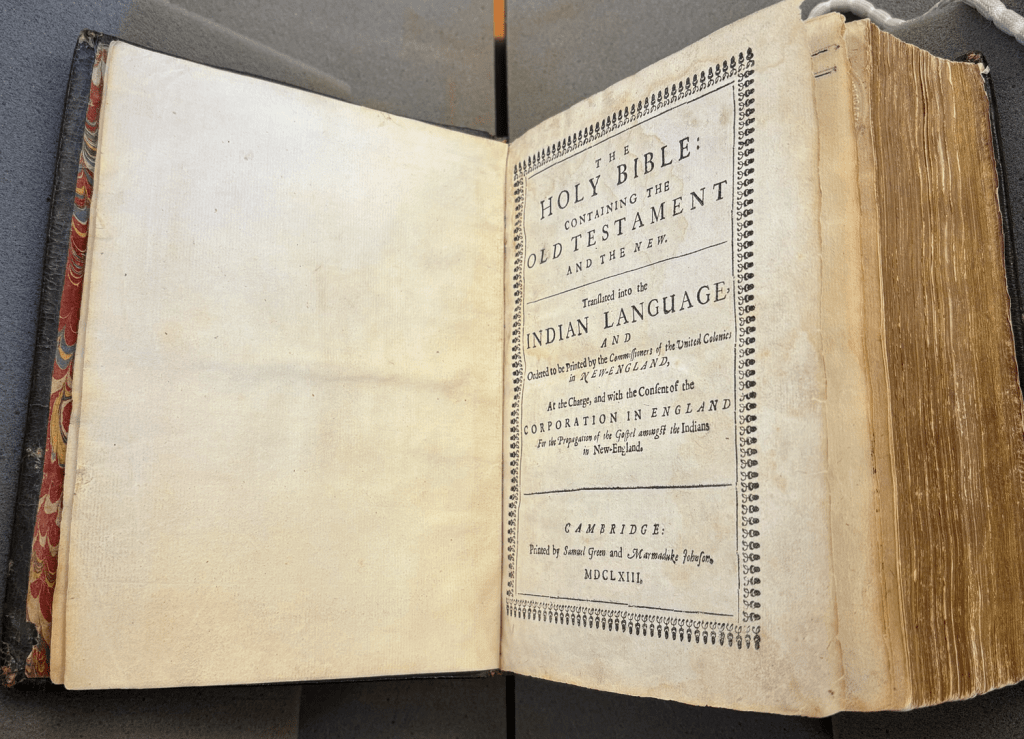
Eliot then ramped up his commitment to translate the Bible into their language, Algonquin. No easy task, there was no Algonquian alphabet! Eliot had to devise one, and thus became a lexicographer and grammarian in their language. He spent the next 14 years doing this but eventually in 1663, published “Mamusse Wunneetupanatamwe Up-Biblum God”.

The Eliot Indian Bible, published in 1663 as the first Bible printed in North America, was published with the support of the Society

Three years later, The Indian Grammar Begun was published also.

Now that it was translated, the Bible needed to be printed. Eliot wrote to the Corporation-

“I shall not trouble you with anything at present save this one business of moment, the printing of the Bible in the Indian language, which business sundry of the elders did petition unto the Commissioners, moving them to further it, as a principal means of promoting religion among them. … [Please send a printer] to New-England at the press in Harvard College, and work under the College printer, in impressing the Bible in the Indian language and with him send a convenient stock of paper“. (Source- The early Massachusetts press, 1638-1711, by George Emery Littlefield)

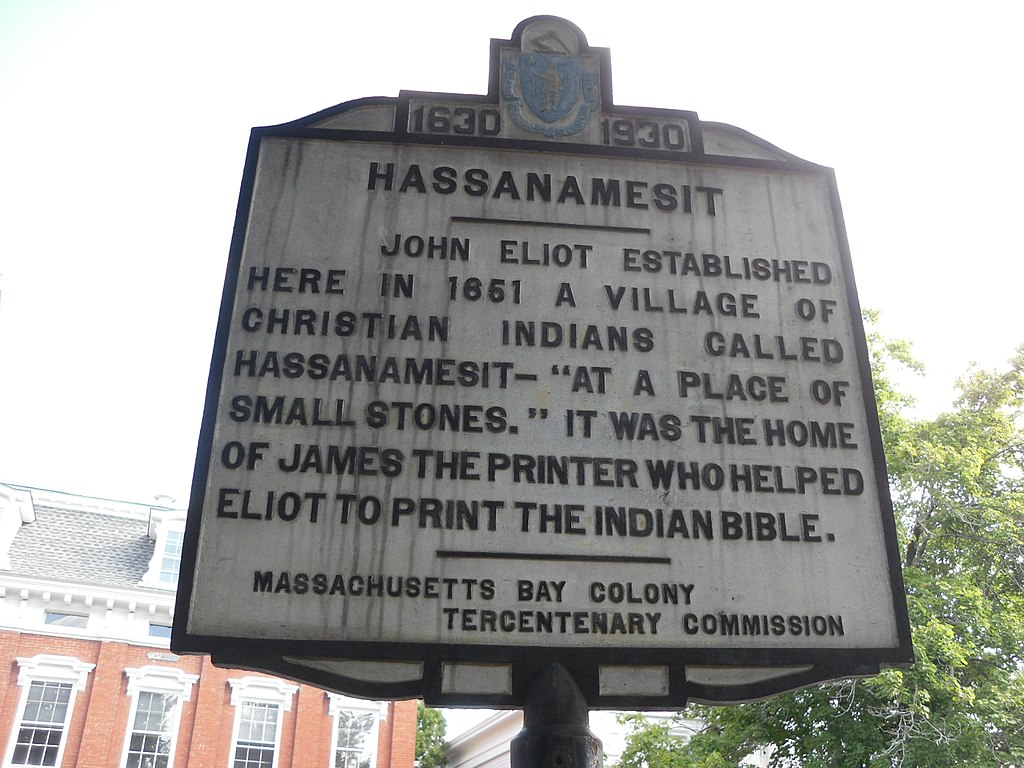
And the Corporation did just that, sending professional printer Marmaduke Johnson, 100 reams of paper, and 80 pounds of new type for the printer.

Eliot was the only missionary to devise a new alphabet from an unwritten language for the purpose of teaching and preaching the scriptures“, we read in The American Puritans by Benge and Pickowicz. Eliot helped found the first missionary society in the New World, printed the first Bible in the New World, and was known as ‘Apostle to the Indians.’

Meanwhile, the “Indian Praying Towns” were multiplying. Eliot’s son John Jr. was now helping, then his son-in-law came to serve as well. There were 14 Indian Praying Towns in Massachusetts and 3 in Connecticut at the height. Eliot also established schools for the Christian Indians, established churches, and encouraged commerce between the Natives and the Puritan colonists. All was going well until…

Metacomet (English name: King Philip, 1638 – 1676) was chief of the Wampanoag people. The King Philip War – the most devastating war (1675 – 1676) between the colonists and the Native Americans in New England – is named according to him. Wood engraving, published in 1884. Source

King Philips War ended things abruptly. King Philip was actually a Native American called Metacom who started a war in 1675 until 1676 between a group of Indians and the English Colonists & their Native allies. Metacom’s father was Massasoit, you may remember, the Native American who helped the earliest Pilgrims who landed at Plymouth. Massasoit helped them avoid starvation. After Massasoit passed away, Metacom was not as friendly, claiming violations of the English in the treaties, and encouraged raiding parties. Eventually as tensions increased, war broke out.

Praying Indians offered to aid the Colonists in this war but were rejected. Many were either confined to their towns or relocated to Deer Isle. When the war was concluded relations among any and all Native Americans’ including the Praying Indians, was permanently damaged. It was said that it was a violation to even speak well of an Indian.

In 1675, when Philip’s war broke out, the English inhabitants generally were jealous of the praying Indians, and would have destroyed them, had not General Gookin and Mr Eliot stepped forth in their defence. Source, “History of the town of Natick, Mass. : from the days of the apostolic Eliot, MDCL, to the present time” by William Bigelow, 1830.

Things never got back to the height of the well-thought-of Praying Town. Ten of the original fourteen MA towns were disbanded. A few stragglers filtered back to Natick, the original Praying Indian Town, but it was closely supervised by the colonists.

John Eliot poured out his life for the Native Americans in his sphere. He was earnest for these souls and in return was beloved by the people he helped convert. Tokkohwompait was one of these men. At the end of Eliot’s life, he wrote to John Eliot,

God hath made you to us and our nation a spiritual father, we are inexpressibly engaged to you for your faithful indefatigable labors, and love, to us and for us, you have always manifested the same to us as well in our adversity or prosperity, for about forty years making known to us the glad tidings of salvation of Jesus Christ.”

What a testimony for the name of Jesus Christ. What a well-done life poured out on behalf of pagan souls. Many do not know of John Eliot’s missionary endeavors, but I encourage you to search further and read up on this inspiring man.

Sources:

Massachusetts History

Book- The American Puritans by Dustin Benge and Nate Pickowicz

Wikipedia Indian Praying Towns

Native Northeast Portal: John Eliot

Native Northeast Portal: Margaret Tyndal Winthrop

The early Massachusetts press, 1638-1711, by George Emery Littlefield

Boston University/ History of Missiology: Puritan minister and pioneer missionary among Native Americans

Posted in theology

The man is dying. Do you still want the room?

By Elizabeth Prata

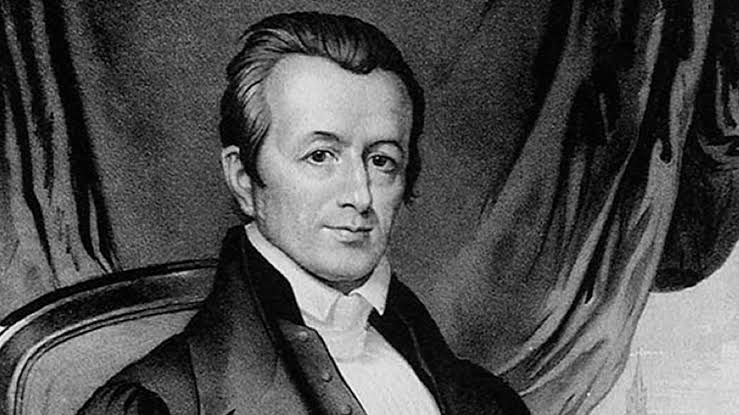
Adoniram Judson

Our pastor preached a parable from Matthew the other day. He explained an anecdote from the biography of Adoniram Judson. Judson was raised Christian. He went to college. He roomed with a magnetic, charming non-believer named Jacob Eames who slowly drew Judson away from the faith. Judson did not share this with his parents, but after a while, Judson apostatized. After Judson graduated he finally told his parents he wasn’t a Christian any more.

He asked for his inheritance like the Prodigal, which was a horse and some money. His mom sank to her knees and started praying right then. Judson left anyway. He desired to write plays in New York City. Later, Judson found his life of sin was not as fulfilling as he thought it’d be. This perplexed Judson.

One day he was riding thru a small town he never went to before and lodged at an inn he was unfamiliar with. Innkeeper said there was only 1 room but in the next door room a man lay dying, probably not make it thru the night. Do you want the room? Judson said fine, ‘OK, I’ll take the room, I’m not afraid of death’.

All night people whispered coming and going, taking care of the unwell man. Judson heard moanings and groanings from the man. Finally the man was quiet. Judson was disturbed about the proximity of eternity for the man, thoughts which soon turned to himself. Am I ready for eternity? Judson thought. He became troubled.

Judson fell asleep, awakening the next day feeling good and bounded downstairs for breakfast. He inquired of the man. The Innkeeper said the man did indeed die. Judson was sad, and began to think about the man’s eternity. He asked if the Innkeeper knew the man’s name. “Oh yes, It was Jacob Eames.”

Just 21 years old, charming magnetic vibrant Eames was dead and facing hell forever. Judson was so shocked, because he knew this was from God; the happenstance of finding this little village, this inn, the last room, the dying man he used to room with in college just a year ago, heard his groanings of his last night on earth…now dead. Judson stayed stock still in shock for three hours.

He didn’t convert right then but this was a key moment. Adoniram WAS in fact, scared to death of death. He enrolled in seminary that year and soon after, became one of the very first missionaries to leave America for other tribes far away, dedicating his life to Christ.

The Lord does pursue His people.

I think of that heartbroken mother on her knees praying Adoniram as he left the house. I am sure she continued praying. If you have a prodigal child, don’t stop praying. If the child is one of His, Jesus will seek that lost sheep and bring him home. if he is not one of His, your prayers glorify Jesus in any case. And our chief end is to give Him glory no matter our own desires, circumstances, or feelings.

Further Resources:

Ligonier: 5 Minutes in Church History (audio with transcript): Adoniram Judson

IMB essay: Missionaries You Should Know: Adoniram Judson

Book: To the Golden Shore: The Life of Adoniram Judson by Courtney Anderson