Posted in discernment, theology

Throwback Thursday: Does God Speak in Unidentified Promptings?

By Elizabeth Prata

This post first appeared on The End Time in September 2016

A quick lesson on discerning a meme. I saw this on Facebook. Here is a lesson on how to parse the silly sayings we see on social media. Let;s take it apart phrase by phrase and really think about what it is trying to communicate.

“Unidentified promptings” contradicts his word on the face of it, because He always identified Himself as the One speaking. Even when God spoke to pagans they knew this was an authoritative and undeniable voice of a God they must obey.

Would God speak behind a veil of uncertainty as to the source? No, never. Further, the Lord never spoke unclearly to an audience. He was always open and authoritative when He spoke. (Matthew 7:29). Did the Lord say “I shall give Pharaoh unidentified promptings to let My people go”? (Exodus 4:22). Does Exodus 7:17 say, “Thus prompts the LORD in unidentified manner, In this thou shalt strongly suspect through an inner voice that I am the LORD: behold, I will smite with the rod that is in mine hand upon the waters which are in the river, and they shall be turned to blood. Probably. If you discern the prompting correctly.”

In addition, if the promptings are unidentified, how do you know they are from God? We know the devil speaks. (John 8:44). We know our own heart speaks too, for out of it come evil thoughts–murder, adultery, sexual immorality, theft, false testimony, slander; says Matthew 15:19. Why would you want to risk acting upon something that could either be from the devil or your own dark heart?

Third, do you ever act on unidentified promptings in other cases in real life? If an unidentified voice whispered over the intercom at work to go do something, would you? If an unidentified voice left on your phone messages urged you to an action, would you do it? No. You’d probably say ‘This is creepy’ and delete the message or ignore the intercom. Why risk following an unidentified prompting that more than likely is coming from the devil or your own foolish heart?

Next, ‘promptings’ cannot be confirmed by the word. A prompting is a nebulous, gossamer thought like the last remnant of a dream you’re trying to hold on to before full consciousness erases it. How can the word of God confirm something so tenuous? In the Bible, is there a Book of Unidentified Promptings to which we turn blank pages and write our own indefinite and unclear words in invisible ink?

Last, ‘promptings’ are not a communication. They are an unidentified feeling, more than likely generated by ourselves from ourselves to ourselves.

Leave the unidentified promptings alone. Better to just read God’s word, make decisions according to His commands and precepts, and take responsibility for them.
Posted in discernment, Uncategorized

MemeHeresy: Don’t Be a Pineapple

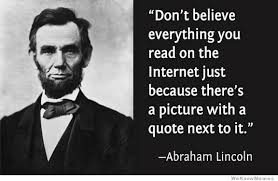
Meme Heresies are those frequently re-posted or re-tweeted quotable quotes or Bible verses, usually with a picture. Sometimes the scripture picture or quote will contain the Bible address associated with it, usually not. Sometimes the quote will have the person’s name as to who originally said it, but usually not. If there is a Bible address, it’s sometimes wrong. The same thing happens with the repeated memes with quotes on them, the quote is sometimes misattributed.

There’s a satirical meme that speaks to this,

Which is funny of course, because Abraham Lincoln lived and died well before the internet was invented. They are called memeheresies because many of these memes promote things that are at odds with the Bible, hence, “heresies”

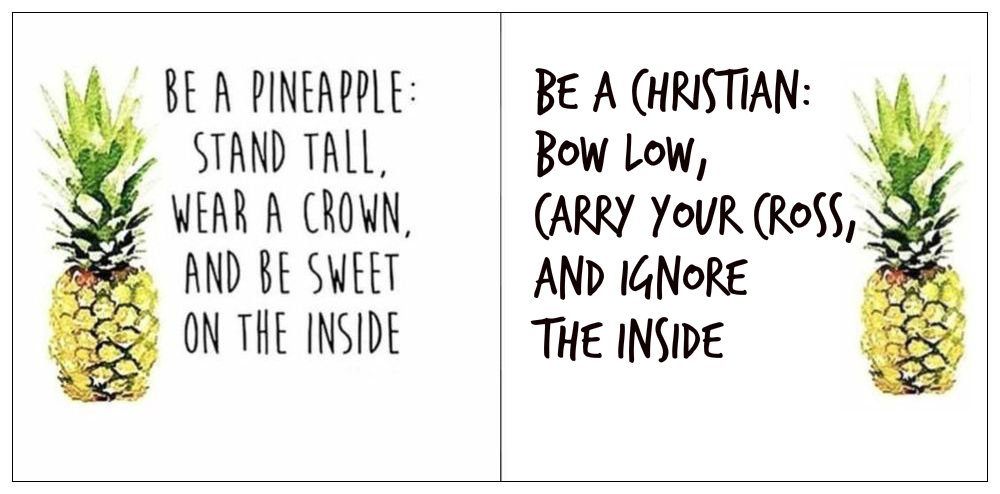
The meme on the left is one that I saw this week, and I addressed it by creating my own counter-point on the right.

The meme isn’t explicitly Christian but it’s being promoted as if it is. It’s one of those nebulous, inspirational sayings that people go “awww’ when they read it and then think they’ve absorbed something from the Lord. But it’s not. Let’s see what the Bible has to say about being a pineapple.

Be a Pineapple

There is nothing expressly wrong with being compared to something. Jesus compares his children as sheep and the unsaved ones to goats. Saved vs. unsaved are compared as wheat and chaff. We can go to the ant, we’re to be as wise as a serpent and harmless as a dove. And so on. There is nothing wrong with humans being compared to something. But there are no qualities of a pineapple stated here that are especially helpful to the body of Christ or to the lost people.

Stand Tall

The Bible tells us to stand firm. (Philippians 4:1-2). It says that a lot. We are also to stand our ground. We’re also to stand.  (Ephesians 6:13). But stand tall?. The righteous grow as tall as the cedars of Lebanon. (Psalm 92:12).

1 Corinthians 10:12 does warn us not to put too much stock into our standing, lest we fall.

So, whoever thinks he stands must be careful not to fall.

Those who stand tall receive a warning.

Christians can and do stand tall – in our soul because the Good in us is Christ. We do not need to prance around standing tall. We know who we are, craven sinners forgiven by the grace of Jesus Christ. He is tall. We are not.

Wear a Crown

The only people who wear crowns are kings and queens, and even then, just for ceremonial purposes. Taken literally, it’s ridiculous. Biblically, we read in Isaiah,

The earth mourns and withers, the world fades and withers, the exalted of the people of the earth fade away. (Isaiah 24:4).

I’d rather wait to wear my crown, and at that, we will probably hand it back to Jesus just as the elders did. (Revelation 4:10–11).

If it’s meant metaphorically, walking around as if we were kings and queens just makes for haughtiness. We know that Jesus hates haughty eyes. (Proverbs 6:17). As a matter of fact, we are to ‘Take up your cross and follow Me’ which means being willing to die in order to follow Jesus. Wear a crown? How about deny self.

Be Sweet on the inside

It’s always nice to try and be nice to people. We are called to be gentle, sweet, kind, thoughtful… As a matter of fact, if we are pressing on toward the prize, the Spirit is growing us in sanctification and we are bearing fruit of the Spirit consistent with those qualities I just mentioned. However, the heresy comes in where people believe there is anything sweet inside of us to begin with, or apart from the Spirit. On our own, there is nothing sweet in us. There is sin, pollution, iniquity, rebelliousness and depravity inside us. Nothing sweet at all.

So you can see that on the surface if you read the meme quickly it seems nice and probably true. If you compare it to scripture, you find the opposite. The point of exploring memes for heresies is to get you to think before you share on social media. Be thoughtful about what you present as inspiring or as Christian.

The younger generation needs solid food and we do not need to be confusing them or anyone with what Jesus’ real message was and is. We should not confuse, but enlighten. We should not settle for shallow, but dig deep. We should not promote heresy. We are not to mislead, but are to be salt and light. What you put out on social media should clarify and edify. Every time.

Posted in discernment, Uncategorized

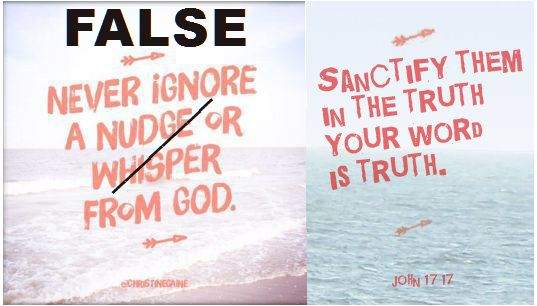
MemeHeresy: Christine Caine’s nudges & whispers from God; Visual Theology: picture of unified scripture

In our ongoing series (originated by Jessica Pickowicz at Beautiful Thing), we have here a tweet from Chirstine Caine. She asserted that we should never ignore a nudge or whisper from God. This might seem Chrisitany-y or even possible and hopefully true. But it’s not. First, the canon of the Bible is closed. That means God is not speaking directly to people today. If He was, then every whisper would have to be written down and obeyed, because God had spoken. Secondly, nudges do exist. We are led by the Holy Spirit every day. How or when is not detectable by us however and definitely not when it is happening. It’s called Providence. Continue reading “MemeHeresy: Christine Caine’s nudges & whispers from God; Visual Theology: picture of unified scripture”