Posted in doctrine, martyn lloyd-jones

It’s Not Enough to Say “I Believe in Jesus”. Doctrine Matters

By Elizabeth Prata

A while back I listened to the great Dr Martyn Lloyd-Jones preach through a series called “Great Biblical Doctrines.” I love doctrine. By doctrine, I come to know Christ. Through living it, I manifest a Christlike character. Far from being “head knowledge” only, learning doctrine ignites my heart in love for Christ and to obey Him more fully in all things. One cannot pursue holiness (2 Peter 1:15-16) without knowing what or Whom you pursue.

Lloyd-Jones began his series of 81 sermons on the great doctrines of the Bible in 1952, finishing in May 1955. He preached them on Friday nights, and by the end, the 2000 person capacity of the room was exceeded and they had to find a larger room to hold all the people interested in hearing these great truths. Far from the sometimes heard sentiment “Doctrine bores people”, Christians are eager to hear about the decrees of God, and love getting to know Him better.

Dr Lloyd-Jones said way back in 1953 in his sermon as part of the Great Biblical Doctrines series “The Lord Jesus Christ”, the following, which is something people say to me and around me all the time:

Begin Lloyd-Jones quote:

“I am anxious that I should deal with the case of anybody might be present and whom may think and say, ‘Well, I don’t have much time to be interested in Doctrine like this. I’m just a simple believer in the Lord Jesus Christ.’ My friend, if you take up that position, you’re utterly unscriptural. It was because such simple Christians were ready to believe false teachers, and DID believe false teachers, that so many of these Epistles had to be written with their stern warnings against the terrible danger to the soul of believing these wrong teachings and false ideas concerning the Person of our Lord and Savior Jesus Christ.

Continue Lloyd Jones quote:

“It is not enough to say ‘I believe in Jesus Christ’. The New Testament asks you a question when you say that. It asks, ‘What do you believe about Him? Is He man only or is He God only? Has He come in the flesh or hasn’t He? What is the meaning of His death? What did He do?’ The New Testament is concerned with definitions. I suggest that there is nothing that is further removed from the teaching of the New Testament itself than to say ‘it’s all right as long as you believe in the Lord Jesus Christ that it doesn’t matter very much what you say about Him in detail.’ It is the detail that is the most important and vital to our whole position.”

—end Lloyd-Jones.

I recommend the series. Please enjoy the series Great Biblical Doctrines here:

https://www.mljtrust.org/sermons/great-biblical-doctrines/ 

Posted in theology

Zeal Without Knowledge: Discerning True Revival from Emotional Fervor

By Elizabeth Prata

SYNOPSIS
In a time of heightened emotion and spiritual activity—such as the Asbury Revival and recent cultural flashpoints like the Charlie Kirk memorial—Christians are often stirred to act. But is all zeal for God genuine? Drawing on Scripture, historical revivals, and the powerful preaching of Dr. Martyn Lloyd-Jones, this essay explores the critical distinction between true zeal rooted in knowledge and false zeal fueled by emotionalism, activity, or crowd-driven momentum.

Continue reading “Zeal Without Knowledge: Discerning True Revival from Emotional Fervor”
Posted in theology

Of toxic empathy, false zeal, and how satan’s demons masquerade to fool you

By Elizabeth Prata

Allie Beth Stuckey published a book that’s out this week, called Toxic Empathy: How Progressives Exploit Christian Compassion. The book is making waves and causing a hearty discussion on social media.

That’s good. Stuckey explores the concepts of the current cultural mantras, “love is love”, “trans women are women”, “abortion is health care”, “social justice is justice”, and pointedly, that empathy is not always empathy. Love, justice, empathy are good words, but they can and are appropriated by bad people who use those words to manipulate the people around them, especially Christians. Stuckey wrote in her introduction,

But empathy alone is a terrible guide. It may be part of what inspires us to do good, but it’s just an emotion and, like all emotions, is highly susceptible to manipulation. That’s exactly what’s happening today. Empathy has been hijacked for the purpose of conforming well-intentioned people to particular political agendas. Specifically, it’s been co-opted by the progressive wing of American society to convince people that the progressive position is exclusively the one of kindness and morality. I call it toxic empathy. Source: page xii)

Of course the culture will push back on a Christian re-redefining the words that the progressives have appropriated and redefined. Here we see one reaction-

Mason Mennenga @masonmennenga wrote on Twitter, “if you think empathy is toxic then you’re going to hate this guy named jesus christ“.

According to our own understanding of the word ’empathy’, of course the guy is right. But then again, this is a situation that calls for thought, not knee-jerk reactions such as “Yeah!” then press ‘like’.

The ever wise Ron Henzel @ronhenzel replied to Mennenga, (≠ means ‘does not equal’):

“toxic substance” ≠ “all substances are toxic”
“toxic waste” ≠ “all waste is toxic”
“toxic relationships” ≠ “all relationships are toxic”
“toxic empathy” ≠ “all empathy is toxic

We must, MUST think things through. Christians are a thinking people, (Philippians 4:8). As Stuckey said, emotions can be manipulated.

Emotions are a part of life. But I bring this to your attention…what were the first emotions seen in the Bible? Shame, guilt, blame. Genesis 3. Satan manipulated Eve’s curiosity into a temptation and we know what happened from there.

Of ‘toxic empathy’, the American writer Flannery O’Connor said,

“If other ages felt less, they saw more, even though they saw with the blind, prophetical, unsentimental eye of faith. In the absence of this faith now, we govern by tenderness. It is a tenderness which, long cut off from the person of Christ, is wrapped in theory. When tenderness is detached from the source of tenderness, its logical outcome is terror. It ends in forced-labor camps and in the fumes of the gas chamber.”

AI explains the quote-

This quote, by Flannery O’Connor, argues that modern society, lacking a strong religious faith, governs itself through a detached “tenderness” that, without the grounding of Christ, ultimately leads to horrific consequences like violence and oppression, symbolized by the gas chambers of concentration camps.

And haven’t we seen that? “Love thy neighbor” was the covid-flu mantra pressuring the populace to ingest untested or unwieldy vaccinations, to close down society against common sense, and to become isolated robots. What happened was the elderly were left to die alone and society’s children were impacted negatively for a generation to come. That’s just one example of how progressives used toxic empathy against the people in their society.

Moving away from toxic empathy to examining toxic zeal, Martyn Lloyd-Jones preached a 2 part series on true zeal versus false zeal.

There IS such a thing as false zeal. False Christians who seem so zealous for God are actually not zealous for God. It’s a manufactured zeal cloaking their zeal for themselves, or for satan. See this verse-

Brothers, my heart’s desire and my prayer to God for them is for their salvation. For I testify about them that they have a zeal for God, but not according to knowledge. (Romans 10:1-2).

By this verse we see there is such a thing as a zeal that is not of God. There can be zeal, or fervor, or energy around religious things, but not according to what we know from the Bible. AKA knowledge.

Zeal: great energy or enthusiasm in pursuit of a cause or an objective. Synonyms: passion, fervor, enthusiasm.

Photo by Luan Cabral on Unsplash

They went across the world to make one proselyte, but wound up making him twice the sons of hell they were. (Matthew 23:15). That verse is the example of zeal without knowledge. You can be passionate, you can be busy making disciples, but a false zeal will make disciples who miss the mark completely and will wind up in hell as a son of hell. Zeal, no knowledge.

Beth Moore has been consistently described through the years as “energetic”, “charismatic”, “passionate”. She puts out an energy as zealous for God. But because we know she is a false teacher, her zeal is without knowledge. She is full of emotion but lacks the tether to the Rock via faith.

She was recently interviewed by Ed Stetzer at Church Leaders. He ended by asking Moore how she prepares for a lesson. I was struck by her answer.

Question: Can you encourage teachers and preachers, especially in this season when it is hard to speak truth and there is a lot of destructive forces that are trying to take down teachers and preachers?

Answer:
“Keep asking the Lord to give you fire in your bones, to teach and preach and communicate the Scriptures so that you can’t keep it to yourself. Ask him for it when it wanes, and it’s going to wane…Nobody just keeps that naturally on their own.

It’s love for scripture, love for Jesus, that drives the Christian to search the scriptures and then the scriptures fire up that proper zeal.

Is My word not like fire?” declares the LORD, “and like a hammer which shatters a rock?” (Jeremiah 23:29).

You get a ‘fire in the bones’ when you open up the scriptures!

And they said one to another, Did not our heart burn within us, while he talked with us by the way, and while he opened to us the scriptures?(Luke 24:32).

But Moore said it is important that “we’re not just going to the scriptures to prepare a lesson.

To be fair, she was talking of the teacher having a right relationship with Jesus as one prepares the lesson. I can intuit that she means not apathetic, in prayerful humility, regular church goer, etc But she didn’t say those things. She just muddily talked of the overflow (whatever that means). Consulting the scriptures is primary. But for the false zealer, it’s secondary. Emotions tops the list.

I was struck by what she said and what she did NOT say. Any thinking Christian must think of both- what is said and what is not said. Moore did not say it was crucial for the leader to pray for perseverance in staying in right doctrine. To ask for moral righteousness. Begging to rightly divide the scriptures. Her reply focused on emotion. ‘Fire in the bones’ (whatever that means) was most important to her because, as we know, she is driven by emotion. Zeal misapplied is false. Zeal untethered from the Rock will lead you nowhere good.

False teachers appear to be doing a religious effort, they look like they are on the right track, and part of that appearance is because of their fervent energy.

The Bible says that satan and his demons masquerade as angels of light. That means behavior, outward appearance. The thinking Christian must look deeper.

Do not fall for toxic empathy. Do not mistake toxic zeal for righteous fervor. Above, all, THINK!

Lloyd-Jones’ sermon can be heard here, for free: True Zeal and False Zeal: A Sermon on Romans 10:1-2. Or on Youtube with closed captions (which might help due to his accent).

Further Reading

Real Zeal vs. False Zeal part 1

Real Zeal vs. False zeal part 2

Here is a good article on turning information into knowledge by Rick Holland.

Here in this article What do you think about emotional sensationalism in the modern church? Stephen Nichols of Ligonier says there are valid emotions, but “especially in the American church, we seem to be very susceptible to this. There is a difference between emotion and emotionalism.”
Posted in theology

What IS idolatry?

By Elizabeth Prata

EPrata photo

I recently wrote about the “Trad wife/Trad life” issue. I said that idolizing a lifestyle can replace genuine worship of biblical life standards. Anything can be an idol, including a lifestyle.

I decided to look into the topic of idolatry to understand it better. Also to make sure I was not misrepresenting it to you or to myself. When sin is on the table, our sinful nature wants to marginalize it, water it down, or ignore it. We always should strive for understanding, even when we think we already understand. The depths of God’s word never end.

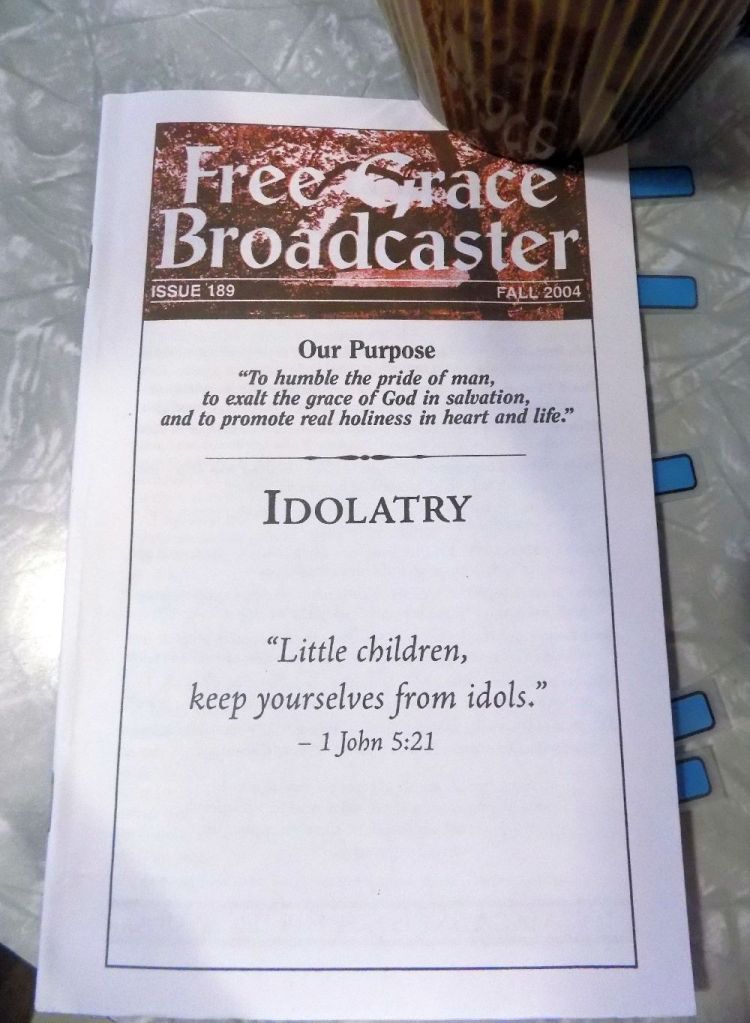
I happened to have on hand a Free Grace Broadcaster from Mt. Zion Chapel Library. Chapel Library is a marvelous ministry, offered free to one and all. You can read online, or order a hard copy to be mailed to you for free. Yes, free. Their monthly magazine is based on one topic each month and contains essays from old-timey theologians and pastors of the past on that topic. In this Idolatry edition I found so much to bookmark and ponder and I’d only read 3 of the essays yet!

I constantly think on these things. I ask myself- is my blog my idol? Is my comfort an idol? Is my apartment and idol? I must always be vigilant. I’d read a startling thought in Spurstowe’s book “The Wiles of Satan.” One of satan’s strategies is to tempt us. We know that. But an even wilier strategy is to “cease to tempt, or to feign flight.” Have you ever thought of that? It’s to provoke our pride. We SEEM to have won the battle. We think, ‘Oh great, I’ve got this temptation licked! I got the victory of that sin!’ But no. Just as we release our guard, satan comes back! (Luke 4:13).

Within this Free Grace Broadcaster issue are so many nuggets, which I will share. Here is the link to the entire pamphlet if you care to read it online.

Martyn Lloyd Jones preached “Keep Yourself from Idols,” verse from 1 John 5:21. His was one of the articles in the pamphlet.

“Let me, therefore, put this in the form of three propositions. The first is that the greatest enemy that confronts us in the spiritual life is the worshipping of idols. The greatest danger confronting us all is not a matter of deeds or of actions, but of idolatry… What is idolatry? Well, an idol can be defined most simply in this way: an idol is anything in our lives that occupies the place that should be occupied by God alone…Anything that holds a controlling position in my life is an idol.”

“Of course, an idol may indeed be an actual idol. … idolatry may consist of having false notions of God. If I am worshipping my own idea of God and not the true and living God, that is idolatry… But let me go on to point out that idolatry can take many other forms. It is possible for us to worship our religion instead of worshipping God.”

“It is possible for us to worship not only our own religion but our own church, our own communion, our own religious body, our own particular community, our own particular sect, our own particular point of view—these are the things we may be worshipping.”


In this next excerpt on Idolatry, from “Soul Idolatry Excludes Men out of Heaven,” in The Works of David Clarkson, Vol. II. Clarkson (c. 1621-1686) we read that was a Puritan preacher, colleague of John Owen, and successor to Owen’s pulpit. Misunderstanding who God is can be idolatry:

“If either you do not think of God or think otherwise of Him than He is—think Him all mercy, not minding His justice; think Him all pity and compassion, not minding His purity and holiness; think of His faithfulness in performing promises, not at all minding His truth in execution of threatenings; think Him all love, not regarding His sovereignty—this is to set up an idol instead of God. Thinking otherwise of God than He has revealed Himself or minding other things as much or more than God is idolatry.” –end Clarkson


Charles Spurgeon notes that idols are not merely graven images but can be philosophies and concepts. Even though he wrote this in 1874, his warning is fresh today.

“I would say to you, beloved, in closing my observations upon this point: in the matter of your faith, be sure to keep yourselves from the idol of the hour. Some of us have lived long enough to see the world’s idols altered any number of times. Just now, in some professedly Christian churches, the idol is “intellectualism,” “culture,” “modern thought.” Whatever name it bears, it has no right to be in a Christian church, for it believes very little that appertains to Christ.”

…[T]he minister who goes into a pulpit and addresses people when he knows that he does not believe any of the doctrines that are dearer to them than their own lives. Yet, the moment the congregant is called to account for his unbelief, he cries out, “Persecution! Persecution! Bigotry! Bigotry!” A burglar, if I found him outside my bedroom door and held him till the policeman came, might consider me to be very bigoted because I did not care to have my property stolen by him and because I interfered with his liberty. So, in like manner, I am called bigoted because I will not allow a man to come and assail from my own pulpit the truths which are dearer to me than my life.”

“Believe me, my brethren, that the Church of Christ, if not the world, shall yet learn that the highest culture is a heart that is cultivated by divine grace; that the truest science is…Jesus Christ and Him crucified; and that the greatest thought and the deepest of all metaphysics are found at the foot of the cross; and that the men who will keep on simply and earnestly preaching the old-fashioned gospel, and the people who will stand fast in the old paths are they who will most certainly win the victory.” –end Spurgeon


John Calvin, in his The Institutes of the Christian Religion, famously said that the heart and mind of man is “a perpetual forge of idols.” (1:11.45) This has often been translated as an “factory of idols.”

We create idols for ourselves when we’re not paying attention. We create idols for ourselves when we are paying attention. We create idols for ourselves when we are asleep. We create idols for ourselves when we are awake. MLJ wrote of the 1 John 5:21 verse (Keep yourselves from idols), that those were very likely the last words John wrote. He said the point cannot be proved, but if those were the last or nearly last words John wrote, we must pay even closer attention, saying,

“The last words of all people are important, but the last words of great people are of exceptional importance, and the last words of an apostle of the Lord Jesus Christ are of supreme importance…”

Keep. Yourselves. From. Idols.

Posted in theology

Real Zeal vs. False Zeal part 2

By Elizabeth Prata

Part 1 Discerning false zeal, here

Brothers, my heart’s desire and my prayer to God for them is for their salvation. For I testify about them that they have a zeal for God, but not according to knowledge. (Romans 10:1-2).

By this verse we see there is such a thing as a zeal that is not of God. There can be zea, or fervor or energy around religious things, but not according to what we know from the Bible. AKA knowledge.

Zeal: great energy or enthusiasm in pursuit of a cause or an objective. Synonyms: passion, fervor, enthusiasm.

Dr. Martyn Lloyd-Jones preached on the Romans 10:1-2 verse in a sermon called False vs. True Zeal. The sermon is stunning, relevant, and informative. He laid the foundation as he always does, logically, then laid out tests to determine of someone is exhibiting false zeal. Then in the later part of the sermon he laid out how to determine if a person is exhibiting true zeal. I paraphrased the part of his sermon discussing false zeal, here. Today, we have an exam of true zeal.

Lloyd-Jones’ sermon can be heard here, for free: True Zeal and False Zeal: A Sermon on Romans 10:1-2. Or on Youtube with closed captions (which might help due to his accent).

What follows is Dr. Martyn Lloyd-Jones’ excerpt from the sermon True Zeal vs. False Zeal, focusing on true zeal.


What are the characteristics of a true zeal? A true zeal is never a zeal that’s put on. It’s not put on you by anybody else it’s not put on by you yourself. If you’ve got a zeal you’ve got it not because you’ve been told it’s the thing to do when you join this church or this society. That’s not the reason if you are doing it, simply because it’s the thing to do in this society or company. It’s never put on or mechanical either by other people or the thing to do or by ourselves as the result of a decision.

Secondly, it is always the result of being the man who’s got a true zeal has it because he is what he is. He has it because he’s grown in grace and because he’s grown in sanctification. It’s not an act.

Thirdly and putting it still more specifically and in terms of our text true zeal is always the result of knowledge. It is always the outcome of knowledge. With the Apostle is really put this very wonderfully for us already in chapter 6 in verse 17, (KJV)

But God be thanked, that ye were the servants of sin, but ye have obeyed from the heart that form of doctrine which was delivered you.

Now you notice the order. He actually puts the obeying first. That the obeying actually in practice was the last. This is what he says has happened to you – he says the first thing was this a form of doctrine was delivered. The gospel was preached to them and they received it and believed it with their minds. But it wasn’t only in their minds, the heart was involved. They were moved by it and because the heart was involved they were moved by it. They gave it obedience. Their will came into action but that was the order they received it with the mind first, it moved the heart it moved them to action.

That is the true order of true zeal. The trouble with a false zeal is that it puts the will first and is not interested even in the heart nor in the head. The man who says ‘nothing matters but activity’ is exhibiting a false will. That’s the danger of activism. It goes on in his headlong blind manner. The right order is the mind, the heart, then the will.

The man who has the true zeal he knows what he’s doing and he knows why he’s doing it. Zeal is according to knowledge!

The fourth test is that it’s a deep zeal. Not superficial. It’s not a spectacular, showy blaze, but a controlled fire that’s longer lasting and more useful.

Photo by Ben White on Unsplash

As such, the true zeal displays control. Fire is a bad master, but when zeal is controlled by knowledge it’s as it should be. If a fire is in the hearth it’s controlled and warming the room and pleasant to be around. Fire that is out of control is damaging and unwanted. It burns and destroys. It is the same with zeal. A person exhibiting true zeal controls it.

Sixth, a true zeal is never self-confident. He’s always reverent. He doesn’t get excited. The Apostle Paul says to the Corinthians that when he went amongst them he did so in weakness and in fear and in much trembling, Paul, trembling, apprehensive, fearful nervous? How different that is from the false zeal and the confidence and the assurance and the mastery of the occasion some men show in their false zeal!

A person with true zeal knows he operates under grace and not in his own strength. His confidence comes from knowing his energy is deposited by the Spirit of God.

Remember, the Corinthians were despising Paul because he wasn’t boasting about himself. Some of the false teachers were boasting about themselves. They were recommending themselves. Well, says Paul, if you really want to know I laboured more abundantly than they all yet not I but the grace of God that was with me. I am what I am by the grace of God .

Seventh- What’s the motive that animates true zeal? Well it isn’t just to be busy and to do things and to get results. It’s the glory of God… the glory of God. The love of Christ. Their motivation is the love of Christ and wanting to share that with others who are lost.

A man of true zeal is not simply anxious that people should decide for Christ. He wants them to come to what Paul calls our knowledge of the truth. He’s not interested in superficial results. He is very concerned that men and women should have a knowledge of the truth that will save them from hell. 

It comes to this – that the man who is animated by a true zeal however successful he may be he is never elated he’s never excited with his own success. When the Lord sent the seventy out to preach and to cast out devils and they were so successful that they came back full of excitement. They said ‘master the very devils are subject unto us!’ and our Lord looked at them and said ‘In this rejoice not that the devils of the spirits are made subject unto you, but rejoice rather that your names are written in heaven.’

I ask you a question as I close. What’s the effect of all this upon you is it that you are so afraid of the false zeal that you do nothing at all. If it is I have spoken in vain if you are so afraid of a false zeal that it paralyzes you, then you’re the very antithesis of Paul. You’ve not understood the truth. Knowledge of the truth always moves the heart and moves the will.

If the knowledge of the truth hasn’t moved you, hasn’t engaged your affections and your emotions hasn’t made you do something, you have not known the truth properly. When a man really knows this truth he says we cannot but speak of the things which we have seen and heard.

In any case the Apostle teaches us in Romans that we must not be slothful in business we must rather be fervent in spirit serving the law not a false zeal but a true one. Fervent in spirit serving the Lord. He’s not writing to apostles he is writing to ordinary church members. Are you fervent in spirit? Are you moved by what you claim to believe? Do you really believe it? If you do you know that everybody who doesn’t believe it is going to hell, can you be passive and quiet and paralysed and say nothing and do nothing?

To what extent are you concerned about the souls of the Lost? How can a man believe the gospel and not be concerned about those who don’t? How can a man sit down feeling his own pulse worrying about his own temptations and sins and problems and have no concern about the lost?

————end MLJ sermon part 2 on true zeal.

We don’t often talk about zeal, or energy, or fervor for the lost. We talk of how ‘busy’ we are, but as we saw in part 1 and in part 2, there can be a false motivation, a false energy propelling us in this busyness that is completely vain. Make sure your energy comes from the Spirit, that it isn’t something put on and springs from a fountain of carnality. Matthew 7:21-23 shows the unmasking of people who exhibited a false zeal, only to find they were doing it in their own strength and not in the Lord.

Brothers, my heart’s desire and my prayer to God for them is for their salvation. For I testify about them that they have a zeal for God, but not according to knowledge. (Romans 10:1-2).

The only way to obtain knowledge of God is to go where God is: the Bible. That is where he has revealed Himself, and is the source of truth and knowledge.


Posted in theology

Real zeal vs. False Zeal part 1

By Elizabeth Prata

Real Zeal vs. False zeal part 2

Photo by Luan Cabral on Unsplash

A regenerated heart means different affections, different point of view, different citizenship. It means the world will hate the believer. And it does. It does.

Post-salvation, I learned that some of the most vicious and difficult evangelistic responses don’t come from the world, but sometimes actually come from people calling themselves other Christians. That is because I learned there are false Christians who possess a false zeal. Or, actually, it’s a true zeal, but it’s misplaced from glorifying God in truth, to glorifying satan in hate.

Brothers, my heart’s desire and my prayer to God for them is for their salvation. For I testify about them that they have a zeal for God, but not according to knowledge. (Romans 10:1-2).

By this verse we see there is such a thing as a zeal that is not of God. There can be zeal, or fervor, or energy around religious things, but not according to what we know from the Bible. AKA knowledge.

This contrast of false zeal vs. true zeal was highlighted recently with several events in the news. Of course, the “Asbury Revival”, a week-long event that had occurred at a college in Kentucky where a seemingly spontaneous move of God spread across the campus, drawing hundreds of matriculated students, then busloads of students from other campuses, then rubber-neckers. The event seemed to indicate a spiritual move of the Spirit to awaken dead sinners. Or was it? There certainly was an abundance of zeal present. Was it real or false? How to tell? At the very beginning it was especially hard to tell.

Zeal: great energy or enthusiasm in pursuit of a cause or an objective. Synonyms: passion, fervor, enthusiasm.

In addition, another zeal event occurred. Beth Moore’s third memoir was released in February and the enterprising little Bible thumper from Texas has been busy as a bee flitting from interview to interview. The book rests at this writing at the top of famous best-seller lists. It’s creating quite a buzz. She has been on TV, streaming, and print, her opinions delivered with as much verve as ever, and are eagerly absorbed by audiences, never waning despite her 65 years and over 4 decades in the Christian biz.

Beth Moore has been consistently described through the years as “energetic”, “charismatic”, “passionate”. She puts out an energy as zealous for God.

But how can we discern if we observe a true zeal or a false zeal? Let’s turn to the scriptures.

As Paul finished Romans 9, and remember, there were no chapter breaks in the original letter, before he went on to mentioning false zeal in Chapter 10:1, had reminded the Roman Christians that Israel, pursuing a law of righteousness, did not attain that law. Why? Because they did not pursue it by faith, but as though it were by works. (Romans 9:31-32).

They appeared to be doing a religious effort, they looked like they were on the right track, and part of that appearance is because of their fervent energy.

They went across the world to make one proselyte, but wound up making him twice the sons of hell they were. (Matthew 23:15). That verse is the example of zeal without knowledge. You can be passionate, you can be busy making disciples, but a false zeal will make disciples who miss the mark completely and will wind up in hell as a son of hell. Zeal, no knowledge.

Dr. Martyn Lloyd-Jones preached on the Romans 10:1-2 verse in a sermon called False vs. True Zeal. The sermon is stunning, relevant, and informative. He laid the foundation as he always does, logically, then laid out tests to determine of someone is exhibiting false zeal. Then in the later part of the sermon he laid out how to determine if a person is exhibiting true zeal. I’ll paraphrase his sermon below in 2 parts. Today, we have an exam of false zeal. Tomorrow, true zeal.

Lloyd-Jones’ sermon can be heard here, for free: True Zeal and False Zeal: A Sermon on Romans 10:1-2. Or on Youtube with closed captions (which might help due to his accent).

I think almost invariably that zeal is one of the most prominent characteristics of people who belong to the cults.

Martyn Lloyd-Jones

Test of False Zeal
by Martyn Lloyd-Jones, paraphrased & quoted from his sermon

Here is one thing which should always raise the query in our minds and that is that our zeal has been imposed upon us by somebody else and we are just conforming to a pattern. You’re becoming just like the rest of them, conforming to an external pattern.

Secondly if it is a zeal that has to be whipped up or organized as it were, or that we have to be kept up to it. If the stimulus has to come from other people on the outside, it may very well be a false zeal.

A third test if you find that you put greater emphasis upon doing than upon being, it’s always an indication. You should be careful if you are more anxious to do things than to be a saint, you better examine your zeal again.

Another way of putting that my fourth test can be put in this form that involves zeal the activity is always very prominent and at the center of the life rather than the truth. The thing you are hit by all along is the activity, this energy that’s being put forth, rather than by the truth which even the people themselves claim to be representing. In other words, there’s always a tendency in false zeal to overdo things. There’s always an element of excess where the activity is more in evidence than the thing which is claimed.

In the fifth place the more prominent the machinery and the element of organization the more likely it is to be a false zeal. When methods and means and organization of machinery are very prominent it’s good presumptive evidence that it is a false zeal.

As my sixth test MLJ grouped a number of things together under the heading of carnality carnality. He meant that by that the flesh. In false zeal there is always this carnal element and it shows itself by a kind of lightness, a lightness of spirit, almost sometimes even a frivolity.

This can sometimes be seen even in religious meetings. There’s a lightness and a joviality and the kind of jovial superficiality. You can’t imagine such things anywhere near the Apostle Paul or any other of the Apostles or anywhere near our Blessed Lord himself, but you get it in these meetings. They’re very zealous. I’m not quitting their zeal I’m granting their zeal. I’m granting their enthusiasm but they always overdo it and there is this light touch about it.

Indeed I have often on some occasions in a certain type of meeting I’ve had to remind myself that I am in a religious meeting. The spirit I have felt present has been the spirit of a cricket team or a football team. The spirit of doing something worldly some wealthy entertainment. Now the people were absolutely sincere but there was lightness in the atmosphere there was no sense of awe, no sense of God, no sense of holiness no sense of reverence but everything was bright and breezy. It was being carried along with the verve and wonderful organizing power I say these are indications of carnality, not of true zeal.

Still under carnality, if there is an element of self-confidence and of assurance and of being in control of the situation, you can be quite certain it is false zeal. Any impression that is given by men – I don’t care how zealous he is, I don’t care how sincere he is – if he gives that impression that he’s in control and self-confident in the show I’m suspicious of his zeal and of his sincerity. If there’s any suspicion at all of his being proud of himself, it is still worse.

But let’s go on to test number seven – false zeal is always impatient to the examination. It dislikes being examined. It dislikes being questioned.

It resents this- it says ‘Can’t you see that I’m zealous … I’m enthusiastic … I’m sincere … I want to do …’ But you say ‘Well but let’s make sure because of the teaching.’ No, no, it’s impatient of all that. It wants to get on with things, must be doing something.

False zeal dislikes slowing down long enough to be examined.

Eighth, that is surely a very bad sign and when it is impatient of teaching. It is still worse they have a zeal of God but not according to knowledge. They don’t want the knowledge, for they’ve rejected the knowledge. They are not interested in it. They must get on with it they say. They don’t want to be taught and teaching is unnecessary. The thing to do is to be doing something that’s the spirit of the false zeal test number nine.

—end Martyn Lloyd-Jones tests of false zeal from his sermon.

As you read along of the 9 tests, did anyone come to mind? I can think of a lot of Christian celebs I see on social media who resist being tested, or don’t like their teaching being compared to the Bible. I can think of several people who exhibit a zeal but after having seen them PERFORM, their teaching actually evaporates. Their teaching has no substance when parted from their charismatic personality.

Monday I’ll post what Lloyd-Jones outlines as tests of true zeal. You’ll notice the difference immediately. Meanwhile, don’t be one of the many who think that just because a person seems passionate for God, they possess a true understanding of the faith. There IS such a thing as false zeal.

There is a danger of setting up zeal or sincerity to the supreme position.

Martyn Lloyd-Jones

Further Reading

Real Zeal vs. False zeal part 2

Today’s blog and podcast was about Romans 10:1-2, having a false zeal, that is, zeal about God but no knowledge of God. Zeal without knowledge Here is a good article on turning information into knowledge-

https://expositors.org/turning-information-into-knowledge/

Posted in holy spirit, martyn lloyd-jones

The Holy Spirit’s work through Common Grace explained by Martyn Lloyd-Jones

By Elizabeth Prata

I listened to a wonderful sermon recently. I’ve been enjoying and savoring Martyn Lloyd-Jones’ series called “The Great Biblical Doctrines.” The one I’m referring to was called Creation and Common Grace.

Jones was a preacher in the UK in the last century. The bio states, “

“David Martyn Lloyd-Jones (1899-1981) was a Welsh Protestant minister and medical doctor who was influential in the Calvinist wing of the British evangelical movement in the 20th century. For almost 30 years, he was the minister of Westminster Chapel in London.”

It’s only 27 minutes long, because unfortunately the beginning portion has been lost. Nevertheless, you can easily understand the points this great pastor is making from the jumping off point where the sermon does open.

I was struck by the multi-layered aspect of the sermon. The sermon puts so many pieces together. The Bible is one great, unified work. It’s the revelation God wants us to know about Him and His work among the people and of earth. It is THE TRUTH, not a truth and not many truths. As you study to understand it precept by precept, a jot here, a tittle there, you begin to see a large picture emerge.

This sermon explains the work of the Holy Spirit through His ministry of common grace, and through understanding common grace, you’ll understand how when the restraining ministry of the Spirit ends at the rapture, this will be a dramatic moment as the Tribulation begins. (2 Thessalonians 2:7). You’ll understand how men could be so sinful that without the common grace of the Holy Spirit’s restraint we’d all kill each other immediately. You’ll understand why Jesus said that unless the days of the Tribulation were cut short, no flesh would survive. (Matthew 24:22). You’ll understand that the Holy Spirit has been working on earth since before earth was created. You’ll understand that it’s the Spirit who sustains all, Jesus does it through the Spirit. (Colossians 1:17).

“You stiff-necked people, uncircumcised in heart and ears, you always resist the Holy Spirit. As your fathers did, so do you. (Acts 7:51).
The Spirit is the conscience that exists in all men. Though Jones’s sermons sadly are not transcribed on the site, someone took the time to publish long excerpts of this particular sermon here.

Jones said of man’s conscience,

You will remember that we are told in the prologue of John’s Gospel about ‘the true light which lighteth every man’ (John 1:9). It does not matter how you translate that verse – ‘the light which lighteth every man that cometh into the world’ says the Authorised Version; ‘the Light that lighteth every man was coming into the world,’ says another. We are not concerned about that. We are interested in the phrase ‘the light which lighteth every man’. And there is such a light. It is a kind of natural light, as we call it, natural understanding. It is the light that is in the conscience and there is that light of conscience in every person born into this world. Now that is one of the operations of the Holy Spirit in what is called common grace.

You will remember that in 2 Thessalonians 2:7 it is written, For the mystery of lawlessness is already at work. Only he who now restrains it will do so until he is out of the way. When the Spirit lifts his retraining hand from man’s conscience, sin will be loosed in such a way that it is today impossible to comprehend. No man will have a conscience. Sin will reach its full expression. The horror of the few believers who come to faith in the Tribulation and live long enough to see these horrors will be permanently scarred by what they see, save the promise that God will not allow them to remember. (Isaiah 65:17).

Dr Lloyd-Jones’ delivered this sermon in 1954, and already back then he could see the decaying effects of a society being given over to its sin. That was 68 years ago, and how much more we see the accelerating effects of societies being given over to sin now. He said,

God, through the Holy Spirit, restrains the foulest manifestations of sin, but there are times when He gives people up to them. Are we, I wonder, living in such an age? Compare the twentieth century with the nineteenth. It is obvious that the moral level is very much lower today. That does not mean that everybody was a Christian in the Victorian era, but it does mean that even people who were not Christians were better men and women, speaking generally, than people now. Why? It was because of the general influence of the Holy Spirit. But it does look as if again, today, God is giving humanity over ‘unto vile affections’ as Paul outlines in Romans 1.

The Holy Spirit’s influence in the world and upon the world is not to be underestimated in light of the more visible qualities of the Messiah Savior and Father God. Please listen to the sermon and its part 2, The Significance of Pentecost, where the Spirit’s ministry dramatically changed when the Church was formed.

EPrata photo
Posted in eternal, God, martyn lloyd-jones, sovereign

Spiritual Journey, MLJ & the Eternal Decrees of God

By Elizabeth Prata

There’s a meme going around where people post photos of the men who have been part of your spiritual journey. It’s interesting. Of course the moment I posted mine, a person came on and commented “How about following Christ, not men?” Sigh. There’s always one.

Anyway, mine went like this:

Joel Osteen, Adrian Rogers, John MacArthur. Some didn’t know who Adrian was, I posted part of his bio that he was three time President of the Southern Baptist Convention, was conservative and stood for those theological principles, his ministry was Love Worth Finding and you can still tune in and hear his sermons today, and was a four point Calvinist or sometimes confused Arminian. He had his own theological journey, lol.

Of course someone immediately came on and started crabbing about Calvinism. I replied a few times then just deleted her comments. There’s always one. Sigh.

But they represent a journey that’s apt for me. I was new to the faith. Osteen was at the height of popularity. I listened to Osteen because I loved the arc of his rhetoric, because I thought with such a large church he must be THE guy, and because his man-pleasing speeches touched me. But as I grew and opened my Bible more and more along with what he was saying I saw pretty quickly thanks to the Holy Spirit that he was far from it. I ditched Osteen.

I loved Rogers’ clear delivery and deeper theological concepts. His focus on the sovereignty of God was a balm to my increasingly sanctified soul.

Yet as I studied it became clear that God was sovereign also in salvation, that He pre-ordained whom He would choose for salvation, and once I heard MacArthur confirm what I’d been learning from my study of the Word, that was it for me. I’d found my guy.

Not to say that I wasn’t also influenced by my own pastor, or by other men. There’s Sproul and the men at Ligonier. There’s The Master’s Seminary and the men under JMac. In the discussion on my Facebook page of who we enjoy listening to, someone mentioned Martyn Lloyd-Jones. The Doctor, the man of Logic on Fire. I agreed he was a good one also. Aren’t we blessed in this day and age to have such opportunities to hear such men of God expound the word?!

Martyn Lloyd-Jones

When the commenter mentioned Lloyd-Jones, it reminded me of a blog post I’d published a few years ago on MLJ’s sermon series on the Eternal Decrees of God. It’s the best sermon I’ve ever heard on the “Eternal Decrees of God”, and one of the best sermons I’ve heard on any topic, ever. It is by UK preacher from the last century, Martyn Lloyd-Jones, and it’s 50 minutes long. This is the first sermon in his wonderful series, Great Biblical Doctrines. Please take a listen, I know you will be edified.

Blurb: “Scripture: The character of God’s activities; antinomy explained; the importance of understanding the harmony of the Biblical doctrines; God’s unchanging plan; the decrees of God are unconditional and sovereign; problems in understanding this doctrine; God is not unjust.

The Eternal Decrees of God

MLJ’s other sermons are at the Martyn Lloyd-Jones Trust, here. I recommend him. Who do you enjoy listening to?

Posted in biblical resources, Uncategorized

Resources on Depression and the Christian

depressed
Depression is something Christians don’t talk about much. Some are embarrassed by it, deeming it a weakness. Others believe that they are supposed to present a joyful countenance all the time, every day. Others adopt a plan of fake it till you make it.

So I was surprised and heartened to read Drew Dyck’s heartfelt sharing of his own journey through a long-term depression which was also punctuated by panic attacks. Mr Dyck is an acquisitions editor at Moody Publishers and a senior editor at CTPastors.com. He’s the author of Yawning at Tigers (2014) and Generation Ex: Christian (2010).

It’s always risky when one is open about something that some parts of society stigmatize. He muses on some of that in his article, as he shares the lessons he’d learned. His article is here:

You Can Break Your Brain … And 4 Other Things I’ve learned from My Struggle with Depression and Anxiety

Did you know that the Prince of Preachers, Charles Spurgeon, suffered from depression? It seems strange that on the surface, this man who was a global success at preaching, writing, pastoring, founding colleges, orphanages, and married to a wonderful woman, could ever be depressed. But he was. There are numerous resources available recounting it, including many of his own writings, but this can get you started:

The Anguish and Agonies of Charles Spurgeon

Martyn Lloyd-Jones was a physician and then a preacher. In 1960 he began preaching on depression in a lengthy sermon series which can be listened to here. The sermon series was also made into a book, “Spiritual Depression: Its Causes and Cure”. The Amazon blurb introducing the books states,

[Lloyd-Jones] carefully and compassionately analyzes an undeniable feature of modern society from which Christians have not escaped — spiritual depression.

What robs Christians of the joy that is theirs? Why does faith’s vitality drain away, leaving melancholy and anxiety it its place? In the sermons, Lloyd-Jones explores the cause and the cure.

Martyn Lloyd-Jones Spiritual Depression series

David certainly had his own ups and downs. We read in Psalm 43:4,

Why are you cast down, O my soul, and why are you in turmoil within me? Hope in God; for I shall again praise him, my salvation and my God.

Mr Dyck says that prayer and Scripture were a tremendous source of comfort in the valley (especially the Psalms). It would be wrong and neglectful of me to leave off the Bible itself as a resource. Especially the Psalms.

depressed guy
Though the Bible is its own premier resource, Mr Dyck shares that the person suffering from depression “finds it hard to even muster the energy or concentration to engage deeply in spiritual practices.” He advises asking others to pray for you when your depression sinks you too low to open His word.

Therefore we have the greatest resource of all: the Body of Christ in prayer and supplication, appealing to the Great Physician, Jesus, in prayer.

All these resources and more are available to you if you happen to be suffering from persistent panic, anxiety or depression.

Further reading:

Insufficient Help, Part 1: Grace To You’s recounting of a depressed, suicidal young man seeking help from church counselors in addition to doctors and secular therapists, who eventually took his own life. The church was sued. Did the church offer insufficient help? Are Biblical counselors qualified to use the Bible in therapy?

Overwhelmed by Anxiety? A blog series on attacking the anxiety that is attacking you.


Posted in encouragement, Uncategorized

What does ‘disciples’ mean?

In listening to Martyn Lloyd Jones today I was struck by how he brought out nuances to the word ‘disciple.’ All that the word disciple really means is learner. More on Lloyd-Jones below in a moment.

I’ve thought a lot about education over my lifetime. My foremost profession has been an educator in various capacities. I’ve attained a post-graduate degree, a Master’s in Education with a 4.0 average. However my family is one of high achievers, and a Master’s in my family is the low end of the educational totem pole. Many of my family have Doctorate degrees. They’re Professors or Deans in universities, or are doctors or are highly educated in other professions. They all worked very hard for their education and they are all very smart.

I am second and third generation immigrant, so the family emphasis on education was great and for that I’m grateful.

So often, I ponder my family’s well-earned achievements in the secular world (for none are saved that I know of, except perhaps one). Their brilliance, thirst for learning, and great intellectual capacity will become as nothing on The Day. Their wisdom which is of the world and which the world admires, will be as dung on Judgment Day. It’s an upside down notion that takes getting used to.

Where is the wise man? Where is the scribe? Where is the debater of this age? Has not God made foolish the wisdom of the world? For since in the wisdom of God the world through its wisdom did not come to know God, God was well-pleased through the foolishness of the message preached to save those who believe. (1 Corinthians 1:20-21).

And in an even more upside down twist, the uneducated, the simple, the ignorant, have the mind of Christ.

Finally, after three days they found Him in the temple courts, sitting among the teachers, listening to them and asking them questions. And all who heard Him were amazed at His understanding and His answers... (Luke 2:46-47).

This is because Jesus had no sin. His mind was pure, undefiled, and divine, and therefore the top mind in the universe.

Now when they saw the boldness of Peter and John, and perceived that they were unlearned and ignorant men, they marvelled; and they took knowledge of them, that they had been with Jesus. (Acts 4:13, KJV).

No doubt Paul had a great intellect, and had been trained in the only secondary school there existed for Jews at the time: the Sanhedrin. However most of the apostles were as the verse says, uneducated and ignorant men. They were simple men, fishermen and craftsmen, jailers and soldiers. The Holy Spirit dispenses the mind of Christ to His followers, and with it, the thirst to learn His word. The men went from being fishermen to being disciples. What are disciples? Learners. Here is Martyn Lloyd Jones on disciples and learning:

The Holy Spirit can make any man new, it doesn’t matter who he is. The Holy Spirit can regenerate an ignoramus quite as easily as He can a great philosopher. Perhaps even more so! He does the same thing in both cases. And when He does, He does the same thing to both of them. He creates a desire and an appetite in them for the truth.”

And they [the 3000 souls just converted at Pentecost] devoted themselves to the apostles’ teaching and the fellowship, to the breaking of bread and the prayers. (Acts 2:42).

The thing that is put first [in the verse] is the teaching, the doctrine. These people, suddenly converted from ignorance and darkness, from the vileness of their lives…what do they want? They want more teaching. They’ve suddenly got an appetite and a desire for teaching! Have you ever heard of such a thing? People who have never read, who’d never thought. People who had lived for gambling and for sex and for drunkenness … people who hadn’t seemed to have brains at all, suddenly they want teaching! They wanted it daily. They continued steadfastly. … This is the miracle of redemption, and it is proof of the fact that they have become a Christian.

Many people are “making decisions” but they don’t want to be taught. They don’t like teaching. They grumble at it. They say sermons are too long. They want something nice and simple, bright and breezy. When a man is born again, he wants teaching. He’s a disciple. ~Martyn Lloyd Jones, Acts 6:1-7, The Church and Her Message

Disciples are learners. Anyone and everyone can learn, when the Spirit puts the thirst for the word of God into you. The most formerly foolish and ignorant drunken gambler now seeks the highest wisdom that exists, and is given access to it by the Holy Spirit Himself.

Before I was saved, all my accumulated learned wisdom from University stood me no closer to understanding Jesus and gave me no advantage or wisdom that counts with God. I was equally as ignorant as the most ignorant person on earth. Yet when He gives us the new man inside is, comes with is a capacity for unfolding the wisdom of heaven, direct from the mind of Christ. We’re disciples, praise God.

The fear of the LORD is the beginning of wisdom; all those who practice it have a good understanding. His praise endures forever! (Psalm 111:10).
bible with glasses