Posted in theology

Lectio Divina is not a harmless Bible reading practice. Here’s why

By Elizabeth Prata

You are at risk. Every minute. IF you are in Christ, that is.

EPrata collage

Satan seeks those whom he may devour. He does not rest. He got Peter, didn’t he? Peter had been with the Lord day and night for three years. Seen all the healings, miracles, heard all the lessons. Peter knew Jesus was the Christ. (Matthew 16:16). Yet when the moment of highest pressure came, Peter denied Jesus. Succumbing to his/our corrupt nature, he opted for self preservation.

Satan is subtle (Genesis 3:1), relentless (1 Peter 5:8), bold (Matthew 4), has an evil, prideful agenda (Isaiah 14:13), deceitful (Ephesians 6:11) and more.

Satan masquerades as an angel of light. (2 Corinthians 11:14). A masquerade is someone dressing as someone else, in costume and with a mask so as to hide their true self.

HOW does satan deceive? By promoting error and undermining. Matthew Henry says,

They would be as industrious and as generous in promoting error as the apostles were in preaching truth; they would endeavour as much to undermine the kingdom of Christ as the apostles did to establish it.

By promoting error and undermining.

Satan’s subtlety and his masquerade means that something that’s deadly will be hidden as something good, religious, even. The error won’t look like error. It’s hidden behind a mask, remember? But it hides its true nature behind the mask, and will eventually damage you.

One example of his subtle evil is when he inserted Lectio Divina (LD) into the true church. LD is a Roman Catholic/Mystical practice, so it comes from the false church. It is a practice that on its surface, seems good, holy, proper. But satan masquerades, remember. LD only has a veneer of goodness to it. Take the mask off and you can see its true nature.

Many people these days refuse to look beyond the mask. Ephesians 6:11 says to

Put on the full armor of God, so that you will be able to stand firm against the schemes of the devil.

Satan has schemes. Many people these days also refuse to even put ON their armor, never mind look into these things to see IF there is a mask and if so, to see what is lurking behind it.
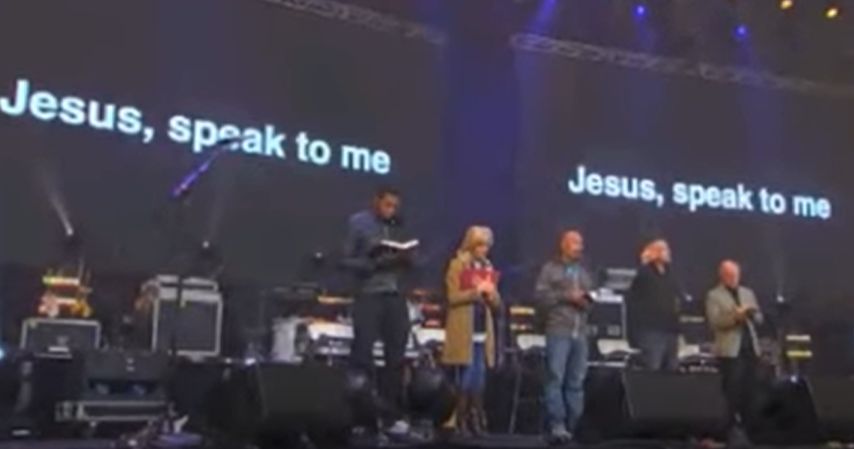
screen shot from Passion 2012 segment where Lectio Divina (lite) was taught to 16,000 attendees.

LD arose over ten years ago and immediately became popular when Francis Chan, Beth Moore, Louis Giglio, Lecrae (I think), and John Piper taught 16000 impressionable youths at the Passion Conference a version of how to do it. The lesson became seeds of false doctrine that the youths returned to their churches to plant. This is both error and undermining, satan’s tactics.

The panel stood on stage before the youths and one by one went through what seems to be a modification of the full LD process, and all the while, a 30 foot high billboard behind them was emblazoned not once but twice with the mantra, “Jesus, speak to us”. Asking Jesus to speak outside his word is error, and it underme the sufficiency of scripture.

Does God still give revelation?

Beth Moore, for example, read a passage from the Bible, and then urged the youths to “be still and ask Jesus to speak his word to us.”

No. The audience had just heard Jesus speak His word. (Hebrews 1:1-2). She had JUST read His word to them. Jesus IS the Word. (John 1:1). The prayer should not be, ‘Jesus speak your word to us’, but ‘Holy Spirit illuminate the word to us.’

What is the biblical doctrine of illumination?

those eyes…

Though these kind of practices are fads negatively impacting the global church, and some fade quickly, LD is still kicking around. I saw women on Twitter defend Lectio Divina this week. One defender said:

Here. Here is where we get these ideas. Brad Klassen explains what Lectio Divina is and why we should stay away from practicing it.

The Bible and Lectio Divina: A Helpful Tool or a Dangerous Practice?

It’s a good article, just a 10-minute read. Klassen proposes 4 reasons why Lectio Divina is harmful to your walk with Christ.

Lectio Divina is dangerous due to-
-Its historical origin and development
-Its alienation of the human writer
-Its eisegesis
-Its subjectivity

After explaining the 4 reasons, Klassen concludes,

While more reasons [not to do LD] could be listed, these suffice. Lectio divina—the “sacred reading” of the Bible—is not just one more instrument that the Christian can add to his spiritual toolbox to better read the Word of God. Inherent to its practice are elements that lead the reader away from the meaning of the text and toward the reader’s own subjective intuition.

I encourage you to read his article.

Satan is subtle. You need to be wary of a fad that enters the church and is almost eagerly accepted, even if it seems to be everywhere, even by people on stages you might look up to. Your faith needs to remain as pure as possible. So, put on the armor, look behind the mask, and pray for illumination.


Further Resources

Discernment review: The mystical practice of Lectio Divina
Why I no longer follow John Piper or Desiring God ministry

When Study Isn’t Study

No Shortcuts to Growth

Posted in discernment, theology

Spiritual Formation: What is it, and is it as innocent as it sounds?

By Elizabeth Prata

It’s encouraging for me to hear from women who ask penetrating and insightful questions, and are training their discernment to detect truth from error. Ladies who adhere to sufficiency of scripture, who want to engage with people on the basis of the Rock, and not feelings. I’m so grateful for sisters in the faith.

I received a question about Spiritual Formation. What is spiritual formation, and how do I help a sister who is caught up in it? Continue reading “Spiritual Formation: What is it, and is it as innocent as it sounds?”

Posted in discernment, Uncategorized

Discernment review: The mystical practice of Lectio Divina

lectio

Several mystical practices have been making their way into the more conservative quarters of the faith. One has been contemplative prayer, or centering prayer. Another practice that crept in from the mystical religions was Lectio Divina.

First, what do we mean by ‘mysticism’? GotQuestions looks at the blending of the faith with mystical practices, called Christian Mysticism:

The term “Christian mystic” is an oxymoron. Mysticism is not the experience of a Christian. Whereas Christian doctrine maintains that God dwells in all Christians and that they can experience God directly through belief in Jesus, Christian mysticism aspires to apprehend spiritual truths inaccessible through intellectual means

Any practice that urges the adherent to avoid the intellect is not to be trusted. Christianity is a religion of the mind. I can’t stress this fact strongly enough. It is a thinking religion.

Paul said in Romans 12:2, Be transformed by the renewing of your mind,  not by ‘the subjective impulses of the heart’.

Paul also said in 1 Corinthians 2:16, ‘we have the mind of Christ’, not that ‘some have the mind of Christ and if you adopt their mystical practices you, too, can know truth‘.

We read in 2 Corinthians 10:3-6,

For though we walk in the flesh, we are not waging war according to the flesh. For the weapons of our warfare are not of the flesh but have divine power to destroy strongholds. We destroy arguments and every lofty opinion raised against the knowledge of God, and take every thought captive to obey Christ, being ready to punish every disobedience, when your obedience is complete.

See? We destroy mind-strongholds, we take thoughts captive, destroy base opinions, and seek knowledge. This is all about the mind.

So the first thing mystical, anti-Christian practices will do is the opposite of what the Bible tells us. The teachers of such practices will tell you to clear you mind, empty your mind, or not to rely on the mind.

A second thought to introduce this review. I am doing a follow-up on the not-new-news of Lectio Divina because of the way satan works. He will creep in, and introduce extra-biblical practices antithetical to our growth. These will be discovered sooner or later, and there will be an outcry. Then the outcry will die down. What the outcry does is two-fold, only one of which is actually helpful to us.

First, an outcry against anti-biblical practices raises the alarm and lets the faithful know an intrusion is underway. Such an outcry occurred at the 2012 Passion Conference when several leading members of the faith taught 60,000 youths a version of Lectio Divina and called on them to stand still, be quiet, and listen actively for a response. That rightly caused an outcry. More on that in a moment.

But secondly and sadly, not everyone is as vigilant a Christian soldier as they should be. The outcry serves to allow the terms of the false practices become familiar to us. We actually get used to the terms, like ‘contemplative prayer,’ or ‘Lectio divina’ or ‘impression on my heart’ and once used to the terms, without vigilance and knowledge, we accept them. We become inured to them, which means, “to accustom to accept something undesirable.” We’ve heard the terms, but without constant reminder and instruction against them, a new person to the fray might think they are acceptable practices, simply on the basis of their familiarity with the terms but not the content.

Lectio Divina is a Catholic practice. It is supposedly something innocuous-sounding, it’s just ‘praying with scripture.’ Lectio Divina actually teaches you to listen with your heart, not your mind. It teaches you to experience the text, not to understand the text.

In researching this essay I’d gone back to ground zero of Lectio Divina in its original intrusion into the evangelical faith. In 2012, three of then-Christendom’s most popular leaders taught and practiced Lectio Divina at the Passion conference with 60,000 youths in attendance. John Piper, Beth Moore, Francis Chan, and one or two others on stage led the youths in attendance through a lectio practice.

Subsequently, there was an outcry. What were these respected teachers doing at an evangelical conference showing youths how to do a Catholic mystical practice? Todd Friel of Wretched Radio did a spot answering these and other questions the incident raised, and thoroughly explained the pitfalls of Lectio Divina.

Essentially, the difference between proper study and the Lectio mystical way of study is that the evangelical student studies the text using proper cognitive methods, the Lectio student attempts to experience the text. Here’s John MacArthur on Lectio Divina and other mystical practices, When Study Isn’t Study

For many leaders in the spiritual formation movement, Bible study doesn’t really involve study at all. Instead, it’s an attempt to experience the text.

Many spiritual formation gurus advocate various meditative Bible-reading methods, most of them adapted from a Catholic Church practice called lectio divina. Regardless of the name they apply to it, the pattern is usually the same—slow, methodical, repetitive reading, with an eye toward words and phrases that pop out to the individual reader. It’s through those individual words and phrases, we’re told, that the Lord speaks directly to us.

Bible study, then, is not a question of digging deep into God’s Word but letting your imagination and intuition guide your own personal understanding of the text.

Dear sisters, avoid Lectio Divina and other mystical practices. As was said earlier today on Twitter,

Scripture never commands us to tune into any inner voice. We’re commanded to study and meditate on Scripture.

~~~~~~~~FURTHER READING~~~~~~~~


A teacher or leader may be teaching you Lectio Divina without calling it that. Here’s GotQuestions explaining it, so you’ll know if it appears in your lessons, Sunday School, book you’re reading, conference, etc.

Heroes of the faith that sadly allowed themselves to be led by subjective promptings AKA ‘woeful delusions’ and fancies:
When Fancy Is Mistaken for Faith

So how are we to determine God’s will, since indeed the Spirit does lead us?
Subjectivity and the Will of God