Posted in theology

How Grace Transforms Our Fear of God

By Elizabeth Prata

SYNOPSIS
The hymn “Amazing Grace” presents a dual concept of fear shaped by grace: one where knowledge of Christ sparks terror and another that relieves spiritual anxiety. For believers, this fear of God is a respectful, loving acknowledgment of His majesty, contrasting with the terror experienced by non-believers facing divine judgment.

Continue reading “How Grace Transforms Our Fear of God”
Posted in theology

The Greatness of the Soul by John Bunyan: A Review

By Elizabeth Prata

1685, John Bunyan (1628 – 1688), the English writer and preacher who wrote ‘Pilgrim’s Progress’. Original Artwork: Drawn by Kenneth Maclean from a rare print by Francis Hall, after the painting by T Sadler. (Photo by Hulton Archive/Getty Images)

SYNOPSIS
I review John Bunyan’s “The Greatness of the Soul,” a challenging yet rewarding Puritan work. I mention the emotional and intellectual demands of reading unedited texts from the 17th century, advocating for their spiritual richness. I encourage readers to incorporate such literature into their routine for personal growth.

Continue reading “The Greatness of the Soul by John Bunyan: A Review”
Posted in conversation, encouragement, john bunyan, pilgrim's progress, salvation

Godly conversation has more impact than we think

By Elizabeth Prata

I am a literacy educator in a lower elementary school. I am also a writer. I am an editor. And I have been a voracious reader since I read “Dick and Jane“.

I love words, everything about words. Words have great impact. Nothing will convince me otherwise.

I read an interesting list of points an author made about John Bunyan’s conversion. John Bunyan was the writer of Pilgrim’s Progress, a book many say is the most important book in English ever written, apart from the Bible. It is without doubt a literary masterpiece. It has stood the test of time since its publication in 1678. It is regarded as one of the most significant works of religious English literature in history. And the man who wrote it was raised as an atheist.

In Geoff Thomas‘ essay titled “John Bunyan,” Mr Thomas wrote,

“John Bunyan had no family influences encouraging him to become a Christian. … In June 1644 when he was 16 his mother passed away and four weeks later his sister died. Eight weeks after his mother’s death his father remarried and in 8 months his wife gave birth to a boy whom his Royalist father named ‘Charles’. Four months earlier John had left home and had joined the Parliamentary Army fighting against King Charles. There was little affection between son and father. How then did John Bunyan become a Christian? There were ten factors which all played their part, great and small:”

One of these factors caught my attention-

Bunyan was stirred by the godly conversation of Christians.
He would work in Bedford and eat his bread with some Christian women who tailored their conversation for his ears. They talked of their own sin, the new birth, and the love of Christ. Bunyan listened intently and later wrote, ‘They spoke as if joy was making them speak. They were to me as if they had found a new world,’ and he often sought them out and sat with them.

‘they tailored their conversation for his ears.’ How important it is, to speak of Jesus in truth for known hearers and unknown hearers! The women must have seen the Spirit working in Bunyan, and they made a choice to and selflessly not speak of the carnal or mundane or the personal, but of the joy of His grace!

They were living this:

Let your speech always be gracious, seasoned with salt, so that you may know how you ought to answer each person. (Colossians 4:6)

Gill’s Exposition says of the Colossians verse,

“let grace be the subject matter of your speech and conversation. When saints meet together they should converse with each other about the work of grace upon their souls, how it was begun, and how it has been carried on, and in what case it now is; they should talk of the great things and wonders of grace, which God has done for them, which would be both comfortable and edifying to them, and make for the glory of the grace of God”

Jason L. Sanders wrote,

Preachers Aren’t The Only Ones With Pulpits

Parents carry a pulpit with them. And from it, thousands of times a day, we preach a sermon to our kids. Whether the sermon is a good one or a bad one, we can be sure of this one thing.

Whether we are preachers exhorting in church, parents teaching our children, or two simple Puritan Christian ladies serving lunch to an obviously tortured soul in John Bunyan, we have the privilege and the responsibility to speak ‘as if joy was making us speak.’

What glory it brings the Lord when we intentionally speak of the riches of His grace. Hearers known and unknown to us, Christian and perishing, listen to us and our Spirit-carried words,

For we are a fragrance of Christ to God among those who are being saved and among those who are perishing; to the one an aroma from death to death, to the other an aroma from life to life. (2 Corinthians 2:16)

For John Bunyan, the ladies’ words were the aroma of life to life (‘he often sought them out and sat with them‘). Therefore season your conversation with love, joy, and salt, and watch with admiration and joy where He carries your words. For we all have a pulpit.

For from him and through him and to him are all things. To him be glory forever. Amen. (Romans 11:36)

Posted in theology

You never know which words

By Elizabeth Prata

The other day I was scrolling around online, and I passingly saw a quote from John MacArthur. “God is holy. We are not.” It was a simple phrase, common, a regularly spoken thing. I see that kind of sentiment frequently and it never affected me like it did at that moment. It wasn’t even scripture, just a spiritual/doctrinal concept.

But my spirit was immediately overcome. I teared up, I bent over in my chair, I whispered aloud, “Praise the Lord”. I kept praying for a while, tearing up at the sweetness of such a simple but true concept.

Where’d THAT come from? I wondered…

It had to have been the Holy Spirit in me knitting Himself to the Lord of Lords in truth. It was a mini-event. To use a trite phrase, “a God thing”. But it was a potent reminder. When we go about our daily lives in public, whether online or in real life, we never know which scriptures or which scriptural concepts will be flung into a heart and pierced with eternal truth. Especially to the lost.

If you don’t know how Spurgeon was saved…he had been wrestling with the issue of his sin and longing for redemption for a few years. But to no avail. It wasn’t until he stumbled into a small church during a snowstorm, knowing he would not make it to his intended church destination. The pastor of that church couldn’t make it either so a layman took the pulpit. Hardly knowing what to say, he simply repeated the verse several times, mispronouncing along the way, and added a bit of his own commentary in his own halting, simple manner. But the words grabbed Spurgeon with a vise-like grip and would not let go. Here was the verse-

Look unto me, and be ye saved, all the ends of the earth: for I am God, and there is none else. (Isaiah 45:22 KJV).

After that, the layman substituting for the regular pastor just kept saying, Look! Look! A simple verse, a simple man, but it did the work and the heart of the soon to be Prince of Preachers was pierced.

The Conversion of Charles Haddon Spurgeon: January 6 1850


If you don’t know of the conversion of John Bunyan…

John Bunyan…”The thing that gave Bunyan any notoriety in the days of his ungodliness,” writes his biographer, Dr. Hamilton, “and which made him afterwards to appear to himself such a monster of iniquity, was the energy which he put into all his doings. He had a zeal for idle play and an enthusiasm in mischief which were the perverse manifestations of a forceful character.” (source)

Bunyan was notorious in his raucous doings among the town. He was well known for being a rake. In fact, he was a hardened sinner – yet deeply disturbed by his own sin. He experienced a prolonged conviction of sin and tried in his own strength at various times to remove this burden from himself by reforming his character. Of course, this did not work. His sinful nature always re-emerged, to Bunyan’s despair.

One day Bunyan passed some women sitting in the doorway in the sun, talking of Godly things, the graces the Lord had afforded them, satan’s wiles and resisting temptation. Bunyan later wrote,

And methought they spake as if joy did make them speak; they spake with such pleasantness of Scripture language, and with such appearance of grace in all they said, that they were to me as if they had found a new world, as if they were people that dwelt alone, and were not to be reckoned among their neighbours (Num. 23.9). (Source)

There were actually about ten things over time that entered Bunyan’s bosom and rested there, until the appointed day they should come together and knit a glorious salvation into his soul, but the women’s plain talk was one of them, a significant point of entry on his path toward eternal glory. Regular women, salted conversation.

The conversion of John Bunyan


Augustine: a rotting, foul, fetid sinner, by his own characterization, Augustine was definitely one who by man’s eyes would seem beyond redemption. But his mother Monica prayed. And prayed. And prayed.

Augustine was tormented by his sin and inability to change the direction of his life. He had gotten to a point in his depravity it bothered even him, but more so, how he constantly lied to his mother. One day he heard a child in a garden singing simple words- Augustine later wrote,

I was saying these things and weeping in the most bitter contrition of my heart, when, lo, I heard the voice as of a boy or girl, I know not which, coming from a neighbouring house, chanting, and oft repeating, Take up and read; take up and read. Immediately my countenance was changed, and I began most earnestly to consider whether it was usual for children in any kind of game to sing such words; nor could I remember ever to have heard the like. So, restraining the torrent of my tears, I rose up, interpreting it no other way than as a command to me from Heaven to open the book, and to read the first chapter I should light upon —

Romans 13:13-14, Not in rioting and drunkenness, not in chambering and wantonness, not in strife and envying; but put on the Lord Jesus Christ, and make not provision for the flesh, to fulfil the lusts thereof

Gulp. The exact verse he needed to see himself reflected in scripture describing his flavor of sin in which he was drowning. Augustine was pierced through. He later wrote of his mother’s prayers, “whereby when I was cleansed, the streams of my mother’s eyes should be dried, with which for me she daily watered the ground under her face.”

The conversion of Augustine


Simple words, some, from a child. Scriptures, plainly stated. Godly conversation seasoned with salt and grace. We don’t have to be experts in nuance and knowledgeable of the Greek and Hebrew. Simple words carried by the winds of the Holy Spirit to minds and hearts will cause change in perspective unto conversion as much as a complex sermon from a seminary professor. The point is, do not be afraid to speak Godly verses, concepts, conversations. The hearers will be blessed.

Let no unwholesome word proceed from your mouth, but only such a word as is good for building up what is needed, so that it will give grace to those who hear. Ephesians 4:29

Any of God’s words or concepts can pierce a heart
Posted in theology

John Bunyan’s conversion: Words of grace overheard

By Elizabeth Prata

Two Sundays ago I came across a wonderful sermon by Charles Spurgeon. It was titled “Christian Conversation.” It’s based on Psalm 145,

They shall speak of the glory of thy kingdom, and talk of thy power;

One of the reasons Spurgeon gave for the fact we believers must speak of Christ more often, is that conversions happen when we speak of him more. He said,

Souls are often converted through godly conversation. Simple words frequently do more good than long sermons. Disjointed, unconnected sentences are often of more use than the most finely polished periods or rounded sentences.

Continue reading “John Bunyan’s conversion: Words of grace overheard”
Posted in encouragement, theology

Abecedarium, Bestiary, and Emblem books: What do they have to do with the Bible?

By Elizabeth Prata

“I don’t have time to read.” I hear this a lot. I say this a lot. I used to read widely and incessantly before I was saved. Nowadays I am working a day job and ministering/serving at night, with Bible reading too. That leaves me either no time to read other books or tired eyes if I do have time. The pile of books grows high and the finished pile is small.

I’m preparing an essay “On Reading” for later this week, but in researching for it, and in researching for another essay I’m doing on a scene from Pilgrim’s Progress, I am discovering some things that inform my background on reading and the importance of immersing one’s self in a variety of types of literature.

Let this essay be considered an introduction to “On Reading” that I’ll write later this week.

We know that John Bunyan wrote Pilgrim’s Progress. We also know that it is the second-best selling book in the English language. The book is an allegory. What is an allegory?

An allegory is: a story, poem, or picture that can be interpreted to reveal a hidden meaning, typically a moral or political one. “Pilgrim’s Progress is an allegory of the spiritual journey”

Bunyan’s book contains literary devices and genres within it of which we may not be familiar. These are are good to know as we read his amazing allegory. What are some other types of literature? Abecedarium, Bestiary, Emblem books were popular at Bunyan’s time and before.

Abecedarium: (plural abecedaria)

A book used to teach the alphabet; alphabet book; primer. An inscription consisting of the letters of an alphabet, almost always listed in order.

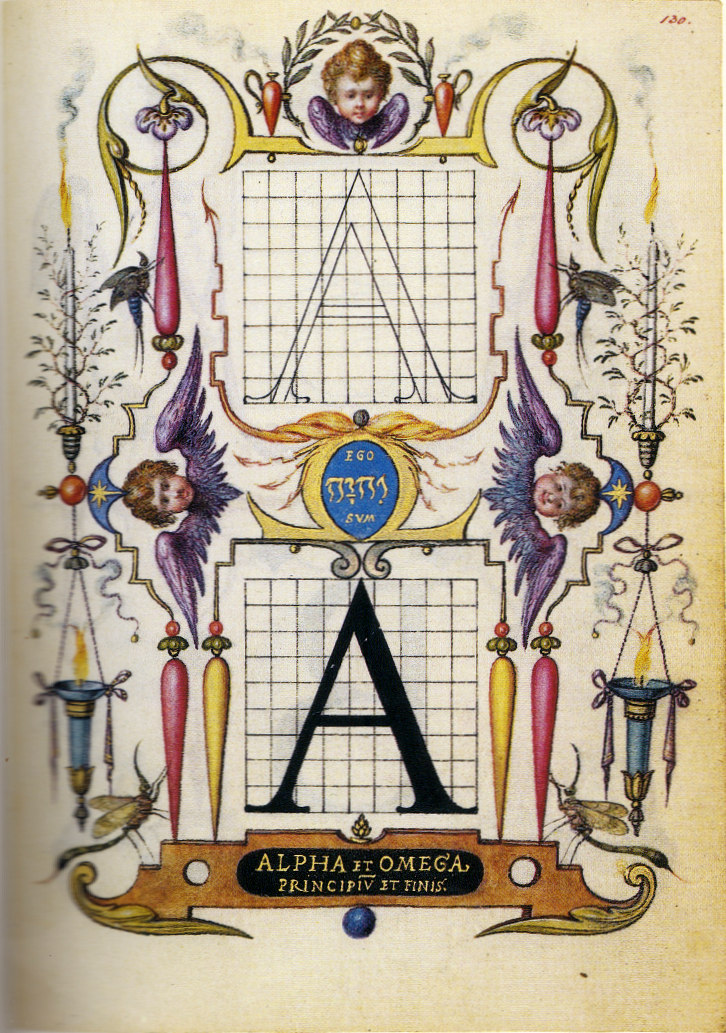
In past eras childrens’ abecedaria lessons included Bible lessons and verses. I have an abecedarium (of course I do!) and here is its first page. It is an illuminated alphabet from the court of Emperor Rudolf II.

Rudolf II (1552 – 1612) was Holy Roman Emperor, King of Hungary and Croatia, King of Bohemia and Archduke of Austria. He was a member of the House of Hapsburg. The illuminated ‘A’ and picture represents a verse from Revelation 1:8,

I am the Alpha and the Omega,” says the Lord God, “who is and who was and who is to come, the Almighty.”

The explanation of the picture from the abecedarium is that: “the first written symbol pays homage to God, the ruler of heaven and earth, the “beginning and the end”. The biblical verse, accompanied by the tetragram of Gods’ name is quoted within a stylized Omega in the middle of the page and in a cartouche at the bottom margin. With this verse, the first letter of the Greek alphabet simultaneously refers to the last one. The blue medallion containing the tetragram of his name occupies the the center of the folio. It connects the constructional drawing of the letter A with its executed version and is surrounded by the Omega, which generates flashes of lightning and thunderheads as symbols of God’s might.”

“In the upper margin, a cherub is surrounded by a laurel wreath, a sign of God’s fame, and flanked by incense burners. This angel praises the Lord along with the cherubim at the right margins. At both left and right, eternal lights burn in praise of God, as so candles entwined by olive branches, which symbolize his peace, Four demonic winged insects (the two antennae on the abdomens of the upper ones indicate that they are Ephemerae, whose life span is a single day) are attracted by the flames.”

A children’s book can be very sophisticated. Another antique book style was a Bestiary.

Bestiary is “a descriptive or anecdotal treatise on various real or mythical kinds of animals, especially a medieval work with a moralizing tone. The natural history and illustration of each beast was usually accompanied by a moral lesson. This reflected the belief that the world itself was the Word of God, and that every living thing had its own special meaning. For example, the pelican, which was believed to tear open its breast to bring its young to life with its own blood, was a living representation of Jesus. The bestiary, then, is also a reference to the symbolic language of animals in Western Christian art and literature.

Illustration from from the Oxford Bestiary; Perindens, a magic tree and keeper of the birds.

Another kind of book that was popular when Bunyan was writing Pilgrim’s Progress was the Emblem Book:

An emblem book is a book collecting emblems (allegorical illustrations) with accompanying explanatory text, typically morals or poems. This category of books was popular in Europe during the 16th and 17th centuries.

In part 1 and in part 2 when Christian and Christiana are in the House of the Interpreter, there seems to be a similarity to the scenes Bunyan records there with an Emblem Book. This Wiki entry explains.

“Many of the pictures in the House of the Interpreter seem to be derived from emblem books or to be created in the manner and spirit of the emblem. … Usually, each emblem occupied a page and consisted of an allegorical picture at the top with underneath it a device or motto, a short Latin verse, and a poem explaining the allegory. Bunyan himself wrote an emblem book, A Book for Boys and Girls (1688) …”, cf. Sharrock, p. 375.

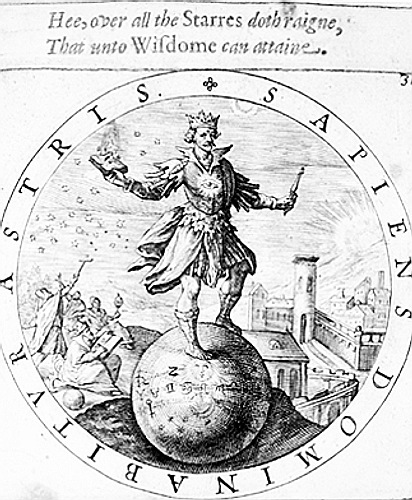
Right, Wisdom – from George Wither’s Book of Emblems (London 1635)

So…that is all pretty interesting. We know that the Bible itself contains many different kinds of literary styles. From GotQuestions’ list

historical literature (1 and 2 Kings),
dramatic literature (Job),
legal documents (much of Exodus and Deuteronomy),
song lyrics (The Song of Solomon and Psalms),
poetry (most of Isaiah),
wisdom literature (Proverbs and Ecclesiastes),
apocalyptic literature (Revelation and parts of Daniel),
short story (Ruth),
sermons (as recorded in Acts),
speeches and proclamations (like those of King Nebuchadnezzar in Daniel),
prayers (many Psalms),
parables (such as those Jesus told),
fables (such as Jotham told), and
epistles (Ephesians and Romans).

I recently read an epistolary novel, The Guernsey Literary and Potato Peel Pie Society. I read Pilgrims Progress part 1 this summer and I’m reading part 2 now, which is an allegory. I’m reading poetry, a book of short stories, and a non-fiction historical. This past summer I read Moby-Dick, which is a little of every genre, I think!

Reading widely in various genres helps the Christian when s/he reads the Bible. Reading the Bible with its many genres helps the Christian when s/he reads widely. It works both ways. Christians should be readers. Challies explains why. An abecedarium might not be your cup of tea, neither a bestiary or an emblem book, but there are many different kinds of books besides the standard Christian novel or the non-fiction theology book. Try one! I had a hard time at first with Pilgrim’s Progress because I don’t connect well to abstractions like symbolism or allegory, but I’m glad I stuck with it. The skill helps me when I read the Bible. The word pictures in the allegory also stay with me.

Let me know what different genre you tried and how you liked or didn’t like it!


Posted in gospel, theology

The Gospel is simple, and narrow

By Elizabeth Prata

There is something in us that deep down, quite disbelieves the Gospel could be so simple.

Years ago when I was teaching fourth graders, they thought that the more you wrote, the better the answer. They thought that the bigger the words they used, the better. The more complicated their essay was, the better grade they were going to receive.

Sometimes that’s the case, but usually not. Less is more.

Ernest Hemingway is famous for his writing rules. He always said that shorter sentences and vivid words, but not longer words, made for a clearer story.

Now, brothers and sisters, I want to remind you of the gospel I preached to you, which you received and on which you have taken your stand. By this gospel you are saved, if you hold firmly to the word I preached to you. Otherwise, you have believed in vain. For what I received I passed on to you as of first importance: that Christ died for our sins according to the Scriptures, that he was buried, that he was raised on the third day according to the Scriptures (1 Corinthians 15:1–4).

The Gospel is short & simple. It’s deep and mysterious, but on the surface it’s simple. If a man repents of his sin and asks the risen Savior who died for those sins to forgive him, he is saved. A person is saved by grace, not by works. He is not saved by complex hierarchical rituals, or lengthy creeds, or religious systems based on byzantine schemes. He is saved by grace, a free-to-us gift from Christ. (Ephesians 2:8–9).

For all its simplicity, the Gospel is narrow. It is simple and understandable, but narrow. There is no other way into heaven.

John Bunyan in his autobiography Grace Abounding, wrote of a dream he’d had. It involved walking up to a base of a tall mountain with a wall around it.

Now, this mountain and wall, etc., was thus made out to me—the mountain signified the church of the living God; the sun that shone thereon, the comfortable shining of His merciful face on them that were therein; the wall, I thought, was the Word, that did make separation between the Christians and the world; and the gap which was in this wall, I thought, was Jesus Christ, who is the way to God the Father (John 14.6; Matt. 7.14). 

But forasmuch as the passage was wonderful narrow, even so narrow, that I could not, but with great difficulty, enter in thereat, it showed me that none could enter into life, but those that were in downright earnest, and unless they left this wicked world behind them; for here was only room for body and soul, but not for body and soul, and sin.

We can’t bring anything with us as we pass through that narrow gate. We do not add to the Gospel nor do we take away from the Gospel. Its simplicity is part of what makes it clear. Grace abounds when its efficacy is bestowed upon us.

Every word of God proves true; he is a shield to those who take refuge in him. Do not add to his words, lest he rebuke you and you be found a liar. (Proverbs 30:5-6)

But even if we or an angel from heaven should preach to you a gospel contrary to the one we preached to you, let him be accursed. (Galatians 1:8).

gospel

Posted in encouragement, Uncategorized

The Pilgrim’s Progress, John Bunyan, and Helpful Resources

Pilgrim's_Progress_2I really love this book. I’ve read it once, picked through it several times, and now I’m listening to Derek Thomas lecture on it at Ligonier.org’s Daily Video. (1st lecture in the series here).
There is a part 2 to Pilgrim’s Progress that Thomas urges us to read, as both parts are meant to be a coherent whole. I had not known that.

Pilgrim’s Progress was written by John Bunyan while he was in prison for 12 years for preaching the Gospel. Wilkipedia has a bio of the man, more at link

John Bunyan (unknown birth date, baptised on November 30, 1628 – August 31, 1688) was an English writer and Puritan preacher best remembered as the author of the Christian allegory The Pilgrim’s Progress. In addition to The Pilgrim’s Progress, Bunyan wrote nearly sixty titles, many of them expanded sermons.

He also penned the world’s first recognized visual theology, the Mapp Shewing Order and Causes of Salvation & Damnation“. Tim Challies updated the Map to modern graphical styles, though let it be said I enjoy the original, with its angels and dragons and soaring language. Challies said of the maps,

In a pair of side-by-side timelines he traced the salvation of the believer (or the elect) and the damnation of the unbeliever (or the reprobate). …

Let me start you with a hint: Begin on the left side and read through circles one to 25 as a big, long sentence. When that’s complete, do the same for the other side. Finally, go back to read the verses and additional information. I think you will find, as I did, that the first sentence is terrible and chilling while the second is beautiful and encouraging. Whatever you do, linger. Bunyan has a lot to teach us through this infographic.

Here’s a link to Bunyan’s original (and IMO, better) map. Bunyan’s spiritual autobiography, Grace Abounding to the Chief of Sinners, is also a wonderful book. You can find a free text version online here. Or here in .pdf form, which you can download and then send to your Kindle via Kindle email attached as a file and it will be installed on your device.

Since Bunyan is so well known for Pilgrim’s Progress, few people know he wrote so many other books.

Anyway back to the book Pilgrim’s Progress. Why is this book important?

Leland Ryken said in a foreword at Desiring God about the 2 books(s) The Pilgrim’s Progress parts 1 & 2,

The book that became known to posterity as The Pilgrim’s Progress is a Christian classic whose importance is impossible to overstate. For more than two centuries after its first publication, The Pilgrim’s Progress ranked just behind the King James Bible as the most important book in evangelical Protestant households. Te book has been translated into some two hundred languages, including eighty in Africa. Any book that has achieved such popularity has a very large claim to our attention. Facts of Publication The Pilgrim’s Progress actually has two publication dates, corresponding to the two books that comprise it. The first book was published in 1678 and bore the title The Pilgrim’s Progress: From This World to That Which Is to Come, Delivered Under the Similitude of a Dream. It tells the story of the spiritual journey of the protagonist named Christian from the City of Destruction to the Celestial City (meaning heaven).

Book II was published six years later as part of an old artistic tradition known as a “companion piece.” It tells the story of the same journey, this time undertaken by Christian’s wife, Christiana, and their four sons.

The hard part for me when reading Pilgrim’s Progress is not the 350-year-old language. Though, if the language presents a difficulty, there are free updated, modern language versions available, both for free online and in hard copy.

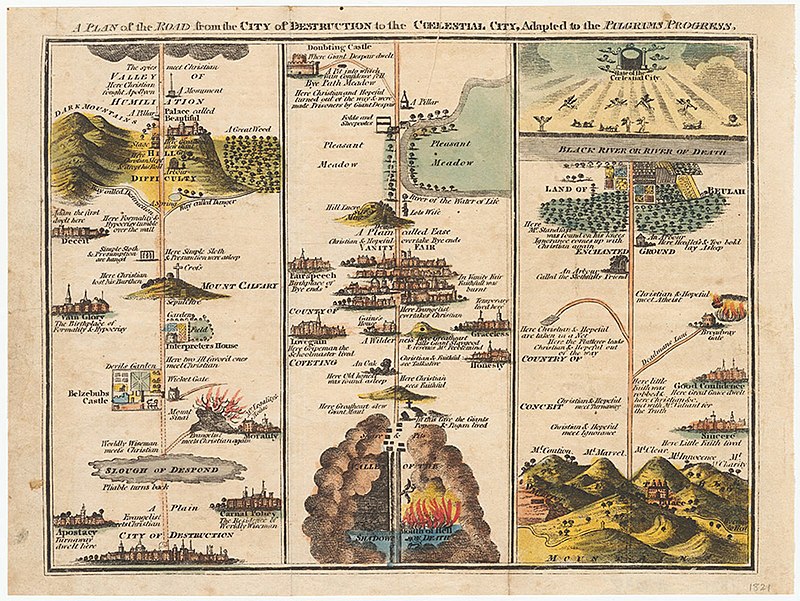
800px-John_Bunyan,_The_Road_From_the_City_of_Destruction_to_the_Celestial_City_1821_Cornell_CUL_PJM_1038_01

A Plan of the Road From the City of Destruction to the Celestial City, Adapted to The Pilgrim’s Progress, 1821. Public Domain

What I find hard is the abstractness of it, because I’m very literal. I do not understand allegory or symbols in literature.

Pilgrim’s Progress is an allegory. An allegory is a literary device. Here is allegory defined

Allegory is a figure of speech in which abstract ideas and principles are described in terms of characters, figures, and events. It can be employed in prose and poetry to tell a story, with a purpose of teaching or explaining an idea or a principle. The objective of its use is to teach some kind of a moral lesson.

Difference Between Allegory and Symbolism
Although an allegory uses symbols, it is different from symbolism. An allegory is a complete narrative that involves characters and events that stand for an abstract idea or event. A symbol, on the other hand, is an object that stands for another object, giving it a particular meaning. Unlike allegory, symbolism does not tell a story.

I enjoyed Ligonier Theologian Derek Thomas in these free 23-minute lectures explaining Pilgrim’s Progress, both parts one and two. I found them extremely helpful in understanding the book. In addition to explaining the allegories and what they (likely) stood for, Thomas folded in Puritan history and culture of Bunyan’s day and set the context for how Bunyan thought and what was happening in his life as he wrote the book. This information gives depth and nuance to understanding it.

The City of Destruction
The Wicket Gate
The Interpreter’s House
The Cross & the Sepulcher
The Hill Difficulty
The Palace Beautiful
The Valley of Humiliation
The Valley of the Shadow of Death
The Godless City: Vanity Fair
The Castle of Giant Despair
The Delectable Mountains
The Celestial City

Another resource for this marvelous book is Notes & Commentary, Guide to Pilgrim’s Progress by Ken Puls.

An additional resource is Mt Zion Chapel Library, Pilgrim’s Progress for Everyone

I hope you enjoy the resources and would consider reading The Pilgrim’s Progress.