Posted in encouragement, Uncategorized

Sisters having a tough Father’s Day, you are not orphans

It’s Father’s Day and Facebook is all aglow with well wishes for loving fathers and family photos vintage and current of dads with their happy families. I find this heartwarming. I love seeing pics of dads with daughters proclaiming their father’s virtues.

My experience was different. I didn’t have a loving father and he wasn’t traditionally involved in my life to any appreciable degree. He was a good worker, and intelligent. He created a business from scratch and made a successful go of it. I’m so proud of him for that. He was a raconteur, regaling dinner guests with humorous stories he told in entertaining fashion. But as a father…his virtues take a little longer to discover.

He did provide us a home, and a nice one, too. He paid for my college, no strings, the best gift he he ever gave me. He did keep his promise to financially support us after he and his wife divorced. He helped me financially at periods through my early adult life. He usually remembered my birthday and Christmas with a check, signed “Love, Dad.”

But in all his 81 years of life he never said the important words “I love you.” Not once.

Neither did he show through action any love hidden deeply and unspoken. Despite invitations to personally come to Parents’ Day at College, or the ribbon cutting of my new business or other celebratory things Facebook Fathers seem to enjoy, that was not my lot. Despite tragedies such as unwanted divorce or hospitalization, no father appeared by my bedside or at the lawyer’s to give support. There simply was a great, silent, empty vacuum on the Interstate corridor between his home and mine.

It was kind of a blessing to learn late what kind of relationship other girls had with their dad. I was unaware for a long time of what I had been missing. For example, I had not known that dads and daughters spent time alone together, like having a picnic or going to the movies. I was shocked to learn this. I was never alone with my father, for any reason at any time, casual or scheduled. I literally would not know what to say to him if we ever had been.

He was a man full of laughter during dinner parties but with the family that was another matter. He had a low tolerance for many things, such as noise, questions, failing an unspoken standard, moving his remote control, sitting in his chair, and lots of other stuff. Anger eruptions would occur at any time and send us fleeing to separate quarters to escape the wrath.

As an adult things eased. There was a period of time we were socially friendly. Me and my husband and he and his live-in, long term girlfriend would go out to dinner, sail on his boat, swim in the pool. It was like we were his young friends, not family. I remember one time he was telling a story about kids and we were laughing and laughing at the foibles of this kid he was recalling and the story picked up steam and the laughter got more hilarious and unthinkingly at the end he wiped his eyes and blurted, “I’m glad I never had kids.”

That was how far we were from his heart, so far that we weren’t his children at all. When we were little, we were noisy inconveniences not usually tolerated. As young adults we were a financial obligation. As older adults we were a built-in social network to ease his loneliness. And as a senior, he completed his life-long rejection thus- with disownment.

He not only wrote us off but specifically made note that this was intentional. The last act of Mr Prata regarding his children is an act of bitterness. He wrote an ending to a relationship that wasn’t over yet, but punctuated it anyway with a stroke of a pen.

I’m not writing this out of anger, just sadness. Sadness for him and of what he missed, and what he is missing now. I believe he died outside of the grace of Jesus, and that means he will remember for a punishing eternity the things written here and all the rest of his acts during his 81 years of life, forever. Nothing I could say or do about him is worse than that.

I hope that the silent daughters who are sad on this day looking online or in real life at all the happy dads and daughters would take heart. Coming up is an encouragement.

Daughters of Jesus, we know that the sweetness of a Father that will not reject us nor cast us out of His hand is a balm for the soul where the dad’s love should have been. Sisters who are watching the Facebook wall scroll by with happy cries of well-wishes for dads alive and dads gone on to glory, if that had not been your experience, just remember that we have a Father in Heaven. He has said we cry Abba! Father! for all our needs and upon whom to pour out all our love as he pours out His upon us. He is perfect, having formed us and known us from heart to soul to mind to strength. He is a Dad who sees us, El Roi, whose eyes roam to and fro over the earth “to give strong support to those whose heart is blameless toward him.” (2 Chronicles 16:9a).

We are His children-

But to all who did receive him, who believed in his name, he gave the right to become children of God, (John 1:12)

See what kind of love the Father has given to us, that we should be called children of God; and so we are. (1 John 3:1).

We are heirs to our Abba-

To redeem those who were under the law, so that we might receive adoption as sons. And because you are sons, God has sent the Spirit of his Son into our hearts, crying, “Abba! Father!” So you are no longer a slave, but a son, and if a son, then an heir through God. (Galatians 4:5-7)

For all who are led by the Spirit of God are sons of God. For you did not receive the spirit of slavery to fall back into fear, but you have received the Spirit of adoption as sons, by whom we cry, “Abba! Father!” The Spirit himself bears witness with our spirit that we are children of God, and if children, then heirs—heirs of God and fellow heirs with Christ, provided we suffer with him in order that we may also be glorified with him. (Romans 8:14-19)

I will not leave you as orphans; I will come to you. (John 14:18)

If you have lost your family due to the faith-

And everyone who has left houses or brothers or sisters or father or mother or children or lands, for my name’s sake, will receive a hundredfold and will inherit eternal life. (Matthew 19:29)


All these promises and more are for us and in us and about us, those who believe. There is much to take heart over. There is everything to be encouraged by in our relationship with the heavenly Father.

If you are not saved by grace of Jesus, and you’re feeling alone on Father’s Day with no father in your life, my deepest empathy goes out to you. I don’t know how you cope with the loss and not have the comfort of Jesus – the true Father – to turn to. If you would like to know something of this sweetness, comfort, and joy, email me. My email is in the “About this blog” tab up top.

With his seething pen, my father sought to obliterate the memory of his children from his heart and to puncture us with a long lasting wound. The irony is, the Lord causes those who reject Him to remember each and every sin of their earthly life, forever, while we, children of God, will not remember sorrows nor shall these things come to mind. (Isaiah 65:17). He will remember forever and lay in an eternal bed of anger and bitterness, while I will forget him and go on in joy and peace with my heavenly Father.

The former sorrows of the earth, under the fall, shall be so far from recurring, that their very remembrance shall be obliterated by the many mercies I will bestow on the new earth (Re 21:4-27). Jamieson-Fausset-Brown Bible Commentary on Is 65:17.

So take heart, sad or mourning or grieving daughters! I am happy to say that it has become my joy to rely on the love of my real Father and it will remain so all through eternity. I have a Father, and every day is Happy Father’s Day. You do too.

Posted in Uncategorized

Why study prophecy? And what does apocalypse really mean, anyway?

Do you notice that many of today’s news headlines refer to the apocalypse? ‘Drachmageddon”… “Election Apocalypse”, “Apocalypse-like hailstorm..” etc. … Though fewer people say they don’t believe in apocalypse, more and more the secular world is talking about it. Society is expecting…something. Carl Worline explained his opinion of this phenomenon:

“It is a pervasive feeling that something really big is about to happen. This feeling is exceptionally difficult to define. Christians hopefully look for the return of the Messiah. Many in the New Age Movement look[ed] for the Age of Pisces to end on the winter solstice on December 21, 2012, and for the Age of Aquarius to begin as the earth’s equatorial plane aligns exactly with the center of our galaxy. Buddhists look for the return of Maitreya sometime in the very near future. Mayans predicted and end of an epoch on December 21, 2012, and a new epoch to begin. The Aztec looked for the return of the flying serpent, Quetzalcoatl, sometime around the end of 2012. Aztecs also predict the possible end of time, as we know it, and possibly the end of the world. The I-Ching independently predicts the end to occur on the winter solstice this year. … The entire world is on edge because its inhabitants from every nation and culture feel something. Something that is almost impossible to identify or define…”

That’s the secular world for you, nibbling at the edges of the meaning of spiritual things but never quite coming to the truth. However, we have Christ, the mind of Christ, and His Spirit, so we know the definition of Apocalypse. We don’t have to guess. Though it’s often referred to as an event that is of great destruction or even the end of the world, it literally meansunveiling. It comes from the Book of Revelation, where the word is used in Revelation 1:1. God’s intent for the world is unveiled. From Strong’s Greek in Revelation 1:1,

The revelation of Jesus Christ, which God gave him to show to his servants the things that must soon take place. He made it known by sending his angel to his servant John,

Apokalypsis   Ἀποκάλυψις    [The] Revelation

In that sense, the entire Bible could be called the Apokalypsis, because it is God’s inspired revelation of Himself to humanity. But the word and the concept is deeply explored in Revelation 1-22 because Jesus specifically reveals His Second Coming.

Do not avoid prophecy, study it! Why study prophecy? Aside from the fact that we are commanded to? (Mark 13:37).

I study prophecy because –

–it is part of the bible, God’s revelation of Himself through holy inspired word
–it is commanded (See above)
–it instills in me an urgency to live righteously and to witness. We don’t study just for the information and go our way. It has to affect our Christian walk, just as any scripture does.
–It comforts me to think of these things being fulfilled:

In the last days the mountain of the Lord’s temple will be established as chief among the mountains; it will be raised above the hills, and peoples will stream to it. Many nations will come and say, Come, let us go up to the mountain of the Lord, to the house of the God of Jacob. He will teach us his ways, so that we may walk in his paths. The law will go out from Zion, the word of the Lord from Jerusalem. (Micah 4:1-2)

Isn’t that beautiful! I’m sometimes saddened by the number of people who profess Christianity but obviously do not possess Him. It’s comforting to know the peoples will stream to the holy Hill to worship! Or this prophecy from Isaiah 19:23-25, it’s so beautiful, uplifting, and hopeful.

In that day there will be a highway from Egypt to Assyria, and Assyria will come into Egypt, and Egypt into Assyria, and the Egyptians will worship with the Assyrians.  In that day Israel will be the third with Egypt and Assyria, a blessing in the midst of the earth, whom the Lord of hosts has blessed, saying, “Blessed be Egypt my people, and Assyria the work of my hands, and Israel my inheritance.”

We study the Bible to know God and worship Him rightly. We also study it to know of His past mighty deeds. If you avoid prophecy you won’t be studying His future deeds! Again, why study prophecy?

–observing and studying is not just for knowledge, but to apply as we grow in knowledge
–to learn the entire sweep and scope of God’s promises,
–to instill a wonder at His sovereign hand from beginning to end
–to create in us an urgency so as to live righteously and to share boldly
–to be encouraged

When the fog totally lifts and it becomes apparent to all that the end IS near (Revelation 6:15-17), it is most comforting of all to know that the greatest revival on earth will take place. Though it takes place through blood and judgment, the LORD saves many to be with Him in heaven. (Revelation 7:9, 14).

What a prophecy, the best of all. This age will conclude with myriad upon myriad of saints worshiping Jesus at His throne! Despite the crushingly low count of seeming Christians around today, even in churches, the Lord wakes many hearts for His name. This is the best reason of all to study prophecy, to see His future handiwork in hearts.

After this I looked, and behold, a great multitude that no one could number, from every nation, from all tribes and peoples and languages, standing before the throne and before the Lamb, clothed in white robes, with palm branches in their hands, 10and crying out with a loud voice, “Salvation belongs to our God who sits on the throne, and to the Lamb!”
 
And all the angels were standing around the throne and around the elders and the four living creatures, and they fell on their faces before the throne and worshiped God, 12saying, “Amen! Blessing and glory and wisdom and thanksgiving and honor and power and might be to our God forever and ever! Amen.”
 
13Then one of the elders addressed me, saying, “Who are these, clothed in white robes, and from where have they come?” 14I said to him, “Sir, you know.” And he said to me, “These are the ones coming out of the great tribulation. They have washed their robes and made them white in the blood of the Lamb.
 
15“Therefore they are before the throne of God,
and serve him day and night in his temple;
and he who sits on the throne will shelter them with his presence.
16They shall hunger no more, neither thirst anymore;
the sun shall not strike them,
nor any scorching heat.
17For the Lamb in the midst of the throne will be their shepherd,
and he will guide them to springs of living water,
and God will wipe away every tear from their eyes.”


Posted in Uncategorized

Be a Weeble: dealing with depression and discouragement at the world’s evil

Remember the Weebles commercial of the early 1970s? Back then the commercials were of a more innocent quality than the ones we’re subjected to now. This Weebles ad from the 1970s is just so cute.

Whoever created that ad was a genius. Why? I remember the tagline even 40 years later! THAT is an effective ad. ‘Weebles wobble but they don’t fall down.” These Hasbro toys, launched in 1971, were a small, egg shaped toy with a weight at the bottom. If you pushed the toy over with your finger, the toy tipped because of the spherical shape at the bottom but the weight inside at the bottom immediately returned the toy to its center of gravity and it popped upright. No matter how often you pushed it over, it always returned upright.

A weeble

The events of the world are dark and evil. They can easily infiltrate our heart with a depression that clouds us and weighs heavy. We do Rejoice with those who rejoice, weep with those who weep as Paul advised in Romans 12:15. Christians should be defined by their faith, which includes compassion and love. We not only weep with those brethren who weep, but like Jesus, we weep for those who should weep but do not (Luke 19:41, MacArthur Commentary).

As the world descends into its prophesied Days of Noah, (Matthew 24:37), more and more of the world’s tragedies shock our sensibilities. The state of the world would surely cause any sane person to become depressed just by looking at headlines for one moment, never mind living in this cauldron of evil day after day. Opposition to the truth of Jesus Christ is another depressing item that causes many to weep with broken hearts at the broken churches and the broken bibles littering what today is called Christianity.

And dark clouds not only hover from without, but they can hover from within. Dark clouds of upset and impatience drift over the heart on little cat’s feet and poise, ready to descend at a moment’s notice. From within, a discouragement, frustration, a melancholy, or a depression can creep over the believer. Biblical illiteracy and confusion sets in to the heart, allowing more and more sin to infiltrate it. This becomes ripe ground for defeatism and depression. If some people are struggling with the dark clouds of spiritual depression, imagine how difficult these time are for preachers, whose main instrument is the heart! They labor with broken hearts much of the time.

I’ve been asked two questions recently. One is, don’t I get frustrated or discouraged with the rise in deception of the serpent, and its capturing into false doctrine of so many who profess to believe? And, how can a person stay positive in these dark times?

Many of the great believers of times past suffered from spiritual blackness of one level or another for periods of time that lasted from fleeting to lengthy. Asaph, Jeremiah, David, Paul, Martin Luther, Charles Spurgeon, Martyn Lloyd-Jones, Randy Alcorn, and John Piper were oppressed with clouds of melancholy or frustration or even full-blown depression at various times in their lives. Please don’t think you are alone. You’re not. Charles Spurgeon is almost universally recognized as a mature leader of the faith who also had a deep, long-lasting spiritual depression. Spurgeon said that depression happens frequently to many people.

However, please excuse my straight-forwardness, but please also don’t think wallowing in a spiritual depression is proper. It’s not.

Less talked about was that Spurgeon himself considered this a sinful weakness. He distinguishes between a God-appointed weakness and a human sinful weakness, and he places depression squarely in the latter category. Spurgeon believed despondency was not a virtue, but a vice.

He said “that to be unbelieving, desponding, nervous, timid, cowardly, inactive, heartless is not excusable and not proper” and of despondency, Spurgeon said “I am heartily ashamed of myself for falling into it, but I am sure there is no remedy for it like a holy faith in God.

Charles Spurgeon’s depression started when he was 24 years old. Spurgeon later recalled,

My spirits were sunken so low that I could weep by the hour like a child, and yet I knew not what I wept for.

In a Conversation Between John Piper and John MacArthur, John Piper recounted his depression that began at 40 and lasted years,

I was 40, halfway through my vacation, sitting on the steps, sobbing. Noelle comes down the stairs, asks me “What’s wrong?” I said, “I don’t have a clue.”

As the segment is summarized here, we learn of depression and two pastors’ responses to it-

…it begins with “MacArthur explaining that he has never really been depressed. Some Christians are a bit like MacArthur. To be honest, that can make it hard for them to empathize with the Pipers of this world who goes on to describe how he had a period of his life where he was significantly depressed that lasted several years. MacAthur’s incredulous “Years?!” demonstrates how very differently they are wired.”

“Years?!”

So how do we stay positive when the world is crazy and it seems like the visible church is collapsing under top-heaviness of celebrity pastors, megachurches, and false doctrine?

1. The number one way is to recognize, worship, and rest in the sovereignty of God.

Ecclesiastes reminds us that from the top government down, from Kings, Prime Ministers, Presidents, and Judges, down to the lowliest of tax collectors and pagan sinners, God has His hand in all they do and don’t do. He ordains everything and purposes it according to His plan. Judgment for the evil done on earth WILL happen.

I said in my heart, God will judge the righteous and the wicked, for there is a time for every matter and for every work. (Ecclesiastes 3:17)

Why would God delay judgment, and not take care of it all at once? One reason is this, the Preacher of Ecclesiastes continues:

I said in my heart with regard to the children of man that God is testing them that they may see that they themselves are but beasts. (Ecclesiastes 3:18).

He will not let evil go on forever, and He will purge the world of all unrighteousness.

2. Have faith. Ask for more faith. Faith.

Spurgeon preached that faith was the cure. Use your faith to trust God, ask for more faith to trust Him more. This is what Charles Spurgeon did. He noted,

When the sinner is pointed to the Cross and comes to trust himself with Jesus—viewing the blood sprinkled and the righteousness worked out—then the man can pray, can sing, can melt in penitence or can rise up in flames of love! … The inability of human nature is instrumentally removed by the energy of faith.

Speaking of energy…

3. Stay busy in spiritual disciplines.

In the conversation between Piper and MacArthur, MacArthur said that he stays very busy. Having to write several sermons per week keeps him in the Word. Studying for preaching infuses him with a joy that drags him past the discouragement and he leaves it behind. Staying busy in the word is his primary mechanism to stave off discouragement or depression. Also, he said he ponders Paul and other biblical heroes who have endured worse and yet stayed hopeful.

John Piper said prayer is his go-to discipline. He prays to the Lord to keep him and preserve him, more than any other prayer. Piper said he prays to God to keep him in His will, keep him in his marriage, keep him in understanding and wisdom, etc.

3. Bask in the glory of God in His creation, in faith

Spurgeon commended the glory of God in creation as a remedy for depression:

To sit long in one posture, poring over a book, or driving a quill, is in itself a taxing of nature; but add to this a badly-ventilated chamber, a body which has long been without muscular exercise, and a heart burdened with many cares, and we have all the elements for preparing a seething cauldron of despair, especially in the dim months of fog—

“Heaviest the heart is in a heavy air,
Ev’ry wind that rises blows away despair.”

“Creation” by EPrata

Others like Alcorn took heart during his two-month depression just knowing he wasn’t alone, that other men battled spiritual depression was a balm. He battled it and his other periodic depressions by taking time to pray in thankfulness and gratitude.

I opened this essay by mentioning the old toy “Weeble.” They wobble, but they don’t fall down. They don’t stay down because they have a weight in the bottom that keeps the center of gravity centered. No matter the length of your Christianity, whether you’ve been saved for days or decades, no matter the level of maturity, babe or grizzled soldier, Jesus is our center of gravity. With our feet on the weighty rock, we might be knocked around a bit, but He will not let us stay down. Sometimes our battles are with temptations, or with the enemy, or sometimes it’s with despondency or depression. Don’t let the evil of the world get you down, or even wobble you for a moment. Jesus has overcome all the world’s evil, and if we are in Him, we have overcome it, too.

Peace I leave with you; My peace I give to you. I do not give to you as the world gives. Do not let your hearts be troubled; do not be afraid. (John 14:27)

Posted in Uncategorized

Prophecy: Living in peaceful dwelling places

In the bible, vines (usually grape) and fig trees were emblematic of agricultural abundance and that abundance bespoke wealth. Many fig trees meant prosperity. The promised land was described in Deut. 8:8 as “a land of wheat and barley, and vines and fig-trees and pomegranates.” It was not described as a land flat and therefore ripe for land prospecting development. It was not described as a land full of silver and gold mines. It was not described a land of great cities producing a rich population. The prosperity that was promised was riches from a bountiful earth.

Remember, that after the Fall, Adam was cursed with toil, and that the land would not yield unless he toiled with sweat and labor. What was it like before the Fall when the curse will be released? I can’t wait to find out, and that is what the Bible’s prophecies promise.

Cursed is the ground because of you; through painful toil you will eat of it all the days of your life. It will produce thorns and thistles for you, and you will eat the plants of the field. By the sweat of your brow you will eat your food until you return to the ground,” (Genesis 3:17b-19b).

Doesn’t sitting under our own fig tree and our vine and sound relaxing? Refreshing? Cool? Like walking with God in the garden in the cool of the day. He used the vine and fruit metaphor to symbolize spiritual abundance.

And Jesus said, “I am the vine; you are the branches. Whoever abides in me and I in him, he it is that bears much fruit, for apart from me you can do nothing.” (John 15:5).

And look what Jesus did! He did everything! He accomplished redemption for mankind, by breaking His own body and allowing it to be poured out! We are His branches, connected to the Great Gardener whose vine covers us, and which provides all sustenance.

In the end, the “Land” will not solely be the Middle-East lands promised long ago to Abraham, but all the earth. (2 Peter 3:10-13).

When you’re out haying this summer, sweat running down your face, or you’re out mowing this summer, and thirsting because of the heat, or you’re gardening and battling the bugs who are killing your bean plants, remember, the prophecies.

My people will live in peaceful dwelling places, in secure homes, in undisturbed places of rest.” (Isaiah 32:18).

I will sing for the one I love a song about his vineyard: My loved one had a vineyard on a fertile hillside.” (Isaiah 5:1)

How beautiful the relationship. We are the branches, closely grafted into the true vine. The true vine covers us, and we sit under it in peace and abundance. The abundance comes from the Vine Dresser who is the Father (John 15:1), who cares for the true vine in love and cares for his children, the branches.

Our God is a tremendous God!!!!!


[By Elizabeth Prata]

Posted in Uncategorized

Abimelech learned that sin is sin against God

We underestimate sin. We underestimate its power. We underestimate its effect. We underestimate its presence. And we certainly underestimate how God feels about it. Most of all, we underestimate against whom we are really sinning against.

The story in Acts 9 is familiar. The scene is the road to Damascus, and a man named Saul was breathing out threats and killing the Lord’s disciples. Jesus spoke to Saul, soon to be Paul, and asked in verse 4: “Saul, Saul, why are you persecuting Me?”

What? Saul was killing the disciples, not Jesus. Ah, but this verse shows us how intimately Jesus is involved in our lives, how tightly we are one, how, when you come against one of His children you come against Him. Saul was not just railing against the name of Christ in the disciples, but coming against Christ Himself.

for the union between Christ and his people is so close, that what is done to them is done to him. ~Gill’s Exposition
There is another scene in the Bible that displays a similar sentiment. It’s in Genesis 20. Abraham fears for his life and lies to Abimelech king of Gerar that Sarah is his sister so they won’t kill Abraham in trying to get to Sarah. Based on what Abraham said, Abimelech took Sarah.

Now comes the interesting part. Genesis 20:3 says what happened next was,

God came to Abimelech in a dream by night and said to him, “Behold, you are a dead man because of the woman whom you have taken, for she is a man’s wife.”

I wrote about one aspect of the verse a few days ago, here in an essay titled Beware of desiring a dream/vision, word from the Lord. God said to Abimelech, ‘Behold you are a dead man’?! The dreams and words from God the false teachers say they receive today are far from that powerful – and deadly. Anyway, Abimelech pleads his case. He replies inGenesis 20:4-5,

“Lord, will you kill an innocent people? Did he not himself say to me, ‘She is my sister’? And she herself said, ‘He is my brother.’ In the integrity of my heart and the innocence of my hands I have done this.”

God agrees with him. Abimelech had gone forward based on the information that was given to him, that Sarah was single. Given that he thought she was single, he took Sarah. However it was still sin.

Here is the climactic verse for the point of this essay:

God said to him in the dream, “Yes, I know that you have done this in the integrity of your heart, and it was I who kept you from sinning against me.” (Genesis 20:6). emphasis added.

There it is again. Abimelech learned the hard way that he was sinning. Worse, he learned that was sinning against God Himself. It didn’t matter that Abimelech hadn’t known Sarah was married. It didn’t even matter that Abimelech didn’t know God. Note that God did not say, ‘you would have been sinning against Abraham, the husband.’ Abimelech would have been sinning against Abraham. Ultimately though, all sin is performed against our Holy God. The King would be sinning against God if he had gone through with what he’d intended with Sarah. Here comes to mind the axiom, ‘Ignorance of the law is no excuse”.

Genesis 39:9 recounts a similar scene,

Joseph was being tempted to commit adultery with Potiphar’s wife. In resisting her, he said, “My master has withheld nothing from me except you, because you are his wife. How then could I do such a wicked thing and sin against God?” It is interesting that Joseph did not say that his sin would be against Potiphar. This isn’t to say that Potiphar would be unaffected. But Joseph’s greater loyalty was to God and His laws. It was God he did not want to offend. ~GotQuestions

Psalm 51:4 says “Against you, you only, have I sinned and done what is evil in your sight, so that you may be justified in your words and blameless in your judgment.”

All our sins are against a just and Holy God. Our sins might be toward a co-worker, a sibling, a passerby. But all sins are against God. We should keep this in mind.

No proof of the fullness of sin, after all, is so overwhelming and unanswerable as the cross and passion of our Lord Jesus Christ and the whole doctrine of His substitution and atonement. Terribly black must that guilt be for which nothing but the blood of the Son of God could make satisfaction. Heavy must that weight of human sin be which made Jesus groan and sweat drops of blood in agony at Gethsemane and cry at Golgotha, “My God, My God, why have You forsaken Me?” (Matt. 27:46). Nothing, I am convinced, will astonish us so much, when we awake in the resurrection day, as the view we will have of sin and the retrospect we will take of our own countless shortcomings and defects. Never until the hour when Christ comes the second time will we fully realize the “sinfulness of sin.” JC Ryle

We should keep this in mind also-

but God shows his love for us in that while we were still sinners, Christ died for us. (Romans 5:8)

Greater love has no one than this, that he lay down his life for his friends. (John 15:13)

Our knowledge of the sinfulness of sin and our resulting feeling of guilt is tempered by our love for Jesus who atoned for that sin. It is this love for Him that makes us want to mortify it in ourselves all the more. And so it goes, until the Day when we awaken, and see the true effect of sin, and say “what hath God wrought!” (cf Numbers 23:23)


[By Elizabeth Prata]

Posted in Uncategorized

Truly, truly, pay attention now! Amen

John is a profound book. John 3 is an exceptionally profound chapter. It is there we find Jesus speaking with Nicodemus about how to be saved. Is there anything more important than that?

In modern times we have word processing software to help us emphasize different words of phrases we want the reader to note. We can highlight, bold, italicize, underline, or print selected words in a different color. The Hebrews used to repeat a word they wanted the hearer or reader to note for emphasis.

In John 3:3, John 3:5, John 3:11 Jesus says three times in the same conversation about being born again, “Truly, truly.” Not only is the word doubled, but the doubled phrase is used several times in quick succession. This means PAY ATTENTION. In John 5 in the section about the authority of the Son, Jesus again repeats “truly, truly” several times for emphasis. (John 5:19, John 5:24, John 5:25).

It is only in John we see the double wording, even in the same stories told in other chapters, where there is a single “truly.”

The born-again teaching’s importance is emphasized by Jesus’ introduction of the doctrine by proclaiming, “Verily, verily”—or “Truly, truly,” “Most assuredly,” or “Amen, amen,” depending on the translation. All of His “Verily, verily” statements appear in the book of John, and they are used by Christ only when He is about to teach on a profound matter. The doubled “verily” denotes that what follows is of especially weighty and solemn significance, so we are to pay special attention. (Forerunner Commentary, John Ritenbaugh)

In other words, when coming across the doubled “truly” the reader should pay careful attention to the words being presented.

And it is interesting to learn about a literary device which will enhance our understanding of and love for the Word. But it goes even deeper than that. We can intensify our understanding by learning that the phrase “truly, truly” is the Hebrew word “amen.”

Charles Spurgeon explains the depth of meaning behind the word amen and why it is a title for Jesus, in a sermon delivered in 1866 called The Amen. (Revelation 3:14). In the sermon, Spurgeon says that there are three ways Amen is used; when an individual or the congregation is asserting, consenting, or petitioning. He explains at one point,

He was also “the Amen” in all His teachings. We have already remarked that He constantly commenced with “Verily, verily I say unto you.” Christ as teacher does not appeal to tradition, or even to reasoning, but gives Himself as His authority.

Spurgeon’s sermon on Amen (“truly, truly”) is wonderful and I recommend reading it.

In the sermon, Spurgeon makes note of another sermon, this one delivered by Abraham Booth, called The Amen of Social Prayer. Spurgeon recommends Booth’s sermon for its thorough explanation of the use of Amen. Spurgeon said,

Should you desire still further to enquire into the use and meaning of this remarkable word, there is a valuable sermon upon it in the works of Abraham Booth, which you may read, as I have done, to great advantage. If anything should lead to the revival of its use more generally in public worship, it will be a matter of great congratulation.

So note we have traveled a ways away from the initial reading of the Bibles passages in John 3, whereupon one may notice a repeated use of a phrase containing a repeated word. That’s the Bible, ever deeper, ever higher, ever more interesting. Jesus says truly, truly, (amen & amen), and He IS The Amen.

[By Elizabeth Prata]
Posted in Uncategorized

The problem with secular movies is…

… “they are trying to find the antidote for the emptiness of existence.”

Before I was saved I was of the world. After I was saved I became not of the world. (John 15:19). Given that this is stated plainly in scripture many times, it might seem obvious. And it is. However, what does that ‘of the world/not of the world’ look like in sanctification? In daily life?

After we are justified (declared righteous by Jesus) we grow in sanctification until we die. GotQuestions’ definition of sanctification is:

To “sanctify” something is to set it apart for special use; to “sanctify” a person is to make him holy.

Our overall trajectory should always be headed up. Though we might make temporary snail trails circularly or even go backward, our overall sanctification is always more, higher, up. (Colossians 3:10, 1 Thessalonians 4:3).

Before I was saved, I really loved movies. I bought Roger Ebert’s books. I read the Times reviews. I subscribed to the New Yorker. I enjoyed foreign films and independent movies and prided myself on knowing about them before everyone else. I knew each Oscar nominated movie and had a definite opinion on each.

The point of a secular movie has noting to do with the plot. It’s not obvious but is usually an is undercurrent, buried a bit. It’s there though. Movies are mainly a worldy endeavor and if it is written by a secular writer it will always reflect his fleshly world view. Not being saved and having the same world view as the world I missed that. I just thought movies were great.

After I was saved I continued to watch movies but my increasing sanctification made me sensitive to sex, profanity, and the like. We all notice that as we grow. Words or actions the characters take bother us when they didn’t used to. I mean, the very popular 1990s book Bridges of Madison County was made into a film (1996). I read the book and watched the film. I thought the movie had much to say about marriage, deeply exploring concepts and drilling down to the essence of everyman and everywoman in us. Upon re-watching the film after I was saved, I was horrified to find that it’s just a two-hour advertisement for adultery.

Secular movies by definition have to reflect the empty world view because that is the world view the writer of the book or movie possesses. They can’t see anything else. Though they try to get at the center of things, and they write around the hole in their heart, neglect the void in their conscience, there is nothing they can present to us on the pages of a book or in a film that will solve their eternal issue. They’re empty and they know it.

Since school ended for the year I like to watch movies or documentaries. I’ve watched Up in the Air with George Clooney, Men in Black III, 48 Hrs, Midnight in Paris, Trading Places. In all of them there runs a palpable sense of despair.

Wikipedia: “the individual’s starting point is characterized by what has been called “the existential attitude”, or a sense of disorientation and confusion in the face of an apparently meaningless or absurd world. This is existentialism or existential nihilism.

I’d watched Trading Places out of nostalgia, and found it enjoyable but less sweet than I’d remembered. A couple of scenes I really hated. That brought me to 48 Hrs, another Eddie Murphy movie, which shocked me with the amount of profanity I’d forgotten it contained. Looking for something happier, I turned to a George Clooney movie, but Up In The Air was so nihilistic I wanted to shoot myself by the end. Clooney in that movie IS the poster boy for the very definition of nihilistic existentialism (And forget The Descendants and The American. Classy despair is still despair.) Noticing this undercurrent of despair veritably makes secular movies for me, unwatchable.

In one scene in the Movie Up in the Air, Clooney’s prospective brother-in-law got cold feet immediately before the wedding ceremony. Clooney was called in to give the groom some courage. Here is the groom’s worry:

Well, last night I was just kinda laying in bed and I couldn’t get to sleep. So I started thinking about the wedding and the ceremony, and about our buying a house and moving in together. And having a kid, and having another kid and then Christmas and Thanksgiving and spring break. Going to football games, and then all of a sudden they’re graduating. They’re getting jobs, they’re getting married. And, you know, I’m a grandparent. And then I’m retired. I’m losing my hair, I’m getting fat. And then the next thing you know I’m dead. I’m just, like…I can’t stop from thinking, what’s the point?

It is the exact question asked of all people who dwell on this earth without Christ. Philosophers have made entire philosophies in trying to fill the void, celebrate the void, explain the void. In the movie, Clooney told the groom that sharing an empty life is what it’s all about. It makes the emptiness slightly more bearable. OK, Clooney didn’t say that exactly but that’s what his advice boiled down to. He did actually say this: “Life’s better with company.” I guess two people can stave off the despair better than one.

In searching for a sweet, nice movie to watch I stumbled on the very excellent Midnight in Paris. The opening 3 1/2 minute montage was a postcard ode to Paris, in cinematic softness and lovingly photographed. Main character Owen Wilson is a writer who wants to write novels in Paris but his high-maintenance fiance wants him to stick with script writing and buy a house in Malibu. One night as Owen was walking along a Parisian cobblestone street, musing about his writer heroes of the Paris of the 1920s, he was gestured inside a 1920s Peugeot and happily and wonderingly finds himself time-traveled back to the 1920s. He meets Hemingway, Fitzgerald, Cole Porter, Pablo Picasso, Gertrude Stein. At one point in his magical evening, as Stein held court at her salon with budding artistic and creative luminaries swirling around her, she said to Owen,

“We all fear death and question our place in the universe. The artist’s job is not to succumb to despair but to find an antidote for the emptiness of existence.”

The movie’s lightness, effervescent hopefulness, softly rounded hills of romantic perfection could not stop the undercurrent of secular truth. Masked it for a good while, but it came out nonetheless. I haven’t been able to find if the real Stein ever said that in real life. But searching endlessly for the antidote for the emptiness of existence has made Woody Allen (who wrote and directed the movie) a rich and successful man…who is still searching for that antidote.

I have no doubt that if you said to most screenwriters that they are unwittingly revealing the Book of Ecclesiastes in their movies, they’d deny it. But there it is. Vanity of vanity, all is empty- without Christ.

Christ is that antidote, and I find it curious that the screenwriter used the word antidote. You need antidotes for a poison, a disease. Life on this earth ultimately is a disease to unsaved people because they are dying, dying. Sin is a poison, a disease for which we sinners all need a cure.

The antidote is the blood of Jesus Christ.

For he satisfies the longing soul, and the hungry soul he fills with good things. (Psalm 107:9)

Only Christ satisfies. Chasing the endless vapor of possessions, pleasures, or people leaves one exhausted and even more discontent. There is nothing under the sun which will ever eternally satisfy. Only the Son, who comes from beyond the sun and in whom there is life, peace, rest. Solomon knew. His life is the plot for every movie to ever emerge from any screenwiter’s heart. And Solomon said all is vanity…but in Solomon’s despair there is hope, at the end.

Since God purposefully subjected the physical creation to vanity, therefore we can honestly conclude that all this vanity is a reality that serves our overall good in preparation for the Kingdom of God. It is a challenging obstacle. In His wisdom, He has determined we must first experience the emptiness of life without Him, become thoroughly disillusioned with what it has to offer, throw it off, and depart from it. The sufferings that vanity imposes help us to make a true assessment of the value of His grace and goodness, as well as truly and zealously commit ourselves to Him and His purpose. In such a circumstance, vanity will not have the last word.
John W. Ritenbaugh, Ecclesiastes and Christian Living (Part One)

The river of discontent and vanity running through secular movies, though depressing, reminds us once again of the emptiness we ourselves once felt when we were in our youth and without Christ. Ecclesiastes 12:11-14

The words of the wise are like goads, and like nails firmly fixed are the collected sayings; they are given by one Shepherd. My son, beware of anything beyond these. Of making many books there is no end, and much study is a weariness of the flesh. The end of the matter; all has been heard. Fear God and keep his commandments, for this is the whole duty of man. For God will bring every deed into judgment, with every secret thing, whether good or evil.

[By Elizabeth Prata]

Posted in Uncategorized

The Gospel is not a man-made invention

This morning I was reading another prayer from my wonderful Valley of Vision book. These are Puritan prayers and devotions, collected into one volume by Editor Arthur Bennett and printed by The Banner of Truth Trust. It is a must-have for your bookshelf.

These prayers often stop me in my tracks with their convicting beauty, depth of spirit, and fervency of faith. Today’s prayer was the first prayer in the section “Redemption & Reconciliation”, and it’s called The Gospel Way. You can read the entire prayer here.

I was immediately struck by the first line.

BLESSED LORD JESUS,
No human mind could conceive or invent the gospel.

Think about this for a while.

Really think.

This one statement has enormous ramifications. Thoughts could erupt in a thousand different paths. For me, I clearly remember the years (decades) before I was saved. I remember being mightily puzzled by the Jesus people, their fixation on the blood (Ew, gross) and the communion bread/wafer they ate that was supposed to be the Lord’s body (Ew, grosser). I remember being confused by their joy even when they were diagnosed with a dread disease, why they so often and profusely thanked the Lord for anything and everything (Oh, get over it, I’d say), and why, oh why, has Christianity persevered all these thousands of years when other religions … didn’t?
Continue reading “The Gospel is not a man-made invention”

Posted in Uncategorized

Jan Crouch and Muhammad Ali- questions of death, final destination, and eternity

Jan Crouch died a few days ago. Muhammad Ali died yesterday. Famous people dying makes us think about eternity. The news coverage puts eternity into the spotlight, along with the eternal question, what happens after death?

One minute after you slip behind the parted curtain, you will either be enjoying a personal welcome from Jesus Christ, or catching your first glimpse of gloom as you have never known it. Either way, your future will be irrevocably fixed and eternally unchangeable. ~Erwin Lutzer, One Minute After You Die

Of those family and friends of who we are pretty sure were justified on earth and are now glorified in heaven, we mourn their passing but celebrate their ongoing life. We might envision them meeting Jesus, and think of their wonder at the glory that surrounds them, and how excited they might be to praise and sing to the Savior. It is pleasant to ponder these imaginings of those we miss but are fairly sure have gone on to glory.

For those of whom we are less sure they are resting in peace or singing in the choir invisible, we have different imaginings. These ponderings would include people like Jan Crouch and Muhammad Ali. What was it like for them one minute after they died?

Janice Wendell Bethany Crouch was a woman who professed Christ but in near certainty did not possess Him. She was in fact a greedy false teacher who taught and believed in a different Jesus. I don’t think that can be debated. By any stretch, she was likely not justified and is probably not resting in peace, but in all probability is in torment. (Titus 1:16). We can’t say for sure, because final destination is the task of Jesus to determine. But there are strong indicators given what the Bible verses say about the entry requirements to heaven. So, we ponder her meeting one minute after she died.

The UK Daily Mail pulled no punches about Crouch’s death and life:

Televangelist Jan Crouch who founded the world’s largest ‘prosperity praying’ church and was famous for her purple hairdo and extravagant spending dies aged 78 

But before she passed away yesterday, days after suffering a massive stroke at her Florida home, the 78-year-old lived a life of enormous wealth funded by her Evangelical TV empire. Alongside her husband Paul, Crouch preached to millions of viewers on a weekly basis, promising them wealth if only they would open up their own pockets and donate to her. Using that money the couple bought adjoining mansions in Florida, jets worth almost $60 million and a $100,000 mobile home just to house Janice’s dogs, according to a lawsuit filed in 2012.

Jan Crouch was a ridiculous caricature of a woman. With her cotton candy, wild colored hair, extravagant lifestyle, and outlandish statements it was easy to dismiss her for being unbiblical in even her appearance. (1 Timothy 2:9, 1 Peter 3:3). Her evil influence regarding life and doctrine affected people across the entire globe. Jan Crouch did not know the Jesus of the Bible. So it’s easy to imagine that she might well have entered hell one minute after she died.

Matthew Henry said of false teachers (2 Corinthians 11:15),

It is far better to be plain in speech, yet walking openly and consistently with the gospel, than to be admired by thousands, and be lifted up in pride, so as to disgrace the gospel by evil tempers and unholy lives.

I have many thoughts about her and others like her, who lead millions astray. She grieved the Spirit many times, and though I want to say more, I’ll end this part on Jan Crouch saying exactly what Paul said in 2 Corinthians 11:15, of false teachers:

Their end will be what their actions deserve.

Muhammad Ali was a famous boxer, heavyweight champion of the world in fact. He was a masterful athlete, a gifted marketer, an orator extraordinaire. I came of age during his tenure as heavyweight champ. I was 14 when the Ali’s victory over Joe Frazier, happened. You remember the Thrilla in Manila. It was the greatest fight of all time, people say. Ali dominated my early adulthood like no other athlete did, not even Olga Korbut, Nadia Comăneci, or Evel Knievel. OK, lol on that last one. But my point is, Ali’s deeds and persona insinuated into even this retiring, bookish gal’s mind. He surely was a force to be reckoned with.

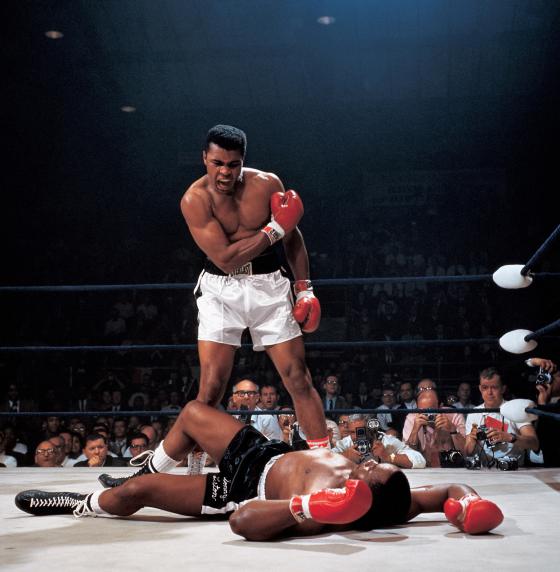
My father-in-law was a policeman and he was on duty inside the arena during the famous 1965 Lewiston Maine Ali-Vs. Sonny Liston fight. Ali was named Cassius Clay then, his real name before his conversion to Islam. The most famous and iconic shot of Ali ever taken occurred in Lewiston during that controversial fight. Neil Leifer’s photo is below,

Muhammad Ali after first round knockout of Sonny Liston
during World Heavyweight Title fight at St. Dominic’s Arena
in Lewiston, Maine on 5/25/1965. Leifer photo

In retirement since 1981, Ali has “helped promote world peace, civil rights, cross-cultural understanding, interfaith relations, humanitarianism, hunger relief, and the commonality of basic human values.”

In 1965, Ali joined the Nation of Islam and changed his name. He converted to Sunni Islam in 1975, and then to Sufism in 2005. Wikipedia reported,

Several weeks before the [Lewiston] fight, the Miami Herald published an article quoting Cassius Clay Sr. as saying that his son had joined the Black Muslims when he was 18. [Nation of Islam]. “They have been hammering at him ever since,” Clay Sr. said. “He’s so confused now that he doesn’t even know where he’s at.” He said his youngest son, Rudy Clay, had also joined. “They ruined my two boys,” Clay Sr. said. “Muslims tell my boys to hate white people; to hate women; to hate their mother.” Clay Jr. responded by saying, “I don’t care what my father said….I’m here training for a fight, and that’s all I’m going to say.”

In 1967, Ali was fervent enough in his beliefs in Nation of Islam to accept the consequences for his refusal to be conscripted. He had objected on religious grounds. Ali was arrested, found guilty and stripped of his heavyweight championship title. He fought the charge all the way to the Supreme Court, where his conviction was overturned. However, Ali had lost 4 prime fighting years in his career. He felt THAT strongly about Islam.

Muhammad Ali was easy to love and Jan Crouch was easy to hate. One spent a lifetime helping people and the other spent a lifetime bilking people. One rejected Christianity and another professed Him. Yet it is entirely likely that both are in hell, enduring eternal torment.

And so while relatives and friend plan your funeral- deciding on a casket, a burial plot, and who the pallbearers shall be, you will be more alive than you ever have been. You will either see God on His throne surrounded by angels and redeemed humanity, or you will feel an indescribable weight of guilt and abandonment. There is no destination midway between these two extremes; just gladness and gloom. Erwin Lutzer, ~One Minute After You Die

Ali’s good works won’t satisfy the entry requirement to heaven. His sincere religious beliefs won’t get him in. (Proverbs 16:25). Crouch’s pleas that everything she did, she did in His name won’t get her in. (Matthew 7:21-22).

The requirements to enter heaven are few, but are clear and direct. You must repent of your sins, and believe in the Jesus as revealed by the Bible. (John 3:15, Acts 1:11, Acts 2:32). Evidence for your profession is that you are submitted to Jesus’s ways, have stayed on the narrow path, and have grown in sanctification-producing fruit. If not…then not.

And these will go away into eternal punishment, but the righteous into eternal life. (Matthew 25:46)

I don’t write these things to point fingers and certainly not to gloat. I have shed tears writing this, and have stopped many times through the day to pray to Jesus in gratitude for His saving grace. I’m not saying that to appear super-spiritual but to demonstrate the weightiness of eternal matters. We cannot comprehend the seriousness of sin. Unbelievers are eternally guilty. Believers are eternally righteous. These are the most important ponderings in all of life.

When the curtain parts for us, nothing can keep us from answering the summons. One minute after we die we will either be elated or terrified. ~Lutzer

How can we be sure of where we are going after we die?

There are two important tests in Scripture for a person to determine whether or not he or she is a true believer.

There is first of all an objective test, which asks, “Do I believe?” Ask yourself if you affirm the Scripture’s record of the person and work of Jesus Christ. Do you believe that He is God manifest in the flesh? Do you believe that God saves sinners solely through the merits of Jesus Christ’s obedient life and substitutionary death on the cross?

Second is the subjective or experiential test of assurance in which you ask yourself, “Is my faith real?” The apostle John’s purpose in writing the epistle of 1 John was to give true believers assurance of their salvation (1 John 5:13). In that small epistle John gives several marks to distinguish a true believer. Source Gty.org

For more, go to the link, or here:

A Believer’s Assurance: A Practical Guide to Victory over Doubt

Is It Real: 11 Biblical Tests of genuine Salvation

For the unbeliever who may be wondering about the questions of eternity and final destiny, here is a resource,

What is the nature of true saving faith?

May God bless you and may you be assured of your destination into eternity. We all enter an eternity. Mine is with Jesus. I pray yours will be too.

And this is that testimony: God has given us eternal life, and this life is in His Son. (1 John 5:11)

[By Elizabeth Prata]

Posted in Uncategorized

Trip report, Lazarus’ trip to heaven

I see so many books and even movies coming out recounting someone’s trip to heaven. How exciting, they got to visit personally with Jesus! They were privileged with seeing the details of heaven, like the different colors we don’t have here on earth, and the winged rainbow horse Jesus pets. So I decided to turn to the Bible and see what the Bible people who have visited heaven say about their time there.

Lazarus was dead for four days. (John 11:17). Here is what Lazarus reported of the details of heaven upon his resurrected return. Looking in the Bible for the record of all that Lazarus said Jesus spoke, and Lazarus did, and what Lazarus saw, down to the colors, and all the necks of people he hugged, here is what Lazarus said:


Oops. Well, not to worry, the Widow’s Son from Nain was dead and resurrected. (Luke 7:11-15). I am sure he had a lot to say about heaven.


Maybe his book was lost over the centuries. I’m sure that Jairus’ daughter had a lot to say! (Luke 8:41-42, 55). Everyone else during the 2000’s seems to have so much to say about their trip to heaven! Let’s check out her trip report of the celestial places!


OK, OK, surely Dorcas would speak. She owes at least that much to the dozens who pleaded for her life! (Acts 9:36-41).


Certainly since Eutychus was young when he died and was resurrected and had a lot of time since his heaven tour would definitely have written a recounting of all the marvels. (Acts 20:9-10).


Drat. Well, there were “many” that were raised from their graves on the day of the Resurrection of Jesus. (Matthew 27:52). They probably wrote a lot of books all about what heaven was like, since their job was the be a witness, right?


I’m so disappointed that none of the Bible people who have been to heaven (or hell) told us in detail what it’s like. I mean, “I know a man in Christ who fourteen years ago was caught up to the third heaven—whether in the body or out of the body I do not know, God knows. And I know that this man was caught up into paradise—whether in the body or out of the body I do not know, God knows— and he heard things that cannot be told, which man may not utter.” (2 Corinthians 12:2-4).

Oh. It’s not lawful to speak of what you see in heaven? Paul and John and Isaiah and Ezekiel visited there and they did have a legal commission to report a few details. Paul was given a messenger of satan to help him remember not to speak of the heavenly glories. And it seems that no one else who was dead and resurrected spoke of what it’s like in heaven or hell?

Paul was such a strict interpreter of God’s word! What a party pooper. So are Lazarus and Dorcas and Eutychus ad the rest, they’re falling down on the job! At least these people aren’t worried about what is lawful or not to utter! They went right ahead and uttered it! Heaven tourism seems pretty lucrative, too. So glad they are profiting from trading on Jesus name. (2 Peter 2:3). Got to make a living.

I guess I’ll have to be satisfied with the lawful trip reports of heaven, from John (Revelation) and Ezekiel 1 and Isaiah 6.

——————————–

Further Reading

The End Time: Heaven Tourism Books are Bad

SO4J: False visits to heaven and hell = False Teaching

Justin Peters video: Heavenly Tourism

Editor’s Note: This essay is /sarcasm/. I do not believe the secular stories of trips to heaven, visions of heaven, and audible conversations with beings from heaven. (I’m talking to YOU, Joanna Gaines).  If you’re curious about it, I believe that the best and only approach is to read what the Bible has to say about heaven. It is sufficient.

[By Elizabeth Prata]