Posted in encouragement, Uncategorized

What is Living Water?

In our small group discussion on Thursday nights, people come with Bibles in hand and the pastor opens the floor to anyone with a question. We search the scriptures and engage in a discussion regarding the person’s question. Last night someone asked about one of my favorite metaphors in the Bible. What is the Living Water?

It is from the scene from John 4, when in Samaria, a tired Jesus sat down in front of the well, and a woman from the village came out a noonday to draw water. An amazing conversation ensued. Here are verses 10-14:

Jesus answered her, “If you knew the gift of God, and who it is that is saying to you, “Give me a drink,” you would have asked him, and he would have given you living water.” 11The woman said to him, “Sir, you have nothing to draw water with, and the well is deep. Where do you get that living water? 12Are you greater than our father Jacob? He gave us the well and drank from it himself, as did his sons and his livestock.” 13Jesus said to her, “Everyone who drinks of this water will be thirsty again, 14but whoever drinks of the water that I will give him will never be thirsty again. The water that I will give him will become in him a spring of water welling up to eternal life.

From this verse, we understand the Living Water is eternal life in Jesus. Nowhere else but in Jesus does a person have eternal life. He is the fountain. (Jeremiah 2:13). He is the spring. (Isaiah 12:3, Revelation 22:14, John 7:38).

What about after the moment of regeneration, after the person has received eternal life? The waters do not stop flowing. The living water is eternal life in Jesus, as mediated by the Spirit. It is the flow of the Spirit’s guidance that transforms the newly forgiven creature into a person gradually conformed to Christ for all eternity.

———————————————

Further reading

Founders Ministries: The Model

GotQuestions: What did Jesus Mean when he said Living Water?

Posted in encouragement, Uncategorized

God needs nothing … but …

God, as God, needs nothing. He is above all things. He is Creator of all things. He is self-sustaining, self-sufficient. He needs nothing.

Nor is He served by human hands, as if He needed anything, because He Himself gives all men life and breath and everything else. (Acts 17:26)

Think of this. As man, Jesus needed everything. As a babe He needed protection when his life was threatened. (Matthew 2:13). He needed shelter, the milk from His mother, the fostering of His father. He was weak, He grew strong. (Luke 2:40). As an adult, He needed sleep, food, rest. (John 4:6, Mark 11:12, Mark 4:38).

I’ve read and enjoyed the Prince and the Pauperand other switcheroo type stories, where the privileged character (usually royalty) accepts reduced circumstances either willingly or unwillingly and learns much from the experience, while the elevated one learns lessons too.

In life we are “upwardly mobile.” We’re standing on the provision and achievements of our parents, who give us opportunities and life-lessons. We then strive to exceed theirs. When we grow to adulthood we turn around and give a helping hand up to our children. We almost never willingly thrust it all aside and reduce our circumstances, just because.

Jesus did.

For we do not have a high priest who is unable to sympathize with our weaknesses, but one who in every respect has been tempted as we are, yet without sin. (Hebrews 4:15).

Jesus knows hunger, weariness, grief, joy, stress. He knows our need because He needed too.

What a great Savior we have.

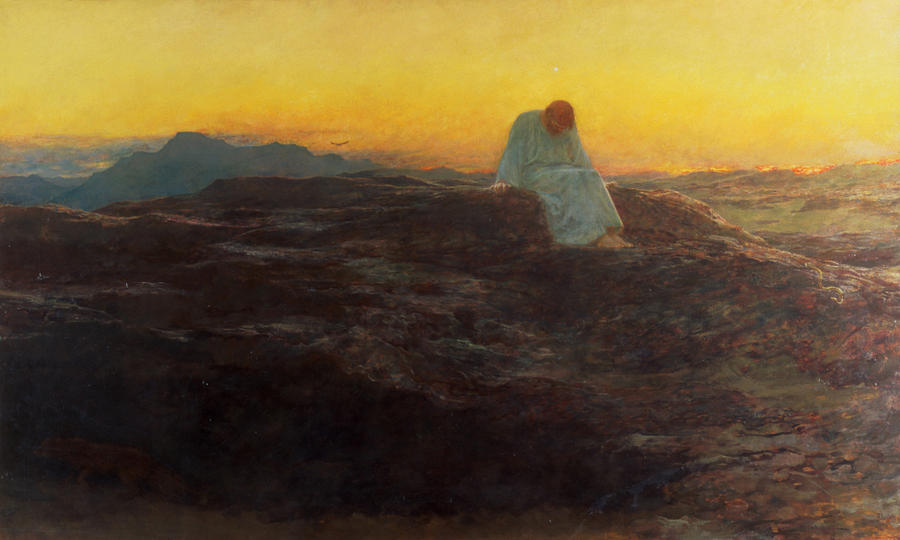
Christ In The Wilderness by Briton Riviere
Posted in encouragement, Uncategorized

Do you know how fast God can run?

I’m reading through Jeremiah. It’s been about ten years since I read through and so it’s time again. What a blessing God’s word is! I am overfilled and overwhelmed with just the first 11 verses in chapter 1.

And the word of the LORD came to me, saying, “Jeremiah, what do you see?” And I said, “I see an almond branch.” 12Then the LORD said to me, “You have seen well, for I am watching over my word to perform it.”

I enjoy the natural history aspects of scripture. As I read verse 11, I stopped to learn more. The first chapter deals with Jeremiah’s call to his fifty-year-plus long prophetic office, almost all of which was difficult, depressing, and discouraging.

The word of the LORD came to Jeremiah, opening with the famous line-

Before I formed you in the womb I knew you,
and before you were born I consecrated you;
I appointed you a prophet to the nations.

This is an example of foreordination, where God does not merely react to events on earth, but ordains them from before He created the world. He not only knows the end from the beginning, He authored it, ordained, it and performs it.

I was curious about the linkage of the almond tree with God’s word. What it is about an almond tree that I need to know so I can understand this verse better? How is an almond tree like God’s word? Why is an almond branch being used as a promise from the LORD that He will perform His word?

Spurgeon helped here, preaching an entire sermon on just verse 11. (sermon #2678, THE LESSON OF THE ALMOND TREE)  His sermon is ripe with meaning, insight, and background. It was extremely illuminating.

The almond tree is the first tree to awaken in the winter, hastening to put out leaves and then ripe fruit before any other tree. Spurgeon said that the Hebrew word for almond is wakeful.

Observe, first, that THE ALMOND IS A WAKEFUL TREE. The Hebrew word which is rendered “almond” comes from a root signifying to be wakeful, so this passage might be read thus, “I see the wakeful rod.”

Now, to my question about the linking of the almond tree with God’s word. In the section of his sermon explaining the almond tree with God being quick in performing His promises, Spurgeon said in part,

“Oh, but!” says one, “There are often long delays before peace is enjoyed.” Then it is because you make them, for God does not. “But sometimes we have to wait,” says one. Yes, yes; I know all about that waiting. Do you remember, in the parable of the prodigal son, where he waited? Why, with the harlots and others with whom he wasted his substance in riotous living, or with the swine, when he was feeding them with the husks with which he would gladly have filled his own empty belly. That is where he waited; but when did he end his waiting? When he said, “I will arise and go to my father.” He did not wait any longer, for we read, “And he arose, and came to his father;” and then it is written, “When he was yet a great way off, his father saw him,

and”—”and”—”and”—”and stood still, and waited for him to come”? No, no; I know that God waits to be gracious; but, according to the teaching of that parable, “when he was yet a great way off, his father saw him, and had compassion, and ran.” Do you know how fast God can run?

But again I ask, can you tell me how fast God can run? No, you do not know, you cannot tell; but you do know that He is all on fire with love to embrace a poor penitent sinner, and He speeds towards him at an amazing rate. … Swift as the lightning’s flash is the glance of divine compassion that brings life to a penitent soul.

I’ve always been slain and humbled by this fact. In my own conversion, I was in a dire spiritual circumstance, at very rock bottom. My next stop was the pit to be lost forever. At the end of myself, the only place I had to look was up. I was 42 years old, having pursued sin all my life. Yet when I cried out to Him for “help”, He helped me immediately. He didn’t say, ‘Wait, you decades-old sinner.” He did not say “Let me think about it.” I pled for my soul and He answered immediately. He ran!

He is a good God, a just God. I would have deserved my place alongside other sinners in hell. Yet he hastened to fulfill my appeal. Do I know how fast God can run? Yes, I do. I am eternally grateful.

Posted in encouragement, Uncategorized

There’s no such thing as tragedy in a Christian’s life

This will be among the shortest blog essays I’ve ever written, but it will be one of the most powerful. At least, it was for me. I pray it is for you as well.

John Gerstner was a Professor of Church History at Pittsburgh Theological Seminary and Knox Theological Seminary and an authority on the life and theology of Jonathan Edwards. He produced many edifying works in his life, most famously, his “Handout” series. Handout Church History, Handout Theology, and Handout Apologetics are among some of the most wonderful series of lectures and handouts he ever produced. They are easily available online, foremost at Ligonier.org but also in books and videos elsewhere.

Anyway, in his Handout Theology series I’m watching at Ligonier, he did several lectures on the Doctrine of Providence, which is my favorite doctrine. He referenced Romans 8:28 which I’ll post. Then his comment below.

And we know that for those who love God all things work together for good, for those who are called according to his purpose. (Romans 8:28)

I was once asked, ‘what is tragedy?’ It is whatever happens to the unconverted. No matter how great a blessing, it is a curse to the unconverted because he does not receive it with gratitude to the Giver. On the other hand, no matter whether a snake bite, or whatever, it is a blessing to God’s children for whom all things work together for the good. ~John Gerstner, Handout Theology lecture on Providence, part 2

When we focus on Jesus in His heaven, it changes our perspective. When our worldview changes, we settle into the peace that Jesus gives us, the peace that passes all understanding.

———–

Further reading

John Gerstner, Handout Theology lecture on Providence, part 1

John Flavel: The Mystery of Providence

Spurgeon sermon: Providence

Posted in encouragement, Uncategorized

Our compassionate Lord

This world is so depraved it shocks me still, sometimes. The depravity of my own heart shocks me, especially as I recall the person I was before salvation. Ow! What weight of memory burdens my soul! What dark corners leap out to poison my psyche!

Yet the Light of Jesus’ salvation is the balm to a poor, aching soul. He ministers peace and joy to us in abundance. If I focus on Him, all is well. His endless and infinite qualities bear pondering. His love is something in which we delight, like birds at the fountain or children on the playground. As the song says, the things of earth grow strangely dim in the light of His glory and grace.

More and more I feel the Spirit’s growth in me. I know this because I am more patient with the lost, and I feel a burden for them increasingly. This is not due to any natural capacity I possess for loving other people. I opened the essay reiterating my own depravity. Such patience and compassion are entirely due to the Spirit. Ultimately, the wellspring of such compassion comes from Jesus. See how many scriptures refer to his longing to save, His compassion for those who wander in the dark. Yes, we’re all aware of His wrath upon such poor souls. I speak of His wrath often. But His compassion is magnificent also. Let’s see what the Savior says.

O Jerusalem, Jerusalem, the city that kills the prophets and stones those who are sent to it! How often would I have gathered your children together as a hen gathers her brood under her wings, and you were not willing! (Luke 13:34)

When He stepped ashore and saw a large crowd, He had compassion on them and healed their sick. (Matthew 14:14)

As Jesus approached Jerusalem and saw the city, He wept over it. (Luke 19:41).

When he saw the crowds, he had compassion for them, because they were harassed and helpless, like sheep without a shepherd. (Matthew 9:36).

Barnes’ Notes says of the KJV of the verse (i.e. fainted v. harassed)

Because they fainted – The word used here refers to the weariness and fatigue which results from labor and being burdened. He saw the people burdened with the rites of religion and the doctrines of the Pharisees; sinking down under their ignorance and the weight of their traditions; neglected by those who ought to have been enlightened teachers; and scattered and driven out without care and attention. With great beauty he compares them to sheep wandering without a shepherd. Judea was a land of flocks and herds. The faithful shepherd, by day and night, was with his flock. He defended it, made it to lie down in green pastures, and led it beside the still waters, Psalm 23:2. Without his care the sheep would stray away. They were in danger of wild beasts. They panted in the summer sun, and they did not know where the cooling shade and stream was. So, said the Saviour, is it with this people. No wonder that the compassionate Redeemer was moved with pity.

We serve a great and compassionate King. He is not distant, nor is He uncaring. As much as we are longing to see Him, He is longing to see us, to bring His Bride Home safe as a hen gathers her chicks.

Praise God from whom all blessings flow.

Posted in encouragement, Uncategorized

Earthly Footsteps of The Man of Galilee: the thorny fence

I love the old book, Earthly Footsteps of The Man of Galilee and the Journeys of His Apostles.

The book contains 400 original photographs by Robert E.M. Bain, taken in Egypt, Israel, Syria, Lebanon, Turkey, Greece, and Italy. Descriptions for each photograph are written by James Lee. These photographs depict the life of Christ and the influence of his ministry—the locations where Christ was born, baptized, crucified, as well as scenes from his prayers, miracles, and sermons. This resource also contains photography of sacred sites between Jerusalem and Rome.

In these photographs taken in the late 1890s, not much had changed in Palestine from the time of Jesus until then. When one sees the vintage, sepia photo of a lone colt tied to a tree in front of a house, one can easily imagine the scene when Jesus told the disciples to go find the young donkey so He could ride into Jerusalem. When one sees a cracked and browned picture of an oil or a flour mill, we can easily imagine commerce and trade as Lydia had with her business of purple.

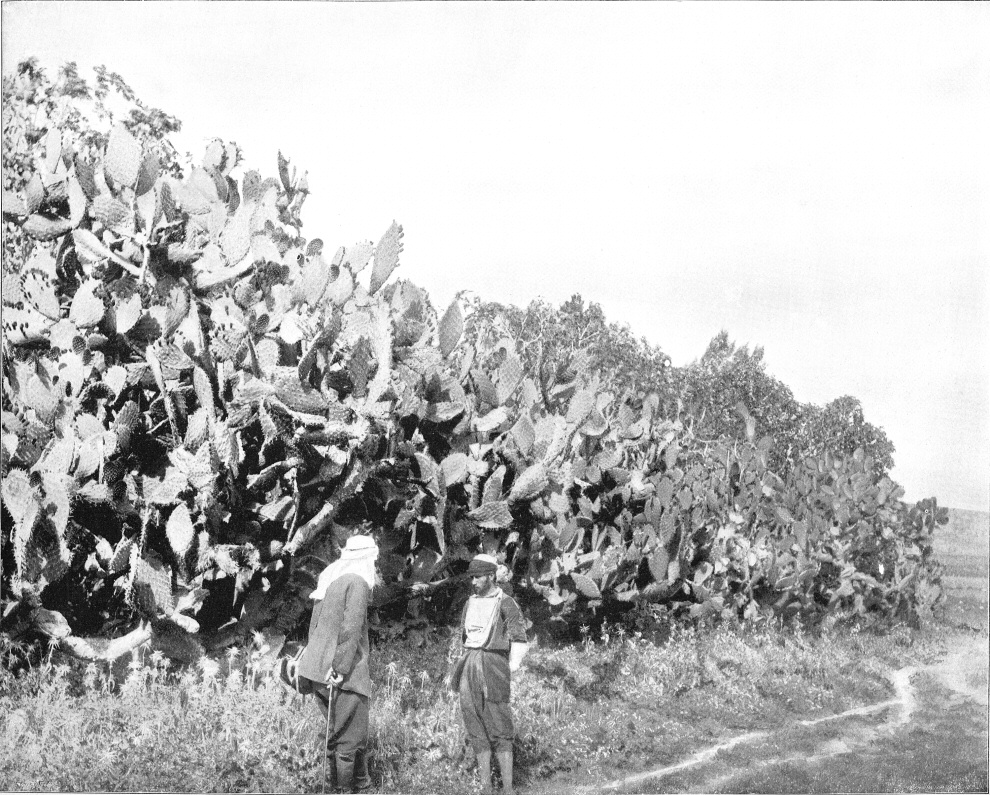
Here below is a fence in Palestine. The caption explains what the reader is seeing and also contains thoughtful ponderings about Jesus and His Gospel. What I think of when I see this photo, is the impenetrable aspect of the fence and the strong deterrent of thorns. The verse from the Parable of the Sower springs to mind.

Other seed fell among thorns, which grew up and choked the plants. (Matthew 13:8)

The agricultural and localized references written in the Bible are so much better appreciated by us in our day when looking at photos like this, or when I seek to learn about the plants and animals of the region.

Sadly, the book is out of print and very rare and expensive, but fortunately, it has been digitized and I can look at the photos on my Logos 6 software. By the way, if you are reading this before noon on this day, Tim Challies has a Free Friday Giveaway that runs until noon on Saturday, raffling off a Logos 7 Silver package. A hefty gift, if you sign up and become the lucky winner.

Earthly Footsteps of The Man of Galilee and the Journeys of His Apostles caption-

‎The thorny cactus abounds in Palestine. It forms a most secure fence, growing sometimes to a height of twelve feet. Beyond this wall are fig trees and olive trees, pleasant vines and fragrant flowers. The man in the picture with white head dress and staff held behind him is the dragoman of the photographic company of 1894.

We linger at Dothan because, besides the memories of Joseph and his brethren, there is an Old Testament picture which must have been recalled by Mary on her pilgrimage to Bethlehem. The prophet Elisha lived here for a time, and it was to Dothan that the Syrian King sent an army to surround and to capture him. By night they came—”horses and chariots and a great host.” And they “compassed the city.”

In the early morning, when Elisha’s servant arose from his bed and went forth “behold, a host compassed the city both with horses and chariots.” Then the prophet’s servant was afraid and he said: “Alas, my master; how shall we do?” And the prophet answered: “Fear not, for they that be with us are more than they that be with them. And Elisha prayed and said: Lord, I pray thee open his eyes that he may see. And the Lord opened the eyes of the young man, and he saw; and behold, the mountain was full of horses and chariots of fire round about Elisha.”—2 Kings 5:13–18.

The reality of the invisible realm, of God and His angels, of life immortal, of the protecting influence of heaven in all the struggles and endeavors of earth—these are doctrines which the Man of Galilee came to proclaim to the race of man. These are doctrines which gave strength and comfort to Mary in her pilgrimage from Nazareth to Bethlehem.

Jesus is utterly fascinating. These long-ago glimpses into the lands upon which He walked are endlessly interesting and encouraging. I hope you find them encouraging also. Of course, nothing can compare to the lands that await us, a renewed earth and domicile in New Jerusalem. Jesus is worthy to be praised, for His earthly sinless life, and His holy sovereign reign over all the earth and universe beyond.

I am the Alpha and the Omega,” says the Lord God, “who is and who was and who is to come, the Almighty.” (Revelation 1:8)

Posted in prophecy, Uncategorized

Throwback Thursday: He will open the door and He will close the door

This essay was first published on The End Time in December 2011.

Do you take the Lord’s power and grace for granted? Have you diminished His Holiness in your mind? Many people in this day and age have. How do I know? They think the Lord will somehow relent, and allow everyone into heaven after all. Or that His mercy is so great and so wide that they will be forgiven, even if they do not know Jesus. Jesus will not relent. His decision is final, and His decrees are sure. If you do not know Jesus on the day you die, you will be cast into hell. If you do not know Jesus on His day of wrath, if you die you will be cast into hell.

Even saying such a thing in this day and age seems like a revolutionary act. People chide us Christians who flatly declare the truth from the Word, that He will not relent. “Our God is a loving God,” they exclaim. “He would never do that!” Well, Remember rebellious Korah who was swallowed by the earth? Remember Uzzah who touched the ark? Remember Ananias and Sapphira, who blasphemed the Spirit by lying to the Apostle? Jesus will not relent, because He is the door.

I am the door: by me if any man enter in, he shall be saved, and shall go in and out, and find pasture.” (John 10:9).

He is the only One who opens the door.

I know your deeds. See, I have placed before you an open door that no one can shut. I know that you have little strength, yet you have kept my word and have not denied my name.” (Revelation 3:8).

He is the One who shuts the door.

And they that went in, went in male and female of all flesh, as God had commanded him: and the LORD shut him in. (Genesis 7:16).

When the ark was filled He shut the door and the rest of the world was judged. And so it will be again, for the unaware.

But while they were on their way to buy the oil, the bridegroom arrived. The virgins who were ready went in with him to the wedding banquet. And the door was shut. “Later the others also came. ‘Sir! Sir!’ they said. ‘Open the door for us!’ “But he replied, ‘I tell you the truth, I don’t know you.’ (Matthew 25:10-12)

He is the King of the Kingdom and it is He who says who enters and who doesn’t. He is the Door. Right now the door is open to all who would repent. It will be shut at the rapture. Not that anyone cannot be saved after the rapture, but with the door shut, you are in the cold, hard world and exposed to believing the lie.

and with all the deceit of unrighteousness in those who perish, because they received not the love of the truth, that they might be saved. And for this cause God shall send them strong delusion, that they should believe a lie,” (2 Thessalonians 2:10-11)

Enter now while the door is open. Repent and believe the truth: that Jesus is resurrected Lord and He is the only way to enter the Kingdom. He speaks the truth, and when He says that judgment is coming, believe it. The time will come when the door will be shut. As it says in Isaiah 26:20- “Come, my people, enter you into your chambers, and shut your doors about you: hide yourself as it were for a little moment, until the indignation is past.”

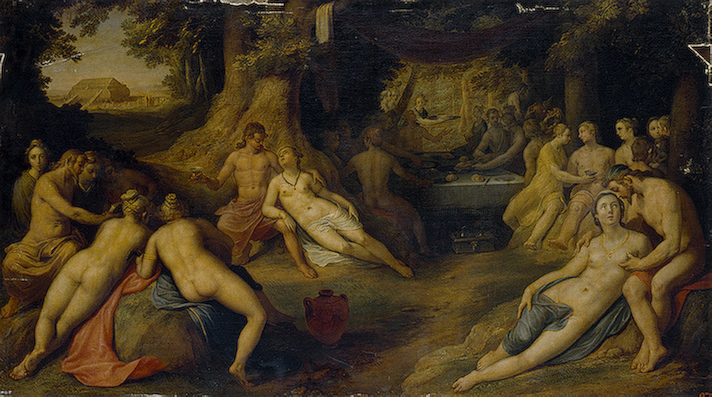
While the door was open, they did not listen and believe in Noah’s day:

Sinners before the Flood, 1594 Cornelis Cornelisz. van Haarlem
After the Flood, Circa 1588 Cornelis Cornelisz. van Haarlem

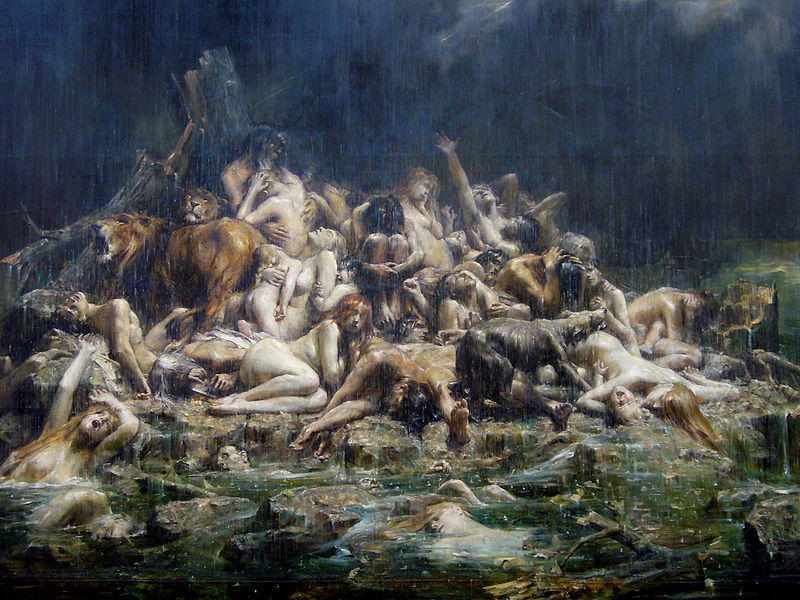
This is what Judgment looks like:

The deluge, Léon Comerre  (1850–1916) 

This is what grace looks like:

Noah’s flood KAULBACH, Wilhelm von (1805-1874)

How so? you ask. How is this grace? The serpents are writhing, the people are dying! Well, don’t focus on the serpents and the people. It is one way we diminish His holiness and His mercy. Focus on Him and His protected righteous and the fact that His promises of salvation are sure. The angels ministering, the ark itself was a lengthy warning to the same people who are now crying for the door to be opened. “Come, my people, enter you into your chambers, and shut your doors about you: hide yourself as it were for a little moment, until the indignation is past.” He made a way for the righteous to be saved!

Please answer His call, and repent!

Once the owner of the house gets up and closes the door, you will stand outside knocking and pleading, ‘Sir, open the door for us.’ “But he will answer, ‘I don’t know you or where you come from.'” (Luke 13:25)

Don’t grumble against each other, brothers, or you will be judged. The Judge is standing at the door!” (James 5:9)
Posted in encouragement, Uncategorized

The Galilean fishermen and their boats (and calming of the storm)

One day he got into a boat with his disciples, and he said to them, “Let us go across to the other side of the lake.” So they set out, 23and as they sailed he fell asleep. And a windstorm came down on the lake, and they were filling with water and were in danger. 24And they went and woke him, saying, “Master, Master, we are perishing!” And he awoke and rebuked the wind and the raging waves, and they ceased, and there was a calm. 25He said to them, “Where is your faith?” And they were afraid, and they marveled, saying to one another, “Who then is this, that he commands even winds and water, and they obey him?” (Luke 8:22-25; also Matthew 8:23-27).

Sea of Galilee, at Tiberias. View of ruins at shore of Galilee. 1862.
Public Domain

The Calming of the Storm, a 33-minute sermon on the biblical text of  Luke 8:22-25 from Ligonier Ministries is very good.

The Sea of Galilee is an important location in the biblical history. Jesus displayed His sovereignty over creation on the sea of Galilee when He calmed the storm and rebuked the waves. ‘The wind and waves obey Him!’.

Don’t you find it interesting that seasoned fishermen were afraid for their lives? These were tough men who saw death on a daily basis. Between the high death rate in general in the first century, the daily animal sacrifices, and the naturally high mortality rate due to their profession, they were familiar with terror and the presence of death. Yet in this storm, they were afraid for their very lives.

What’s the Sea of Galilee like? Let’s get a mental picture.

The “sea” is really a freshwater lake. It ranges from 16 miles tall to 9 miles wide. By comparison, Lake Tahoe in the United States is 22 miles long and 12 miles wide. The Sea of Galilee has been given other names, including Lake Gennesaret, and Lake Tiberias.

City of Tiberias – Jewish Fishermen by the Sea of Galilee, Palestine,
a photograph by William H. Rau, 1903. Public domain

The storms on the Sea are legendary. This is because of its geography, which makes it prone to sudden, boiling storms and pitched waves. It sits about 640 feet below the level of the Mediterranean Sea, and it’s surrounded by towering hillsides. Ravines on the Sea’s west side funnel cool air into the basin. When the cool air rushes into hot air rising from the low sea level valley, the resulting clash can create sudden, fierce winds that stir up steep waves. These choppy waves can become big enough to swamp a boat. When you get a steep chop and no space for the waves to become rolling, there’s no time for the boat to climb up one wave and surf naturally down another. The waves simply pound down on its bow, and if caught broadside, the waves can capsize you in a moment. As a former yachtsman, I can attest that there is no worse situation for sailor and boat alike than high winds and a steep chop. The boat takes a severe pounding, as does the helmsman!

In Jesus’ time, a thriving fishing industry was one of the main ways men earned a livelihood in and around that area. Peter, James, and John earned their living as fishermen. The lake yielded many kinds of fish. Three of the most popular were Sardines, Biny fish, and Tilapia, now known as “St. Peter’s Fish”.  According to the Wiki Bible project, “Biny fish are easily identified by the “barbels” or whisker type flesh that hangs from around the mouth. These fish are a hardy fish that was popular for the Sabbath feasts. These Biny fish can usually be found near schools of sardines as they are predatory fish eating everything from snail and mollusks to sardines.”

‘The Storm On The Sea Of Galilee’ By Rembrandt van Rijn

We know that the fishermen were petrified for their lives during the terrible storm. But after Jesus calmed the storm, they became more petrified.

He said to them, “Where is your faith?” And they were afraid, and they marveled, saying to one another, “Who then is this, that he commands even winds and water, and they obey him?” (Luke 8:25).

The word in the verse for afraid is phobēthentes, the main word is phobéō or phobos. You will recognize the English use of the word in ‘phobia’. It means to put to flight, to terrify, frighten. If the men hadn’t been trapped in the boat in the middle of the sea they would have run away! Much like the men did in Daniel 10:7. It is a fearful thing to fall into the hands of the living God. (Hebrews 10:31).

The scene should stir in us an awe and a recognition that there is nothing more terrifying, even waves that swamp your boat, than the living God who created the waves and calms them at a word. The takeaway is that though the waves made the men were fearful for their lives, when Jesus displayed His sovereignty over the creation, they feared for their souls.

He is a great God, powerful, yet kind to His children. Praise His holy name.

Posted in encouragement, Uncategorized

The Tree of Life

I like trees.

They’re majestic. They’re interesting. They’re helpful to the environment. They provide a home for birds. They provide scenes for artists. They enhance the view.

The Bible mentions many trees. Acacia, myrtle, juniper, cedar, cypress, chestnut, olive, almond, fig… The list goes on.

There are references to trees as a metaphor for strength and for prominent men (Psalm 1:3) or as a symbol of evil (Psalm 37:35).

Of all the trees mentioned in the Bible there is one pre-eminent tree. The Tree of Life.

Tree of Life
The meaning of “the tree of knowledge of good and evil” in the Eden narrative is not as clear as the meaning of the “tree of life.” Direct allusions to the tree of life are found in both the Old Testament and the New Testament. Significantly, in the book of Proverbs the tree of life is like a symbol: 

  •      of knowledge (Prov 3:18);
  •      of righteous fruit (Prov 11:30);
  •      of accomplished desires (Prov 13:12);
  •      of a wholesome tongue (Prov 15:4; Marcus, “The Tree of Life,” 117–20). 

Baez, E. (2016). Tree of Knowledge. Lexham Press.

The New Testament contains four references to the tree of life, all of which appear in Rev 2 and Rev 22. In this eschatological context, the tree of life functions as a future source of healing and immortality for the faithful. 

In Revelation 2:7 and 11, the saints who emerge victorious in Christ through testing are promised the tree of life (Rev 2:7) and deliverance from the second death (Rev 2:11). Osborne argues that in this context, the tree of life symbolizes the cross, which makes access to God and eternal life possible (Osborne, Revelation, 124, 563). Similar imagery is attested elsewhere in the New Testament (e.g., Gal 3:13). Tree of life imagery also serves as a polemic against the Greek Artemis fertility cult of Ephesus, where her temple was a “tree shrine” in which she symbolized life (Osborne, Revelation, 124). 

The final chapter of Revelation ties the tree of life back to the garden of Eden as “a picture of forgiveness and consequent experience of God’s intimate presence.” This chapter uses language and imagery of early Jewish literature (Beale, The Book of Revelation, 234–35). 

Faro, I. (2016). Tree of Life. Lexham Press.

The tree of life used to be in the Garden of Eden. (Genesis 2:9). Where is it now? In the paradise of God- AKA heaven. (Revelation 2:7b, 19)

It is an actual tree. Will the tree of life be a palm tree? A new kind of tree humans have never seen before (except Adam and Eve)? I am very much looking forward to seeing this tree.

Spiritually, our precious Savior is a Tree of Life (John 14:6). In only Him is life. Praise God for sending His Son. He is the tree of life, in whom we are rooted, in whom we grow, and in whom we shelter.

Further Reading:

Answers in Genesis: The Tree of Life

The Tree of Life stood in the centre of the Garden of Eden which elsewhere is called ‘The Garden of the LORD’.1 It was a real tree, to be sure, but let me suggest that it was also symbolic of the fact that God was, and is, the source of eternal life and blessing. Adam and Eve were to have their life centred in Him, even as the Tree was in the centre of His Garden.

Posted in prophecy, Uncategorized

One of Jesus’ titles is “The Coming One”. He IS coming again. Are you ready?

In listening to John MacArthur’s series in Revelation, this sermon yielded some glorious truths, once again. The sermon is titled The Certainty of the Second Coming. Now, we all know Jesus is coming to earth again. This time He will not be a meek servant, but a powerful judge. But do we know just how certain His coming is? How often the Bible makes reference to it? We don’t hear the Second Coming preached much, or spoken of often. But it is the next prophetic event on the calendar (along with the rapture, which will happen just prior). Here is an excerpt from the sermon:

“The Coming One” was a title for Messiah. “The Coming One” was a special name for Messiah. In fact, back in Matthew we have an interesting reference to it. I’ll just read it to you. In Matthew, John the Baptist was in prison and he sent word by his disciples to Jesus. And they said to Him, “Are You the Coming One?” You see, the Jews all knew that the Coming One was a Messianic title. Jesus is the Coming One. That same verb, erchomai [???], that means “coming,” is used directly or indirectly with reference to Christ nine times in the book of Revelation. Seven of those nine times it is the words of Jesus Himself, referring to Himself as “the Coming One.”

This book, then, is about the coming of the Coming One. And the present tense indicates to us that He’s already coming, so that we have this sense of expectation that leads John to say, “Look, He is coming,” as if we are to be living in eager expectation. This, again, is the great heart of the book [of Revelation].

For every time the Bible mentions the first coming of Christ, it mentions the second coming 8 times. For each time the atonement is mentioned once, the second coming is mentioned twice. Jesus refers to His second coming 21 times, and over 50 times we are told to be ready for His return.

Over 50 times we are warned to be ready for His return? Wow. Yet for all the lack of preaching and teaching on it, one would think it is not important. But it is highly important. I recommend MacArthur’s series in Revelation. My personal opinion is that his best book has been Because the Time is Near, an overview of Revelation.

Through death, rapture, or Judgment, you will meet Him. Are you ready?

~~~~~~~~~~~~~~~~~~~~~~~~~~~~~~~~~~
Further Reading

Alistair Begg/Truth for Life Devotional: Be Ready

Ligonier Devotional: Discerning the Signs

Grace to You Article: Marks of a Committed Christian