Posted in theology

The Mystery of the Trinity: Embracing God’s Fellowship

By Elizabeth Prata

I think most Christians probably have heard the hymn Holy, Holy, holy. The refrain is

Holy, holy, holy! Lord God Almighty!

Early in the morning our song shall rise to thee.

Holy, holy, holy, merciful and mighty!
God in three persons, blessed Trinity!

Your mind is humming it right now, isn’t it? 🙂

Our finite minds can’t grasp the notion of one person in three persons. So we don’t usually delve into the mystery of the Trinity. We don’t ponder it so much. It is a doctrine that just is.

“Theologian J.I. Packer noted that the Trinity is usually considered a little-thought-about piece of “theological lumber” that no one pays much attention to. But whatever your level of understanding of the doctrine of the Trinity, one thing you can know for sure: The Triune God is unchangeably committed to including you in the wonderful fellowship of the life of the Father, the Son and Holy Spirit.” (Source).

The concept of the Trinity is mentioned a lot in the New Testament. I was surprised when I started thinking about this and studied it, there are more verses that mention it than I thought.

Jesus is teaching. “If you had known Me, you would have known My Father also; from now on you know Him, and have seen Him.” (John 14:7).

Philip asks, “Lord, show us the Father, and it is enough for us.” Jesus replied, “Do you not believe that I am in the Father, and the Father is in Me? The words that I say to you I do not speak on My own, but the Father, as He remains in Me, does His works.” (John 14:10).

As our pastor taught, this is a concept called mutual indwelling. He explained in his sermon,

“He said something similar in chapter 10, verse 38; know and understand that the father is in me and I am in the father. That’s the language of mutual indwelling. What Jesus had been teaching them all along was his unity with the father. He is so united with the father, the best way to express it is mutual indwelling. The father dwells in him and he is in the father. Now that doesn’t mean that Jesus and the Father are identical in personhood. After all, according to verse 12 here, He was going to the Father, which indicates a distinction between them. And so their oneness doesn’t mean they’re identical in all respects, but to see Jesus is to see the Father in essence.

It is a mystery how all three Persons of the Trinity are one but separately they are three individual people, with their own wills, purposes, tasks. But God is one. I am glad He is a mystery. I would not respect a God I could understand. He has deigned to stoop to our level of understanding in magnificent ways. He gave us His word. He gave us His Son. He gave us the Holy Spirit to indwell us. He raised up the prophets. He have us this world in order to see his wonderful works. He gave us providence, where we can see in hindsight how He takes care of us.

Mutual indwelling as a term describing the relationship among the persons of the Trinity is an easy to understand term. Theologians also use a more technical term, perichoresis or circumincession.

Perichoresis is “the mutual intersecting or “interpenetration” of the three Persons of the Godhead and may help clarify the concept of the Trinity. It is a term that expresses intimacy and reciprocity among the Persons of the Godhead. Perichoresis is the fellowship of three co-equal Persons perfectly embraced in love and harmony and expressing an intimacy that no one can humanly comprehend. The Father sends the Son (John 3:16), and the Spirit proceeds from the Father and was sent by the Son (John 15:26)—another example of perichoresis, with the result that God’s people are blessed,” says GotQuestions.

Though one Person or another may be emphasized in a particular work, no one person does any work exclusive of the other two persons, for as the classic dictum states, “the external works of the Trinity are undivided.” ~John MacArthur, Biblical Doctrine.

Our comprehension of this doctrine will always be beyond our mind’s finite grasp. But by faith we know the unity of the Godhead is perfect, the works of the Trinity are ongoing, the Trinity’s essence is shared perfectly yet without blurring each person’s distinctions.

Hebrews 1:3 says- And He is the radiance of His glory and the exact representation of His nature, and upholds all things by the word of His power.

The God-head’s fellowship has opened up to include humans. Our fellowship with God becomes possible after we repent and by faith we are saved through grace. Then, as JI Packer says:

fellowship becomes a possibility; and it is only as the Holy Spirit enables us to speak to others, and others to us, in such a way that Christ and the Father are made known through what is said, that fellowship is made a reality. When we seek to enjoy fellowship together, we should do so in prayerful dependence on the Holy Spirit, the third Person of the Trinity, whose office it is to reveal Christ to us. ~Source, God’s words : studies of key Bible themes, JI Packer

Posted in heaven, jesus

Your new name!

By Elizabeth Prata

Here is a prophecy to look forward to!

Believers, if you have been faithful and your persevering walk is evidence of that faith, you will be given a pass into eternal glory upon which the Lord of Hosts, the Ancient of Days, the Holy-Holy-Holy Lord has written upon it Himself, personally for just YOU!

He who has an ear, let him hear what the Spirit says to the churches. To the one who conquers I will give some of the hidden manna, and I will give him a white stone, with a new name written on the stone that no one knows except the one who receives it.” (Revelation 2:17)

“But there’s an interesting little historical note, when a victor won in the games, whatever great games were being held, it was not uncommon for the victor to be given as part of his prize a white stone. And the white stone was his admission pass into the festival that was held following the games for all the victors. Could it be that the overcomer will receive the ticket to the eternal victory in heaven?”

Commentary on that verse from John MacArthur:

“And then He says, “And a new name written on the stone,” and I read where they would do that. They would give the victor, like a trophy, a stone with his name and he alone could use it as his pass. “A new name written on the stone which no one knows, but he who receives it.” I can’t tell you how many people have asked me…what is that name?”

“A lady will come to me any time I preach on the book of Revelation and say, “What is the name that no man knows?” Folks, I don’t know what the name is. If I knew what the name was then this verse couldn’t say what it says, it would have to say, “And no one knows except John MacArthur.”

“The only one who knows what it says is the person who receives it, that’s how personal it is. What it is to me is some kind of personal message from Christ to the one He loves which is given as an admission pass into eternal glory. I’ll know mine and you’ll know yours and we’ll know the Lord wrote them for each of us and for none of the others of us.” (source)

It is huge to think of the precious Savior not only saving me, not only guiding and protecting me, not only providing for me, but when He brings me to glory (amazing!) He gives me a personal message just for me, out of the millions thronging there!

Friend, if you have ever been picked last, if you have ever had unwanted divorce thrust upon you, if you have ever been fired from a job, marginalized at home, or left in any feeling invisible and unwanted, THIS should pick you up. A secret message/name is waiting for you, just for you, with the Savior’s love and care personally imprinting it and gracefully extending it to you in heaven. What a day that will be!!!!!!!


Posted in theology

Starting off well but ending badly

By Elizabeth Prata

Many people start off in their salvific walk with God well, but end badly. I don’t mean ones like Judas or Demas, who were always bad but hid it well until the end. I mean genuinely faithful men whom the LORD loved, but strayed from the path of righteousness and ended badly. Let’s take a look at the object lesson in this sad state of affairs, King Solomon.

But King Solomon loved many strange women — Solomon’s extraordinary gift of wisdom was not sufficient to preserve him from falling into grievous and fatal errors. A fairer promise of true greatness, a more beautiful picture of juvenile piety, never was seen than that which he exhibited at the commencement of his reign. No sadder, more humiliating, or awful spectacle can be imagined than the besotted apostasy of his old age; and to him may be applied the words of Paul (Ga 3:3), of John (Re 3:17), and of Isaiah (Isa 14:21). A love of the world, a ceaseless round of pleasure, had insensibly corrupted his heart, and produced, for a while at least, a state of mental darkness. The grace of God deserted him; and the son of the pious David — the religiously trained child of Bath-sheba (Pr 31:1-3), and pupil of Nathan, instead of showing the stability of sound principle and mature experience became at last an old and foolish king (Ec 4:13). His fall is traced to his “love of many strange women.” source (Commentary Critical and Explanatory on the Whole Bible — Robert Jamieson at Biblehub)

It would seem that Peter started off well and it seemed his ending was a sad state of affairs. He closely followed Jesus in Jesus’ incarnation for years, was the leader of the group, was the first to say the right things (and sometimes the wrong things, but for the right reasons). But when Jesus was crucified, at the moment when Peter needed to pull together all his strength, he denied Christ.

But that was not the end! It was the beginning! The difference came when the disciples received the Holy Spirit, including Peter. He was endowed with superhuman knowledge and a tongue to preach praises to God in a sermon that stands forever. He became bold, wise, and earnest.

Solomon did not have the benefit of an indwelling Holy Spirit. He had direct access to God. God visited Solomon in dreams, but for daily holy help in resisting sin, following God’s statutes, Solomon relied on his flesh. And we know how that turned out.

We have the indwelling Spirit in us. We still have our flesh, the devil, and the world harassing us, tempting us, and trying to make us swerve from the path. But the Spirit in us is our holy help to stay inside the narrow lanes of God’s statutes and expectations. What Solomon’s experience teaches us is that no matter how wise we are, our wisdom and even our desire to please God is no match for the world. cf: Peter.

Our flesh, our emotions, and our innate weakness cannot withstand sin. Only the Holy Spirit can help us do that, because He transcends sin. He is holy, supernatural, and is present in us specifically to help us grow in Christ’s likeness.

I think of the scene in Acts where the demon-possessed slave girl kept following Paul around hollering about salvation. Even though she was saying what sounded like a true thing, it as just vague enough to please Jews and upset pagans. Paul was mightily aggravated. This is what our flesh does to us, our thoughts, the world, and our own minion demons that might be harassing us in the invisibles. Saying things that sound vaguely true but are false.

Solomon’s failure was incremental. I’m sure the first wife who had proposed setting up an altar to her false god didn’t come right out and say to Solomon, ‘Let’s worship Baal!’ Incremental creep must be nipped in the bud before it grows, settles, and spreads its tentacles. Eve’s failure was listening to the serpent for too long. She should have turned away the moment it said “Hath God said?” He caused her to doubt, then contradicted God’s word, then offered a tempting promise. Three strikes and she was out. So was Adam.

Christ’s grace is sufficient for us. But how often do we rely on it? How often do we appeal to God in our own weakness for His strength?

Peter eventually did. In the Spirit’s strength, Peter became so brave and humble he did not even want to die in the same manner as Jesus did. Tradition says he died crucified upside down.

Reliance on the Holy Spirit will aid us faster and better and more accurately in our pursuit of righteousness in sanctification than our own flesh. Here are further resources on the Holy Spirit. Remember, the very God Himself in the Person of the Holy Spirit is inside us, helping us become like brave like Peter end even ultimately like Jesus, and avoid pitfalling like Solomon.

Who is the Holy Spirit?

What does the Holy Spirit do?

How does the Spirit help us?

Posted in theology

Am I growing? What are some markers of sanctification?

By Elizabeth Prata

How do we know we’re growing in Christ? How do we know the Holy Spirit is at work in us?

Firstly, because if you’re genuinely saved, you know He is because He said He would be. It’s a matter of faith and trust in believing what God says He will do, He will do.

But we should always give thanks to God for you, brothers and sisters beloved by the Lord, because God has chosen you from the beginning for salvation through sanctification by the Spirit and faith in the truth. (2 Thessalonians 2:13).

Secondly, because we look back. If you sit on your lawn and stare at the grass, you cannot see it growing. But go away for the weekend and arriving home, suddenly you can see it’s grown 2 inches and needs a mow!

Our sanctification may be fast or slow, hurtle along steadily or go in chugs and fits, but it’s happening.

Finally then, brothers and sisters, we request and urge you in the Lord Jesus, that as you received instruction from us as to how you ought to walk and please God (just as you actually do walk), that you excel even more. (1 Thessalonians 4:1).

Of course, it doesn’t happen passively, with God dripping down holiness to our mind and heart. We participate in this sanctifying work. There are verbs for us in this process, verbs such as walk, pursue, slay, cleanse… We are active in the sanctifying work.

Therefore, having these promises, beloved, let’s cleanse ourselves from all defilement of flesh and spirit, perfecting holiness in the fear of God. (2 Corinthians 7:1).

I sometimes despair, like Paul did, that I am a wretched woman, sick of my sin, pleading ‘who will deliver me from this body of death?!’ But then I find a marker on my walk. We do not have a personal roadmap to see the way ahead, but we know that if we stay within the guardrails of His commands and pursue holiness, our steps will be directed forward.

We may not see the path ahead but we advance step by step in faith and He directs our steps.

Establish my steps in Your word, And do not let any wickedness overpower me. (Psalm 119:33).

I’ll share a few personal insights to some of the markers that show me the Spirit is alive and working inside me.

1. Prayer moves me. It’s mind-blowing to think that we can clasp our hands, bend our heads, and speak to the Majestic, Powerful God above, and He eagerly listens! This makes my eyes tear up every time. Before I was saved, I cared not for any of the things God cares about, and I certainly didn’t speak to Him. I suppressed the truth in unrighteousness. Now I am moved just at the thought I can petition Him.

2. Some particular Bible verses move me. All the Bible’s word is emotional, causing conviction or rejoicing in my heart. But there are a few I just don’t know why they bring me to tears every time I read them. One is Zechariah 1:11, the scene of the Man among the Myrtles. It brings me to tears. Why should such unremarkable words bring me to my knees? It must be the Spirit. I’ve long ceased trying to figure it out.

Another one is the verse from Acts 2:27/Psalm 16:10, FOR YOU WILL NOT ABANDON MY SOUL TO HADES, NOR WILL YOU ALLOW YOUR HOLY ONE TO UNDERGO DECAY.

Thinking of our precious Savior’s body moldering in the tomb is beyond infinitely grievous to my soul.

Lastly for the purposes of this essay, the nickname Dayspring for our Lord. It also moves me. It’s the King James version that uses the word dayspring, it’s now an archaic word and we usually just say ‘dawn’ or ‘sunrise’.

Why should so old and innocuous a word move my spirit? It can only be because the Spirit is alive and working within me. The Holy Spirit rejoices at the Dayspring Himself, and so must I.

Through the tender mercy of our God; whereby the dayspring from on high hath visited us, (Luke 1:78 KJV)

Here is a rabbit trail into MacLaren’s Expositions on ZACHARIAS’S HYMN: THE DAYSPRING FROM ON HIGH, Luke 1:78 – Luke 1:79.

“As the dawn is ushered in by the notes of birds, so the rising of the Sun of Righteousness was heralded by song, Mary and Zacharias brought their praises and welcome to the unborn Christ, the angels hovered with heavenly music over His cradle, and Simeon took the child in his arms and blessed it. The human members of this choir may be regarded as the last of the psalmists and prophets, and the first of Christian singers.”

EPrata photo

Look back on your road of sanctification. See what markers of progress you find. Books you own but now see aren’t as healthy or edifying as you once thought? Movies where the language or certain scenes now bother you? Old tee shirts with slogans you now find corrupt? Verses which move you, ones that ‘leap off the page,’ or stick in your head?

If the Spirit is in us, He will be working on our corrupt nature, slowly siphoning off the dross and cleansing the heart ever purer.

Oh what a day it will be when we are finally purified, glorified, and no sin in us! And it is due to Him who died for His people, love beyond words.

Posted in theology

Remember!

By Elizabeth Prata

Sermons hit different people differently. Some say it was the best they’d ever heard, others say meh. It’s why I don’t usually post sermons claiming such things, the Holy Spirit emphasizes different things to different people. What I think is blockbuster the next person can take or leave, and vice versa.

Individually, like for myself, I can’t tell what the Spirit is doing. I can’t tell if I’d advanced in sanctification a lot or a little that day, month, year. There aren’t bells or alarms that indicate such things.

But, we KNOW that the Holy Spirit leads us. We KNOW that He advances us in Christlikeness day by day. But can we detect it?

Not usually. But sometimes.

Allow me to share my experience. In November of this past year, I tuned in to a sermon from The Master’s Seminary because I was curious about the title: “The Secret to Endurance”. It was delivered by Dr. Abner Chou. I’ve listened to him before. I went through his Seminary course in Job, twice. And Exodus. I’ve heard his sermons and Chapel talks. He talks fast and is high-level. Many times I can’t keep up. But I keep at it.

Anyway, I was curious about ‘the secret.’ I tuned in. His text was Remember Jesus Christ, risen from the dead, descendant of David, according to my gospel, (2 Timothy 2:8). The sermon was aimed at pastors and soon-to-be pastors but it is highly applicable to anyone in ministry, AND any lay person who just wants to endure.

Remember Jesus Christ, risen from the dead, descendant of David, according to my gospel, (2 Timothy 2:8)

I enjoyed the sermon. It’s good. As happens many times with the Holy Spirit, one particular thing ‘jumped out at me.’ The word “remember”.

Abner Chou can wring out more truth from one word than I think any man alive. He spent some time setting up the premise for Paul telling Timothy to remember, then explained the word remember’s meaning.

Remember Jesus Christ…

I took that part of the sermon to heart. It imprinted in me. Since early November to early December, every time I heard the word remember, I thought of that sermon. In December it drove me batty enough so I tuned back in and re-listened to that part, except longer before and after the part I was wrestling with.

And again throughout December, every time I heard the word remember. I brought it back up and read the transcript.

This morning someone posted on Twitter a JC Ryle link to a short essay called Remember Lot’s Wife. I’m curious about that scene in the Bible as well so I downloaded the link and read the essay. It’s a really good essay. (free download here).

The word remember, remember, remember kept coming up in my mind, so I looked up the sermon AGAIN today. This time I re-listened to the entire thing. Though I enjoyed it the first time in November, this time, something was happening. I cried tears after tears listening to all the explanations about the power of Jesus, the Person of Jesus, the preeminence of Jesus. Paul’s use of the term Jesus Christ, Paul’s entire goal in life to honor Jesus, verses and more verses.

Even though I’d heard the sermon before in its entirety and in parts 2X after that, this time I sat stock still, eyes glued to the screen. I did not multitask. I did not move. All I did was get tissue after tissue and listen, amazed at the beauty and grace of Christ presented through the eyes of Paul to Timothy. The Spirit was obviously doing something. What, I do not know. Knitting truth to my soul…transforming my mind…

It HAS to be the Spirit. I wasn’t moved over a romantic comedy. I wasn’t moved reading a story over a lost cat. I didn’t have tears over a sad news story. It was scripture. And if it’s scripture, it has to be the Spirit, who uses scripture to point to Jesus.

We cannot grow if we do not absorb the scriptures (hearing it or reading it for ourselves). We need to meet with Jesus to learn about Him and be pliable to have the Spirit form Christlikeness in us. If you hear something or read something and your mind keeps turning back to it, follow it up. I’m not talking about mystical signs or omens. But if you keep meditating on a scripture, or part of scripture, then, what are you waiting for? Keep digging. It may be an example of the Spirit leading you. Even if it isn’t, it’s a good thing to return to a verse and keep praying over it for deeper meaning. And if it is, you will have glorified Jesus whom the Spirit is leading you to meet with.

I humbly bow to the power of the Spirit-filled word. I am grateful to the Savior for fashioning for me a life where I can listen to sermons like this, to have time to do so and space to ruminate on the powerful preaching. He is a good, good God. I will remember.

Posted in discernment, Uncategorized

“The Holy Spirit really showed up!” and “A big move of the Spirit!” = crass emotionalism?

By Elizabeth Prata

We hear a lot about the big moves of the Holy Spirit. We see Youtube clips of young millennials falling to the floor, or standing with arms upstretched in front of smoke filled stages, pulsing lights, glitter, laughing and sobbing. Afterward they smile tiredly, saying “The Holy Spirit really moved!” Or, “The Holy Spirit really showed up!”

As an aside, I dislike that phrase, ‘The Holy Spirit showed up.’ It’s crass. It’s akin to attending a funeral and saying to the bereaved, “So your wife croaked, eh?’ The Holy Spirit doesn’t ‘show up.’ He isn’t hailing a taxi running late, throwing a scarf around his neck while jumping out of the cab and huffing into the church. The Spirit doesn’t ‘show up’. The Holy Spirit governs the universe.

To the main point regarding big moves of the Spirit. Successive years of successive generations of younger church-goers have twisted Hebrews 11:1’s statement of what faith is:

Now faith is the substance of things hoped for, the evidence of things not seen.

Into –

Now faith is the substance of things we’ve come to tangibly possess, the evidence of things seen and experienced.

Spurgeon had something to say about these “Christian emotionalists” in Sermon 898, A Word with Those Who Wait for Signs and Wonders,

There are some, and these are generally the most uneducated, who expect to experience remarkable dreams or to behold singular visions. Others we have met with, who suppose that in order to being saved they must feel some very peculiar physical sensation. Now you must not look for this. You must not put physical contortions or sensations as a test before the Lord, and say you will not believe in Him otherwise.

You seek what is quite unnecessary. What do you want a sign for? You want, you say, a token of God’s love. What token of God’s love to you can ever be wanted, now that He has given His only-begotten Son, first to live on earth, and then to die in pains extreme, the just for the unjust, “that whosoever believeth in Him should not perish, but have everlasting life”! I blush for you, that you should ask any token of God’s love while Jesus Christ is before you…

I must tell you what is more, you are acting the part of an idolater. What does an idolater do? He says, “I cannot believe in an unseen God; I must have a golden calf or an image, that I can see with my eyes and touch with my hand.” You say just the same. You cannot believe God’s naked word, you demand something you can feel, something you can see. Sheer idolatry.

And when the people were gathered thick together, he began to say, This is an evil generation: they seek a sign... (Luke 11:29-30)

You might feel an overwhelming sense of joy, or peace, or well-being, or love for Jesus at times. These emotional times can occur when prayer is answered, providence is seen, worship is genuine, or Bible reading has deepened your view of the Savior. Strong emotion is good and appropriate. But to rely on such moments as proof of the Spirit’s presence casts a vain hope upon the shores of the Rock which stands above all. Your sure faith is in Him and His word that reveals Him.

Depending on signs is seeking a golden calf of experience over faith.

If you’re looking for a move of the Spirit, a miracle, sign, or wonder, there are many that we can name which exalt Jesus. Unsaved men are helpless and unable to come to God unless the Spirit draws them. (John 6:44). He saves by grace. Any new believer is a miracle, because they cannot save themselves. Sanctification is a miracle of God, because only by the Spirit can we resist sin and grow in His likeness. Providence is a miracle of God because He sustains the universe by the power of His word every minute, and He ordains every event that happens to all 8 billion people on earth at every second.

Stop looking for glitter dust falling from the ceiling, for personal prophecies, and visible signs when we already have the redemptive, sanctifying, providential work of the Lord occurring all over the world every second.

I’ll leave John MacArthur with the last word-

For all those true believers who love the Lord, the promise is a wonderful promise. … I think it’s time in the church of the Lord Jesus Christ to give honor to the Holy Spirit, to worship Him, to love Him, to ascribe to Him the glory that He is due and to stop the nonsense that brings dishonor on His holy name.

EPrata photo
Posted in theology

“IF in fact the Spirit is in you” ?

By Elizabeth Prata

Paul wrote in Romans 8,

However, you are not in the flesh but in the Spirit, if indeed the Spirit of God dwells in you. But if anyone does not have the Spirit of Christ, he does not belong to Him. If Christ is in you, though the body is dead because of sin, yet the spirit is alive because of righteousness. But if the Spirit of Him who raised Jesus from the dead dwells in you, He who raised Christ Jesus from the dead will also give life to your mortal bodies through His Spirit who dwells in you. (Romans 8:9-11).

The little words in the Bible matter. Paul often says, “therefore” which, when we encounter such a word, my Bible teacher says we should mentally say to ourselves ‘what’s it there for?’ The word ‘however’ at the start of the excerpt means Paul has been explaining something and is now contrasting the previous something with what is coming next. My focus today, though, is on the word “if” that Paul uses here.

What a weighty thought; “IF” the Spirit dwells in us or IF the Spirit does not dwell in us.

We should not be constantly engaging in introspection, mulling over our past life prior to salvation, or pondering our sins to a gross extent, or constantly wailing ‘woe is meee, I’m such a vile sinner’… but a bit of introspection is often warranted. Paul said in 2 Corinthians 13:5, that we should examine ourselves to see if we pass the test. In 1 Corinthians 11:28 we must examine ourselves before we take the cup of remembrance and the bread at the Lord’s table.

John MacArthur said, “Churches are full of spiritual cripples, paralyzed by the grudges, bitterness, sins, and tragedies of the past. Others try to survive in the present by reliving past successes. They must break with that past if they are to pursue the spiritual prize.” Source, MacArthur, J. F. The MacArthur New Testament Commentary: Philippians.

Here, Paul makes a flat statement, ‘If the Spirit is in you, then…’ The word ‘if’ warrants a quick look-see in this case. What does it mean IF the Spirit is in us? It means then we are changed and changing. We know the Spirit is in us because when we examine ourselves, we discover that our affections have changed. We now hate sin. We enjoy the word of God. We bring glory to Jesus, not ourselves. No one in the flesh will do those things. The flesh is only ever selfish.

Genesis 6:5 says, “Then the LORD saw that the wickedness of mankind was great on the earth, and that every intent of the thoughts of their hearts was only evil continually.” That verse is not meant only for people living in the pre-flood times (antediluvian) but it applies to all living and dead humans who are not in the Spirit.

Gill’s Exposition of the Entire Bible says of the Romans 8:9-11 verse-

“But ye are not in the flesh, but in the Spirit,…. That is, ye are not carnal, but spiritual men; or ye are not in a state of unregeneracy, but in a state of grace: the reason proving this is, if so be, or “seeing”

“that the Spirit of God dwell in you; the inhabitation of the Spirit is a distinguishing character of a regenerate man; which is to be understood not of his omnipresence, nor of a participation of his gifts, whether ordinary or extraordinary: nor does the Spirit of God only dwell in his people by his graces, but in person as in office, and in a way of special favour; as a spirit of illumination, regeneration, sanctification, and faith, as a comforter, a spirit of adoption, an intercessor, and as a pledge and seal of happiness:”

“which inhabitation is personal; is not peculiar to him to the exclusion of the Father and of the Son; is expressive of property and dominion; is not confined to the souls of men, for he also dwells in their bodies; it is operative, powerful, and perpetual; it is the security of the saints’ perseverance, and the pledge of their resurrection and future glory.”

“This is owing not to any goodness in them, or to any fitness and preparations of theirs to receive him; but to a federal union to Christ and relation to him, to our Lord’s ascension and intercession, and to the love and grace of the Father; and this proves a man to be a regenerate man, to be in the Spirit, and not in the flesh; for the Spirit of God is never in this sense in an unregenerate man, nor is he in any such sense without his grace; so that the indwelling of the Spirit is the grand evidence of relation to God, of an interest in Christ and union to him, and of a man’s state and condition God-ward;” –end Gill’s

If you have been saved by grace for any length of time, and you look back, do you notice changes in yourself? Do you feel pricked by sin more? Is your conscience softer? Do you understand the Bible better? Are you releasing attachment to sins you used to enjoy, finding you enjoy them less or have abandoned them altogether? This is the Spirit at work in you. In that case the Spirit IS in you! Rejoice for the Lord is gracious and powerful to save sinners!

The End Time Blog Podcast Season 2, Episode 275

Posted in theology

Cessationism vs. Continuationism

By Elizabeth Prata

I had listened to Phil Johnson lecture in the Wretched series Drive By Pneumatology. ‘Drive By’ means short lessons of 7-11 minutes that you can listen to on your driving commute. (Or anywhere else). Johnson defined cessationism and continuationism. Here is Phil’s definition- I transcribed it, that’s why it is in quotes-

Link below to the Drive By Pneumatology series for sale at Wretched Store

“The Holy Spirit is at work in us in the ordinary things of life. A lot of people have an idea that the Holy Spirit is only working if He is doing miraculous or phenomenal things. If it’s not something that takes your breath away, or amazes you, that if He is not doing things like that, that He is not at work at all. But I believe that scripture teaches that the Holy Spirit is at work in all the ordinary aspects of life. He orders every minute detail of our lives. It is He who actually gives us life. That’s what it says in Romans 8- He gives life to our mortal bodies… . Most of what He does seems ordinary but it is really extraordinary because He is the Holy Spirit.”

Phil Johnson went on to explain the difference between revelatory gifts and ministry related gifts. Revelatory ones (the Charismata) are utterance of wisdom, utterance of knowledge, prophecy, miracles, healing, tongues and interpretation of tongues (1 Corinthians). This is compared to the gifts in Romans 12: preaching, service, exhortation, generosity, leadership, mercy, and teaching. These gifts are ministry related, neither supernatural in character nor revelatory. Revelatory means giving new revelation, or new information, outside of and apart from what is revealed in the Bible.

Phil again: “The distinctive claim of the Charismatic movement is that these revelatory gifts of healing, miracles, tongues knowledge/wisdom and prophecy are continuing today just as they were in Apostolic times. The Charismatic person says they continued since then and never ceased. That these gifts are available and operational just as they were since Pentecost. This is the continuationist view.

“The opposing view is cessationism. This is the belief that these revelatory gifts, these sign gifts, have ceased. That they pertained uniquely to the Apostolic age and that those gifts ceased sometime at the end of the first century upon the death of the last apostle”. (Phil is a cessationist).”

“So the question is, is the Holy Spirit doing everything exactly as He was doing as He did in the book of Acts? Has that stopped, or has that continued? And is there a proof text that shows it has stopped?”

“The miraculous gifts of the apostolic era had a specific and clearly defined purpose. I contend that it is also clear in scripture that they did diminish in frequency and importance and in fact, faded from use after the era in the Book of Acts ended.”

“However, cessationism is today a minority opinion. It was practically standard evangelical theology for many centuries until about 60-75 years ago. Prior to the 20th century, it would have been hard at any time to find any Protestant who believed that the charismata, the miraculous gifts, continued uninterrupted from the time of the apostles thru all of church history. It is a fact that the most orthodox church theologians all believed the miracle gifts ceased.”

“The reason they say this today, that the charismatic gifts continue, is that they cannot find a proof text or a verse that would support the view that the spiritual gifts of this nature have ceased. Specifically there is no verse in scripture that says the miracle gifts have stopped at a particular date or time. Bottom line there is no proof text that states that the miracle gifts would end at the conclusion of the Apostolic era. I grant you that.”

“There is no proof text to show the Jehovah’s Witness to show their flawed view of the Trinity, either. You compare scripture with scripture to show the Trinity. I would say the same method applies to cessationism.”

“Those of us who are cessationists base our conviction not on a single proof text but is a theological conclusion that is drawn from a number of biblical, historical, and doctrinal arguments.”

“Scripture does teach that the charismata had a specific, foundational and temporary purpose. They are part of a hierarchy of supernatural signs and wonders that were associated with the founding of the church. That hierarchy is listed in 1 Corinthians 12. It specifically states not all the miracle gifts were given to all in the church. (Phil goes on to explains some verses here). Scripture does not have a specific proof text that shows the Apostolic age ended, that there are no more apostles. There is no specific proof text that the canon of scripture is closed. Those arguments are the same exegetical arguments used to also say that the miraculous gifts ended too.

——————end Phil Johnson——————–

So in effect,

–tongues were for a sign to the unbeliever, fulfilling prophecy that judgment has come,
–they, as all miracle gifts, were for a sign to confirm the message and the messenger,
–we no longer need such signs because we have the Bible to compare a message and can confirm the messenger if he brings a message consistent with it,
–they were real languages,
–they were not the highest gift,
–they were to be interpreted or people were to be silent,
–they were dying out as the Apostolic Age came to an end,
–they obviously ceased for 1900 years,
–they were not the gibberish we see today.

So that is the continuationist vs. the Cessationist view. Continuationists believe the sign gifts (or the miracle gifts) continued unabated from the NT era. Cessationists believe they ceased at the end of the NT era when the last verse was written and the canon of God’s word closed.

I am a cessationist. I believe scripture shows that the sign gifts ceased. A common charge by continuationists is that they say cessationists claim that our position means the ‘Holy Spirit isn’t operating anymore’. Of course He is. He regenerates hearts every day. He draws men to the Lord every day. He brings scripture to mind every day. He does a ton. He just doesn’t dispense the sign gifts anymore because we have the sign in writing: the New Testament, which is completely profitable for all training, education, reproof.

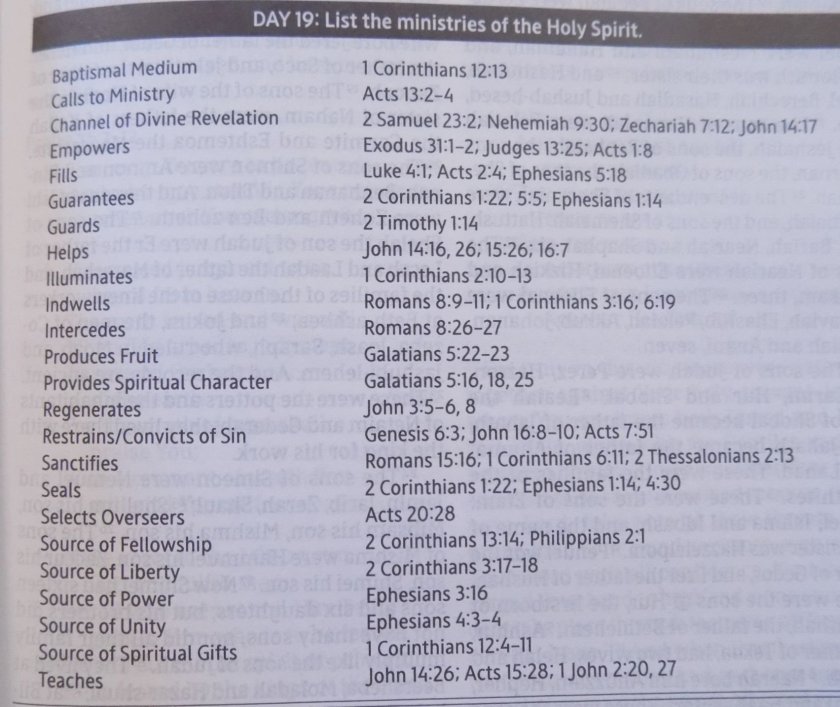
List of the Holy Spirit’s ministries and activities, from John MacArthur Daily Bible

So that is a quick lesson on the distinctions between the two positions on the sign or miracle gifts. Here are further resources:

FURTHER RESOURCES

Is cessationism biblical? What is a cessationist?

What is continuationism?

It is finished

How would you persuade someone that the sign gifts have ceased?

Wretched Store: Drive By Pneumatology

Posted in theology

I died … to the law

By Elizabeth Prata

Such is the confidence we have toward God through Christ. Not that we are adequate in ourselves so as to consider anything as having come from ourselves, but our adequacy is from God, who also made us adequate as servants of a new covenant, not of the letter but of the Spirit; for the letter kills, but the Spirit gives life. (2 Corinthians 3:4-6).

In this 2 Corinthians verse, Paul is explaining that following the ‘letter’ of the law is a shallow, external conformity to the commands of the Law and not an internal faith and belief. Think: Pharisees. The Pharisees were rebuked for swallowing a camel but straining out a gnat. It means they were hyper-vigilant over little things (going after a gnat), but ignored the big need- forgiveness from sin. They tithed cumin but their sacrifices to God were empty. They observed rites and ceremonies to the letter but missed the spiritual significance of its intent- to demonstrate their need for a Savior.

They adhered to the letter of the Law but entirely missed its intent: which was to make a person recognize his sinfulness and total inability to reach the Law’s required perfection. Anyone who relied on the Law for salvation would die (i.e the Law/letter kills). Paul admitted his own inability to reach perfection after salvation, seeing in hindsight that his adherence to the Law was only shallow works that meant nothing to God, it was all rubbish.

Paul explains further in Galatians. He is re-teaching the Galatians that justification is by faith alone, apart from the works of the Law of Moses. Legalistic Jews had insisted that Christians must keep the Mosaic Law and their stance had confused the Galatians. Galatians 2:19 says –

For through the Law I died to the Law, so that I might live for God.

Barnes’ Notes says of that verse’s meaning:

that by contemplating the true character of the Law of Moses itself; by considering its nature and design; by understanding the extent of its requisitions, he had become dead to it; that is, he had laid aside all expectations of being justified by it.”

Or, if you’re Italian like me, “the Law is dead to me!” It’s all of grace!

Knowles in The Bible Guide says,

The key question is this: did they receive the Holy Spirit by following the law or by receiving the gospel? And if keeping the law can achieve salvation, why did Jesus go to the cross? The answer is, of course, that they have come to spiritual life only through the death of Jesus and faith in the gospel.

I’m reminded of the Dagon incident of 1 Samuel 5. Dagon was a false deity in the form of a half-man, half-fish. He was supposedly the father of Baal. The Philistines were feeling joyful because they had captured the Ark of the Covenant and put it in their temple next to Dagon. When they got up the next morning, the Dagon statue was on its face. They set it right. The next morning, the Dagon statue’s trunk was in its place, but the head and hands had been cut off and were on the threshold. Gulp! They were so spooked, “This is why the priests of Dagon and all who enter the house of Dagon do not tread on the threshold of Dagon in Ashdod to this day.” (1 Samuel 5:5). Whether a false god is a fish or any other image, it is empty. Clinging to the Law as a work for salvation is just as empty as the mere block of wood that Dagon was.

People have been trying since Cain to approach God in the way they want to, not in the way He demands. The Gentiles think they will be heard for their many words repeated in prayers. The modern version of this is Contemplative prayer, or for Catholics, penance (repeating the same prayer a certain number of times, or doing a work, or making an offering). The Judaizers thought that works like circumcision were the pathway to God. The modern version of this is Oprah’s good works and generosity religion being one pathway to God – among many. (Oprah’s words- “There are many paths to what you call God. Her path might be something else, and when she gets there she might call it the Light, but her loving and her kindness and her generosity, if it brings her to the same place it brings you, it doesn’t matter whether she calls it God or not.”) Mystics think that pursuing wisdom and higher knowledge will get them to God, as satan said to Eve in the Garden, ‘you will be wise’.

Satan is the originator of all the paths to God that aren’t Jesus, and he recycles them over and over. Why? Because they are successful on the unwary. There are two religions. Jesus as the way to God, and all the others which are satan’s. In those ways, satan has twisted even the New Testament’s Gospel into a killing letter. Matthew Henry said:

But even the New Testament will be a killing letter, if shown as a mere system or form, and without dependence on God the Holy Spirit, to give it a quickening power. (2 Timothy 3:5).

Faith is through grace alone. Beware of twisting even the good and great Gospel into mere rites and ceremonies and form letters. The power of the Spirit quickens us, enlivens us, gives power and might to live according to all that is holy and right. “Such is the confidence we have toward God through Christ.

Letter of the Law
Posted in theology

The Holy Spirit Changes Everything

By Elizabeth Prata

Before the Spirit came to them:

The Pharisees loved the chief seats (Matthew 23:6)

Diotrephes loved to put himself first. (3 John 1:9)

James and John wanted to sit at Jesus’ right and left hand. Mark 10:37.

Peter denied knowing Christ. (Mark 14:72).

After the Spirit came:

Pharisee Nicodemus donated in today’s dollars $150,000 in spices to bury Christ, publicly.

James and John labored well for Christ all their lives, boldly, courageously, doctrinally.

Peter boldly preached to the Gentiles, Jews, and faced down the Pharisees, accusing them of killing the Messiah. (Acts 5:30).

We never do find out what happened to Diotrephes. Without the Spirit, all his work for Jesus is in vain and will be rejected. The Spirit makes all the difference.

Therefore if anyone is in Christ, he is a new creature; the old things passed away; behold, new things have come. (2 Corinthians 5:17).

We see that new-ness in the above mentioned Bible people (except for Diotrephes). We should see that newness in anyone who converts, repents, and claims Christ. Their life pattern should be ever-upward-conforming to Christ. Conversion is a Triune activity, God set the plan into motion before the foundation of the world, Jesus effected it, and the Spirit applies it.