Posted in theology

Heresy vs false doctrine: What are they? Part 2

By Elizabeth Prata

Heresy vs false doctrine: What are they? Part 1
Heresy vs false doctrine: What are they? Part 3

I’m often asked discernment questions, which pleases me because that means a woman is thinking about her faith, wants the truth of the Bible, and pursues holiness in her walk. I was recently asked ‘Are false teachers and heretics the same thing, and can they repent? Should we pray for them?’

In the first part, I looked at the question: What is the difference between a false teacher and a heretic? The 3rd part will look at the issue of repentance. CAN a false teacher repent? Can a heretic repent?

Now, in this part 2, let’s look at a definitions of heretic and heresy:

The Heretic is the most prominent and perhaps the most dangerous of the false teachers. … The Heretic is the person who teaches what blatantly contradicts an essential teaching of the Christian faith. ~Tim Challies

And so, heretic is worse than a false teacher: “I think we need to say that there are some absolutely non-negotiable truths that you are false to teach: if you deny the Trinity, if you deny the deity of Christ, if you deny His sinless life and substitutionary death, salvation by grace through faith, the gospel. That’s the drivetrain of truth, saving truth. Those are not negotiable.~John MacArthur

The main characteristic of a false teacher was their teaching springs of off the Bible but is twisted or wrong in some way. They might teach about baptism, but baptismal regeneration. They might teach about food, but introduce food laws. They might teach about fasting, but become legalistic in their teaching of this practice. They might teach about prayer, but slide in some Gnostic practices about prayer. And so on.

The main identification of a false teacher is that when their theological error is pointed out, they display an unwillingness to make a correction. Either when the Spirit points out in scripture, or when another person points it out, if the teacher refuses to listen and continues on teaching it, they are a false.

False teachers reject biblical correction and continue teaching falsely, refusing to repent or even listen.
Photo by Priscilla Du Preez 🇨🇦 on Unsplash

As for heretics, their teaching is not even IN the Bible, it is a doctrine of their own making, from their own mind, and is their choice to believe. They have shown they are divisive. (Titus 3:10) The word ‘division’ in the verse means heretical.

HERESYfrom a Greek word signifying (1) a choice, (2) the opinion chosen, and (3) the sect holding the opinion. In the Acts of the Apostles (5:17; 15:5; 24:5, 14; 26:5) it denotes a sect, without reference to its character. Elsewhere, however, in the New Testament it has a different meaning attached to it. Paul ranks “heresies” with crimes and seditions (Gal. 5:20). This word also denotes divisions or schisms in the church (1 Cor. 11:19). In Titus 3:10 a “heretical person” is one who follows his own self-willed “questions,” and who is to be avoided. Heresies thus came to signify self-chosen doctrines not emanating from God (2 Pet. 2:1). Source for this definition of heresy- Easton’s Illustrated Bible Dictionary.

In around 144 AD Marcion taught that the Old Testament should be rejected and that the God of the New Testament was the true God, the OT God being vengeful and false. This heresy is called Marcionism and it’s alive today. Kevin DeYoung wrote a great article about it and noted that some preachers today teach their followers to “unhitch” from the OT and reject it because Jesus is nicer… that old Marcionic heresy.

Pelagius. From Wikipedia

Sadly, thought is is 2023, many of the ancient heresies – which never disappeared – are making a comeback. Another one is Pelagianism, the heretical belief that denies original sin, and promotes that babies are born innocent. Lori Alexander “The Transformed Wife” believes and teaches this, for example. Lori’s mentor and idol, Michael Pearl, is also a Pelagian, teaching this heresy in these modern days.

Sadly, Alexander and Pearl are not the only heretics believing this, this heresy is more common than one may think. Pelagianism is believed by 71% of respondents according to results of the 2022 Ligonier State of Theology survey.

Another heresy that was surprisingly widely held according to the survey is Arianism. This heretical belief states that Jesus is not God. Whether someone says, “Jesus was a good teacher, but not God” or that “Jesus was a created being” (something the Mormons claim) or any statement that denies His divinity, it’s Arianism and a heresy.

Tim Challies “The False Teachers: TD Jakes

In another modern example, TD Jakes is a heretic because he teaches and believes that God is One but is also ONE person, not three persons in one. Jakes says God manifests Himself in different modes. This heresy is called Modalism. This is a concept striking at the heart of the Trinity, and therefore is a heresy.

Challies: “Modalism has long been labeled as a heresy meaning that if you believe it in place of the biblical understanding of the Trinity, you are not and cannot be a true Christian.” 

More here by Chris Rosebrough on the heresy of Modalism and modern people who teach it.

Phil Johnson has preached a 6-part series on old heresies that aren’t really old, they are alive and well today. Here is Phil Johnson’s introduction to his series A Survey of Heresies:

“It’s important for Christians to have a grasp of heresies that the church has battled over the centuries, because they often return with new clothing, and the unprepared Christian is likely to fall into these old pits. Phil does an excellent job of looking at some of the major heresies that are revisiting the church today: Socinianism, Arianism, Pelagianism, Gnosticism, and Judaizing. This is an excellent 6 part series that will shore up some weak points in the church today.”

The Judaizers
The Gnostics
The Arians pt1The Arians pt2
The Pelagians
The Socinians


Heresies are serious. Heresies are alive and well today. They are completely distinct from anything taught in the Bible and are dangerous because they draw the unwary into sinful teachings on the road to apostasy and/or condemnation.

False teachings turn to heresy when they lift off from the Bible and become a doctrine completely separate from anything that can be found in God’s word. You think it might not happen to you, but see how many millions of people believe today in Pelagianism, Modalism, Arianism, Marcionism, Modalism, and so on. There are many warnings in the Bible about not falling for myths.

People believe these dastardly things because there is some kind of sin in them that rears its desire (2 Timothy 4:3) and the sin attaches itself to the false doctrine with tentacles that can only be pried apart by repentance. Heretics would not have an audience unless their followers propped them up. Notice the phrasing in the 2 Tim verse, “accumulated for themselves” these heretics.

It’s one reason we need to stay ‘repented-up’ all the time. Sin desires to have us and it’s not only sinful actions but sinful minds that enjoy false doctrines and heresies.

In the next and final part, we will look at repentance. What it is, whether a false teacher can repent, and whether a heretic can repent.


Heresy vs false doctrine: What are they? Part 1
Heresy vs false doctrine: What are they? Part 3

Sources consulted in researching this essay:

The Bible

John MacArthur Commentary on 2 Timothy 2:24-25

RC Sproul Critical Questions: What is Repentance?

Nathaniel Vincent: Puritan Treasures for Today: Turn and Live

Logos 9 resources such as The International Standard Bible Encyclopaedia, Matthew Henry Full Commentary, etc.

Posted in discernment, Uncategorized

#memeHeresies on Facebook, how to spot them and how to refute them

We’re visual creatures. We love the beautiful. I don’t think there is any person who says they prefer ugliness to beauty. Beauty has allure. Satan knew that in the garden, when he incited Eve to take another look at the fruit. (Genesis 3:6). Beauty can be used to exalt God, for He made everything beautiful in its time (Ecclesiastes 3:11). Unfortunately, beauty can also be used as a mask for the corruption within. (Matthew 23:27).

We all know what heresy/false doctrine is. It’s a teaching about Jesus that varies with what the Bible teaches about Jesus. The Nicolaitans and the Judaizers were two groups mentioned in the Bible for going around teaching false doctrine. Alexander and Hymaneus were two named teachers in the New Testament who were teaching falsely and were rebuked by Paul. In the OT, Micaiah rebuked Zedekiah the false prophet. False teaching has been around as long as humans have been around. (Genesis 3:1)

For millennia, to hear a teaching, one went to a public venue like the Areopagus or Solomon’s Porch, and listened to the teacher like Paul, then went home and compared to scripture as the Bereans did. (Acts 17:11). Nowadays, false messages disseminated more widely and more instantly than ever before. Just think of “TBN” AKA Trinity Broadcasting Network, founded in 1973. TBN is a place called “Unholy Trinity” by John MacArthur, where “religious quacks are actually multiplying at a frightening pace.” And with the multiplying quacks comes their quackery, AKA false teaching.

Add to that, satan targets women to send his false doctrines through (Genesis 3:4), because we are weaker (1 Peter 3:7), and more vulnerable (2 Timothy 3:6) and this dissemination includes social media. I’m on Facebook a lot, I administer a page there (The End Time) as well as my personal FB page. Facebook is used mostly by women. This is an amazing statistic by Pew Research from 2015,

Fully 72% of online American adults use Facebook, a proportion unchanged from September 2014. Usage continues to be especially popular among online women, 77% of whom are users.

What this boils down to is that Facebook is a place where satan has a wonderful time propagating his lies to the faith’s most vulnerable who are rarely given oversight by husbands while she surfs among the Facebook walls and statuses riddled with beautiful false teaching. These are the meme pictures.

Many of these memes going around are satanic. When I say satanic, don’t think of a black background and a red faced man with horns and fangs in the foreground. Satan is God’s most beautiful angel, an angel of light, and his work is flowers and a cute saying and pretty colors and a Christian-y saying all aimed to seduce women. Like this:

Jessica Pickowicz ( @Jess_Pickowicz , @BeauThing146 http://beautifulthing146.com/) has created a hashtag called . The above photo is a . I asked her if I could write about memeheresies and use that term in this essay and she said yes.

HOW TO MAKE A

Satan enjoys deluding women, so flowers are usually a go-to graphic. Women like those. I don’t see many containing golf clubs, fishing tackle, or neckties.

So the first rule when a false teacher makes a false graphic of some kind of inspirational quote, it’s to choose something beautiful as the background. Of course, that’s a no-brainer. I mentioned above that beauty carries false teaching very well. Genesis 3:6a tells us that the lust of the eyes is a major part of sin.

When the woman saw that the tree was good for food, and that it was a delight to the eyes,…

The second criteria for a false inspirational picture is to choose something that is human-focused but mentions God. This is tricky, but then again, Joel Osteen has made a gazillion dollar industry out of treading that thin line. The quote below usually attributed to Roman Catholic friar St. Francis, but probably did not originate with the medieval monk, is the kind I’m talking about:

“Preach the gospel, and if necessary, use words.”

The quote mentions the gospel, and preaching, so it must be good, right? Wrong. The Gospel is Good News, and we are to proclaim it. With words. We can’t BE the message. Only Jesus was ever the message. And in addition to living that perfect life, He used lots of words. That’s because He IS the Word. (John 1:1). And besides, isn’t preaching a form of using words aloud? You see the ridiculousness once you begin to think about the quote. Also, note the sly turning away from Jesus onto ourselves with that one quote? Suddenly Jesus and His Gospel isn’t the message, human beings are the message.

In that exact same vein is the picture above, attributed to Mother Teresa. Mother Teresa was a Roman Catholic nun who hated the gospel of Jesus Christ, and lived under the delusion that her Catholic dogma was going to save her. Nonetheless, she allegedly said “I’m a pencil in the Hand of God”, which is set on a beautiful flower graphic.

The reason that seems scriptural and inspirational is because it mentions God. On first look, it also seems to put the person in a humble position. You think, ‘awww, I’m just a meager tool in the hand of God.’

This would be a wrong interpretation of that meme.

The Apostles were pencils in the hand of God. The result was inspired Holy Scripture. If we put ourselves in that place, we are elevating ourselves beyond our position. Today no one is writing anything inspired by the Holy Spirit. Though, plenty of women are writing things inspired by satan. The most popular books of our day have been inspired directly by satan through the means of channeling. (For ex., When Godly People do Ungodly Things, Jesus Calling, &etc.)

If “Mother” Teresa meant that the metaphorical pencil is writing a metaphorical message through the the outward seeming goodness of our lives, then we have the same problem that we had in the St Francis quote. WE are not the message. We are ambassadors OF the message. (2 Corinthians 5:20). The message was proclaimed by Jesus. And by the way, we’re not good.

Finally, if we are but helpless tools in the Hand of God, then we are excusing our part in our own sanctification. We must press on, slay sin, submit, obey…all those are active verbs showing that we have a responsibility to Jesus while here on hearth. We’re not passive pencils, being used. We’re to be active participants in our life of obedience and usefulness.

Sometimes a meme will quote a scripture, and the scripture isn’t totally ripped from context as this one below shows. Did you know that a lot of times when you see a pretty photo with a verse over it, the verse address and the verse being quoted don’t match up? This one quoted blow is the tail end of a verse and it’s not twisted. So what’s the problem? The organization or person spreading it. The verse is OK, but She Reads Truth is not. Passing along a meme in which the verse is accurate but is promoted by a false teacher is just as bad. Double check the verse, the address, AND the teacher or organization publishing it.You don’t want to put a stumbling block in front of a sister and send her directly to a false teacher by your tacit recommendation of re-posting a good verse.

Same goes for this one below. The quote is not scripture but it’s an accurate saying. It is something I say myself. I am not familiar with the person mentioned at the bottom, but I am certainly familiar with the IF:gathering and its women. Again- avoid. Re-posting an accurate quote but from a false bunch of teachers will only confuse those less discerning sisters. Every re-post you do is tacitly giving your stamp of approval not only to the quote but to the author and organization, in this case, Mabuni and IF:gathering.

HOW TO REFUTE A

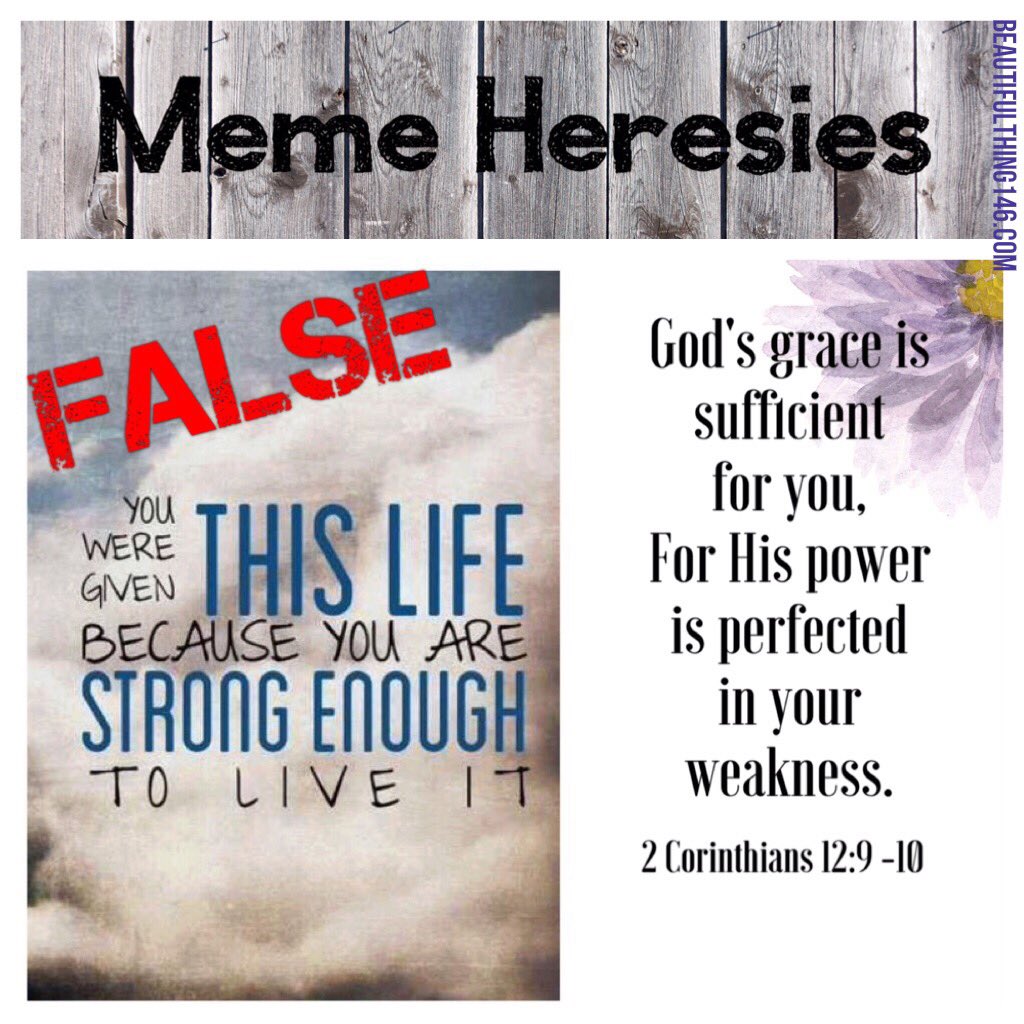
I liked what Jessica did with the side by side refutation here. The stamp of the word “FALSE” across the left side states the situation in no uncertain terms, and the correct verse which refutes the false one is placed on the right. The left side is the man-oriented one and the right side is what God actually said about man.

By Jessica Pickowicz

Here is another one from Jessica. Do you see on the left, it’s man-oriented again? The scripture-y quote is supposed to makes us think, “Wow! I’m strong!” Yet the truth stated in real scripture is, “Wow, God’s gives grace!”

By Jessica Pickowicz

In sum, how to spot the false memes is to check, think, wait. Before passing it along,

1. Double check the address on the verse (if there is one).
2. Double check that the verse isn’t ripped from its context to say something it wasn’t intended to mean.
3. Check the person or organization publishing the quote.
4. STOP. THINK. Does this quote that sounds so Bible-y really reflect a true teaching of God?

To refute them you can always do what Jessica did and create a side-by-side refutation. If you’re not graphically skilled then simply post the scripture picture with a verse that refutes it and maybe a short explanation showing how one is man-oriented and the other is Jesus-oriented.

Well, some might say, doing all that checking, double checking, and investigating, at is a lot of work,. Yes. It’s work. You remember I mentioned the Bereans at the top? They heard Paul then went back and checked that these things were so. They worked, and were commended for it! Just because we’re living in a fast time doesn’t mean we have to quickly press “Post” or “Publish”. Stop. Think.

We handle the Bible’s message with care, because it is the most important message in life. You don’t toss a carton of eggs into the back seat of your car like you do your son’s soccer ball. You handle with care. We don’t toss around Bible-y sayings either. We take care, for the Word is precious. The false teachers toss around the Word carelessly, we believers don’t need to toss it around as well.