Posted in theology

Q&A: Is warning about a person (ie. Beth Moore) different than gossip?

By Elizabeth Prata

EPrata photo

I received this question in my comment section. Here is the question and my answer. I thought it was a good one. See what you think:

Q. I was convicted by the article about gossip, but wondered if you could explain how warning about a person (ie. Beth Moore) is different than gossip. Thank you.

A. Good question. Today’s climate has become so sensitive that anything that is said negatively about another person is screamed to be GOSSIP! (or slander). If warning something negative about a false teacher like Beth Moore is gossip, then Paul gossiped when publicly called out in his letters Alexander, Philetus, Hymenaeus, Demas, Phygelus, and Hermogenes; or John against the Nicolaitans. The instructions in Matthew 18 for church discipline where two go to confront a person in their sin, or if they have to confront the person in front of the church as we are instructed in some cases, would also be gossip.

We are told in Ephesians 5:12-12 Do not participate in the useless deeds of darkness, but instead even expose them; for it is disgraceful even to speak of the things which are done by them in secret.

Warning the sisters or sharing with your pastor is one way to expose them.

Let’s understand the terms, first. I found this definition online: “casual or unconstrained conversation or reports about other people, typically involving details that are not confirmed as being true.”

Meanwhile, discernment is a conscious effort to consider the right and wrong of a situation based on biblical doctrinal or behavioral standards.

Gossip: “I heard that Susie is having an affair and her husband is considering a divorce!” (unsubstantiated negative news and unnecessary to repeat).

Gossip: “Susie told me she flunked the Bar Exam again!” (substantiated because it came from the primary source, but unnecessary to repeat)

Not Gossip: “Pastor, Elder John confirmed to me he is having an affair and divorcing Susie, and he refused to repent when I and Jim confronted him about it”. (Substantiated and necessary to repeat to proper authority as per 1 Timothy 3:2, Matthew 18).

Not Gossip: “Pastor I need to let you know that John, who has recently come to our church and applied for membership and to serve in Kids Club, has a record of child sexual molestation in another state according to that state’s online sex registry, and he is hiding this fact from you.” Obvious why this substantiated information needs to be repeated to proper authority.

While many people warn others about the dangers of a particular false teacher’s teaching, sermons, Bible studies etc, when we begin warning because of their lifestyle, the claim that someone is gossiping becomes more heated.

Yet we are to watch both life and doctrine. Most of the qualifications for teachers of the faith are behavioral. 1 Timothy 3:1-7 has it as well as Titus 1:5-9. Behavioral standards for youths, women, and slaves are contained in Titus 2, among other places (Proverbs, etc).

Joel Osteen is known for his false teachings of the prosperity gospel, (doctrine) but Mark Driscoll was disqualified mainly due to his unbiblical behavior (behavior).

Older women likewise are to be reverent in their behavior, not malicious gossips nor enslaved to much wine, teaching what is good, 4so that they may encourage the young women to love their husbands, to love their children, 5to be sensible, pure, workers at home, kind, being subject to their own husbands, so that the word of God will not be dishonored. (Titus 2:3-5).

While all gossip is bad, the verse here emphasizes “malicious gossip”. The meaning in Greek is a “false accuser; unjustly criticizing to hurt (malign) and condemn to sever a relationship.” The intention is to hurt another person or to harm a relationship.

Jesus said to test the fruit of the teachers’ lives (Matthew 7:15–20) and this includes behavior- good fruit or bad fruit. Paul urged the Thessalonians to test his fruit in 1 Thessalonians 1:5, saying  just as you know what kind of men we proved to be among you for your sakes and then in verse 6 Paul urged the congregation to imitate him. His behavioral witness was part of his qualification.

While it is harder to know what kind of men (or women) they prove to be if they are a celebrity Bible teacher and you know them only by online works, it is still possible to make an assessment and to substantiate it (test the fruit). Except, be careful not to spread secondhand news, OR to spread news of a behavior that has happened only once or twice. Be patient, look for a pattern, like the police look for a MO (modus operandi, which means “mode of operating”.)

Mainly, we can test if it’s gossip vs. a warning if the information is true, if the information be substantiated, and if it is necessary to repeat. Warning someone about a false teacher, if that has been substantiated, is necessary. It’s actually commanded. It would be like if the Sheriff came to your neighborhood homes to warn about an escaped convict in the area and gave you the details of his behavior and what he looks like, and you told him that this is gossip and you won’t listen. The sheriff came to you for your protection. It’s the same with discernment, warning about an evildoer outlaw is for your spiritual protection.

Keep the questions coming, I appreciate them. Finally, I thought this was a good link explaining the difference:

Further Resources

The Masters University- Beware of False teachers

Article by Matt Mitchell: The Scriptures do not provide a definition of gossip in one location. Instead, they describe gossip in action and intimately tie it to the character of the people participating in this tantalizing sin. The Bible often uses the word gossip to describe a kind of person more than just a pattern of communication. FMI- What is Gossip? Exposing a Common and Dangerous Sin

Posted in theology

It all started with two trees: When your reputation is slandered

By Elizabeth Prata

I know what hack reporting is. I know all too well how people with a platform can manipulate public perception under the guise of “journalism”. I know how easily they may turn from good intentions at some point in the past, but once they get a taste of blood in the water, they begin use their platform as a bully pulpit.

Continue reading “It all started with two trees: When your reputation is slandered”
Posted in theology

This is worth its own post

By Elizabeth Prata

Charles Surgeon’s Morning Devotional this morning is especially pointed regarding tale-bearing.

In this day and age, we are so proccupied with ‘bigger’ sins such as abortion and homosexuality, we forget that tale-bearing was almost the original sin (satan’s pride was first) but his tale-bearing “widespread merchandise” in Ezekiel 28:16 is lamented over deeply. Satan’s tale-bearing caused war in heaven and a third of the holy angels to fall! Tale-bearing blackens the Imago Dei of each human, we are all made in the image of Christ.

The scripture is so clear. DO. NOT. DO. IT.

Thursday, November 29, 2018
This Morning’s Meditation
C. H. Spurgeon

“Thou shalt not go up and down as a talebearer among thy people . . . Thou shalt in any wise rebuke thy neighbour, and not suffer sin upon him.”—Leviticus 19:16, 17.

TALE-BEARING emits a threefold poison; for it injures the teller, the hearer, and the person concerning whom the tale is told. Whether the report be true or false, we are by this precept of God’s Word forbidden to spread it.

The reputations of the Lord’s people should be very precious in our sight, and we should count it shame to help the devil to dishonour the Church and the name of the Lord. Some tongues need a bridle rather than a spur. Many glory in pulling down their brethren, as if thereby they raised themselves. Noah’s wise sons cast a mantle over their father, and he who exposed him earned a fearful curse. We may ourselves one of these dark days need forbearance and silence from our brethren, let us render it cheerfully to those who require it now. Be this our family rule, and our personal bond—SPEAK EVIL OF NO MAN.

The Holy Spirit, however, permits us to censure sin, and prescribes the way in which we are to do it. It must be done by rebuking our brother to his face, not by railing behind his back. This course is manly, brotherly, Christlike, and under God’s blessing will be useful. Does the flesh shrink from it? Then we must lay the greater stress upon our conscience, and keep ourselves to the work, lest by suffering sin upon our friend we become ourselves partakers of it.

Hundreds have been saved from gross sins by the timely, wise, affectionate warnings of faithful ministers and brethren. Our Lord Jesus has set us a gracious example of how to deal with erring friends in His warning given to Peter, the prayer with which He preceded it, and the gentle way in which He bore with Peter’s boastful denial that he needed such a caution.

gossip

Posted in discernment, Uncategorized

The Tongue is a Rudder: A Sailing Story

I lived on a sailboat and cruised up and down the eastern seaboard for two years. Just as there is with any lifestyle, there are niches within that lifestyle. The circumnavigators go around the world, traveling for weeks across the seas from one continent to another. These folks are serious, and they generally have sold all they own and permanently live on their boat.

Then there were people like us who lived aboard and cruised along the shoreline. Live-aboard cruisers don’t usually venture far out to sea, though we may be without sight of land for hours or a day or so on an overnight passage. We usually keep our houses and relationship attachments, live this way for a period of time, and then return to life on shore. This is called “swallowing the anchor”. For liveaboards like is cruising is more of an adventure than a way of live.

Then there are the folks who own a sailboat and dock it at a yacht club and sail for a few hours on the weekend. Many of these folks dream of living aboard or circumnavigating but haven’t been able to do so yet.

Though there are tiers of sailors with varying levels of commitment and skill, the Sea can be kind or cruel to each one of us. When an emergency happens while sailing on the ocean it’s just as life threatening whether you’re near shore or in the middle of the ocean.

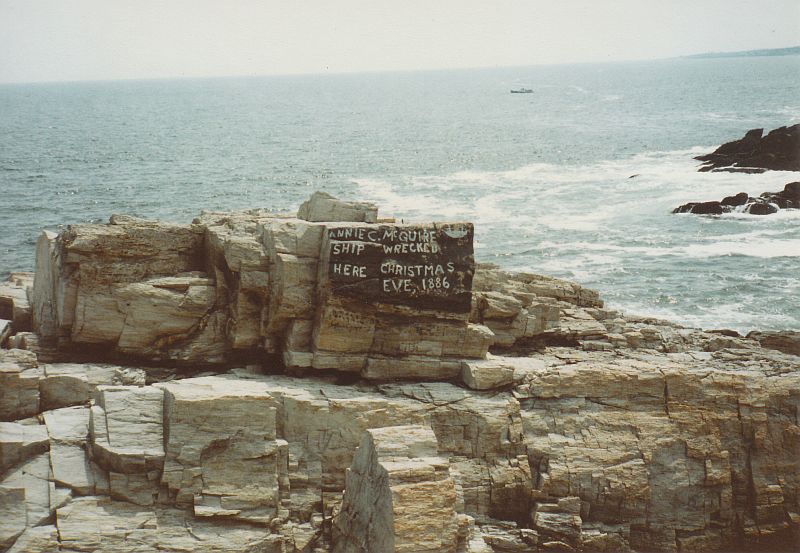
Annie C. Maguire wreck. Portland ME. EPrata photo
photo Collections of ME Historical Society. FMI on the wreck- Source

My husband and I had sailed from Maine to Florida with a variety of passages that included motoring down the Intracoastal Waterway,sailing across huge Rivers and Sounds, and making some offshore overnight ocean passages. We’d finally arrived at Fort Lauderdale’s Las Olas anchorage, the traditional launching off point to cross the Gulf Stream to the nearby nation of The Bahamas. It’s 50 miles, but a tricky 50 miles.

The Gulf Stream is a fast moving river of water atop the ocean. The Gulf Stream is about 60 miles wide and runs at an average surface speed of 5.5 mph. Since the boat can sail at around 5 mph it means that the combined speed plus the Gulf Stream’s fast northward push means you have to make exact navigation maths and be on constant vigilance. You could get pushed to Ireland if you’re not careful. A worse disaster would be pushed a few miles, or even a few feet off course and wind up on the rocks, shipwrecked on the shores of a foreign nation or in hazardous waters.

You need to stay on your toes regarding weather. You’ll be traveling in open ocean, the islands are low, some anchorages will be exposed on one or more sides, and there will be potentially rough passages through reefs and cuts between islands. Source

The warm waters of the Gulf Stream (red). FL is at bottom,
the topmost island left side is town of West End, Grand Bahama Island.

So you start off from Ft. Lauderdale and let the Gulf Stream push you north and your sails push you east toward the intended harbor. The biggest danger is a wind that flows from the north tot he south, and meets the Gulf Stream waters moving from the south heading north. The collisions of southerly flowing air and northerly flowing fast water makes for a steep waves. Steep waves are rough because the front part of the boat (the bow) goes up and then down fast. At least with a rolling wave the boat can roll with it. A steep chop makes the boat pound. Pounding is hard on everyone and is hard on the boat.

Because crossing over the Gulf Stream is a bit dangerous and not for the fainthearted, mariners usually take off from the anchorage in little groups. Safety in numbers. Not that if anything happens we can go from one boat to another to troubleshoot the problem, but if the worst happens we can rescue a person from the water or call for the Coast Guard for help and stand by.

So our little clutch set off in the dark hours, so we would arrive at a time when the rising sun would be over our shoulders and not in our eyes. The weather report was for gentle winds flowing north, which would actually help flatten the Gulf Stream waters.

All was well … sailing over the bounding main … for a while.

The wind unexpectedly shifted from the south to the north, creating that dreaded sharp, steep chop. The boats took a pounding. Then the rain and thunder and lighting started. It was dark and it was rough.Then…one of the boats’ rudders broke.

I think you know how important a rudder is. It is a tiny thing, relatively speaking, a small part of the boat. Not heavy like the motor, not showy like the sails. However it’s the most critical part, since it steers the boat. Without the rudder, our friend’s yacht was drifting helplessly in the storm, in the Gulf Stream, toward the reefs. They were at the mercy of waves, rocks, and winds. They had no control and it was terrifying.

When we put bits into the mouths of the horses to make them obey us, we can guide the whole animal. Consider ships as well. Although they are so large and are driven by strong winds, they are steered by a very small rudder wherever the pilot is inclined. In the same way, the tongue is a small part of the body, but it boasts of great things! James 3:3-5

A small rudder can guide the whole boat. A small muscle like the tongue can guide the whole body. With the rudder not guiding the boat, it was at the mercy of other more destructive things than the pilot’s inclination. Just like the tongue. The ‘pilot’ must be in control of the tongue so it does not become subjugated to other, more destructive things like slander, gossip, tale-bearing, and criticism. These are the rocks and reefs of relationships, as Jude describes in Jude 1:12-13, using the same sailing metaphors of waves, reefs, and winds.

I was busy handling our boat and my husband was on the VHF radio in contact with the stricken vessel. We all had slowed down and were kind of trying to circle around them and stay close. It was hard to do so in the storm. Eventually the other men talked him through and somehow he got his rudder fixed.

We were off course by then so we had to regroup and figure out how to get back on track. The winds were still high and we were in the hump of the Gulf Stream, the current was flowing fast. Entering West End Grand Bahama was a tricky maneuver of sliding between reefs through a narrow channel. We were off by a few feet. However you can see the destruction ready for the unwary in the Annie C. Maguire vintage photo above. They were only off by a few feet also.

Providentially, there was a Good Samaritan who happened to be carrying a VHF radio who happened to be walking the beach who guided us in. If he had not been there we would have ended up on the rocks. It’s another example of how the Lord protected me until the appointed time for salvation, 13 years later.

I’ll never forget the terror of our friends losing their rudder. Even though the James verse about taming the tongue by using marine metaphors is vividly alive for me, I still failed in this last week. I’ve repented. After listening to a lecture by Justin Peters on the importance of wholesome talk and the destructive inclinations of the tongue by gossip I will do better this week. I do not want to end up on the rocks for correction. I am the pilot. I am in charge of my boat. With the Holy Spirit to guide me safely to port, I know I have all the help I need.

EPrata photo

The dark blob in the foreground is a coral head. Their sharpness can rip the keel or underside of your boat like a razor. The boat with two men on it is grounded. The water gets shallow very fast in The Bahamas. In the middle horizon, those brown humps are the land, which is just a few feet above sea level. Now picture trying to find the right channel, in the dark, in a storm, on 0 sleep in the last 24 hours.

Posted in prophecy, Uncategorized

The crooked speech of gossip

Introduction

God hates sin.

Let me say that again.

God hates sin.

Of course, we know that, but sometimes we let our minds pass over it without thinking more deeply about the fact that God hates sin. Really hates it. Why does God hate sin?

God hates sin because it is the very antithesis of His nature. The psalmist describes God’s hatred of sin this way: “For You are not a God who takes pleasure in wickedness; no evil dwells with You” (Psalm 5:4). God hates sin because He is holy; holiness is the most exalted of all His attributes (Isaiah 6:3; Revelation 6:8). His holiness totally saturates His being. His holiness epitomizes His moral perfection and His absolute freedom from blemish of any kind (Psalm 89:35; 92:15; Romans 9:14).

The Bible presents God’s attitude toward sin with strong feelings of hostility, disgust, and utter dislike. For example, sin is described as putrefying sores (Isaiah 1:6, NKJV), a heavy burden (Psalm 38:4), defiling filth (Titus 1:15; 2 Corinthians 7:1), a binding debt (Matthew 6:12-15), darkness (1 John 1:6) and a scarlet stain (Isaiah 1:18).From: GotQuestions, Why Does God Hate Sin? For the rest of the essay, go to link here

If I let my mind do it, I’d be telling myself what a good person I am. Hey, I’m not a murderer. I’m not a thief. I’m not a rapist. I’m not queer. Hey, I don’t do those big sins! I’m pretty good.Not so much.

I do the “respectable sins”. I sure do. According to Jerry Bridges in his book “Respectable Sins: Confronting the Sins We Tolerate“, respectable sins are the ones we don’t repent of, and nobody calls us to account for them. These are the sins we all collude over because we all do them, hence, the tolerating. What are some of these respectable sins? Pride, worldiness, anxiety, impatience, selfishness, gossip…

Am I proud? Yes. Am I selfish? Yes. Do I gossip? Yes. I’m a sinner! A disrespectable one!

Part 1: Sins of the Tongue

We can dispense with the obvious first. Some sins of the tongue are so immediately identifiable as inappropriate that we can and do call the speaker on those. Lewd jokes or using the F-word, especially in mixed company, at work, or worse, at church, are not tolerated.

If you ever read any parts of Proverbs at all, you run up against warnings about engaging in various types of bad speech. There are over 60 different verses addressing poor speech/right speech. There are lots of sins of the tongue besides lewdness and profanity, such as gossip, white lies, critical/harsh words, slander, insults, sarcasm/ridicule.

When Isaiah was given the vision of God on His throne, and He saw the majesty and perfection of our God, what did Isaiah say? I am a man of unclean heart? I am a man of unclean mind? No, though he was a man of unclean heart and mind (as are we). He said,

Woe is me! For I am lost; for I am a man of unclean lips, and I dwell in the midst of a people of unclean lips; for my eyes have seen the King, the LORD of hosts!” (Isaiah 6:5)

Where did the angel cleanse Isaiah with the hot coal from the altar? On his breast to cleanse his heart? On his head to cleanse his mind? No. On his lips. Why? McLaren says

The vision kindled as with a flash Isaiah’s consciousness of sin. He expressed it in regard to his words rather than his works, partly because in one aspect speech is even more accurately an act, as it were, of character, and partly because he could not but feel the difference between the mighty music that burst from these pure and burning lips [of the seraphim] and the words that flowed from and soiled his own.

Though we are saturated through and through with sin, our heart, mind, strength and soul are all drenched with impurity and pollution. However, the mouth gives birth to the sin inside us. James said in James 3:10,

And so blessing and cursing come pouring out of the same mouth. Surely, my brothers and sisters, this is not right!

Sins of the mouth also include hasty words, flatteries, anger. (Prov 29:5, 11, 20). Proverbs warns against hasty words, and James 1:19 advises us to be slow to speak.

Part 2: Gossip

Let’s talk about gossip. It might be a ‘respectable sin’ on earth but God spoke against “sins of the tongue”manytimes in scripture. Don’t be fooled. Gossip is a big sin.

Proverbs 4:24 says,

Put away from you crooked speech, and put devious talk far from you.

And Matthew Henry’s Commentary on the Whole Bible says of the Proverbs 4:24 verse,

Our hearts being naturally corrupt, out of them a great deal of corrupt communication is apt to come, and therefore we must conceive a great dread and detestation of all manner of evil words, cursing, swearing, lying, slandering, brawling, filthiness, and foolish talking, all which come from a froward mouth and perverse lips, that will not be governed either by reason or religion, but contradict both, and which are as unsightly and ill-favoured before God as a crooked distorted mouth drawn awry is before men. All manner of tongue sins, we must, by constant watchfulness and stedfast resolution, put from us, put far from us, abstaining from all words that have an appearance of evil and fearing to learn any such words.

Let no corrupting talk come out of your mouths, but only such as is good for building up, as fits the occasion, that it may give grace to those who hear. (Ephesians 4:29).

Only such as good for building up…how many times do we fail at speech that is solely for the other person’s good? How many times even in church do we gossip?

A dishonest man spreads strife, and a whisperer separates close friends. (Proverbs 16:28)

Whisper campaigns can be devastating. Sometimes a Christian doesn’t mean to spread tales or doesn’t know the tales are untrue. It’s still sin. Sadly, other times, people deliberately whisper against others, even those who sit in the same pew. Whisper campaigns are-

-a method of persuasion in which damaging rumors or innuendo are spread about the target, while the source of the rumors seeks to avoid being detected while spreading them. Wikipedia

Part 3: The Solution

In returning to the moment when Isaiah realized the magnitude of his sin, and how it’s expressed via his lips, McLaren says,

The next stage in Isaiah’s experience is that sin recognised and confessed is burned away. Cleansing rather than forgiveness is here emphasised. The latter is, of course, included, but the main point is the removal of impurity. It is mediated by one of the seraphim, who is the messenger of God, which is just a symbolical way of saying that God makes penitents ‘partakers of His holiness,’ and that nothing less than a divine communication will make cleansing possible. It is effected by a live coal. Fire is purifying, and the New Testament has taught us that the true cleansing fire is that of the Holy Spirit. But that live coal was taken from the altar. The atoning sacrifice has been offered there, and our cleansing depends on the efficacy of that sacrifice being applied to us.

We’re warned to put to death our sin. (Colossians 3:5). And yet, I don’t. I don’t regularly murder, but I readily kill their character, name, or reputation through gossip, thoughtlessness, or hasty words. Daily I pray for strength to speak words that only build up. Every day I fail. Given the numerous verses which warn about gossip or other poor speech it seems that this particular sin is important to God for us not to commit. I continue in my pursuit of good speech.

I can console myself that several of the heroes of the Bible were caught up in the sin of gossip and complaining and tale-bearing.

Miriam and Aaron spoke against Moses because of the Cushite woman whom he had married, for he had married a Cushite woman. And they said, “Has the LORD indeed spoken only through Moses? Has he not spoken through us also?” And the LORD heard it. (Numbers 12:1-2)

But it is no consolation at all. The second part of this verse says, And the LORD heard it. Gulp.

In 1 Timothy 3:3, the passage outlining qualifications of overseers, the candidates are warned not to be quarrelsome. Matthew Henry has explained the word quarrelsome,

He must be patient, and not a brawler, of a mild disposition. Christ, the great Shepherd and Bishop of souls, is so. Not apt to be angry or quarrelsome; as not a striker with his hands, so not a brawler with his tongue; for how shall men teach others to govern their tongues who do not make conscience of keeping them under good government themselves? Matthew Henry’s Commentary on the Whole Bible

Isn’t that a good insight? A brawler with the tongue. One who can govern his or her tongue is worthy to lead.

The solution:

–Remember, the LORD hears it.

–Let us confess our sin of gossip and tale-bearing when we do stumble.

–Adhere to the verse which admonishes that we should sanctify our lips by only allowing good speech such as for building up.

–Repeat

The Conclusion

There is an obscure prophecy in Zephaniah. At the end of time at the conversion of all the nations, the Lord promises that,

For at that time I will change the speech of the peoples to a pure speech, that all of them may call upon the name of the LORD and serve him with one accord.”

Interpreters are divided as to exactly what this will mean. Does the pure speech refer to one language, as prior to the dividing of the peoples at the Tower of Babel when God confused the languages? Some think that this verse promises a reversal of the confusion of multiple languages and a return to one language, whether that possibly will be Hebrew, or not.

Jamieson, Fausset, Brown Commentary explains,

turn to the people a pure language—that is, changing their impure language I will give to them again a pure language (literally, “lip”). The confusion of languages was of the penalty sin, probably idolatry at Babel … The full restoration of the earth’s unity of language and of worship is yet future, and is connected with the restoration of the Jews, to be followed by the conversion of the world. Compare Isaiah 19:18; Zechariah 14:9; Romans 15:6, “with one mind and one mouth glorify God.” The Gentiles’ lips have been rendered impure through being the instruments of calling on idols and dishonoring God (compare Ps 16:4; Ho 2:17). Whether Hebrew shall be the one universal language or not, the God of the Hebrews shall be the one only object of worship. Until the Holy Ghost purify the lips, we cannot rightly call upon God (Is 6:5–7).

Yet others think the verse in Zephaniah means less the literal ‘one language’ theory as a pure lips to call upon God once again interpretation. (As Adam and Eve did before the Fall.)

Instead it means the renewal of once-defiled speech. One’s lips represent what he says (the words spoken by his lips), which in turn reflect his inner life (cf. Isa. 6:5–7). The nations, formerly perverted by the blasphemy of serving idols, will be cleansed by God for true worship. As a result the nations, turning to reverential trust in God, will call on the name of the LORD and will evidence their dependence on Him by their united service (shoulder to shoulder). In J. F. Walvoord & R. B. Zuck (Eds.), The Bible Knowledge Commentary: An Exposition of the Scriptures

What a blessing to have only blessing come from our lips! As James said above, blessing and cursing from the same mouth? It is not right! Yet there will be a day when only blessing will emerge from our glorified lips, no inner stain to pollute pure worship and the name of the Lord as we vocally call hallelujah upon Him. And the LORD will hear it.

Further Reading:

The Sin of Talking Too Much