Posted in prophecy, Uncategorized

Examining Christmas Traditions #2: Wise Men at the manger?

There are traditions regarding the Christmas story within the faith. We have Christmas carols with lyrics that say that angels sing, we set up nativity scenes with Wise Men, we erect Christmas trees, and more.

Do these traditions have any bearing from scripture? If not should we care? If not, should we abandon them? Accept them? Are we disrespecting Christ by perpetuating them? Or not?

Friday I wrote about the hymns we sing at Christmas time where lyrics portray angels singing. I looked at whether scripture shows angels singing or not. Scripture shows angels saying, proclaiming, and shouting, but not singing. Today let’s look at nativity scenes with Wise Men crowded around the babe in a manger. Is that scriptural?

Yes, and no.

Wise men did come from the east upon learning of the birth of the Messiah. They did not arrive at the night of his birth though. They arrived up to two years later. The verse says,

Now after Jesus was born in Bethlehem of Judea in the days of Herod the king, behold, wise men from the east came to Jerusalem, 2 saying, “Where is he who has been born king of the Jews? For we saw his star when it rose and have come to worship him.” (Matthew 2:2).

The ‘after this’ is after His birth, where Matthew 1 ends. How do we know it wasn’t the day after, and that it was up to two years after? Because of this-

After listening to the king, they went on their way. And behold, the star that they had seen when it rose went before them until it came to rest over the place where the child was. (Matthew 2:9).

The verse says where the child was, not ‘where the baby was’. In the Greek the word used for child means,

(“a little child in training”) implies a younger child (perhaps seven years old or younger). Strong’s.

The Magi went to Bethlehem and fell down and worshiped Jesus at his house. He was not in a barn, or stable, or any sort of animal enclosure, and He was not laying in a manger.

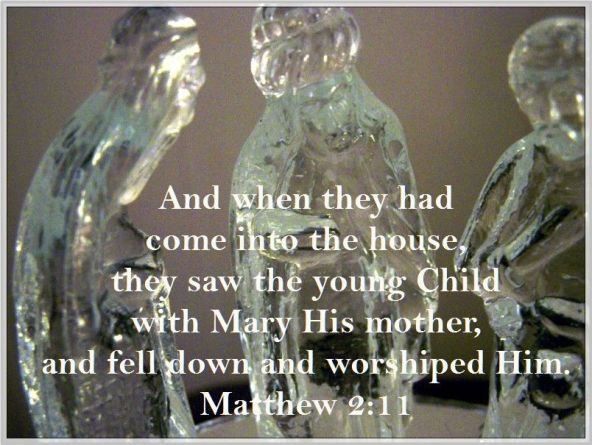
And going into the house, they saw the child with Mary his mother, and they fell down and worshiped him. (Matthew 2:11)

Herod died in 4BC so the men must have visited between the birth and up to when Jesus was around two years old. Later, Herod made a declaration to kill all the children under two years of age.

Then Herod, when he saw that he had been tricked by the wise men, became furious, and he sent and killed all the male children in Bethlehem and in all that region who were two years old or under, according to the time that he had ascertained from the wise men. (Matthew 2:16).

It is clear that in actual time, the Magi from the East did not arrive in time to worship Jesus in his birth location, which was temporary. So is it unscriptural to set up a nativity scene with the Wise Men? I don’t believe so.

The Wise Men did in fact arrive to worship. It happened. It would be unscriptural for example, if a nativity scene had figures such as Moose or beavers, not indigenous to the location. Or if the scene had added figures such as Herod or Jezebel, who were evil and certainly not depicted anywhere in proximity (and of course Jezebel was long dead).

I believe that collapsing time is an acceptable literary license. The Apostles did so when they wrote inspired scripture. They said things like, ‘Then Jesus went…” where the actual time might have been months later from the evetnt written of in the previous sentence. “Jesus was born, then the Wise Men came…”

What I like about the birth chronology is that everyone involved with it, from announcement to just before the Family had to flee to Egypt, is that everyone worshiped. Elizabeth and Mary, Joseph, the Shepherds, Anna and Simeon, the angels, and the Wise Men. Worship is the proper response to meeting Jesus, both intellectually and emotionally. Our Savior is born, and hallelujah that He came into the world. Though not exactly perfectly historic, the crowd around the manger of animals, shepherds, parents, and wise men do depict an accurate response to the birth of the Savior. However, I understand if some people decide to remove or not install figures of the Wise Men in their nativity, or decline to have Wise Men circulating at a live nativity scene, due to historical inaccuracy.

Jesus lived the perfect life under God’s standards for holiness that we could not. Enduring agonizing separation from His Holy Father, He cried out and absorbed all God’s wrath for our sin.  Accused unjustly, He was nailed to the cross and executed, thus becoming the sacrificial lamb. Pleased with His Son, God resurrected Jesus on the third day and Jesus ascended into heaven. Now, His blood atones for our sin and forgiveness awaits those elected to ask for it. Praise God He made a way for us to be reconciled to Him! Mercy abounds.

Further Reading: Answers In Genesis Three Wise Men?

Grace To You 2 min podcast- Where Are the Wise Men?
christmas-wise-men-verse

Posted in encouragement, Uncategorized

The ‘Wondrous Strange’ Gospel

Back in 1998 I drove a few hours from my home in Gray, Maine to Rockland, Maine. The destination was the Farnsworth Library & Art Museum. The Farnsworth is a gorgeous museum tucked away on the rockbound coast. The New York Times wrote of the opening of the Farnsworth and the Wyeth collection this way,

Ever since N. C. Wyeth bought a place in Port Clyde, south of Rockland, in the early 1930’s, the family has summered here, and Andrew Wyeth’s painting ”Christina’s World” is, for many people, synonymous with Maine. The Wyeth center is attached to the Farnsworth Art Museum, a respected 50-year-old institution that focuses on artists connected with Maine and that has built one of the best small, specialized collections in the country.

They had advertised a collection I was dying to see. It was called, “Wondrous Strange: the Wyeth Tradition: Howard Pyle, N.C. Wyeth, Andrew Wyeth, James Wyeth.” You might or might not know that the three generations of Wyeths have a deep connection to Maine, and all three generations owe inspiration to Pyle. The generations went like this- Turn-of-the-last-century illustrator Howard Pyle; His student was N. C. Wyeth; N. C.’s student and son was Andrew Wyeth (wife Betsy); Andrew’s student and son was Jamie Wyeth. Betsy Wyeth chose the paintings and illustrations for the show I was driving to see, and named it Wondrous Strange.

The theme of the show is described from the catalog as, “an imaginative, often disquieting, dreamlike imagery.” The catalog/book describes the paintings- “Demonic eyes shining out of a shadowy tree. A blind man staggering through a moonlit landscape. Disembodied, dark hands rising out of snow. A feral dog with one blue eye. Ambiguous shadows harboring human shapes.”

The NY Times described it this way:
While Andrew and Jamie work in cooler times, there is no question that some of the images in ”Wondrous Strange” are really weird. Andrew paints a corpse emerging from a block of melting ice and severed hands perched on ice floes; Jamie portrays himself with a pumpkin head and as a clownish scarecrow. He depicts lighthouses with the same fierce perspective that his grandfather used for Peg Leg Pete.

One of the paintings’ raison d’etre is described by the artist Andrew Wyeth himself as ”to memorialize the emotions he felt upon viewing his father, N. C. Wyeth, in his casket.” Yes. Weird indeed.

Here are a few of the paintings that were mounted in that long-ago show.

“Mischief Night,” by Jamie Wyeth.
“Pumpkinhead Visits the Lighthouse,” by Jamie Wyeth

Treasure Island illustration, NC Wyeth, 1911

One painting that was included in the show was this one, called simply, “Lighthouse”, by Jamie Wyeth. This painting adorns the cover of the catalog/book.

It’s eerie. There’s nothing particularly ghoulish about the scene. In fact, many other paintings were more weird and fiendish. But there is something maniacal and out of control in this painting. The scudding clouds evoke thoughts of monstrous hands strangling the world, the fortress-like lighthouse, the wild hair, the jarring vestment of a wrinkled military uniform worn on a wild hill… the painting is a perspective of the world that’s cracked, tilted, and agitated.

Perhaps that was the appeal- weirdness, agitation, and ghoulish specter of the disquieting. As I said, I’d driven a few hours and it was going to be a day trip, no less. After seeing the exhibition and having lunch with the friend accompanying me, we’d turn around and drive home. The attraction of the wondrous strange to the pagan heart is strong.

The title of the show comes from Shakespeare’s Hamlet Act I Scene V-

HORATIO
O day and night, but this is wondrous strange!
HAMLET
And therefore as a stranger give it welcome.
There are more things in heaven and earth, Horatio,
Than are dreamt of in your philosophy.

Returning from nostalgia, on Saturday I was listening to John Gerstner’s Handout Apologetics this morning. The lesson was on The Gospel of God, lesson 10. Gerstner said of the Gospel,

The question remains, how do I know that this Jesus of Nazareth, a man among men, was more than a man among men? You ask me to believe He was actually God incarnate? When did anybody ever stretch the credulity of the human mind more than when it is asked to believe that that simple peasant of Galilee was God dwelling in human flesh?!

The mind of man couldn’t think it up. To think a Person in the Godhead, would unite humanity with deity, and suffer in that humanity and yet as deity, survive the wrath of the Godhead, that is something that when you read about it in the Bible you know it has to be true, it couldn’t be fictional. It is so strange, so wonderful so beyond human anticipation that it has to be a God-given reality.

Well, you know of course why I spent time writing about the Wyeth wondrous strange exhibition. The mind of man I’d thought was so imaginative in painting and illustrating eerie and strange scenes, is not so wondrous strange after all. The REAL wondrous strange is the reality of the Gospel, of a God whose act of sacrificial incarnation, suffering, and death is SO strange that man had never ever thought it up in any religion, before or since. The wondrous strange mind of God, who had planned this devastatingly necessary separation of His Son from the Godhead since before the foundation of the world, in merciful love and grace, is the strangest wonder of all. As Halloween proceeds through this day, please ponder the most strange philosophy, Horatio, ever not dreamt of in earth, but is real and true from heaven.

Posted in Uncategorized

The Gospel is not a man-made invention

This morning I was reading another prayer from my wonderful Valley of Vision book. These are Puritan prayers and devotions, collected into one volume by Editor Arthur Bennett and printed by The Banner of Truth Trust. It is a must-have for your bookshelf.

These prayers often stop me in my tracks with their convicting beauty, depth of spirit, and fervency of faith. Today’s prayer was the first prayer in the section “Redemption & Reconciliation”, and it’s called The Gospel Way. You can read the entire prayer here.

I was immediately struck by the first line.

BLESSED LORD JESUS,
No human mind could conceive or invent the gospel.

Think about this for a while.

Really think.

This one statement has enormous ramifications. Thoughts could erupt in a thousand different paths. For me, I clearly remember the years (decades) before I was saved. I remember being mightily puzzled by the Jesus people, their fixation on the blood (Ew, gross) and the communion bread/wafer they ate that was supposed to be the Lord’s body (Ew, grosser). I remember being confused by their joy even when they were diagnosed with a dread disease, why they so often and profusely thanked the Lord for anything and everything (Oh, get over it, I’d say), and why, oh why, has Christianity persevered all these thousands of years when other religions … didn’t?
Continue reading “The Gospel is not a man-made invention”