By Elizabeth Prata
I love books! I love everything about them. I like inventorying them when I bring one home. I like looking at the ones on my shelves. I like my library room full of books. I like thinking about the ones I have read and the ones I want to read. I like the covers (I DO judge a book by its cover). I like the thrill of maybe finding a first edition (I have a 1st ed C.S. Lewis and a 1st Book Club edition of Dune). I like book bindings. I like antiquated books. I like the thrill of the hunt for books.

Like this find delivered to the Metropolitan Museum. Maybe someday I’ll find a book like that!
I also like reading. I’ve always been a reader. I was weaned on 1960s Dick and Jane. I grew into Nancy Drew in 2nd grade, enjoyed Harriet the Spy as a 5th grader, got wrapped up in King Arthur as a High Schooler (The Once and Future King, The Crystal Cave, Le Morte d’Arthur), and the Classics. I loved the classics, like Huck Finn and Following the Equator from Mark Twain, The Great Gatsby from F. Scott Fitzgerald, Hemingway, Gabriel Garcia Marquez. I did go on a tear in my early 20s on South American literature’s Magic Realism from Marquez, Esquival, Allende, Neruda etc.
In my thirties I was living on the sailboat and also traveling a lot and the internet hadn’t come to the little people yet so I always had a book in hand. I liked at that time the traveling/adventure narratives such as A Year in Provence, Into Thin Air, Tim Cahill books, seafaring books and explorer books like The Lost City of Z.
In my 40s I was establishing my business of a local newspaper and read journalism books and books about civic society. In this era the book Bowling Alone stood out.
Reading is my identity as a person. It’s also my professional identity. My two education degrees revolve around literacy, so my professional days are to urge people to become better readers, to enjoy stories, to find the value of reading.

In my 50s I still read but not as much. I went back to work in education, this time not a teacher but as a teacher’s aide. It is a demanding job and with my aging I found I was tired when I got home. But the frequent breaks from school still provided ample time to read, and I revisited the classics and some modern literature. I had also been saved by the grace of Jesus and I started reading theological books such as the Puritan Paperbacks and other religious topics.
Then I turned 60. I was still working, and the job had deepened into being a teacher’s aide PLUS doing interventions with struggling readers and keeping up with the data. Educators make as many decisions all day as an air traffic controller. Decision fatigue is real. The irony of aging is that as one gains seniority or more experience, she is given more responsibility. This is natural. However more responsibility comes at a time when the person is tiring mentally and physically. This is natural too.
I realized that I just don’t actually read much any more. My brain is tired when I get home from work. On weekends my eyes are weary, dry, and sometimes aching or throbbing. It’s tempting to just watch a screen when there are so many options for entertainment.
I berated myself for a long time for being weak-willed, for being lazy, for starting to become aliterate (unwilling to read, although able to do so).
But I DO want to read! It’s a habit I cherish. I’ve read so many good books. I’ve used books as escapism, I’ve learned so much, expanded my vocabulary, and sparked my imagination. Many of my travels had a goal to visit bookish places, such as the great bookstores of the world, or the homes of famous authors, or locations where famous book events happened.
Why, WHY don’t I read (as much) anymore?

I set about to find out and to solve my problem.
I came across a video where the host proposed Why Adults Don’t read…And How to Start Again from The Book Guy. I don’t know anything about the Book Guy but his video was articulate and well researched.
Here are his reasons. But don’t just read them and go ‘Oh yah’, there’s more to them than first appears.

For example, in No. 1, he gives information about 4 levels of literacy. As an educator, I found level 1 and 2 to be interesting when thinking of my students and the lack of literacy at home. It helped me be more informed and more sensitive.
No. 3, not having enough energy is definitely a major reason. Between old eyes, decision fatigue, mental weariness, it had become much easier to watch TV mindlessly than read a book engagingly. And reading is a habit, letting it go even for a while like I have, dulls the skill. It’s harder to pick up later.
No. 4 is more complex than one would think from the statement. It’s not just a bad experience, which does tend to turn some people off. It’s the pressure from others or pressure put on one’s self to read certain books.

After I was saved in my early 40s I happily read lots of theology. As my 40s were left behind and then the 50s as well, I then realized I had put pressure on myself to read what I thought I SHOULD read rather than what I wanted to read. I had incrementally viewed fiction as ‘dessert’, only to be enjoyed after dutifully absorbing ‘better’ books or more worthy books. Now, don’t get me wrong. I LOVE the Puritan Paperbacks, Commentaries, Christian living books I’ve read. Many have impacted me deeply and added greatly to my life.
[From Death to Life: How Salvation Works, Blood Work: How the Blood of Christ Accomplishes Our Salvation, Valley of Vision, Pilgrim’s Progress are just a few!).
I felt also that if I had time and inclination I should be reading the Bible. Was I letting Jesus down by not spending MORE time in the word if I had the chance?
But reading fiction is instructive in its own way. It’s not dessert. I’m amazed that as a younger adult all I read was fiction and now all I read is non-fiction. Did I become a snob? Perhaps.
Fiction IS instructive. It teaches us languages skills and communication; fiction teaches us empathy, as explained more thoroughly in Neil Gaiman’s transcripted talk Why our future depends on libraries, reading and daydreaming.
I decided to get a fiction book from the Library that had been recommended to me. I pushed my computer away and got up to snuggle in my chair under a quilt, and read it. It was so relaxing. I sort of gave myself permission to indulge, and I even had a sink full of dishes, too.

There are a few lessons for me here. First is just because I’ve been a reader all my life, I took the SKILL of reading for granted. As I transition to a slower season of life, I can’t take anything for granted- not energy, not skills, not time.
Second, read what you want. I will continue to read solidly theological books, but I will intentionally fold in fiction to the pile, and not feel guilty.
Third, just do it, as the saying goes. If I want to read, and I do, then just do it. Resist the temptation to first do the dishes, fold the laundry, and dust before, only to be too tired after. If it is important to me, then make the time.

So that’s my confession, my search for answers, and my resolve. Now if you will excuse me, I have a book to finish.


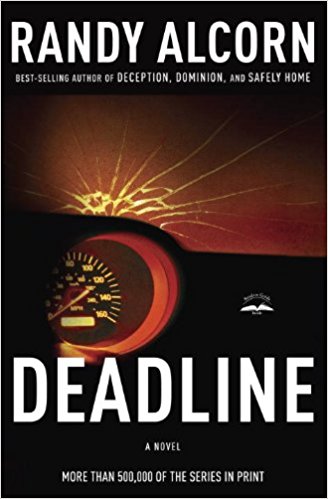 Randy Alcorn’s Deadline
 the-end-time.org