By Elizabeth Prata
Tag: fiction
Summer Reading: Paradise Lost
By Elizabeth Prata
When someone says “summer reading” it usually brings to mind beach reads, AKA light novels, that are aimed to entertain. Since people take vacations in summer, they bring with them a novel that isn’t mentally demanding, just aiming to soak up the book in their hand and the sun above as they escape briefly from their workaday life.
I’m the opposite. Summer reading for me means I choose demanding books because I’m off work for the summer. During school my mental capacities are stretched to the max. I teach reading to a succession of 6 small groups over 4 different grades using 3 different reading programs. It’s a lot. I love it, but it drains me mentally.
When I get home, I’m a zombie and it takes a pot of tea and an hour to recover. I have nNo capacity for demanding novels.
So in the summer when I’m off and I’m not being challenged mentally, it’s the perfect time to make my TBR stack of classics, or ‘books I’ve always wanted to read but haven’t yet’ or ‘a book that is hard for me. Four summers ago I tackled Moby-Dick. Then it was Treasure Island. Then Joseph Conrad’s Heart of Darkness. So this summer it’s going to be…
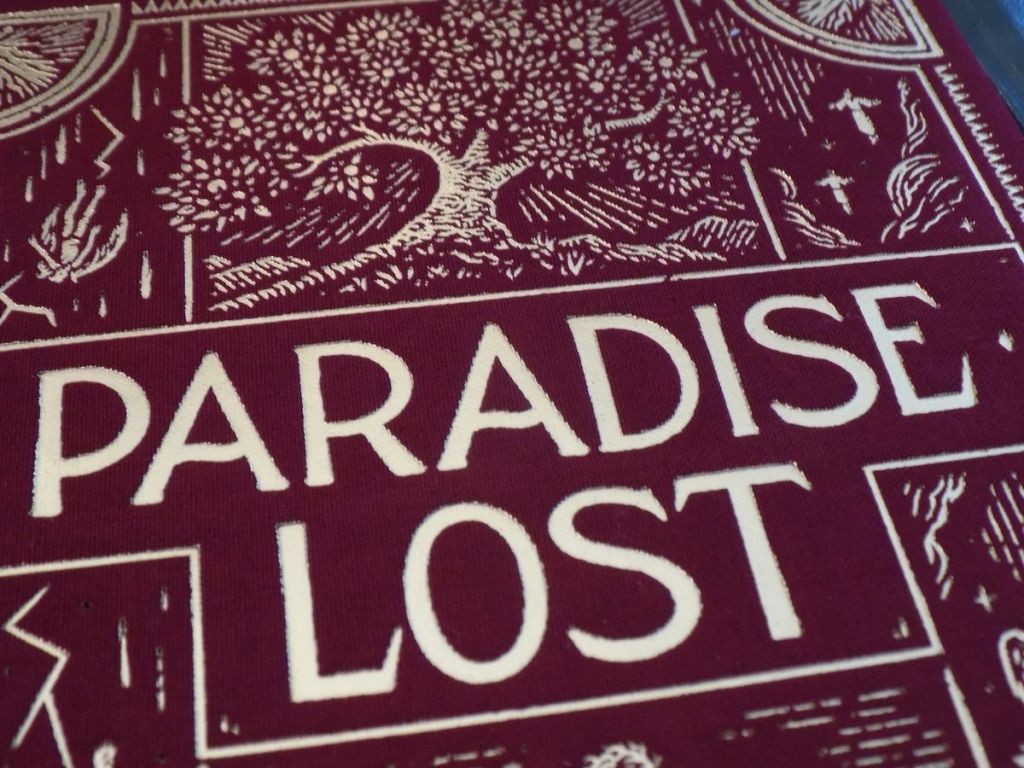
I saw it advertised on Grace Books’ website and it is not only one I’ve always wanted to read but this edition is a beautiful book. I mean, you had me at ‘gilt edged’. And ‘cloth bound’. Yes, I judge a book by its cover. Come at me, lol.
It’s John Milton’s epic poem, “Paradise Lost’. Written in 1667, the publisher promises that it is an unabridged version but there are margin notes for unfamiliar words. So already I know the language is going to be demanding. And harder for me personally, is the fact that it is written as an Epic Poem. I have a rough time with poetry, I just don’t understand it.
An Epic Poem is (according to Encyclopedia Britannica), “long narrative poem recounting heroic deeds. Outstanding examples of the written epic include Virgil’s Aeneid and Lucan’s Pharsalia in Latin, Chanson de Roland in medieval French, Ludovico Ariosto’s Orlando furioso and Torquato Tasso’s Gerusalemme liberata in Italian, Cantar de mio Cid in Spanish, and John Milton’s Paradise Lost and Edmund Spenser’s Faerie Queene in English.”
I read The Aeneid, The Odyssey and The Iliad, when I was in my early 20’s. Forty-five years later – ahem – my brain may have dimmed somewhat. In fact, I when I was in High School and just after, I read most of the standard classics listed in top 100 lists and I’m glad I did back then because reading or re-reading them now is much harder. But every summer, I select a classic to read or re-read, and that is my Summer Reading!
The version issued by Grace Books was on 40% off the regular price at the time (it’s still 10% off now), so of course I could not resist. The book itself (according to the blurb) contains:
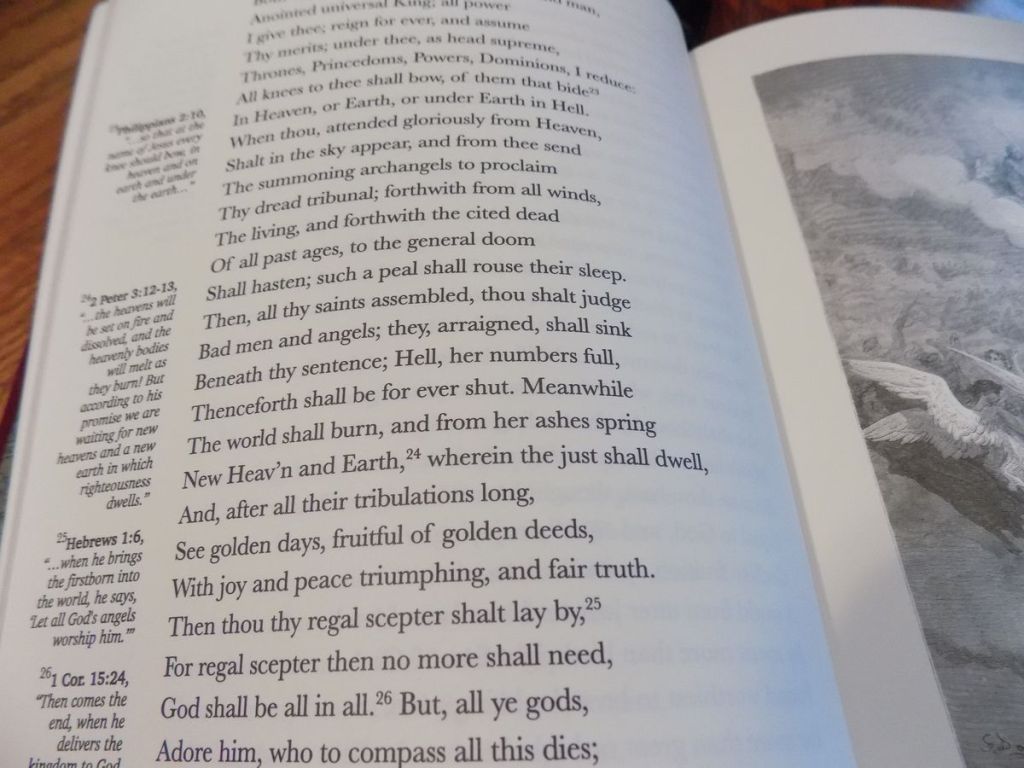
Explanatory notes are included in the margins for allusions to Greek mythology and obscure words.
- Introduction by Dr. Leland Ryken
- Cover design by Stephen Crotts
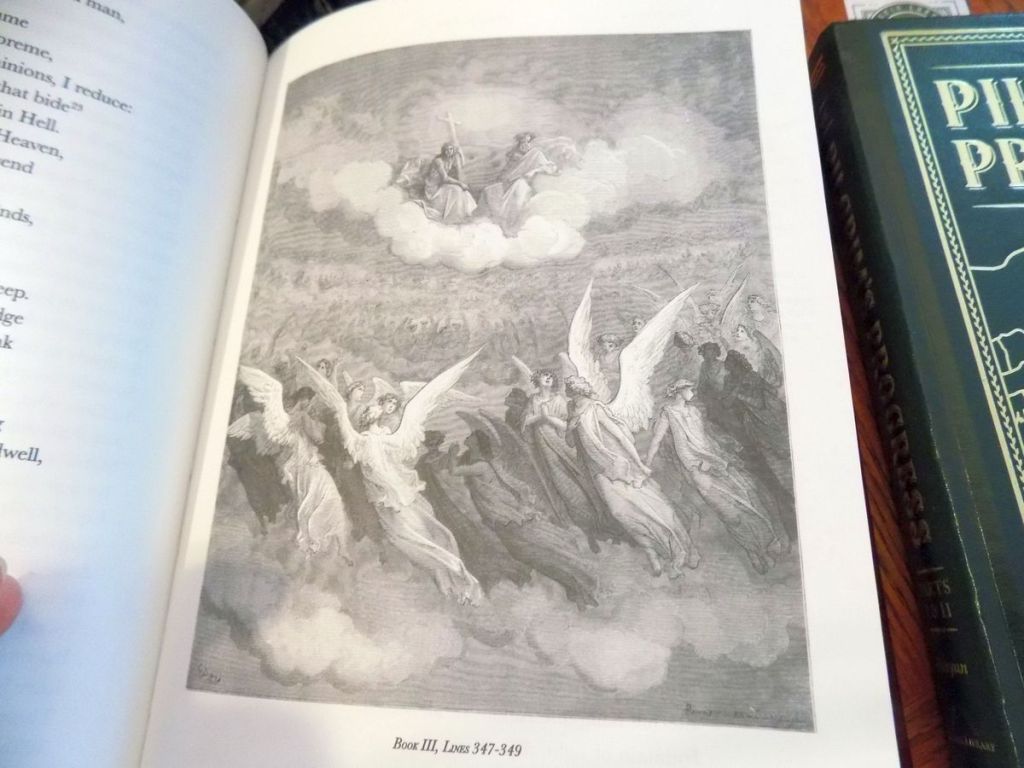
- 50 vintage illustrations by the renowned Gustave Doré; modified to cover nudity
- Genuine cloth cover with gold foil print and a ribbon page marker
What is Paradise Lost about? Adam and Eve’s rebellion and humanity’s fall from grace. One reviewer of this edition on Amazon said,
“Having biblical backgrounds in its plot of being about Adam and Eve‘s temptation and humanity’s fall from grace, “Paradise Lost” should be read for its unparalleled sonorous language, it’s profound exploration of human freedom, disobedience and rebellion, and its impact on Western literature. It offers a complex, timeless, psychological portrait of Satan serving as a foundational text for understanding the archetypal antihero.”
OK, this should keep me busy! Here are the photos of this beautiful edition. I appreciate Gustave Doré’s illustrations. He was a famous French artist, printmaker, and caricaturist who died in 1883. He is best known for his wood-engravings illustrating classic literature, especially Dante’s Divine Comedy. What I really appreciate in this edition is that though the language has been left alone, the illustrations have been lightly edited to cover up the nudity in Doré’s illustrations.
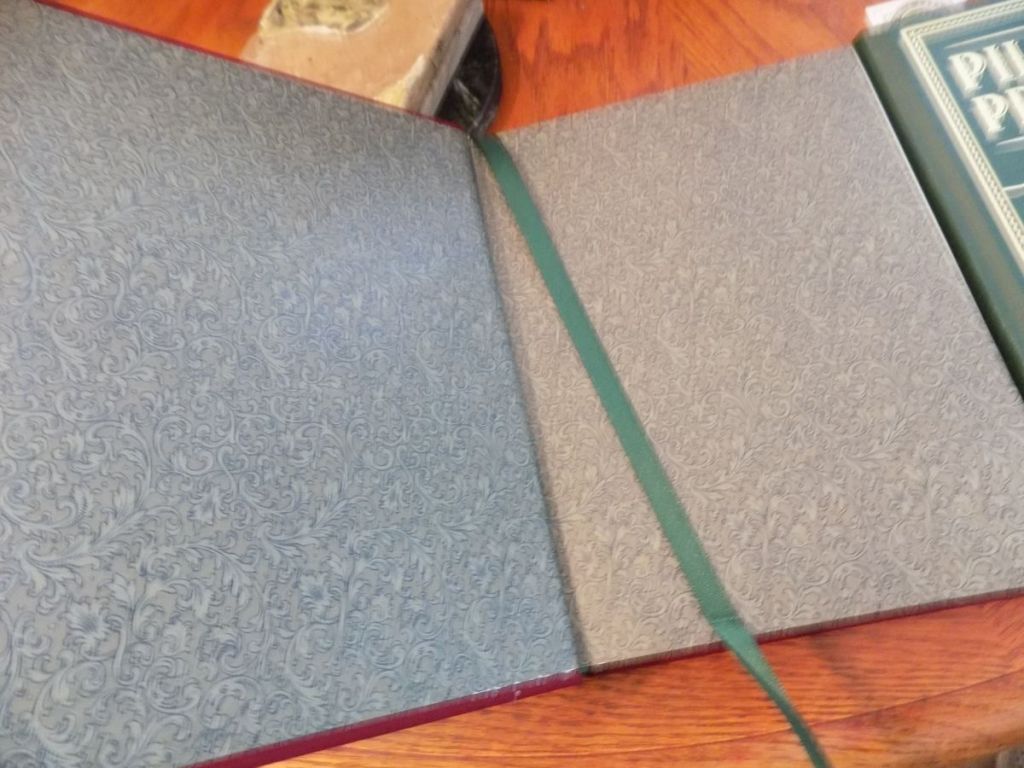
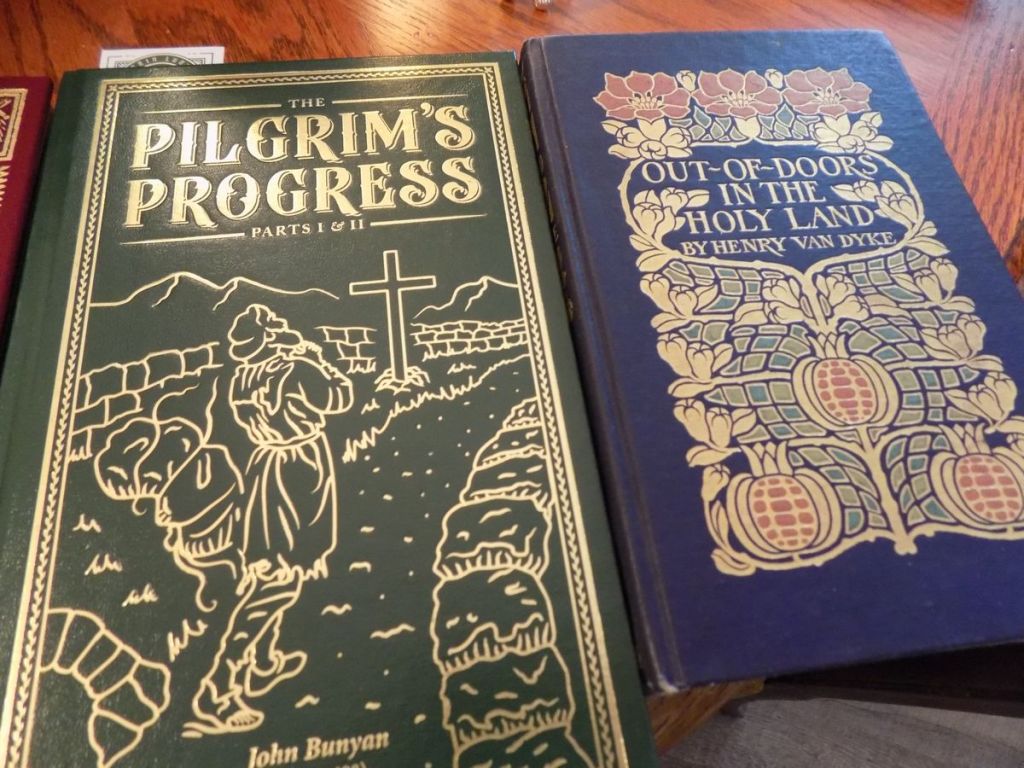
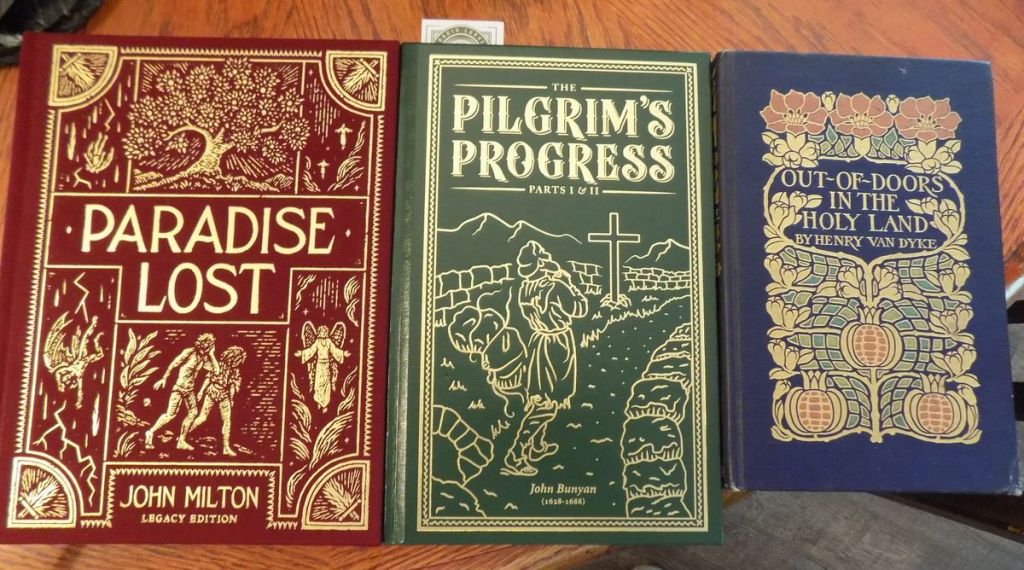
I mentioned I do judge a book by its cover. Here are two others I’ve recently acquired. The Pilgrim’s Progress was a free gift from Chapel Library, and the Van Dyke I bought myself. See what I mean? If I am going to own books, they might as well be beautiful. My other reading selection this summer is a re-read of Pilgrim’s Progress. I’ll also finish the Grisham I started, as well as Lady Audley’s Secret, Lord willing and the eyes don’t fail!
Happy reading and book-ing this summer! What is on your TBR list?
Not Every Christian Book Is Safe
By Elizabeth Prata
SYNOPSIS: Examining trends in Christian publishing, the article warns that bestselling breakout books often gain popularity through marketing and consumer demand rather than sound doctrine. Because false teaching can spread through widely read titles, believers should approach popular books cautiously, seek counsel, and practice discernment carefully.
Continue reading “Not Every Christian Book Is Safe”The Disappearing Dress: When Display Replaces Dignity
By Elizabeth Prata
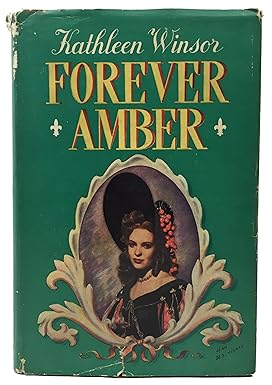
As a teen and young adult, I loved reading historical epics. Follett’s Pillars of the Earth, Mitchell’s Gone with the Wind, Michener’s Hawaii, and of course, Winsor’s Forever Amber.
Forever Amber was written by Kathleen Winsor in 1944. It’s a romance set in Restoration England with historical events as a backdrop, such as the Great Fire of London, the Plague, and the ascension to the throne of King Charles II. It was banned in Boston, but there are no explicit sexual details or graphic scenes, just suggestions, which was enough back then. It is praised for historical accuracy. Amber was a character often likened to Scarlett O’Hara who used her fierce ambition, sensuality, (sexuality, too) to climb to the heights of social standing, acclaim, and wealth.
The book involves Amber pursuing one man, her lifelong love, Bruce, which is unrequited, as his was solely a physical attraction and he viewed Amber as just a mistress, not wife material. It shows Amber’s increasing desperation to reclaim him with a scene near the end of the book of the disappearing dress. As the King’s concubine, Amber had also sensed the King’s interest in her was waning as new court rivals emerged. Knowing Bruce had married a young virgin, Amber decides to capture Bruce and the King’s attention with a unique dress in a desperate attempt to challenge what she believed was her rival and to remain the center of the court’s attention. Amber never accepted that her and Bruce’s relationship was over and had never been substantial to begin with.
Amber is amoral, a literal whore, scheming, and unlikable. So of course at 970 pages the book was a total success. The audio book takes 42 hours.
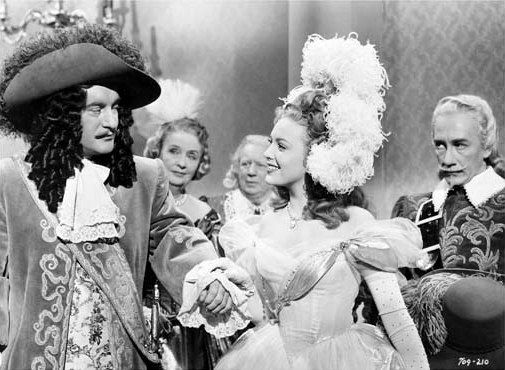
As to the “Naked Dress” scandal: Near the end of the book in a climactic display of her desperate need for attention and status, Amber attends a court ball in a gown made of real pearls. The dress is designed to gradually “fall apart” as the pearls drop off throughout the evening, eventually leaving her virtually naked—a literal and symbolic representation of her willingness to expose everything to reclaim her unrequited love. It didn’t go as planned. After Amber makes her sweeping entrance, all eyes were indeed on her. The men whistled low, with arched eyebrows. The women sneered. Soon the men did too. Amber had gone too far. From the book:
“But aren’t you cold?” interrupted a feminine voice, and turning swiftly Amber found Mrs. Boynton beside her, looking her over with feline insolence.
Another voice, a man’s this time, came from her other side. “Ods-fish, madame. But this is the greatest display that ever I’ve seen in public since I was weaned.” It was the King, lazy, smiling, obviously amused.
Amber felt suddenly as if she had been hurt inside.
She turned sick with a feeling of horror and self-disgust. What have I done! she thought. Oh, my goodness, what am I doing out here half undressed?
Her eyes swept round the room and every face she saw was secretly smiling, covertly sneering at her. All at once she felt like the person in a dream who sets out confidently to go up-town stark naked, gets halfway there and then realizes his mistake. And, like the dreamer, she wished passionately that she were back home where no one could see her-but to her wild dismay she realized that this time she was caught in her own trap. She could not wake up from this bad dream.
–end quote from the book
At least Amber was ashamed. More on that in a minute.
Display is a good word. Hearing that word, the character of Amber realized what her moral descent had led to, she had descended to displaying the only thing she had left, not character, not wisdom, not gentility, not decorum, but her very flesh.
The 67th Annual Grammy Awards just concluded the other day. I did not watch it. I am out of step with today’s music, and frankly, shocked at the outfits. Or, should I say, lack of them. Literally. One male musician performed in silky boxers only. Some women bared nearly all. Class is out of style. Don’t go looking for the costumes worn at this event, they are un-edifying to pass before your eyes.
The Grammy event showed a lot of displays. If one ever wanted to see a stark realization of where this society is on the moral-immorality scale, this event is it. Lots and lots of ‘Ambers’ parading around naked. I mean, naked. Flesh displayed for all to see, in desperate attempts at what? To retain attention? To prop up one’s mistaken notion of empowerment? To bolster self-esteem? It is disgusting and a reminder that modesty is God’s command. Worse, there was barely a murmur from the press about the licentiousness. If ever there was a society that needed to look at where their immorality has descended to, this is it.
I am truly amazed to see where we are now compared to when I was young. I remember when ‘short shorts’ AKA hot pants were controversial. In 1970 they came into fashion, but a few years later extremely short hot pants had become shorthand for prostitution, particularly underage prostitution.
“Asked in 1971 to explain the popularity of hot pants, a male psychiatrist based in Manhattan borrowed language from the contemporary women’s liberation movement to suggest that they were “an expression of the female’s new freedom.” ~Girl Culture [2 volumes]: An Encyclopedia by by Claudia Mitchell (Editor), Jacqueline Reid-Walsh.
The world’s version of ‘freedom’ for women is parading around in flesh. God’s version of freedom is His eternal gift of freedom from the slavery of sin, which nakedness is one of those sins.

Empowered women do not shamelessly dangle their flesh in front of a global audience. Empowered women are powered by the Holy Spirit, on whom she relies. Her meek spirit, her gentle wisdom, her steady encouragements of her husband and children are entirely the attraction. Flesh is flesh. It will wither and die. The lasting contribution of a woman is not her paraded nakedness, but her modesty in apparel and her modest attitude.
I truly feel terrible for those women (and man) who came to a global event to celebrate music, creativity, and showmanship wearing their flesh as the display. God made humans in His image, and as image bearers they know not what they do when they uncover themselves.
Remember Noah, drunk and naked in his tent? (Genesis 9:20-24). Noah’s son Ham went in, saw his drunken naked father, and in delight, chortling, went out to tell his brothers and show them. What dishonor! To revel in someone else’s shame!
“Woe to you who make your neighbors drink, Who mix in your venom even to make them drunk So as to look on their nakedness!” (Habakkuk 2:15 LSB).
Ham father of Canaan was cursed for his dishonor. We must not delight in another’s nakedness.
Just as in Forever Amber, Bruce never considered Amber marriage material, she was too willing to use her flesh and display it to anyone who could get her further along in her agenda. Ladies, make sure what you display is what God wants: a meek and quiet spirit, with clothing.
The Importance of Reading for Christians: Advice from Puritan Richard Baxter
By Elizabeth Prata
SYNOPSIS
I present the importance of reading for Christians, yet advocate for the Bible as the primary text. I reference Puritan Richard Baxter’s advice on selecting books that enhance scriptural understanding and do not present stumbling blocks to growth. Christians should be readers of all kinds of appropriate books.
Chick Lit with a Touch of Magic: Blackbird Café Review
By Elizabeth Prata
SYNOPSIS
In my review of a book set in Wicklow, Alabama, the protagonist, Anna Kate, returns to bury her grandmother and confront her family history while grappling with magic realism. I explain the genre of ‘magic realism’, discuss my genre preferences, and note that some genres present stumbling blocks to some while not to others.
Continue reading “Chick Lit with a Touch of Magic: Blackbird Café Review”Why Christians Should Embrace Reading Fiction
By Elizabeth Prata
I discuss reading fiction as a Christian. Despite the notion that some people have that “God’s word is enough” and that other reading isn’t required, I and others argue that fiction enriches our understanding of human experience and offers valuable leisure. I share insights from Leland Ryken and Tony Reinke, urging people to consider the importance of good literature in a busy life.
Continue reading “Why Christians Should Embrace Reading Fiction”Book Review: The Invisible Life of Addie LaRue
By Elizabeth Prata
SYNOPSIS
I express disappointment in contemporary books, mentioning my struggle to find engaging stories. I specifically critique a novel about Adeline Larue, who makes a Faustian bargain, resulting in a dull, unmemorable existence. I find the writing pretentious and the character unlikable, thus choosing to stop reading, continuing my search for better literature.
Continue reading “Book Review: The Invisible Life of Addie LaRue”The Christian Romance Genre: Faith and Fiction
By Elizabeth Prata
SYNOPSIS
I discuss the genre of Christian romance, with its emphasis on Christian values, faith, and wholesome themes. While this genre avoids explicit content, the field varies widely in interpretation and acceptance of certain topics. The piece also points to Harlequin’s influence in popularizing these narratives while advising readers to choose wisely.
Continue reading “The Christian Romance Genre: Faith and Fiction”Tales from the internet outage
By Elizabeth Prata
SYNOPSIS
I share my summer experiences as an educator enjoying time off to read, reflect, and engage with media. I experienced a lengthy internet outage that interrupted my studies and entertainment. I mention various books, focusing on their content and spiritual themes, while expressing gratitude for the opportunity to use my time wisely.
Continue reading “Tales from the internet outage” the-end-time.org