We hear so much these days about women being empowered. Needing empowerment. Wanting power. We hear from the feminists that women in today’s church have been oppressed, marginalized, and discriminated against because they do not have the same ‘opportunities’ that men do. Meaning, the feminists are saying women have been denied the equal opportunity to teach men, preach or pastor a church.
This is bunk, of course.
If we go all the way back to Genesis 1:28, we see that God made us male and female. After making humans in 2 genders, God gave both humans a job:
God blessed them; and God said to them, “Be fruitful and multiply, and fill the earth, and subdue it; and rule over the fish of the sea and over the birds of the sky and over every living thing that moves on the earth.”
God said to THEM. Is there any additional power women need than with men as partner to jointly care for all of the creation? And to do so within clearly defined boundaries, which is a gift, not a restriction?
Along the way, as the Old Testament and New Testament progressed, we see women with amazing abilities being used by God, as well as men. Esther, the Queen who saved her people. Mary, the humble servant given opportunity to first share the Good News of the resurrection. Lydia, Asia’s first convert and host of one of the earliest home churches. The Samaritan Woman, who was discipled one-on-one by Jesus, then she shared news that helped convert a whole village.
-the high position given to women within Scripture. Women are never relegated to a secondary status and, unlike so many other religions, are never degraded and considered less important than men. From the beginning of the New Testament era to the close of the canon of Scripture we see God granting extraordinary privilege to women. There are countless women in the Bible who stand as examples of faithfulness, integrity, hospitality and every other admirable virtue.
What more do you want, women who demand empowering?
We see the eternal discontent of feminists as a reflection of what happened in the original Garden. God gave Adam and Eve everything, absolutely everything, except for one thing. It was that one thing satan enticed Eve to want.
So it doesn’t matter if the feminists push their way into the pulpit. Their discontent never stops, because there is always that one thing they will want. The Bible says they cannot preach? They want to. Can’t teach men? They want to. Can’t lead men in spiritual authority? They want to. Can’t be master in the home? They want to. We could capitulate and give it all to them and they’ll still want more. That is because sin is a bottomless pit.
Their discontent stems not only from wanting what is forbidden, but from a failure to be grateful for all the opportunities we women DO have. Want to teach other women? We can. Want to raise children? We can. Want to teach children? We can. Want to be hospitable and open your home to others in His name? We can. Want to minister to the brethren? We can. Want to disciple younger ladies? We can. Want to share the Good News of the Gospel? We must.
And so much more.
We have power, power that God gave us. It’s when women step outside the boundaries of that power that our lives go awry. We ladies should be content with the magnificent privileges God has given us. We should be joyful at the stately way Jesus treated women in His day. We should be busy doing ministry in His name within the bounds of the myriad opportunities He did give us.
As for empowerment itself? What IS power?
Jesus has all power. He gives it as He wills. (Luke 9:1).
The angels have power (2 Peter 2:11).
Jesus gave His two witnesses power. (Revelation 11:6).
Salvation and glory and power belong to our God, (Revelation 19:1).
His divine power has given us everything we need for a godly life through our knowledge of him who called us by his own glory and goodness. (2 Peter 1:3).
An entire level of angels is called powers. (Colossians 1:16).
When you hear women saying they want to be empowered, they are not pushing for power from the men who lead churches or denominations. They are making demands of God. How do I know this? John 19:11a
Jesus answered, You would have no power over me if it were not given to you from above.
All power comes from God. So before you might be tempted to listen to women who go around clamoring for empowerment, stop and think of what they are really demanding and who they are demanding it from.
If we are content, we will be doing what Paul advised in 1 Thessalonians 4:10b-11,
But we urge you, brothers, to excel more and more 11and to aspire to live quietly, to attend to your own matters, and to work with your own hands, as we instructed you.
If we work hard, attend to our own business, and live quietly, we will be doing much better than the loud women who roar for empowerment and make evil claims against a holy God. After all, we have a co-charge to be fruitful and multiply, and fill the earth, and subdue it; and rule over the fish of the sea and over the birds of the sky and over every living thing that moves on the earth. That’s power enough, don’t you think?
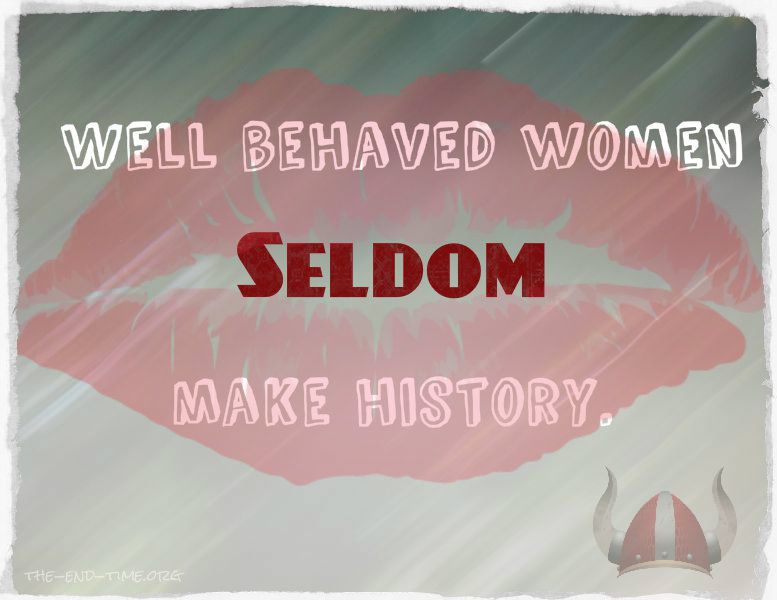
This was a bumper sticker adorning the car ahead of me at a red light. A long light. I had time to read it and think about it and then get steamed about it. Of course next to that bumper sticker there was a ‘coexist’ bumper sticker. How can those two be reconciled? If a women isn’t being well-behaved, she is being rebellious. And if she is being rebellious, she is not co-existing peacefully with those around her, is she? Illogical.
In any case, I thought that the bumper sticker’s premise was that for women to be recorded in history, they must have had to do something daring or against societal expectations, or had done something ‘out there’ in some way. This, I had mused, is illogical too, because there are plenty of women in history who were simply good at what they did, and that was why they got into the history books. Louisa May Alcott, Laura Ingalls Wilder, Marie Curie, Queen Elizabeth II, Sally Ride… Would NASA have chosen a rebellious upstart to be part of their space program? Of course not.
Curious now, I looked into the origins behind the bumper sticker and I was surprised by what I found.
The phrase comes from Harvard Professor Laurel Thatcher Ulrich. Ulrich identifies herself both as a feminist and a Mormon. It was her 1976 little-known academic paper published in American Quarterly called “Vertuous Women Found: New England Ministerial Literature, 1668-1735” where the now famous bumper sticker phrase was first seen.
Massachusetts, where Harvard is located, was populated in the 1600s by deeply religions Puritans who had emigrated from England and the Netherlands to worship God freely, something they could not do on the Continent.
Ulrich looked into the lives of ‘ordinary’ Puritan women, especially midwives, through their own diaries. The ordinary, the mundane, the repetitive nature of the life, consisting of hard work mainly at home, drew Ulrich’s attention. She expanded her paper into into a 1990 book called, “A Midwife’s Tale: The Life of Martha Ballard, Based on Her Diary, 1785-1812.” The staying power and viral nature of the adage she had coined back in 1976 led to Ulrich eventually write a book in 2007 called by the very phrase she had coined: “Well-Behaved Women Seldom Make History.” Here is an excerpt from the 1976 paper:
Cotton Mather called them “The Hidden Ones.” They never preached or sat in a deacon’s bench. Nor did they vote or attend Harvard. Neither, because they were virtuous women, did they question God or the magistrates. They prayed secretly, read the Bible through at least once a year, and went to hear the minister preach even when it snowed. Hoping for an eternal crown, they never asked to be remembered on earth. And they haven’t been. Well-behaved women seldom make history; against Antinomians and witches, these pious matrons have had little chance at all.
It turns out, that Ulrich wanted to simply promote the lives of the Puritan and the 1800s women which history had forgot.
Ulrich noted that though women were nearly invisible in society, only recording when they were born, married, or died, their standing in spiritual realms was highly elevated.
…this circumscribed social position was not reflected in the spiritual sphere, that New England’s ministers continued to uphold the oneness of men and women before God, that in their understanding of the marriage relationship they moved far toward equality, that in all their writings they stressed the dignity, intelligence, strength, and rationality of women even as they acknowledged the physical limitations imposed by their reproductive role. … Source 1976 paper, “Vertuous Women Found”
Huh. Go figure. A Mormon Harvard feminist professor who got it right. As for the popularity of the phrase I’d seen on the bumper sticker, Ulrich said that its ambiguity (when taken out of its context) accounts for its appeal. In other words, you can interpret it any way you want. Which is exactly what I had done at the red light when I first read it.
My objective when I wrote those words was not to lament their oppression but to give them a history. … [T]he ambiguity of the slogan surely accounts for its appeal. To the public-spirited, it is a provocation to action, a less pedantic way of saying that if you want to make a difference in the world, you can’t worry too much about what people think. To a few it might say “Good girls get no credit.” To a lot more, “Bad girls have more fun.” … Source: “Well-Behaved Women Seldom Make History” (Knopf, September 2007)
Well there you go.
There’s one more thing. The premise that ‘well behaved women seldom make history’ is supposed to spark a knee-jerk reaction that it’s a bad thing not to make history. Like, “Hey! I wanna get into history! Why can’t I be in the history books?! The biblical worldview would have a response to this in several respects. First, woman already are in the only history book that matters, the Bible. Well-behaved and rebellious women are both recorded throughout the pages of that holy Book. From Jezebel to Esther, from Mary to the Woman at the Well, women are recorded in biblical history doing what they do as humans.
Secondly, women already are recorded…in the Lamb’s Book of Life. There is NO OTHER book than that precious book one should aspire to have our names written.
And I saw the dead, great and small, standing before the throne, and books were opened. Then another book was opened, which is the book of life. And the dead were judged by what was written in the books, according to what they had done. (Revelation 20:12).
Nothing impure will ever enter it, nor will anyone who does what is shameful or deceitful, but only those whose names are written in the Lamb’s book of life. (Revelation 21:27).
If you have repented and believed in the risen Christ, then us well behaved women are all set with names written in the Lamb’s book. All other books will fade away. But not Jesus’ words, those are the only words and the only history that matters.
Heaven and earth will pass away, but my words will not pass away. (Matthew 24:35).
Alistair Roberts wrote at Mere Orthodoxy about the need to dispense with the strong female character. It’s a well-written, if long, article. He made some excellent points. Then he followed up with another article at his own site, Alistair’s Adversaria, reacting to some push-back, here.
I want to include a few excerpts from his good original article and then continue with my own thoughts. We may need to dispense with the ‘strong female character’ as Roberts suggests, or as I propose, we may need to redefine what a strong female character is in the first place.
Popular culture is the focus of some of the most determined attempts to shift attitudes on a host of issues within society at large, and such forms of representation are an important dimension of this. While popular media and the various ‘messages’ within it may often appear innocuous, they are frequently anything but. Behind them lie concerted efforts to change the public’s thinking and perception on key matters and some carefully calculated agendas. The supposed shallowness of pop culture is deceptive: It is a realm where brilliant and talented people go to try to shape minds at their most unguarded and impressionable. It is on the ground of entertainment media that the so-called culture wars have largely been lost.
Yes! Yes! Yes! Entertainment is never innocuous. What we absorb in entertainment has an agenda, a worldview, and a purpose. It’s not merely to entertain you and me, it is to change our perceptions, and this happens more easily when we are at our most unguarded.
RE more recent portrayals of Disney Princesses:
Yet, despite their likeableness and roundedness as characters, these new princesses betray some concerning anxieties about women’s place and agency within the world. Within the kickass princess trope lurks the implication that, to prove equality of dignity, worth, agency, and significance as a character, all of a woman’s resolve, wisdom, courage, love, kindness, self-sacrifice, and other traits simply aren’t enough—she must be capable of putting men in their place by outmatching them in endeavors and strengths that naturally favor them, or otherwise making them look weak or foolish.
That is very well said!
His article becomes tremendous toward the end. The section titled The Heroism of Lady Wisdom recounts the strong female through God’s eyes. The woman at home, raising children, is where the real strength is-
Our failure to see the heroism and the strength of such a diligent and active woman is a failure to see the world as God does. The strength of such a woman is not that of conformity to more typically male forms of strength, but rather of the reflection of the work of the master creator, Lady Wisdom, within her own world of activity.
Women can be trained in martial arts and sword play. It takes strength of the physical type to perform those feats. Of course, women lack the same upper body strength as men and cannot replicate male feats of warlike strength exactly, but thanks to animation and CGI, we can overlook that fact.
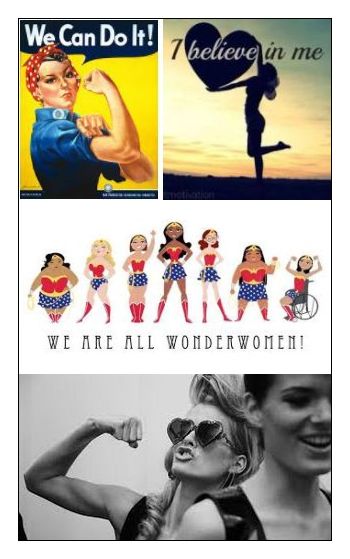
If you do a Google image search for ‘strong women’ you get photos like these:
But truly, who is stronger, Mulan, or Lydia? Lydia hosted a home church. (Acts 16:40). She was a working woman, but she also prepared endlessly for guests, cleaning and readying the domicile so that the main concentration could be on studying the Word and fellowshipping with one another. Dorcas/Tabitha sewed endlessly for charity. (Acts 9:36). She made garments and sat among other women, edifying and speaking and loving. It’s harder to unfailingly love through the years than it is to swing a sword once or twice.
Jael swung a hammer and drove one tent peg for a few minutes. (Judges 4:17-22). Yet Leah was used by Laban her father and unpreferred by her husband, but submitted to them both, uncomplainingly raised 6 boys, and was faithful to God all her days. Which takes more strength, a few moments of physical exertion, of a lifetime of putting God first? Who is the woman of valor?
Hannah was barren, a devastating indictment in the culture’s eyes. She was tormented by her husband’s other wife. She asked for a son and vowed to give him back to God- and then did. Which takes more strength, the woman of Abel-Bethmaach who negotiated a peace treaty, (2 Samuel 20:16-21a), or Hannah? Could you give up your son and only see him once a year? Withstand insults and torment from a competing wife and turn only to the Lord for comfort and petitions? I know my answer. I’d complain and gossip and plot against the jealous other wife. Hannah showed strength of character not just in one Bible event like the wise woman of Bethmaach, but maintained Godly character for years. What woman is “stronger”?
Mary is to me one of the strongest women of the entire Bible. As a virginal teenager (probable age) betrothed but not yet connubially married, she was told that she would conceive and bear a child by the Spirit. Adultery was a crime for which people were stoned. Mary faced it and said to angel Gabriel, ‘let it be done to me as God wills.’ She gave birth in the cold and among animals. She lived with the whispers of adultery and attendant humiliation and doubts about her character all her life. She was told at His birth she would see Him die horrifically. And she did see her Son die horrifically. She was obedient, she bore it- and praised God through it. Isn’t that strength? Could you do as Mary did?
Our culture sees external fighting as strength. Feminists create women who appear in movies and shows, proficient in martial arts, wars, battles involving swords, knives, or guns as ‘strong’ women. It’s the trope that’s constantly pushed in front of us. Rapunzel, Merida, Elsa, Wonder Woman, Rey, are all presented to us in entertainment as the external female strong ideal because they wield weapons. They’re called strong because of their derring-do. They’re lauded because they make men look foolish. But the REAL battle is not with swords, but is the internal fight against sin. Truly strong women wield the sword of the Word. (Ephesians 6:17). Truly strong women help their husbands, support and care for them, (Genesis 2:18; 20b) not make them look weak or foolish.
There are so many named and unnamed Godly women in the Bible who fought their own sin-nature and demonstrated quiet strength for years. Real strength is obedience to God, submission to our roles, and resisting sin always. Be strong, women, be strong.
Three years ago I had an inquiry from a sister in the faith about the women of She Reads Truth and the IF:Gathering. In looking at these two organizations, which feature overlap of the ladies who participate in them, I discovered they adhere to a too-forward lifestyle, and teach an aberrant theology that’s unhealthy for women. A series resulted.
Three years later, the IF:Gathering and its women have only embedded themselves deeper into the faith and are tainting even more women with their brand of liberal theology, shaky hermeneutics, usurping lifestyles, and their idol of social justice.
Last week I received two additional, separate inquiries from women who sent me material showing why they were concerned over the IF:Gathering women. I decided to post about this para-church/social justice/liberal organization once again. I am adding new information.
The title “IF:Gathering” comes from their motto, “If God is real, then what?” The purpose statement on their IRS forms is to equip women by having them share their feelings about Bible passages posted online. I’m not joking. Here’s their IRS tax form statement of purpose: (click to enlarge)
Did you notice the ‘like-hearted‘ community? The faith is not about feelings, but about what we know about Jesus. Like-minded.
In any case, these women teach other women, usually younger, based on a foundational question that doubts God’s existence. Their entire activity is one of simply hedging bets.
The ‘gathering’ part is actually brilliant. They purport to disciple women in gatherings at homes and other locales, sometimes churches. They know where to gather through social media, which is employed in a major way. That’s why their embeddedness and vigorous activity is hidden from view and thus their danger is not readily seen. There aren’t posters, advertisements, billboards, pamphlets. etc. There’s texts, social media whispers, person-to-person promotion, all of it done in a way that is more subterranean than any other generation’s activity.
IF:Gatherings are ongoing in living rooms and lawns by the thousands. There are A LOT OF GATHERINGS. Look. This map is three years old and their gatherings are only increasing in number:
The idea to disciple women is a good one. However, that is an activity that the church is responsible for. These gatherings take place outside of the auspices of the local church and its pastoral authority.
The gatherings were born from the mind of a young woman named Jennie Allen. At the first Gathering, she revealed that she had heard God whisper to her, and after a few years decided to step out from her church to enact this so-called God-whispered “vision to gather, equip, and unleash women to live out God’s calling on their lives.” She further wrote that she-
“together with a team of friends, formally established IF:Gathering. … Some of the first friends to believe in her vision put aside their own individual ministries to leverage their collective influence for the glory of God and the good of His Church.” (Source, source).
So they abandoned their local ministries to go online for the good of the global church? Exactly wrong. Here is Jennie Allen claiming direct revelation from God as the catalyst for IF.
They abandoned their ongoing locally accountable ministries, to follow a young woman who’d heard a whisper, in order to establish Bible studies about a God they doubted existed, in order to equip women to discuss feelings about the Bible, enact social justice, reconcile the world, heal the nations, and disciple a generation. Hmmm. I’m not being satirical. All the previous verbiage is from their own statements.
I live in a rural county in Georgia with a population of about 27,000 people spread through five towns in an area of over 286 square miles. My town itself is small, about 1,113 people, and it’s the largest town in the county. And this month there are not one, but two IF gatherings in my town. IF is everywhere, pastors, leaders, and ladies!
In the first two years, our gatherings have reached more than a million women in 50 countries worldwide.
Rather than re-hash the information I’d first published three years ago, I’ll simply offer some new information. First I’ll list some bullet points of concern. Then I’ll post lists of speakers who are involved with IF. Lots of links throughout.
Basic concerns with IF:Gathering:
Founded on Direct Revelation: Founder Jennie Allen said she heard a whisper from God telling her to start a discipleship group. (source, also see above). Direct revelation is hazardous to one’s soul. If you test a direct, audible command from God against the Bible and it’s there, you do not need the audible command. If it is not there, it’s a lie and you don’t need it anyway.
Doubting God: The premise itself is based on study of a God those gathered doubt exist. IF God is real? Doubt is not noble. The Bible says doubt is a destroyer of life. (James 1:5-8).
Lack of male oversight and involvement: Jennie’s husband Zac says he provides theological oversight, but he is listed as working only 10 hours per week at the 501(c) 3 non-profit, and the only other males on the Governing Board are Larry Cotton, who is listed as working 1/hour week and Treasurer Jonathan Harper, who is also listed as a 1-hour a week. The 40-hour/weeks are put in by Jennie and Lindsey. It’s Jennie’s baby, she is listed as Principal Officer on the tax forms. It’s led by Lindsey Nobles who’s listed as CEO. In fact it operates as a para-church organization with little local accountability and pastoral oversight.
IF:Gathering IRS tax return year ending 2015. Source Guidestar
The IF:Gathering’s premise is flawed and so are its goals. Again, from their IRS form, it states that their goals are to foment a ‘global movement’ that ‘promotes healing around the world’. Is that what the Bible says women are to do? Unleash movements? These women are mothers. With children at home. The Bible tells us what we are to do: raise the kids, support the husband. Did even Jesus come to promote healing around the world? And just what IS “healing”, anyway? More on that just below.
Goals are postmodern and extra-biblical: As Tim Challies said, the words reconciliation and healing have a different meaning to the postmodernist liberal than they do to the Christian fundamentalist:
“…perverts the Biblical meaning of “reconciliation.” The Bible does not use this word arbitrarily, but speaks of the reconciliation of man to God and how this can be accomplished. It speaks of redemption! Salvation! Our ministry of reconciliation is not relational healing of myself to my neighbor (right and good as that may be), but the far more important relational healing of a sinful man to a holy God.
The ‘reconciliation’ the IF-ladies mean is the latter, promoting relational healing. Hence their emphasis on feelings and their activity of social justice.
Very good critique from Lighthouse Trails on IF:Gathering. Please read.
Ann Voskamp. Does she even know how to use the English language anymore? Below is a recent tweet. I thought teachers were supposed to be ‘able to teach’. (2 Timothy 2:24). Being able to teach presumes a facility with the language so as to communicate truths in a way that will edify the hearer. Voskamp’s gone beyond #babble all the way to to #Babel.
The remaining list of IF speakers and participants was sent to me by a concerned sister, which I appreciate. I am familiar with many of the women, and I’m unfamiliar with several. I’ve used the links sent to me and also added links and statements from their own bios where applicable. As always, do your diligence and research yourself.
Jenny Yang (self-described “visionary who works on behalf of refugees as the Vice President of Advocacy & Policy at World Relief.” AKA social justice).
Jeanne Stevens: self-described teacher who urges women to “take any opportunity to encourage people to live boldly from the fullest part of themselves”. Rather than die to self and live in the strength of the Spirit? Jeanne is also a Female Pastor -Co-Pastor of Soul City Church with her husband.
B. David Smith: (“B. David loves helping people cultivate their artistic potential and use their gifts, voice, and lifestyle to create God encounters”. What does that even mean?)
Tann Smith (Singer at Andy Stanley’s North Point Church. Need I say more.)
Angie Smith (“Her greatest passion is to make the Bible feel accessible and relevant”. Again with feeling the Bible and not studying/knowing/believing)
Roce Anog (“helps people who don’t speak the majority language to express their worship to God with the use of music, art, dance, storytelling, and food”. So she helps people learn about God through dancing and food? Nope. 1 Corinthians 8 has something to say about that.)
Amena Brown (poetess, which is cool. vision-caster, not cool. Friend to Louie Giglio and Passion conference. Uncool.)
Jo Saxton (Female Pastor. A director of yet another ‘movement’ whose goal is “to CHANGE the world by putting DISCIPLESHIP and MISSION back into the hands of everyday people.” Emphasis theirs. I guess ordinary people haven’t been living and dying for the Gospel these last 2000 years.
Keisha Polonio (helps leaders of Tampa’s microchurches)
Latasha Morrison (“justice fighter, a bridge builder and a champion of people. Through the work of her non-profit Be the Bridge, she is fostering healthy dialogue around the topic of race.” Just like Lydia, Esther, Mary and the Proverbs 31 woman. Oh wait.)
Britt Merrick (pastor, surfer, founder of Reality Churches (multi-campus)
IF God is real, then what? IF:Gathering Hath God said? Satan, Genesis 3:3
I hope any of this information helps you. IF gatherings are occurring every day in living rooms and lawns near you. No town is too small, too rural, too citified or too sophisticated to host an IF:table. The brand of Christianity the women promote is far from the Bible’s due to their emphasis on social causes, feminist living (i.e, gallivanting off to Africa while the kids languish at home), doubting God, and discussing their feelings. I pray you protect your daughters and granddaughters from any and all IF activities.