An essay critiques feminism within conservative Christianity, arguing it disguises itself as ministry. Tracing roots from temperance to suffrage, it defines feminism, challenges female celebrity teachers, and claims biblical hierarchy is violated when women pursue public platforms, careers, and influence while neglecting home-centered roles scripturally.
The other night I enjoyed reading historical newspaper articles from the early 1900s, particularly regarding women’s suffrage and First Wave feminism. While supporting women’s voting rights, I critique the underlying philosophy of feminism, saying it promotes a negative view of traditional gender roles. Editorials from that era reveal mixed sentiments on women’s societal roles from opposition prior to WWI to acceptance afterward. The Right to Vote for women passed in 1919.
Our local paper has been going since 1882. This week I was captured by reading the old, old digitized historical articles going back to the early 1900s. The writing used to be so good, even in ads. The social news cracked me up, like, so-and-so is visiting so-and-so, who is sick, who has recovered. But there were serious articles too, many about farming, especially cotton, since 100 years ago that was a major crop. And as the Women’s Suffrage debate heated up nationally, it heated up locally too.
Women’s suffrage was passed by Congress in 1919, giving women the vote. First Wave feminism historically began in 1848 at the Seneca Falls convention, and outlined the platform in a white paper called the Declaration of Sentiments, which was to secure legal rights for women.
The right to vote, own property, have a bank account, seen as independent of the husband etc., were contended issues. These are good things, of course, but look at the attitude and position behind these items of these first wave feminists that propelled their cause. In their 1848 “Declaration of Sentiments” they contended that men have perpetuated-
a long train of abuses and usurpations, pursuing invariably the same object, evinces a design to reduce them [women] under absolute despotism,
and
“the history of mankind is a history of repeated injuries and usurpations on the part of man toward woman, having in direct object the establishment of an absolute tyranny over her“
and that men have fomented
“their social and religious degradation over her“. (Source).
Viewing God’s design for men and women as a ‘degradation’ began early, I see. The notion that men have in all cases engendered a widespread ‘absolute tyranny’ and ‘absolute despotism’ over women is hyperbole. And it cannot be a ‘usurpation’ if that is the way God had designed roles for the genders, in other words, if that is how things are supposed to be.
I am for women voting. I believe if I’m represented in government, I should have a say. I also believe that women should participate in civic spheres, which includes philanthropy, volunteering, good works, hospitality, church work, and so on.
Editorials appeared in many newspapers across the country written by The President of the Texas Farmer’s Union, WD Lewis. He wasn’t wrong when he said “It is, as a rule, the city woman promoted to idleness by prosperity, who is leading the suffragette movement.” Indeed, it was many upper middle class white women from prominent families with access who were the original founders.
Suffragette Katharine Dexter McCormick, who was born to a life of wealth, which she compounded through marriage, could have sat back and simply enjoyed the many advantages that flowed her way. Instead, she put her considerable fortune — matched by her considerable willfulness into … most notably to underwrite the basic research that led to the development of the birth control pill in the late 1950s. Above, McCormick in 1914, traveling to a suffrage convention on the RMS Aquitania. She contributed financially to the movement, and ultimately took on leadership roles. Credit Bettmann Archive/GettySource, NYT.
I also agreed with some of the sentiments expressed by men who opposed the Suffrage concept, too. Like this paragraph:
“It is her hand that plants thoughts in the intellectual vineyard; It is through her heart that hope, love and sympathy overflow and bless mankind. Christ—the liberator of womankind—was satisfied to teach the lessons of life and He was a man. He chose to rule over human hearts and refused worldly power and men followed after Him, women washed His feet, little children climbed upon His knees and the Ruler of the universe said that In Him He was well pleased. Can woman find a higher calling?” from Ordway New Era, (Ordway, Colo.) 1902-1927.
Does he sound like an oppressive, tyrannical, despot?
Bettmann Archive. Despite the threat of incarceration, Suffragettes continued to march with American flags in protest, circa 1910.
The First Wave Feminists asserted that the genders were equal, as they began their Declaration with the same words as our founding document, the Declaration of Independence did:
We hold these truths to be self-evident; that all men and women are created equal…
Yes, we are equal. But we each have different roles, according to God. But for them, ‘equal’ meant ‘interchangeable’. It was a subtlety not lost on the TX Farmer’s Union President, who wrote,
“From many standpoints, perhaps a woman has as much right to vote as a man. So has she as much right to plow as a man; she has has much right to work in a factory as a man; she has as much right to shoulder a musket as a man, but we would rather she would not do so from choice and we regret that necessity ofttimes compels her to earn a living by engaging in gainful occupations.”
Of the articles I’ve read this week, I noticed the same arguments were promoted by Phyllis Schlafly in the 1970s when she organized to oppose the Equal Rights Amendment- which was originally introduced to Congress as a bill in 1923. Suffrage came to women in the US in 1920. The ERA came close to succeeding but thanks to Schlafly, with only 3 sates needed to ratify, she almost singlehandedly organized and stopped the political momentum. ERA finally failed in 1982, never recovering the momentum to regain the 3 states needed to ratify.
“Schlafly’s conservative values led her to staunchly oppose feminism in all of its forms, Faulkner says, and the ERA was certainly part of the feminist agenda. “She feared that greater sex equality would lead to a moral decline in society by changing the roles that women had traditionally held,” she says.” (History.com)
Suffragists Standing at U.S. Capitol. Bettmann Archive.
Phyllis was right. She was exactly right. So were the men in the 1913 and 1915 newspapers who said the same in opposing original suffrage.
Now, to be sure, not all the rhetoric opposing women’s suffrage was politically or even morally appropriate. When you go to the historical newspapers web page, there is a disclaimer that says some of the material contains “harmful content”. I disagree with the terminology of ‘harmful’ but it’s true that the prejudicial attitudes toward women, Chinese, and black people in 1913 were more accepted and widespread than they are today. Nonetheless, it bears reading to see how the citizens of the nation felt about women getting the vote, and their tactics both sides employed along the way.
The writers of the historical articles in the paper were also adept at sly (or wry) insults. Here, is an article I do not believe is real, since the Women’s March never planned to march IN the inaugural parade. Their march the day before the Inauguration of Woodrow Wilson was the largest Washington DC had ever seen. However, the subtle dig at women’s aims to not be satisfied with just getting the vote, but to actually supplant men is clearly seen, and the writer made a sly joke about it:
Women Won’t March. Chicago.— “There will be no band of Suffragists marching behind President Wilson and Mr. Taft in Washington, March 4 (1913). The plan has been dropped, it was announced here, by officials of the National American Woman’s Suffrage Association. Instead the Suffragists will march through the streets of the national capital March 3, headed by Mrs. Carrie Chapman Catt, Miss Jane Addams and Dr. Anna Howard Shaw. The officials said that It was poor policy to play second fiddle to anybody.”
TX Farmer’s Union president WD Lewis opposed suffrage. I saw his editorials in newspapers far flung from Texas, and they were all different in content, not repeated as a syndicated column. He asks good questions and comes at the concept the same way that Phyllis Schlafly did almost 60 years later when the Equal Rights Amendment (proposed by suffragette Alice Paul in 1923 as part of the feminists’ “Great Demand”) was eventually derailed. It was written in 1915, so as per the culture at that time, it was a little florid, but still, many good points. Here’s Lewis:
WHY IS WOMAN RESTLESS? DESTINY OF NATIONS DEPENDS UPON CONTENTED HOMES. By W. D Lewis, President Texas- Farmers’ Union, May 1915.
Why is woman dissatisfied? Why does she grow restless under the crown of womanhood? Why is she weary of the God-given jewel of motherhood? Is it not a sufficient political achievement for woman that future rulers nurse at her breast, laugh in her arms and kneel at her feet? Can ambition leap to more glorious heights than to sing lullabies to the world’s greatest geniuses, chant melodies to master minds and rock the cradle of human destiny? God pity our country when the hand shake of the politician is more gratifying to woman’s heart than the patter of children’s feet.
Woman Is Ruler Over All.
Why does woman chafe under restraint of sex? Why revile the hand of nature? Why discard the skirts that civilization has clung to since the beginning of time? Why lay aside this hallowed garment that has wiped the tears of sorrow from the face of childhood? In its sacred embrace every generation has hidden its face in shame; clinging to its motherly folds, tottering children have learned to play hide and seek and from it, youth learned to reverence and respect womanhood. Can man think of his mother without this consecrated garment? Why this inordinate thirst for power? Is not woman all powerful?
Man cannot enter this world without her consent, he cannot remain in peace; without her blessing and unless she sheds tears of regret over his departure, he has lived in vain. Why this longing for civic power when God has made her ruler over all? Man has given woman his heart, his name and his money. What more does she want? Can man find it in his heart to look with pride upon the statement that his honorable mother-in-law was one of the most powerful political bosses in the country, that his distinguished grandmother was one of the ablest filibusters in the Senate or that his mother was a noted warrior and her name a terror to the enemy? Whither are we drifting and where will we land?
God Save Us From a Hen-Pecked Nation.
I follow the plow for a living and my views may have in them the smell of the soil; my hair is turning white under the frost of many winters and perhaps I am a little old-fashioned, but I believe there is more moral influence in the dress of woman than in all the statute books of the land. As an agency for morality, I wouldn’t give my good old mother’s homemade gowns for all the suffragette’s constitutions and by-laws in the world.
As a power for purifying society. I wouldn’t give one prayer of my saintly mother for all the women’s votes in Christendom. As an agency for good government, I wouldn’t give the plea of a mother’s heart for righteousness for all the oaths of office in the land. There is more power in the smile of woman than in an act of congress. There are greater possibilities for good government in her family of laughing children than in the cabinet of the President of the United States.
The destiny of this nation lies in the home and not in the legislative halls The hearthstone and the family Bible will ever remain the source of our inspiration and the Acts of the Apostles will ever shine brighter than the acts of Congress.
This country is law-mad. Why add to a statute book, already groaning under its own weight, the hysterical cry of woman? If we never had a chance to vote again in a lifetime and did not pass another law in twenty five years, we could survive the ordeal, but without home, civilization would wither and die. God save these United States from becoming a hen-pecked nation; help us keep sissies out of Congress and forbid that women become step fathers to government, is the prayer of the farmers of this country.
A DIVINE COVENANT.
God Almighty gave Eve to Adam with the pledge that she would be his helpmeet and with this order of companionship, civilization has towered to its greatest heights. In this relationship, God has blessed woman and man, has honored her and after four thousand years of progress, she now proposes to provoke God to decoy man by asking for suffrage, thereby ending an agreement to which she is not a party. Woman, remember that the Israelite Scorn’d a divine covenant, and as a result wandered forty years in the wilderness without God. Likewise man should remember that it is a dangerous thing to debase woman by law. –end of Lewis editorial
So these are a few thoughts on the passage of the votes for women. As I said, I do believe women should have the vote, should be able to own property, to have her own bank account, and to be able to work if she needs to. However, as one editorial from an anonymous person said in the historic newspaper, “militant feminists put the rage in suffrage”. The underlying philosophy of feminism, though topped with the cream of the above civic concepts, is rotten down to the bottom. Indeed, it is right to say 100 years later, ‘God save us from a hen-pecked nation’.
Feminism is evil. But I didn’t know HOW evil until I read The End of Woman: How Smashing the Patriarchy Has Destroyed Us, by Carrie Gress.
I had avoided books and discussions about feminism because I’m 64, meaning, I’m old enough to have actually lived through Second Wave Feminism. It wasn’t fun. I grew up with feminists. I’ve seen the impact of the 1960s and 1970s on women, culture, the workplace, media, education, and more. Been there, done that. Even though I wasn’t saved and possessed a worldly perspective, I still didn’t like feminism. It didn’t make sense to me. So I avoided any scholarly or deep dive into feminist doctrine.
Cut to 50 years later. I follow Erin Coates on Instagram. Erin highly recommended the book, The End of Woman: How Smashing the Patriarchy Has Destroyed Us by Carrie Gress, which she had listened to on audio. On the strength of Erin’s strong faith and wise discernment, I bought the book.
I’m glad I did.
Erin was right, it was a tough read. Not a hard read due to the words, it was very well written. It’s a tough read because it’s spiritually burdensome and quite anger-inducing.
What ‘The End of Woman’ covers
The author Carrie Gress presented a historical overview of feminism from the academically accepted origins in the late 1700s, to now. However, she embedded feminist concepts against its birth milieu, the French Revolution. She showed the clear ties of feminism to Marxism. Most of all, she demonstrated the vapid, degraded, hopeless lives of history’s biggest proponents of feminism who tried to live the lifestyle to earn all its fulfillment promises but failed. Many actually committed suicide, or lived a life so depraved they died from its accumulated sins, went insane, or ended life economically impoverished.
Consider this, as Gress wrote: “The French Revolution represented a dramatic shift in culture, even more so than the American Revolution. America’s revolution was against British rule for the sake of freedom, but the French Revolution was an effort to recreate and reshape society in a world without God.”
It NEVER goes well for a society when it attempts to remove God. “Nature abhors a vacuum” is a truism. A biblical truism is that satan prowls around like a roaring lion, and his subtlety and craftiness never sleeps. The French Revolution gave rise to the doctrine of feminism in order to fill that vacuum.
Feminism is unwieldy, mainly because it is against God’s best for men, women, marriage, child-rearing, and society, but also because it just doesn’t make sense in and of itself. Something that arose frequently in the book was that adherents usually came to a crossroads with promoting the principles of feminism or succumbing to ‘societal norms’ of marriage, monogamy, and tending to children. Time and again, those who had promoted free love or a living together arrangement ended up married or leaving the commune. ‘Do as I say, not as I do.’
They discovered feminism’s limits
Mary Wollstonecraft, c. 1797, source Wikipedia
For example the ‘patient zero’ of feminism usually attributed to Mary Wollstonecraft, saw how society treated children born out of wedlock- especially her own daughter from a previous relationship. Her intended husband, anarchist Willliam Godwin, had stridently declared marriage to be “possession of a woman”, “odious selfishness,” and that the family was the enemy of unhappiness because of its unnatural enslavement of free male sexuality.
Then they got married.
The hypocrisy of feminist adherents is natural, because God’s ways are best and deep down, says Romans 1, they know it. Though they side with their fleshly desires, to the detriment of their own lives and souls, it just makes sense to marry and have a family. “They lived with a kind of hubris believing that they were new and radical by defying convention. History, of course, shows that they were not so novel…” writes Gress.
It should be noted that many if not most of the women in first wave feminism and second wave feminism were middle to upper class women. They had money, means, and time to experiment with fulfilling their sinful desires to restructure society into one that not only accepts their sinful choices but heartily approves of them. (Romans 1:32).
The second wave was worse than the first wave
Second wave feminism’s catalyst is attributed by historians to Betty Friedan and her 1963 book The Feminine Mystique. Friedan’s stance was that women were made for more than “just” their ‘mystique’ which is housewifery and mothering. They were shackled to their stoves, crying out on behalf of a “problem that could not be named” but, (according to Friedan) all of them felt. The question in housewife’s minds was, “Is this all?” Buying curtains and waxing the floor?
Friedan rebutted this ‘assumption,’ and opined that all housewives were beleaguered, voiceless drones, going so far as to compare homemaking with ‘a comfortable concentration camp.’
That book was a match that ignited women’s discontent to levels that shook the culture, turned it upside down, and still reverberates over half a century later.
Gress rightly calls Friedan’s comparison of housewifery to a comfortable concentration camp, “overwrought.” “What the starved, gassed, lice-infested, raped, brutalized, tortured, and ultimately exterminated people in real concentration camps would have given to live like the most privileged women in human history,” Gress said.
Friedan’s husband Carl acknowledges, “She had time to write it because she lived in a mansion on the Hudson River, had a full time maid, and was completely supported by me.” So when reading about Friedan’s grievance about being a full-time housewife and mother and how it led to a nameless, widespread problem of voiceless drudgery, consider the source. They were rich dilettantes who had time and means to monkey with society’s structure for the fulfillment of their own sinful desires.
Friedan in 1960. Wikipedia source
Gress wrote: “Feminism offered us women’s studies and women’s health and women’s rights, but they didn’t tell anyone, even once solid data was in, that their goals leave women miserable, unhealthy, and wondering what we did wrong. … Their goal via the sexual revolution was to reject motherhood, monogamy, and marriage in favor of hookups, money, glamour, and it has left so many unfulfilled, and deeply unhappy.”
Because they lack God.
Feminism easily mixes with other bad doctrines
Gress shows feminism’s connections to communism, lesbianism, and how it aligned with and morphed into the homosexual ‘rights’ and civil rights movements. Feminism is more than a philosophy, and it is more widespread in its pernicious evil than one would initially think. Gress shows how the feminist doctrine itself has turned into a kind of religion.
Smashing the patriarchy has harmed men, too, of course. Men are “Tossed aside, largely because they are not required to win the heart or body of a woman, and the concepts of commitment, self-mastery, self-sacrifice, and family, and many of the practical virtues that accompany them…” writes Gress.
Why read this book?
The End of Woman is not an easy read, as I mentioned. It is well written and well-researched, but the research is solid, which makes for a more academic book than a casual one. It is worth reading though. Why?
-To give you a grounding in the depths and width that feminism has infiltrated not only society but the minds of women, including you, your daughters, and your granddaughters.
-To give you proofs for rebutting the doctrine of feminism. If you are in a wellness group, homeschool group, play date group, book group, or any other group where today’s women congregate, after reading The End of Woman you will likely have a firmer grasp of how feminism operates and can be a witness for Jesus in the rebuttal, or just to strengthen your own resolve to live the Godly goal of wife, mother, and homemaker.
Far from having a ‘problem with no name’ which was Friedan’s code for an aimless, amorphous dissatisfaction with one’s role, Godly femininity is fulfilling, pleases God, and raises strong children.
-To fire you up for hating what God hates and loving what God loves. What feminists focus on are the humdrum tasks of housewifery. Granted, those can be dull at times. No one’s soul is lifted scrubbing your boys’ bathroom toilet. But the satisfaction of providing a clean, warm, safe home for the children and husband to return to, is. Ultimately what feminists leave out is the satisfaction of living inside of God’s boundaries for women, whether married, widowed, single, mother, or childless.
Conclusion
I recommend reading The End of Woman. As Erin Coates also warned, however, the author is Catholic. Coates wrote,
As well researched as this book is Carrie’s solution is sorely lacking, she believes that simply doing the opposite of what we have been doing and a rediscovery of womanhood will rescue us. I believe that that only true repentance and a turning to Christ will turn this ship around. The gospel silence was deafening.
Gress wrote, that “we have to come to know ourselves as women…” No, we have to submit our soul to the Captain of our souls for the transforming of our mind into Christ-likeness. ‘Who we are’ as women is that we are sinners. While Gress goes into the need to recover what it means to be a homemaker, and to learn lost arts of bread making, sewing and the like, and though her concluding sentence is that it is time to come home to ourselves as wives and mothers, the ultimate solution is missing. Praying for redeemed souls who understand obedience to Jesus brings the most fulfillment there is on earth.
It’s a good and interesting book. Please consider reading it.
Further Resources
Podcast from DoubleTake: The Feminine Mystake, 40 min. This podcast essentially summarizes the book reviewed here, in fact, interviews and excerpts from Gress’ book are within. Plus more!
The Nativity, Bernardo Daddi, circa 1330. The Nativity is set in a stable whose wooden supports and thatched roof are visible, located in a rocky landscape. Mary is seated next to the manger, in which she gently lays the Christ Child, accompanied by the ox and the ass. Two hosts of angels, five on the right and five on the left, enter the picture, celebrating the birth of the Saviour.
It’s the time of year when we regard the Nativity. The Babe’s miraculous conception, His soon arrival, and the lowly circumstances of his birth. During this time it is natural to center thoughts, sermons, devotionals, etc, on Mary, the Messiah’s mother. Her submission to the News, her Magnificat of praise, and her visitation with cousin Elizabeth- who has a miracle of her own to report- are crucial elements of the story.
There can be a tendency to exalt Mary’s role beyond its bounds. By the same token, a tendency to downplay her role as a reaction to not wanting to exalt her.
RC Sproul wrote in “The Messiah’s Mother,” over-exaltation of Mary can be blasphemous.
[A]nyone familiar with Roman Catholicism also knows that pleading for Mary to intercede on one’s behalf is central to Roman Catholic piety. By contrast, evangelicals laudably and unambiguously affirm the biblical truth that there is only “one mediator between God and men, the man Christ Jesus” (1 Tim. 2:5).
Sproul again,
In so doing, however, we often reduce Mary’s role to the extent that she is almost an afterthought in the Lord’s plan of salvation.
As with everything, let’s take a balanced and clear-eyed look at Mary. As Sproul noted, Mary IS “blessed among women” (Luke 1:42), and she is also a “favored one.” (Luke 1:28).
She is, as the Council of Chalcedon affirmed, the theotokos—”God-bearer” or “mother of God.” This title was not given to Mary to confer quasi-divine status upon her; rather, it was given to defend the truth of the deity of Christ. That is, the title is for Jesus’ sake. (Sproul).
Yet it is comments like this one below that display one’s interior restlessness and discontent with the facts of the Nativity as they are revealed in scripture:
The overwhelming male-ness of the nativity scene felt jarring. For millennia and across many cultures, including in the days of Jesus, birth was an exclusively female event: a laboring woman was attended by midwives and female family members. Only after the groans of productive agony had ceased and the blood and afterbirth were cleaned up were men permitted to enter. There is little reason to suppose Jesus’ birth was any different. (feminist ElleK “The Forgotten Women of the Nativity”).
Luke 2:7 sets the scene: “[Mary] gave birth to her firstborn son; and she wrapped Him in cloths, and laid Him in a manger, because there was no room for them in the inn.”
That verse is explicitly concerned with a lonely birth. There were no midwives, no assistance to Mary at all. The Bible doesn’t even mention that Joseph was present. Perhaps he was, but if he was typical of first-time fathers, he would have been of little help to Mary. She was basically on her own.
Mary brought forth the child; she wrapped Him in swaddling cloths; and she laid Him in a manger. Where usually a midwife would clean the baby and wrap Him, there was no one. Mary did it herself. And where usually there would have been a cradle or basket for the baby, there was none. Mary had to put Him in an animal’s feeding trough.
When Christ entered the world, He came to a place that had some of the smelliest, filthiest, and most uncomfortable conditions. But that is part of the wonder of divine grace, isn’t it? When the Son of God came down from heaven, He came all the way down. He did not hang on to His equality with God; rather, He set it aside for a time and completely humbled Himself (Philippians 2:5-8).
The feminist writer above asserts that women are “written out” or “forgotten” in recorded histories. Laying aside the fact that the scriptures are perfect in their original languages because they are inspired by the Holy Spirit, it is a shame that the official record recorded that Mary was favored by God and chosen to bear and raise the Messiah. Sad that this is not enough for some.
But for us who know the miracle of a God who loves, who saves, who chose to depart glory and be born, live, and die in humiliating circumstances, it is MORE than enough! The wonder of the Nativity is multi-faceted, like a diamond among the straw. A jewel among the animals. A miracle of love. What more can we ask or even think of a God who would send His Son to do this? Who sends angels to bring Good News, to comfort, protect, and warn? Of a God who chose His people before the foundation of the world knowing we would hate Him until He touched our heart with the gift of repentance?
Praise Him for all His ways. He is the inscrutable God, who chose to reveal Himself in His Son, who as we view him this month, as a baby!
God does a powerful and magnificent thing by raising up missionaries. He not only regenerates hearts but He establishes some to go to the hard places, live a hard life, and some even to die for His name. The selfish will of the natural man would never do that. The self-sacrificing heart of a regenerated Christian, would.
I think of many woman missionaries who lived and died for His Gospel. One of my favorites is Gladys Aylward, missionary to China. We remember the female missionaries of the 1800s and early 1900s who first went places, like Lottie Moon, Amy Carmichael, Annie Jenkins Sallee, Mary Slessor, and Isabel Crawford… among many others.
This week and last week I’ve presented essays about a few of these female missionaries, including Elisabeth Elliot, Amy Carmichael, and Gladys Aylward. These are ladies who seem to have done “missionary” right.
There are some women who have not behaved well on the mission field, or whose motives for going became obvious via their words or their letters.
We might be inclined to even think of them like super-Christians, given extra strength or morality or character, or who were extra spiritual. LOL, they were simply women, with the same sins, tendencies, and foibles as the rest of us.
In fact, you might be surprised to find that some female missionaries may have possessed extra doses of foibles and struggles as they considered the mission field. Some of them may have mixed their motives for going, struggling with the exact same issues we do today- feminism and being conflicted about prescribed gender roles.
After William Carey, missionary to India and considered the Father of Modern Missions, died in 1834, a fervor arose among the faithful. He had founded the Baptist Missionary Society, spent 41 years in India (without a furlough) and raised consciousness among Christians of the need for bringing the Gospel to the nations. Missions exploded.
In addition to the missions movement powerfully springing up in the mid 1800s, in which many Christians desired to go, another powerful movement sprang up too- First Wave Feminism. (1848-1920). Whereas previously, the only credible careers available to women were teaching or nursing, now, many women found that a missionary life afforded them a chance at a fulfilling career and even leadership opportunities on the foreign field that would not have happened back home. The Civil War had helped with that, either with women handling the homestead or the business while the men were gone, or serving in the army itself as doctors. Once bitten by the independence bug, many women found that missions offered similar opportunity to lead an independent life free from most of the societal restrictions that squelched their more forward ambitions.
In 1834, New York businessman’s wife, Sarah Doremus, heard a sermon about the need for women on the field in China, in order to reach Chinese women. She tried to get an organization going, but it went nowhere. By the time of the Civil War in 1861, there was less opposition to females singly joining men on the foreign mission field. Doremus’ organization was finally founded in 1861 with success: the Women’s Union Missionary Society (WUMS). It proposed to send out only single women, and indeed it became the first American organization to send single women to the foreign mission field. Early results were sending two medical missionaries, Dr. Sara Seward and Dr. Mary Seelye to India, who in 1871 established a children’s hospital in Calcutta.
Let’s look at one of the famous missions ladies.
Charlotte ‘Lottie’ Moon (1840-1912) Missionary to China.
One of the earliest and easily the most famous single female missionary, Lottie Moon, seems to have been a relentless advocate for expanded women’s roles, a proto-feminist.
Lottie was indifferent to the Baptist religion of her parents until age 18, when she experienced an awakening during a series of revivals. She then attended Virginia Female Seminary and Albemarle Female Institute in Charlottesville, Virginia graduating in 1861 with the first master of arts degrees awarded to a woman by a southern institution.
Lottie taught at home for a while, but then responded to a call from her sister Edmonia in 1871 who had already been approved for the China mission field and had been there a year. Lottie’s other sister Orianna had previously served in the Confederate Army as a Doctor in the US Civil War.
Foreign missions often encountered an issue of gender. In many nations, only women could reach women. Men counseling or giving the Gospel or interacting in general with women presented a scandalous problem. The teaching career having palled for Lottie, she responded to her sister’s call and went to China to “go out among the millions” as an evangelist. Instead she wound up in the same work-situation as she had been back home, teaching what she termed as “unstudious children” in China and feeling like an oppressed class of single women missionaries. She complained about this. A lot.
In an article titled “The Woman’s Question Again,” published in 1883, Lottie wrote:
Can we wonder at the mortal weariness and disgust, the sense of wasted powers and the conviction that her life is a failure, that comes over a woman when, instead of the ever broadening activities that she had planned, she finds herself tied down to the petty work of teaching a few girls?
Lottie had planned it all out, did she?
I know, O LORD, that a man’s way is not his own; no one who walks directs his own steps. (Jeremiah 10:23)
It is sad how Lottie viewed women missionaries teaching children on the mission field. It was “petty work” to her.
Lottie Moon was in fact ardent activist for women’s rights and a tireless supporter for an expanded sphere for women’s evangelistic work, despite what the Bible said women’s roles are to be. Her specific directive from the SBC Missions Board was to teach women, not to plant churches, evangelize, or teach men. Rebelling, Lottie did all three, loudly. She decided that to make a lasting impact she had to reach the men of the community. So she incited curiosity in showy ways, so that the curious men would attend her teaching meeting, and Lottie ‘innocently’ said that she was just mainly preaching to women but would not send the men away if they chose to come. That attitude was similar to Beth Moore’s stance a hundred years later,
Being a woman called to leadership within and simultaneously beyond those walls [of an SBC church] was complicated to say the least but I worked within the system. After all, I had no personal aspirations to preach nor was it my aim to teach men. If men showed up in my class, I did not throw them out. I taught. ~Beth Moore
Lottie wrote,
“Simple justice demands that women should have equal rights with men in mission meetings and in the conduct of their work.”
Lottie did receive criticism from both men and women for her opinions, one of which included women entering the missions field in order to do the “largest possible work,” but other women abhorred Lottie’s “disorderly walk” and one Mrs. Arthur Smith called for her to stop her “lawless prancing all over the mission lot.” Lottie didn’t.
Lottie: “What women want who come to China is free opportunity to do the largest possible work…. What women have a right to demand is perfect equality.” Mission Frontiers
She found it easier to advance her expanded view of female missionary work on the foreign field. When no men were available to preach, she did. Around 1885 Lottie decided on her own without permission from the home Board, to move to China’s interior, P’ingtu. Her heart was burdened for the many who were ‘groping ignorantly for God,’ and where incidentally there was also less Board oversight.
By 1886, Lottie had completely abandoned the “woman’s work for women” policy that had she had agreed to in order to receive her appointment as a Southern Baptist missionary to China. Her move to P’ingtu accomplished, she had no male protection, no male supervision, and evangelized as she saw fit, experimenting with various methods.
And of her Field Director’s attempts to redirect her efforts toward the call to which she agreed, teaching, she wrote-
“[His plans] would make him, through the Board, dictator not only for life but after he had passed from earthly existence. If that be freedom, give me slavery.”
Forgoing biblical submission, she threatened resignation. Lottie Moon was an egalitarian who did much to erode the SBC’s stance on complementarian roles for men and women. Her rebelliousness resonates to this day.
Lottie remained unmarried to her death. As regards her death, the common story is that Lottie gave away all her money and gave her food to starving Chinese during a famine, dying a board a ship at Kobe Harbor weighing 50 pounds. Other documents indicate Moon suffered from an infection located behind her ear, which the missions doctor theorized had invaded her spinal column and caused dementia. Part of Moon’s end-of-days dementia included fixations on lack of money and refusal to eat.
While some see Lottie Moon as a lover of the Gospel and a lover of souls, she was certainly a rebellious and relentless campaigner for ‘women’s rights’ within the SBC, spending many years fighting the SBC (once safely out on the field), rights that went far outside the bounds of biblical roles.
Mary Slessor 1848–1915
Annie J. Sallee (1877-1967)
There were others also who wrestled with the biblical roles for women and found ‘independence’ and ‘freedom’ on the mission field, such as Mary Slessor (L)(Nigeria) and Annie Jenkins Sallee (R). (China).
As the missionary fever caught on the earnest people went out, many at risk to their lives or at the least, knowing they would never see near family again. There were others who were more led by personal passions than the glory of God. Some women went forth using Jesus as a vehicle to satisfy their aspirations, with a secondary consideration for His glory. No doubt many of these ladies did good. They healed, adjudicated, salved, built…but when unholy motivations factor in, the entire endeavor becomes tainted.
We praise God for the women and men missionaries who served well. As for the others, we leave it to Jesus to sort them out.
It’s spiritually grieving to see so much false teaching and wrong doctrine on Twitter (AKA “X”). Satan certainly does use social media to his advantage, doesn’t he.
One flavor of wrong doctrine these days has to do with women’s roles in the church. Feminism since the 1960s has crept into the church and led the way for people to disregard Godly roles and to pursue roles not ordained for us. And I’m not talking solely about women usurping men, but there are other roles that have been ignored by men, also. For example, the recently converted are not to take on leadership roles, lest they become conceited. Too many recent converts untested by time have vaulted into leadership roles, grown large platforms, and shipwrecked spectacularly.
Older women are to teach the younger and not be busybodies in everyone’s business. But many older women do not teach the younger and instead, especially after retirement, and speak of things not edifying of which to speak.
But back to women and godly roles. It is obvious from plain reading of the Bible that women are not to preach in church. We see in 1 Timothy 2:12,
But I do not allow a woman to teach or to exercise authority over a man, but to remain quiet.
And then to remove any discussion of present time or culture or temporariness, some common excuses, Paul cites the creation order, For it was Adam who was first formed, and then Eve.
He did so again in 1 Corinthians 11:8-9,
For man does not originate from woman, but woman from man. For indeed man was not created for the woman’s sake, but woman for the man’s sake.
No woman was a pastor of any church in the Bible. No woman had ongoing authority over any man (except Deborah, as Israel’s only female JUDGE, not preacher, was an exception to a normative rule, and was given the role likely to shame men- Isaiah 3:12.) No woman wrote any part of the Bible. No woman was a priest.
But it is interesting to see how today’s ladies who want to rebelliously twist the Bible into saying things it doesn’t. It would be funny to see all these pretzel verses, if it wasn’t so tragic.
I saw on Twitter last week some women who Beth Moore whipped up and then flicked into off into fantasyland with outspoken but wrong ideas of women’s leadership in the early church. Beth does this so well, wind women up. Here is Beth’s tweet,
Notice the analytics. 63,000 people engaged with her tweet in one way or another. This is also tragic and it is why I write about her like this. She INFLUENCES negatively. A Mr. Robert Fletcher commented,
At best, @BethMooreLPM doesn’t seem to understand the difference between evangelism and teaching/having authority over men in the church. At worst, she does understand it, and she is purposefully drawing a straw man to further deceive her followers. Either way, she is eisegeting.”
The only options are Beth’s ignorance, or her deception. But women get whipped up when Moore disingenuously comments about women along these lines. One replied to Beth Moore,
Sarah went on to present verses about Chloe, Priscilla, Phoebe and ‘the elect lady’ who were allegedly “leading” the early church.
First of all, the Bible says women are not to lead. And don’t @me about Deborah. She was the clear exception to the rule, she wasn’t a king, Priest, or scribe, and she was installed to shame the men. It was about men’s weakness, not women’s strength or ability
The word “lead” is incorrectly used. We’ll start with Chloe. Chloe didn’t lead. We know next to nothing about this women. She actually was not even specifically named! The verse in 1 Corinthians 1:11 names only that some from her household let Paul know of strife at Corinth. That’s it. That is the sum total of Chloe. Oh and her name means green herb. How someone gets from that to Chloe being “an early church leader” is insane.
Priscilla was mentioned, too. We know she was married to Aquila, and we know she took Apollos aside along with her husband in order to teach Apollos more accurately.
Priscilla was mentioned 6 times, (Acts 18:2, 18, 26; Romans 16:3; 1 Corinthians 16:19; 2 Timothy 4:19). She is always mentioned along with her husband. They are a pair, and separating Priscilla in order to place her on an imaginary leadership pedestal would be to use a scalpel to excise Aquila from scripture. We cannot vault Priscilla to a leadership position any more than we could for Aquila.
Phoebe was also put on the list in this discussion of ‘early women leaders’ as a leader in the church. We do know from scripture she was a benefactor of the early church. Susannah was a benefactor too, but not claimed as a leader. Hmm. Phoebe was mentioned as having brought a letter to Rome, probably in a group of others since traveling alone as a female was dangerous. Phoebe was called a deaconess, meaning servant, and as such, could have been a teacher of all female inquirers of the faith, (because we know from 1 Timothy 2:12 she would not have been teaching the men). Or she could have been active in the helping the poor among the flock, since Paul called her a benefactor.
That’s it. Nothing in there to lead one to believe she was a leader of any type more than Mary and Martha, who opened their home and served those who came, and who were active in Jesus’ ministry as believers and followers.
The simple fact that some women are mentioned is far from proof they led. Dorcas/Tabitha was more than mentioned, an entire story revolves around Dorcas. She was even resurrected from the dead. Yet feminists do not call her a leader. I wonder why. Could it be because the Bible clearly limits her sphere of influence to sewing and widows, traditional female domains?
The stretch and twisting that feminist women give to these few Bible women and try to vault them into positions they clearly did not attain is startling. But when one has an agenda, one will go to lengths to prop it up.
Women’s position in society pre-Incarnation was as chattel, and invisible. They were equated with slaves as far as admissibility in testifying in court, which was a big NOPE. Public worship can take place in a synagogue only if at least ten adult Jewish males were there for a quorum. Women do not qualify as part of this quorum, which is likely why there was a group of women by the river (which included Lydia) that Paul found.
Jesus elevated the status of women by including them in his ministry. Susannah and Lydia and Phoebe were benefactors. Mary and Martha (and Lazarus) opened their home to Jesus. Philip’s daughters evangelized. Priscilla (and Aquila) taught. But their elevation into the mix of daily service does not mean they led in church. Many scriptures are clear that women are not to lead in services but to be silent participants. And to serve enthusiastically in all other places God has ordained and in the many roles we see women serving in the New Testament: financial support, evangelizing, hospitality, serving other women, teaching women, children, and grandchildren, and other background but critical service.
My greatest wish is for usurping women to finally become content with the roles Jesus has outlined for us in all spheres; church, home, and world. If they do not, Jesus will address this on the Day, which will be more uncomfortable and more embarrassing than accepting it here on earth.
In Genesis 3, Eve chose a path that defied her God and ignored her husband’s teaching. Adam’s passivity as a leader was part of that event. As a result, God cursed the ground the man worked, (Genesis 3:17-18). Remember, man’s original charge was to work the Garden, Genesis 2:17). He told the woman her pains in childbirth will be greatly multiplied. Additionally, God said that the woman’s desire will be for her husband and he will rule over her.
Thus, the harmonious, companionable relationship established in Genesis 2, was corrupted by the woman’s quest for self-fulfillment instead of obedience, by man’s failure to lead, (“Because you have listened to the voice of your wife”), mankind fell into sin and separation from God.
In the latter part of chapter 3 of Genesis, God pronounces the results of the wife’s rebellion and the husband’s passivity. Of the woman, God said that she will desire her husband. Desire is the same word as in Genesis 4 where God told Cain sin is crouching at the door ‘desiring’ to have you. It means an inward inclination. A wife’s inward inclination will be to usurp her husband. She will always strive to take control. If a secular wife, this causes either heartache and strife, made worse for both if the husband remains passive. In Christian marriages, God was merciful to tell us ahead of time, so we can work at slaying this tendency to want to usurp the husband.
“For Eve listened to a creature instead of the Creator, followed her impressions against her instructions, and made self-fulfillment her goal. This prospect of material, aesthetic, and mental enrichment (6a) seemed to add up to life itself; the world still offers it. But man’s lifeline is spiritual, namely God’s word and the response of faith (Dt 8:3, Hab 2:4); to break it is death.” Source: Derek Kidner, “Genesis- An introduction and commentary”).
It should be noted that the woman when confronted by God, did not humble herself. Nor did she repent. She instead cast blame and attempted to justify her disobedient actions. We see this all too frequently in rebellious “Christian-professing” wives today! Pink says,
“She did not humble herself before the Lord, gave no sign of repentance, made no broken-hearted confession. Instead, she vainly attempted to vindicate herself by casting the blame on the serpent. It was a weak excuse, for God had capacitated her with understanding to perceive his lies, and with rectitude of nature, to reject them with horror.” (AW Pink, Gleanings from the Scriptures).
“If men don’t stand up and lead the women will fill that vacuum.” Josh Buice
As for the husbands, “We also need to be mindful of the fact that not every man is this this just roaring bold personality. Sometimes a more passive man marries a more bold woman. In that case he’s going to have to work extra. He has to be taking his leadership responsibilities in his home seriously“. (Buice, ibid).
When I was married I was not a Christian. I did want my husband to lead, but he was very passive (and lazy). In practical matters like managing the home, like cleaning, organizing, and repairmen appointments, I just took up the slack, figuring it was my job anyway. But in marriage matters and in big decision matters, his vacuum left me in a quandary. There was strife, resentment, and eventually bitterness. I’m glad I have Christ now. Though I’m not married any more, I know to submit to my elders and the Bible provides the template on how and why. I was a lot like post-Fall Eve, instantly blaming and being defensive, justifying myself. It’s what sinners do!
If you, dear sisters, have a personality that is more bold, the reverse is true of the passive man, we need to work extra to adhere to biblical precepts so that the home will run smoothly. Marriage is hard, really hard. Two sinners living together in mutual harmony seems almost impossible but it is possible. Why? because there are two sinners and One Sinless, as this article from the Council on Biblical Manhood and Womanhood describes:
We believe in the power of the Holy Spirit—the power that brought about resurrection life, softened hearts of stone, and gave eyes of faith when we were blinded by sin. Yet sometimes in marriage, in the dismal moments of anger, hostility, or painful hurt, we forget that we’re not doing this alone. Sometimes in our sin and failures, we forget that the power and help of the Holy Spirit is ever present, ever helping, ever convicting, guiding, prompting and empowering us to do what is right.
Praise the Lord for His wonderful mind, that sympathizes with us, gave us all the helps, and will bring us to blissful heaven in His time! Meanwhile, ladies, don’t be tempted to fill that vacuum…or to go beyond our role in marriage. It’s easy to do, but Jesus will forgive if we repent. The wedding over, marriage begins the long work of sanctification.
I was saved in around January 2004. For 18 months I followed Joel Osteen, until I got a Bible that is. In mid-2006 I moved to Georgia and began attending church, and was baptized.
Since then, the acceleration of false teachers populating the faith and their numerous public implosions, seem to be accelerating. Even previously solid-seeming platformed teachers and theologians are falling like dominoes.
Byrd’s Author pic at Amazon
I used to listen to Reformation 21’s Mortification of Spin Podcast with Carl Trueman, Todd Pruitt, and Aimee Byrd. I’m not a huge fan of listening to women, I prefer men, but I was pleased that the so-named “Housewife Theologian” was able to speak on theological issues in a roundtable with men. ‘Good for her’ I’d thought. ‘If she has time away from family to do that.’
Aimee wrote as to why she wrote her book Housewife Theologian: How the Gospel Interrupts the Ordinary and joined the podcast in 2013, “Much of my blogging speaks to why it matters to know the true God and what hinders our growth in this in our own church culture.”
Initial reviews of her first book were good:
Jodi Ware at TGC wrote, She evidences how thinking rightly about God and his revelation strengthens and directs women in their particular roles of wife, mother, and homemaker; though, gratefully, much of what she writes also applies to women in other circumstances and in different stages of life. ~Housewife Theologian: How the Gospel Interrupts the Ordinary, 2013.
Downgrades have always happened, they’re cyclical. “Church history is a series of cycles. You can see what’s going to happen by knowing what happened before.” ~Phil Johnson.
But does it seem to you like it does to me that the downgrades, controversies, falling pastors, teachers exposed as false, whole ministries disqualifying themselves, is happening at an ever increasing rate? It seems to me it’s speeding up.
So in 2013 Aimee Byrd appeared suddenly when her blog got noticed, was put on a podcast, wrote a book, seemingly solid in 2013, but by May 2020 she was gone. Seven years for her arc to appear, crest, and crash. What happened?
Recovering from Biblical Manhood and Womanhood is what happened, Byrd’s 2020 published book where she rejected complementary roles for women, confused the lines between biblical masculinity and biblical femininity, insinuated patriarchal abuse, and more. The book was an outward evidence of her inward drift.
Her drift and new feminist-ish stances upset many. Her book sparked many questions, some of them put onto a lengthy list by Greenville Seminary President Dr. Jonathan Master, published at Reformation 21 titled “Questions for Aimee“.
Byrd replied to Dr. Master at Reformation 21 somewhat wide-eyed innocently that she was ‘a bit perplexed’ by Master’s questions, saying “I wrote a book highlighting how a contemporary movement has damaged the way that we disciple men and women in the church, focusing on the way we read scripture, the way we view discipleship, and our responsibilities to one another.“
No. No, it wasn’t. Most people could see that.
Either Byrd didn’t see it, failing to pay close enough attention to her own drift (Hebrews 2:1), she was cunningly masking it (2 Corinthians 11:15), or she knew exactly what she was doing (Galatians 2:4).
The Council for Manhood & Womanhood was not perplexed with Byrd, but a bit perturbed. The Council knew, as Andy Naselli wrote, that “For the past several years on her podcast and blog, Byrd has been criticizing the version of complementarianism that leaders such as John Piper teach.” They weren’t blindsided at Byrd’s drift, but perhaps they were surprised at the now public level of her rejection of male-female roles. Andy Naselli wrote at the Council that the premise of Byrd’s book was that “Byrd argues that “biblical manhood and womanhood” is not all biblical. A lot of it is unbiblical. A lot of it is based on cultural stereotypes that wrongly restrict women and thus prevent them from flourishing.“
In June of 2020, a month after her book hit the shelves like a bombshell, Aimee Byrd still maintained at Reformation 21 that she was writing about ‘just discipling’, “There are some fundamental differences in the lens CBMW writers and I use in understanding men and women. Also, “I take a look at some of these to see how the female voice functions in Scripture, often telling the story behind the story, making visible the invisible.“
If a person is telling a story not in the Bible, then it’s made-up and based on man’s – er – woman’s biases/philosophies/ideas… Right? Right.
Do you see feminism on the horizon? Or even closer? Many did. Shortly after her book’s publication and the public back-and-forth on blogs etc, The Alliance of Confessing Evangelicals, which sponsored the Reformation 21 podcast, released Byrd from their cadre of contributors. They wrote:
This post is motivated by the recent action of the Alliance of Confessing Evangelicals Board of Directors to part ways with our long time contributor, Aimee Byrd. Those asked to leave have one thing in common; they have caused our audience to respond in a largely negative way. They have caused other contributors to either speak up, to sit out, or to leave altogether. And these situations often and recently have kept other contributors from joining us. Yet it must be a conversation, a two-way dialogue, and done so graciously. When that is not possible, when contributors will not or cannot define or defend what they believe, continuing together is no longer viable.
The firestorm heated up, naturally, with more militant feminists insisting that Byrd’s release was either due to cyberbullying (Julie Roys’ contention), or that Byrd’s dismissal was due to the fact that the patriarchy is threatened by strong women. (Rachel Green Miller’s contention). Byrd herself countered that she was targeted, underwent spiritual abuse, and was subjected to ‘misogyny’. She insisted she was complementarian, perfectly satisfied with the distinction between male and female roles.
But… if a person is a complementarian inside a complementarian camp, they are not a “threat”, are they? If a person is complementarian, why would they need rebukes? If their biblical orientation of male and female roles was orthodox, why dismiss her from a podcast hosted by two other men who are also orthodox in their biblical views of male and female roles?
It’s a case of speaking out of two sides of the mouth. On the one side, words come out that are supposed to quell the waves of concern, and on the other, words that stir up the waves in the first place. Most people only listen to one side of the mouth of the double speakers. But if you’re ‘inside the camp’, you don’t part ways with same-believing folks.
“I predict arguments like Byrd’s will prove over time to be a briefly held way-station on the movement from narrow complementarianism to egalitarianism. Readers who do not wish to take that journey should be cautious about Byrd’s book.” ~Denny Burk.
Well he nailed it. People with discernment see the markers of the slide much earlier than others, and alert the church to them. This month, we see that Aimee Byrd is preaching. Byrd has gone from way-station to terminus.
I changed the word “speak” to “preach” because such minimizing language fools no one. Byrd is preaching in church services. Period.
Colin Smothers at the council for Biblical Manhood and Womanhood wrote this month of Byrd’s slide downward,
From the article above: The reason Byrd’s article from 2013 is suddenly relevant today is because this week, in an apparent reversal from the position she once articulated, Aimee Byrd preached her first Sunday morning sermon…
But what is new is Aimee Byrd’s position on preaching, which was on display this past Sunday. How she squares her new position with 1 Timothy 2:12 is yet to be seen. As Andy Naselli pointed out in his excellent review of her 2020 book, 1 Timothy 2:12 is conspicuously absent from Recovering from Biblical Manhood and Womanhood, which she wrote as a trenchant critique of CBMW’s ministry. CBMW was formed in 1987 to help the church faithfully live out verses such as 1 Timothy 2:12, and to not ignore them.
It is of course sad that people drift from the Rock, and if unchecked, drift into deep waters of sin. But the Hebrews verse is pointed, and applicable to each and every person, you and me included.
For this reason we must pay much closer attention to what we have heard, so that we do not drift away from it. For if the word spoken through angels proved unalterable, and every violation and act of disobedience received a just punishment, how will we escape if we neglect so great a salvation? (Hebrews 2:1-3).
What happens when we do not pay attention? Aimee Byrd is what happens. A very public, and very sad, implosion. But make no mistake! This could happen to any one of us, me included! Drift is an ever-present warning. Our flesh is so strong. We underestimate how strong. Add to that, God put the usurping curse on us (Genesis 3:16). So while it is sad that Aimee Byrd is now usurping the pulpit, hers is an object lesson for all of us. Do not neglect so great a salvation. We will want to, we will sometimes, but pray to the Spirit of God to draw us back. And if we still neglect it, and still drift happily away from the object of our love and devotion, and cease reading His word as our anchor, pray the Spirit will yank us back. Yes, it’s unpleasant when He does that, but it is for the glory of God above all, and our good. Where Byrd landed is the rocks of usurpation and the reefs of feminism. We need to remain under the wings of love.
For You have been my help, And in the shadow of Your wings I sing for joy. Psalm 63:7.
In 2019 at the Truth Matters conference, there was a panel Q&A. Moderator Todd Friel of Wretched Radio ended the session with a sort of lightning round, by asking John MacArthur to respond to the some names with one or two words only. Friel said, “Beth Moore” and famously, MacArthur’s reply was “Go home”.
You can see the entire discussion with video host commentary, here. Or without commentary, here.
That was not all he said. He expounded on his thought regarding why he said what he said, why Moore should go home. He used scripture and said there is no place in the Bible that allows a woman to preach. Owen Strachan was asked to reply as well, and Phil Johnson replied too. So the entire conversation was not simply two words, but a scripture-based mini-lesson on the error of a woman preaching.
Moore waited two and a half years, and this week tweeted out a Twitter thread whining about how long she has been waiting to hear an apology from MacArthur who said ‘go home’ and also from the other men who replied.
As a side note, it should be said that this week, the same week she tweeted her plaintive plea for an apology for being told to go home, Moore herself took issue with a man who was noting that Beth’s support of a certain feminist was untoward. Moore’s reply? “Cody, go to your room.” Hypocrisy at its best.
Apparently there was not enough attention at the moment focused on Beth Moore, so she needed to swivel that spotlight back to her. Using the ‘go home’ comment as her basis, it worked.
Her tweet thread caused a firestorm of news and chatter. Of course it did, that is what it was intended to do. Moore claimed that telling her to go home was mocking her, deriding her, and all around ridicule. Her sycophants piled on, supporting Moore in the notion that saying that this preacher-woman, false prophetess to go home was mockery, ridicule and she was due an apology. Those are just some of the words Moore used to describe the instruction to a woman to go home.
Think about this. Why is it ‘mocking‘ a woman to instruct her to go home? Moore has been living a feminist, career-oriented life for 40 years. Her focus has NOT been the home, though of course biblically, it should be. (As stated in this article that their “professionally ambitious” mother was absent often, so the now-adult children admitted they ate a lot of takeout growing up).
Why is it ridicule to tell a woman to go home? Why is it derision to say so? The Bible says, in fact a woman SHOULD be at home. Titus 2:4-5 to be precise:
the young women to love their husbands, to love their children, 5to be sensible, pure, workers at home, [underline added]
The Proverbs 31 woman is lauded for working hard- at home. Her entire orientation is supporting the home.
In fact, the Bible says that a woman who does NOT stay at home, tends to wind up going from house to house as idle gossips and busybodies, (1 Timothy 5:13).
An adulteress is described as a woman whose feet do not stay at home (Proverbs 7:11).
The Bible is FOR a woman at home, and against a wandering woman NOT at home.
So what is their problem with “go home’? Why does a two-year-old comment inspire such heat from Moore-supporters? What does it reveal?
They hate home.
Obviously. They are rebel feminists who enjoy the unbiblical example of Beth Moore gallivanting as an itinerant preacher, professionally ambitious and career oriented, to the detriment of the family. A functional feminist doing what she wants, making her own rules, and being completely rebellious against the holy God she claims to know and love. They love it and they love her because they want to do the same. Their concealed feminism rears up to the light of day and the emerge from the woodwork to support their idol.
Romans 1:32 has a word for people like these:
and although they know the ordinance of God, that those who practice such things are worthy of death, they not only do the same, but also approve of those who practice them.
If they loved the Lord rightly, they would applaud ‘go home’. If they understood biblical roles for men and women, they would say Amen and Hallelujah. They would agree that women are to be at home raising children, supporting the husband, doing good and being humble and quiet. These are all things the Bible tells us that women should seek, but these anti-go-homers are rebels. They hate home. They want to usurp and slide into places the Bible says they are not to go. But they go anyway.
I was not saved by the Lord’s grace until I was about 43 years old. I lived through the virulent second wave of feminism of the 1960s and 1970s. I remember it.
Before salvation, I wanted to be a wife and stay at home. I loved being a teacher, and I thought the profession could be fulfilling while affording me time at home to serve my husband during the many school breaks and in the summer. It just felt right. The feminists I talked to were fine with the teaching part, but whenever I said I wanted to be at home serving my husband, they discounted housewifery as a viable career. Forcefully.
I had thought feminism was about choices and availabilities and opportunities for women. But apparently it was only about making the right choices, certain choices that feminism approved of.
To put an opposite spin on it, as John MacArthur said, there aren’t many female plumbers. The feminists don’t want choices for careers or equal standing in the workplace, they want power. In the secular society they want to be Senators, CEOs, President. Housewifery is definitely not powerful enough for them.
from Twitter
Housewifery is also is also distasteful to the so-called Christians. They want power, too. They want to captivate audiences with their dazzling rhetoric, be applauded on book tours, preach in front of their congregation on Sundays. They want the power, and they applaud those who have it.
Housewives don’t have it.
Housewifery is to be mocked, derided, ridiculed. THAT is why they grow so angry at John MacArthur saying ‘Go Home’. Because it’s biblical, and their rebel hearts won’t submit.
Seven years ago I wrote a series on the IF Gathering. (2014). Four years ago I did an update. (2017)
The organization reports that in 2021, there were 6,648 IF:Local events in 66 countries. Because this para-church organization is still growing so much, it’s time for another reminder in discerning love and care for women everywhere, to avoid IF:Gathering.
The IF:Gathering and its women have only embedded themselves deeper into the faith and are tainting even more women with their brand of liberal theology, shaky hermeneutics, usurping lifestyles, and their idol of social justice. After 8 years of watching this organization (since its inception in 2013) we can see by now that it is essentially a female takeover of the church as a feminist, para-church/social justice/liberal organization, where women are drawn out from under their pastoral authority of the local church, fed false notions about Jesus and about our own identity, and reinserted as thorns and weeds to infect the local church with these modernly false ideas, only to turn around and recruit more women to do the same. It’s a multiplying movement that fulfills several scriptures about how false doctrine gets into the church.
Source and video below.
PROBLEM #1: Their premise is based on doubt.
The title “IF:Gathering” comes from their motto, “If God is real, then what?” The purpose statement on their IRS forms is to equip women by having them share their feelings about Bible passages posted online, and the by-product is to instill or institutionalize doubt. Their IRS tax form statement of purpose states:
If:Lead: equipping women to share and learn through Christ-centered discussions

IF:Austin: a two-day gathering that brought thousands of women together in Austin and at local gatherings across the globe. The gathering is a fresh, deep, honest space for a new generation of women to wrestle with the essential question: if God is real… then what?

If:Equip: a holistic, strategic, deep way to connect online with a like-hearted community and relevant resources. We hope to prepare women around the world to know God more deeply and to live out their purposes by sharing comments and feelings about daily passages posted online.
PROBLEM #2: It’s based on feelings we have, not on biblical truths revealing who Jesus is
Did you notice the ‘like-hearted‘ community? The Christian faith is not about feelings, but about what we know about Jesus. It’s supposed to be like-minded. This is an organization that calls their homes ‘spaces’, their local communities ‘contexts’, and their goal is to ‘change the world’. Its mission is to wrestle with the notion IF God is real. Using this amorphous, non-specific language helps cultivate the doubt, which is the opposite of the certainty we are supposed to preserve and promote as believers. We’re believers, not doubters. It’s Good News, not Maybe News.
The ‘gathering’ part is actually brilliant. They aim to disciple women in gatherings at homes, dorms, and other locales, sometimes churches. It’s not public, nor it is under the authority of local churches or of men. Participants know where to gather through social media, which is employed in a major way. It’s why this is a stealth approach to infect the church. Galatians 2:4 and 2 Peter 2:1 said this would happen. Yet discipleship is supposed to take place within and around the local church.
PROBLEM #3: Secretiveness (I haven’t looked lately to see if they are still secretive, Jan, 2025). But for years, they were.)
There aren’t any posters, advertisements, billboards, pamphlets that one can see. They don’t normally make known who will be speaking at the annual large Gathering ahead of time. That’s allegedly so that people don’t come for the personalities but for the fellowship and learning. But would you want to spend time and money to go to a conference without being able to vet the speakers? Or your own pastor helping you vet the speakers?
Instead, there’s texts, social media whispers, person-to-person promotion, all of it done in a way that is more subterranean than any other generation’s Christian activity (apart from the actual persecuted church.)
IF:Gatherings are ongoing in living rooms and lawns by the thousands. There are A LOT OF GATHERINGS. Look. This map is four years old and their gatherings are only increasing in number:
The idea to disciple women is a good one. However, that is an activity that the church is responsible for. These gatherings take place outside of the auspices of the local church and its pastoral authority and is based on curricula that has shaky scripture interpretations at best.
PROBLEM #4: Founded on direct revelation
The gatherings were born from the mind of a young woman named Jennie Allen. At the first Gathering, she revealed that she had heard God whisper to her, and after a few years decided to step out from her church to enact this so-called God-whispered “vision to gather, equip, and unleash women to live out God’s calling on their lives.”
“together with a team of friends, formally established IF:Gathering. … Some of the first friends to believe in her vision put aside their own individual ministries to leverage their collective influence for the glory of God and the good of His Church.” (Source, source).
So they abandoned their local ministries to go online for the good of the global church? Exactly wrong. Here is Jennie Allen claiming direct revelation from God as the catalyst for IF.
PROBLEM #5: Draws women away from local churches, the place where we’re supposed to disciple
They abandoned their ongoing locally accountable ministries, to follow a young woman who’d heard a whisper, in order to establish Bible studies about a God they doubted existed, in order to equip women to discuss feelings about the Bible, enact social justice, reconcile the world, heal the nations, and disciple a generation. Hmmm. I’m not being satirical. All that verbiage is from their own statements.
PROBLEM #6: Feminist oriented
The constant refrain in the IF material is that these women will “change the world” (source, 2022 promotion). This is why I call it a stealth feminist takeover. I’m not being hyperbolic, it’s actual, from their own vision statement
women out from local authority, changing the world based on misinterpreted Bible verses and their feelings. Not promoting Jesus of the Bible to call people to repentance and salvation.
I wonder how it works to be submitted to a local church, yet to draw away women from other churches to come to your house to discus your feelings about direct revelation, extra biblical Jesus while then returning to church to ‘take initiative.’
IF’s founders are paying lip service to the concept of local church, while the entire movement’s thrust is about taking initiative to change the world, start global movements, heal the world, etc. (SOURCE) Not to return to one’s church, submit to local leadership, and operate in our spheres, nor to find contentment in our roles as wives and moms. There is nothing local about IF:Gathering.
Problem #7: If:Gathering and subsidiary output platforms false teachers such as Ann Voskamp, Christine Caine, some of which preach. This provides a poor example to younger women, who absorb the idea that women can preach despite what the Bible says about it.
Conclusion- Concerns with IF:Gathering are:
Founded on Direct Revelation: Founder Jennie Allen said she heard a whisper from God telling her to start a discipleship group. (source, also see above). Direct revelation is hazardous to one’s soul. If you test a direct, audible command from God against the Bible and it’s there, you do not need the audible command. If it is not there, it’s a lie and you don’t need it anyway. That’s a paraphrase from John Owen.
Doubting God: The premise itself is based on study of a God that those who gather doubt exist. IF God is real? Doubt is not noble. The Bible says doubt is a destroyer of life. (James 1:5-8).
Lack of male oversight and involvement and severe emphasis on women-led initiatives: Jennie’s husband Zac says he provides theological oversight, but he is listed as working only 10 hours per week at the 501(c) 3 non-profit, and the only other male on the Governing Board is David Willis for 2 hours per week. The 40-hour/weeks are put in by Jennie and Lisa Huntsberry. It’s Jennie’s baby, she is listed as Principal Officer on the tax forms. It’s led by Lisa Huntsberry who’s listed as CEO. The fact is, it operates as a woman-led, para-church organization with little male accountability or pastoral oversight.
The IF:Gathering’s premise is flawed and so are its goals. Again, from their IRS form, it states that their goals are to foment a ‘global movement’ that ‘promotes healing around the world’. Is that what the Bible says women are to do? Unleash movements? These women are mothers. With children at home. The Bible tells us what we are to do: raise the kids, support the husband. Did even Jesus come to promote healing around the world? And just what IS “healing”, anyway?
Goals are postmodern and extra-biblical: As Tim Challies said, the words reconciliation and healing have a different meaning to the postmodernist liberal than they do to the Christian fundamentalist:
“…perverts the Biblical meaning of “reconciliation.” The Bible does not use this word arbitrarily, but speaks of the reconciliation of man to God and how this can be accomplished. It speaks of redemption! Salvation! Our ministry of reconciliation is not relational healing of myself to my neighbor (right and good as that may be), but the far more important relational healing of a sinful man to a holy God.
The ‘reconciliation’ the IF-ladies intend is the latter, promoting relational healing. Hence their emphasis on feelings and their activity of social justice.
Liberal-to-false teachers as partners and speakers. For example- Ann Voskamp. Does she even know how to use the English language anymore? Below is her tweet. I thought teachers were supposed to be ‘able to teach’. (2 Timothy 2:24). Being able to teach presumes a facility with the language so as to communicate truths in a way that will edify the hearer. Voskamp’s gone beyond #babble all the way to to #Babel.
The list of IF speakers for the recent gathering that concluded in March 2021 is posted but their talks are behind a paywall. Nevertheless, this list is only a quarter of the amount of listed speakers, and demonstrates immediately that the speakers are part of the problem with IF:Gathering leaders’ discernment. Francis Chan, Christine Caine are false teachers, Lauren Chandler and Lysa TerKeurst are heavily suspect, as well as severe concerns with Jackie Hill Perry and Jefferson Bethke (of the ‘Why I hate religion‘ author)
Jo Saxton (Female Pastor. A director of yet another ‘movement’ whose goal is “to CHANGE the world by putting DISCIPLESHIP and MISSION back into the hands of everyday people.” Emphasis theirs.
No town is too small, too rural, too citified or too sophisticated to host an IF:Table. The brand of Christianity the women promote is far from the Bible’s call to obedience for women, due to their emphasis on social causes, feminist living and usurping thrust of the IF:Movement, doubting God, and discussing their feelings. I pray you protect your daughters and granddaughters from any and all IF activities.
IF:Gathering says, IF God is real, then what? Satan says, “If you are the Son of God, command this stone to become bread.” Satan says, “If you are the Son of God, throw yourself down from here…” (Luke 4:3, Luke 4:9)


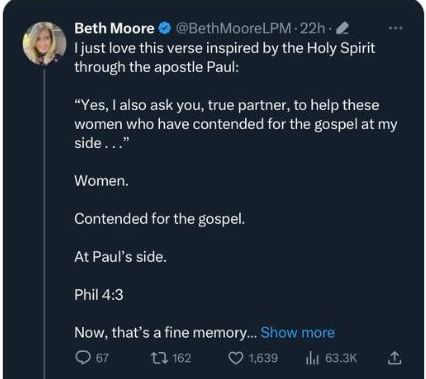




 the-end-time.org