Posted in theology

Lessons from Jethro: Wisdom and Support in the Bible

By Elizabeth Prata

I’m going through the John MacArthur Daily Bible. A week or so ago I was in Exodus 18. I’ve been thinking about a sweet scene in that chapter. There are a lot of important scenes in Exodus, and some hard scenes, but this one was sweet and left an impression on me.

Exodus 18:13 – “¶ And it came to pass on the morrow, that Moses sat to judge the people: and the people stood by Moses from the morning unto the evening.” art from Bible.art

It’s when Moses’ father-in-law Jethro comes to Moses after the Exodus at the Red Sea and escape from Pharaoh.

When Jethro, Moses’ father-in-law, came with his sons and his wife to Moses in the wilderness where he was camped, at the mountain of God. 6And he sent word to Moses: “I, your father-in-law Jethro, am coming to you with your wife and her two sons with her.” 7Then Moses went out to meet his father-in-law, and he bowed down and kissed him; and they asked each other about their welfare, and went into the tent.

8Moses told his father-in-law everything that the LORD had done to Pharaoh and to the Egyptians for Israel’s sake, all the hardship that had confronted them on the journey, and how the LORD had rescued them. 9And Jethro rejoiced over all the goodness which the LORD had done for Israel, in rescuing them from the hand of the Egyptians. 10So Jethro said, “Blessed be the LORD who rescued you from the hand of the Egyptians and from the hand of Pharaoh, and who rescued the people from under the hand of the Egyptians.

11Now I know that the LORD is greater than all the gods; indeed, it was proven when they acted insolently against the people.” 12Then Jethro, Moses’ father-in-law, took a burnt offering and sacrifices for God, and Aaron came with all the elders of Israel to eat a meal with Moses’ father-in-law before God.

The impressive scene goes on afterward when Jethro observes Moses judging Israel and the heavy burden it was, and gives Moses counsel to appoint men and delegate the responsibility in various ways. It was wise and good advice.

Exodus 18:24 – “So Moses hearkened to the voice of his father in law, and did all that he had said.” Illustration from Bible.Art

So I got to wondering how often we mimic the Jethro scene in our lives in this century. How often do we have dinner and break bread together, and discuss the wonder that is God? Or exult over what He has done for His people in general and us personally? Do we give or accept wise advise from elders?

Jethro seemed to be available when Moses needed him and retreated when not needed to allow Moses to live his life. Jethro was an observant and loving father-in-law!

The scene was a good reminder for me to be prepared to glorify the Lord with my words, recounting His deeds and ways in conversation. Being available for loved ones, keenly observing otherwise and ready to step in. Think about the Moses-Jethro relationship and see how we can model ourselves after these Bible people who came before us.

Posted in theology

God’s Response to Human Questions in the Bible

By Elizabeth Prata

God came to Moses in a burning bush. The bush was burning but not consumed. Moses saw the spectacle and his amazement awakened, He turned aside to view it. That’s when God announced His presence and said Moses was standing on holy ground.

Just think on that for a second. What if you were going about your daily life, and by the side of the road you saw a car that was burning but not consumed. Would you stop? Would you believe it if God said I AM to you?

Anyway, we know Jesus is not making appearances these days but we tend to take for granted the shocking biblical moments when we read about when the supernatural breaks into the mundane. ‘Oh yah, that’s the burning bush’ we think. But pause and consider what it was REALLY like for Moses.

God told Moses what Moses must do. Yet, Moses wasn’t too sure about these marching orders. He questioned God in Exodus 3 in a series of questions. He asked several reasonable questions and God patiently instructed Moses. It was only the last one, where Moses’ questions turned to objection, that God became angry. This is instructive for us.

1. But Moses said to God, “Who am I, that I should go to Pharaoh, and that I should bring the sons of Israel out of Egypt?” (Exodus 3:11).
2. Now they may say to me, ‘What is His name?’ What shall I say to them?” (Exodus 3:13).
3. Then Moses said, “What if they will not believe me or listen to what I say?” (Exodus 4:1)
4. Then Moses said to the LORD, “Please, Lord, I have never been eloquent…(Exodus 4:10a).
5. But he said, “Please, Lord, now send the message by whomever You will.” (Exodus 4:13). Other translations say that Moses said ‘Send someone else’.

NOW the Lord became angry. Moses’ questions, while initially reasonable, drifted to faithless objection. He wanted out from the responsibility. There was a consequence to his attitude, as Jamieson-Fausset-Brown Bible Commentary states,

The anger of the Lord was kindled against Moses—The Divine Being is not subject to [boiling] passion; but His displeasure was manifested by transferring the honor of the priesthood, which would otherwise have been bestowed on Moses, to Aaron, who was from this time destined to be the head of the house of Levi (1Ch 23:13).

Mary asked a reasonable question to the angel Gabriel informing her that she would soon be pregnant. Very reasonable! She wondered about this, an event that had never happened before and never would again. “How can this be,” Mary asked the angel, “since I am a virgin?“(Luke 1:34). In her innocence, she was not rebuked. Her question was sincere and pure.

Habakkuk asked God about the timing of God’s plan, and was patiently instructed. The Prophet was earnestly inquiring. More at Habakkuk Questions the Lord, a Ligonier article.

But Zechariah the father of John the Baptist questioned the angel Gabriel too. Why was he punished and Mary wasn’t? Because of all people, a priest of God should have remembered the same angel Gabriel brought a message to Daniel. He should have remembered that Abraham and Sarah bore Isaac in their dotage just as Gabriel said Zechariah and Elizabeth would bear John. Worse, Zechariah asked for a sign- “how shall I know this?” and thus, demonstrated his unbelief. Gabriel replied exactly that -“because you did not believe my words, which will be fulfilled at their proper time.” (Luke 1:20b).

Where Mary accepted the news in submission, Zechariah’s question showed unbelief, so he was punished. JC Ryle here on Zechariah’s question: Zechariah’s Unbelief .

The Pharisees asked a whole bunch of questions. Their questions were insincere, dishonest, and came with an evil agenda (they were trying to trap Him, test Him, and destroy Him.)

God encourages us to ask questions. If we are truly wondering, seeking, grappling with the enormity of it all, God understands. He answered Habakkuk and Mary. He was patient with Moses (to a point). Jeremiah, Job, and Elijah all asked God to let them die. They were not rebuked or punished. Instead, GotQuestions explains:

Through the prophet Jeremiah, God says, “Ask me and I will tell you remarkable secrets you do not know about things to come” (Jeremiah 33:3, NLT). How could it be wrong to question God when Jesus Himself encouraged, “Keep asking, and it will be given to you. Keep searching, and you will find. Keep knocking, and the door will be opened to you. For everyone who asks receives, and the one who searches finds, and to the one who knocks, the door will be opened” (Matthew 7:7–8, HCSB).

The point is, we can ask questions of God sinfully, thinly veiled queries which are really asking Him to justify Himself. We can ask questions sinfully like the Pharisees did, just to gather evidence that God is not worthy. Or we can be a Mary or Habakkuk and sincerely ask and give him worshipful praise when the answer comes- or not, as Job did.

All the articles linked to here are good to explore the question of whether it is OK to question God. Ultimately though, Mary’s and Job’s conclusion, “Let it be done to your servant as you will,” and “Shall we actually accept good from God but not accept adversity?” is the best thought to rest on as you await an answer- whether it comes or not.

Posted in prophecy, theology

When God changed the calendar

By Elizabeth Prata

The LORD said to Moses and Aaron in the land of Egypt, 2“This month shall be for you the beginning of months. It shall be the first month of the year for you. (Exodus 12:1-2).

In that verse, the LORD Is preparing the Hebrews for the grand finale, the last plague and their exit from Egypt. Upcoming is the Passover, where the LORD Instructs Moses and Aaron to tell the people to stay in their homes that night, eat only unleavened bread, and to take an unblemished lamb, slaughter it, and use a hyssop branch to daub the doorposts with its blood. The death angel would pass over any home so marked.

So in commemoration and in preparation, the LORD changed the month. Formerly Abib, corresponding to our April (roughly), the LORD announced the change. Continue reading “When God changed the calendar”

Posted in prophecy, Uncategorized

Prophecy: They sang the song of Moses in Exodus AND Revelation

When the Israelites were miraculously delivered from their bondage to the Egyptians, they sang a song of praise. This is known as the Song of Moses. It’s an ode to the one True God, who is all-powerful. The Israelites, led by Moses and Aaron, knew that God was God. They knew who He is.

He is a man of war, who smites enemies. He is a God of wrath,  and power, and salvation. He does wonders that make His people tremble. He is King of Kings, who dismays the kings of the earth. He is mighty. He is to be exalted.

Please read this wonderful song.

The Song of Moses, Exodus 15:1-18

“I will sing to the Lord, for he has triumphed gloriously;
the horse and his rider he has thrown into the sea.
2 The Lord is my strength and my song,
and he has become my salvation;
this is my God, and I will praise him,
my father’s God, and I will exalt him.
3 The Lord is a man of war;
the Lord is his name.
4 “Pharaoh’s chariots and his host he cast into the sea,
and his chosen officers were sunk in the Red Sea.
5 The floods covered them;
they went down into the depths like a stone.
6 Your right hand, O Lord, glorious in power,
your right hand, O Lord, shatters the enemy.
7 In the greatness of your majesty you overthrow your adversaries;
you send out your fury; it consumes them like stubble.
8 At the blast of your nostrils the waters piled up;
the floods stood up in a heap;
the deeps congealed in the heart of the sea.
9 The enemy said, ‘I will pursue, I will overtake,
I will divide the spoil, my desire shall have its fill of them.
I will draw my sword; my hand shall destroy them.’
10 You blew with your wind; the sea covered them;
they sank like lead in the mighty waters.
11 “Who is like you, O Lord, among the gods?
Who is like you, majestic in holiness,
awesome in glorious deeds, doing wonders?
12 You stretched out your right hand;
the earth swallowed them.
13 “You have led in your steadfast love the people whom you have redeemed;
you have guided them by your strength to your holy abode.
14 The peoples have heard; they tremble;
pangs have seized the inhabitants of Philistia.
15 Now are the chiefs of Edom dismayed;
trembling seizes the leaders of Moab;
all the inhabitants of Canaan have melted away.
16 Terror and dread fall upon them;
because of the greatness of your arm, they are still as a stone,
till your people, O Lord, pass by,
till the people pass by whom you have purchased.
17 You will bring them in and plant them on your own mountain,
the place, O Lord, which you have made for your abode,
the sanctuary, O Lord, which your hands have established.
18 The Lord will reign forever and ever.”

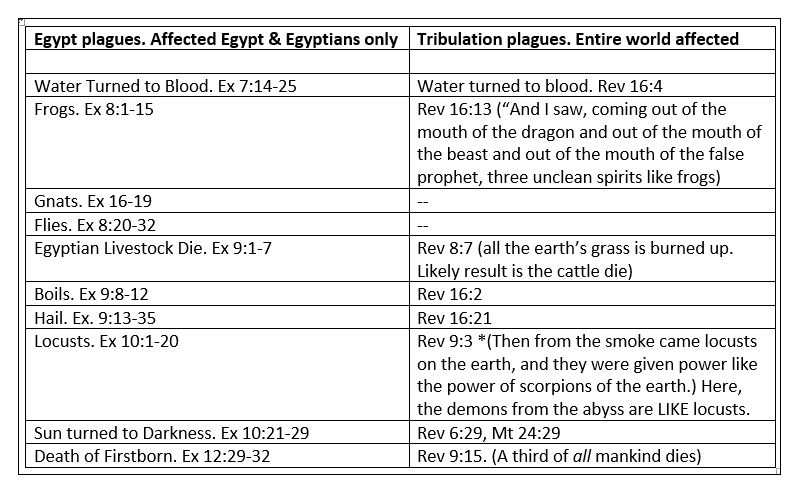
You might recall the ten plagues of Egypt that God placed on Pharaoh and his people. They were step-for-step dethronings of the Egyptian gods. God demonstrated He is the One True God with power over all the false gods the Egyptians worshiped. The plagues were also punishment for rebelling against God.

God has promised that after the rapture, when all the earth’s people who rebel against Him, from kings on down to slaves, they will be punished in wrath for their rejection of Him. (Revelation 6:15-16). At that time He will dethrone not only all false gods, but the false god of all time- satan. God will send to people of the earth plagues that are in like kind to the plagues God sent to Egypt. In Exodus, the plagues occurred just to the Egyptians. Even when the sun was darkened, the Israelites had light inside their own homes. (Exodus 10:23). Even when the Egyptian cattle died, the Israelite cattle lived. (Exodus 9:6). God is that precise.

During this post-rapture time of wrath, called The Tribulation (Or The Time of Jacob’s Trouble, Jeremiah 30:7), all the earth will be affected by these plagues. Everyone. During that time many will come to Christ and be saved, but most of the newly saved believers will be martyred. We read in Revelation, that just as the Hebrews sang the song of Moses in praise to God after their deliverance, the martyred will also sing the Song of Moses. We read this in Revelation 15:2-4

And I saw what appeared to be a sea of glass mingled with fire—and also those who had conquered the beast and its image and the number of its name, standing beside the sea of glass with harps of God in their hands. 3 And they sing the song of Moses, the servant of God, and the song of the Lamb, saying,

“Great and amazing are your deeds,
    O Lord God the Almighty!
Just and true are your ways,
    O King of the nations!
4 Who will not fear, O Lord,
    and glorify your name?
For you alone are holy.
    All nations will come
    and worship you,
for your righteous acts have been revealed.”

Here is a side by side comparison of the plagues of Egypt with the plagues of the tribulation, in both cases, God’s people were delivered from bondage. Click to enlarge.

Barnes’ Notes explains the parallels between the two circumstances of the singing of the song of Moses, at the commentary of Revelation 15:3,

Barnes’ Notes on the Bible
And they sing the song of Moses the servant of God – A song of thanksgiving and praise, such as Moses taught the Hebrew people to sing after their deliverance from Egyptian bondage. See Exodus 15. The meaning here is, not that they would sing that identical song, but that, as Moses taught the people to celebrate their deliverance with an appropriate hymn of praise, the redeemed would celebrate their delivery and redemption in a similar manner. There is an obvious propriety here in referring to the “song of Moses,” because the circumstances are very similar; the occasion of the redemption from that formidable anti-Christian power here referred to, had a strong resemblance to the rescue from Egyptian bondage.

As does Jamieson-Fausset-Brown Bible Commentary

song of Moses … and … the Lamb—The New Testament song of the Lamb (that is, the song which the Lamb shall lead, as being “the Captain of our salvation,” just as Moses was leader of the Israelites, the song in which those who conquer through Him [Ro 8:37] shall join, Re 12:11) is the antitype to the triumphant Old Testament song of Moses and the Israelites at the Red Sea (Ex 15:1-21). The Churches of the Old and New Testament are essentially one in their conflicts and triumphs. The two appear joined in this phrase, as they are in the twenty-four elders.

Our pastor preached on the Exodus plagues and the majesty of God this past Sunday. Our pastor has a Spirit-given talent for bringing the listener up to heights to glimpse up close the power and glory of God, which is itself if breathtaking and humbling. One becomes crushed after glimpsing Him through the exposition of scripture in sch a powerful way. After the sermon, I realized that as difficult as it is for me, who is saved, to see God as He really is (through scripture) that the lost people I know will meet Him in their own flesh. How like grass the flesh is! How they will be brought low, to wither as a match against a universal conflagration! When we ‘see’ God, we understand our own position in relation to Him, first as sinner worthy of all punishment, and then gratefully, as adopted sons and daughters of righteousness.

I recommend the sermon, if you have 40 minutes. It’s worth listening to. As for God’s work between the Old Testament and the New, from Egypt to the Tribulation-

But Jesus answered them, “My Father is working until now, and I am working.” (John 5:17)

Exodus and the Glory of God
What is the book of Exodus really about? We covered the heart of the book (with a brief summary of the whole) this week. Exodus is about God’s Glory in Salvation through Judgment.

May God and God alone be praised!!