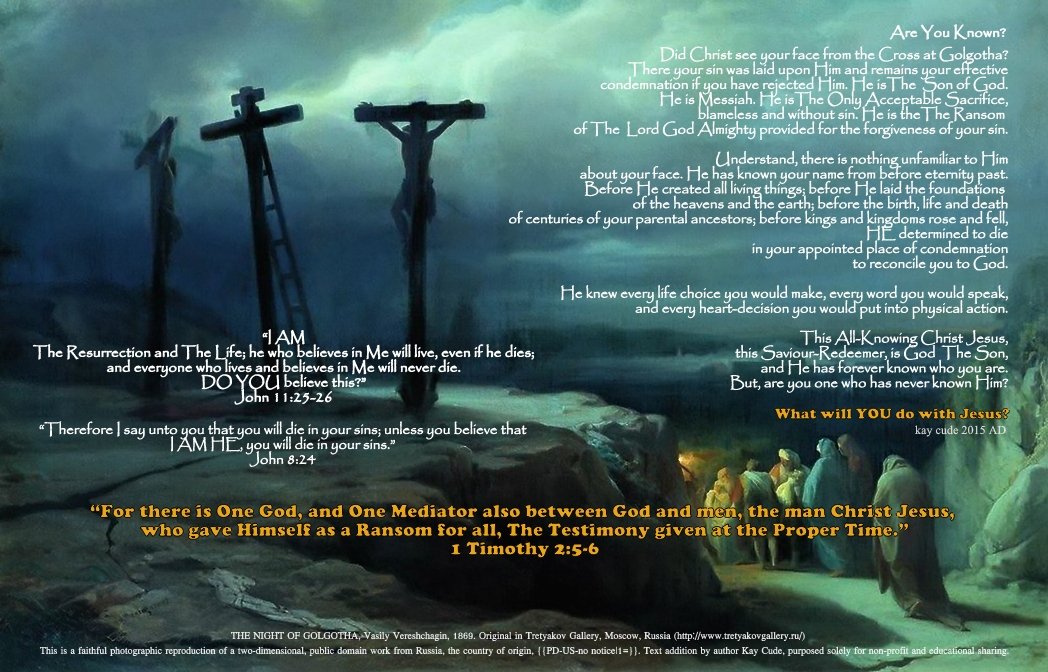
When you are released from the burden you sense but can’t define, (sin), when you are freed from the chains of slavery to it, when you are forgiven and loved perfectly by The Perfect, you will rejoice, as all Christians do. You will love being a Christian. Repent now, for the kingdom is at hand.
15 and saying, “The time is fulfilled, and the kingdom of God is at hand; repent and believe in the gospel.” (Mark 1:15)
A friend asked me to recommend some women’s studies for a new church plant. Though there are many fine Bible studies aimed at women or by women on the market, I don’t prefer them. First, these times if apostasy means women are especially vulnerable to it, and there are tons of false teachers out there of the female persuasion. Even solid teachers who have for decades developed good curricula of late have made a turn for the worse. (I’m thinking of Kay Arthur, among others). What is recommended today might be apostasy-ridden tomorrow when the woman creates her next curriculum. Though men are not immune from the same, it is a fact that satan attacks women with impunity. (Eve, symbolic Jezebel of Revelation 2, 2 Tim 3:6, etc)
J. Ligon Duncan and Susan Hunt do express the need for women’s ministry in the local church in their excellent book, Women’s Ministry in the Local Church. I would say if one is going to start a women’s ministry in a new church or resurrect a suspended ministry in an old church, to know why you are doing it and what the Bible has to say about it. Don’t have a women’s ministry just to have one. That’s where the Duncan book comes in. An excerpt from the Dallas Theological Seminary’s review of it states,
The book builds on five foundational themes taken from Paul’s pastoral letters: the Gospel, truth, sound doctrine, discipleship, and covenant. From these themes Duncan and Hunt identify five key passages, each emphasizing a different element that they feel is necessary for developing a healthy women’s ministry: 1 Timothy 2:9–15 (submission), 1 Timothy 3:11 (compassion), 1 Timothy 5 (community), Titus 2 (discipleship), and 2 Timothy 3:1–17 (Scripture). Each section offers a solid interpretation of the text, gives biblical examples of women who exemplify the meaning, and lists practical ways to carry out each element in a women’s ministry. Each chapter ends with testimonies from men and women who have implemented that principle in their own ministry experience.
The authors give five reasons why women’s ministry is important in every healthy evangelical church, and they warn of the adverse effects to marriages, families, and churches if women fail to have opportunities to meet and serve together.
I’m not opposed to all women’s ministries of course, but I’m advising care and thought into the creation of it and a watchful eye from the elders to ensure its solidity over time.
What I’d shared with my friend is the second reason I’m not all that excited about women’s ministries led by women is that all too often the ministry delves into topics aimed at women only, meaning, dating, courtship, marriage, and children. While they are important and worthy topics, first, it marginalizes single women by definition. Second, many times these topics are dealt with emotionally and not as theologically as one would prefer. I prefer theology for all ministries, men’s, women’s, and youth. Even children.
As for women, my specific target audience, if satan targets women then it behooves the church elders to formulate a plan for combating that attack. Grounding women in solid theology seems the best method. And yet women are often the last to be offered solidly theological studies in which to delve.
Even at that, the women who nod most vigorously during a solid theological sermon are often the first to gush about the latest Beth Moore study/LysaTerKeurst book/Sarah Young devotional. That’s why I appreciated the chapter on Scripture in Duncan & Hunt’s book about women’s ministries.
There are three issues with the church ministries’ approach I’ve noticed over time, I’d mentioned in the conversation, and I’ll flesh out further here. (Twitter limits are so exasperating sometimes!) Women as well as men-
1) deny the beginning,
2) mock the end,
and
3) are biblically illiterate with most everything in between.
To ground women in the beginning, Genesis 1-11 studies help. I believe the following studies from Genesis would make a wonderful addition to the rotation of any women’s or men’s ministry. We must know what we believe and why. Genesis provides that foundation. If more youths, especially girls, were taught the basics that are contained in Genesis, perhaps when they reach age 20 they would not be Already Gone.
Another good resource for Revelation: This book promises blessing yet too many people fear it, especially women. Here is a booklet that will help, “Jet Tour Through Revelation” ($2 for the booklet or click here to read it free of charge)
Biblical illiteracy: For a new church, I recommend Justin Peters’ seminar “Clouds Without Water“, which discusses what discernment is and why it is important, as well as critiquing the word-faith movement;
9Marks: Anything from 9Marks, an organization designed to help church plants and older churches become and stay healthy.
So that’s it. I might be somewhat if an anomaly, single and childless yet in my mid 50’s. I’m a Titus 2 elder woman who has nothing to say about marriage or child rearing except what the Bible says, not from experience. Perhaps that is why I focus on theology so much. Of maybe it is the Holy Spirit impressing on me that women, man, youth or child, you’re never too young or too old to study God, which is simply what theology is.
I can’t wait to see what you all look like when you are glorified! I can’t wait to see the glassy sea, the angels who have helped me, the face of Jesus! I can’t wait to be free from pain and shed of my sin nature. I can’t wait to be in eternity! However, I will await His timing. We all must await the number of our days to be up and His determination of when we enter glory.
For now though, the Tribulation is still to come according to the Divine schedule.
The Tribulation is prophesied to be a period where many things will happen. One of them is that the earth and heavens themselves will be wildly disrupted. Landforms disappear. Weather patterns evaporate. Orbits cease. And more.
The outline of what Jesus will be doing at that time is presented to us in Daniel 9:24. The Lord will do 6 things:
Remember the Weebles commercial of the early 1970s? Back then the commercials were of a more innocent quality than the ones we’re subjected to now. This Weebles ad from the 1970s is just so cute.
Whoever created that ad was a genius. Why? I remember the tagline even 40 years later! THAT is an effective ad. ‘Weebles wobble but they don’t fall down.” These Hasbro toys, launched in 1971, were a small, egg shaped toy with a weight at the bottom. If you pushed the toy over with your finger, the toy tipped because of the spherical shape at the bottom but the weight inside at the bottom immediately returned the toy to its center of gravity and it popped upright. No matter how often you pushed it over, it always returned upright.
A weeble
The events of the world are dark and evil. They can easily infiltrate our heart with a depression that clouds us and weighs heavy. We do Rejoice with those who rejoice, weep with those who weep as Paul advised in Romans 12:15. Christians should be defined by their faith, which includes compassion and love. We not only weep with those brethren who weep, but like Jesus, we weep for those who should weep but do not (Luke 19:41, MacArthur Commentary).
As the world descends into its prophesied Days of Noah, (Matthew 24:37), more and more of the world’s tragedies shock our sensibilities. The state of the world would surely cause any sane person to become depressed just by looking at headlines for one moment, never mind living in this cauldron of evil day after day. Opposition to the truth of Jesus Christ is another depressing item that causes many to weep with broken hearts at the broken churches and the broken bibles littering what today is called Christianity.
And dark clouds not only hover from without, but they can hover from within. Dark clouds of upset and impatience drift over the heart on little cat’s feet and poise, ready to descend at a moment’s notice. From within, a discouragement, frustration, a melancholy, or a depression can creep over the believer. Biblical illiteracy and confusion sets in to the heart, allowing more and more sin to infiltrate it. This becomes ripe ground for defeatism and depression. If some people are struggling with the dark clouds of spiritual depression, imagine how difficult these time are for preachers, whose main instrument is the heart! They labor with broken hearts much of the time.
I’ve been asked two questions recently. One is, don’t I get frustrated or discouraged with the rise in deception of the serpent, and its capturing into false doctrine of so many who profess to believe? And, how can a person stay positive in these dark times?
Many of the great believers of times past suffered from spiritual blackness of one level or another for periods of time that lasted from fleeting to lengthy. Asaph, Jeremiah, David, Paul, Martin Luther, Charles Spurgeon, Martyn Lloyd-Jones, Randy Alcorn, and John Piper were oppressed with clouds of melancholy or frustration or even full-blown depression at various times in their lives. Please don’t think you are alone. You’re not. Charles Spurgeon is almost universally recognized as a mature leader of the faith who also had a deep, long-lasting spiritual depression. Spurgeon said that depression happens frequently to many people.
However, please excuse my straight-forwardness, but please also don’t think wallowing in a spiritual depression is proper. It’s not.
Less talked about was that Spurgeon himself considered this a sinful weakness. He distinguishes between a God-appointed weakness and a human sinful weakness, and he places depression squarely in the latter category. Spurgeon believed despondency was not a virtue, but a vice.
He said “that to be unbelieving, desponding, nervous, timid, cowardly, inactive, heartless is not excusable and not proper” and of despondency, Spurgeon said “I am heartily ashamed of myself for falling into it, but I am sure there is no remedy for it like a holy faith in God.”
I was 40, halfway through my vacation, sitting on the steps, sobbing. Noelle comes down the stairs, asks me “What’s wrong?” I said, “I don’t have a clue.”
As the segment is summarized here, we learn of depression and two pastors’ responses to it-
…it begins with “MacArthur explaining that he has never really been depressed. Some Christians are a bit like MacArthur. To be honest, that can make it hard for them to empathize with the Pipers of this world who goes on to describe how he had a period of his life where he was significantly depressed that lasted several years. MacAthur’s incredulous “Years?!” demonstrates how very differently they are wired.”
“Years?!”
So how do we stay positive when the world is crazy and it seems like the visible church is collapsing under top-heaviness of celebrity pastors, megachurches, and false doctrine?
1. The number one way is to recognize, worship, and rest in the sovereignty of God.
Ecclesiastes reminds us that from the top government down, from Kings, Prime Ministers, Presidents, and Judges, down to the lowliest of tax collectors and pagan sinners, God has His hand in all they do and don’t do. He ordains everything and purposes it according to His plan. Judgment for the evil done on earth WILL happen.
I said in my heart, God will judge the righteous and the wicked, for there is a time for every matter and for every work. (Ecclesiastes 3:17)
Why would God delay judgment, and not take care of it all at once? One reason is this, the Preacher of Ecclesiastes continues:
I said in my heart with regard to the children of man that God is testing them that they may see that they themselves are but beasts. (Ecclesiastes 3:18).
He will not let evil go on forever, and He will purge the world of all unrighteousness.
2. Have faith. Ask for more faith. Faith.
Spurgeon preached that faith was the cure. Use your faith to trust God, ask for more faith to trust Him more. This is what Charles Spurgeon did. He noted,
When the sinner is pointed to the Cross and comes to trust himself with Jesus—viewing the blood sprinkled and the righteousness worked out—then the man can pray, can sing, can melt in penitence or can rise up in flames of love! … The inability of human nature is instrumentally removed by the energy of faith.
Speaking of energy… 3. Stay busy in spiritual disciplines.
In the conversation between Piper and MacArthur, MacArthur said that he stays very busy. Having to write several sermons per week keeps him in the Word. Studying for preaching infuses him with a joy that drags him past the discouragement and he leaves it behind. Staying busy in the word is his primary mechanism to stave off discouragement or depression. Also, he said he ponders Paul and other biblical heroes who have endured worse and yet stayed hopeful.
John Piper said prayer is his go-to discipline. He prays to the Lord to keep him and preserve him, more than any other prayer. Piper said he prays to God to keep him in His will, keep him in his marriage, keep him in understanding and wisdom, etc.
3. Bask in the glory of God in His creation, in faith
To sit long in one posture, poring over a book, or driving a quill, is in itself a taxing of nature; but add to this a badly-ventilated chamber, a body which has long been without muscular exercise, and a heart burdened with many cares, and we have all the elements for preparing a seething cauldron of despair, especially in the dim months of fog—
“Heaviest the heart is in a heavy air,
Ev’ry wind that rises blows away despair.”
“Creation” by EPrata
Others like Alcorn took heart during his two-month depression just knowing he wasn’t alone, that other men battled spiritual depression was a balm. He battled it and his other periodic depressions by taking time to pray in thankfulness and gratitude.
I opened this essay by mentioning the old toy “Weeble.” They wobble, but they don’t fall down. They don’t stay down because they have a weight in the bottom that keeps the center of gravity centered. No matter the length of your Christianity, whether you’ve been saved for days or decades, no matter the level of maturity, babe or grizzled soldier, Jesus is our center of gravity. With our feet on the weighty rock, we might be knocked around a bit, but He will not let us stay down. Sometimes our battles are with temptations, or with the enemy, or sometimes it’s with despondency or depression. Don’t let the evil of the world get you down, or even wobble you for a moment. Jesus has overcome all the world’s evil, and if we are in Him, we have overcome it, too.
Peace I leave with you; My peace I give to you. I do not give to you as the world gives. Do not let your hearts be troubled; do not be afraid. (John 14:27)
This morning I was reading another prayer from my wonderful Valley of Vision book. These are Puritan prayers and devotions, collected into one volume by Editor Arthur Bennett and printed by The Banner of Truth Trust. It is a must-have for your bookshelf.
These prayers often stop me in my tracks with their convicting beauty, depth of spirit, and fervency of faith. Today’s prayer was the first prayer in the section “Redemption & Reconciliation”, and it’s called The Gospel Way. You can read the entire prayer here.
I was immediately struck by the first line.
BLESSED LORD JESUS,
No human mind could conceive or invent the gospel.
Think about this for a while.
Really think.
This one statement has enormous ramifications. Thoughts could erupt in a thousand different paths. For me, I clearly remember the years (decades) before I was saved. I remember being mightily puzzled by the Jesus people, their fixation on the blood (Ew, gross) and the communion bread/wafer they ate that was supposed to be the Lord’s body (Ew, grosser). I remember being confused by their joy even when they were diagnosed with a dread disease, why they so often and profusely thanked the Lord for anything and everything (Oh, get over it, I’d say), and why, oh why, has Christianity persevered all these thousands of years when other religions … didn’t? Continue reading “The Gospel is not a man-made invention”→
The unsaved man says, I am a good person, it’s just that the world doesn’t give me a chance to show how good I am.
The saved man says, I am no good. I was of the world and the world is evil.
This is why Jesus had to come from elsewhere than this world to save us.
“And no man hath ascended up to heaven, but He that came down from heaven, even the Son of man which is in heaven” (John 3:13).
He is not of the world, because if He was of the world, the world would love its own. No earthly ‘savior’ will ever save us. Our hope does not lay in any political leader, any spiritual pioneer, any business innovator, any scientific genius. They are of the world.
When we are saved by His grace, we become not of this world, either. Our citizenship transfers to heaven. And no matter what the world thinks of us, this is a temporary stay. We will all be there, either by death or rapture, we will leave this world and go to where all are good, because we will share in the Righteousness JESUS gave to us.
“I saw the holy city, the new Jerusalem, coming down out of heaven from God, prepared as a bride adorned for her husband. And I heard a loud voice from the throne saying, “Behold, the dwelling place of God is with man. He will dwell with them, and they will be his people, and God himself will be with them as their God.” (Revelation 21:2-3)
By Chris Powers at fullofeyes.com. Free to use. Illustration & verse explanation here