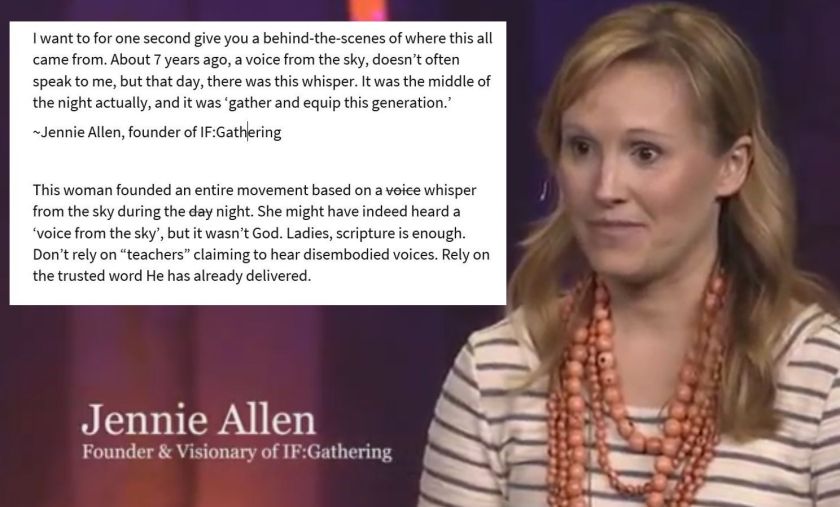
In 2007, Jennie Allen heard a “voice from the sky”. Or it was a whisper. It spoke to her that day. Or it was the middle of the night. Anyway, the whisper told her things. It said, “Gather and equip this generation”. So she obeyed and founded IF:Gathering in 2014.
Ahem, you can see from the dates that there was a delayed reaction to her obedience…
Quote from Jennie Allen’s first IF:Gathering. I have the video of her saying it. It’s real.
This non-profit organization’s stated main mission is: “TO GATHER, EQUIP AND UNLEASH THE NEXT GENERATION OF PEOPLE TO LIVE OUT THEIR PURPOSE.”
Revenue last year was 11.3 million, expenses were 7.6 million, for a total take of 3.7 million dollars and 6.8 million in assets. (Source).
Their stated three-fold sub-mission is stated as the following:
If Lead: equipping women to share and learn through Christ-centered discussions
If Gather: a two-day gathering that brought thousands of women together in Fort Worth and at local gatherings across the globe. The gathering is a fresh, deep, honest space for a new generation of women to wrestle with the essential question: If God is real… Then what?
If Equip: a holistic, strategic, deep way to connect online with a like-hearted community and relevant resources. We hope to prepare women around the world to know God more deeply and to live out their purposes by sharing comments and feelings about daily passages posted online.
On Friday, February 26, Founder Jennie Allen will host this year’s big event: IF:One Night. On their website it’s stated that IF is not only an event, “but a discipleship ministry focused on putting tools and resources in the hands of women in the church. Through these, IF is able to empower women to reclaim discipleship as God’s means to change the world.”
Before you decide to attend (digitally only, the real life event being held at what I believe is Jennie’s church, Watermark Church in Dallas, is sold out) or before you decide to host a local gathering to stream along the event happening at Watermark Church, think on these things.
-Do you want to trust a founder who listens to voices from the sky? The Lord has ceased speaking directly to individuals. That voice from the sky cold have been anything from bad quesadilla rumblings in the night to demons whispering to her ear.
-Do you want to align with an organization that is based on doubt? “IF” God exists? He does. The entire organization, besides the whispery issue, is founded on doubt and promotes women gathering to obsess over them and their ‘feelings’.
-Do you want to trust an organization who presents to you “Bible” teachers who are apostate, false, and otherwise unhealthy? Slated to teach you at IF:One Night are Francis Chan, Matt Chandler, Lauren Chandler (who loves & partners with false teacher Beth Moore), Jennie Allen, Christine Caine, and others who are proven to be unreliable Bible teachers.
-Do you want to compete with and be drawn away from your own local church? Talk about feelings with strangers with whom you do not connect on a weekly basis over the preached word of God in your own assembly? This is a para-church organization whose intent is to multiply groups away from your local church and to whom you are not accountable as you are to your own elders. Please consider discussing any doubts or fears you have with your own church members. It is what they are there for and how the church grows through the word, fellowship, and discipling.
I’ve written about IF:Gathering negatively since the beginning of their foray into Christianity and women’s minds and hearts. I give you an earnest plea: Avoid IF.
See video clip here where Jennie admitted her impetus for founding IF was a voice from the sky:
My “Cut To the Chase” articles are shorter form, bulleted discernment outlines, rather than a longer essay.
@JustinPetersMin wrote, “Experiencing God was one of the most damaging books introduced to the evangelical world in over a hundred years.”
That us a lot of power in a book. False doctrine does not only emerge from the pulpit. In fact, it is more likely to emerge from the tangential ministries in a church, such as the women’s Bible study, the church Library, or brought in as evil seeds from external conferences members attend elsewhere.
Why was “Experiencing God” so damaging? Let’s take a look.
Issue #1: Normalizing hearing from God
5 Solas wrote on X about Blackaby and Experiencing God, “The false teaching that the way God speaks to His people under the New Covenant is audibly or internally by some “still small voice,” and not through His all-sufficient written Word, has done unimaginable harm to the church. The idea that it’s not a personal relationship unless you are hearing voices or getting impressions is damnable. You are essentially saying that God doesn’t speak through His Word.”
This issue relates to the “Sufficiency of Scripture.” We often refer to 2 Timothy 3:16-17 when saying that God’s written word as contained in the 66 books of the Bible is enough for the Christian to learn, absorb, and live by. We do not see and interpret signs or omens, hear whispers, or listen to audible voices directing our steps. The verse says:
All Scripture is inspired by God and beneficial for teaching, for rebuke, for correction, for training in righteousness; so that the man or woman of God may be fully capable, equipped for every good work.
Note the words- All, fully, every. Those words are quantifiers that indicate total, complete, or inclusive quantity. Note what the Bible is good for- all the things a Christian might need to do- teaching (and learning), training, rebuking. Note the benefits of living by the Word only- righteousness, capable, equipped.
How many verses does one need when we have such a perfect description of the Christian life right there in 2 Timothy? But wait, there’s more: Hebrews 4:12, Romans 15:4, Matthew 4:4 and other verses reinforce the sufficiency of God’s word alone.
Issue #2: Believing we can see where God is working
A refrain comes up frequently in the book: “watch to see where God is working and join Him in His work.”
One question: Where ISN’T God working? There is not one molecule not under his jurisdiction, command, and movement. If there is one maverick molecule in the universe (as Sproul famously said) then God is not God, not in control, and not working. It would invalidate His divine sovereignty.
One thought: Do we, being sinners with sin-darkened minds and a finite perspective, have the intelligence to see and know exactly where God is doing a work? The way Providence operates is that it sometimes can be seen but only AFTER the work is done.
One warning: God doesn’t ‘invite’ us to join Him. He commands us to do His will. Working out our salvation with fear and trembling and pursuing holiness is not a cafeteria experience of choosing. ‘I want to join Him there, but not there, that looks uncomfortable…’
Issue #3: That we can come to know God through our own, self-interpreted experiences
In the book, Blackaby (and co-author Claude King) constantly prioritize personal experience over the commands of God through scripture. From the book blurb at Lifeway: “God is inviting you into an intimate love relationship through which He reveals to you His will, His ways, and His work” but the book teaches that He does this not through scripture, but through our experiences and observations.
We don’t come to know God by looking around and observing. Romans 1 teaches that the danger in doing this is that we begin to worship the creation and not the creator.
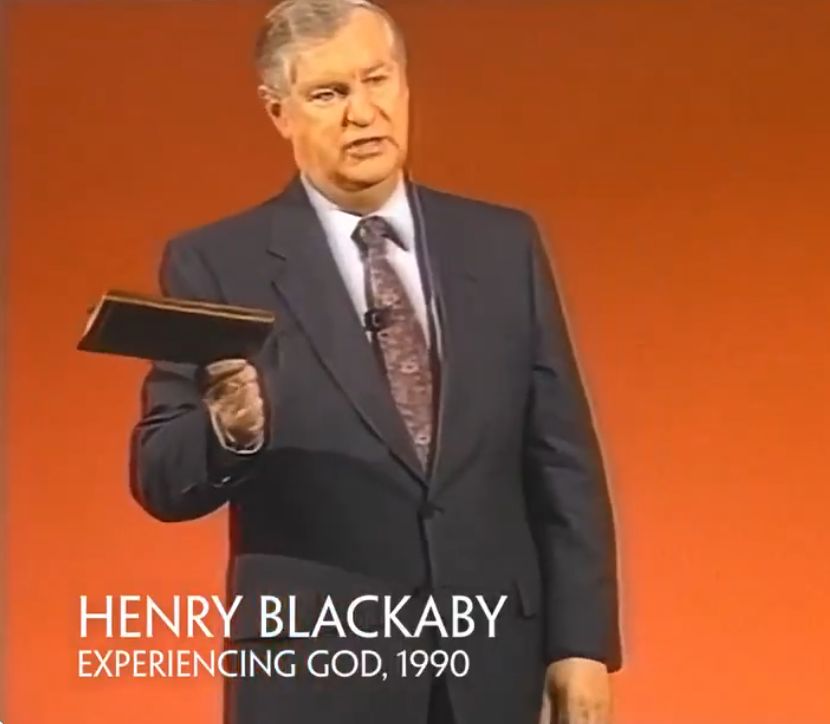
Justin Peters said in his teaching linked below that, in “Experiencing God, Henry Blackaby says this: “If you have troubling hearing God speak, you are in trouble at the very heart of your Christian experience.”
That is a dire warning that Blackaby and King issued in their book. ARE we in trouble is we don’t hear God speak? Many conscientious and committed Christians would not want to make a mistake in failing to do something God wants us to do, so they would in all diligence strain to listen. Others who are not as conscientious but are more prideful would seize that claim and puff themselves up as conduits for God. Many professing Christians did just that and claims began popping up like multiplying viruses that various people claimed to hear from God all the time and ‘He said…’
Peters continued, “I would submit to you that the resource, the book that is singularly most responsible for introducing charismatic theology into at least theoretically non-charismatic churches is Experiencing God by Henry Blackaby that came out in 1991. If you go back before 1991, at least in non-charismatic churches, almost everyone would have understood that God speaks to us through the Bible, we speak to Him in prayer. Today hardly anybody understands that; and I believe experiencing God is singularly most responsible for introducing these notions into non-charismatic churches.” –end Justin Peters quote.
The Bible is the most trustworthy source for living life under God’s heaven, for understanding HIs will, and for how to pursue holiness. God gave us His book and that is where He speaks, nowhere else. Avoid “Experiencing God” and experience living by His word from the Bible instead.
Further Resources
“The book that is singularly most responsible for introducing charismatic theology into at least theoretically non-charismatic churches is Experiencing God by Henry Blackaby…” said Justin Peters at the 2019 Truth Matters Conference.
The essay argues that while God used dreams during Christ’s advent and occasionally in Scripture, revelatory dreams ceased with the completed biblical canon. Claims of divine dreams, including Muslim visions, contradict Scripture’s sufficiency and misapply Joel and Acts, affirming Scripture alone as God’s final revelation.
This essay explores biblical decision-making, explaining that Christians need not seek mystical signs or personal revelations to know God’s will. Instead, believers should obey Scripture, apply godly wisdom, and trust God’s providence, understanding that no decision can derail His sovereign plan or purposes.
EPrata photo
Does the Bible speak to whom we should marry? Which college to attend? Whether to join the Army? Should we relocate to another state? Change careers now, later, or never? Go back to college?
While we cannot know God’s infallible will about anything except that which is revealed in Scripture, we are not to think that we have been left on our own with no assistance from God.”
Paul just decided things. He wrote often that he decided this or decided that. You would think, if we had to wait for a sign or a word from the Holy Spirit, which Paul absolutely directly received many other times, that he would wait to hear, watch for a sign, or listen to omens. But no, more often than we think, Paul just decided things.
2 Corinthians 2:1But I decided this for my own sake, that I would not come to you in sorrow again.
1 Corinthians 16:6Perhaps I will stay with you awhile, or even spend the winter, so that you can help …
2 Corinthians 1:23, But I call God as witness to my soul, that it was to spare you that I did not come again to Corinth.
Acts 20:16, For Paul had decided to sail past Ephesus so that he would not have to lose time in Asia; for he was hurrying, if it might be possible for him to be in Jerusalem the day of Pentecost.
It’s OK to decide!
In the 1970s and 1980s an extremely popular author was Richard Bach. He wrote Jonathan Livingston Seagull which was on the NY Times bestseller list for years. He was New Agey, mystical, advanced soul, self-enlightenment kind of guy. Lots of man-made philosophies in his books. He followed up Seagull with The Bridge Across Forever: A True Love Story. In it he sparked a frenzy for finding one’s “soulmate.” He proposed that there was one true predestined soulmate for each of us and it is our job to find her (or him). If we do not, then we miss out on the one fulfilling relationship we could have had.
The book centered on Bach eventually finding his alleged soulmate, Leslie Parrish, whom he married. They later divorced. In fact, Bach has been married 4 times.
But it was books like his with their massive cultural impact that sent people into an anxious state of mind, thinking that everything hinges on ourselves to figure out the right decision for everything or our self-actualization will never occur.
Sadly, the Christian culture of the 90s and 2000s absorbed some of that leaven, and introduced a similar mysticism to decision-making (and to Christian life in general) that unfortunately included waiting for personalized whispers, looking for signs, or other extra-biblical methods that will guide Christians along in decision-making, a process that that forgets God’s sovereignty.
For example, as in Experiencing God, the Blackabys say much about prayer being two-way communication with God (pp. 113, 117, 122, 131) — we speak, then wait for God to speak.
“Your task is to wait until the Master gives you instructions” (141). This is the critical fourth step in the “Seven Realities of Experiencing God.” Blackaby sums it up simply as “God speaks” (52). The Christian receives an “assignment” from God that is special and unique to each individual, the specific will of God for his own life.
Pastor Phil Johnson debunked about inner promptings and whispers, (transcript here from Super Session at the 2002 Shepherds’ Conference, audio here)
Now this kind of thinking is totally at odds with the principle of Sola Scriptura. We believe as Protestants don’t we, that the written Word of God – the Bible – contains everything necessary for our salvation and our growth in grace. 2 Timothy 3:16-17, All Scripture is given by inspiration of God and is profitable for doctrine, for reproof, for correction, for instruction in righteousness…listen to the next phrase…that the man of God may be PERFECT, thoroughly furnished unto all good works. Scripture alone is able to equip us thoroughly, perfectly for all good works. Everything we need in the process of our sanctification. There is no need for extrabiblical revelation. The Bible will equip you for all good works. It will give you all the explicit guidance you can possibly get from God. It contains principles to help you be wise and discerning as you pursue the course of your life, and beyond that we simply trust God in His providence to order our steps. You don’t need an explicit message from God telling you whom to marry, or where to go to school, or where to go to the mission field. [italics mine]
So how should we approach making decisions? As Johnson said, either there is explicit guidance in the Bible or there is wisdom to guide us as we read the Bible.
Any first step to decision making would assume first that one is saved. Apart from Christ, we can do nothing. (John 15:5). Secondly it assumes that the thing you’re undecided about does not involve sin. We never decide toward sin, we flee from sin. ( 2 Timothy 2:22; Genesis 39:12). Thirdly, it assumes that you’re relying completely on God’s word. If the item you’re trying to decide about is directly in the Bible, follow that command. “Should I submit to my husband?” isn’t really a decision to ponder, because it is already commanded.
Fourthly, the decision-making process assumes that you’ve yielded yourself to the Spirit of Christ within you. You’ve been striving for holiness, and you’re as much as a clean plate as you can be, being a sinner, lol.
Now, how to decide those things which are not directly addressed in God’s word?
Garry Friesen wrote a good book on Christian decision-making, linked above. He wrote that:
God’s guidance according to the way of wisdom can be summarized in four simple statements:
1.Where God commands, we must obey. 2.Where there is no command, God gives us the freedom (and responsibility) to choose. 3.Where there is no command, God gives us wisdom to choose. 4.When we have chosen what is moral and wise, we must trust the sovereign God to work all the details together for good.
–end Garry Friesen quote
Did you know that You Are Part of a Grand Plan? It’s not like you can mess it up. If you make this decision or that decision, it isn’t going to surprise God, or alter what He has planned for you. Providence, as mentioned above by Phil Johnson, is secure. His plan will be fulfilled, and your decision making isn’t going to change it. You aren’t going to miss out on anything. Beyond what is specifically prescribed in the Bible, and “we simply trust God in His providence to order our steps” as Phil Johnson explained.
In my own life, I moved from Maine to Georgia. I wanted a place with lower cost of living, and warmer weather. That’s it. He would have worked it out of I’d chosen Texas or North Carolina. Deciding on Georgia wasn’t a life-or death decision, just one that wasn’t sinful, fit my lifestyle, and made sense.
When I got to Georgia I applied for a number of jobs. I applied using common sense. What did I have experience in, was trained for, and was good at? It’s not like I consulted the Lord and waited for a sign or anything. I was following the biblical principle that he who does not work does not eat. I sought jobs I thought I had the best chance of getting and sustaining myself.
Some jobs I applied for were at the University in the journalism department, some with local magazines. The one I got (in His providential care) was for the Athens Banner Herald writing feature stories of people in my county as a freelancer. Later when I decided to go back to education – subbing at first and applying for parapro jobs, I didn’t consult the Lord. I just used common sense. The freelance job simply wasn’t paying enough. A job with the County Education system would:
-be fairly secure as jobs go (education is the largest employer in the county) -had health benefits (I was soon to be 50) -was what I was trained for. (formerly certified teacher with Masters degree) -I’d be working with kids (something I love).
If I’d decided to get a job as a bungee jumper trainer, lol, that would not be common sense. Watching for omens and signs, or waiting to hear directly from God would not make sense, either.
I knew the Lord would work it out. In His providence He did not ordain that I was given the first job I’d interviewed for as a parapro at another school, but a year later I got a job at the school I’m at now, a great fit. I’ve been there 17 years, 15 as a parapro. It’s not like there is only ONE decision or only ONE path.
If your life is in harmony with all the commands and principles of the Bible, you can actually do what you want to do without beating yourself up with introspection and fretting over whether God told you to do something or not. When Scripture says He orders our steps it’s talking about His guidance through His hand of providence. We step out in faith, and He guides our steps.
A man I follow on X asked “Do you think God still uses visions and dreams today? Even if it’s non-normative?“
I answered “No. The scripture as given is sufficient. He speaks through His Gospel, not direct revelation at this time. Heb 1:1-2. Rev 22:18-19, 2 Tim 3:14-17, 2 Pet 1:19. There is nothing that a vision or dream could say to us directly that would be better truth than what is already written.“
Another lady piped in and replied to me that SHE hears His voice. “He reveals things directly to me and to many other Christians. The Bible tells us “my sheep hear my voice.“
This verse is a vastly misunderstood and overused excuse for people who do not think the Bible is enough to cling to as a defense for their voice-hearing activities.
I said, “You’re not an actual sheep, so you’re not actually hearing God’s voice. Interpret both sides of the verse the same. Heb 1:1-2a says, ‘God has spoken to us in His Son’ which means the Bible. More here, please watch 18 minutes of truth why you’re not hearing Him.“
And I linked to Justin Peters’ wonderful video series titled Inigo Montoya Series. The series, Peters wrote, “dives deep into the world of commonly misinterpreted scriptures, carefully unraveling misconceptions and providing clear, biblically grounded explanations.” The pertinent entry I’d linked to was My Sheep Hear My Voice.
She replied, “I’m not going to watch a video. I read the Bible. And I have a relationship with Jesus.“
Maybe it’s just me. But if someone said I’m doing something that is against the Bible, or, if I’m following someone who teaches falsely, I’d investigate. I’d consider the advice. Jesus is too important to reject the possibility out of hand. But in discernment work, too often that is exactly what I’ve found that people do.
Hers was a typical reply. The person defending a false notion or a false teaching never reads the verse or the link and comes back to address it in the conversation. We must reason together over scriptures, it is the only common ground we have for truth (IF the person is saved it would be common ground, if not, then they need scriptural truth anyway.) Always bring the Bible verses into the conversation as quickly as possible.
So I told her that “I’d gently suggest that the Bible warns constantly about the dangers of deception. You may indeed have a relationship with Jesus, OR you may have a relationship with an entity that is pretending to be Jesus, who as you claim “reveals things to you” outside of the Bible. Mat7:21-23“.
Her reply, “You probably shouldn’t assume that about people you don’t know.”
Again, ignoring the verse that has been offered, not using verses in her reply, and making an accusation flung back within seconds is par for the course in discernment conversations. Prayerful conversation seems to be out of fashion. Careful consideration of the scriptures seems out of fashion.
I’d replied (and I’m not including the entire conversation here), “I am not assuming anything about your salvation, and in fact I’ve already said you may be saved or you may not be, I said watch out because deception is warned of constantly in the Bible. Matt 7:21-23 is real. God is not speaking to you. 😦 You’re being deceived if you think so…
There were a few more replies, one which misused a verse in Jeremiah and a statement that said she doesn’t want a relationship with a “silent and powerless God”. It is sad to see that she believes if God is not speaking directly to her that God is ‘silent and powerless.’
Posting Justin Peters’ famous quote seen below only elicited a terse reply “That’s a false teaching.”
This lady has a podcast. It’s with her husband. It’s fairly new and thankfully does not have a lot of followers yet. But this is the thing. Discernment is more important than ever as opportunities for us to be deceived abound. Opportunities also abound for us to damage our witness either by promoting false doctrines or false teachers, or by our behavior in our defense of the truth. You have to know when a conversation has run its course and when to bow out, and that moment hopefully occurs before I get angry or sarcastic or fling an ad hominem accusation of my own.
Continuationists are wrong, but as to the person who believes the miracle gifts continue, it isn’t usually a salvation issue. (It can become one later, though). But the unteachable attitude is unbiblical. The accusations also are not warranted. The youngster (and she was young) declaring with full confidence “‘Justin Peters’ quote is false teaching’ or as she stated flatly later “You are absolutely wrong” is sad to see.
We speak the truth, in love. We gently bring people along,
The Lord’s bond-servant must not be quarrelsome, but be kind to all, skillful in teaching, patient when wronged, 2 Timothy 2:24.
I do a lot online and I need to remember these admonitions also. Be kind, be firm but loving, don’t take things personally. When the conversation becomes pointless or you’ve shared scripture that has been rejected, move on.
Leave the presence of a fool, Or you will not discern words of knowledge. Proverbs 14:7
The successful pursuit of wisdom presupposes at least earnestness and reverence. The scoffer shuts himself out from the capacity of recognizing truth. ~Matthew Henry’s Concise Commentary
Go from the presence of a foolish man—when the time comes that you see you can do him no good; for “evil communications corrupt good manners.” Thus Samuel “came no more to see Saul,” when he saw that remonstrances were unavailing with him, though he continued to “mourn” for him, remembering from what high estate he had fallen. ~Ellicott’s Commentary
In part 1, I offered a short history of the “God told me” phenomenon (from my personal perspective). I gave some examples of highly platformed Christian celebrities who say they have conversations with God outside of scripture. Some of these ladies claim this constantly; and shockingly, very casually.
In this part let’s look at what hearing the voice of God means, if He is actually speaking outside of the Bible, and finally, how do we rebut the claim using scripture?
Most practitioners of God told me (GTM) would absolutely affirm that He speaks through scripture. But they claim He ALSO speaks individually to proffer advice for daily living, for decision making, or just for comfort, intimacy, or to have a chat.
People claim He does this through the “still small voice” of 1 Kings 19, visions, dreams, appearances, or whispers. Some even claim that it is necessary to be hearing from God outside of scripture in order to have a healthy, thriving intimacy in true faith. Others say that His personal advice is more of “an inner peace” that settled over them when making a decision or entering a crossroads.
As an aside, I’ve never been a fan of the inner peace. Some decisions are scary and actually roil the spirit with turbulence. In addition, the “inner peace” can be wrong- witness Jonah sleeping peacefully as he tried to go in the opposite direction of where God wanted Jonah to go. Some decisions may be costly, or painful for you or others. (Achan comes to mind). Of those decisions you don’t have peace about – but if your conscience is clear – then go ahead. It’s just not true that we have perfect peace all the time if we are interpreting an omen or sign correctly.
One must ask one’s self, “Why do I need to hear from God outside of scripture? What is lacking in my view of God and His word that makes me need to hear more?” Yet God already told us – in His word – that all scripture is sufficient.
All Scripture is inspired by God and beneficial for teaching, for rebuke, for correction, for training in righteousness; so that the man or woman of God may be fully capable, equipped for every good work. 2 Timothy 3:16-17. This is the go-to scripture for the GTM rebuttal.
Let’s take the verse bit by bit.
All means in the Greek, all, every part, the whole. God-breathed, meaning inspired from God. If it is from God, it is perfect. Beneficial means useful, profitable What is scripture profitable for? teaching (instruction), reproof (expose discipline), training (training of children, discipline), correction (setting straight), righteousness– what kind of righteousness? righteousness of which God is the source or author, but practically: a divine righteousness.
What else IS there? Scripture does all that for us! One would have to ask the GTM lady, which part is NOT sufficient for teaching? Which part is NOT beneficial? Which scripture did God make a mistake on and has to subsequently correct, if it isn’t all God-breathed?
So that man may be fully equipped for every good work.” (“entirely outfitted”) is used in the passive voice in 2 Tim 3:17, stressing the end-impact of Scripture on the receptive believer. Indeed the Bible thoroughly fits (“furnishes”) each believer to live in full communion with God” says Strong’s Greek.
Why is the GTM lady needing more than that?
From Jim Osman in God Doesn’t Whisper, about Priscilla Shirer:
She believes subjective revelations through whispers and impressions are an essential way we enjoy an “intimate and interactive” relationship with God. She writes, “I mean, come on, do you really think He loved you enough to die for you, but not enough to talk to you?”[47] Given that she promotes private revelations in her books, it wouldn’t be unfair to say she means something akin to this: “Do you really think God loved you enough to die for you and then just leave you with the Bible?!”
Indeed, people who say they hear from God are not only angering God with their lies, but are dismissing the very Word He breathed into existence for us, preserved for us, nailed to the cross for us, shed blood over, raised up martyrs to get to us, and gifted to us out of His love.
What a slap in the face is direct revelation! What it actually is, is an attitude that God’s word is defective because it doesn’t hold personally tailored instructions for us in how to live our life in Him.
Be diligent to present yourself approved to God as a worker who does not need to be ashamed, accurately handling the word of truth. (2 Timothy 2:15).
God’s word doesn’t contain instructions for how to an oil change in the car, but that doesn’t mean it isn’t perfect for instructing us in daily living. Scripture does that through principles, and also of course, its direct commands.
By this we read that there is a way to accurately handle truth, and intuit that there is a way to INaccurately handle truth. If we are to believe that people hear directly from God, we cannot test what they heard against scripture. And if this is so, there is no way to tell if someone is inaccurately handling truth.
“Proverbs 8 reminds us that wisdom is possessed by God and utilized and embedded in the depths of the Earth the heights of the mountains, the way things operate and even Transcendent over the dust by which man is Created from. So what does that tell us? That tells us that to make sense of anything in life and to rightly view everything in life you must have the scripture.” ~Abner Chau, ACBC, “The Sufficiency of Scripture, link below.
2 Peter 1:20 states that “no prophecy of Scripture is a matter of one’s own interpretation.” Peter explains in the next verse that scripture was given by the Holy Spirit through men. Since Scripture is of divine origin, its meaning is fixed by divine intent. There is one interpretation based on the One author’s intent for us to know.
You can rely on the word of God which is transcendent and certain, or impressions and voices. Garry Friesen said in his book Decision Making and the Will of God, “If the source of one’s knowledge is subjective, then the knowledge will also be subjective—and hence, uncertain.”
Friesen goes on, “For in nonmoral areas, Scripture gives no guidelines for distinguishing the voice of the Spirit from the voice of the self—or any other potential “voice.” And experience offers no reliable means of identification either (which is why the question comes up in the first place). . . . Tremendous frustration has been experienced by sincere Christians who have earnestly but fruitlessly sought to decipher the code of the inward witness.“
For some, wanting to hear the voice of God personally tell them things is out of a sense of earnest obedience, though, going about it wrongly. For many others, however, it is a pride issue, an attempt to elevate themselves above the run-of-the-mill layman in having something special or extra to say. They claim to have an inside track.
However we are all grace-forgiven sinners at the foot of the cross. If you are in Christ, you are on equal ground with everyone else.
“Scripture never commands us to tune into any inner voice“, says John MacArthur. “We’re commanded to study and meditate on Scripture (Joshua 1:8; Psalm 1:1–2). We’re instructed to cultivate wisdom and discernment (Proverbs 4:5–8). We’re told to walk wisely and make the most of our time (Ephesians 5:15–16). We’re ordered to be obedient to God’s commands (Deuteronomy 28:1–2; John 15:14). But we are never encouraged to listen for inner promptings.” ~John MacArthur
“On the contrary, we are warned that our hearts are so deceitful and desperately wicked that we cannot understand them (Jeremiah 17:9). Surely this should make us very reluctant to heed promptings and messages that arise from within ourselves.” ~John MacArthur
Conclusion:
Saying GTM violates the sufficiency of scripture, it takes God’s name in vain, sets up a two-tier system of hearers and non-hearers (a breeding ground for pride and resentment), it trivializes God, and it’s just plain wrong.
Please instead, read the word, pray to the Spirit to illuminate its meaning to you, and ask Jesus to rightly guide you into all righteousness. That is all we need, His word, prayer, and subduing the flesh.
If you want fresh revelation, turn to the scriptures with a fresh prayer coming out of your lips. Scripture never has an expiration date. The Spirit will illuminate the Bible to you.
If you reject the sufficiency of Scripture — or even if you simply look to supplement it with fresh, personal revelation from God — you cut yourself off from the only reliable source of God’s truth. ~John MacArthur
Further Resources
G3 Cessationist Conference Oct 3-5, 2024. More resources there! It is in conjunction with the Cessationist Movie.
The biggest topic I used to receive pushback on was naming a false teacher. People got angry when their favorite pet teacher was outed as false, thus, out flowed their invective. But lately the most pushback I receive is when I say that God is not speaking to us audibly or personally in these days. People are REALLY defending that one!
It’s sad how embedded the notion of God still speaking directly and audibly to people has become in such a short time. It’s particularly crushing to see that Celebrity women with large platforms are promoting this, and have been for years. Almost an entire generation now.
Is He whispering? Sending signs or omens? Should we seek intuitions, feelings, nudgings, whispers, small voices, and promptings that we might sense inside of our brain? Or even hear audibly?
Does God give new revelation today? Did He tell Beth Moore to go to a zoo and watch a napping baby koala together or build a snowman with Him? Did He respond to Sarah Young’s yearning “for more” than scripture by giving her so many personal devotions? Did He awaken IF:Gathering’s founder Jennie Allen one night and tell her to gather and equip this generation? Did He walk with HGTV’s Fixer Upper Joanna Gaines in her garden and tell her that He has a calling for her and that one day she will have a platform taking Magnolia further than she ever dreamed? Did Priscilla Shirer write an entire Bible study to teach us how we can prepare to “hear God’s voice and receive wisdom from Him”? These women have all claimed to have heard from God, AND put His alleged words in quotes.
A short history of “God told me”
I mention these particular women because they are (or were) not fringe, not in a cult, and not outside the bounds of orthodoxy when they first began claiming direct revelation. Oh, for years false prophets had been claiming God spoke to them, but they were never taken seriously. From around 90 AD when the canon was completed in the Book of Revelation to the 20th century, it was a given that the mainline church believed God’s new revelations were concluded. His final word was THE Word.
So why is it so rampant now?
top row l-r: Jennie Allen, Priscilla Shirer. Bottom row, Beth Moore, Sarah Young of Jesus Calling
Justin Peters addressed this issue at the Truth Matters conference in 2019 (one of many tmes he has addressed the problem). The title of his talk was “Hearing from Heaven: How to Know the Voice of God” He said-
I would submit to you that the resource, the book that is singularly most responsible for introducing charismatic theology into at least theoretically non-charismatic churches is Experiencing God by Henry Blackaby that came out in 1991. If you go back before 1991, at least in non-charismatic churches, almost everyone would have understood that God speaks to us through the Bible, we speak to Him in prayer. Today hardly anybody understands that; and I believe experiencing God is singularly most responsible for introducing these notions into non-charismatic churches.
I agree with this perspective. I remember when the book came to my former church. There was a huge buzz about it and immediately groups were formed to go through the study. We were told that it was going to change our life, make a huge difference in our walk, and so on.
Southern Baptist Convention member Beth Moore soon latched onto this notion that God speaks to us directly and from her earliest days promoted the idea through constant sharing of anecdotes of what He was supposedly telling her. Her very first “Bible study” called A Woman’s Heart: God’s Dwelling Place was published in 1995. Every page of the 200 page workbook (!) Moore asked the student to write on the blanks the answer to the following 2 questions: [underline mine]-
“At the conclusion of each lesson you will find two questions: 1) How did God speak directly to you today? 2) What is your response to Him?”
“By the conclusion of each lesson you should be able to identify something in particular that you believe He was saying directly to you.”
Due to Moore’s large platform and general respect (back then) for the Southern Baptist Convention’s orthodoxy, her idea grew tentacles among women’s ministries and went everywhere from there.
In 2004 Sarah Young’s book Jesus Calling was published, where young outright said she heard from God. This book also made a huge impact and picking up the baton from Moore, the notion began forging new trails into the heart and mind of conservative women. It was no longer a fringe notion, since Blackaby and Moore were in conservative churches, not Charismatic nor Pentecostal…nor were either of them being chastised for their presumption that Jesus chooses special people to whom he gives special revelation directly and apart from the Bible. Sarah Young’s book became a brand and a cottage industry.
in 2014 Jennie Allen held her first IF:Gathering, in which she related to her audience that God woke her up one night to tell her, or whisper, or both, she couldn’t decide exactly, to gather and equip this generation, something not even Paul was charged with.
And now it’s 2024 and everyone and their sister seems to say, “God told me”. Luke Smallbone of the Christian musical group For King and Country said this month,
From Smallbone’s Instagram reel
It was actually a sweet moment. He was saying he had felt far from God, hadn’t dived into the Word in a while, and was repenting of that. Great. But he continued, “I felt God say to me, ‘Luke’, and I listened, and I felt him say, “I’ve missed you”.
While the sentiment is true, God does love us and wants us close to Him, it is unhelpful for Luke to claim that he heard God personally deliver the comfort. It is just plain wrong to put it in quotes. Even though Luke said ‘I felt God was saying’ it is still wrong. Luke didn’t say “I went to the scripture and the Holy Spirit, through the word, comforted me”. No he alleges he had a conversation. Tellingly, he did not turn to scripture for comfort nor did he advise his followers to do so. He just said “When life gets a little hectic, listen to what God is saying.”
A little leaven leavens the whole lump of dough. (Galatians 5:9).
And “God told me” IS leaven.
In the next part, what direct revelation is (leaven) and isn’t (happening now), and how to respond to people who claim to have heard from Jesus.
FurtherResources
G3 is hosting the Cessationist Conference Oct 3-5, 2024. “Join us in October of 2024 as we carefully consider key biblical arguments for the cessation of the miraculous gifts of the Spirit.”
Today is the last part of a 4-part series on direct revelation. Direct revelation is when God personally and individually and uniquely speaks to a person on earth. He has a personal message for the person which is outside of the Bible. Sometimes people claim to hear God audibly, like Jennie Allen who founded IF:Gathering did, claiming “a voice from the sky”, or they say they hear Him speak in dreams, whispers, visions, or impressions. However the method the claim is “God told me”.
The question I’ve been answering is, “Does God still give revelation today?” The answer is NO.
We can refer to two verses in the Bible. One in the OT in Deuteronomy 4:2 You shall not add to the word which I am commanding you, nor take away from it, that you may keep the commandments of the Lord your God which I command you.
And in the NT in Rev 22:18-19 where the Bible is closed out with this warning, I testify to everyone who hears the words of the prophecy of this book: if anyone adds to them, God will add to him the plagues which are written in this book; 19 and if anyone takes away from the words of the book of this prophecy, God will take away his part from the tree of life and from the holy city, which are written in this book.
Does God ever call Christian mothers to full time ministry outside of their homes, especially if their children are still young?
Mom doing dishes. EPrata
Let’s be cautious about using the word ‘call.’ God doesn’t call people to do the opposite of what he has ordained in His word. Anyone claiming that they heard a voice or received a dream, vision, or message from God telling them otherwise is either self-deceived or lying. God does not contradict Himself.
His word is clear that the primary orientation of the woman in the home is to the home. Titus 2 records some principles for the woman/wife/mother, here-
Older women likewise are to be reverent in their behavior, not malicious gossips nor be enslaved to much wine, teaching what is good, so that they may encourage the young women to love their husbands, to love their children, to be sensible, pure, workers at home, kind, being subject to their own husbands, so that the word of God will not be dishonored.
If a woman follows those verses she will not dishonor the Lord. Now perhaps a woman hasn’t had children or her children are older teens or adults and she has more time at home. Rather than become bored and tempted, she might obtain a job or volunteer. The key is being sensible. If a full time job, removes the mother from the home in ways that cause the home to become fractured or run less well, the verse says the word of God will be dishonored. It is up to each couple to decide what is sensible for them and how the love commanded to her husband and children is best expressed. But in fact I’ve seen few woman be able to manage a full time job outside the home AND raise the children with full attention and energy.
Why is claiming direct revelation from God dangerous?
Allowing ground to the devil makes one drift away. Hebrews 2:1- For this reason we must pay much closer attention to what we have heard, so that we do not drift away from it. ANYTHING that drives a wedge between our mind and soul and Jesus is a danger. Satan’s lies do that.
Sinclair Ferguson explains why so many prefer an immediate revelation of God to the ongoing illumination of the word of God by the Spirit of God:
–It is more exciting to have direct revelation rather than Bible revelation. It seems more “spiritual,” more “divine.” –For many people, it feels much more authoritative to be able to say, “God has revealed this to me” than to say, “The Bible tells me so.” –Direct revelation relieves us of the need for painstaking Bible study and careful consideration of Christian doctrine to know the will of God. In comparison to immediate revelation, Bible study seems—to be frank—boring. ~Source Ligonier.org, Knowing God
Why is all of this important knowledge for the average Christian mom and wife?
For the name of Jesus and His glory. That is the chief end of man, the Westminster Confession says in number 1. We must glorify Him. Anything that glorifies him is necessary and anything that detracts from it is, well…
I understand the loneliness of the stay at home wife and mom. You are thirsty for an adult to talk to, you want grown up conversation, you feel your mind dulling by the day. This makes a woman a target for voices that are pitched to her yearnings and inner desires for affirmation, attention, or just love in a busy life. Ignore those devilish voices. Say in the word, the sure word. A MORE sure word honor the word by following the prescriptions outlined for women of all ages, no matter what age you are.
I am publishing a 4 part series on Direct revelation. This is part 3. Part 4 will be tomorrow. Next week I have some different topics to cover. People in greater numbers, not fewer, are still claiming God spoke to them personally, or directly. This is known as direct revelation.
Throughout the Bible from Adam to Noah to the Prophets to Saul/Paul to the Apostles even John on remote Patmos, God and Jesus spoke directly to people to communicate His word. He also spoke through angels, a burning bush, and even a donkey.
When the Bible was completed, He ceased speaking directly. We have the word of God now as the final communication from Him.
Yet with the plethora of people claiming God still speaks, even some claiming He speaks to them, offering encouragements and making promises, I am examining whether those claims can be true. Despite the stern warning in Revelation 22:18-19 and despite the clear statement in Hebrews 1:1-2, people are alleging ‘God told me’.
I bear witness to everyone who hears the words of the prophecy of this book: If anyone adds to them, God will add to him the plagues which are written in this book. And if anyone takes away from the words of the book of this prophecy, God will take away his part from the tree of life and from the holy city, which are written in this book. (Revelation 22:18-19).
God, having spoken long ago to the fathers in the prophets in many portions and in many ways, in these last days spoke to us in His Son, whom He appointed heir of all things, through whom also He made the worlds, (Hebrews 1:1-2).
After Revelation when John penned the words of Revelation, the final book, God concluded that the revelation was complete.
Some people, when they claim God has communicated with them, say they felt a sense of peace about the issue which they discussed. Is a feeling of peace a sure way to determine that a message from God was real?
Is having peace about something a fool proof way for Christians to know God’s will?
No. Firstly, founding any decision or action on a feeling is unwise. Feelings are fleeting. Feelings are deceptive.
Secondly, since we have already determined that God is NOT speaking directly to people these days, therefore any feelings that are evoked from a lying action are also suspect. The ‘peace’ they are feeling could easily be a deceptive feeling of peace, brought on by a seeming affirmation of what their flesh wanted.
People in the New Testament didn’t usually feel ‘peace’ when they communed with God. Peter shrunk back in the boat and pleaded with Jesus to ‘go away from me!’ Isaiah said he was undone. Even the gentle scene with Hagar, she was told to go back and serve abusive Sarah, was not a decision that would have evoked a peaceful feeling. Paul was told to stay in Corinth and keep preaching, that polluted city of licentiousness and blasphemy.
Not that communication with God audibly was never peaceful, but usually in these communications, God is telling people to do something either countercultural or counter to what the flesh wants. These are difficult things that normally evoke other feelings besides peace.
Further, Paul learned peace. Philippians 4:11, Not that I speak from need, for I have learned to be content in whatever circumstances I am.
He had to learn it. He learned it the hard way, being beaten in every city, jailed, hounded by false teachers, accused of preaching false doctrine, slandered. He learned contentment. But he didn’t start out being peaceful with every situation. He learned it. So must we.
You can be anxious about a path you know you should take but still be confident in the LORD, but not have peace in ourselves. We often DON’T have peace, because the Gospel and holy living we are called to do is oppositional to our flesh, which still is infused with sin. That there might be an unpeaceful battle in our conscience or our heart about a particular decision is by no means indicative of its error. Though sometimes it is, like everything with the Bible, we don’t determine holy standards by our feelings or experiences.
The answer to the question in the title is: NO. God is not speaking now apart from or outside of His written word. Take a look at Part 1 for scriptural explanation of this question and answer.
Of the many millions of ‘Christian’ teachers and authors out there who claim that God IS speaking today, they claim also to have the insider information on how to hear him, how to detect if the voice was from God, and how to communicate with him in return.
Again, no. But the question remains, that so many people unfortunately ask:
If we do hear a voice, how do we know it’s from the Lord? And if it’s not from God, then who is speaking?
It is not from the Lord. It is not. There is an entire sub-industry to the Christian Publishing industry of ‘how to hear from God’. Rick Warren, Priscilla Shirer, Joyce Meyer, Mark Batterson, Dallas Willard, and many others have written books and teaching curricula on this topic. The marketplace is flooded with books on how to hear from God. If direct revelation was such an important method of communing with God, why is it so lacking in instruction in the Bible? No, 2 Timothy 3:16 says, says All Scripture is inspired by God and beneficial for teaching, for rebuke, for correction, for training in righteousness;
We can tell by comparing what was said by this voice and how the people reacted. First, the reaction of the recipient-
The Reaction
The true recipients of God’s word or even of His word through an angel was they all fell down, they were crushed and undone as Isaiah was. ‘The trauma of holiness‘, as RC Sproul used to say. An encounter with God always was a traumatic experience. Peter cried out, “depart from me for I am a sinful man!” They hear the word and obey immediately, because they know it is God speaking.
Yet these ladies who claim to hear from God flit around as if it’s a robo-caller on the other side of the phone. When Beth Moore receives a message, she argues with God, so does Joanna Gaines, who actually reported that she flatly told ‘god’ NO. Beth Moore even put ‘Jesus’ on hold saying she’d get to him in a minute and went on with what she was doing first! No, IF it was God first they would fall down in despair for their own sinfulness, and second they would be eager to hear and obey.
The Content
Next, you can tell the voice isn’t from God because of the content of the message. The women (and men) claim to have casual chats with the holy almighty. Sarah Young’s revelations are all things a woman would like to hear, and in a manner that doesn’t even sound like God is speaking, but a 13 year old girl mooning over a poster on her bedroom wall of the latest celebrity teen.
Many times, the content of the so-called message from God is centered around the person to whom God is supposedly communicating- their wants, their needs, their issues. When God communicated in the Bible with people, his messages were mainly concerned with proper worship, His glory, His prophetic plans, His commands, His judgments.
For example, in the New Testament God communicated with Joseph in a dream. In the dream, God told Joseph to take Mary as his wife and to flee to Egypt. He didn’t tune in to ask Joseph how he was feeling about Mary’s pregnancy.
In the Old Testament when He spoke to Hagar in such a personally compassionate way, He told her what to do and then uttered a prophecy about her son.
No, Jesus taught his disciples and by extension us, to pray. He didn’t teach us anywhere in the New Testament to seek His audible voice. (Matthew 6:9-13). All we need is in the Bible.
The Deception
People who claim to hear a voice rarely say that it could be a deception. They seem sure that it was God and only God who spoke to them. For example, Joanna Gaines of HGTV’s show Fixer Upper and the Magnolia Empire, said she heard God clearly in a garden no less, and he supposedly assured her that all her dreams of having a large platform will come true. It never occurred to her seemingly, that the ‘voice’ was indulging her flesh and that it could have been a deception. No, because she was being assured of her dreams, that seemed to cement it for her and she went on to tell this ‘testimony’ in a widely circulated video. Here is a sample:
“I hear God say very clearly, he said ‘Joanna if you trust me with your dreams I’m gonna take Magnolia further than you could have ever dreamed so just trust me.’ I remember hearing that and feeling completely peaceful about it…”
Of course she felt peaceful, she was just told by a voice she thinks is the creator of the universe telling her he will make her dreams come true. Wouldn’t YOU feel ‘peaceful’ about that?
Why do these direct messages – especially the ones to women – never seem to have anything negative to them? God told Hagar to go back and serve Sarah who hated Hagar and abused her. Not so ‘peaceful’. Did God tell the Angel Gabriel to tell Mary that all her dreams would come true? No, he told her what would happen to her body and what to do next. Rebekah inquired of God why her pregnancy was so painful, God told her that 2 nations were in her womb and one will be stronger than the other. He didn’t take time to assure her of her feelings about it.
That dreamy, sentimental faith which ignores the judgments of God against us and listens to the affirmations of the soul is as deadly as cyanide. Faith in faith is faith astray. To hope for heaven by means of such faith is to drive in the dark across a deep chasm on a bridge that does not quite reach the other side.
If someone hears a voice it could be the devil or his unholy angels. Satan masquerades as minister of righteousness, after all, and so do his fallen angels. (2 Corinthians 11:14). Eve was deceived by satan masquerading as a serpent. Demons spoke through men, (Acts 9:13-15). There is such a thing as lying spirits who speak through the mouth. (1 Kings 22:19–23).
Peter said we have a “more sure word”. (2 Peter 1:19). You can be SURE that it is God speaking when you read His word. You don’t have to take courses to learn how to determine if what you are hearing is from God or not. (It’s not). You can be sure that His written word is sufficient for your life. Read it, enjoy it, be confident in it!











 the-end-time.org