Posted in encouragement, theology

From Soulmates to Sola Scriptura: Escaping the Myth of ‘The One Right Choice’

By Elizabeth Prata

SYNOPSIS

This essay explores biblical decision-making, explaining that Christians need not seek mystical signs or personal revelations to know God’s will. Instead, believers should obey Scripture, apply godly wisdom, and trust God’s providence, understanding that no decision can derail His sovereign plan or purposes.


EPrata photo

Does the Bible speak to whom we should marry? Which college to attend? Whether to join the Army? Should we relocate to another state? Change careers now, later, or never? Go back to college?

While we cannot know God’s infallible will about anything except that which is revealed in Scripture, we are not to think that we have been left on our own with no assistance from God.”

from God’s Will and Personal Decision Making, by David Boxerman, TableTalk Magazine

EPrata photo

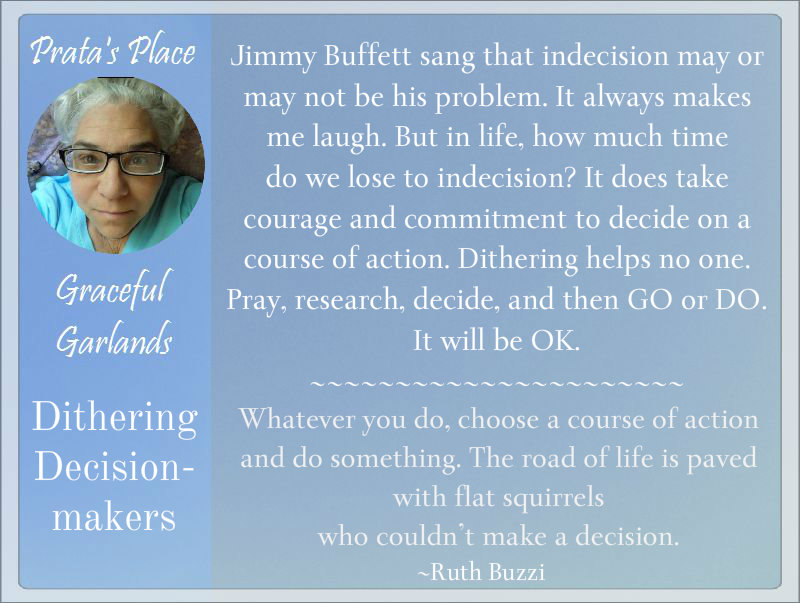
Paul just decided things. He wrote often that he decided this or decided that. You would think, if we had to wait for a sign or a word from the Holy Spirit, which Paul absolutely directly received many other times, that he would wait to hear, watch for a sign, or listen to omens. But no, more often than we think, Paul just decided things.

2 Corinthians 2:1 But I decided this for my own sake, that I would not come to you in sorrow again.

1 Corinthians 16:6 Perhaps I will stay with you awhile, or even spend the winter, so that you can help

2 Corinthians 1:23, But I call God as witness to my soul, that it was to spare you that I did not come again to Corinth.

Acts 20:16, For Paul had decided to sail past Ephesus so that he would not have to lose time in Asia; for he was hurrying, if it might be possible for him to be in Jerusalem the day of Pentecost.

It’s OK to decide!

In the 1970s and 1980s an extremely popular author was Richard Bach. He wrote Jonathan Livingston Seagull which was on the NY Times bestseller list for years. He was New Agey, mystical, advanced soul, self-enlightenment kind of guy. Lots of man-made philosophies in his books. He followed up Seagull with The Bridge Across Forever: A True Love Story. In it he sparked a frenzy for finding one’s “soulmate.” He proposed that there was one true predestined soulmate for each of us and it is our job to find her (or him). If we do not, then we miss out on the one fulfilling relationship we could have had.

The book centered on Bach eventually finding his alleged soulmate, Leslie Parrish, whom he married. They later divorced. In fact, Bach has been married 4 times.

But it was books like his with their massive cultural impact that sent people into an anxious state of mind, thinking that everything hinges on ourselves to figure out the right decision for everything or our self-actualization will never occur.

Sadly, the Christian culture of the 90s and 2000s absorbed some of that leaven, and introduced a similar mysticism to decision-making (and to Christian life in general) that unfortunately included waiting for personalized whispers, looking for signs, or other extra-biblical methods that will guide Christians along in decision-making, a process that that forgets God’s sovereignty.

Just as much as Seagull and Bridge from Bach made a cultural impression in the previous generation, Henry Blackaby and Claude King’s book “Experiencing God” advanced these philosophies into Christian culture. Pastor Gary Gilley explained in his site Think on These Things, (TOTT), Gilley said;

For example, as in Experiencing God, the Blackabys say much about prayer being two-way communication with God (pp. 113, 117, 122, 131) — we speak, then wait for God to speak. 

At the Website Stand to Reason, we read,

“Your task is to wait until the Master gives you instructions” (141). This is the critical fourth step in the “Seven Realities of Experiencing God.” Blackaby sums it up simply as “God speaks” (52). The Christian receives an “assignment” from God that is special and unique to each individual, the specific will of God for his own life.

Pastor Phil Johnson debunked about inner promptings and whispers, (transcript here from Super Session at the 2002 Shepherds’ Conference, audio here)

Now this kind of thinking is totally at odds with the principle of Sola Scriptura. We believe as Protestants don’t we, that the written Word of God – the Bible – contains everything necessary for our salvation and our growth in grace. 2 Timothy 3:16-17, All Scripture is given by inspiration of God and is profitable for doctrine, for reproof, for correction, for instruction in righteousness…listen to the next phrase…that the man of God may be PERFECT, thoroughly furnished unto all good works. Scripture alone is able to equip us thoroughly, perfectly for all good works. Everything we need in the process of our sanctification. There is no need for extrabiblical revelation. The Bible will equip you for all good works. It will give you all the explicit guidance you can possibly get from God. It contains principles to help you be wise and discerning as you pursue the course of your life, and beyond that we simply trust God in His providence to order our steps. You don’t need an explicit message from God telling you whom to marry, or where to go to school, or where to go to the mission field. [italics mine]


So how should we approach making decisions? As Johnson said, either there is explicit guidance in the Bible or there is wisdom to guide us as we read the Bible.

Any first step to decision making would assume first that one is saved. Apart from Christ, we can do nothing. (John 15:5). Secondly it assumes that the thing you’re undecided about does not involve sin. We never decide toward sin, we flee from sin. ( 2 Timothy 2:22; Genesis 39:12). Thirdly, it assumes that you’re relying completely on God’s word. If the item you’re trying to decide about is directly in the Bible, follow that command. “Should I submit to my husband?” isn’t really a decision to ponder, because it is already commanded.

Fourthly, the decision-making process assumes that you’ve yielded yourself to the Spirit of Christ within you. You’ve been striving for holiness, and you’re as much as a clean plate as you can be, being a sinner, lol.

Now, how to decide those things which are not directly addressed in God’s word?

Garry Friesen wrote a good book on Christian decision-making, linked above. He wrote that:

God’s guidance according to the way of wisdom can be summarized in four simple statements:

1.Where God commands, we must obey.
2.Where there is no command, God gives us the freedom (and responsibility) to choose.
3.Where there is no command, God gives us wisdom to choose.
4.When we have chosen what is moral and wise, we must trust the sovereign God to work all the details together for good.

–end Garry Friesen quote

Did you know that You Are Part of a Grand Plan? It’s not like you can mess it up. If you make this decision or that decision, it isn’t going to surprise God, or alter what He has planned for you. Providence, as mentioned above by Phil Johnson, is secure. His plan will be fulfilled, and your decision making isn’t going to change it. You aren’t going to miss out on anything. Beyond what is specifically prescribed in the Bible, and “we simply trust God in His providence to order our steps” as Phil Johnson explained.

In my own life, I moved from Maine to Georgia. I wanted a place with lower cost of living, and warmer weather. That’s it. He would have worked it out of I’d chosen Texas or North Carolina.  Deciding on Georgia wasn’t a life-or death decision, just one that wasn’t sinful, fit my lifestyle, and made sense.

When I got to Georgia I applied for a number of jobs. I applied using common sense. What did I have experience in, was trained for, and was good at? It’s not like I consulted the Lord and waited for a sign or anything. I was following the biblical principle that he who does not work does not eat. I sought jobs I thought I had the best chance of getting and sustaining myself.

Some jobs I applied for were at the University in the journalism department, some with local magazines. The one I got (in His providential care) was for the Athens Banner Herald writing feature stories of people in my county as a freelancer. Later when I decided to go back to education – subbing at first and applying for parapro jobs, I didn’t consult the Lord. I just used common sense. The freelance job simply wasn’t paying enough. A job with the County Education system would:

-be fairly secure as jobs go (education is the largest employer in the county)
-had health benefits (I was soon to be 50)
-was what I was trained for. (formerly certified teacher with Masters degree)
-I’d be working with kids (something I love).

If I’d decided to get a job as a bungee jumper trainer, lol, that would not be common sense. Watching for omens and signs, or waiting to hear directly from God would not make sense, either.

I knew the Lord would work it out. In His providence He did not ordain that I was given the first job I’d interviewed for as a parapro at another school, but a year later I got a job at the school I’m at now, a great fit. I’ve been there 17 years, 15 as a parapro. It’s not like there is only ONE decision or only ONE path.

I’ll conclude with Phil Johnson

If your life is in harmony with all the commands and principles of the Bible, you can actually do what you want to do without beating yourself up with introspection and fretting over whether God told you to do something or not. When Scripture says He orders our steps it’s talking about His guidance through His hand of providence. We step out in faith, and He guides our steps.


bible out loud

Posted in theology

What if I decide something that’s not in God’s will?

By Elizabeth Prata

A reader asked the question in the title. I appreciate questions like this, not only because it glorifies God to seek His will, and not only because I enjoy ministering to my sisters, but because questions based on the Bible drive me TO the Bible and researching helps me grow as well. The more we ask questions of the word of God, the more that the Spirit through His word will minister to us. Ask questions of your pastor, an older sister in Christ, and directly to the Word. The Spirit won’t answer back audibly, but the word IS living and active, and He will lead you toward holiness and sanctification because He leads us to and points to Christ always.

God’s will is that we strive toward holiness all the time, every day. He wills – commands – that we kill our sin and obey His holy precepts.

“We do not usually hear about a God who commands obedience, who asserts His authority over the universe and insists we bow down to His anointed Messiah.”

~RC Sproul, “Does God Control Everything?”

So often, Christians who want to obey become paralyzed with indecision, thinking if they go to this college, or join the Army instead of the Marines, or marry this woman and not that woman, they will destroy the path God has set out for them to follow. First, we puny humans can’t do anything to thwart God’s will for us. Second, His will is spelled out in Scripture.

Let’s begin with a simple assumption. Since God has a will for us, He must want us to know it. If so, then we could expect Him to communicate it to us in the most obvious way. How would that be? Through the Bible, His revelation. Therefore, I believe that what one needs to know about the will of God is clearly revealed in the pages of the Word of God. God’s will is, in fact, very explicit in Scripture. ~John MacArthur, Found: God’s WIll.

Be saturated with the things of Christ, absorb His Word, be consumed with His person.

That pamphlet explains 5 duties of Christians to follow His will, then a sixth (I’ll reveal it at the end!). As long as we are saved, submitted, striving along the road of sanctification, and periodically suffering, you’re in God’s will. After that, just decide.

Decision making is not a partnership, really, but we do decide things and at the same time, God is providentially ordaining it. We don’t understand exactly how this works, only that all the decisions made, for example, in the case of Joseph and his brothers, the brothers MEANT for evil but God MEANT it for good. He doesn’t just clean up the aftermath of any poor decisions, He ordains them…yet we also freely decide. Joseph’s brothers decided what to do with Joseph. Kill Him? No. Put him in a pit? Maybe. Sell him? Yes. They went through a decision making process, and came to a conclusion about what to do. (Bad decisions, obviously, but here, I’m just remarking that we freely decide what to do on a day by day or moment by moment basis, while God ordains it all for His glory and His plan).

Look in the Bible at how many times Paul said “I decided,” or “I resolved to”. In Titus 3:12 he decided to spend the winter in Nicopolis, he decided between Tychicus or Artemas as Titus’ replacement, he decided to send Onesimus back to Philemon. Paul decided to take Timothy with him (Acts 16:3). He was minutely directed by the Spirit to an exceptional degree as an Apostle, yet Paul still decided things. In 1 Corinthians 7:39 women decide to marry ‘whom they will’ (only in the Lord).

My best advice is to be in the word of God, every day or as nearly every day as you can be, keep praying for God’s will to be done, which includes us making the best, most moral, God-honoring decisions possible based firstly on biblical precepts but also on the best information we can find.

Wherever true religion is, there are vigorous exercises of the inclination and will towards divine objects…

Jonathan Edwards, Religious Affections

God slowly aligns our desires with His will. At the end of MacArthur’s book Found: God’s Will, after spending a short amount of ink describing five principles for the Christian in decision-making, the sixth is “Do whatever you want!”

“If the five elements of God’s will are operating in your life, who is running your wants? God is!” he said.

Pursue holiness, seek Jesus, slay sin, and you ARE in God’s will. He will align your desires with His plan. We can’t know His specific plan for our lives, unlike Peter whom Jesus told that martyrdom awaited. But we can know He is ordering our lives according to His plan which will bring Him the most glory.

So otherwise, just decide on that life change, marry that woman, accept that job, and so on. Joseph had no idea that being in the pit, sold as a slave, languishing in jail, and being Pharaoh’s right-hand man would yield saving of the Egyptians and surrounding nations, and the return of his family safe and sound. But Joseph did know who was ordaining Joseph’s steps day by day, and he knew God always has a bigger plan. In his case, he discovered after, it was to keep many people alive.

As for you, you meant evil against me, but God meant it for good in order to do what has happened on this day, to keep many people alive. (Genesis 50:20).

Job never knew what the plan was or why the terrible things happened to him, but he still trusted God for the outcome. Despite his many tribulations, he never sinned against God with his mouth. After it was all over we know that God increased Job’s holdings again and gave him and Mrs. Job more children. Along the way, Job must have decided where to build his new house, and which cattle to breed, and so on. But God was ordaining it from above.

And we know that for those who love God all things work together for good, for those who are called according to His purpose. (Romans 8:28).

HE knows His purpose. We’re just called to do His will in the generalities. Leave the specifics to Him, decided for yourself what’s best, and rest easy. And keep on truckin’!

Definition of Keep On Truckin’. Illustration by Robert Crumb
Posted in encouragement, theology

Am I doing something wrong if I make a huge decision and don’t wait to hear from God?

By Elizabeth Prata

Does the Bible speak to whom we should marry? Which college to attend? Whether to join the Army? Should we relocate to another state? Change careers now, later, or never? Go back to college?

Christian decision-making … I’m often asked these very questions by women who care about being obedient to the will of God. But the Christian culture of the last generation has introduced a mysticism to decision-making (and to Christian life in general) that unfortunately includes waiting for personalized whispers, looking for signs, or other extra-biblical methods that will guide them along in deciding things that aren’t directly in the Bible.

Phil Johnson has explained about inner promptings and whispers, (transcript here from Super Session at the 2002 Shepherds’ Conference, audio here)

Now this kind of thinking is totally at odds with the principle of Sola Scriptura. We believe as Protestants don’t we, that the written Word of God – the Bible – contains everything necessary for our salvation and our growth in grace. 2 Timothy 3:16-17, All Scripture is given by inspiration of God and is profitable for doctrine, for reproof, for correction, for instruction in righteousness…listen to the next phrase…that the man of God may be PERFECT, thoroughly furnished unto all good works. Scripture alone is able to equip us thoroughly, perfectly for all good works. Everything we need in the process of our sanctification. There is no need for extrabiblical revelation. The Bible will equip you for all good works. It will give you all the explicit guidance you can possibly get from God. It contains principles to help you be wise and discerning as you pursue the course of your life, and beyond that we simply trust God in His providence to order our steps. You don’t need an explicit message from God telling you whom to marry, or where to go to school, or where to go to the mission field. [italics mine]

So how should we approach making decisions?

Any precursor to decision making would assume first that one is saved. Apart from Christ, we can do nothing. (John 15:5). Secondly it assumes that the thing you’re undecided about does not involve sin. We never decide toward sin, we flee from sin. ( 2 Timothy 2:22; Genesis 39:12). Thirdly, it assumes that you’re relying completely on God’s word. If the item you’re trying to decide about is directly in the Bible, follow that command. “Should I submit to my husband?” isn’t really a decision to ponder, because it is already commanded.

Fourthly, the decision-making process assumes that you’ve yielded yourself to the Spirit of Christ within you. You’re striving, repenting, obeying, praying, etc. You’re as much as a clean plate as you can be, being a sinner, lol.

Now, how to decide those things which are not directly addressed in God’s word?

As from a pamphlet I found online which no longer is online,  from Crossroad Bible Church,

Here are four questions to ask yourself:
• Have I yielded myself completely to Christ’s Spirit?
• Is there a clear Bible command concerning this decision?
• Is there a Bible principle that will guide me in this decision?
• Which choice would be most prudent in this situation?

The above wee fleshed out more with scriptures at their website but sadly is gone now.

Did you know that You Are Part of a Grand Plan? It’s not like you can mess it up. If you make this decision or that decision, it isn’t going to surprise God, or alter what He has planned for you. Providence, as mentioned above by Phil Johnson, is secure. His plan will be fulfilled, and your decision making isn’t going to change it. You aren’t going to miss out on anything. Beyond what is specifically prescribed in the Bible, and “we simply trust God in His providence to order our steps” as Pastor Johnson explained.

In my own life, I moved from Maine to Georgia. I wanted a place with lower cost of living, and warmer weather. That’s it. He would have worked it out of I’d chosen Texas or North Carolina.  Deciding on Georgia wasn’t a life-or death decision, just one that fit my life and made sense.

When I got to GA I applied for a number of jobs. I applied using common sense. What did I have experience in, was trained for, and was good at? It’s not like I consulted the Lord and waited for a sign or anything. I was following the biblical principle that he who does not work does not eat. I sought jobs I thought I had the best chance of getting and sustaining my means.

Some jobs I applied for were at the University in the journalism department, some with local magazines. The one I got (in His providential care) was for the Athens Banner Herald writing feature stories of people in my county as a freelancer. Later when I decided to go back to education – subbing at first and applying for parapro jobs, I didn’t consult the Lord. I just used common sense. The freelance job simply wasn’t paying enough. A job with the County Education system would:

-be fairly secure as jobs go (education is the largest employer in the county)
-had health benefits (I was soon to be 50)
-was what I was trained for. (formerly certified teacher with Masters degree)
-I’d be working with kids (something I love and I’m told I’m good at).

If I’d decided to get a job as a bungee jumper trainer, lol, that would not be common sense.

I knew the Lord would work it out. In His providence He did not ordain that I was given the first job I’d interviewed for as a parapro at another school, but a year later I got a job at the school I’m at now, a great fit. I’ve been there 11 years, 9 as a parapro. It’s not like there is only ONE decision or only ONE path.

I’ll conclude with Phil Johnson

If your life is in harmony with all the commands and principles of the Bible, you can actually do what you want to do without beating yourself up with introspection and fretting over whether God told you to do something or not. When Scripture says He orders our steps it’s talking about His guidance through His hand of providence. We step out in faith, and He guides our steps.

bible out loud