Reflecting on travel documentaries like Pole to Pole, I admire exploration yet feel sadness when the explorer expresses awe of nature but fails to glorify God for it. In many of these docs, I watch seekers yearn for meaning but misattribute the meaning of life to creation.
At the thrift store, I got this book called “Bizarre Birds”, a youth Peterson Bird guide. It lists 20 birds that have an unusual quality: such as feeding, migration, looks, call and so on. I am pleased that I’ve seen 10 of them!
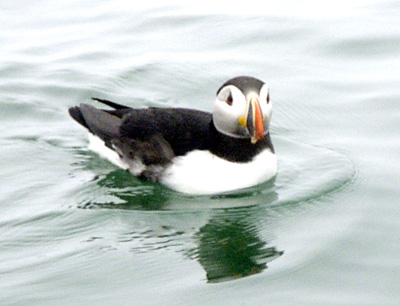
Puffin. Seen off Canadian coast at Seal Island. EPrata photo
“Did you know? A flamingo’s bill is unlike any other bird’s. It contains rows of bony plates that act like filters. A flamingo finds food by dipping its head into the bottom of saltwater bays. It sucks up the ooze and uses its tongue to force the mud out through these bony filters, leaving a rich meal of tiny crustaceans in its mouth. A flamingo feeds with its head upside down. Unlike the jaws of other birds, the flamingo’s upper jaw moves up and down instead of its lower jaw.”
Cool. This couldn’t have evolved. The first flamingo to try eating like that would drown. God is amazing in His creative abilities! I also learned that the Arctic Tern migrates from the North Pole to the South Pole and back every year. That’s 22,000 miles round trip, and mostly over ocean!
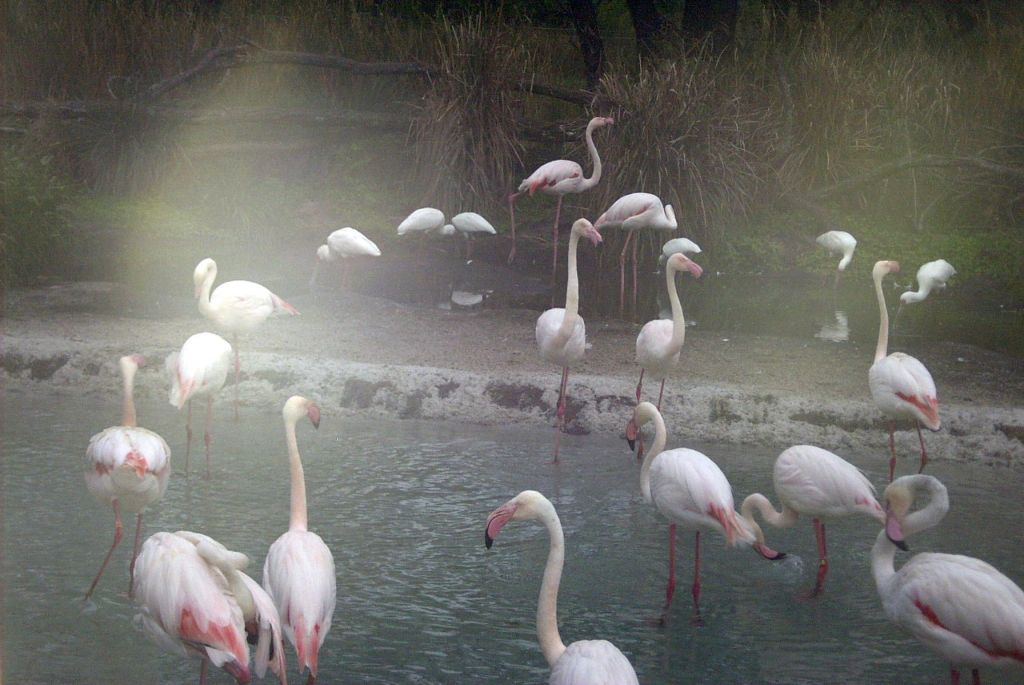
FLamingoes. Seen in The Everglades of Florida. EPrata photo
Think on Him as Creator for a moment. He made all the birds of the air in one day, on Day 5 of Creation Week. Each bird uniquely suited to its habitat. Each bird delightfully different in plumage. God’s creative ability is so infinite my finite mind can barely even comprehend how He even made all the birds of the world in one day! Along with other animals, too. Wow.
Let’s pause for a moment and praise Him.
Then God said, “Let the waters teem with swarms of living creatures, and let birds fly above the earth in the open expanse of the heavens.” 21And God created the great sea creatures and every living creature that moves, with which the waters swarmed, according to their kind, and every winged bird according to its kind; and God saw that it was good. 22God blessed them, saying, “Be fruitful and multiply, and fill the waters in the seas, and let birds multiply on the earth.” 23And there was evening and there was morning, a fifth day.
I comment on the beauty of the quiet predawn of rural life and the first bird’s song of the dawn chorus, seeing in it a symbol of creation’s praise to God. Thinking of scripture and nature, I imagine heavenly harmony where all creation sings in eternal joy.
Observing the mathematical beauty of shells and other natural forms, I connect Fibonacci’s spiral to divine design. Once a nonbeliever, I come to see creation’s harmony as evidence of God’s intelligent artistry.
I reminisce about vacations from Maine to Florida, exploring beaches from Labrador to the Bahamas. Each beach offers unique treasures—shells, sea glass, coral, and rocks—revealing the wonders of God’s creation. Blending natural history, personal reflection, and Scripture, my essay celebrates the beauty and mystery of the sea.
Even though it’s Fall and heading into Thanksgiving, Christmas, and deep winter, I never stop thinking about the ocean. During the Fourth of July long weekend, lots of families take vacations, and many choose to go to the beach. I used to as well.
Shells, sea glass, rocks, coral, barnacles, and pottery from the sea, collected from Labrador to the Bahamas. EPrata photo
I used to take a week off at Christmas and head to Florida, and the week of the 4th I’d go to my favorite spot in Maine, Lubec. If you see the map of Maine as a profile of a dog, Lubec is at the dog’s nose. It borders Canada separated only by a narrow inlet. The bridge from Lubec takes you to Campobello Island on the Canadian island of New Brunswick.
As you might guess, the beaches on the hardy, rockbound and foggy coast of Maine are wild. As a matter of fact, Dr Beach, AKA Stephen Leatherman, several years ago rated a beach near Lubec as the most wild in America.
In December, I took my vacation at Venice FL, where the sand beaches are white and the ocean is azure and gentle at the Gulf coast.
Beaches around the US and around the world all have their own personalities. Each one yields up its own treasures. At Jasper Beach in Machias Maine, the beach has no sand! There’s only smoothly polished rocks of rhyolite and jasper. I’ve taken home many smooth, glittering rocks from Jasper Beach. At Lubec’s Globe Cove, the sea yields sea glass, from the hundreds of years the fishing fleet used to throw over their glass bottles. At Venice FL, the sea yields up shark’s teeth in great numbers. At the deserted beaches in The Bahamas, you find coral washed up, bleached and in interesting twisted shapes. In Labrador, you find scallop shells bigger than your hand! All you need is one of these for dinner!
You rule over the surging sea; when its waves mount up, you still them. (Psalm 89:9)
And of course, there’s shells!
If you ever have headed to the beach, here are a few facts I find fascinating. As you amble along the borderline between ocean and ground, as you wade in the waters to cool your tired feet, as you shield your eyes and gaze out to the limitless blue expanse, praise God for making such a beautiful habitation, and its creatures so complex and wondrous.
My favorite shell is the moon snail. He has a lot of cousins. They all have that sweet spiral, so pleasing to the eye. Their hushed colors of slate grey or moon blue are also pleasing. In the US’s warmer waters and the tropics the shell colors are brighter. Some think this is because of the temperature of the ocean. Others think it’s because of the different food available that translates through digestion to the calcium the shells are made of. Scientists still aren’t sure what kinds of pigments the mollusks are using. The reasons for shell coloration and variation are a mystery to scientists, but God created them all. In one day! He knows why their colors and shaes are so varied. Perhaps to create a palette of beauty that glorifies Him.
Moon snails for all their delicate beauty are actually rapacious predators. The holes you see on other snail shells are made by the moon snail. He climbs on top of a shell, spits acid, uses his tongue lined with teeth to drill a hole, then spews acid onto the hapless mollusk inside. He waits for his prey to melt a little, then inserts his stomach into the hole and absorbs the prey. Ouch! Yuck!
This is what the LORD says, he who appoints the sun to shine by day, who decrees the moon and stars to shine by night, who stirs up the sea so that its waves roar— the LORD Almighty is his name: (Jeremiah 31:35)
Did you know that the moon snail is hatched with a little shell attached already? That’s the point at the start of the spiral. So cool.
Moon snail, collected Maine. Prata photo
Scallops can grow into the size of dinner plates, their age shown by lines on the shell – just like the rings of a tree. I found that one in the photo at the top, in Blanc Sablon at the border of Labrador/Newfoundland, Canada.
He is the Maker of heaven and earth, the sea, and everything in them— he remains faithful forever. (Psalm 146:6)
The Bahamas has been described as having the third most extensive coral reef system in the world. Did you know? Andros Island has a 140-mile Barrier Reef – and that is one of the longest coral reefs in the world.
Coral. The Bahamas. EPrata photo
Did you know?Corals are in fact animals, not plants. Coral reefs are the largest structures on earth of biological origin.
Sea glass is becoming rarer.
Did you know? Sea glass takes 20 to 40 years, and sometimes as much as 100 years, to acquire its characteristic texture and shape. Sea glass begins as normal shards of broken glass that are then persistently tumbled and ground until the sharp edges are smoothed and rounded. In this process, the glass loses its slick surface but gains a frosted appearance over many years. Naturally produced sea glass (“genuine sea glass”) originates as pieces of glass from broken bottles, broken tableware, or even shipwrecks, which are rolled and tumbled in the ocean for years until all of their edges are rounded off, and the slickness of the glass has been worn to a frosted appearance.
This article talks about the best places to find sea glass and mentions Jasper Beach in Machiasport, Maine among other beaches Downeast. That’s where you find the round and tumbled stones. Some glass can be found there, too. But if you’re going that far, drive just a bit further to Lubec, and walk the small beach at Globe Cove. That’s where even more sea glass treasure can be found.
If you spot some sea glass, salute our God who made the ocean and currents’ motion so strong that over time his waters will wear away hard glass.
See the barnacles on the scallop? Apparently in Labrador they grow ’em big! Barnacles are a sea creature that attaches to things, like they did to the underside of our sailboat. Enough of them get on there and it slows down the boat considerably, creating a lot of drag. Occasionally you have to pull the boat out of the water at a marina and scrape them off.
Barnacles on a scallop. They make it hard for the scallop to swim, too. Prata photo
Did you know that the cement barnacles use is stronger than anything man can make synthetically? How barnacles did it was a mystery from time immemorial until 2014. The US Navy has been intensely interested in barnacles, partly because of the issue of slowing the boats when barnacles grow on the hull, and also because the cement the creatures use is so sticky in salt water!!
When you’re walking on a pier and see the barnacles on the pilings, salute our God who made them so super strong.
Jasper Beach Machiasport ME. Prata photo
Whether it’s shark’s teeth, shells, rocks, sea glass, pottery, or any other treasure you find on vacation, praise God who made it all in 6 days by the power of His word and the creativity of His intellect.
Below you’ll find some resources I’ve enjoyed to help me learn more about the wonderful finds you find at the beach!
Conchologists of America, information about the shells and the animals that inhabit them. Conchologist is a shell collector.
Anne Morrow Lindbergh wrote a books of poems and thoughts called Gift from the Sea. Here is the link to the 70th anniversary edition
In this essay, I explore how earthquakes unsettle people, prompting people to seek meaning and divine answers. I reflect on humanity’s attempts to categorize nature, and to control the climate. I discuss biblical prophecies of the Tribulation, highlighting a time of uncreation when the ‘natural order’ will be anything but natural. God has ultimate authority over the Earth and its ‘natural’ order.
I like to get to work about a half hour early. There are many reasons for this. A practical reason is that I have the first duty at opening bell, and then I go right into teaching small groups. I need a few minutes to prepare the room and my materials.
I also enjoy seeing the school ‘wake up’. There are only a few people there when I arrive. Someone is in the front office manning the phones, but I go in by the back. I greet the lone custodian who comes in half an hour before I do, and we chat a moment. She is a Christian lady and we usually take time to pause and praise the Savior. The lunch ladies scuttling around in the kitchen, banging pots and opening oven doors, making breakfast ready for the kids who enter beginning at 7:10am.
The school’s lights are on in the cafeteria and on the other side of the building in the office but in between it’s dark, quiet, and calm. As more staff trickle in the school wakes up. It almost feels like an organism opening one eye, then the other, then stretching, then rising, then bounding over the meadows.
I enjoy watching the day wake up too. I admire the School District’s handling of money and how they maintain the campuses. Our school has a lower elementary with 3 playgrounds, an upper elementary with some raised gardens, the Board Office next to that, and the High school next to that, with numerous fields and outbuildings. Behind it all is the PreK school and the transportation garage with many buses starting up. All these are all well maintained.
Ground fog in the early dawn. EPrata photo.
So when I arrive I pause to see the floodlights streaming over the fields, the distant whistle at the high school as the football team practices, the transportation garage idling buses, the cut grass and rolling fields around the track.
But then I look up. It’s my favorite part. I see Orion constellation beaming down his starlight. He is embedded in a velvet blanket of purple as the sky begins to slightly lighten. It’s the gloaming time when as Yeats says, “The blue and the dim and the dark cloths Of night and light and the half-light”. The moon is a crescent fingernail and just off the tip of the pointy edge, is bright Venus.
As I arrive each day I notice that Orion is moving to the right, to the east and rising higher. The planets in their courses revolve on the plane of the ecliptic. I marvel that God placed them there, hung them all on nothing. What a God we serve.
Pause in your day and look up. Look around. Find something to rejoice in. Discover what can be praised to the Lord. A towering evergreen you pass each day? A puffy cloud that looks like a mountain of sheep? The blue sky dazzling bright? A family of foxes scampering over the field? Dew glistening on the early morning grass? Hoar-frost on the fence?
Frost at dawn on the fields with one escaping umbrella. EPrata photo
The discussion revolves around whether pets will be present in heaven, from a Christian perspective. Although humans uniquely reflect God’s image, there is speculation about the fate of animals post-New Earth. The article emphasizes God’s care for animals and suggests trust in His intentions, ultimately asserting joy in heaven will be fulfilled in Christ.
The article highlights the complex workings of cells, particularly through the animation “The Inner Life of the Cell,” which showcases scientific animation’s potential. Ultimately, it reveals the Creator’s intelligence in creating these complex systems.




 the-end-time.org