“It was a God-thing!” “The sign couldn’t have been more clear!” “It surely wasn’t a coincidence, it must have been from God!”
Have you ever heard anyone say any of these things? Or said them yourself?
Even after salvation we are sinful creatures. It would be so much easier to interpret circumstances rather than interpret the Word. We see what is happening in our lives and immediately interpret that these circumstances are in fact signs from God, omens, and ‘Godly coincidences’ that are directly and presently speaking to us. We go ahead and make decisions based on them.
But should we? Let’s look at two examples of interpreting circumstances, from the Word of God. Thanks goes to my wonderful and brilliant pastor for preaching this yesterday. Here, I summarize part:
We all know the story of Jonah. He was a Prophet of God, who prophesied to Israel. (2 Kings 14:21-25). He prophesied good things to Israel. It was during the reign of Jeroboam II King of Israel, when God was bestowing unmerited grace upon the people even though the King did evil in God’s eyes. The nation’s boundaries were being set and prosperity was growing. Therefore, likely Jonah was popular as a Prophet.
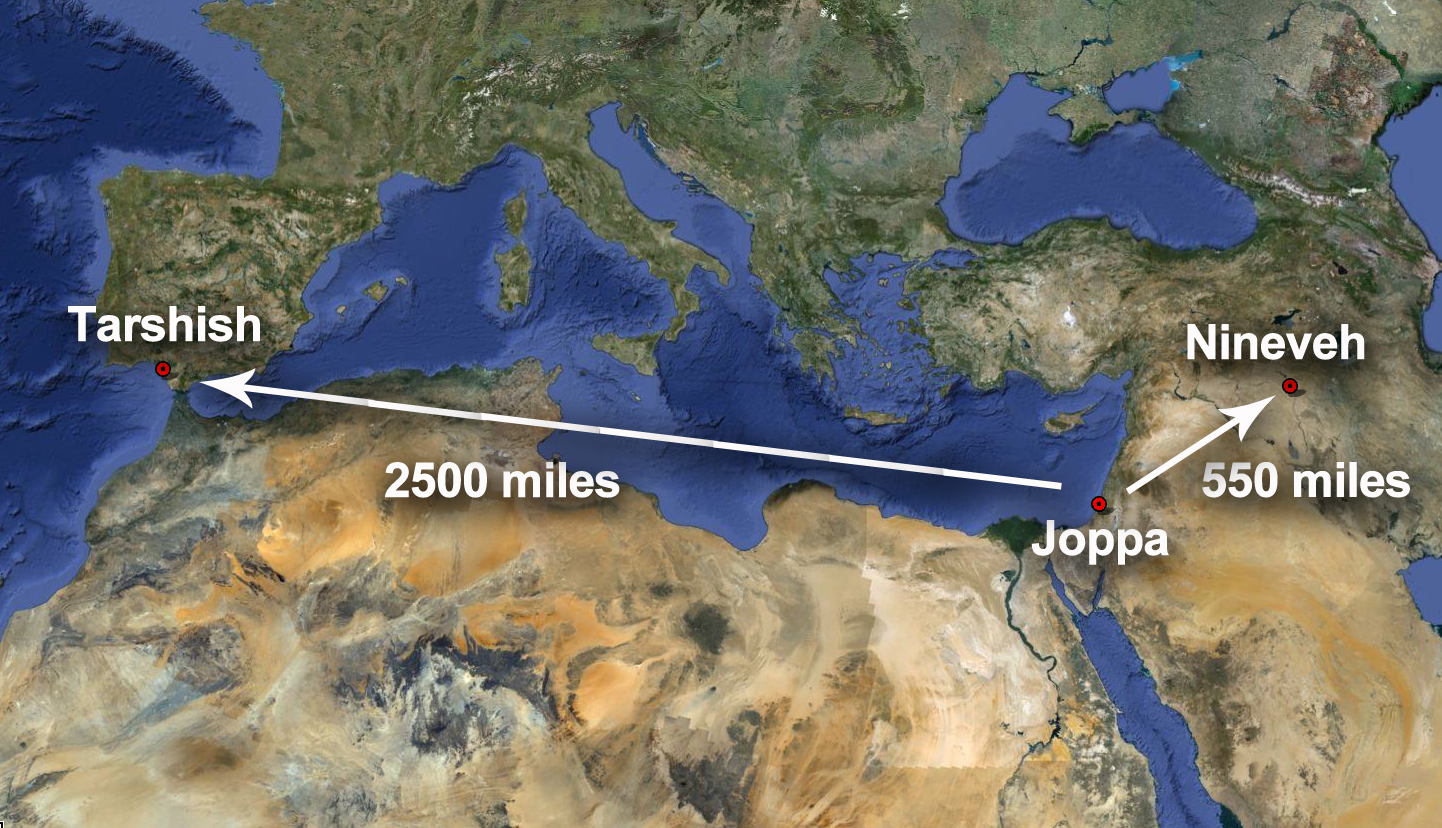
Then one day the word of the LORD came to Jonah. Jonah was told to travel to the city of Nineveh in order to prophesy to them. Nineveh was evil, they were an enemy, and Jonah was aghast. He refused. Effectively resigning his mantle, Jonah ran to Joppa instead, a seaside city where Jonah intended to grab a ship to Tarshish. This was the opposite direction of where God had told Jonah to go.
 |
| Source |
When Jonah got to Joppa (now Jaffa), he saw that there was a ship at harbor. Jonah paid the fare and flung himself into the bowels of the vessel, tired beyond bearing, and went to sleep. Though this next scene is a little beyond the time frame of my focus today, I can’t resist the glorious language from Herman Melville’s Moby-Dick:
All dressed and dusty as he is, Jonah throws himself into his berth, and finds the little state-room ceiling almost resting on his forehead. The air is close, and Jonah gasps. then, in that contracted hole, sunk, too, beneath the ship’s water-line, Jonah feels the heralding presentiment of that stifling hour, when the whale shall hold him in the smallest of his bowel’s wards.
Did Jonah feel vindicated when he saw a ship at sail, ready to voyage with the next tide? Did Jonah say, “See? It is providential! This must be what God wanted, since a ship appears before me at the ready!”
Interpreting circumstances is a dangerous thing.
Let’s look at David. He was fleeing from King Saul, who was seeking David’s life. David and his men huddled in a cave in the wilderness of Engedi, hiding from the fire-breathing king. Saul suddenly appeared in that exact cave. There are hundreds of caves at Engedi. Hundreds. Yet Saul entered the exact cave in which David hid.
 |
| Pixabay, free to use. Hundreds of caves dot the En-gedi desert. |
David’s men interpreted circumstances, saying, ‘Look, here is the king! It must be the hand of God delivering the king to your sword!’
After stealthily snipping a bit of Saul’s robe David felt convicted. He said to his men,
“Behold, this day your eyes have seen that the LORD had given you today into my hand in the cave, and some said to kill you, but my eye had pity on you; and I said, ‘I will not stretch out my hand against my lord, for he is the LORD’S anointed.’” (1 Samuel 24:10-11).
The word of the LORD had not come to David. David knew that the LORD’s anointed were protected by God, raised up by Him to perform His will and plan. David knew that the LORD Himself had placed Saul into kingship and it was the LORD’s business to remove Him if He so wanted. It was not up to David. (1 Samuel 26:10)
“If we detach ourselves from the Word, we will never interpret circumstances correctly.” ~Mark McAndrew, Jonah 1:1-3, June 4, 2017
What Pastor Mark meant here is not that we interpret signs and omens, but that when things happen and we want to know what to do or how to think about it, we refer back to the Word. David knew God’s word and David knew His character. David acted according to this knowledge, not according to subjective impressions of the circumstances.
Romans 8:14 says “For all who are led by the Spirit of God are sons of God.” So we know that the Spirit leads because He promised to lead us. But the Spirit doesn’t speak to us except through His word. And when you start thinking that God is giving you special revelation outside of His word, you have diminished the singular authority of scripture.
Source Special Revelation and the Work of the Holy Spirit, 1-min video
We don’t know whether our interpretation of the circumstance is “a heavy conscience, a strong personal desire, or emotion-driven enthusiasm” as Jeremiah Johnson wrote at the link above. If David had decided to kill King Saul because Saul had showed up in the cave at that moment and had slain Saul, it would have been grievous sin for David. If Jonah had deduced that because the ship was ready to sail in the direction he wanted to go, it must be providential, it would have been a sin for Jonah. There are always ships ready to sail to Tarshish! Jonah would be simply rationalizing his own personal desire and back-hoeing the Spirit into his sin, which is blasphemy. Johnson wrote,
We ought to look for the Holy Spirit’s leadership, but we must be cautious about assigning to Him responsibility for our words and actions. Our feelings are not necessarily a trustworthy source of information, nor are they an accurate indication that God has a special message to deliver to us or through us.
God’s people need to be circumspect when it comes to His leadership, particularly through subjective impressions and inclinations. Moreover, we need to be wary of those who hijack the prophetic seat and presume to speak for God. Source
Some throw out a fleece for guidance, some look for open doors or windows. Satan can create circumstances too. Remember Job. Satan brought about the many different circumstances that plagued Job. Stay away from interpreting signs and circumstances and just interpret life through God’s word.
————————–
Further Reading
Let Us Reason: What does ‘touch not my anointed really mean?
Book Review: Experiencing God, by Henry Blackaby : 9Marks
[Remember, Blackaby was the one who ‘legitimized’ interpreting God’s will through circumstances, introducing the concept to conservative evangelicals]

 the-end-time.org