Posted in christian life, theology

Popular Christian Blogger says you don’t have to “do” church

By Elizabeth Prata

Kendra Fletcher is a popular podcaster, blogger, and book author. She writes at her own space but also directs you her archive of articles she’s written for at KeyLife Ministry, where the motto is “God is Not Mad At You.”

Kendra’s latest blog essay is titled,

What To Do When You Just Can’t Do Church Anymore

You read that correctly.

Mrs Fletcher’s very first point begins thus:

YOU DON’T HAVE TO DO CHURCH ANYMORE.
For some of us, church attendance was a non-negotiable weekly imperative with many assumptions attached to it. Our attendance and involvement has been linked to our faithfulness, our commitment, and our spiritual depth. Church attendance should be none of those things. It’s entirely okay to step out.

For all of us, church attendance IS a non-negotiable. Mainly for the reasons of: the Body (Romans 12:5), gratitude (Colossians 3:16), and command (Hebrews 10:25).

It is entirely not OK to step out.

Mrs Fletcher’s second point is that it is OK to step out if you were doing it for the wrong reasons. Take time to reassess, navel gaze, grab some me-time, she says. Not in those exact words, but close.

If you find that your church has become an idol, or ritual, or that you have become spiritually neglectful toward others within that body, or whatever wrong motivation you’d had- the solution is not to step out. You repent and confess. You lay your sin down in front of the throne, asking for forgiveness, and lay your sin down in front of the pastor and church people, and ask for forgiveness. Then pick yourself up and go next Sunday, pleading with the Spirit to help you grow in this area.

In the essay there is a lot of me-me-me. She writes-

Answering a concerned or critical question about why you aren’t involved/serving/plugged in/part of a community group can be answered with a simple, gracious, “I’m working through some stuff and just need some time, thanks.” Then walk out the back door.

What about relying on the Holy Spirit to help you through ‘your stuff’? What about dumping the prevalent attitude that I can work through my own stuff, Jesus need not apply, thanks. What about realizing that ‘your stuff’ is the Body’s stuff and that you’re not supposed to carry it alone? (Galatians 6:2). What about setting aside ‘your stuff’, die to self, and help someone else who is going through stuff?

Sadly, Mrs Fletcher equates church attendance with ‘doing’. It’s not. It’s called obedience.  Mrs Fletcher does as so many bloggers, writers, and teachers these days do- equates obedience with ‘legalism.’

Ladies, following the commands of scripture is not legalism, try as many female bloggers tell you that it is. It’s called obedience. Developing Godly habits and adhering to them is not legalism, hard as many woman essayists explain to you that it is. It’s called Discipline. Legalism defined by Theopedia is,

a term referring to an improper fixation on law or codes of conduct for a person to merit or obtain salvation, blessing from God, or fellowship with God, with an attendant misunderstanding of the grace of God. Simply put, legalism is belief that obedience to the law or a set of rules is the pre-eminent principle of redemption and/or favor with God.

Arthur Pink put it simply, legalism is the notion  ‘that sinners become saints by obeying the Law.’

We know that grace first abounded in God’s sovereign choice to regenerate us as a person from dead in sins to alive in Him.

POST salvation, our gratitude becomes so great and our worship so deep, we want to obey the Word that comes from a wellspring inside us that flows from our regenerated heart up to heaven, into the throne room, passing the cross with a wide-eyed gaze of wonder and relief.

Here is TableTalk’s most recent essay that happens to be on the topic of Joining and Being a Member of a Church. Their biblical take on it is that church membership and regular attendance is non-negotiable.

There’s not a hint of individualism or independence anywhere in those images. Nowhere does Scripture describe, much less prescribe, the Christian life as something that can be lived alone. In Christ, each Christian is related to every other Christian, and together we are the family of God (Rom. 8:14–16; Eph. 2:19–22). Deep commitment to and active participation in the church are nonnegotiable.

There are legitimate reasons for leaving a church, and the TableTalk essay covers those and gives practical ideas for maintaining one’s obedience to the Word as you transition.

Ladies, don’t let popular bloggers deceive you into thinking church attendance is a negotiable. You really can’t hit the pause button for temporal, selfish reasons and then pick it back up when you’re good and ready.

To say that it’s OK not to “do church”? That is a repellent phrase. It’s undignified given the majesty of the Triune God whom we worship the wondrous Person we praise, Him who saved us from a craven life of rebellion and an eternity from the tortures of hell.

The chief end of man is to glorify God and enjoy Him forever. One way we do that is go to church, faithfully, regularly. Not ‘doing church’ but loving the God who gave us His body, of which we are a part.

church

Posted in discernment, Uncategorized

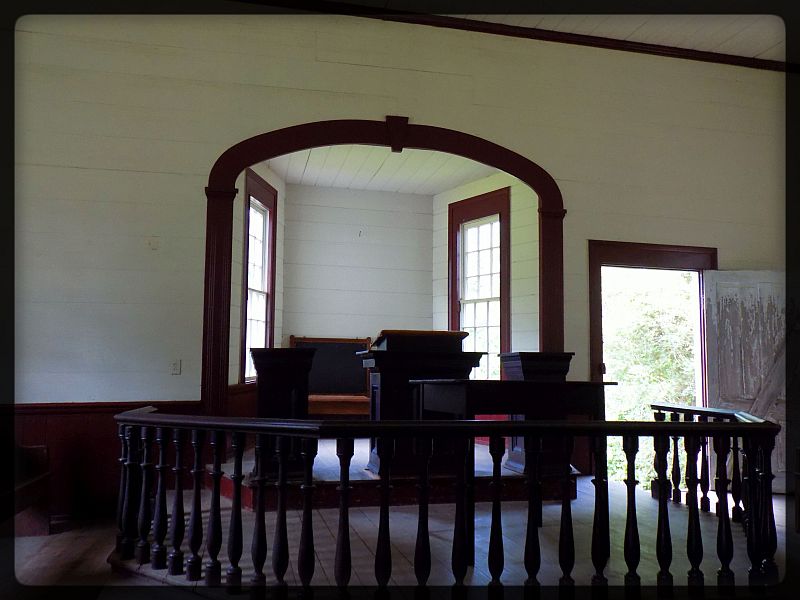
What does your church use your pulpit for?

A church is not just a building.

It is special.

I am a fan of traditional church architecture and its traditional uses. More on that in a moment.

Reminiscing:
Exterior_of_Trinity_Church,_Newport,_RI

Traditional white steepled churches dotted the New England landscape wherever I went as a kid growing up in that part of the country. Some had bells atop the steeple, which I liked very much. There was something comforting about the ever-present visual of the white church steeple against a blue sky ringing out peals of music or the sound of bells, echoing across the foliage laden hills.

However, I was unfamiliar with what went on inside a church. The flip side of the comforting feeling I felt when looking at the outside of a church or of hearing its bells was changed to one of forbidding mystery and deep disquiet if I ever dared to go inside. I wasn’t saved and never attended church services, even as a kid.

Above, Trinity Episcopal, Newport RI, 1920s postcard

I did visit churches sometimes. I was interested in them from a historical aspect. For example, Trinity Church in Newport Rhode Island was established in 1698, and it is reported that George Washington attended services there. This is not the typical “George Washington slept here” stuff of legend. Washington was heavily present in Rhode Island during the Revolutionary War and Newport was the one among the state’s rotating capitals. Trinity is a gorgeous church, a New England traditional church building for sure.

I was married in a church. That seemed proper.

My mother took me to several churches as a kid, very occasionally when her conscience got too prickly to ignore. I remember the Unitarian Church, sunlight and people sitting on the floor in a circle singing along with a hippie holding a guitar in his lap. That seemed wrong. Although I didn’t like churches much when I went in one, I thought that there should be rows of pews be arranged in such a way that they faced a pulpit. If there was going to be a speaker and a message (some mysterious and incomprehensible message people kept reappearing week after week to hear) then it seemed logical that people would sit in such a way as to give attention to the message that indicated its singular importance.

I was at once attracted and repelled by the church building, its unstated message given through its appearance enough to unsettle my spirit. Church people perturbed me. I watched the church people emerge from the building week after week, but I did not dare join. It was like those folks in Acts:

Now many signs and wonders were regularly done among the people by the hands of the apostles. And they were all together in Solomon’s Portico. 13None of the rest dared join them, but the people held them in high esteem. (Acts 5:12-13).

Churches look the way they do for a reason. And I am of the strong opinion that they should remain looking like they look. The people inside are a set apart people, the pastor inside is set apart and called to preach the true words of heaven. I’m not suggesting churches are holy ground. However, but their existence, looks, architecture, and what goes on inside has meaning and import distinct from any other building and any other activity. Churches should look and act the part.

The church building should be used exclusively for worship, religious education, leader training, and ecclesiastical meetings.

Sadly today, many inside think little of giving over their building and/or their pulpit for profane purposes.

In 2010, a porn star and a pastor held a debate about pornography, the porn star on the “for” side. This “debate” was held in a San Diego church.

In 2014 the very Protestant church built to honor Martin Luther in Speyer Germany was host to an interfaith, ecumenical concert in which an Imam made the call to Muslim prayer.

In 2017, pastor Robert Jeffress of First Baptist Dallas spent 15 minutes of the Sunday service interviewing Roman Catholic television political pundit Sean Hannity at his pulpit.

The Pulpit

The pulpit is the most sacred and exalted place in the church. He who occupies this position stands as the representative of Christ. This is the minister’s first line of offense. From this honored and dedicated place he boldly denounces sin and courageously challenges the devil. From the sacred desk are heard the truths of God, which cut as a two-edged sword, bringing both conviction and contrition to the worshiper. Words of life and death flow from this fount. To this vantage point the penitent looks for the heavenly balm of Gilead. Is it not important then that one’s comportment in the desk give no cause for needless offense and bring no reproach against the name of Christ?

Phil Johnson of Grace Community Church’s stance on using the pulpit follows:

The reason we don’t have debates and dialogues with unbelievers in the worship center at Grace Community Church is the same reason we don’t use the facility for drama, secular music concerts, comedy routines, political rallies, variety shows, Amway meetings, or a host of other activities where an auditorium like that would be useful. Namely, the facility is dedicated to the proclamation of God’s Word and the corporate worship of God’s people. That was a purposeful decision made years ago. The point is not that the physical building itself is a shrine or an idol, but this is one of the ways we keep a sharp focus on what we as a church are most committed to. In other words, our unwillingness to use our pulpit for non-worship events is a strategy, not a superstition.

BTW, although people often use the word _pulpit_ to refer to the lectern on which a preacher places the Bible and his notes, the actual _pulpit_ is the raised platform on which that lectern rests. Remove the lectern and replace it with a table or a stage set, and whatever takes place on that platform is still being done “in the pulpit.”

Just some food for thought for you today. How is your pulpit used?

pulpit


pulpit2

Posted in beauty, Uncategorized

Art and beauty have a place in church

I love church. I love the music, hymns & songs connecting me to my ancestors in the faith, all the way back. I love the sermons, God’s word expositionally preached is thrilling and fascinating every moment the preacher speaks truth to his flock. I love the people, singing praises to the Lord and singing His attributes to each other. Communion is an especially sweet time with the Lord. Just the thought that I can pray to Him asking for forgiveness of sins, and He will forgive them, is humbling. Dipping the bread into the wine is an act that Jesus performed as His last supper, when He instituted the ritual. My arm picking up the bread and dipping it feels like a long line holding me to time past, and in between, and the now with a oneness with all the other believers who have done the same thing. Continue reading “Art and beauty have a place in church”