Posted in discernment, Uncategorized

Is the virgin birth a necessary tenet of the faith?

By Elizabeth Prata

It is not possible to deny the virgin birth yet accept Christ as a holy, sinless deity. In 2022 at Christmas no less, Andy Stanley made his statement that there is no need to be concerned with how Jesus got into the world. Here is Pastor Gabe Hughes in a WWUTT 90 second explanation rebutting Stanley’s notion, saying it is actually critical and foundational to the faith. We must believe it.

However, Stanley is not the first pastor claiming to be conservative who denies the virgin birth as necessary to the faith. Billy Graham also denied the necessity of belief in the virgin birth. Yet there was no hullabaloo over Graham’s denial but only excuses made for his ‘misstatements.’

The Annunciation, by Henry Ossawa Tanner, 1898.

In my thorough study of Graham, which encompassed listening to sermons from 1949 through to the 1980s, reading several of his books, reading books about him, listening to interviews, and reading two dissertations looking at the evolution of his theology over Graham’s 50 active years, the conclusion is clear to me. In 1993 Graham said to Time Magazine (as codified in Ken Garfield’s book Billy Graham, a Life in Pictures, of the virgin birth specifically,

“Graham has said that the virgin birth of Christ is NOT an essential part of the Christian faith. In an interview with a United Church of Canada publication in 1966 (“Billy Graham Answers 26 Provocative Questions,” United Church Observer, July 1, 1966), Graham gave the following reply to a question about the virgin birth of Christ: 

Q. Do you think a literal belief in the Virgin birth — not just as a symbol of the incarnation or of Christ’s divinity — as an historic event is necessary for personal salvation?
A. While I most certainly believe that Jesus Christ was born of a virgin, I do not find anywhere in the New Testament that this particular belief is necessary for personal salvation.

Graham denied the necessity of the virgin birth not just once but several times in different decades. Graham’s response was a classic example of his penchant for doubletalk. Is there any other kind of salvation, besides the personal? Is there global salvation? Impersonal salvation?

And if we use his contradictory statement as the basis, “I don’t find anywhere in the New Testament” …we can also say “I don’t find anywhere in the New Testament any specific reference to the Trinity” so therefore “belief in the Trinity is not necessary to personal salvation”.

If Christ be not the virgin-born Son of God, He could not be our Savior. To reject the doctrine of the Virgin Birth is to reject the only Sinless Savior that God has provided for sinners.

Graham’s public denial of Jesus as the exclusive way to God, as seen in his adoption of the wider mercy approach, was articulated clearly and affirmed with follow-up questioning, at Robert Schuller’s Crystal Cathedral interview in 1997, displays Graham’s saddest denial of all.

Though there are discussions about which fundamental of the faith is necessary for belief, there are at least five fundamentals of the faith below which are essential for Christianity and must be believed-

1.      The Deity of our Lord Jesus Christ (John 1:1; John 20:28; Hebrews 1:8-9).
2.      The Virgin Birth (Isaiah 7:14; Matthew 1:23; Luke 1:27).
3.      The Blood Atonement (Acts 20:28; Romans 3:25, 5:9; Ephesians 1:7; Hebrews 9:12-14).
4.      The Bodily Resurrection (Luke 24:36-46; 1 Corinthians 15:1-4, 15:14-15).
5.      The inerrancy of the scriptures themselves (Psalms 12:6-7; Romans 15:4; 2 Timothy 3:16-17; 2 Peter 1:20). 

Essentials of the faith listed by CARM.org
Why is the virgin birth so important? (CARM.org)

GotQuestions: Why is the Virgin Birth so Important?
Jesus was not born in sin; that is, He had no sin nature (Hebrews 7:26). It would seem that the sin nature is passed down from generation to generation through the father (Romans 5:12, 17, 19). The Virgin Birth circumvented the transmission of the sin nature and allowed the eternal God to become a perfect man.

Ligonier: Must Christians believe in the Virgin Birth?
Christians must face the fact that a denial of the virgin birth is a denial of Jesus as the Christ.

Grace To You: Why the Virgin Birth is Essential
The virgin birth is an underlying assumption in everything the Bible says about Jesus. To throw out the virgin birth is to reject Christ’s deity, the accuracy and authority of Scripture, and a host of other related doctrines central to the Christian faith. No issue is more important than the virgin birth to our understanding of who Jesus is.

Praise God for His unique, stunning, and most compassionate Gospel, with all its details, including that “Therefore the Lord Himself will give you a sign: Behold, a virgin will be with child and bear a son, and she will call His name Immanuel.” (Isaiah 7:14).

Gari Melchers, “The Nativity”, 1891
Posted in theology

Billy Graham: Standout evangelist, or sad example of one who will say ‘Lord, Lord’?

By Elizabeth Prata

I made a comment the other day in a recent essay about Billy Graham. A person directly asked me if I was saying Graham was not saved. I said I didn’t know about his salvation, but given his stances over the years, it is not likely.

Billy Graham was a 20th century (and a bit of 21st century) itinerant evangelist. He was known for his “Crusades”, which were events that filled arenas to the max and so popular they were held over multiple days, weeks, or even months. He’d preach, there would be choirs and singing, testimonies, and a final “Just as I Am” song with invitations for attendees to come and pray with a counselor on the field, and then be referred to a local church for follow up.

Los Angeles Crusade, I think, 1963. Source

Graham was listed by Time Magazine and others as “pastor to Presidents”, meeting with 13 presidents, from Harry Truman to George W. Bush, over his career. He was known as “America’s Pastor” and was seen as a major religious figure of the 20th century. 

Rolling Stone wrote of Graham,

Since the late 1940s, when two of the country’s most powerful publishers – William Randolph Hearst and Henry Luce – helped turn the ambitious blond hunk of North Carolina farmboy into a national celebrity, Graham had merged old-time fundamentalism with modern media to create a wildly popular civic religion. The Billy Graham Evangelistic Association produced movies, radio shows, magazines and syndicated newspaper columns. Its crusades were television spectacles watched by millions of families like ours. They sometimes became headline news: Just a few years earlier, a single night of “crusading” in Seoul, South Korea, was attended by a jaw-dropping 1.1 million people. You might have called Billy Graham the rock star of Biblical literalism, except that he was bigger than Elvis and the Beatles combined. Source

It’s hard to picture a man who spent his entire adult life ‘crusading’ for Jesus and “winning souls” all over the world as a false teacher or a false convert. Our minds have a hard time going there. He was so busy! He was so fervent!

But the Bible pierces that mental resistance and trumps it. Matthew 7:21-23 says that on that Day, “Not everyone who says to Me, ‘Lord, Lord,’ will enter the kingdom of heaven, but the one who does the will of My Father who is in heaven will enter. Many will say to Me on that day, ‘Lord, Lord, did we not prophesy in Your name, and in Your name cast out demons, and in Your name perform many miracles?’ And then I will declare to them, ‘I never knew you; LEAVE ME, YOU WHO PRACTICE LAWLESSNESS.‘ (Matthew 7:21-23).

There are many other warnings about being true to Jesus and not false, as well, like James 1:22, Luke 6:46, John 14:21, 1 John 2:4, Romans 2:13

Judas lived with the other disciples day and night, was trusted with the treasury, and heard every sermon and teaching that came out of Jesus’ mouth for three and a half years. Yet none of the disciples even had a whisper of an idea that Judas was false. They first suspected themselves over him.

So it is possible to be ‘doing’ for Jesus but not ‘knowing’ Jesus.

David Frost, a famous English interviewer and mid 20th century journalist followed Billy Graham’s trajectory from the 1940s and onward. Cecil Andrews of Take Heed Ministries said in a talk about Graham,

“David Frost said in the early days Billy Graham would usually preface things by saying the Bible says but he says as time went on he dropped that and it began to be more what Billy Graham thinks rather than what the Bible says. I think that really sums up the problem where Billy Graham is concerned.

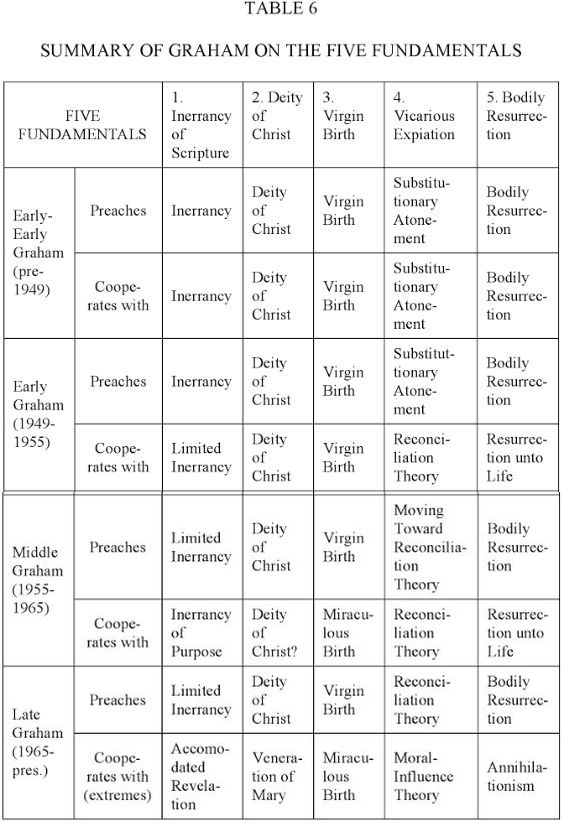
We see in the book Examining Billy Graham’s Theology of Evangelism by Thomas P Johnston on page 379, a table showing the four phases of Graham’s drift over the years. Johnson lists the five fundamentals for belief as a saved person and how Graham compromised on all of them over the years. By the end, Graham even taught that even if someone didn’t know Jesus, they were saved.

Cecil Andrews participated in a Crusade as a counselor in the later 20th century and also sang in Graham’s choir once or twice in England. Andrews said,

“I know a number of men who do door to door work in Northern Ireland and they constantly come across people whose view is ‘oh I made a decision at a Billy Graham crew said but I don’t go to church now I haven’t gone for years and so on’. But yet somehow or other they’re relying on this emotional response 30 or 40 years ago. Yet they would have gone down as one of the people who went forward as an Inquirer. They would be viewed rightly or wrongly by others as fruit…”

Did you know that people streaming down the aisles at the end of the Crusades during the ‘Invitation’, would be funneled to receiving counselors of their home religious tradition. If a Jew, there was a rabbi there. If a Catholic or ex-Catholic, they would receive counseling from a priest. So, no, those likely would not be bearing fruit for the Lord. Nor the ones who made an Arminian decision once (“prayed a prayer”) and then never honored the Lord by attending church.

Are the people who said they were ‘saved’ at a Graham Crusade really saved? It’s another question I was asked.

I am sure though that of the masses of people who had contact in some way with something Graham has said or taught, that the Lord in his providential wisdom saved some.

The Youtube talk by Cecil Andrews of Take Heed Ministries is called “Billy Graham: The man and his message” and it’s been on Youtube for 12 years. I’ve watched it several times, including 12 years ago, when barely anyone said Graham’s evangelism methods were problematic. Andrews was clear but humble in the talk, pointed about orthodoxy but sensitive when delivering his biblical perspective. I recommend the talk.

There are many reasons why Graham in my opinion will be one of the sad souls pleading with the Lord on Judgment day Lord, Lord. Many. Dissertations, books, and essays have been written about Graham’s personal life and how it didn’t follow the biblical pattern for a godly husband, and many essays recounting Graham’s non-biblical stances- all of which indicate he was not a true believer. Too many to explain and back up in one essay. But the point is:

Not everyone who says “Lord, Lord” will gain heaven. Event he most seemingly busy and fervent workers for Jesus may be false.

The Pharisees spent their lives ‘doing’ religious things for God, but were not saved. Also the Sadducees. Also Cain, Demas, Judas, and the hordes who will cry out on Judgment day as per Matthew 7. These false teachers and false converts masquerade as righteous, (2 Corinthians 11:13-15) and masquerade means they wear a disguise to cloak and hide their unrighteousness. It is hard to detect some of these. Others, well, the mind does not want to go there, as in the case of Graham.

Therefore, do not be surprised that one who seems so fervent for the Lord, so busy doing for the Lord many not be all he or she seems to be. Be discerning.

Posted in theology

Billy Graham rule may not be a good idea for some (a different reason why)

By Elizabeth Prata

A very famous married elderly Reformed preacher was forced to confess he had been having a five-year-long affair with a woman almost 50 years younger than he. He was fired from his preaching position, ejected from the ministry he founded, and rejected in his many other ministry positions of authority and prestige.

The shock went around the world. Literally. The ensuing shock is still reverberating. Some insiders have said, “No one saw this coming.” Not that they disbelieved that anyone can sin into adultery, but no one saw it coming from this man in particular.

Al Mohler spoke about this situation, answering a question he’d been asked as to whether pastors falling due to adultery are happening more frequently these days. It seemed so to the questioner.

Moher said that he “doesn’t sense an increase in number but an increase in public damage to the church of Jesus Christ. The effect of the issue upon the church and the ministry of the Gospel of Jesus Christ is so grievous

Mohler also quoted advice given him by an elder honorable Christian man,

You will never have sex with a woman not your wife, if you are never alone with a woman not your wife.”

In the aftermath of this news, people have been discussing the background of Mohler’s quip, the Billy Graham Rule. (BGR)

The BGR is a rule that 20th century evangelist Bill Graham instituted for himself never to be alone with a woman not his wife. As a traveling evangelist, he was subject to gossip and speculation, particularly in the wake of traveling religious men before him who had been charlatans.

Graham tells the story of when he was walking along a quiet street with his 18-year-old daughter: the next day, the local paper printed the story that Graham was “again” seen with a beautiful, young woman, insinuating that Graham’s sexual exploits were beginning to be a problem,” explains Kurt Edwards in his dissertationBilly Graham, Elmer Gantry, and the Performance Of A New American Revivalism

.

In this June 27, 1954 file photo, Evangelist Billy Graham speaks to over 100,000 people at the Olympic Stadium in Berlin, Germany (AP)

Graham himself had said of the issue, “There is always the chance of misunderstanding. I remember walking down the street in New York with my beautiful blond daughter, Bunny. I was holding her hand. I heard somebody behind us say, ‘There goes Billy Graham with one of those blond girls.'” (Source).

These rumors bothered Graham, who wanted to maintain a pure reputation. He had recently read the devastating book Elmer Gantry, about the perseverance, rise, and ultimate success of a corrupt preacher who was in fact a false convert. This book spooked Graham. He was concerned enough with his reputation in light of the Gantry book and subsequent movie, that in 1948 “while in Modesto, California, he [Graham] gathered close advisers, including Grady and T.W. Wilson, Cliff Barrows, and Bev Shea” wrote Edwards, to discuss how to handle this kind of attention.

The issues they were concerned about were money, sexual
immorality, discord with local churches, and telling journalists the true numbers of attendees (not inflating the truth when speaking of publicity) – these “rules” were to help squash any issues with these 4 problems and became known as “The Modesto Manifesto”.

The rule Graham had about maintaining sexual purity was that he would never travel alone, nor would he meet with or eat alone with any woman other than his wife. But there is an interesting twist to that Rule many people do not know. More on that below.

It was a purposeful strategy to ignore the Elmer Gantry-ish excesses of the famous American evangelists who’d come before him. And it worked like magic. When scandals destroyed some of his imitators in the 1980s, like Jim and Tammy Bakker, Graham’s operation looked even more like a model of rectitude in comparison. (Rolling Stone, The Soul Crushing Legacy of Billy Graham).

BGR or BGR-ish Can Be Good

I have an issue with the Billy Graham Rule, and it is not what you think. I believe the wisdom behind the Rule is good. It is NOT wise for a man, clergy, pastor, counselor to meet alone with a woman. Not professionally and certainly not personally. Not even in public, as in a restaurant, mall, or park. I also believe it is not a good idea to frequently text or email or phone call a woman who is not his wife, an added caveat since new technology has been invented since Billy Graham was around.

It was not holiness that prompted Graham and his cohorts to formulate this rule. It was not to establish guardrails for the purpose of maintaining discipline so God gets the glory.

It was performance. It was to create an external appearance in order to glorify self.

Some may take issue with what I’m saying here. But I’ve done a lot of thinking about Billy Graham and even more study on his life and ministry. Much. I don’t say these things lightly or without reason or substantiation. I know some won’t like it because some idolize him. That’s fine. Their opinion. I have mine.

As a side note, I’ve read Stephen King’s The Mist, Conrad’s Heart of Darkness, Lovecraft…and Elmer Gantry. Let me say that Elmer Gantry out-horrored them all and was the most chilling, horrific book I ever read. It definitely leaves an impression.

Throughout Billy Graham’s career, the evangelist sought performative manners to ensure that he would not be perceived as another “Elmer Gantry”, or huckster preacher out to win money, fame, and favor. Graham’s intent was to grow a ministry that would form a new performance paradigm for American revivalism. Graham prepared as an actor to use his gifts, train his voice and body, to write a different style of script, to capitalize on celebrity, and to embrace new media forms that would bring his message around the world thus creating a “New” revivalism while at the same time distancing himself from being seen as the character in Sinclair Lewis’ novel Elmer Gantry…” ~Dr. Ronald E. Shields, Bowling Green State University.

Why I am suspicious about the BGR

Graham decided not to sup alone, be seen with, or in any way be tainted by the notion that he was alone with a woman not his wife in public, and this included his daughters.

This is my issue and it’s why I deem it performance, a whitewashed tomb rather than a God-glorifying pursuit of purity.

He sacrificed his girls on the altar of personal reputation. It wasn’t for the glory of God. It was so people would think he was a highly moral person. We see this conceptually in the Modesto discussions, and we see in reality at the abandonment of his daughters for the sake of being well thought of.

From that point on, Graham would not to travel, meet, or dine alone with any woman other than his wife Rutheven his very own daughters when they came of age.” ~Edwards

Evangelists were often separated from their families during long periods of time and could be tempted with immorality (at least to do things that were disparate with what they were preaching for or against). The team pledged to avoid even the appearance of compromise. From that day forward, Graham never traveled alone, nor did he meet or eat alone with any woman other than his wife (including his teenage daughters). ~paraphrasing William Martin’s book, “A Prophet with Honor: The Billy Graham Story.

So: the entire point about me cautioning with regard to the Billy Graham Rule is —

MOTIVE

You ask and do not receive, because you ask with the wrong motives, so that you may spend what you request on your pleasures.
(James 4:3)

All the ways of a person are clean in his own sight, But the LORD examines the motives. (Proverbs 16:2)

The Pharisees were ALL ABOUT performance. Jesus called them out on it. He said they stand on corners (busy location) so they would be seen They didn’t wash, so they would be seen. They pulled long faces at fasting, so they would be seen. When they tithed they sounded trumpets. They sought the chief seats at banquets. All so they would be praised and glorified.

Then the Lord said, “Because this people approaches Me with their words And honors Me with their lips, But their heart is far away from Me, (Isaiah 29:13).

Practicing righteousness to heap glory onto one’s self is a worthless endeavor.

Take care not to practice your righteousness in the sight of people, to be noticed by them; otherwise you have no reward with your Father who is in heaven. (Matthew 6:1)

CAUTION

As you think about the BGR, ponder your motives. And sin being what it is, even if you’ve instituted such a rule for yourself at the start based on wanting to give glory to God through a holy lifestyle, over time it can become hardened and rigid, and become one of many rules that are void of worship and instead by now are just a performance. A rule for the sake of a rule.

For am I now seeking the favor of people, or of God? Or am I striving to please people? If I were still trying to please people, I would not be a bond-servant of Christ. (Galatians 1:10).

That question should always be utmost in our minds. WHY do we do the things we do? Is what I am doing out of love and submission to the Savior? Am I pursuing holiness for the sake of God getting glory, or for myself so as to be well thought of? Has it become rote, and devoid of meaning and worship?

but just as we have been approved by God to be entrusted with the gospel, so we speak, not intending to please people, but to please God, who examines our hearts. (1 Thessalonians 2:4)

Posted in discernment, Uncategorized

Billy Graham Waffles for Breakfast #2: Is AIDs a judgment from God?

Waffles for Breakfast #1: Billy Graham on the Nixon Tapes, remarking about the Jews

This series is a study on hypocrisy. Number 1 is above. The series is based on the following verses.

it is not what goes into the mouth that defiles a person, but what comes out of the mouth; this defiles a person. (Matthew 15:11).

Woe to you, scribes and Pharisees, hypocrites! For you are like whitewashed tombs, which outwardly appear beautiful, but within are full of dead people’s bones and all uncleanness. 28 So you also outwardly appear righteous to others, but within you are full of hypocrisy and lawlessness. (Matthew 23:27-28)

Waffling is a secular term that means changing one’s mind frequently on a topic. “For breakfast” means to do it easily. That defines world-famous evangelist and itinerant crusade preacher Billy Graham, whose going back and forth on theological issues was so easy and so frequent it became second nature to him.

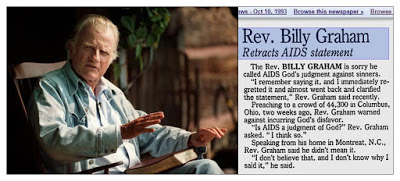
His slide from what he stated he believes, into doctrines so far outside orthodoxy, was so incremental and so little reported, that many people don’t know that he spent a lot of time retracting, clarifying, re-explaining and watering down any doctrine where he encountered push-back. Here is one example. In a sermon given on September 1993 in Columbus OH he remarked about AIDs

Is AIDs a judgment of God? I could not say for sure, but I think so.

Afterwards, Graham received many protest letters. He contacted the Cleveland Plain Dealer newspaper and retracted what he’d preached. His stated reason for saying it in the first place was that he was tired.

“I do believe God stands in judgment of all sins but AIDs is a disease that affects people and is not part of that judgment. To say God has judged people with AIDs would be very wrong and very cruel. I would like to say that I am very sorry for what I said.”

When Graham preached about sins, he said he wasn’t sure if AIDs was a judgment of God, but when experiencing criticism for saying it, suddenly he is sure that it is NOT a judgment for sins.
aids graham final

Here is a comparison to Graham’s waffle on AIDS of how a preacher of God’s word is clear on biblical doctrines. He is supposed to be able to succinctly give an answer, and then stand on the Rock when the waves of cultural anger resulting from his firm stand wash up upon him. Here is John MacArthur on the same subject 4 years before Graham dealt with it in his sermon.

People have asked me whether I believe that AIDS is the judgment of God. My response is that AIDS is the judgment of God in the same sense that cirrhosis of the liver is the judgment of God or that emphysema is the judgment of God. If you drink alcohol, you’re liable to get cirrhosis of the liver. If you smoke, you’re liable to get emphysema or heart disease. And if you choose to violate God’s standards for morality, you’re likely to contract venereal disease—even AIDS. It is a law that the Bible describes in terms of sowing and reaping. Article You can Trust the Bible, 1988

When a preacher is at the pulpit, it is assumed that he has been confirmed by elders as to his calling, been trained, and has studied/ prepared for the sermon. He should then declare the biblical truths with clarity and conviction. If there exists a pattern of waffling, retracting, and constantly clarifying, then it is perhaps either an issue of his qualifications for preaching (able to teach- 1 Timothy 3:2) or his heart, with hypocrisy leaking out.

Paul’s criterion “able to teach” in 1 Timothy 3:2 refers to the ability to communicate and apply the truth of Scripture with clarity, coherence, and fruitfulness. Source

Watch out for the constant clarifying, retracting etc. A preacher is supposed to be a declarer of truth, not a constant retractor of tired sermon mistakes. Such a pattern could betray either hypocrisy as stated in the two verses above, or the following:

Woe to you, when all people speak well of you, for so their fathers did to the false prophets. (Luke 6:26)
for they loved the glory that comes from man more than the glory that comes from God. (John 12:43)
For am I now seeking the approval of man, or of God? Or am I trying to please man? If I were still trying to please man, I would not be a servant of Christ. (Galatians 1:10)

Posted in discernment, Uncategorized

Billy Graham Waffles For Breakfast #1: The Jews

Billy Graham Waffles for breakfast #2: AIDs as a Judgment from God 

This is a study on hypocrisy. Hypocrites deceive us so easily, sad to say. They deceive themselves, worse to say. Hypocrisy is poison for everyone involved.

This series is based on two verses.

it is not what goes into the mouth that defiles a person, but what comes out of the mouth; this defiles a person. (Matthew 15:11).

Woe to you, scribes and Pharisees, hypocrites! For you are like whitewashed tombs, which outwardly appear beautiful, but within are full of dead people’s bones and all uncleanness. 28 So you also outwardly appear righteous to others, but within you are full of hypocrisy and lawlessness. (Matthew 23:27-28)

BG-NIXON
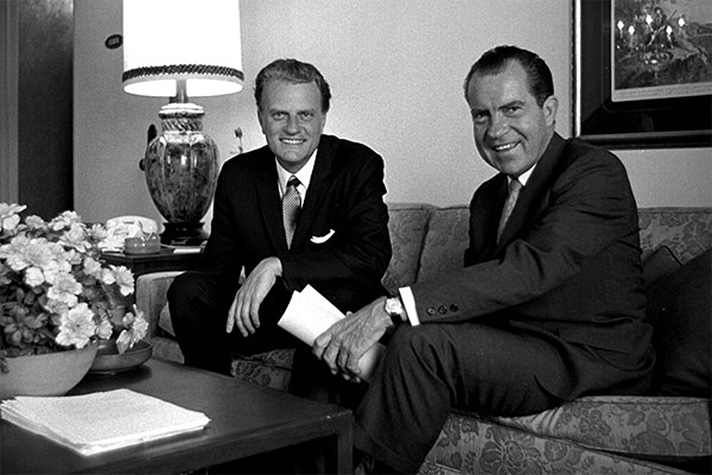
Billy Graham with Richard Nixon in 1968. Source 

Waffling is a secular term that means changing one’s mind frequently on a topic. “For breakfast” means to do it easily. That defines world-famous evangelist and itinerant crusade preacher Billy Graham, whose going back and forth on theological issues so easily it is second nature to him.

It’s been 15 years since Graham’s last crusade. His heyday of the 1960s, 70s, and 80s was well before this latest generation’s knowledge and experience. Youngsters don’t know who Graham is, except for the name. Hence, this essay series.

As for the waffling, Graham’s pattern has been to say something in an interview or in print and when it causes a ruckus, then he apologizes, or says he was misquoted, or he didn’t mean it, or he doesn’t remember saying it. Back and forth the waffling goes, on issues like creation/evolution, baptism, AIDS, alien life outside the planet, and more, over every decade of Graham’s life.

It is well known that Graham has been a friend and counselor to Presidents. He has counseled every President of the United States, since WWII up through #45, Donald Trump.

Richard Nixon, who served from his election in 1969 until his resignation in 1974, met with and took phone calls from Billy Graham on a regular basis. They were personal friends and had been since before Nixon’s election.

Unbenownst to Graham, Nixon secretly recorded all his phone calls and visits inside the White House, and later, at Camp David, the presidential retreat. The recordings of course included calls to and from Graham.

In 2002, hours of the Nixon tapes were released to the National Archives. In one that was recorded on February 1, 1972, Nixon and Graham can be heard discussing Nixon’s and Graham’s true feelings about the Jews. This conversation was secretly recorded with H.R. Haldeman in attendance, who also kept a diary, (archives here) in which he further reported that Graham said that “the Bible says there are satanic Jews and that’s where our problem arises.”

In the tape under consideration today, February 1, 1972, Nixon is complaining about the Jewish dominated media. In researching Graham’s flip-flops on different theological topics, I’d read one in which great evangelist Graham is quoted as explaining why he chose NOT to evangelize Jews. (as stated in Christian News April 24, 1972, “The Conversion Of The Jews” where Graham said he does not judge the Jews as a people lost to salvation).

Really? So I researched further, googling “Graham evangelize Jews.” What I found was equally disturbing. The Nixon Tapes. I had not been aware of Graham’s recorded conversation revealing his thoughts on what he deemed as a Jewish problem.

Here is the (near) transcript I put together from various quoted articles and also some of the actual tapes. The conversation was held after Graham had led a White House prayer breakfast. The NY Daily News called the conversation “chilling and frightening.” I agree.

Source 1
Source 2 (short)
Source 3 (long)

Graham had said he’d planned a meeting with editors of Time Magazine

Nixon: You meet with their editors, you better take along your Jewish beanie (yarmulke).
Graham: That right? /chuckles/
Nixon then said that media such as Life magazine, Newsweek, the New York Times, the Los Angeles Times, and others, are “totally dominated by the Jews.” Nixon goes on to say that network TV anchors Howard K. Smith, David Brinkley and Walter Cronkite were “front men who may not be of that persuasion,” but that their writers are “95 percent Jewish.”

Graham: This stranglehold has got to be broken or the country’s going down the drain.
Nixon: You believe that?
Graham: Yes, sir.
Nixon: Oh, boy. So do I. I can’t ever say that but I believe it.
Graham: No, but if you get elected a second time, then we might be able to do something

Nixon: … not all the Jews are bad, the best Jews are the Israeli Jews
Graham: That’s right … but there’s a powerful bloc of Jews … opposing you in the media.
Graham: And they’re the ones putting out the pornographic stuff.

Graham later confides to Nixon how he acts when Jews are around.

Graham: I go and I keep friends with Mr. Rosenthal at The New York Times and people of that sort, you know. And all — I mean, not all the Jews, but a lot of the Jews are great friends of mine, they swarm around me and are friendly to me because they know that I’m friendly with Israel. But they don’t know how I really feel about what they are doing to this country. And I have no power, no way to handle them, but I would stand up if under proper circumstances.
Nixon: You must not let them know.

Graham’s actions of friendliness to Jews to their face and internal hatred for their control of media and their destruction of the country, in addition to being satanic, is hypocrisy at its worst.

In 1994 when the Haldeman diaries were published and Graham was questioned about Haldeman’s memory of events, Graham said flatly that “those are not my words.”

He lied.

A false witness will not go unpunished, and he who breathes out lies will perish. (Proverbs 19:9).

Imagine, to lead a prayer breakfast so sensitively delivered that Nixon said people were in tears, and then for Graham to turn around and speak about the Jewish controlled media that is ruining this country, and colluding with the President to “do something about it” is venal beyond belief.

They are Graham’s words. In 2002 when the tapes themselves were released, it turned out to be true that Billy Graham had indeed spoken those words. He is either a deeply anti-Semitic man, or pretended to be in order to curry favor with a President and keep his seat at the power table. Either way, it’s gross.

In 2002 when the tapes were released, The Nation magazine sought reaction to Graham’s remarks from some prominent Jews. Here is one:

“He just showed that he was the pious hypocrite that we all knew that he was anyway,” says Arthur Schlesinger Jr., who had served in the Kennedy White House a decade earlier. “Sinclair Lewis wrote about all those fellows in the great Elmer Gantry.”

Schlesinger nailed it when he referred to Elmer Gantry.

Gantry is an incendiary look at hypocrisy from the inside. I don’t know how author Sinclair Lewis did it so expertly, but he showed us the very thought process and the slow hardening of heart of one pastor over a lifetime, who inside his whitewashed tomb was evil, lusty, craven, self-seeking, vainglorious, greedy, and more. Read that book.

Oh! The waffle? It came in a 2002 statement.

Although I have no memory of the occasion, I deeply regret comments I apparently made in an Oval Office conversation with President Nixon. They do not reflect my views, and I sincerely apologize for any offense caused by the remarks.’ NY Times

Posted in discernment, Uncategorized

Billy Graham Rule: a short, touching follow up by Jared C. Wilson

Yesterday I’d published a piece on the criticism of Vice-President Mike Pence and his statement that he does not eat alone or spend time alone with women other than his wife. Pence’s commitment stems from what’s known as the ‘Billy Graham Rule.’ Early in his career Graham had set out 4 rules by which he and his team would follow.

-Don’t be alone with women
-Don’t criticize the local church
-Be scrupulous with reporting Crusade attendance
-Be transparent with Crusade finances

In my piece yesterday, I’d looked at the issue of one’s motivation for instituting personal rules for behavior. If your motivation is to serve and honor God, personal rules can be an enhancement to one’s sanctification, although caution is needed so one’s rules don’t become a substitute for scripture, nor a hard-and-fast blind tradition. If your motivation for instituting personal rules is external-only and to win man’s approval and applause, and to avoid man’s criticism, then no rule is going to aid your sanctification, ever.

Today’s follow-up piece has one point. Man will always criticize you, especially if you’re a pastor. The flesh in man, sanctified or unsanctified, always finds a negative in which to fill in a gap. Even if you institute ‘Billy Graham Rules’ like Graham did, where he chose even to avoid eating with his adult daughter because of how people might perceive it if they didn’t know she was his daughter, man will still find something with which to criticize you. That’s what the part below clearly shows us.

So, are strict rules worth it especially they cause you to violate other scriptures in the process? No. And if you somehow miraculously achieve being well-spoken of by many, it may be a woe to you! (Luke 6:26). Though we do care about appearances because we do care about holiness, we also know that there will always be someone on the fringes watching and accuse you, (me) either to our faces or behind our backs.

Finally, Jesus behaved perfectly and followed ALL the rules, and He was killed. We can never escape criticism, if that is your reason for instituting personal rules for behavior.

If we are SO concerned with appearances that we alter our behavior to the degree that the rules we institute to guide us overtake our genial and joyful nature in Jesus and trust in Him as our ultimate Advocate, then we have become a Pharisee.

The best thing to do with respect to personal holiness is to follow the Bible’s prescriptive commands. Follow the spirit of the descriptive gray areas. Be scrupulous and transparent in behavior. If you follow the center line of Jesus’ path you will be well-served, because Jesus is your Advocate.

The crucible is for silver and the furnace for gold, And each is tested by the praise accorded him. (Proverbs 27:21)

Jamieson-Fausset-Brown Bible Commentary explains the Proverbs verse:

Praise tests character. A man to his praise—according to his praise, as he bears it. Thus vain men seek it, weak men are inflated by it, wise men disregard it, &c.

With those thoughts in mind, here is Pastor Wilson’s recounting of his experience with the Pharisaical accusers. The sentences are in short bursts because this was a Twitter blast. In my opinion, the recounting of that experience is a good illustration of Matthew 23:23-24, where people were so concerned with appearances they forgot love, mercy, and kindness.

Woe to you, scribes and Pharisees, you hypocrites! You pay tithes of mint, dill, and cumin, but you have disregarded the weightier matters of the Law: justice, mercy, and faithfulness. You should have practiced the latter, without neglecting the former. 24You blind guides! You strain out a gnat but swallow a camel.

~~~~~~~~~~~~~~~~~~~~~~~~

I [Jared C. Wilson] was once accused of eating a meal with a woman for lustful reasons, even though it was in plain view of our church in fellowship hall.

She was a lady from our town, an unbeliever, and dressed immodestly. I entered the hall late after most everyone was seated at tables.

She was at a table all by herself. Numerous church folks, women included, filed past her to sit at other tables. The image stunned me.

I stood there for a second & watched this lady sitting all alone, ignored and unmet. And my heart was broken for her. I sat down w her.

I was not attracted to her at all. She was dressed immodestly but she wasn’t, to my taste, attractive. (Not sure why I share that.)

I heard her story. Drug addict. Single mom. In and out of hospital for constant surgeries after a car accident.

I listened mostly. Invited her to come to church service. (This was a community fellowship-type thing.) But I mostly listened.

Almost immediately after, 2 ladies approached me, smirking, cracking jokes about pastor sitting with woman w “boobs hanging out”

I said, “If either one of you, or anybody else, had deemed her worthy of your time, I might not have needed to.”

I also told them I didn’t appreciate the accusations, which could do great harm to the reputations of me, my family, and the church.

One of them apologized. The other kind of snooted & walked away.

In that instance, at least, I was willing as a pastor to have my reputation “tarnished” for doing what I think Jesus would have done.

Not sure if that relates to the “Billy Graham rule,” which I mostly hold to personally out of respect for my wife. But, The End.

Jared C. Wilson is‏ Director of Content Strategy, @MBTS. Managing Editor, of For the Church, Gospel-centered resources from Midwestern Seminary, Director, Liberty Baptist Church Pastoral Training Center, @jaredcwilson.

Posted in discernment, Uncategorized

Mike Pence, the “Billy Graham Rule” and Pharisees

Of late the secular world has mocked a Christian. It’s not news.

Except that the Christian they mocked was the Vice President of the United States, which tends to be news. Further, the mocking ensued because Pence had said he chooses to honor his wife by not spending time alone with women, including eating in restaurants alone with them.

Gasp. Yawn.

This week Vice President Mike Pence was called everything from crazy to bizarre to employing ‘benevolent sexism’ to being a misogynist. In one of the more tame news articles about the issue was the UK Guardian. I chose The Guardian over CNN, NPR, Time Magazine etc. specifically because the media outlet is not American and hopefully they would have some objectivity. Author of the article, Jessica Valenti, opened it this way:

this week a Washington Post article about Karen Pence revealed that the vice-president will not eat a meal with a woman other than his wife. Those on the right are commending Pence’s marital devotion and moral fortitude, claiming that such a rule is a smart defense against sexual temptation.

One conservative blogger questioned where there was ever a good reason for a married person to eat out alone with a member of the opposite sex; the former CEO of the blog RedState chimed in to answer: “Planning your spouse’s surprise party or funeral and that is it.”

penceLeft, VP Pence with wife Karen at Pre-Inaugural dance. Source

So far, so good. Valenti ended her article this way:


Pence is a misogynist. We know it from his voting record, we know it from the things that he’s said about women’s rights and now we know it because of his odd personal rule not to dine with women alone. But let’s not let one man’s sexism distract us from his whole party’s sexist agenda.

OK, so maybe the objective perspective I was hoping for isn’t there after all. But are we surprised? No.

Alternately, The Baptist Press wrote:

Southeastern Baptist Theological Seminary President Daniel Akin responded that he has made the same commitment to his wife Charlotte … Akin, author of two books about marriage based on the Bible’s Song of Solomon, told Baptist Press, “The day I married Charlotte I made the same pledge to her that Mike Pence has made to his wife. I have never broken it. I promised her I would never be alone with any woman other than she. I did not make this promise because I am afraid of women or think they are of lesser value and worth than men. I made it because I know the sinfulness of my own heart.

“The Bible teaches us that King David was a man after God’s own heart,” Akin said in written comments. “But because he was at the wrong place, at the wrong time and with the wrong person, he lied, committed adultery and murdered. I doubt I love God more than David. If something like that could happen to him, then it could happen to me. My goal is to go to my grave being faithful to Charlotte. I really don’t care what the world thinks when it comes to this issue.”

Akin’s explanation goes to the heart of Godly conduct. There is a difference between loving God and wanting to honor Him through our behavior, and men who want to appear sincere because they seek man’sglory and applause.

In the late 1940s and 1950s, the Rev. Billy Graham became the
‘primary engine of America’s Cold War religious revival.’ Source
Courtesy of Billy Graham Evangelistic Association BY TIM FUNK

Mike Pence’s vow comes from what’s colloquially called “The Billy Graham Rule.”

In 1948 when the famed traveling evangelist was starting what became his itinerant global program, Graham realized that certain problems had consistently plagued previous traveling preachers. At that time, Graham was also grievously affected after reading the 1927 book by Sinclair Lewis, Elmer Gantry.

Gantry is an incendiary indictment upon huckster preachers. Author Lewis exposed the fictional character’s hypocritical mindset from the inside of the huckster’s conscience and showed the true evil of religious charlatanism. The book infuriated America. Here is Wikipedia with a synopsis of the book’s reception:

The result is a novel that satirically represents the religious activity of America in evangelistic circles and the attitudes of the 1920s toward it. On publication in 1927, Elmer Gantry created a public furor. The book was banned in Boston and other cities and denounced from pulpits across the United States.

Elmer Gantry had a profound effect not just on America, but on the young up and coming traveling evangelist Billy Graham, who urgently and vocally stated he wanted to avoid any perception of similarity to the scurrilous Gantry.

Adding insult to injury, Graham was particularly stung after seeing an Atlanta Journal Constitution photographic array that juxtaposes one photo of a smiling, hearty, waving Graham with another photo of men carrying away two huge bags of money after the Crusade’s love offering in that city. Graham wrote,

The day after the closing meeting on December 10 [1950], the Atlanta Constitution, accompanying its wrap-up story of the Crusade, printed two pictures side by side. In the first, I was grinning broadly and waving good-bye as I stepped into a car for my departure to South Carolina. In the next, two Crusade ushers, with a uniformed police sergeant between them, could barely wrap their arms around four bulging money sacks. “GRAHAM ‘LOVE OFFERING’ COLLECTED AT FINAL SERVICE,” read the caption. I was horrified by the implication. Was I an Elmer Gantry who had successfully fleeced another flock? Many might just decide I was.

Graham wanted at all costs to avoid that perception. Graham’s main concern, as he wrote in his autobiography and stated in interviews and press conferences, was public perception. Obedience to Biblical precepts were not mentioned nearly so often and never as the main reason Graham instituted his Rules, one of which involved the ‘never alone with women’ vow. There are actually 4 “rules” the then-group created for themselves as a boundary of their personal conduct while away from home. One was the aforementioned “never eat alone/be alone with a woman”. Also, never to inflate attendance numbers and always report honestly. Third, be scrupulous and transparent in finances. Last, they would avoid criticism of local churches.

According to Graham’s autobiography Just As I Am,the magazine Christianity Today has a short recounting of how this ‘rule’ began:

“Sinclair Lewis’s fictional character Elmer Gantry had given traveling evangelists a bad name. To our sorrow, we knew that some evangelists were not much better than Lewis’s scornful caricature. One afternoon during the Modesto meetings, I called the team together to discuss the problem. Then I asked them to go to their rooms for an hour and list all the problems they could think of that evangelists and evangelism encountered. When they returned, the lists were remarkably similar, and we soon made a series of resolutions that would guide us in our future work.”

I make the point that it is good that men (and women) want to conform to God’s standards of behavior with respect to personal piety. It’s good. However where the sticky wicket comes in is the motivation for doing so. Is the person doing it to please God, or men? (Galatians 1:10).

Graham says of the issue, “There is always the chance of misunderstanding. I remember walking down the street in New York with my beautiful blond daughter, Bunny. I was holding her hand. I heard somebody behind us say, ‘There goes Billy Graham with one of those blond girls.'”

Graham and his associates also charted a careful, if rather unusual strategy to ensure the evangelist would not be tainted by the suspicion of sexual impropriety. From that point on, Graham would not to travel, meet, or dine alone with any woman other than his wife Ruth — even his very own daughters when they came of age.

~Source, Billy Graham, Elmer Gantry, and the Performance of a New American Revivalism, a dissertation by Kurt A. Edwards

The favorable side of adopting “rules” are that they can be a personal stamp on biblical precepts, applied to life. Following rules is to be done unto the glory of God to the praise of God. Personal piety is an act of worship, it’s not an external performance. The danger with man-made “rules” are more numerous. You have the danger of hypocritical piety. You have the danger of elevating your rule over the Bible. You have the danger of the rule becoming codified into tradition. You have rather than upholding God’s precepts, disobedience of them. In Graham’s case, if Mr Edwards’ quote is correct, Graham chose to sacrifice his relationship with his adult daughters so as to avoid perceptions of impropriety and man’s disapproval.

The Bible says in Ephesians 6:4, “Fathers, do not exasperate your children; instead, bring them up in the training and instruction of the Lord.” And in Colossians 3:1 we read, “Fathers, do not provoke your children, lest they become discouraged.”

Early Graham Crusade poster

Here at Ligonier, Jerry Bridges discusses:

The most proximate cause of the Pharisees’ antagonism toward Jesus, however, lay in His ignoring of their hundreds of elaborate but petty rules that they had devised for interpreting the law of God. Not only did they devise these hundreds of man-made rules, but they had also elevated them to the level of Scripture, so that to break one of their rules was to violate the law of God itself. And yet these rules not only obscured the true intent of God’s law, but also, in some cases, actually violated it (see Mark 7:9–13).

Are Billy Graham’s four “rules” God-honoring, or Pharisaical? Again, it depends on the reason for creating the rules and it depends a few other things, too. Here, Cameron Buettel’s recent series at John MacArthur’s site helps. He wrote that there were several biblical earmarks of these corrupt [Pharisaical] characters. One of them is:

If You Supplement Scripture with Man-Made Rules, You Might Be a Pharisee

The Pharisees were far more fixated with enforcing their own pharisaical legal code than they were with administering God’s law. They did this by adding mountains of unbiblical fine print to biblical commands as well as inventing their own doctrines apart from Scripture:

Cameron wrote in another part to the Legalism series,

Thankfully, we don’t have to live under the oppressive minutia of pharisaical rules. Nonetheless, many Christians do live their lives in bondage to a similar strain of legalism—one where their Christian identity is largely defined by man-made rules.

That was certainly the case in my earliest experiences as a new Christian. The church I attended had roots in the holiness movement, and the pastor was certainly old school. He believed that salvation was solely by God’s grace, but maintaining that salvation was another story altogether.

My early Christian education primarily revolved around what not to do. Drinking, gambling, dancing, and close proximity to the opposite sex were all strictly taboo. Maintaining that code of conduct made me a member in good standing at my local congregation. Admittedly, I believe following those rules spared me from a lot of personal grief as a young man. But trying to live out those prohibitions was detrimental to my theology—I developed an inverted view of sanctification, believing that good works were the requirement rather than the natural fruit of spiritual regeneration. Source

Establishing our own rules bounding our personal godly conduct can be good. However, they can easily morph into external appearances for man’s approval. As I read numerous and voluminous primary and secondary sources in Graham’s case, Graham had primarily instituted the rules known as the Modesto Manifesto due to his intent to avoid public perception as an Elmer Gantry huckster-type character. And that’s not a good enough reason. (Matthew 23:5).

If one plans to institute rules for one’s life along biblical lines, I believe President Akin’s intent proves the more eternal one. It is an intent grounded in the question, ‘Do I love God more than I love the applause and regard of men?’ It is, ‘Am I being faithful to His precepts and carrying them out in life, to His glory?’ Only the individual man or woman knows their most secret temptations, and appeals to the Spirit might have resulted in their decision to establish personal rules. Others deal with temptations a different way. Ultimately, don’t let the rules become all.

As Buettel stated, we need to be wary of  ‘adding mountains of unbiblical fine print to biblical commands as well as inventing our own doctrines apart from Scripture’ in order to pursue holiness. Though personal rules might help. It’s the Holy Spirit who conforms us to Jesus, through our resistance to temptation and mortification f sin, not how well we appear to others.

For you did not receive a spirit of slavery that returns you to fear, but you received the Spirit of sonship, by whom we cry, “Abba! Father!” (Romans 8:15).

Posted in discernment, Uncategorized

Andy Stanley, Billy Graham, and the Bible on the virgin birth

Andy Stanley, megachurch pastor and son of noted pastor Charles Stanley, said of the virgin birth, this past December,

A lot of people just don’t believe it. And I understand that. Maybe the thought is, ‘Hey, maybe they had to come up with some myth about Jesus to give him street cred, you know, later on.’ Maybe that’s where that came from.

It’s interesting, because Matthew gives us a version of the birth of Christ, Luke does, but Mark and John – they don’t even mention it. A lot has been made of that….

You’ve heard me say some version of this a million times, so this will be old if you’ve been around for a while. But see, if somebody can predict their own death and then their own resurrection, I’m not all that concerned about how they got into the world.

I was not surprised that Andy Stanley said what he said about the virgin birth. Though S. Lewis Johnson reminds us that the miracle was the conception, the birth itself was bloody, messy, and like every other birth in history. After I heard him preach it, I never thought about the virgin birth the same way again!

In any case, Andy Stanley continues to deny our fundamental doctrines (I’ve kept track and there are may doctrines he denies). The way his church treats worship tells us this, too. Just last month he had go-go dancers as part of the singing.

It is not possible either to deny the virgin birth yet accept Christ as holy, sinless deity. When Stanley made his statement, there was quite rightly a hullabaloo over it. However, Stanley is not the first pastor claiming to be conservative who denies the virgin birth as necessary to the faith. Billy Graham also denies the necessity of belief in the virgin birth. Yet there is no hullabaloo over Graham’s denial but only excuses made for his ‘misstatements.’

In my thorough study of Graham, which encompassed listening to sermons from 1949 through to the 1980s, reading several of his books, reading books about him, listening to interviews, and reading two dissertations looking at the evolution of his theology over Graham’s 50 active years, the conclusion is clear to me. In 1993 Graham said to Time Magazine (as codified in Ken Garfield’s book Billy Graham, a Life in Pictures, of the virgin birth specifically,

Graham has said that the virgin birth of Christ is NOT an essential part of the Christian faith. In an interview with a United Church of Canada publication in 1966 (“Billy Graham Answers 26 Provocative Questions,” United Church Observer, July 1, 1966), Graham gave the following reply to a question about the virgin birth of Christ: 

Q. Do you think a literal belief in the Virgin birth — not just as a symbol of the incarnation or of Christ’s divinity — as an historic event is necessary for personal salvation?
A. While I most certainly believe that Jesus Christ was born of a virgin, I do not find anywhere in the New Testament that this particular belief is necessary for personal salvation.

Graham denied the necessity of the virgin birth not just once but several times in different decades. Graham’s response was a classic example of his penchant for doubletalk. Is there any other kind of salvation, besides the personal? Is there global salvation? Impersonal salvation?

And if we use his silly statement as the basis, “I don’t find anywhere in the New Testament” …we can also say “I don’t find anywhere in the New Testament any specific reference to the Trinity” so therefore “belief in the Trinity is not necessary to personal salvation”.

If Christ be not the virgin-born Son of God, He could not be our Savior. To reject the doctrine of the Virgin Birth is to reject the only Sinless Savior that God has provided for sinners.

Of course Graham’s denial of Jesus as the exclusive way to God, as seen in his adoption of the wider mercy approach, was articulated clearly and affirmed with questioning, at Robert Schuller’s Crystal Cathedral interview in 1997, displays Graham’s saddest denial of all.

As mentioned above, Stanley is not the first impostor to preach that believing the virgin conception is unnecessary as a part of the fundamental beliefs for the faith, Graham got there long before Stanley did.

There are five fundamentals of the faith which are essential for Christianity-

1.      The Deity of our Lord Jesus Christ (John 1:1; John 20:28; Hebrews 1:8-9).
2.      The Virgin Birth (Isaiah 7:14; Matthew 1:23; Luke 1:27).
3.      The Blood Atonement (Acts 20:28; Romans 3:25, 5:9; Ephesians 1:7; Hebrews 9:12-14).
4.      The Bodily Resurrection (Luke 24:36-46; 1 Corinthians 15:1-4, 15:14-15).
5.      The inerrancy of the scriptures themselves (Psalms 12:6-7; Romans 15:4; 2 Timothy 3:16-17; 2 Peter 1:20).

Below is a VERY general look at Thomas P. Johnston’s Examining Billy Graham’s Theology of Evangelism, (p. 379) Graham’s four phases of Graham’s life and Graham’s evolution of the five fundamental doctrines.


The fact is, Jesus told us wolves will come in sheep’s clothing. This means they will appear as friendly and soft-spoken. They will seem to adhere to the Bible’s truths, but they are inside ravenous for your soul. Wolves subtly deny God, just as satan did in the Garden. An excellent example of this subtlety is Graham’s statement “I do not find anywhere in the New Testament that this particular belief is necessary for personal salvation. Be wary, friends. Even popular pastors can be wolves. As a matter of fact, especially popular pastors can be wolves.

GotQuestions: Why is the Virgin Birth so Important?

Jesus was not born in sin; that is, He had no sin nature (Hebrews 7:26). It would seem that the sin nature is passed down from generation to generation through the father (Romans 5:12, 17, 19). The Virgin Birth circumvented the transmission of the sin nature and allowed the eternal God to become a perfect man.

Ligonier: Must Christians believe in the Virgin Birth?

Christians must face the fact that a denial of the virgin birth is a denial of Jesus as the Christ


Grace To You: Why the Virgin Birth is Essential

The virgin birth is an underlying assumption in everything the Bible says about Jesus. To throw out the virgin birth is to reject Christ’s deity, the accuracy and authority of Scripture, and a host of other related doctrines central to the Christian faith. No issue is more important than the virgin birth to our understanding of who Jesus is.