The post explores Gehazi, a lesser-known biblical figure and servant to Prophet Elisha, highlighting his tragic downfall due to greed and dishonesty. Despite witnessing God’s miracles, Gehazi’s actions led to his leprosy and a curse upon his descendants, illustrating the dangers of moral failings and the desire for earthly treasures.
Paul’s letters reflect his deep affection for the Roman Church, as he greets many individuals, including Tryphena and Tryphosa, who were likely sisters. Their names suggest a background of luxury, yet they embraced the Gospel and served the Lord. This highlights God’s knowledge of all believers and the unifying power of the Gospel.
Jut as it didn’t take long after the Fall for the first murder, (Genesis 4, Cain killed Abel), it also didn’t take long for the first war to erupt, Battle of the Valley of Siddim. (Genesis 14).
In those days Kings ruled cities and near environs. There was what was known as the Five Cities of the Plain; Sodom, Gomorrah, Admah, and Zeboiim, plus tiny Zoar. (Genesis 13:10-13). They are also known as the Cities of the Valley. It used to be a fertile and lush area, that was the reason Lot chose it when Abraham suggested they split their flocks due to crowding. Now it’s an area of wasteland, salt, and not much else. Most people believe the Plains referred to is the area south of the Dead Sea (Salt Sea).
The kings of the cities of Shinar had warred with the kings of the Plains and won. (Victors were Amraphel king of Shinar, Arioch king of Ellasar, Chedorlaomer king of Elam, and Tidal king of Goiim.)
The triumphant kings exacted tribute from the vanquished, and expected it regularly. Chedorlaomer is mentioned as the King receiving the tribute, perhaps he was the lead king among the five who were allies. His Elamite kingdom extended in what is today modern day Iran along the Persian Gulf. It is believed that the Elamite nation began in the area of modern day Iran sometime around 2700 BC and continued through 640 BC. From the Table of Nations of Noah blessing his sons Ham, Japheth and Shem, that the Elamites were perhaps descendants of Shem.
Except, 13 years later, the defeated kings, having grown rebellious with the state of things, decided to stop paying the tribute to Chedorlaomer and his gang. Of course this brought on a war. Chedorlaomer called upon his allies to let them know, and hostilities were reactivated.
Well, the Kings of Sodom, Gomorrah, Admah, Zeboiim and tiny Zoar, lost soundly. Again. Chedorlaomer ransacked the Cities of the Plain and carried off as much booty as they could, including Abraham’s nephew Lot and all Lot’s people and all Lot’s goods. (Genesis 14:12).
We know from the subsequent chapters that Abraham pursued Lot’s kidnappers for hundreds of miles. With 300 men Abraham eventually got Lot back and all his people and all his goods, too. Abraham praised the Lord.
Who was Chedorlaomer, though? Not much else is known of him via the Bible. He held sway as a successful King over a large area, so he must have been powerful. He is also noted in Genesis 14:5 to have warred against Rephaim, Zuzim, Emim, and Horites and conquered them, too.
His name is known to be a compound word meaning worshiper- ‘Chedor’ and ‘la’omer,’ (“lagamaru”), the name of an Elamite deity, noted by Assurbanipal. In 1896 TG Pinches was reviewing some of the clay tablets held by the British Museum (they had been severely delayed in cataloging them, over 21,000 tablets came in from one site alone) and he thought he read Chedorlaomer’s name on one of the tablets, and there was general excitement in the biblical archaeology community for some years, but it was later disproven. To my knowledge, there are no secular sources in archaeology that mention Lot’s kidnapper king.
Now, Abraham was savvy in war and knowledgeable, but the Bible notes that he defeated mighty Chedorlaomer, powerful King of Elam and victor over many tribes, with only 318 men. As we know, it is really the LORD’S victory. The LORD does this to indicate HIS power and might, over all humans, including mighty kings, if it be His will. Melchizedek King of Salem said as much in Genesis 14:19-20,
Blessed be Abram by God Most High, Possessor of heaven and earth; and blessed be God Most High, who has delivered your enemies into your hand!
Blessed be the Lord, King of Kings, King over all, even mighty Chedorlaomer, who, in the end, worshiped wrongly and paid the penalty for it.
All those who believe in King Jesus, King of all, will have eternal life and have it abundantly. (John 10:10).
After two essays about characters from the Old Testament and two essays on characters from the New Testament (linked below), I return to the Old Testament to discover more about a man named Harbonah.
Harbonah (or Harbona) was the third of the seven eunuchs or chamberlains who served Ahasuerus, king of Persia (AKA Xerxes). The list of the 7 eunuchs is in Esther 1:10;
On the seventh day, when the heart of the king was merry with wine, he said for Mehuman, Biztha, Harbona, Bigtha, Abagtha, Zethar, and Carkas, the seven eunuchs who attended to the presence of King Ahasuerus,
It was a big deal to have access to the King. Not many did. Not even his wife. Esther knew that if she went into the presence of the King without being summoned by name, she could be killed.
The eunuchs did not have first place with the king, that was reserved for “the seven officials of Persia and Media who had access to the king’s presence and sat in the first place in the kingdom” (Esther 1:14b). Those 7 men advised the king. The eunuch group to which Harbonah belonged carried out the kings orders.
Some eunuchs were doorkeepers, two of these, “Bigthan and Teresh, two of the king’s eunuchs from those who were doorkeepers, became furious and sought to send forth their hand against King Ahasuerus”. (Esther 2:21).
Doorkeeper: Person guarding access to an important or restricted place. Temple doorkeeper was an important office in biblical times. The doorkeepers collected money from the people (2 Kings 22:4). Some Levites were designated doorkeepers (or “gatekeepers”) for the ark (1 Chron. 15:23–24). The Persian kings used eunuchs for doorkeepers (Esther 2:21). Women also served this function (John 18:16–17; Acts 12:13). Source- Holman Illustrated Bible Dictionary (p. 438).
So access to the king didn’t mean complete contentment. Discontent, intrigue, and assassination plots were fomented by those close to the king and eunuchs were in a perfect place to do so.
What is a eunuch? “A male servant or supervisory official in the court of a ruler; often castrated.” It was safer for the king to have men who could not procreate in charge of his women. An illegitimate heir was bad for purity of royal lineage.
The eunuchs had the task of managing the two harems. One was for women waiting to go into the king’s bed, (virgins) and the other was for ones who had already been summoned to his bed (concubines).
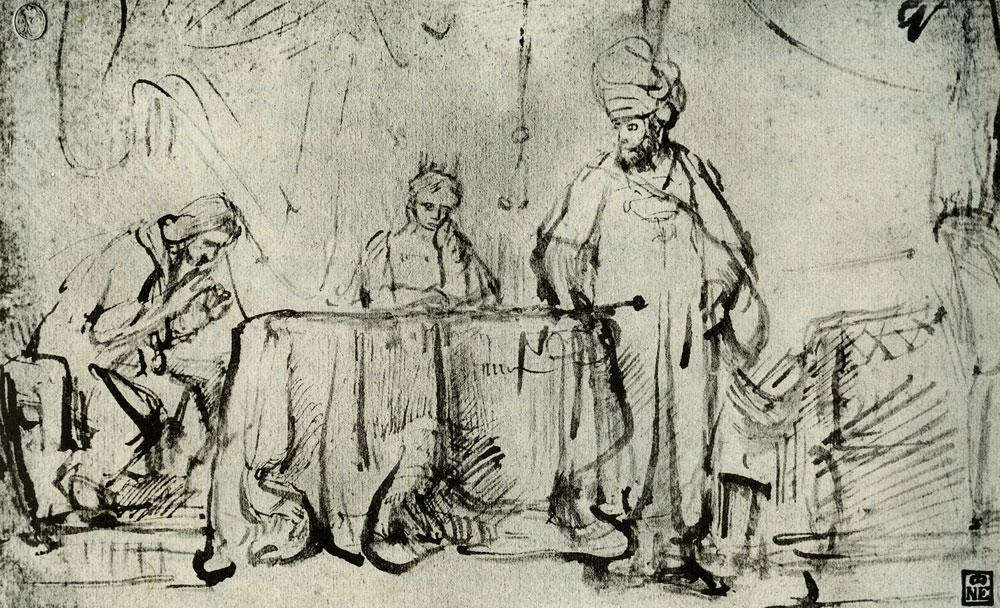
Rembrandt: Haman disgraced before Xerxes and Esther
Eunuchs in the Ancient World
Ancient Near Eastern cultures made frequent use of eunuchs, particularly in service to royalty. Royal leaders such as Cyrus the Great sought out eunuchs as servants because he perceived them as loyal, compliant, and trustworthy around women (e.g., Xenophon, Cyropaedia 7:59–65). Eunuchs could possess noteworthy roles such as statesmen, military generals, and palace officials; however, often they supervised the female quarters of a royal home or oversaw a royal harem. (Source the Lexham Bible Dictionary).
Hegai was Xerxes’ chief eunuch it seems. He managed all the women, and in fact saw Esther as kind and beautiful so he apparently had authority to transfer her to the best place in the harem and supply her with the best cosmetics and food. (Esther 2:9-10).
So after the mention of Harbonah the eunuch in Esther 1:10, he is only mentioned one other time, toward the end of Esther, in Esther 7:9. The Lord used Harbonah to propel the conclusion of Esther’s story.
When it became obvious that Haman’s plot to kill Mordecai and all the rest of the Jews was failing, Harbonah who “just so happened” to be near Xerxes at the right moment, made a powerful suggestion. He delivered this nugget to the King, which the King probably hadn’t known:
Then Harbonah, one of the eunuchs who were before the king, said, “Behold indeed, the gallows—which Haman made for Mordecai who spoke good on behalf of the king—are standing at Haman’s house fifty cubits high!” And the king said, “Hang him on it.” (Esther 7:9).
Rembrandt: Haman at the feast
Just in case the King had forgotten that Mordecai had done the King a good deed in revealing the assassination plot to the King and had been written in the Book of Deeds, Harbonah inserted that reminder in his statement, perhaps to bolster its worthiness. What’s going on with Harbonah? Hmmm-
Jewish tradition has it that Harbona had originally been a confederate of Haman, but, upon noting the failure of the latter’s plans, abandoned him. Harbona, Harbonah. (1915). In The International Standard Bible Encyclopaedia.
Jan Victors: Haman begging Queen Esther for mercy, 1642
Was Harbonah’s suggestion a helpful one to aid the king? Or one to rid himself of a co-conspirator? Only God knows. We do know that eunuchs had previously been involved in dastardly intrigue. The two doorkeepers Bigthan and Teresh had been unmasked as traitors early on in Esther, they had plotted to kill the king. It’s not unreasonable to wonder if Harbonah may have involved himself in the same kind of activity.
Esther Denouncing Haman (1888) by Ernest Normand. Notice all the people attending the king. Some of these are Eunuchs, and according to the Bible, Harbonah would have been in the scene at that moment.
On the other hand, eunuchs were usually loyal. Pragmatically, they had a good place in the court, comfortable surroundings, and influence or at least proximity to the king. So again, only God knows the true intentions of Harbonah in this moment.
The Jewish Encyclopedia entry for Harbonah ends with this: A liturgical piece for Purim beginning “Shoshannat Ya’aḳob” ends with the words, “and let Harbona, too, be remembered for good.”
Jan Lievens (1607–1674) Esther accuses Haman during her meal with Assuerus (Esther 7:1-17)
“One of the most dramatic moments from the Book of Esther comes when the queen accuses the king’s advisor Haman of treachery against her people (Esther 7:1–7). Through her efforts, Haman’s plot for the slaughter of all the Jews in Persia was unmasked before King Ahasuerus (Xerxes). Seated before his chamberlain, Harbonah, the king reacts in anger with arms outstretched and hands clenched. Across from him sits the isolated, shadowy figure of Haman, who cowers at the king’s wrath. Shortly thereafter, Haman’s life would end on the gallows“. (Source)
I never forgot Voddie Baucham’s introduction to a certain sermon. It was back when he was preaching here in the US and on rotation with other pastors in his church. He said his turn came up in the expository preaching passage, and it was the list of names Paul wrote. The passage (I think it was Paul’s sign-off of Romans 16). He said preachers usually read the passage something like: ‘The verse says ‘And give my love to…all these names I can’t pronounce…’ “
Of course, Voddie always says there is a lot to learn from “just a list of names.” Voddie’s preached on the concept before, that ALL scripture has something to offer, even if it was just an introduction or sign-off of a bunch of names in one of Paul’s epistles. Names are important!
Today we see the name “Eutychus.” This young man is mentioned just once, in Acts 20:7-12, but was the central character in a miracle.
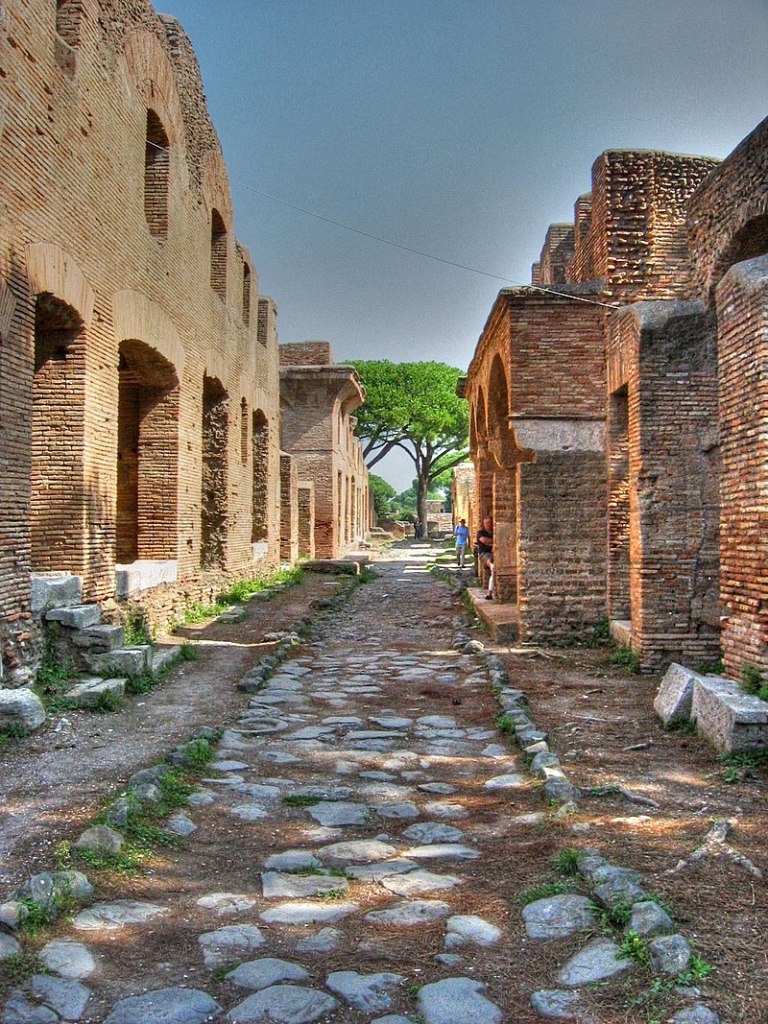
The scene is a home where Paul is preaching. The house is packed. Because the third story is mentioned, the dwelling was probably an insulae, a lower-class apartment building in an area where other apartment buildings were, AKA tenements. The poorer someone was the higher up in the building they lived. The insulae were configured as you might imagine apartments are today, but square with a central courtyard with a fountain. Many of the lowest class ones were not made of bricks but of wood. No such dwellings exist today in Troas, the city (now called Alexandria Troas) is mostly ruins. But in the city of Ostia Italy, we can still see many preserved apartment tenements (insulae). In fact, most urban dwellers lived in such apartments, the density of which would not be seen again until the Industrial Revolution. (Source)
Ostia Antica, regione I, via dei Balconi (public domain). Source
Apartments were cramped and many were not well made or maintained by their owners. Cicero admitted he was a poor landlord when he wrote:
“Two of my shops have collapsed and the others are showing cracks, so that even the mice have moved out, to say nothing of the tenants. ‘Immortal gods, what do such trivialities matter to me?”
So perhaps Eutychus’ fall was not totally due to sleepiness but perhaps a poor condition of the window or the dwelling itself? … hmmm.
Anyway, Paul was leaving the next day, and he wanted to impart as much as he possibly could to his beloved friends. Paul liked to wring out every minute for Jesus.
And he did. He began preaching probably after dinner when they had completed the Lord’s supper, and Paul continued on past midnight.
The three-story house was filled with people, all the lamps were lit, and it was a Mediterranean evening. Lamps in the first century usually emitted a great deal of smoke and it would have become hard to breathe, so, since the crowd was staying in one spot for a long time, shutters were opened to allow fresh air in. All this to say, hot and stuffy. With not a lot of movement, with dinner in their bellies, and the length of time they were sitting still, young man Eutychus nodded off.
This happens. Who can blame him? I get sleepy at all-day meetings when they resume after lunch. The difference is, Eutychus was perched on the open windowsill. When he fell asleep, he fell out the window. He fell to the ground and was pronounced dead.
Imagine the scene. Hazy, warm lamplight, wafting breeze, cicadas, a murmuring voices, all was hushed, then- SUDDEN DEATH!
On the first day of the week, when we were gathered together to break bread, Paul began talking to them, intending to leave the next day, and he prolonged his message until midnight. There were many lamps in the upstairs room where we were gathered together. And there was a young man named Eutychus sitting on the window sill, sinking into a deep sleep; and as Paul kept on talking, Eutychus was overcome by sleep and fell down from the third floor, and was picked up dead. But Paul went down and fell upon him, and after embracing him, he said, “Do not be troubled, for he is still alive. When Paul had gone back up and had broken the bread and eaten, he talked with them a long while until daybreak, and then left. They took away the boy alive, and were greatly comforted.(Acts 20:7-12).
They didn’t have to plan a funeral but could continue to learn from Paul immediately and deepen their love for the Lord through His word!
See similar event in 1 Kings 17:21 where Elijah also fell on the widow’s son and asked the Lord to resurrect the lad. And the same in2 Kings 4:34 with Elisha.
Eutychus was dead. Not mostly dead, but all dead. The first century people saw death often. They knew dead. Luke the physician wrote Acts, he records that Eutychus was dead, and Luke would know. Yet Eutychus came alive!
Imagine having your name inscripturated forever. You’re mentioned in God’s holy word! Anna’s faithfulness, Mary’s submission, Lydia’s hospitality…wow. And on the flip side, also Jezebel forever linked with deep evil. Cain always known as the rebel. And more innocently, Eutychus, the sleeper, lol. Forever known as the guy who fell asleep.
But the positives are these. He was young, but desired to attend a meeting where Paul would be preaching. He didn’t say instead, ‘I’ve got sheep to herd or nets to fix or a girl to date.’ He chose to go and be present where the word of God was taught. Sleepiness at midnight is normal, but then he became the central figure in a display of the power of God! God can resurrect the dead, using ordinary men like Paul and young men like Eutychus!
So now, Eutychus is forever known as the man whom God resurrected from the dead! The man God obviously had plans for. I wonder how Eutychus lived his life for Christ in his remaining days on earth.
The scene in the home where Eutychus fell, crowded with earnest and eager listeners, desiring to have a firehose of theology aimed at them, clinging to as much as they can from the learned lecturer, reminds me of another scene in these present days.
It happened shortly after the Iron Curtain fell and the Soviet Union disintegrated. The loosely united regions and nations under Russian control splintered into their own little countries, and Kazakhstan was one of them. Pastors who had been persecuted or exiled collected in a first-ever conference, and who did they ask to come and teach them? John MacArthur.
They gave MacArthur 6 days to teach them all the doctrines of the Bible. 1600 men came from all over the region, traveling and staying where they could. They crowded into hot, stuffy room to listen to Dr MacArthur and be taught all day and all night, previously not having had the benefit of seminaries or even openly learning because of the atheistic Communist regime which oppressed them. MacArthur said the sessions were about 12 hours long.
Such things as the Eutychus house still happen. Anywhere or at any period of time on earth, if there are people of the Lord there will be people eager to gather and learn more about Him. Eutychus’ time wasn’t up, the Lord had more of a number of days for him. And we will meet him in heaven! Remember, the people we read about in the Bible are real, and those who are said to be believers we will see and commune with in heaven, praising our Savior!
Sources:
EUTYCHUS IN TROAS: THE ARCHITECTURE AND ARCHAEOLOGY OF HIS FALL by Mark Wilson in Biblica.
Paul made three major missionary journeys. Acts 20 records the 3rd. He had spent 3 months in Greece, then planned to get on a boat in Corinth and set sail for Jerusalem via Syria, but he learned that some Jews were plotting to grab him for nefarious purposes on the voyage, so he decided to return to Macedonia by land. So Paul went from Corinth to Berea, Thessalonica, and Philippi, caught up with Luke again and observed Passover.
From Philippi, Paul and Luke set sail for Troas, arriving there five days later and meeting Paul’s traveling companions who had gone ahead of them: Timothy, Sopater, Aristarchus, Secundus, Gaius, Tychicus, and Trophimus. This is where we meet Trophimus.
And he was accompanied by Sopater of Berea, the son of Pyrrhus, and by Aristarchus and Secundus of the Thessalonians, and Gaius of Derbe, and Timothy, and Tychicus and Trophimus of Asia. (Acts 20:4).
Miletus was about 36 miles from Ephesus. Map source
Trophimus was mentioned three times in the Bible, in verse above in Acts 20:4, and also Acts 21:29, and 2 Timothy 4:20.
For they had previously seen Trophimus the Ephesian in the city with him, and they supposed that Paul had brought him into the temple. (Acts 21:29).
Erastus remained at Corinth, but Trophimus I left sick at Miletus. (2 Timothy 4:20).
Trophimus was from the Roman province of Asia and was living in or was from Ephesus. He was a Greek Christian. As we saw from the first mention of him in the verse, Trophimus was one of seven disciples mentioned by name who accompanied Paul on his return to Macedonia (Acts 20:3–4), meaning, the others to whom Paul was writing probably knew Trophimus personally, or knew OF him. These seven men formed an envoy from the various churches at Asia. They protected Paul, as it was better to travel in numbers. They also helped deliver the contributions from the churches of Asia to the saints in Jerusalem at the end of Paul’s third missionary journey (2 Corinthians 8:2–3). The delegation left Paul in Macedonia and traveled to Troas to wait for Paul and Luke to join them (Acts 20:4–6).
When they met up again, the men, including Trophimus, stayed together for a week. Imagine the theological conversations they must have held! The joy of being together!
Next time we read of Trophimus, it isn’t so joyous. We read of poor Trophimus being accused of having gone into the Temple with Paul, which uncircumcised Gentiles were not allowed to do. The Jews at that time were insisting that one had to become a Jew first in order to become a Christian. They leaped on the opportunity to accuse Paul of bringing Trophimus into the temple in order to get to Paul. And they did as much, dragging Paul out to be murdered. Of course, the accusation was false, but Trophimus’ name was used for evil purposes and he was innocently at the center of this controversy.
The modicum of fact lying at the root of this false accusation was that they had seen Paul and T. in each other’s company in the city. On this slender basis “they supposed” that Paul had brought T. past the barrier or middle wall of partition (Eph 2:14; see PARTITION), beyond which no Gentile was allowed to penetrate on pain of death. They supposed that T., who was neither a Jew nor a proselyte, but a gentile Christian, had been introduced into the temple itself by Paul—which would have been profanation. Hence their fury against the apostle. Source: The International Standard Bible Encyclopaedia (ISBE),. 1915.
Sometimes being Paul’s friend was dangerous!
The third time we read of Trophimus is when he had become too sick to travel. Paul had to leave him in Miletus.
As a side note: IF the miracle gifts had still been ongoing, why didn’t Paul just lay hands on his friend so he could continue the mission? Why doesn’t the verse say “Trophimus was sick in Miletus but I laid hands on him and by grace of God he used me to heal my friend.” Or something to that effect. 2 Timothy was written in 64/65 AD, and the sign gifts were well and truly dying out by then. The were for a sign to authenticate the Apostles and since it was nigh on 30 years since Jesus had departed and at least 20 years since the first NT book was written, the need to authenticate the ministers of God was lessening by the day.
In the previous book, 1 Timothy 5:23 written a few years before, Paul had advised Timothy to take wine for his stomach ailments.
Anyway, Trophimus was sick a few years after we last read of him, we know not with what, but was serious enough to cause Paul to have to leave T. behind. But not alone. We read in Acts 20:17 Paul had previously sent for some elders to come from Ephesus, which they did. It was an easy travel jaunt. Therefore, Paul was not abandoning his trusted friend and traveling companion to the wilds,
“Trophimus, therefore, in his sickness, could easily reach Ephesus, or his friends from that city could quickly come to him at Miletus, and give him whatever attention and nursing he might require.” ISBE
Keep in mind that these people we read about in the Bible are real people. They are alive now. We will meet them in heaven and commune with them. We can sit with Trophimus and talk with him about his sickness, his association with Paul at the temple, his missionary journeys. That’s why I write about the ‘little known’ Bible characters. Someday we will fully know them, and they will fully know us. What a day that will be.
I started an occasional series covering little known Bible characters. These are men or women who are named in the Bible, but we do not know much about apart from their names. Though, the Word of God is always worth plumbing its depths, and we can elicit from the text more than we think.
I had thought of several people named in the New Testament to focus on, but as our teaching elder concluded his series on Ezra, the last chapter listed by name, many offenders. That is what the section of text is called in my NASB Bible, “The List of Offenders”.
And among the sons of the priests there were found that had taken strange wives: namely,… (Ezra 1018a).
GIll’s Exposition:
And among the sons of the priests there were found that had taken strange wives,…. So that it need not be wondered at that this evil should spread among the people, when those who understood the law, and should have instructed the people in it, set such an example: namely: of the sons of Jeshua the son of Jozadak; who was the high priest; and perhaps for this fault of his, in not restraining his sons from such unlawful marriages, is he represented in filthy garments, Zechariah 3:3, and his brethren, Maaseiah, and Eliezer, and Jarib, and Gedaliah; these were the brethren of Jeshua.
The Holy Spirit chose to name the men who had grievously sinned by marrying foreign women who brought foreign idols into the sheepfold. The offense was not marrying women of different race or ethnicity, but that they worshiped other gods.
We saw the problem when Solomon married foreign wives who worshiped other gods.
Again, it wasn’t their ethnicity. Canaanite Rahab converted and married Joshua, Moses married Zipporah a Cushite, Ruth was a Moabite.
Do not be mismatched with unbelievers; for what do righteousness and lawlessness share together, or what does light have in common with darkness? (2 Corinthians 6:14).
and you might take some of his daughters for your sons, and his daughters might prostitute themselves with their gods and cause your sons also to prostitute themselves with their gods. (Exodus 34:16)
There were only about 100 or so who intermarried, among tens of thousands of returnees from Babylon, but remember a little leaven… spreads like gangrene. Ezra was so appalled he tore his clothes, his hair, and his beard, and sat in a puddle of prayers appealing to God for mercy.
Every man who had married an unbeliever and thus brought idolatry into Israel was named. This is the “List of Offenders” at the end of Ezra 10.
Imagine…being named in the Bible. So many people were named as a congratulations for their faith. There’s Hebrews Hall of Faith in chapter 11, where men and women are expressly named and commended.
The positively named in Hebrews are, Enoch, Noah, Abraham, Sarah, Isaac, Moses’ parents, Moses, Rahab, Gideon, Barak, Samson, Jephthah, David, Samuel, and the prophets.
Others from the New Testament were named for their faith and/or service also: Anna, Mary, Dorcas, Lydia, Tychicus, and many others of course. We can be sure when they arrived in God’s holy abode in heaven, Jesus was pleased to say to them, “His master said to him, ‘Well done, good and faithful slave. You were faithful with a few things, I will put you in charge of many things; enter the joy of your master.'” (Matthew 25:21)
But to be named in the Bible because of your sin, enscripturated forever as an example of disobedience, what a woe and embarrassment to them! And what a warning to us.
–Sin is a corrupting influence –Leaders should be an example to the positive, not the negative –Sin hurts the reputation of the church and brings reproach to the name of Jesus.
Sin must be dealt with. If we don’t address it with genuine repentance, God will.
In this New Testament era, our names are written in heaven in the Book of Life. What a grace, mercy, and gift! Let us be thankful and do our best to follow the Lord’s statues in obedience as a thank you in return.
Instruct me, O Yahweh, in the way of Your statutes, That I may observe it to the end. (Psalm 119:33).
(Cropped)Art is The neo-gothic fresco of big prophets Isaiah, Jeremiah, Ezekiel, Daniel by Leopold Bruckner from end of 19. cent. in Saint Nicholas church.
When I read the Bible and someone is named that I am not too familiar with, it makes me curious. I’ll never get tired of studying Paul or Peter or John or Stephen or Lydia…but then someone is mentioned and I go “Another person to get to know! Who was h/she?” Like, Tychicus, Eutychus (the guy who fell out the window during Paul’s long sermon), Chloe, Rufus, and so many others.
These were real people. They were fellow believers and part of the body. We will meet them in heaven. So let’s take a look in this new series, at some names of folks we don’t know much about.
While there may not be a huge amount the Bible says about these folks, studying what we do know we will learn there is more than we think.
PROPHETS
The Old Testament is divided into Law, Wisdom, History, and Prophets. Of the Prophets, there are whole books dedicated to these men and the words God used their mouths to utter. The Major Prophets, so called because their books were longer, not because they were more important than any other book, were Isaiah, Jeremiah, Lamentations, Ezekiel, Daniel. There were the Minor Prophets, so called because their books were shorter, Hosea, Joel, Amos, Obadiah, Jonah, Micah, Nahum, Habakkuk, Zephaniah, Haggai, Zechariah, Malachi.
But those were not ALL the prophets operating in the Old Testament (or the New). There were others named and many others in the School of Prophets who were not named.
Of the named Prophets who do not have a book about them or written by them, there is one called Iddo.
He is listed in a verse along with Nathan the Prophet, and Iddo is named as a seer. There are many definitions and suppositions about the seers and their differences in operation to the Prophets, which I won’t get into. Except to paste what The Lexham Bible Dictionary has to say,
Generally synonymous with the role of the prophet (e.g., 2 Sam 24:11; 1 Chr 21:9; Amos 7:12). However, at times, it is used as a distinct term from that of prophet (2 Kgs 17:13). Seer, by connotation of the Hebrew word affiliated with it being connected to the idea of receiving a vision (חֹזֶה, chozeh), may be more connected to the idea of visions than the prophetic word, although this is not necessarily the case in all usages.
An additional term used for “seer” does not necessarily evoke the connotation of one who receives a vision but does evoke the idea of seeing (רֹאֶה, ro’eh; e.g., Isa 30:10). Nonetheless, even this term is used synonymously with “prophet”; this point is explicitly made in an aside in 1 Sam 9:9: “Formerly in Israel, when a man went to inquire of God, he would say: ‘Come, let us go up to the seer.’ For the prophet of today was formerly called a seer” (compare 1 Sam 9:19). A “Chronicle of the Seers” is also mentioned in 2 Chr 33:19.
Source Barry, J. D. (2016). Seer. In The Lexham Bible Dictionary. Lexham Press.
Cleared that right up, didn’t it? Not so much.
Iddo the name means lovely, his beloved, or His love. Iddo was was contemporary to Solomon and Rehoboam. We read this specific Iddo (for there are others named Iddo in the Old Testament), three times in the OT:
Now the rest of the acts of Abijah, and his ways and his words are written in the treatise of the prophet Iddo. (2 Chronicles 13:22)
The Death of Solomon Now the rest of the acts of Solomon, from first to last, are they not written in the chronicles of Nathan the prophet, and in the prophecy of Ahijah the Shilonite, and in the visions of Iddo the seer concerning Jeroboam the son of Nebat? (2 Chronicles 9:29)
Now the acts of Rehoboam, from first to last, are they not written in the records of Shemaiah the prophet and of Iddo the seer, according to genealogical record? Now there were wars between Rehoboam and Jeroboam all their days. (2 Chronicles 12:15).
Iddo prophesied against Jeroboam. He also seems to have written stories about the lives of the Kings and events in Israel and Judah, but those stories have not been included in the canon.
Some claim these writings of Iddo were “lost,” but Yahweh never loses anything and has perfectly preserved His word through centuries. His Spirit has inspired men to include exactly what God wanted included in the canon. If it’s not in the canon, it isn’t meant for us, as God considered it unnecessary for our edification. The Bible is all-sufficient.
Iddo may also be the grandfather of the minor prophet Zechariah (see Zechariah 1:1,7) but there is much discussion as to whether this is the same Iddo.
Hard tellin’ not knowin’, as the saying goes.
And that is all I could find out about Iddo! Blessings, and thank you for reading.
Seven years ago I wrote a series on the IF Gathering. (2014). Four years ago I did an update. (2017)
The organization reports that in 2021, there were 6,648 IF:Local events in 66 countries. Because this para-church organization is still growing so much, it’s time for another reminder in discerning love and care for women everywhere, to avoid IF:Gathering.
The IF:Gathering and its women have only embedded themselves deeper into the faith and are tainting even more women with their brand of liberal theology, shaky hermeneutics, usurping lifestyles, and their idol of social justice. After 8 years of watching this organization (since its inception in 2013) we can see by now that it is essentially a female takeover of the church as a feminist, para-church/social justice/liberal organization, where women are drawn out from under their pastoral authority of the local church, fed false notions about Jesus and about our own identity, and reinserted as thorns and weeds to infect the local church with these modernly false ideas, only to turn around and recruit more women to do the same. It’s a multiplying movement that fulfills several scriptures about how false doctrine gets into the church.
Source and video below.
PROBLEM #1: Their premise is based on doubt.
The title “IF:Gathering” comes from their motto, “If God is real, then what?” The purpose statement on their IRS forms is to equip women by having them share their feelings about Bible passages posted online, and the by-product is to instill or institutionalize doubt. Their IRS tax form statement of purpose states:
If:Lead: equipping women to share and learn through Christ-centered discussions

IF:Austin: a two-day gathering that brought thousands of women together in Austin and at local gatherings across the globe. The gathering is a fresh, deep, honest space for a new generation of women to wrestle with the essential question: if God is real… then what?

If:Equip: a holistic, strategic, deep way to connect online with a like-hearted community and relevant resources. We hope to prepare women around the world to know God more deeply and to live out their purposes by sharing comments and feelings about daily passages posted online.
PROBLEM #2: It’s based on feelings we have, not on biblical truths revealing who Jesus is
Did you notice the ‘like-hearted‘ community? The Christian faith is not about feelings, but about what we know about Jesus. It’s supposed to be like-minded. This is an organization that calls their homes ‘spaces’, their local communities ‘contexts’, and their goal is to ‘change the world’. Its mission is to wrestle with the notion IF God is real. Using this amorphous, non-specific language helps cultivate the doubt, which is the opposite of the certainty we are supposed to preserve and promote as believers. We’re believers, not doubters. It’s Good News, not Maybe News.
The ‘gathering’ part is actually brilliant. They aim to disciple women in gatherings at homes, dorms, and other locales, sometimes churches. It’s not public, nor it is under the authority of local churches or of men. Participants know where to gather through social media, which is employed in a major way. It’s why this is a stealth approach to infect the church. Galatians 2:4 and 2 Peter 2:1 said this would happen. Yet discipleship is supposed to take place within and around the local church.
PROBLEM #3: Secretiveness (I haven’t looked lately to see if they are still secretive, Jan, 2025). But for years, they were.)
There aren’t any posters, advertisements, billboards, pamphlets that one can see. They don’t normally make known who will be speaking at the annual large Gathering ahead of time. That’s allegedly so that people don’t come for the personalities but for the fellowship and learning. But would you want to spend time and money to go to a conference without being able to vet the speakers? Or your own pastor helping you vet the speakers?
Instead, there’s texts, social media whispers, person-to-person promotion, all of it done in a way that is more subterranean than any other generation’s Christian activity (apart from the actual persecuted church.)
IF:Gatherings are ongoing in living rooms and lawns by the thousands. There are A LOT OF GATHERINGS. Look. This map is four years old and their gatherings are only increasing in number:
The idea to disciple women is a good one. However, that is an activity that the church is responsible for. These gatherings take place outside of the auspices of the local church and its pastoral authority and is based on curricula that has shaky scripture interpretations at best.
PROBLEM #4: Founded on direct revelation
The gatherings were born from the mind of a young woman named Jennie Allen. At the first Gathering, she revealed that she had heard God whisper to her, and after a few years decided to step out from her church to enact this so-called God-whispered “vision to gather, equip, and unleash women to live out God’s calling on their lives.”
“together with a team of friends, formally established IF:Gathering. … Some of the first friends to believe in her vision put aside their own individual ministries to leverage their collective influence for the glory of God and the good of His Church.” (Source, source).
So they abandoned their local ministries to go online for the good of the global church? Exactly wrong. Here is Jennie Allen claiming direct revelation from God as the catalyst for IF.
PROBLEM #5: Draws women away from local churches, the place where we’re supposed to disciple
They abandoned their ongoing locally accountable ministries, to follow a young woman who’d heard a whisper, in order to establish Bible studies about a God they doubted existed, in order to equip women to discuss feelings about the Bible, enact social justice, reconcile the world, heal the nations, and disciple a generation. Hmmm. I’m not being satirical. All that verbiage is from their own statements.
PROBLEM #6: Feminist oriented
The constant refrain in the IF material is that these women will “change the world” (source, 2022 promotion). This is why I call it a stealth feminist takeover. I’m not being hyperbolic, it’s actual, from their own vision statement
women out from local authority, changing the world based on misinterpreted Bible verses and their feelings. Not promoting Jesus of the Bible to call people to repentance and salvation.
I wonder how it works to be submitted to a local church, yet to draw away women from other churches to come to your house to discus your feelings about direct revelation, extra biblical Jesus while then returning to church to ‘take initiative.’
IF’s founders are paying lip service to the concept of local church, while the entire movement’s thrust is about taking initiative to change the world, start global movements, heal the world, etc. (SOURCE) Not to return to one’s church, submit to local leadership, and operate in our spheres, nor to find contentment in our roles as wives and moms. There is nothing local about IF:Gathering.
Problem #7: If:Gathering and subsidiary output platforms false teachers such as Ann Voskamp, Christine Caine, some of which preach. This provides a poor example to younger women, who absorb the idea that women can preach despite what the Bible says about it.
Conclusion- Concerns with IF:Gathering are:
Founded on Direct Revelation: Founder Jennie Allen said she heard a whisper from God telling her to start a discipleship group. (source, also see above). Direct revelation is hazardous to one’s soul. If you test a direct, audible command from God against the Bible and it’s there, you do not need the audible command. If it is not there, it’s a lie and you don’t need it anyway. That’s a paraphrase from John Owen.
Doubting God: The premise itself is based on study of a God that those who gather doubt exist. IF God is real? Doubt is not noble. The Bible says doubt is a destroyer of life. (James 1:5-8).
Lack of male oversight and involvement and severe emphasis on women-led initiatives: Jennie’s husband Zac says he provides theological oversight, but he is listed as working only 10 hours per week at the 501(c) 3 non-profit, and the only other male on the Governing Board is David Willis for 2 hours per week. The 40-hour/weeks are put in by Jennie and Lisa Huntsberry. It’s Jennie’s baby, she is listed as Principal Officer on the tax forms. It’s led by Lisa Huntsberry who’s listed as CEO. The fact is, it operates as a woman-led, para-church organization with little male accountability or pastoral oversight.
The IF:Gathering’s premise is flawed and so are its goals. Again, from their IRS form, it states that their goals are to foment a ‘global movement’ that ‘promotes healing around the world’. Is that what the Bible says women are to do? Unleash movements? These women are mothers. With children at home. The Bible tells us what we are to do: raise the kids, support the husband. Did even Jesus come to promote healing around the world? And just what IS “healing”, anyway?
Goals are postmodern and extra-biblical: As Tim Challies said, the words reconciliation and healing have a different meaning to the postmodernist liberal than they do to the Christian fundamentalist:
“…perverts the Biblical meaning of “reconciliation.” The Bible does not use this word arbitrarily, but speaks of the reconciliation of man to God and how this can be accomplished. It speaks of redemption! Salvation! Our ministry of reconciliation is not relational healing of myself to my neighbor (right and good as that may be), but the far more important relational healing of a sinful man to a holy God.
The ‘reconciliation’ the IF-ladies intend is the latter, promoting relational healing. Hence their emphasis on feelings and their activity of social justice.
Liberal-to-false teachers as partners and speakers. For example- Ann Voskamp. Does she even know how to use the English language anymore? Below is her tweet. I thought teachers were supposed to be ‘able to teach’. (2 Timothy 2:24). Being able to teach presumes a facility with the language so as to communicate truths in a way that will edify the hearer. Voskamp’s gone beyond #babble all the way to to #Babel.
The list of IF speakers for the recent gathering that concluded in March 2021 is posted but their talks are behind a paywall. Nevertheless, this list is only a quarter of the amount of listed speakers, and demonstrates immediately that the speakers are part of the problem with IF:Gathering leaders’ discernment. Francis Chan, Christine Caine are false teachers, Lauren Chandler and Lysa TerKeurst are heavily suspect, as well as severe concerns with Jackie Hill Perry and Jefferson Bethke (of the ‘Why I hate religion‘ author)
Jo Saxton (Female Pastor. A director of yet another ‘movement’ whose goal is “to CHANGE the world by putting DISCIPLESHIP and MISSION back into the hands of everyday people.” Emphasis theirs.
No town is too small, too rural, too citified or too sophisticated to host an IF:Table. The brand of Christianity the women promote is far from the Bible’s call to obedience for women, due to their emphasis on social causes, feminist living and usurping thrust of the IF:Movement, doubting God, and discussing their feelings. I pray you protect your daughters and granddaughters from any and all IF activities.
IF:Gathering says, IF God is real, then what? Satan says, “If you are the Son of God, command this stone to become bread.” Satan says, “If you are the Son of God, throw yourself down from here…” (Luke 4:3, Luke 4:9)










 the-end-time.org