Posted in theology

Little Known Bible Characters #4: Eutychus

By Elizabeth Prata

: Iddo (Old Testament)
: The List of Offenders (Old Testament)
: Trophimus (New Testament)
Eutychus (New Testament)

I never forgot Voddie Baucham’s introduction to a certain sermon. It was back when he was preaching here in the US and on rotation with other pastors in his church. He said his turn came up in the expository preaching passage, and it was the list of names Paul wrote. The passage (I think it was Paul’s sign-off of Romans 16). He said preachers usually read the passage something like: ‘The verse says ‘And give my love to…all these names I can’t pronounce…’ “

Of course, Voddie always says there is a lot to learn from “just a list of names.” Voddie’s preached on the concept before, that ALL scripture has something to offer, even if it was just an introduction or sign-off of a bunch of names in one of Paul’s epistles. Names are important!

Today we see the name “Eutychus.” This young man is mentioned just once, in Acts 20:7-12, but was the central character in a miracle.

The scene is a home where Paul is preaching. The house is packed. Because the third story is mentioned, the dwelling was probably an insulae, a lower-class apartment building in an area where other apartment buildings were, AKA tenements. The poorer someone was the higher up in the building they lived. The insulae were configured as you might imagine apartments are today, but square with a central courtyard with a fountain. Many of the lowest class ones were not made of bricks but of wood. No such dwellings exist today in Troas, the city (now called Alexandria Troas) is mostly ruins. But in the city of Ostia Italy, we can still see many preserved apartment tenements (insulae). In fact, most urban dwellers lived in such apartments, the density of which would not be seen again until the Industrial Revolution. (Source)

Ostia Antica, regione I, via dei Balconi (public domain). Source

Apartments were cramped and many were not well made or maintained by their owners. Cicero admitted he was a poor landlord when he wrote:

“Two of my shops have collapsed and the others are showing cracks, so that even the mice have moved out, to say nothing of the tenants.  ‘Immortal gods, what do such trivialities matter to me?”

So perhaps Eutychus’ fall was not totally due to sleepiness but perhaps a poor condition of the window or the dwelling itself? … hmmm.

Anyway, Paul was leaving the next day, and he wanted to impart as much as he possibly could to his beloved friends. Paul liked to wring out every minute for Jesus.

And he did. He began preaching probably after dinner when they had completed the Lord’s supper, and Paul continued on past midnight.
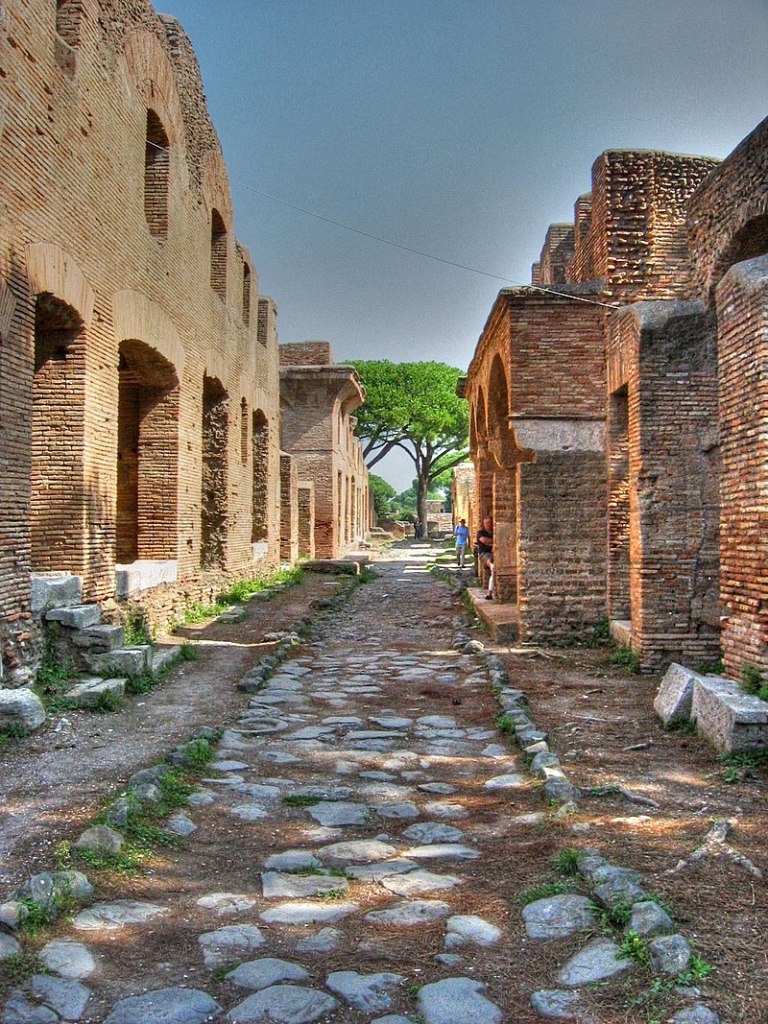
The three-story house was filled with people, all the lamps were lit, and it was a Mediterranean evening. Lamps in the first century usually emitted a great deal of smoke and it would have become hard to breathe, so, since the crowd was staying in one spot for a long time, shutters were opened to allow fresh air in. All this to say, hot and stuffy. With not a lot of movement, with dinner in their bellies, and the length of time they were sitting still, young man Eutychus nodded off.

This happens. Who can blame him? I get sleepy at all-day meetings when they resume after lunch. The difference is, Eutychus was perched on the open windowsill. When he fell asleep, he fell out the window. He fell to the ground and was pronounced dead.

Imagine the scene. Hazy, warm lamplight, wafting breeze, cicadas, a murmuring voices, all was hushed, then- SUDDEN DEATH!

What a shock!

Jerusalem old city. Photo by Levi Meir Clancy on Unsplash

On the first day of the week, when we were gathered together to break bread, Paul began talking to them, intending to leave the next day, and he prolonged his message until midnight. There were many lamps in the upstairs room where we were gathered together. And there was a young man named Eutychus sitting on the window sill, sinking into a deep sleep; and as Paul kept on talking, Eutychus was overcome by sleep and fell down from the third floor, and was picked up dead. But Paul went down and fell upon him, and after embracing him, he said, “Do not be troubled, for he is still alive. When Paul had gone back up and had broken the bread and eaten, he talked with them a long while until daybreak, and then left. They took away the boy alive, and were greatly comforted. (Acts 20:7-12).

They didn’t have to plan a funeral but could continue to learn from Paul immediately and deepen their love for the Lord through His word!

See similar event in 1 Kings 17:21 where Elijah also fell on the widow’s son and asked the Lord to resurrect the lad. And the same in 2 Kings 4:34 with Elisha.

Eutychus was dead. Not mostly dead, but all dead. The first century people saw death often. They knew dead. Luke the physician wrote Acts, he records that Eutychus was dead, and Luke would know. Yet Eutychus came alive!

Imagine having your name inscripturated forever. You’re mentioned in God’s holy word! Anna’s faithfulness, Mary’s submission, Lydia’s hospitality…wow. And on the flip side, also Jezebel forever linked with deep evil. Cain always known as the rebel. And more innocently, Eutychus, the sleeper, lol. Forever known as the guy who fell asleep.

But the positives are these. He was young, but desired to attend a meeting where Paul would be preaching. He didn’t say instead, ‘I’ve got sheep to herd or nets to fix or a girl to date.’ He chose to go and be present where the word of God was taught. Sleepiness at midnight is normal, but then he became the central figure in a display of the power of God! God can resurrect the dead, using ordinary men like Paul and young men like Eutychus!

So now, Eutychus is forever known as the man whom God resurrected from the dead! The man God obviously had plans for. I wonder how Eutychus lived his life for Christ in his remaining days on earth.

The scene in the home where Eutychus fell, crowded with earnest and eager listeners, desiring to have a firehose of theology aimed at them, clinging to as much as they can from the learned lecturer, reminds me of another scene in these present days.

It happened shortly after the Iron Curtain fell and the Soviet Union disintegrated. The loosely united regions and nations under Russian control splintered into their own little countries, and Kazakhstan was one of them. Pastors who had been persecuted or exiled collected in a first-ever conference, and who did they ask to come and teach them? John MacArthur.

They gave MacArthur 6 days to teach them all the doctrines of the Bible. 1600 men came from all over the region, traveling and staying where they could. They crowded into hot, stuffy room to listen to Dr MacArthur and be taught all day and all night, previously not having had the benefit of seminaries or even openly learning because of the atheistic Communist regime which oppressed them. MacArthur said the sessions were about 12 hours long.

Such things as the Eutychus house still happen. Anywhere or at any period of time on earth, if there are people of the Lord there will be people eager to gather and learn more about Him. Eutychus’ time wasn’t up, the Lord had more of a number of days for him. And we will meet him in heaven! Remember, the people we read about in the Bible are real, and those who are said to be believers we will see and commune with in heaven, praising our Savior!


Sources:

EUTYCHUS IN TROAS: THE ARCHITECTURE AND ARCHAEOLOGY OF HIS FALL by Mark Wilson in Biblica.

Roman domestic architecture: the insula By SmartHistory

Logos 9 Bible Software.

Other entries in the series:

Little Known Bible Characters #8: Tryphena and Tryphosa
Little Known Bible Characters #7: Salome
Little Known Bible Characters #6: King Chedorlaomer
Little Known Bible Characters #5: Harbonah the Eunuch
Little Known Bible Characters #4: Eutychus
Little Known Bible Characters #3: Trophimus
Little Known Bible Characters #2: ‘The List of Offenders’
Little Known Bible Characters #1: Iddo
Posted in theology

Little Known Bible Characters #3: Trophimus

By Elizabeth Prata

Little Known Bible Characters #8: Tryphena and Tryphosa
Little Known Bible Characters #7: Salome
Little Known Bible Characters #6: King Chedorlaomer
Little Known Bible Characters #5: Harbonah the Eunuch
Little Known Bible Characters #4: Eutychus
Little Known Bible Characters #3: Trophimus
Little Known Bible Characters #2: ‘The List of Offenders’
Little Known Bible Characters #1: Iddo

Paul made three major missionary journeys. Acts 20 records the 3rd. He had spent 3 months in Greece, then planned to get on a boat in Corinth and set sail for Jerusalem via Syria, but he learned that some Jews were plotting to grab him for nefarious purposes on the voyage, so he decided to return to Macedonia by land. So Paul went from Corinth to Berea, Thessalonica, and Philippi, caught up with Luke again and observed Passover.

From Philippi, Paul and Luke set sail for Troas, arriving there five days later and meeting Paul’s traveling companions who had gone ahead of them: Timothy, Sopater, Aristarchus, Secundus, Gaius, Tychicus, and Trophimus. This is where we meet Trophimus.

And he was accompanied by Sopater of Berea, the son of Pyrrhus, and by Aristarchus and Secundus of the Thessalonians, and Gaius of Derbe, and Timothy, and Tychicus and Trophimus of Asia. (Acts 20:4).

Miletus was about 36 miles from Ephesus. Map source

Trophimus was mentioned three times in the Bible, in verse above in Acts 20:4, and also Acts 21:29, and 2 Timothy 4:20.

For they had previously seen Trophimus the Ephesian in the city with him, and they supposed that Paul had brought him into the temple. (Acts 21:29).

Erastus remained at Corinth, but Trophimus I left sick at Miletus. (2 Timothy 4:20).

Trophimus was from the Roman province of Asia and was living in or was from Ephesus. He was a Greek Christian. As we saw from the first mention of him in the verse, Trophimus was one of seven disciples mentioned by name who accompanied Paul on his return to Macedonia (Acts 20:3–4), meaning, the others to whom Paul was writing probably knew Trophimus personally, or knew OF him. These seven men formed an envoy from the various churches at Asia. They protected Paul, as it was better to travel in numbers. They also helped deliver the contributions from the churches of Asia to the saints in Jerusalem at the end of Paul’s third missionary journey (2 Corinthians 8:2–3). The delegation left Paul in Macedonia and traveled to Troas to wait for Paul and Luke to join them (Acts 20:4–6).

When they met up again, the men, including Trophimus, stayed together for a week. Imagine the theological conversations they must have held! The joy of being together!

Next time we read of Trophimus, it isn’t so joyous. We read of poor Trophimus being accused of having gone into the Temple with Paul, which uncircumcised Gentiles were not allowed to do. The Jews at that time were insisting that one had to become a Jew first in order to become a Christian. They leaped on the opportunity to accuse Paul of bringing Trophimus into the temple in order to get to Paul. And they did as much, dragging Paul out to be murdered. Of course, the accusation was false, but Trophimus’ name was used for evil purposes and he was innocently at the center of this controversy.

The modicum of fact lying at the root of this false accusation was that they had seen Paul and T. in each other’s company in the city. On this slender basis “they supposed” that Paul had brought T. past the barrier or middle wall of partition (Eph 2:14; see PARTITION), beyond which no Gentile was allowed to penetrate on pain of death. They supposed that T., who was neither a Jew nor a proselyte, but a gentile Christian, had been introduced into the temple itself by Paul—which would have been profanation. Hence their fury against the apostle. Source: The International Standard Bible Encyclopaedia (ISBE),. 1915.

Sometimes being Paul’s friend was dangerous!

The third time we read of Trophimus is when he had become too sick to travel. Paul had to leave him in Miletus.

As a side note: IF the miracle gifts had still been ongoing, why didn’t Paul just lay hands on his friend so he could continue the mission? Why doesn’t the verse say “Trophimus was sick in Miletus but I laid hands on him and by grace of God he used me to heal my friend.” Or something to that effect. 2 Timothy was written in 64/65 AD, and the sign gifts were well and truly dying out by then. The were for a sign to authenticate the Apostles and since it was nigh on 30 years since Jesus had departed and at least 20 years since the first NT book was written, the need to authenticate the ministers of God was lessening by the day.

In the previous book, 1 Timothy 5:23 written a few years before, Paul had advised Timothy to take wine for his stomach ailments.

Anyway, Trophimus was sick a few years after we last read of him, we know not with what, but was serious enough to cause Paul to have to leave T. behind. But not alone. We read in Acts 20:17 Paul had previously sent for some elders to come from Ephesus, which they did. It was an easy travel jaunt. Therefore, Paul was not abandoning his trusted friend and traveling companion to the wilds,

Trophimus, therefore, in his sickness, could easily reach Ephesus, or his friends from that city could quickly come to him at Miletus, and give him whatever attention and nursing he might require.” ISBE

Keep in mind that these people we read about in the Bible are real people. They are alive now. We will meet them in heaven and commune with them. We can sit with Trophimus and talk with him about his sickness, his association with Paul at the temple, his missionary journeys. That’s why I write about the ‘little known’ Bible characters. Someday we will fully know them, and they will fully know us. What a day that will be.

Little Known Bible Characters #8: Tryphena and Tryphosa
Little Known Bible Characters #7: Salome
Little Known Bible Characters #6: King Chedorlaomer
Little Known Bible Characters #5: Harbonah the Eunuch
Little Known Bible Characters #4: Eutychus
Little Known Bible Characters #3: Trophimus
Little Known Bible Characters #2: ‘The List of Offenders’
Little Known Bible Characters #1: Iddo

Posted in theology

Little Known Bible Characters #2: ‘The List of Offenders’

By Elizabeth Prata

Little Known Bible Characters #8: Tryphena and Tryphosa
Little Known Bible Characters #7: Salome
Little Known Bible Characters #6: King Chedorlaomer
Little Known Bible Characters #5: Harbonah the Eunuch
Little Known Bible Characters #4: Eutychus
Little Known Bible Characters #3: Trophimus
Little Known Bible Characters #2: ‘The List of Offenders’
Little Known Bible Characters #1: Iddo

Photo by Chela B. on Unsplash

I started an occasional series covering little known Bible characters. These are men or women who are named in the Bible, but we do not know much about apart from their names. Though, the Word of God is always worth plumbing its depths, and we can elicit from the text more than we think.

I had thought of several people named in the New Testament to focus on, but as our teaching elder concluded his series on Ezra, the last chapter listed by name, many offenders. That is what the section of text is called in my NASB Bible, “The List of Offenders”.

And among the sons of the priests there were found that had taken strange wives: namely,… (Ezra 1018a).

GIll’s Exposition:

And among the sons of the priests there were found that had taken strange wives,…. So that it need not be wondered at that this evil should spread among the people, when those who understood the law, and should have instructed the people in it, set such an example: namely:
of the sons of Jeshua the son of Jozadak; who was the high priest; and perhaps for this fault of his, in not restraining his sons from such unlawful marriages, is he represented in filthy garments, Zechariah 3:3, and his brethren, Maaseiah, and Eliezer, and Jarib, and Gedaliah; these were the brethren of Jeshua
.

The Holy Spirit chose to name the men who had grievously sinned by marrying foreign women who brought foreign idols into the sheepfold. The offense was not marrying women of different race or ethnicity, but that they worshiped other gods.

We saw the problem when Solomon married foreign wives who worshiped other gods.

Again, it wasn’t their ethnicity. Canaanite Rahab converted and married Joshua, Moses married Zipporah a Cushite, Ruth was a Moabite.

Do not be mismatched with unbelievers; for what do righteousness and lawlessness share together, or what does light have in common with darkness? (2 Corinthians 6:14).

and you might take some of his daughters for your sons, and his daughters might prostitute themselves with their gods and cause your sons also to prostitute themselves with their gods. (Exodus 34:16)

There were only about 100 or so who intermarried, among tens of thousands of returnees from Babylon, but remember a little leaven… spreads like gangrene. Ezra was so appalled he tore his clothes, his hair, and his beard, and sat in a puddle of prayers appealing to God for mercy.

Every man who had married an unbeliever and thus brought idolatry into Israel was named. This is the “List of Offenders” at the end of Ezra 10.

Imagine…being named in the Bible. So many people were named as a congratulations for their faith. There’s Hebrews Hall of Faith in chapter 11, where men and women are expressly named and commended.

The positively named in Hebrews are, Enoch, Noah, Abraham, Sarah, Isaac, Moses’ parents, Moses, Rahab, Gideon, Barak, Samson, Jephthah, David, Samuel, and the prophets.

Others from the New Testament were named for their faith and/or service also: Anna, Mary, Dorcas, Lydia, Tychicus, and many others of course. We can be sure when they arrived in God’s holy abode in heaven, Jesus was pleased to say to them, “His master said to him, ‘Well done, good and faithful slave. You were faithful with a few things, I will put you in charge of many things; enter the joy of your master.'” (Matthew 25:21)

But to be named in the Bible because of your sin, enscripturated forever as an example of disobedience, what a woe and embarrassment to them! And what a warning to us.

–Sin is a corrupting influence
–Leaders should be an example to the positive, not the negative
–Sin hurts the reputation of the church and brings reproach to the name of Jesus.

Sin must be dealt with. If we don’t address it with genuine repentance, God will.

In this New Testament era, our names are written in heaven in the Book of Life. What a grace, mercy, and gift! Let us be thankful and do our best to follow the Lord’s statues in obedience as a thank you in return.

Instruct me, O Yahweh, in the way of Your statutes, That I may observe it to the end. (Psalm 119:33).


Further Resources

Little Known Bible Characters #8: Tryphena and Tryphosa
Little Known Bible Characters #7: Salome
Little Known Bible Characters #6: King Chedorlaomer
Little Known Bible Characters #5: Harbonah the Eunuch
Little Known Bible Characters #4: Eutychus
Little Known Bible Characters #3: Trophimus
Little Known Bible Characters #2: ‘The List of Offenders’
Little Known Bible Characters #1: Iddo

Posted in theology

Little Known Bible Characters #1: Iddo

By Elizabeth Prata

Little Known Bible Characters #8: Tryphena and Tryphosa
Little Known Bible Characters #7: Salome
Little Known Bible Characters #6: King Chedorlaomer
Little Known Bible Characters #5: Harbonah the Eunuch
Little Known Bible Characters #4: Eutychus
Little Known Bible Characters #3: Trophimus
Little Known Bible Characters #2: ‘The List of Offenders’
Little Known Bible Characters #1: Iddo

(Cropped)Art is The neo-gothic fresco of big prophets Isaiah, Jeremiah, Ezekiel, Daniel by Leopold Bruckner from end of 19. cent. in Saint Nicholas church.

When I read the Bible and someone is named that I am not too familiar with, it makes me curious. I’ll never get tired of studying Paul or Peter or John or Stephen or Lydia…but then someone is mentioned and I go “Another person to get to know! Who was h/she?” Like, Tychicus, Eutychus (the guy who fell out the window during Paul’s long sermon), Chloe, Rufus, and so many others.

These were real people. They were fellow believers and part of the body. We will meet them in heaven. So let’s take a look in this new series, at some names of folks we don’t know much about.

While there may not be a huge amount the Bible says about these folks, studying what we do know we will learn there is more than we think.

PROPHETS

The Old Testament is divided into Law, Wisdom, History, and Prophets. Of the Prophets, there are whole books dedicated to these men and the words God used their mouths to utter. The Major Prophets, so called because their books were longer, not because they were more important than any other book, were Isaiah, Jeremiah, Lamentations, Ezekiel, Daniel. There were the Minor Prophets, so called because their books were shorter, Hosea, Joel, Amos, Obadiah, Jonah, Micah, Nahum, Habakkuk, Zephaniah, Haggai, Zechariah, Malachi.

But those were not ALL the prophets operating in the Old Testament (or the New). There were others named and many others in the School of Prophets who were not named.

Of the named Prophets who do not have a book about them or written by them, there is one called Iddo.

He is listed in a verse along with Nathan the Prophet, and Iddo is named as a seer. There are many definitions and suppositions about the seers and their differences in operation to the Prophets, which I won’t get into. Except to paste what The Lexham Bible Dictionary has to say,

Generally synonymous with the role of the prophet (e.g., 2 Sam 24:11; 1 Chr 21:9; Amos 7:12). However, at times, it is used as a distinct term from that of prophet (2 Kgs 17:13). Seer, by connotation of the Hebrew word affiliated with it being connected to the idea of receiving a vision (חֹזֶה, chozeh), may be more connected to the idea of visions than the prophetic word, although this is not necessarily the case in all usages.

An additional term used for “seer” does not necessarily evoke the connotation of one who receives a vision but does evoke the idea of seeing (רֹאֶה, ro’eh; e.g., Isa 30:10). Nonetheless, even this term is used synonymously with “prophet”; this point is explicitly made in an aside in 1 Sam 9:9: “Formerly in Israel, when a man went to inquire of God, he would say: ‘Come, let us go up to the seer.’ For the prophet of today was formerly called a seer” (compare 1 Sam 9:19). A “Chronicle of the Seers” is also mentioned in 2 Chr 33:19.

Source Barry, J. D. (2016). Seer. In The Lexham Bible Dictionary. Lexham Press.

Cleared that right up, didn’t it? Not so much.

Iddo the name means lovely, his beloved, or His love. Iddo was was contemporary to Solomon and Rehoboam. We read this specific Iddo (for there are others named Iddo in the Old Testament), three times in the OT:

Now the rest of the acts of Abijah, and his ways and his words are written in the treatise of the prophet Iddo. (2 Chronicles 13:22)

The Death of Solomon
Now the rest of the acts of Solomon, from first to last, are they not written in the chronicles of Nathan the prophet, and in the prophecy of Ahijah the Shilonite, and in the visions of Iddo the seer concerning Jeroboam the son of Nebat? (2 Chronicles 9:29)

Now the acts of Rehoboam, from first to last, are they not written in the records of Shemaiah the prophet and of Iddo the seer, according to genealogical record? Now there were wars between Rehoboam and Jeroboam all their days. (2 Chronicles 12:15).

Iddo prophesied against Jeroboam. He also seems to have written stories about the lives of the Kings and events in Israel and Judah, but
those stories have not been included in the canon.

Some claim these writings of Iddo were “lost,” but Yahweh never loses anything and has perfectly preserved His word through centuries. His Spirit has inspired men to include exactly what God wanted included in the canon. If it’s not in the canon, it isn’t meant for us, as God considered it unnecessary for our edification. The Bible is all-sufficient.

Iddo may also be the grandfather of the minor prophet Zechariah (see Zechariah 1:1,7) but there is much discussion as to whether this is the same Iddo.

Hard tellin’ not knowin’, as the saying goes.

And that is all I could find out about Iddo! Blessings, and thank you for reading.

Further Reading

Understanding the Prophets (including seers) from Ligonier

What was a seer in the Bible? from GotQuestions


Posted in theology

Ken Alexander’s messages to me about his wife Lori, The Transformed Wife, @godlywomanhood

By Elizabeth Prata

It’s all because of this article-

When I published that discernment article exposing some major doctrinal and behavioral issues with The Transformed Wife (Lori and Ken Alexander)’s output, there was quite a bit of reaction. One of the reactions was Lori’s husband Ken messaged me on Facebook. I did not solicit nor expect a personal private message, and not from a married man, no less. As you read the correspondence, please keep in mind that I have no relationship with Mr Alexander, personal or spiritual, I did not invite the messaging, and I tried to cut it off, but he breached that boundary of non-consent.

I have the screenshots.

People who message have a reasonable expectation of privacy. Normally I keep messages private and do not publish messages. (Sometimes I ask permission to publish if a reader has offered a really good thought or blog idea, and I publish if yes or no if they say no). However when Ken contacted me again after I’d asked him not to, all bets were off.

As you read this, keep in mind also that he claims identity in Christ as a Godly man.

So here it all is. Explanation at bottom. I refrained from editorializing as much as I could and tried to give you just the facts. You decide. I might have erred in replying. My goal and intent was to try and get him to see the issues and hopefully repent. I tried. Maybe that was my mistake. Again, you decide.


MESSAGE from Ken Alexander. His wife had already blocked me after 1 engagement which she initiated. I believe she blocked me because I’d asked her if she had repented of her false teaching of Pelagianism. Lori never answered that. Neither did Ken when I asked him. I did not solicit this contact. Ken wrote right off the bat that I’m influenced by satan. So much for pleasant contact:

Hi Elizabeth,

After reading your article on Lori I could not recognize my own wife by the time you were done.

I found it interesting that you claim she is unteachable, yet when she makes her position clear on Original Sin in a post you gloss it over as “too little too late.”

We raised four wonderful Children together with strong and reasonable discipline… and they are all secure Believers in Christ with highly successful lives and families of their own. You’re just dead wrong on this idea of “hitting.” It’s spanking and there is very little cold in So Cal. How did you do with your family and kids?

Lori says that some time back you praised her ministry and agreed with her, yet somehow you caught Satan’s whisper and have been quite undiscerning here. You sound like a post from the trolls you are listening to.

She is full of love and grace, but hard hitting because she is goes up against the strong influence of feminism. You are correct that she purposely avoids the teaching the man’s role to keep women focused on what God calls them to do without pointing a finger at their disobedient husband they are called to win.

Lori’s ministry is not perfect, just as you have now proven that yours is not either. But many women write her regularly with wonderful stories of changed lives and marriages, proof that God is using her and blessing her God given wisdom from the Word. We don’t expect everyone to agree with her… even I don’t 100% 🙂. But when you attack one of the few godly women teaching the vital principles of Biblical Womanhood you do a disservice to the advancement of the Kingdom of God. She is teaching things that you and many other women cannot teach because she walks the talk with her life and love of our Jesus.

Thanks for listening and have a great life. Ken


Photo by Eric Prouzet on Unsplash

Ken wrote again before I even saw his 1st message and could reply:

Ken’s MESSAGE

I just read this by you and wonder if the Lord wasn’t telling you something, yet you projected it upon others without careful reflection for the words you just wrote against another sister in Christ?

It’s something to ponder in the Spirit as you asked others to do the same. 🙂

“It is humbling to publicly repent of something done in sin or taught incorrectly in His name. It is humbling to eat crow. But pride should not be so strong that it prevents us from kneeling down and saying “I was wrong. Forgive me.”


 My reply to the above Ken-messages #1 & 2: I wrote-

Lori’s ministry is exactly as I described. The measure of a ministry is not how many people are writing in, but how doctrinally correct it is. She is an obviously troubled woman dwelling in error, and leading many astray. You have your part in that. Your influences such as the Pearls are atrocious, and this error has flowed down into your own ministry to your wife and her errant ministry to women. Her insistence that the Pearls, Partridge, and Gothard are worthy models, and her excuses for lack of sexual boundaries with wives and lack of boundaries in child punishment is appalling. Repent of those things and I’ll listen.

The Pharisees were ‘hard hitting’ too, and they were mostly right on their doctrine but went beyond by adding and adding, and by the guilt (‘millstone’) laid upon the neck of the sheep. You need to repent too for your part in the devastating millstones, and graceless absolutes you teach your wife to lay on women.

As far as the Original Sin controversy, I asked Lori if she has repented of her previous stance that we are not born as sinners but only BECOME sinners when we sin. It was not answered. HAVE you repented of that?

Your statement that Lori is one of “few godly women teaching the vital principles of Biblical Womanhood” is evidence of how skewed your vision has become. Lori is NOT one of the few women teaching this. You are NOT a bulwark. (And she doesn’t even teach it correctly or evenly).

She should look at gracious and doctrinally correct models such as The Women’s Hope Show from The Master’s Seminary, A Word Fitly Spoken podcast (Spreeman & Lesley), Open Hearts in a Closed World online conference and all women associated with that, DebbieLynne Kespert, Susan Heck, and MANY others who believe as you and Lori do, but who have a balanced view of scripture, and a FULL Titus 2:5 wisdom that includes being “sensible, … kind” but are missing from Lori’s online presence.

I have prayed for her and I do hope the Lord will graciously lift the scales from your and her eyes. Something to ponder and I am not being snarky, I am totally grieved over this. Consider, repent, and then we can talk some more. I’m always willing to listen.


Repentance was not forthcoming. Photo by Alex Shute on Unsplash.

Ken’s message , replying to my above: [Editor’s Note- Yes their lives ARE an open book. Lori and Ken have kept a blog for 12 years with hundreds of thousands of words written, 6 years’ worth of hours of video, and thousands of tweets. Yes their lives ‘are an open book,’ therefore there’s much material available to evaluate in order to make a solid assessment of their lives.] Ken wrote:

Elisabeth, I have no idea who you are really, but our lives are open book. Your comment “She is an obviously troubled woman dwelling in error, and leading many astray,” is so very far from the truth.

Lori is a woman whose heart is set completely upon the Lord. She has proven herself to her husband and to her family, friends and online friends as a woman of grace, peace, joy and full of the fruits of the Spirit. How can you make such an awful and incorrect assessment of her and expect me to take you seriously?


It’s not going well for me, is it? Photo by Dawin Rizzo on Unsplash

Ken then messaged again before I could reply. By now I’m getting the idea he lacks patience and self-control. Ken’s message -

If you want to dialogue, pick one or two issues you believe she is “so wrong about” that her errors are worthy of you trying to destroy her ministry over… and let’s talk about them. There are no grave errors in her teaching, just a difference of opinion on things we cannot have a definitive answer about.

You cannot prove from the scriptures that woman should be teaching doctrine and theology. WE know for certain it must not be from the pulpit, but where do you get the authority for women to teach other women outside of Titus 2?

So you and Lori disagree on something… that is not grounds to disqualify her God given ministry.

Child discipline… you know nothing about our child discipline but for a few stories from the trolls you disagree with. You are welcome to disagree, but you are not welcome to mischaracterize the facts that you do not possess. There were no freezing children that Christmas morning, and the discipline was appropriate and well received. A story we all laugh about including the kids. Yet you want to portray it as wring and grounds for disqualification of a ministry?

My question to you is why did you lie about what I wrote to you? You attacked Lori on at least 10-12 things and I challenged you on 3 of them. Yet you write on your page that I challenged you on “everything.” That is not true… why tell falsehoods?

The pattern seems clear to me that you are one who God keeps telling you to repent of your attacks on others, show kindness and grace, yet you have done nothing of the kind yourself. Speaking of Pharisees… you might consider talking the log out of your eye before trying to remove the specks from others.

I have not read any of the rest of your stuff, but I understand that you can be ruthless in your writing, betraying your own stated purpose: “Writing ministry of The End Time, by Elizabeth Prata, Exalting name of Jesus through Christian essays.”

Please prayerfully consider the words my Spirit has given for yours. We are all about trying to build up the kingdom of God, and Lori’s ministry will not be perfect… neither yours. But as far as I know we are on the same team Jesus.


‘You’re a ruthless liar’… ‘We build up the kingdom of God’. Bit of a disconnect
.Photo by nega on Unsplash

My reply to Ken’s message . I kept it short thinking he’d said all that needed to be said and I was done too.

Thanks. I ask you to do the same. Have a pleasant day.

(He gave it a thumbs up in reply)


Ken’s message : out of the blue hours later. I had not replied.

Some of the things you write must be a joke: “I wrote about how Lori’s insistence on not teaching anything except home economics from Titus 2 (a stance which, even then, lacks several aspects of the verse, such as kindness, sensibility, reverence, etc).”

Lori has not only taught on all these subjects extensively but she has a book out with a chapter on each one.

You really need to find the Spirit here. I have never heard her equate Titus 2 with Home Economics. Now your just making up lies.


Mark Jay Goebel/Getty Images

Obviously I’d get nowhere with a man who has that little self-respect and that much anger, to think himself a Christian and called me a troll, a liar, a joke, making up lies listening to satan, not walking the walk, so much ad hominem… but not an ounce of self-reflection. I’d had enough: My reply to Ken Message .

Please do not contact me again. And repent of your rough mouth. “For out of the heart come evil thoughts, murders, acts of adultery, other immoral sexual acts, thefts, false testimonies, and slanderous statements.” Mt 15:19

Photo by Shelter on Unsplash

Ken disrespected my boundary and in a shocking lack of self-control, contacted me again: Ken message :

It’s interesting how often the Spirit gives you thoughts that you should be applying to yourself, yet you ignore them. May He open up your hardened heart to see what you are doing is not glorifying to Him.

I think we are on the same Team Jesus…. I sure hope so.


The line must be drawn here. This far, no further!

My reply to unasked for Ken Message . I knew he’d be looking to see what I’d say so I waited until the little circle showed he had read my reply below, then I blocked him.

“BLOCKED and REPORTED for HARASSMENT”

PS: I tried to find the Facebook information on harassment but had a hard time finding it, and when I finally did and read it, decided his correspondence didn’t rise to the level of harassing. He was just more of an annoyance.

—–end correspondence—–

The reference to the children and the hitting and the cold was a story Lori had published about a Christmas morning when she came downstairs to see her 1, 3, 5, 7 year olds had opened up every single present. She was “so upset” and began hitting her kids with her slipper hard enough to “let them know she was clearly angry”. Running upstairs to Ken he came down and put all of them outside on the porch to them the shutting out of the Garden of Eden, so the 1 year old and the others “could ponder their sin.” Later Ken relished the memory by saying they were ‘so cute all lined up out there.’ Ken and Lori are careful nowadays to say ‘swat’ or ‘spank’ instead of hit or beat. He dislikes when I say “hit”.

Anyway I wanted the messages to be public so it would be transparent, not only his behavior, but mine too. So you can decide. A journalist puts the information out there in the most credible and factual way possible, and so that the reader can make her own assessment.

As a journalist, I am familiar with how people act when their worldview is challenged. I know what happens with some, who, when presented with facts contrary to their long-held opinion, act up. I’m used to people like Ken Alexander.

But the issue is: he is half of the Transformed Wife’s ministry He is an overseer of it, contributing author to it, and ultimate teacher within it. A student will go no higher than his teacher, so, my goal is to present information that clearly shows that the Transformed Wife’s ministry is not healthy. Ken and Lori Alexander should not be followed.

My goal, sole goal, is to present information about this self-stated ‘ministry’ of Lori Alexander, The Transformed Wife, which is partnered by Ken Alexander, that demonstrate that the two of them are to be marked and avoided as false teachers. Their issues, both behavioral and doctrinal, give a clear picture that their material should not be consumed. Stay away.

Posted in biodiversity, israel, jerusalem

Great Cities of the Bible #4: Jerusalem

By Elizabeth Prata

Great Cities of the Bible #1: Damascus
Great Cities of the Bible #2: Babylon
Great Cities of the Bible #3: Rome
Great Cities of the Bible #4: Jerusalem
Great Cities of the Bible #5: Capernaum

It all begins and ends with Jerusalem.

Actually let’s back up a bit. It all begins and ends with God.

Sunset at Jerusalem. Source Faithlife media

Before the foundation of the world, God determined in His mind and His heart to select a people for Himself to have fellowship with. (Ephesians 1:4). He began with Adam and Eve, then made covenants through Noah, Abraham, David, and the entire People Israel. He revealed His extended operations and dealings with man by grafting in the Gentiles (all the world) to His promises of Redemption and grace through faith with any person who repents to Jesus, God’s Son.

Through all this Jerusalem has remained for almost the entire period the central city of God. Earlier named Salem, when we meet King Melchizedek of Salem, this city of Jerusalem is the true eternal city, not Rome as man has dubbed that ancient urban center.

Jerusalem! It is the eternal city, (Psalm 46:4Revelation 3:12) God’s city where He has set His name, (1 Kings 11:362 Chronicles 12:13) and is the city in which Immanuel (Matthew 1:23) will dwell in all His glory, (Zechariah 8:3) calling it Jehovah Shammah, The Lord is There. (Ezekiel 48:35). It is the nickname He uses when he calls His people. (Zechariah 3:2). When Jesus returns, “Then Jerusalem will be called the City of Truth, and the mountain of Yahweh of hosts will be called the Holy Mountain.'” Says Zechariah 8:3.

It is a place that figures solely as the most important land, city, and people in the history of the earth. All of history is dwindling down to one focal point: Jerusalem. So let’s take a look at this incredible place.


In all of history, there’s never been a distinct people group who dwelled outside of a national homeland for thousands of years yet retained their identity like the Jewish people have. There has never been a people on earth restored to their homeland after dozens of generations. There has never been a case where generations upon generations who forgot their own language and let it die, had it restored to the entire nation. No people, that is, except for God’s people in God’s land and in God’s city- Jerusalem. This is God’s hand.

This tiny nation is mighty in many ways, because her very existence has generated hate and war since her birth. Just existing provokes the entire world into hating her. Allowing her to make her own sovereign decisions as a nation inflames the world (satan).

Ancient maps placed Jerusalem in the center of the page. They knew that Jerusalem is God’s city and is the fulcrum of history, the axle of the wheel, and the center of the world stage. In the Jewish tradition, the Ark in the Temple in Jerusalem, through which God dealt with his people through the High Priest, it is the Foundation marking the “navel of world”. Ezekiel 5:5, “This is Jerusalem; I have set her at the center of the nations.

We read a similar reference in Ezekiel 38:2, “to seize spoil and carry off plunder, to turn your hand against the waste places that are now inhabited, and the people who were gathered from the nations, who have acquired livestock and goods, who dwell at the center of the earth.”

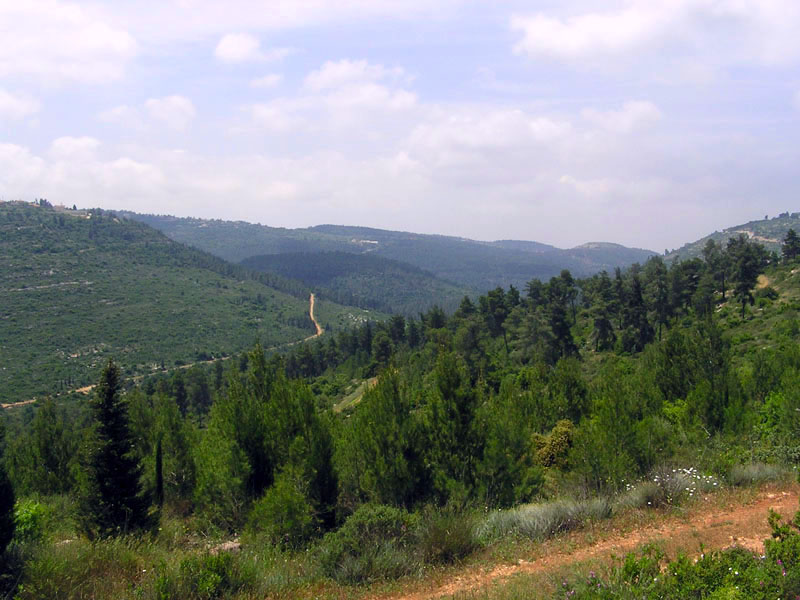
And what of this land? What is it like? It is wonderful! From deserts of the southern Negev to the snow-capped mountains to the north, to the 270 miles of coastline along the Mediterranean and to the frontier at the east, it is a diverse land.

Mountains of Judea, source Wikipedia commons
Northern coast. Source Wikipedia commons
Jordan’s Rift Valley, Source Wikipedia commons
Acacia tree in Negev Desert, Makhtesh Gadol, Wiki photo

Jerusalem itself is about 2500 feet in elevation. It sits on a plateau within the mountains, which includes the Mount of Olives, and Mount Scopus. Valleys surround the city. We read in the Psalms some “Psalms of Ascent” because when Jews made the annual trek to the City for Passover, they climbed to the old City. They were ascending.

As the mountains surround Jerusalem, So Yahweh surrounds His people From now until forever. (Psalm 125:2).

And many mountains do surround the city, almost like a rampart. Some count the peaks numbering 7, and refer to the Revelation 17:9 verse describing a city of seven mountains upon which the harlot sits as Jerusalem, not Rome.

1. Mount Scopus,
2. Mount of Olives
3. Mount of Corruption
4. Mount Ophel
5. Mount Zion/Moriah (AKA the Temple Mount)
6. New Mount Zion
7. the Roman Antonia Fortress peak

The Kidron Valley runs to the east of Old Jerusalem and the Mount of Olives is actually separated from it. Along the southern side of old Jerusalem is the Valley of Hinnom, a steep ravine where hell or Gehenna is mentioned and the trash heaps blazed night and day. In biblical times, lush forests surrounded the city, forests of almond, pine, and olive. These forests are gone now. Due to the steep incline, farmers used a terracing system to keep the soil in place and those can still be seen today.

I’d mentioned that Jerusalem was the primary city for the Israelites for “most” of their life, but in the early years of the Israelite kingdom, the Ark of the Covenant was sometimes moved around to several sanctuaries, especially those of Shechem and Shiloh. Shiloh was the capital for almost 400 years, before the first temple was built. Jeremiah 7:12a says

“But go now to My place which was in Shiloh, where I made My name dwell at the beginning,

After King David’s capture of Jerusalem, the Ark was moved to Jerusalem. Its presence there signified the presence of the LORD within the Holy of Holies. Sadly, the people’s idolatry, bloodshed, and disobedience meant that eventually the glory would depart from the Temple (Ezekiel 9-10). This happened in advance of the Babylonian sacking of the temple. In fact, God’s glory would never again occupy a temple or a building on earth.

Today the glorious temple is mostly gone. Only the grounds and the Western Wall (a retaining wall) are left of the original building. Atop the grounds lies the Dome of the Rock, the 3rd most holy site in Islam. Will there be a third temple? Some believe so, that the events of Ezekiel 37 indicate a future restoration of the temple with Jesus bodily present and with His people:

And the nations will know that I am Yahweh who sanctifies Israel, when My sanctuary is in their midst forever.

Jerusalem today is a bustling city, the intersection of three religions- Islam, Christianity, and Judaism. One day the ‘City of Truth’ will know only 1 true religion, and its inhabitants will worship Yahweh properly. What a day that will be!

Posted in theology

Great Cities of the Bible #3: Rome

By Elizabeth Prata

Great Cities of the Bible #1: Damascus
Great Cities of the Bible #2: Babylon
Great Cities of the Bible #3: Rome
Great Cities of the Bible #4: Jerusalem
Great Cities of the Bible #5: Capernaum

Remains of the Roman Forum. EPrata photo

This is the third of a 4-part series on the Great Cities of the Bible. I’ve written about Damascus and Babylon in the first two parts. Damascus first because it is among the first cities mentioned in the Bible and is the oldest continuously inhabited city in the world. And I chose Babylon second because its presence from Genesis to Revelation dominates the Bible’s spiritual and historical landscape.

Now we turn to Rome. GotQuestions notes that – “Rome is not mentioned in the Old Testament but figures prominently in the New Testament. Although the city of Rome is not often directly mentioned, every place and event in the New Testament has Roman rule as its background.

Part of the reason I’m doing this series is because we tend to be myopic in our day and age, thinking we are the most advanced or the most sophisticated or our culture is the best. It’s hard to physically go see that in Babylon because it is mostly a ruin now. Damascus is considered to be one of the most beautiful cities in the Arab world, but sadly, the ongoing war has destroyed much of it by now. However ROME! Ahh, Rome, one can wander the streets and see many buildings from the Bible days intact. One can envision Paul standing up in court…writing his ‘Jail Epistles’ (Ephesians, Colossians, Philippians and Philemon). We can visit the Colosseum where so many Christians were martyred.

Underfloor of the Roman Colosseum, where many Christians were martyred. EPrata photo

Rome is both the city and was an Empire. It is urban setting and also a character itself in the Bible history. It is a city past from Bible days, a thriving city today, and it is an Roman empire future in prophecy. Rome was the oppressor of the Jews in Judea but its engineered roads allowed for the dispersed believers to bring the Gospel out to the world.

It was first called The Eternal City (Latin: Urbs Aeterna; Italian: La Città Eterna) by the Roman poet Tibullus in the 1st century BC, and the expression was also taken up by Ovid, Virgil, and Livy. Rome is also called “Caput Mundi” (Capital of the World).

Source

Rome is also known as the City of Seven Hills, due to the hills that it is founded on and provide a backdrop. This may become important later when in prophecy, discussed more in the postscript.

For almost a thousand years the continent’s people were either one of the unfortunate tribes conquered and absorbed into the vastly growing Roman empire, or were one of the privileged Romans citizens enjoying the engineering marvels the Romans invented and especially Pax Romana (widespread peace) during the 200 years of the Empire’s height. Paul the Apostle was a Roman Citizen, and this fact allowed him to escape one of the intended beatings, to stand in a Roman Court and plead his case, and at the end, legend says, given the less painful execution of beheading.

Rome was said to be founded around 625 BC in the areas of ancient Italy’s center known as Etruria and Latium. Etruria was home to the mysterious people of the Etruscans (from which we get the name Tuscany). Not much is known of the Etruscans, except they were a sophisticated culture, master bronzesmiths, their tombs were expertly painted, they formed city-states all over Tuscany as far south as Rome, and began sewer and other construction projects in Rome. It is said that the Etruscans had a heavy influence on the conquering Romans.

For about a hundred years or so, this merging and overlap of the Etruscans and the Romans led to the period known as the Age of Kings, which came to an end when the Etruscans disappeared, and the Roman Republic was born. (510 BC). It was during this time that Romans codified their laws and were led by the citizens (upper class senators and knights).

They continued to expand their empire with masterful military strategies and successive victories. By 338 BC they had conquered the entire Italian peninsula and a few years later gained control of the Mediterranean as a dominant maritime power.

The time of Jesus’ birth through his death & resurrection, the rise of the Church, and the last of the first generation witnesses (31BC to 90 AD and beyond) was known as the Imperial Rome era. During this period, Rome saw decades of peace, prosperity, and expansion. Its maximum land expansion occurred in about AD 117, near when Apostle John died. Its empire spanned three continents including Asia Minor, northern Africa, and most of Europe as far north as Scotland.

Unlike many other conquering empires, Rome allowed worship of personal gods. They were a pantheistic society. We remember in Daniel 1 when Nebuchadnezzar besieged and conquered Jerusalem and carried off its captives, “among them from the sons of Judah were Daniel, Hananiah, Mishael, and Azariah.7 Then the commander of the officials set names for them; and for Daniel he set the name Belteshazzar, for Hananiah Shadrach, for Mishael Meshach, and for Azariah Abed-nego.” (Daniel 1:6-7). The practice of forced assimilation was common. The boys were given new names, forced to eat what was eaten by the natives, and forced to worship what the natives worshiped, namely, the king. But unusually for an Empire, that was not Rome’s practice.

Definition: Assimilation is one outcome of acculturation. It involves the complete adoption of the ways of life of the new cultural group, resulting in the assimilated group losing nearly all of its original or native culture.

https://www.ncbi.nlm.nih.gov/books/NBK248431/box/ch1.box12/

Rome practiced assimilation. Captured peoples from the many wars were brought to Rome as slaves but allowed to practice their religion and maintain their culture. The building in Rome called The Pantheon was originally a temple built for all Roman gods, then later any gods. Pan means “all” and “theos” means “gods”.

The Pantheon in Rome, one of Rome’s best preserved buildings to this day. EPrata photo

The Roman Empire was a primarily polytheistic civilization, which meant that people recognized and worshiped multiple gods and goddesses. Despite the presence of monotheistic religions within the empire, such as Judaism and early Christianity, Romans honored multiple deities. They believed that these deities served a role in founding the Roman civilization and that they helped shape the events of people’s lives on a daily basis. Romans paid allegiance to the gods both in public spaces and in private homes. While the Roman state recognized main gods and goddesses by decorating public buildings and fountains with their images, families worshipping at home also put special emphasis on the deities of their choosing. Source

The Jews in Judea were overseen (oppressed) by Rome, which sent it governors and soldiers to keep the peace, but largely (except for taxes to keep up the empire) they were allowed to continue as they were and that included worship.

Romans built things. Bridges, temples, mansions, aqueducts, and roads. They had sewers, hot and cold running water, and spas. They had colosseums for their beloved games. It was the roads that allowed the dispersing Christians to take the Gospel to the outermost parts of the empire and beyond. It was the spread of the Latin language in the huge Empire that allowed folks to understand one another when sharing the Gospel with natives. The Roman influence on art and architecture was massive and stands to this day. They loved games and competitions, and they built amphitheaters to play them in. The round and oval stadiums we see today are derived from the Romans. They even held “naumachia” in them, or sea battles. They engineered a system where the amphitheaters could be flooded to host maritime competitions with ships!

Because of their sophisticated government, art, engineering, culture, and lifestyle, the Romans often referred to all other tribes as “barbarians.” They deeply believed they were a superior race to the Germanic tribes or the Celts, both of which they had conquered. However, the Romans for all their marvels and sophistication in the arts, were still pagans, which means, barbaric themselves. Any culture that enjoys live bloody competitions to the death, which invents crucifixion as a method of execution, or dips Christians in tar and sets them alight for garden illumination, is barbaric themselves. No veneer of art or poetry or law can hide the fact that without Christ, any society will die. And the Romans did. After its Pax Romana era came to a close, the city declined until 410 when the Visigoth King Alaric successfully sacked the city of Rome. The “Eternal City” was no more.

POSTSCRIPT

After Alaric and the beginning of the Middle Ages, Rome slowly fell under the political control of the Popes, and in the 700s, Rome became the capital of the Papal States, which lasted until 1870. Even today, Vatican City is a sovereign state inside Rome. The Pope is one of the very the last absolute monarchs on earth. An Absolute Monarchy, which Vatican City is governed by, is defined as “a form of government in which a single person—usually a king or queen—holds absolute, autocratic power. In absolute monarchies, the succession of power is typically hereditary, with the throne passing among members of a ruling family.”

Absolute monarchies, where the monarch is the final authority, are few and far between these days. There are currently five, excluding subnational monarchies: Brunei, Eswatini, Oman, Saudi Arabia and Vatican City.”

In Revelation 17:7, we read that Babylon the harlot is riding on a beast having seven heads and ten horns. The seven heads are called seven hills or seven mountains in verse 9. Everyone at the time that passage was written was so familiar with Rome being called the city of seven hills it is likely that they understood this to be Rome. As Daniel 2 describes the flow of the world empires from beginning to end in a vision of a statue, will the last empire be a revived Roman Empire? One that includes an absolute monarchy, that already exists today, led by a false prophet (of the Catholic Church?) Many think so.

Further Reading

Book- SPQR: A History of Ancient Rome by Mary Beard. (I’m reading this book. It’s good).

Essay- Rome and the Apostle Paul

Essay: What is the significance of Rome in the Bible?

Sermon: The Rise and Fall of the World part 3 (if you are interested in the revived Roman Empire)

Posted in theology

The Great Cities of the Bible #2: Babylon

By Elizabeth Prata

Great Cities of the Bible #1: Damascus
Great Cities of the Bible #2: Babylon
Great Cities of the Bible #3: Rome
Great Cities of the Bible #4: Jerusalem
Great Cities of the Bible #5: Capernaum

Ruins at Babylon. By Osama Sarm – Own work, CC BY-SA 4.0, https://commons.wikimedia.org/w/index.php?curid=48596563

Babylon. City of mystery, history, prophecy. The very name Bab-iliu means “the gate of the gods” in Akkadian, which is the oldest recorded Semitic language and the most common language of the ancient Near East until the eighth century BC.

It was founded on the great river, Euphrates, about 200 miles north of where the Euphrates joins the Tigris and drains into the Persian Gulf, two of the 4 great rivers flowing out of Eden to “water the garden”. (Genesis 2:14).

Babylon was a sacred site dedicated to the (false) god Marduk, the city’s patron god. Often Marduk’s name is included with the title ‘Bel’ to Marduk’s name to indicate supremacy of all the gods. The city’s inhabitants celebrated Marduk at the start of their new year with a festival noting his ascension as king of all gods and his seating in his temple in the city.

Marduk was mentioned in the Bible in Jeremiah 50:1–2 where Yahweh ordered Jeremiah to declare:

Babylon has been captured;
Bel has been put to shame; Marduk has been shattered;
Her images have been put to shame; her idols have been shattered.’

For two thousand years Babylon dominated Mesopotamia.

The Lexham Bible Dictionary indicates that Babylon was a “cultural and political center of Mesopotamia during much of the second and first millennia BC. Located in modern-day Iraq along one branch of the Euphrates River, about 59 miles southwest of Baghdad.

Babylon Past

Throughout the entire Bible, Babylon stands as a dominating presence as an actual historical empire but also as a symbol of spiritual apostasy and evil opposition to God and His people. Its name Babel is first found in Genesis 11:9,

Therefore is the name of it called Babel; because the Lord did there confound the language of all the earth’

Babylon is the Greek form of the name Babel. Babylon began its ascent in 2300 BC to greatness but really exploded in cultural and architectural wonders during the reign of Hammurabi in 1792 BC, the sixth king of his line. During his reign and later his son’s reign, numerous temples were built and irrigation channels were excavated. King Hammurabi also conquered all of the surrounding cities, including the famous city of “Ur” where Abraham had lived centuries before.

Hammurabi (standing) receiving his royal insignia from Shamash (or possibly Marduk) By Mbzt – Own work, CC BY 3.0, https://commons.wikimedia.org/w/index.php?curid=59794940

But like many cities, Babylon then began to decline, and this up and down swing continued until Assyria was finally defeated. It then reached another pinnacle during the reign of Nebuchadnezzar II and entrenched itself as one of the most important cities in the Near East.

“The empire had been founded by Nebuchadnezzar’s father Nabopolassar (r. 625-605 BCE) after his victories over the Assyrian Empire. Nebuchadnezzar II would go on to even greater things, including the capture of Jerusalem in 597 BCE. The Babylonian king then set about making his capital one of the most splendid cities in the world”. Source World History Encyclopedia

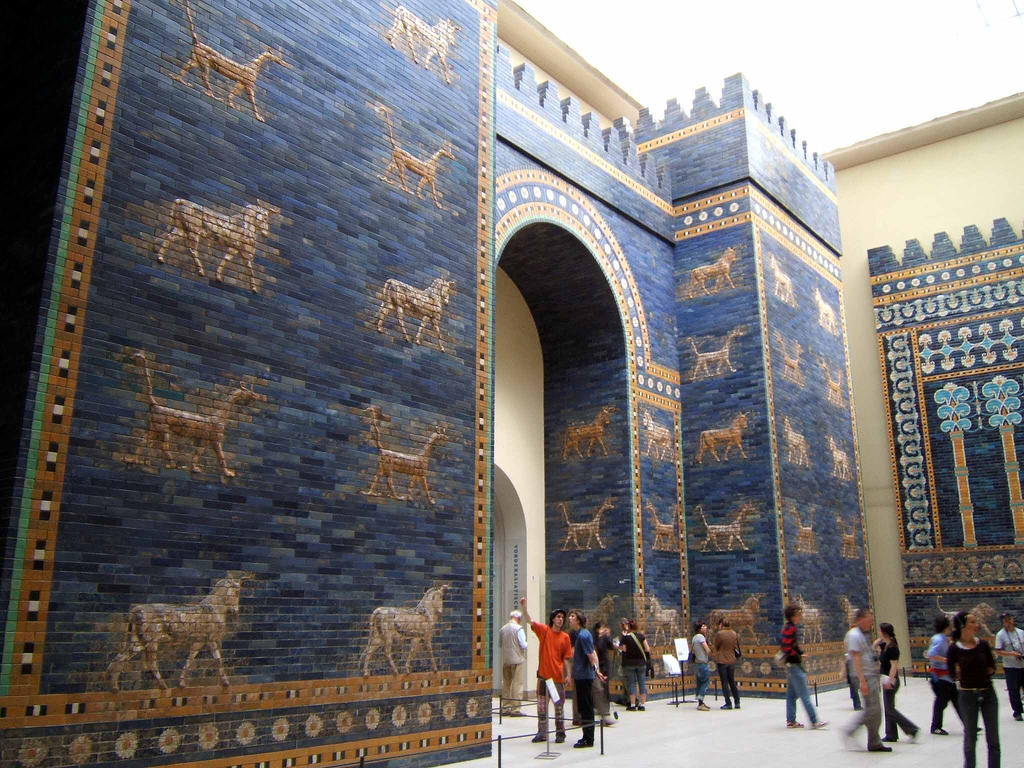
A reconstruction of the blue-tiled Ishtar Gate, which was the northern entrance to Babylon. It was named for the goddess of love and war. Bulls and dragons, symbols of the god Marduk, decorated the gate.
By Rictor Norton – https://www.flickr.com/photos/24065742@N00/151247206/, CC BY 2.0, https://commons.wikimedia.org/w/index.php?curid=1409322

Hanging Gardens

The most famous of these improvements to the city were the Hanging Gardens of Babylon, “ancient gardens considered one of the Seven Wonders of the World and thought to have been located near the royal palace in Babylonsays Encyclopedia Britannica. Though no one is quite sure where they were within the city, there were enough descriptions of them in classical literature to know that they likely existed, though no one is exactly sure of what they looked like.

The Gardens were said to be ‘hanging’ because perhaps they were perhaps on a tall ziggurat with terraces, “were set upon vaulted terraces. They were also described as having been watered by an exceptional system of irrigation and roofed with stone balconies on which were layered various materials, such as reeds, bitumen, and lead, so that the irrigation water would not seep through the terraces.”

A short video about the Gardens-

https://www.britannica.com/video/179976/creation-Nebuchadrezzar-II-designs-structure-video-Hanging

In Daniel 4:30 we read the perhaps most famous story about Babylon, where King Nebuchadnezzar admires his city from his palace rooftop, saying “‘Is this not Babylon the great, which I myself have built as a royal house by the strength of my power and for the glory of my majesty?’”

Barnes’ Notes says: “He greatly enlarged the city; built a new city on the west side of the river; reared a magnificent palace; and constructed the celebrated hanging gardens; and, in fact, made the city so different from what it was, and so greatly increased its splendor, that he could say without impropriety that he had “built” it.

Yet…the very next verse says that King Nebuchadnezzar’s pride and self-glorification was a mistake.

While the word was in the king’s mouth, there fell a voice from heaven, saying, O king Nebuchadnezzar, to thee it is spoken; The kingdom is departed from thee.

The city “under Nebuchadnezzar, who died B.C. 561 after a reign of forty-three years, attained great splendour. In the reign of Belshazzar the capital was taken by Darius the Median (Dan. 5:25–31), who entered it unexpectedly at the head of an army of Medes and Persians, as Isaiah (21:1–9) and Jeremiah (51:31) had predicted some 170 years before. Then began the decay and ruin of this proud city, and the kingdom of Babylon became a part of the Persian empire. In course of time the “great city” became “heaps,” and “an astonishment, and a hissing, without an inhabitant (Jer. 51:37–58).

“Many of the Jews who had been carried captive to Babylon remained there, notwithstanding the decree of Cyrus. After the destruction of Jerusalem there was established at Babylon a school of Jewish learning of great repute.” SourceEaston’s (1893) In Illustrated Bible Dictionary and Treasury of Biblical History.

Babylon future

Babylon is mentioned in Revelation numerous times. We read in Revelation 14:8, “and another angel, a second one, followed, saying, “Fallen, fallen is Babylon the great, she who has made all the nations drink of the wine of the wrath of her sexual immorality.

Babylon was not only a city in history, not only an empire that rose & fell, but the name Babylon is also figurative of an evil commercial-governmental system and an evil spiritual system.

Roy Gingrich interprets both the actual and the symbolic nature of Babylon:

“The fall of Babylon (Rev 14:8)-

“(1) The announcement—Another angel (other than the one in verse 6) announces the soon coming fall of Babylon. The “Babylon” mentioned here is not the religious system of chapter 17 -that “Babylon” was destroyed at the mid-point of “The Seventieth Week”. The “Babylon” mentioned here is the capital city of the political-religious-commercial system of chapter 18, which city and system will be destroyed when the Seventh bowl is poured out. God destroys her because she made the nations drink “the wine of the wrath of her fornication,” that is, because she caused them to commit spiritual fornication, which is punished by God’s wrath.” Gingrich, R. E. (2001). The Book of Revelation (p. 69). Riverside Printing.

Gingrich continues-

The destruction of religious “Babylon” as an ecclesiastical system, chapter 17. In the days of Nimrod, Gen. 10:8–12, and his wife, Semiramis, around 200 years after the Flood, two great systems came into existence, a God-defiant political system and a God-defiant religious system, the one founded by Nimrod and the other founded by Nimrod through his wife, Semiramis. These two systems are often called Political Babylon and Religious Babylon because they had their beginnings in Babylon, the one in the building of the city of Babylon and the other in the building of the tower of Babylon. The city of Babylon is the symbol of organized political rebellion against God and the tower of Babylon is the symbol of organized religious rebellion against God.” Gingrich, R. E. (2001). The Book of Revelation (pp. 76–77). Riverside Printing

“These two systems in varying forms, have continued on side by side down through the centuries, hating one another but for the sake of self-advancement, exchanging favors with one another. During the Middle Ages, these two systems were seen in the Holy Roman Empire and in the Roman Catholic Church. Today, they are seen in the United Nations Organization and in the Ecumenical Church Movement. During the first half of Daniel’s Seventieth Week, they will be seen in the Revived Roman Empire [“the Scarlet-colored beast,” Rev. 17:3] and in the rejected Lacodicean church] [“the great whore,” Rev. 17:1]. It is very helpful in understanding Rev., chap. 17, to know that “the scarlet-colored beast” and “the great whore” of chapter 17 are the final forms of two great God-defiant systems which have been in existence for over 3,000 years.” Gingrich, R. E. (2001). The Book of Revelation (pp. 76–77). Riverside Printing.

–end Gingrich quote

Babylon both actual and spiritual offer many lessons for us. Whenever I think of Dickens’ “A Tale of Two Cities” I often think of ‘Babylon & Jerusalem’. In the NT Babylon is always mentioned negatively, as a seat of evil, ungodly power. It signifies the world and its forces in opposition to God. It is often contrasted with “New Jerusalem”, in which God will finally reign supreme with no opposition ever again.

We will live in the city GOD built, not a city made by man like Assyria’s Damascus, Caesar’s Rome or Nebuchadnezzar’s Babylon. It will be a pure city, devoid of anything detracting from the glory of Jesus and his Light.

Babylon present

Whatever became of the actual, historical city of Babylon? It no longer really exists. It is a ruin, though it was opened to tourists again in 2009. There is not much to see. It is estimated that only about 5% of the old city has been excavated.

Babylon would stay under the Persian Empire’s rule for two centuries before Alexander the Great then conquered Babylon in 331 BC. He had plans to make Babylon the capital of his empire but died there in 323 BC before his dream came into reality. Alexander’s generals divided his empire among themselves immediately after his death. This is how general Seleucus obtained the historical city of Babylon. Not long after, he moved most of the population to his new capital Seleucia, which left the city decaying and deserted. Source

Will Babylon the city rise again? Only the Lord knows. Babylon the metaphor for an economy and an ecclesiastical system will indeed rise again to uncontested dominance, and be part of the major events prophesied to occur in the future, if the Babylonian system even can be said to have disappeared in the first place. Yet “Babylon” actual and Babylon figurative will finally be squashed in the future when Revelation events occur and Jesus’ wrath wipes out the evil system. The Lord as always, reigns supreme.

There will be no king looking out from his own rooftop and congratulating himself on his achievements. There will be no pagan priests celebrating a false god on a mythical throne. There will be no garden except the one the LORD himself planted, meaning, the world. It will be pure, verdant, and full of peoples who acknowledge Jesus as the supreme Lord of Lords and King of Kings. What a day that will be!

Posted in theology

The Great Cities of the Bible #1: Damascus

By Elizabeth Prata

Great Cities of the Bible #1: Damascus
Great Cities of the Bible #2: Babylon
Great Cities of the Bible #3: Rome
Great Cities of the Bible #4: Jerusalem
Great Cities of the Bible #5: Capernaum

This begins a 4-part look at some of the Great Cities of the Bible. Cities are cities, but they are also seats of Empires, also they can be backdrops or even characters in the Biblical narrative. I chose the cities of Damascus, Babylon, Rome, and finally, Jerusalem to take a closer look at.

Damascus is one of the first cities mentioned in the Bible and the oldest continuously lived-in city in the world. Babylon dominated the Near East during its time, but also is symbolic of the struggle since the Fall of man vs. God. Its backdrop flows from Genesis to Revelation! Rome was at its height during the New Testament times, was the site of 4 Epistles written there, and perhaps will be at another height again if the prophecy about a Revived Empire will indeed be Rome as many interpret. And of course I chose Jerusalem because God set His name upon it, and it will be remade new as our eternal future home!

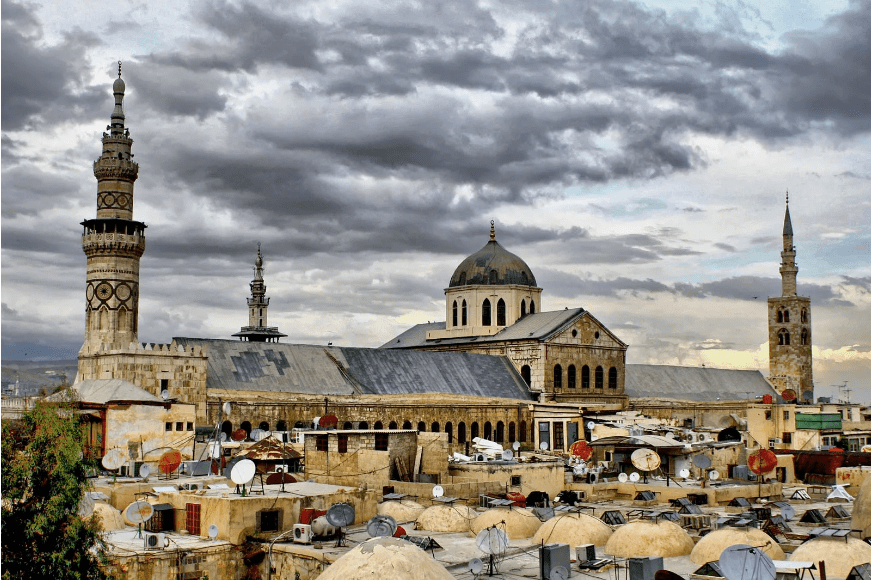
Modern Day Damascus is in Syria. It is the capital of Syria, and people have been living there since about 8000BC. When the Arameans arrived in about 3000 BC it went from villages to a notable city. That’s old!

We may think of that area of Asia as dry and dusty desert, but Damascus is considered one of the most beautiful cities in the world, as well as being ancient and notable. It is a UNESCO World Heritage site. To be sure, its dry and desert-y east is bordered by the Syrian-Arab desert and the west is bordered by the mountains of Lebanon. The mountains bar much rain from dropping on Syria. The mighty Euphrates, which represents more than 80 percent of Syria’s water resources, flows through far to the east of Damascus. Therefore, for Damascus to stay hydrated, the even more important river Barada River is the river on which the city of Damascus relies. Irrigation from the Barada River by aqueducts built during Roman times helps things along.

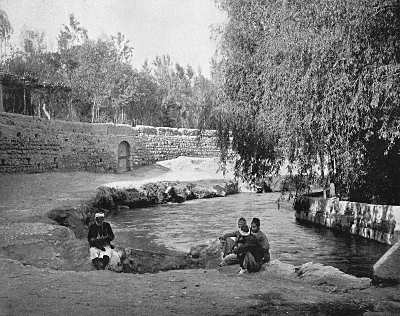
This river is divided into numberless channels and is distributed throughout Damascus and the region immediately about it. In almost every house there is a fountain, and one can stand still almost anywhere and listen to the murmur of the hidden streams that pass under and through the city. Source: Earthly Footsteps of the Man of Galilee, p. 274.)
Barada river, Damascus. Shadi Hijazi photo, CC use

Barada is identified as Abana. This river is mentioned in the Old Testament (2 Kings 5:12), when Naaman argued that its waters would be better than the Jordan for curing his leprosy.

The International Standard Bible Encyclopaedia for the ‘Abanah’ AKA Barada says-

A few miles southeast of Suk Wady Barada the volume of the stream is more than doubled by a torrent of clear, cold water from the beautifully situated spring ‛Ain Fijeh (Greek, “fountain”), after which it flows through a picturesque gorge till it reaches Damascus, whose many fountains and gardens it supplies liberally with water. In the neighborhood of Damascus a number of streams branch off from the parent river, and spread out like an opening fan on the surrounding plain”.

Speaking of those gardens, we read from the 1894 book “Earthly Footsteps of The Man of Galilee and the Journeys of His Apostles”:

“No wonder the Moslems look upon Damascus as an earthly paradise. It is encompassed by gardens and orchards. These cover an area of over twenty-five miles in circumference. Here grow olive, fig, walnut, apricot, poplar, palm, cypress and pomegranate trees. In the above view we have a scene taken from the Jerusalem road in the western part of the city, and looking to the north a ridge of Anti-Lebanon is seen straight before us. In the richness of its soil, in the salubrity and semi-tropical character of its climate, in its varied vegetation, we find the reason for the constant association of Damascus with the thought of gardens.”

“It has been for four thousand years a garden. It is surrounded for miles with this splendor of verdure. Its gardens and orchards and far-reaching groves, rich in foliage and blossoms, wrap the city around like a mantle of green velvet powdered with pearls. The apricot orchards seem to blush at their own surpassing loveliness, and the gentle breezes that rustle softly through the feathery tops of the palms are laden with the perfume of the rose and the violet. Tristram, in his account of what he saw, says:”

“Tall mud walls extended in every direction under the trees, and flowing streams of water from the Barada everywhere bubbled through the orchards, while all was alive with the song of birds and the hum of bees. The great apricot trees were laden and bent down under strings of ripe golden fruit.” Whatever changes may be made by the hand of man in Damascus, whatever changes in government and in commercial activities, the city is sure to be for all time a paradise of fertility and beauty.”

In the Bible, Damascus is first mentioned in a casual comment in Genesis 14:15 (early!). It was the situation when Lot was taken prisoner and Abram had to go rescue him.

And he divided his men against them by night, he and his servants, and struck them and pursued them as far as Hobah, which is north of Damascus.

Damascus is mentioned again in the very next chapter, Genesis 15:2. Abram noted that the only heir he had was his servant Eliezer. And Abram said, “O Lord Yahweh, what will You give me, as I go on being childless, and the heir of my house is Eliezer of Damascus?

I mentioned the Arameans above, that Damascus in Syria didn’t become notable as a city until the Arameans settled it. According to Pulpit Commentary, “The Syrians of Damascus are known in the Hebrew, AramDammesek; that is, Aram-Damascus. The inhabitants of these regions and of Mesopotamia were descended from Aram, the son of Shem, son of Noah. (Genesis 10:22)”. See how old this region is? It is really amazing.

Damascus in mentioned frequently throughout the Old and New Testaments. Damascus played a major role in waging wars against Israel. From around 900 to 721 BC Syria was a terrible fearful opponent of Israel David was much occupied with subduing uprisings and incursions from Damascus, Syria throughout his Kingship. He eventually subjugated the Arameans but they rose again after the death of Solomon.

At various times, Israel and Judah made pacts with those who controlled Damascus (1 Kgs 15:18–20). War between Asa of Judah and Baasha of Israel led Asa to use the treasury of the temple and his personal wealth to pay for the support of Damascus against Israel (1 Kgs 15:19, 20).” Source The Lexham Bible Dictionary. Lexham Press.

When you look at the city in terms of the entire history of the Old Testament, you see how much of a role the Lord had Damascus play in the intertribal wars, alliances, rising and falling of kingdoms, and all impacting the Israelites. In fact, Damascus and Israel joined forces around 734 BC to attack Judah. The war almost destroyed Jerusalem, and evil King Ahaz of Judah asked Assyria’s king Tiglath-pileser to come defend Judah from the attack.

Eventually, Damascus was conquered by Alexander the Great and the city’s fortunes declined. It was taken over in 64BC in Roman times by Pompey. That is when the aqueducts were built that shuffled water from the critically important Barada river to water the great gardens and continue cultivating the crops.

In the New Testament Damascus is mentioned several times but always relative to Saul/Paul, his trip to Damascus, and his conversion. (Acts 9:1–25; 22:5–11; 2 Cor 11:32, 33)

However, despite the 8000 years of history we can trace back to Damascus and the nation of Syria itself, there is one stark piece of prophecy which we can possibly say has not come to pass within all that history yet: Isaiah 17:1 says that Damascus will be destroyed. Never has that ancient city been uninhabited. The prophecy says that the city will be razed and made into rubble, so that no one will live there.

Behold, Damascus will cease to be a city and will become a heap of ruins. The cities of Aroer are forsaken: they shall be for flocks, which shall lie down, and none shall make them afraid.(Isaiah 17:1-2).

Was this prophecy completely fulfilled during 732 B.C. when the Assyrians under Tiglath-pileser subjugated Syria? Has the city ever been so deserted that wild animals feel safe to wander about and even lie down?

Or was it a partial fulfillment, the rest to come at a future time? Whatever the answer, we know that 2 chapters later, the Lord promised good to that region of the world. In that day…Isaiah 19:24-25 says,

In that day Israel will be the third party with Egypt and Assyria, a blessing in the midst of the earth, whom Yahweh of hosts has blessed, saying, “Blessed is Egypt My people, and Assyria the work of My hands, and Israel My inheritance.”

Barnes’ Notes, “That is, the three shall be united as one people. Instead of being rival, hostile, and contending kingdoms, they shall be united and friendly; and instead of having different and jarring religions, they shall all worship the same God. The prophecy rather refers to the spread of the true religion, and the worship of the true God.”

And what a day that will be! The tumultuous epochs of this ancient, beautiful but war-like city shall finally find peace, and so shall all the inhabitants of the earth.

Posted in discernment, Uncategorized

Thinking of attending an If:Gathering? Please read this, it’s eye-opening

By Elizabeth Prata

PODCAST LINK HERE

Seven years ago I wrote a series on the IF Gathering. (2014). Four years ago I did an update. (2017)

The organization reports that in 2021, there were 6,648 IF:Local events in 66 countries. Because this para-church organization is still growing so much, it’s time for another reminder in discerning love and care for women everywhere, to avoid IF:Gathering.

The IF:Gathering and its women have only embedded themselves deeper into the faith and are tainting even more women with their brand of liberal theology, shaky hermeneutics, usurping lifestyles, and their idol of social justice. After 8 years of watching this organization (since its inception in 2013) we can see by now that it is essentially a female takeover of the church as a feminist, para-church/social justice/liberal organization, where women are drawn out from under their pastoral authority of the local church, fed false notions about Jesus and about our own identity, and reinserted as thorns and weeds to infect the local church with these modernly false ideas, only to turn around and recruit more women to do the same. It’s a multiplying movement that fulfills several scriptures about how false doctrine gets into the church.

jennie1
Source and video below.

PROBLEM : Their premise is based on doubt.

The title “IF:Gathering” comes from their motto, “If God is real, then what?” The purpose statement on their IRS forms is to equip women by having them share their feelings about Bible passages posted online, and the by-product is to instill or institutionalize doubt. Their IRS tax form statement of purpose states:

If:Lead: equipping women to share and learn through Christ-centered discussions

IF:Austin: a two-day gathering that brought thousands of women together in Austin and at local gatherings across the globe. The gathering is a fresh, deep, honest space for a new generation of women to wrestle with the essential question: if God is real… then what?

If:Equip: a holistic, strategic, deep way to connect online with a like-hearted community and relevant resources. We hope to prepare women around the world to know God more deeply and to live out their purposes by sharing comments and feelings about daily passages posted online.

PROBLEM : It’s based on feelings we have, not on biblical truths revealing who Jesus is

Did you notice the ‘like-hearted‘ community? The Christian faith is not about feelings, but about what we know about Jesus. It’s supposed to be like-minded. This is an organization that calls their homes ‘spaces’, their local communities ‘contexts’, and their goal is to ‘change the world’. Its mission is to wrestle with the notion IF God is real. Using this amorphous, non-specific language helps cultivate the doubt, which is the opposite of the certainty we are supposed to preserve and promote as believers. We’re believers, not doubters. It’s Good News, not Maybe News.

The ‘gathering’ part is actually brilliant. They aim to disciple women in gatherings at homes, dorms, and other locales, sometimes churches. It’s not public, nor it is under the authority of local churches or of men. Participants know where to gather through social media, which is employed in a major way. It’s why this is a stealth approach to infect the church. Galatians 2:4 and 2 Peter 2:1 said this would happen. Yet discipleship is supposed to take place within and around the local church.

PROBLEM : Secretiveness (I haven’t looked lately to see if they are still secretive, Jan, 2025). But for years, they were.)

There aren’t any posters, advertisements, billboards, pamphlets that one can see. They don’t normally make known who will be speaking at the annual large Gathering ahead of time. That’s allegedly so that people don’t come for the personalities but for the fellowship and learning. But would you want to spend time and money to go to a conference without being able to vet the speakers? Or your own pastor helping you vet the speakers?

Instead, there’s texts, social media whispers, person-to-person promotion, all of it done in a way that is more subterranean than any other generation’s Christian activity (apart from the actual persecuted church.)

IF:Gatherings are ongoing in living rooms and lawns by the thousands. There are A LOT OF GATHERINGS. Look. This map is four years old and their gatherings are only increasing in number:

The idea to disciple women is a good one. However, that is an activity that the church is responsible for. These gatherings take place outside of the auspices of the local church and its pastoral authority and is based on curricula that has shaky scripture interpretations at best.

PROBLEM : Founded on direct revelation

The gatherings were born from the mind of a young woman named Jennie Allen. At the first Gathering, she revealed that she had heard God whisper to her, and after a few years decided to step out from her church to enact this so-called God-whispered “vision to gather, equip, and unleash women to live out God’s calling on their lives.”

“together with a team of friends, formally established IF:Gathering. … Some of the first friends to believe in her vision put aside their own individual ministries to leverage their collective influence for the glory of God and the good of His Church.” (Source, source).

So they abandoned their local ministries to go online for the good of the global church? Exactly wrong. Here is Jennie Allen claiming direct revelation from God as the catalyst for IF.

Video is here, 2 min. Scroll halfway down.

PROBLEM : Draws women away from local churches, the place where we’re supposed to disciple

They abandoned their ongoing locally accountable ministries, to follow a young woman who’d heard a whisper, in order to establish Bible studies about a God they doubted existed, in order to equip women to discuss feelings about the Bible, enact social justice, reconcile the world, heal the nations, and disciple a generation. Hmmm. I’m not being satirical. All that verbiage is from their own statements.

PROBLEM : Feminist oriented

The constant refrain in the IF material is that these women will “change the world” (source, 2022 promotion). This is why I call it a stealth feminist takeover. I’m not being hyperbolic, it’s actual, from their own vision statement

women out from local authority, changing the world based on misinterpreted Bible verses and their feelings. Not promoting Jesus of the Bible to call people to repentance and salvation.

I wonder how it works to be submitted to a local church, yet to draw away women from other churches to come to your house to discus your feelings about direct revelation, extra biblical Jesus while then returning to church to ‘take initiative.’

IF’s founders are paying lip service to the concept of local church, while the entire movement’s thrust is about taking initiative to change the world, start global movements, heal the world, etc. (SOURCE) Not to return to one’s church, submit to local leadership, and operate in our spheres, nor to find contentment in our roles as wives and moms. There is nothing local about IF:Gathering.

Problem : If:Gathering and subsidiary output platforms false teachers such as Ann Voskamp, Christine Caine, some of which preach. This provides a poor example to younger women, who absorb the idea that women can preach despite what the Bible says about it.

Conclusion- Concerns with IF:Gathering are:

Founded on Direct Revelation: Founder Jennie Allen said she heard a whisper from God telling her to start a discipleship group. (source, also see above). Direct revelation is hazardous to one’s soul. If you test a direct, audible command from God against the Bible and it’s there, you do not need the audible command. If it is not there, it’s a lie and you don’t need it anyway. That’s a paraphrase from John Owen.

Doubting God: The premise itself is based on study of a God that those who gather doubt exist. IF God is real? Doubt is not noble. The Bible says doubt is a destroyer of life. (James 1:5-8).

Lack of male oversight and involvement and severe emphasis on women-led initiatives: Jennie’s husband Zac says he provides theological oversight, but he is listed as working only 10 hours per week at the 501(c) 3 non-profit, and the only other male on the Governing Board is David Willis for 2 hours per week. The 40-hour/weeks are put in by Jennie and Lisa Huntsberry. It’s Jennie’s baby, she is listed as Principal Officer on the tax forms. It’s led by Lisa Huntsberry who’s listed as CEO. The fact is, it operates as a woman-led, para-church organization with little male accountability or pastoral oversight.

The IF:Gathering’s premise is flawed and so are its goals. Again, from their IRS form, it states that their goals are to foment a ‘global movement’ that ‘promotes healing around the world’. Is that what the Bible says women are to do? Unleash movements? These women are mothers. With children at home. The Bible tells us what we are to do: raise the kids, support the husband. Did even Jesus come to promote healing around the world? And just what IS “healing”, anyway?

Goals are postmodern and extra-biblical: As Tim Challies said, the words reconciliation and healing have a different meaning to the postmodernist liberal than they do to the Christian fundamentalist:

“…perverts the Biblical meaning of “reconciliation.” The Bible does not use this word arbitrarily, but speaks of the reconciliation of man to God and how this can be accomplished. It speaks of redemption! Salvation! Our ministry of reconciliation is not relational healing of myself to my neighbor (right and good as that may be), but the far more important relational healing of a sinful man to a holy God.

The ‘reconciliation’ the IF-ladies intend is the latter, promoting relational healing. Hence their emphasis on feelings and their activity of social justice.

Very good critique from Lighthouse Trails on IF:Gathering. Please read. Emergent IF: Gathering Conference Coming to a Town Near You (Coming For Your Daughters and Granddaughters)!

Liberal-to-false teachers as partners and speakers. For example- Ann Voskamp. Does she even know how to use the English language anymore? Below is her tweet. I thought teachers were supposed to be ‘able to teach’. (2 Timothy 2:24). Being able to teach presumes a facility with the language so as to communicate truths in a way that will edify the hearer. Voskamp’s gone beyond all the way to to .

Ann Voskamp (concern, concern, concern)

The list of IF speakers for the recent gathering that concluded in March 2021 is posted but their talks are behind a paywall. Nevertheless, this list is only a quarter of the amount of listed speakers, and demonstrates immediately that the speakers are part of the problem with IF:Gathering leaders’ discernment. Francis Chan, Christine Caine are false teachers, Lauren Chandler and Lysa TerKeurst are heavily suspect, as well as severe concerns with Jackie Hill Perry and Jefferson Bethke (of the ‘Why I hate religion‘ author)

Lysa Terkeurst (concern, concern, concern, concern)

Jennie Allen (concern, concern, concern, concern)

Jo Saxton (Female Pastor. A director of yet another ‘movement’ whose goal is “to CHANGE the world by putting DISCIPLESHIP and MISSION back into the hands of everyday people.” Emphasis theirs.

Rebekah Lyons (concern)

I hope any of this information helps you. IF gatherings are occurring every day in living rooms, dorms, (they are coming for your daughters-)

source from 2022 host guide pdf.

No town is too small, too rural, too citified or too sophisticated to host an IF:Table. The brand of Christianity the women promote is far from the Bible’s call to obedience for women, due to their emphasis on social causes, feminist living and usurping thrust of the IF:Movement, doubting God, and discussing their feelings. I pray you protect your daughters and granddaughters from any and all IF activities.

IF:Gathering says, IF God is real, then what?
Satan says, If you are the Son of God, command this stone to become bread.”
Satan says, If you are the Son of God, throw yourself down from here…” (Luke 4:3, Luke 4:9)

FURTHER RESOURCES

Sincere Doubt vs. Dishonest Skepticism

She Reads Truth, IF:Gathering, and women Bible teachers. Part 1 (What They Say)

She Reads Truth, IF:Gathering, and women Bible teachers. Part 2 (What They Do)

She Reads Truth, IF:Gathering, and women Bible teachers. Part 3, the IF:Gathering

She Reads Truth, IF:Gathering, and women Bible teachers. Part 4 (Women Teachers)